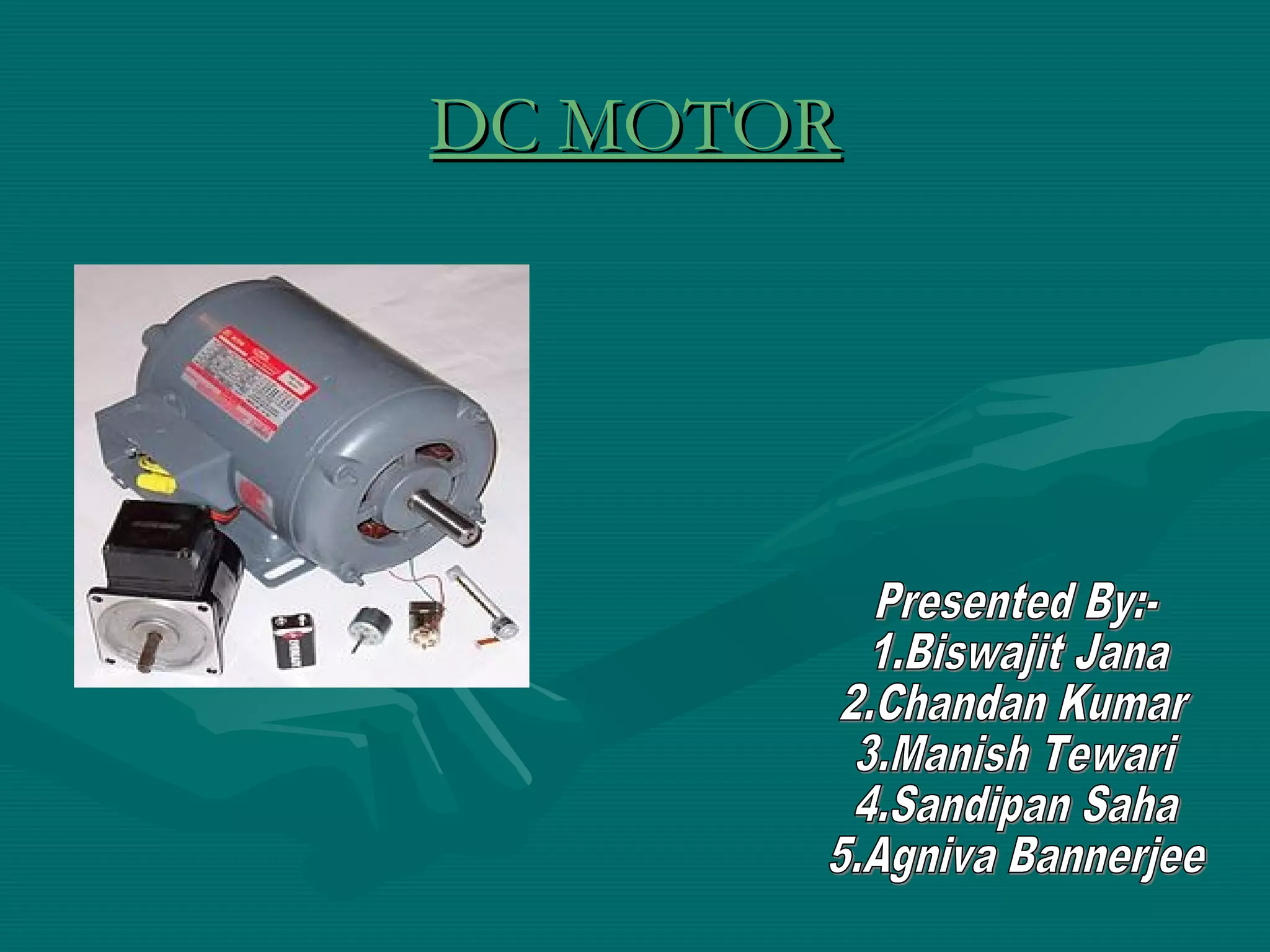
DC MOTOR
INDEX
• HISTORY & INTRODUCTION OF THE DC
  MOTOR
• CONSTRUCTION OF DC MOTOR
• TYPES OF DC MOTOR
• WORKING OF DC MOTOR
• MERITS & DEMERITS OF DC MOTOR
Brief History of DC Motor
• The history of DC Motor can be
  traced back to the 1830s,when Michael
  Faraday did extensive works on disc
  type of machine
INTRODUCTION OF DC MOTOR
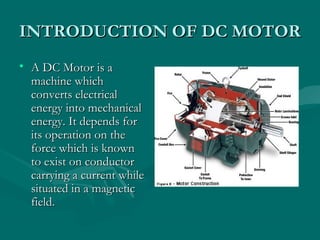
• A DC Motor is a
  machine which
  converts electrical
  energy into mechanical
  energy. It depends for
  its operation on the
  force which is known
  to exist on conductor
  carrying a current while
  situated in a magnetic
  field.
Construction of DC MOTOR

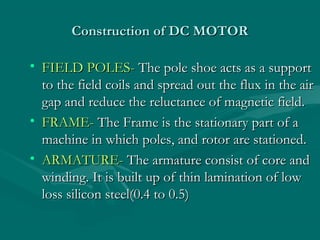
• FIELD POLES- The pole shoe acts as a support
  to the field coils and spread out the flux in the air
  gap and reduce the reluctance of magnetic field.
• FRAME- The Frame is the stationary part of a
  machine in which poles, and rotor are stationed.
• ARMATURE- The armature consist of core and
  winding. It is built up of thin lamination of low
  loss silicon steel(0.4 to 0.5)
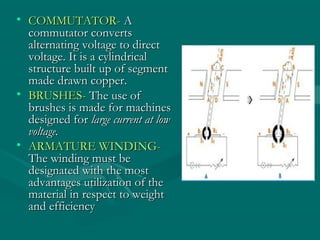
• COMMUTATOR- A
  commutator converts
  alternating voltage to direct
  voltage. It is a cylindrical
  structure built up of segment
  made drawn copper.
• BRUSHES- The use of
  brushes is made for machines
  designed for large current at low
  voltage.
• ARMATURE WINDING-
  The winding must be
  designated with the most
  advantages utilization of the
  material in respect to weight
  and efficiency
TYPES OF DC MOTOR

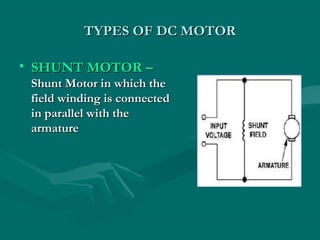
• SHUNT MOTOR –
 Shunt Motor in which the
 field winding is connected
 in parallel with the
 armature
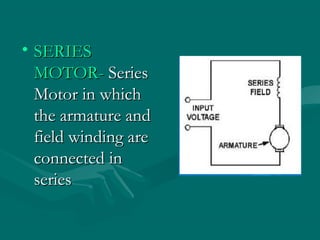
• SERIES
  MOTOR- Series
  Motor in which
  the armature and
  field winding are
  connected in
  series
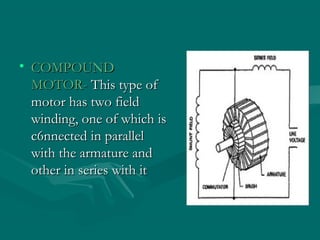
• COMPOUND
  MOTOR- This type of
  motor has two field
  winding, one of which is
  c6nnected in parallel
  with the armature and
  other in series with it
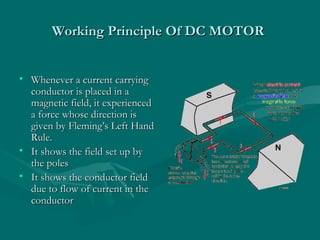
Working Principle Of DC MOTOR


• Whenever a current carrying
  conductor is placed in a
  magnetic field, it experienced
  a force whose direction is
  given by Fleming’s Left Hand
  Rule.
• It shows the field set up by
  the poles
• It shows the conductor field
  due to flow of current in the
  conductor
• MERITS                     • DEMERITS
• High starting torque       • High initial cost
• Speed control over a       • Increased operating and
  wide range, both below       maintenance cost
  and above normal speed       because of the
• Accurate seedless speed      commutator and brush
  control                      gear
• Quick starting, stopping

Dc motor

  • 1.
  • 2.
    INDEX • HISTORY &INTRODUCTION OF THE DC MOTOR • CONSTRUCTION OF DC MOTOR • TYPES OF DC MOTOR • WORKING OF DC MOTOR • MERITS & DEMERITS OF DC MOTOR
  • 3.
    Brief History ofDC Motor • The history of DC Motor can be traced back to the 1830s,when Michael Faraday did extensive works on disc type of machine
  • 4.
    INTRODUCTION OF DCMOTOR • A DC Motor is a machine which converts electrical energy into mechanical energy. It depends for its operation on the force which is known to exist on conductor carrying a current while situated in a magnetic field.
  • 5.
    Construction of DCMOTOR • FIELD POLES- The pole shoe acts as a support to the field coils and spread out the flux in the air gap and reduce the reluctance of magnetic field. • FRAME- The Frame is the stationary part of a machine in which poles, and rotor are stationed. • ARMATURE- The armature consist of core and winding. It is built up of thin lamination of low loss silicon steel(0.4 to 0.5)
  • 6.
    • COMMUTATOR- A commutator converts alternating voltage to direct voltage. It is a cylindrical structure built up of segment made drawn copper. • BRUSHES- The use of brushes is made for machines designed for large current at low voltage. • ARMATURE WINDING- The winding must be designated with the most advantages utilization of the material in respect to weight and efficiency
  • 7.
    TYPES OF DCMOTOR • SHUNT MOTOR – Shunt Motor in which the field winding is connected in parallel with the armature
  • 8.
    • SERIES MOTOR- Series Motor in which the armature and field winding are connected in series
  • 9.
    • COMPOUND MOTOR- This type of motor has two field winding, one of which is c6nnected in parallel with the armature and other in series with it
  • 10.
    Working Principle OfDC MOTOR • Whenever a current carrying conductor is placed in a magnetic field, it experienced a force whose direction is given by Fleming’s Left Hand Rule. • It shows the field set up by the poles • It shows the conductor field due to flow of current in the conductor
  • 11.
    • MERITS • DEMERITS • High starting torque • High initial cost • Speed control over a • Increased operating and wide range, both below maintenance cost and above normal speed because of the • Accurate seedless speed commutator and brush control gear • Quick starting, stopping