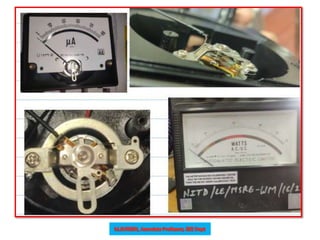
BASIC ELECTRICAL & ELECTRONICS ENGINEERING
UNIT –II: Machines and Measuring Instruments
M.SURESH
M.Tech(NITW)., (Ph.D)
Associate Professor
EEE Department
RISE Krishna Sai Prakasam Group of Institutions
Ongole, Prakasam Dt. AP
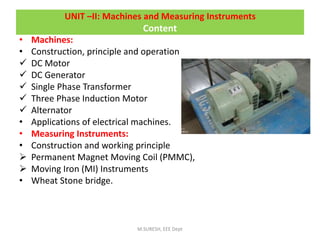
UNIT –II: Machines and Measuring Instruments
Content
• Machines:
• Construction, principle and operation
 DC Motor
 DC Generator
 Single Phase Transformer
 Three Phase Induction Motor
 Alternator
• Applications of electrical machines.
• Measuring Instruments:
• Construction and working principle
 Permanent Magnet Moving Coil (PMMC),
 Moving Iron (MI) Instruments
• Wheat Stone bridge.
M.SURESH, EEE Dept
Introduction
• The DC machines are of two types namely DC generators
and DC motors.
• A DC generators converts mechanical energy into electrical
energy whereas a DC motor converts the electrical energy
into mechanical energy.
• In order to understand the operating principle of a DC
motor, it is necessary to understand how does a current
carrying conductor experience a force, when kept in a
magnetic field.
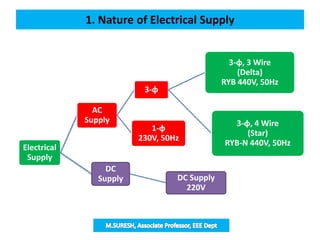
1. Nature of Electrical Supply
Electrical
Supply
AC
Supply
3-φ
3-φ, 3 Wire
(Delta)
RYB 440V, 50Hz
3-φ, 4 Wire
(Star)
RYB-N 440V, 50Hz
1-φ
230V, 50Hz
DC
Supply DC Supply
220V
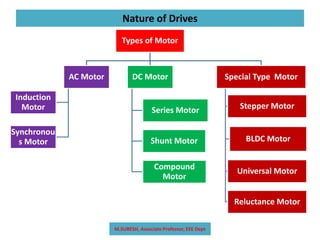
Nature of Drives
M.SURESH, Associate Professor, EEE Dept
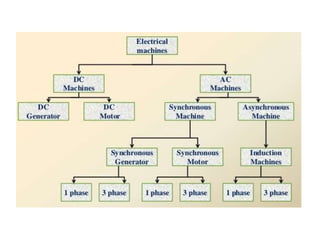
Types of Motor
AC Motor
Induction
Motor
Synchronou
s Motor
DC Motor
Series Motor
Shunt Motor
Compound
Motor
Special Type Motor
Stepper Motor
BLDC Motor
Universal Motor
Reluctance Motor
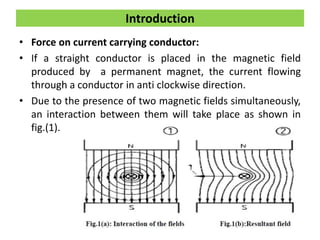
• Force on current carrying conductor:
• If a straight conductor is placed in the magnetic field
produced by a permanent magnet, the current flowing
through a conductor in anti clockwise direction.
• Due to the presence of two magnetic fields simultaneously,
an interaction between them will take place as shown in
fig.(1).
Introduction
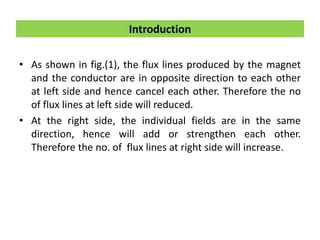
• As shown in fig.(1), the flux lines produced by the magnet
and the conductor are in opposite direction to each other
at left side and hence cancel each other. Therefore the no
of flux lines at left side will reduced.
• At the right side, the individual fields are in the same
direction, hence will add or strengthen each other.
Therefore the no. of flux lines at right side will increase.
Introduction
• Magnitude of Force:
• The magnitude of the force experienced by the current carrying conductor
placed in the magnetic field is given by,
• F = Bil Newton
• Where B = Flux density produced by Magnet
I = current flowing through conductor
l = Length of the conductor
Introduction
• Direction of force:
• The direction of rotation of a motor depends on the direction of force
exerted on the the armature winding and the direction of force
experienced by a current carrying conductor is given by Fleming’s left
hand rule.
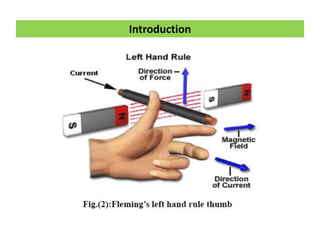
• Statement of Fleming’s left hand rule:
• It states that if the first three fingers of the left hand are held mutually at
right angles to each other and if index finger indicates the direction of the
magnetic field, and if middle finger indicates the direction of current
flowing through the conductor, then thumb indicates the direction of force
exerted on the conductor. This is shown in fig (2).
Introduction
Introduction
• Windings in DC Machine
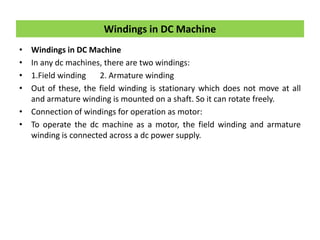
• In any dc machines, there are two windings:
• 1.Field winding 2. Armature winding
• Out of these, the field winding is stationary which does not move at all
and armature winding is mounted on a shaft. So it can rotate freely.
• Connection of windings for operation as motor:
• To operate the dc machine as a motor, the field winding and armature
winding is connected across a dc power supply.
Windings in DC Machine
• Principle of operation:
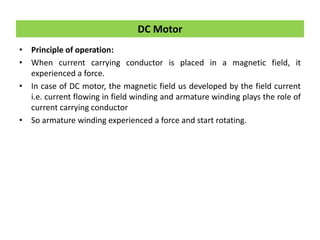
• When current carrying conductor is placed in a magnetic field, it
experienced a force.
• In case of DC motor, the magnetic field us developed by the field current
i.e. current flowing in field winding and armature winding plays the role of
current carrying conductor
• So armature winding experienced a force and start rotating.
DC Motor
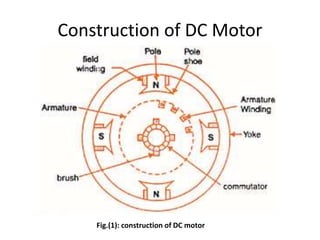
Construction of DC Motor
Fig.(1): construction of DC motor
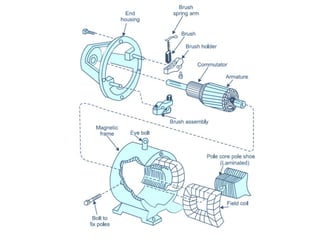
• Important parts of DC Motor:
• Yoke
• Field winding
• poles
• Armature
• Commutator, brushes & gear
• Brushes
1.Yoke:
 It acts as the outer support of a DC motor.
 It provides mechanical support for the poles.
2. Poles:
• pole of a dc motor is an electromagnet.
• The field winding is wound over the poles.
• Poles produces magnetic flux when the filed winding is excited.
3. Field winding:
• The coils wound around the pole are called field coils and they are
connected in series with each other to form field winding.
• When current passing through the field winding, magnetic flux produced
in the air gap between pole and armature.
4. Armature:
• Armature is a cylindrical drum mounted on shaft in which number of slots
are provided.
• Armature conductors are placed in these slots.
• Theses armature conductors are interconnected to form the armature
winding.
5. Commutator:
• A commutatoris a cylindrical drum mounted on the shaft alonwiththe
armature core.
• It collects the current from the armature conductors and passed it to the
external load via brushes.
6. Brushes:
• Commutator is rotating. So it is not possible to connect the load directly to
it.
• Hence current is conducted from the armature to the external load by the
carbon brushes which are held against the surface of commutatorby
springs.
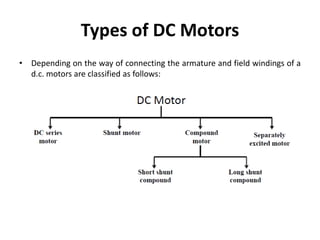
Types of DC Motors
• Depending on the way of connecting the armature and field windings of a
d.c. motors are classified as follows:
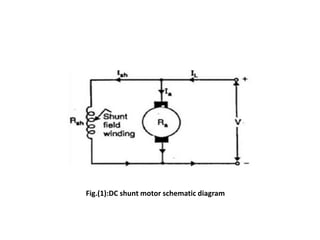
• DC Shunt Motor
• •In DC shunt type motor, field and armature winding are connected
in parallel as shown in fig.(1), and this combination is connected
across a common dc power supply.
 The resistance of shunt field winding (Rsh) is always much higher
than that of armature winding (Ra).
 This is because the number of turns for the field winding is more
than that of armature winding.
• The field current Ishalways remains constant. Since V and Rshboth
are constant. Hence flux produced also remains constant. Because
field current is responsible for generation of flux.
• ∴ø ∝Ish
• •This is why the shunt motor is also called as the constant flux
motors.
Fig.(1):DC shunt motor schematic diagram
• DC Series Motor
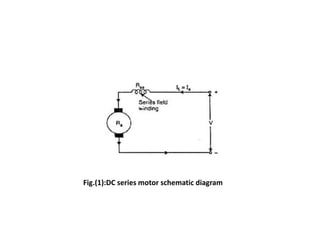
 In DC series motor, the armature and field windings are connected din
series with each other as shown in fig.(1).
 The resistance of the series field winding (Rs) is much smaller as compared
to that of the armature resistance (Ra).
 The flux produced is proportional to the field current. But in series motor,
the field current is same as armature current.
• ∴ø ∝Iaor
• ∴ø ∝Is
• The armature current Iaand hence field current Is will be dependent on
the load.
• Hence in DC series motor the flux does not remains constant.
Fig.(1):DC series motor schematic diagram
• DC Compound Motor
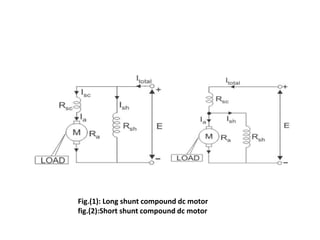
1.Long Shunt Compound Motor:
• As shown in fig.(1), in long shunt dc motor, shunt field winding is
connected across the series combination of the armature and series field
winding.
2. Short Shunt Compound Motor:
• In short shunt compound motor, armature and field windings are
connected in parallel with each other and this combination is connected
din series with the series filed winding. This is shown in fig.(2).
• The long shunt and short shunt compound motors are further classified as
cumulative and differential compound motors
Fig.(1): Long shunt compound dc motor
fig.(2):Short shunt compound dc motor
Applications of DC Motor
• Applications of DC Motor
1.Shunt motor applications:
 Various machine tools such as lathe machines, drilling machines,
milling machines etc.
 Printing machines
 Paper machines
 Centrifugal and reciprocating pumps
 Blowers and fans etc.
• 2. Series motor applications:
 Electric trains
 Diesel-electric locomotives
 Cranes
 Hoists
 Trolley cars and trolley buses
 Rapid transit systems
 Conveyers etc.
Applications of DC Motor
3. Cumulative compound motor applications:
 Elevators
 Rolling mills
 Planers
 Punches
 Shears
4. Differentials compound motors applications:
• The speed of these motors will increase with increase in the load, which
leads to an unstable operation.
• Therefore we can not use this motor for any practical applications
Applications of DC Motor
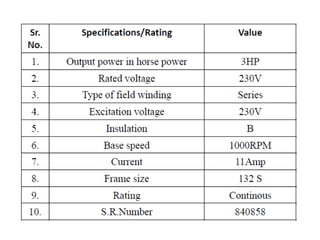
Specifications of DC Motor
• Some of important specifications of a DC motor:
 Output power in horse power(H.P.)
 Rated voltage
 Type of field winding
 Excitation voltage
 Base speed in RPM
 Current
 Frame size
 Rating
D.C. Generators
• Although a far greater percentage of the electrical machines in service are
A.C. machines, the D.C. machines are of considerable industrial
importance.
• The principal advantage of the D.C. machine, particularly the D.C. motor, is
that it provides a fine control of speed.
• Such an advantage is not claimed by any A.C. motor.
• However, D.C. generators are not as common as they used to be, because
direct current, when required, is mainly obtained from an A.C. supply by
the use of rectifiers.
• Nevertheless, an understanding of D.C. generator is important because it
represents a logical introduction to the behaviour of d.c. motors.
• Indeed many D.C. motors in industry actually operate as D.C. generators
for a brief period. In this chapter, we shall deal with various aspects of D.C.
generators.
D.C. Generators
• Generator Principle :
• An electric generator is a machine that converts mechanical energy into
electrical energy.
• An electric generator is based on the principle that whenever flux is cut by
a conductor, an e.m.f. is induced which will cause a current to flow if the
conductor circuit is closed.
• The direction of induced e.m.f. (and hence current) is given by Fleming’s
right hand rule.
• Therefore, the essential components of a generator are:
(a) a magnetic field
(b) conductor or a group of conductors
(c) motion of conductor w.r.t. magnetic field.
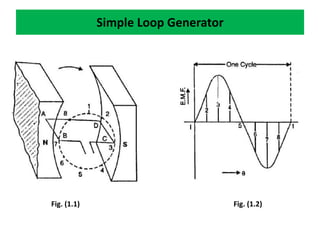
Simple Loop Generator
Fig. (1.1) Fig. (1.2)
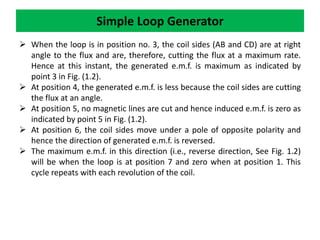
• Consider a single turn loop ABCD rotating clockwise in a uniform magnetic
field with a constant speed as shown in Fig.(1.1).
• As the loop rotates, the flux linking the coil sides AB and CD changes
continuously.
• Hence the e.m.f. induced in these coil sides also changes but the e.m.f.
induced in one coil side adds to that induced in the other.
 When the loop is in position no. 1 [See Fig. 1.1], the generated e.m.f. is zero
because the coil sides (AB and CD) are cutting no flux but are moving
parallel to it
 When the loop is in position no. 2, the coil sides are moving at an angle to
the flux and, therefore, a low e.m.f. is generated as indicated by point 2 in
Fig. (1.2).
Simple Loop Generator
 When the loop is in position no. 3, the coil sides (AB and CD) are at right
angle to the flux and are, therefore, cutting the flux at a maximum rate.
Hence at this instant, the generated e.m.f. is maximum as indicated by
point 3 in Fig. (1.2).
 At position 4, the generated e.m.f. is less because the coil sides are cutting
the flux at an angle.
 At position 5, no magnetic lines are cut and hence induced e.m.f. is zero as
indicated by point 5 in Fig. (1.2).
 At position 6, the coil sides move under a pole of opposite polarity and
hence the direction of generated e.m.f. is reversed.
 The maximum e.m.f. in this direction (i.e., reverse direction, See Fig. 1.2)
will be when the loop is at position 7 and zero when at position 1. This
cycle repeats with each revolution of the coil.
Simple Loop Generator
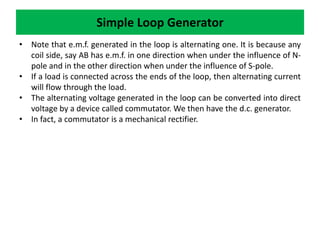
• Note that e.m.f. generated in the loop is alternating one. It is because any
coil side, say AB has e.m.f. in one direction when under the influence of N-
pole and in the other direction when under the influence of S-pole.
• If a load is connected across the ends of the loop, then alternating current
will flow through the load.
• The alternating voltage generated in the loop can be converted into direct
voltage by a device called commutator. We then have the d.c. generator.
• In fact, a commutator is a mechanical rectifier.
Simple Loop Generator
Action Of Commutator
Fig.(1.3) Fig.(1.4) Fig.(1.5)
• If, somehow, connection of the coil side to the external load is reversed at
the same instant the current in the coil side reverses, the current through
the load will be direct current.
• This is what a commutator does.
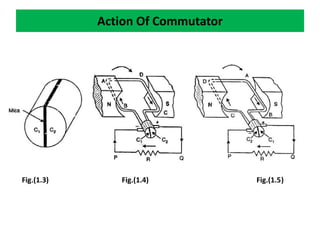
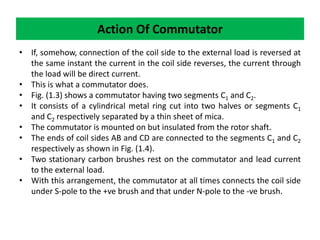
• Fig. (1.3) shows a commutator having two segments C1 and C2.
• It consists of a cylindrical metal ring cut into two halves or segments C1
and C2 respectively separated by a thin sheet of mica.
• The commutator is mounted on but insulated from the rotor shaft.
• The ends of coil sides AB and CD are connected to the segments C1 and C2
respectively as shown in Fig. (1.4).
• Two stationary carbon brushes rest on the commutator and lead current
to the external load.
• With this arrangement, the commutator at all times connects the coil side
under S-pole to the +ve brush and that under N-pole to the -ve brush.
Action Of Commutator
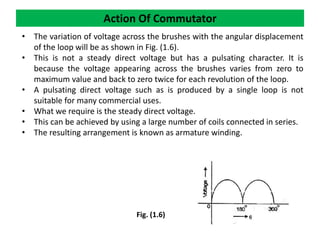
• The variation of voltage across the brushes with the angular displacement
of the loop will be as shown in Fig. (1.6).
• This is not a steady direct voltage but has a pulsating character. It is
because the voltage appearing across the brushes varies from zero to
maximum value and back to zero twice for each revolution of the loop.
• A pulsating direct voltage such as is produced by a single loop is not
suitable for many commercial uses.
• What we require is the steady direct voltage.
• This can be achieved by using a large number of coils connected in series.
• The resulting arrangement is known as armature winding.
Fig. (1.6)
Action Of Commutator
Construction of DC Generator
• The d.c. generators and d.c. motors have the same general construction.
• In fact, when the machine is being assembled, the workmen usually do
not know whether it is a d.c. generator or motor.
• Any d.c. generator can be run as a d.c. motor and vice-versa.
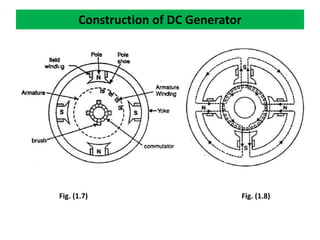
• All d.c. machines have five principal components viz.,
 field system
 armature core
 armature winding
 commutator
 brushes [See Fig. 1.7].
Construction of DC Generator
Fig. (1.7) Fig. (1.8)
Construction of DC Generator
Field system:
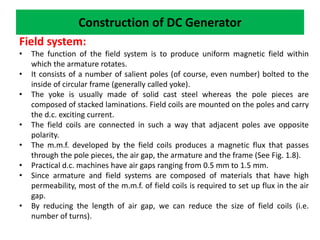
• The function of the field system is to produce uniform magnetic field within
which the armature rotates.
• It consists of a number of salient poles (of course, even number) bolted to the
inside of circular frame (generally called yoke).
• The yoke is usually made of solid cast steel whereas the pole pieces are
composed of stacked laminations. Field coils are mounted on the poles and carry
the d.c. exciting current.
• The field coils are connected in such a way that adjacent poles ave opposite
polarity.
• The m.m.f. developed by the field coils produces a magnetic flux that passes
through the pole pieces, the air gap, the armature and the frame (See Fig. 1.8).
• Practical d.c. machines have air gaps ranging from 0.5 mm to 1.5 mm.
• Since armature and field systems are composed of materials that have high
permeability, most of the m.m.f. of field coils is required to set up flux in the air
gap.
• By reducing the length of air gap, we can reduce the size of field coils (i.e.
number of turns).
Construction of DC Generator
Armature core:
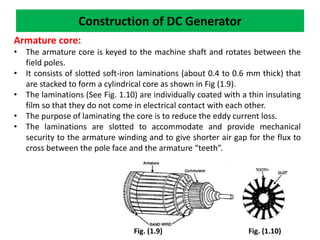
• The armature core is keyed to the machine shaft and rotates between the
field poles.
• It consists of slotted soft-iron laminations (about 0.4 to 0.6 mm thick) that
are stacked to form a cylindrical core as shown in Fig (1.9).
• The laminations (See Fig. 1.10) are individually coated with a thin insulating
film so that they do not come in electrical contact with each other.
• The purpose of laminating the core is to reduce the eddy current loss.
• The laminations are slotted to accommodate and provide mechanical
security to the armature winding and to give shorter air gap for the flux to
cross between the pole face and the armature “teeth”.
Fig. (1.9) Fig. (1.10)
Construction of DC Generator
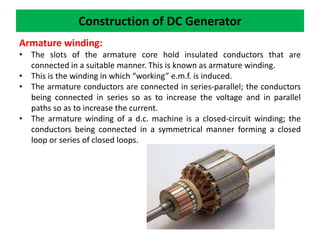
Armature winding:
• The slots of the armature core hold insulated conductors that are
connected in a suitable manner. This is known as armature winding.
• This is the winding in which “working” e.m.f. is induced.
• The armature conductors are connected in series-parallel; the conductors
being connected in series so as to increase the voltage and in parallel
paths so as to increase the current.
• The armature winding of a d.c. machine is a closed-circuit winding; the
conductors being connected in a symmetrical manner forming a closed
loop or series of closed loops.
Construction of DC Generator
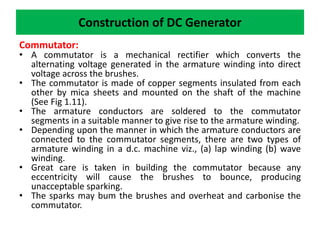
Commutator:
• A commutator is a mechanical rectifier which converts the
alternating voltage generated in the armature winding into direct
voltage across the brushes.
• The commutator is made of copper segments insulated from each
other by mica sheets and mounted on the shaft of the machine
(See Fig 1.11).
• The armature conductors are soldered to the commutator
segments in a suitable manner to give rise to the armature winding.
• Depending upon the manner in which the armature conductors are
connected to the commutator segments, there are two types of
armature winding in a d.c. machine viz., (a) lap winding (b) wave
winding.
• Great care is taken in building the commutator because any
eccentricity will cause the brushes to bounce, producing
unacceptable sparking.
• The sparks may bum the brushes and overheat and carbonise the
commutator.
Construction of DC Generator
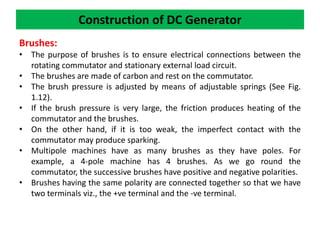
Brushes:
• The purpose of brushes is to ensure electrical connections between the
rotating commutator and stationary external load circuit.
• The brushes are made of carbon and rest on the commutator.
• The brush pressure is adjusted by means of adjustable springs (See Fig.
1.12).
• If the brush pressure is very large, the friction produces heating of the
commutator and the brushes.
• On the other hand, if it is too weak, the imperfect contact with the
commutator may produce sparking.
• Multipole machines have as many brushes as they have poles. For
example, a 4-pole machine has 4 brushes. As we go round the
commutator, the successive brushes have positive and negative polarities.
• Brushes having the same polarity are connected together so that we have
two terminals viz., the +ve terminal and the -ve terminal.
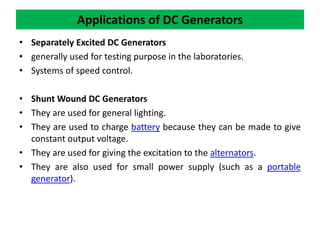
Applications of DC Generators
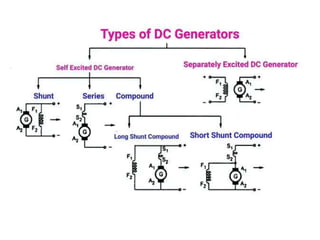
• Separately Excited DC Generators
• generally used for testing purpose in the laboratories.
• Systems of speed control.
• Shunt Wound DC Generators
• They are used for general lighting.
• They are used to charge battery because they can be made to give
constant output voltage.
• They are used for giving the excitation to the alternators.
• They are also used for small power supply (such as a portable
generator).
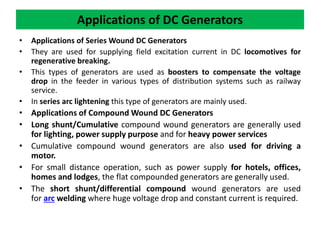
• Applications of Series Wound DC Generators
• They are used for supplying field excitation current in DC locomotives for
regenerative breaking.
• This types of generators are used as boosters to compensate the voltage
drop in the feeder in various types of distribution systems such as railway
service.
• In series arc lightening this type of generators are mainly used.
• Applications of Compound Wound DC Generators
• Long shunt/Cumulative compound wound generators are generally used
for lighting, power supply purpose and for heavy power services
• Cumulative compound wound generators are also used for driving a
motor.
• For small distance operation, such as power supply for hotels, offices,
homes and lodges, the flat compounded generators are generally used.
• The short shunt/differential compound wound generators are used
for arc welding where huge voltage drop and constant current is required.
Applications of DC Generators
• https://youtu.be/mq2zjmS8UMI
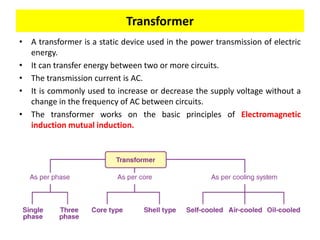
Transformer
Transformer
• A transformer is a static device used in the power transmission of electric
energy.
• It can transfer energy between two or more circuits.
• The transmission current is AC.
• It is commonly used to increase or decrease the supply voltage without a
change in the frequency of AC between circuits.
• The transformer works on the basic principles of Electromagnetic
induction mutual induction.
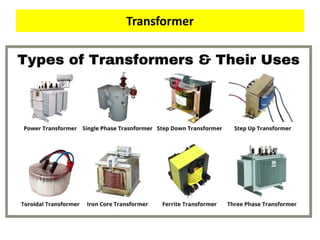
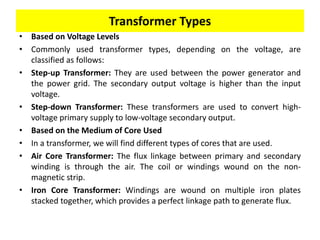
• Based on Voltage Levels
• Commonly used transformer types, depending on the voltage, are
classified as follows:
• Step-up Transformer: They are used between the power generator and
the power grid. The secondary output voltage is higher than the input
voltage.
• Step-down Transformer: These transformers are used to convert high-
voltage primary supply to low-voltage secondary output.
• Based on the Medium of Core Used
• In a transformer, we will find different types of cores that are used.
• Air Core Transformer: The flux linkage between primary and secondary
winding is through the air. The coil or windings wound on the non-
magnetic strip.
• Iron Core Transformer: Windings are wound on multiple iron plates
stacked together, which provides a perfect linkage path to generate flux.
Transformer Types
Transformer Types
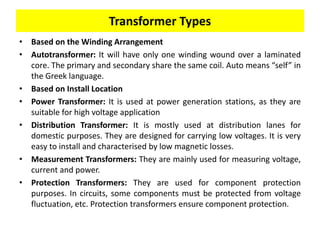
• Based on the Winding Arrangement
• Autotransformer: It will have only one winding wound over a laminated
core. The primary and secondary share the same coil. Auto means “self” in
the Greek language.
• Based on Install Location
• Power Transformer: It is used at power generation stations, as they are
suitable for high voltage application
• Distribution Transformer: It is mostly used at distribution lanes for
domestic purposes. They are designed for carrying low voltages. It is very
easy to install and characterised by low magnetic losses.
• Measurement Transformers: They are mainly used for measuring voltage,
current and power.
• Protection Transformers: They are used for component protection
purposes. In circuits, some components must be protected from voltage
fluctuation, etc. Protection transformers ensure component protection.
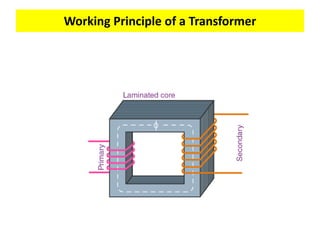
Working Principle of a Transformer
• The transformer works on the principle of Faraday’s law of
electromagnetic induction and mutual induction.
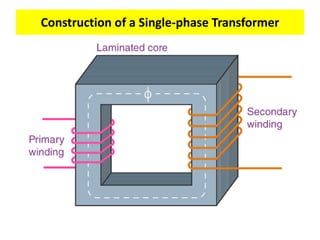
• There are usually two coils – primary coil and secondary coil – on the
transformer core.
• The core laminations are joined in the form of strips.
• The two coils have high mutual inductance.
• When an alternating current passes through the primary coil, it creates a
varying magnetic flux.
• As per Faraday’s law of electromagnetic induction, this change in magnetic
flux induces an EMF (electromotive force) in the secondary coil, which is
linked to the core having a primary coil. This is mutual induction.
• Overall, a transformer carries out the following operations:
• Transfer of electrical energy from one circuit to another
• Transfer of electrical power through electromagnetic induction
• Electric power transfer without any change in frequency
• Two circuits are linked with mutual induction
Working Principle of a Transformer
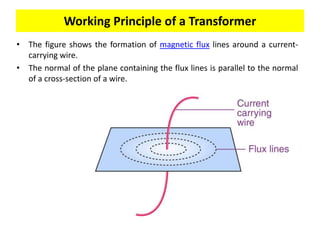
• The figure shows the formation of magnetic flux lines around a current-
carrying wire.
• The normal of the plane containing the flux lines is parallel to the normal
of a cross-section of a wire.
Working Principle of a Transformer
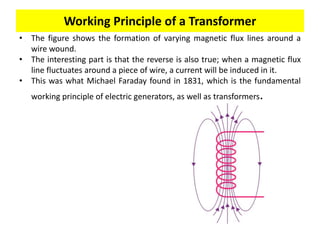
• The figure shows the formation of varying magnetic flux lines around a
wire wound.
• The interesting part is that the reverse is also true; when a magnetic flux
line fluctuates around a piece of wire, a current will be induced in it.
• This was what Michael Faraday found in 1831, which is the fundamental
working principle of electric generators, as well as transformers.
Working Principle of a Transformer
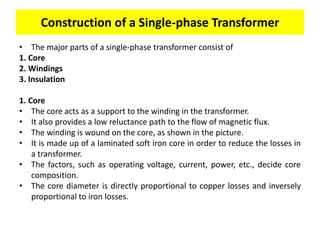
Construction of a Single-phase Transformer
• The major parts of a single-phase transformer consist of
1. Core
2. Windings
3. Insulation
1. Core
• The core acts as a support to the winding in the transformer.
• It also provides a low reluctance path to the flow of magnetic flux.
• The winding is wound on the core, as shown in the picture.
• It is made up of a laminated soft iron core in order to reduce the losses in
a transformer.
• The factors, such as operating voltage, current, power, etc., decide core
composition.
• The core diameter is directly proportional to copper losses and inversely
proportional to iron losses.
Construction of a Single-phase Transformer
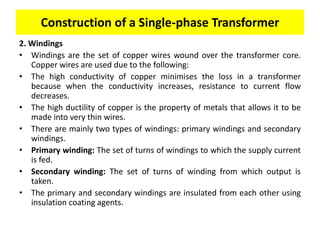
2. Windings
• Windings are the set of copper wires wound over the transformer core.
Copper wires are used due to the following:
• The high conductivity of copper minimises the loss in a transformer
because when the conductivity increases, resistance to current flow
decreases.
• The high ductility of copper is the property of metals that allows it to be
made into very thin wires.
• There are mainly two types of windings: primary windings and secondary
windings.
• Primary winding: The set of turns of windings to which the supply current
is fed.
• Secondary winding: The set of turns of winding from which output is
taken.
• The primary and secondary windings are insulated from each other using
insulation coating agents.
Construction of a Single-phase Transformer
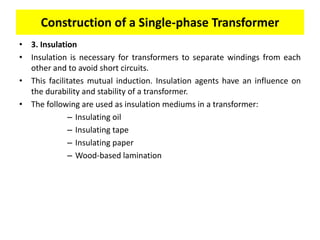
• 3. Insulation
• Insulation is necessary for transformers to separate windings from each
other and to avoid short circuits.
• This facilitates mutual induction. Insulation agents have an influence on
the durability and stability of a transformer.
• The following are used as insulation mediums in a transformer:
– Insulating oil
– Insulating tape
– Insulating paper
– Wood-based lamination
Construction of a Single-phase Transformer
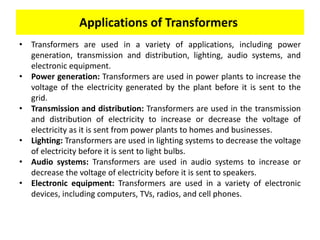
Applications of Transformers
• Transformers are used in a variety of applications, including power
generation, transmission and distribution, lighting, audio systems, and
electronic equipment.
• Power generation: Transformers are used in power plants to increase the
voltage of the electricity generated by the plant before it is sent to the
grid.
• Transmission and distribution: Transformers are used in the transmission
and distribution of electricity to increase or decrease the voltage of
electricity as it is sent from power plants to homes and businesses.
• Lighting: Transformers are used in lighting systems to decrease the voltage
of electricity before it is sent to light bulbs.
• Audio systems: Transformers are used in audio systems to increase or
decrease the voltage of electricity before it is sent to speakers.
• Electronic equipment: Transformers are used in a variety of electronic
devices, including computers, TVs, radios, and cell phones.
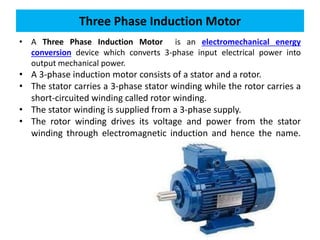
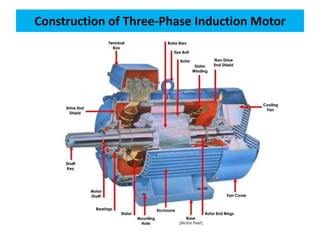
Three Phase Induction Motor
• A Three Phase Induction Motor is an electromechanical energy
conversion device which converts 3-phase input electrical power into
output mechanical power.
• A 3-phase induction motor consists of a stator and a rotor.
• The stator carries a 3-phase stator winding while the rotor carries a
short-circuited winding called rotor winding.
• The stator winding is supplied from a 3-phase supply.
• The rotor winding drives its voltage and power from the stator
winding through electromagnetic induction and hence the name.
Working Principle of a 3-Phase Induction Motor
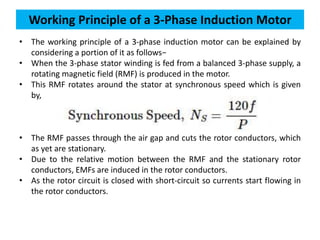
• The working principle of a 3-phase induction motor can be explained by
considering a portion of it as follows−
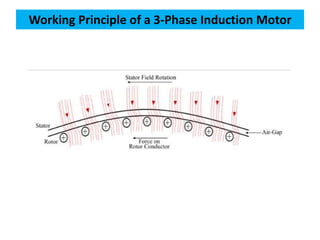
• When the 3-phase stator winding is fed from a balanced 3-phase supply, a
rotating magnetic field (RMF) is produced in the motor.
• This RMF rotates around the stator at synchronous speed which is given
by,
• The RMF passes through the air gap and cuts the rotor conductors, which
as yet are stationary.
• Due to the relative motion between the RMF and the stationary rotor
conductors, EMFs are induced in the rotor conductors.
• As the rotor circuit is closed with short-circuit so currents start flowing in
the rotor conductors.
Working Principle of a 3-Phase Induction Motor
• Since the current carrying rotor conductors are placed in the magnetic
field produced by the stator winding.
• As a result, the rotor conductors experience mechanical force.
• The sum of the mechanical forces on all the rotor conductors produce a
torque which moves the rotor in the same direction as the rotating
magnetic field.
• Hence, in such a way the three phase input electric power is converted
into output mechanical power in a 3-phase induction motor.
• Also, according to Lenz’s law, the rotor should move in the direction of the
stator field, i.e., the direction of rotor currents would be such that they
tend to oppose the cause producing them.
• Here, the cause producing the rotor currents is the relative speed between
the RMF and the rotor conductors.
• Thus to reduce this relative speed, the rotor starts running in the same
direction as that of the RMF.
Working Principle of a 3-Phase Induction Motor
Construction of Three-Phase Induction Motor
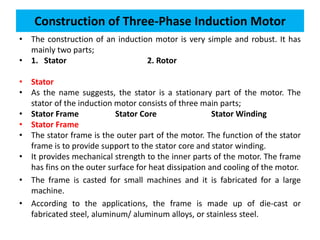
• The construction of an induction motor is very simple and robust. It has
mainly two parts;
• 1. Stator 2. Rotor
• Stator
• As the name suggests, the stator is a stationary part of the motor. The
stator of the induction motor consists of three main parts;
• Stator Frame Stator Core Stator Winding
• Stator Frame
• The stator frame is the outer part of the motor. The function of the stator
frame is to provide support to the stator core and stator winding.
• It provides mechanical strength to the inner parts of the motor. The frame
has fins on the outer surface for heat dissipation and cooling of the motor.
• The frame is casted for small machines and it is fabricated for a large
machine.
• According to the applications, the frame is made up of die-cast or
fabricated steel, aluminum/ aluminum alloys, or stainless steel.
Construction of Three-Phase Induction Motor
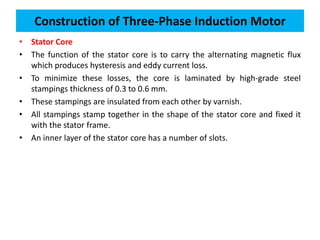
• Stator Core
• The function of the stator core is to carry the alternating magnetic flux
which produces hysteresis and eddy current loss.
• To minimize these losses, the core is laminated by high-grade steel
stampings thickness of 0.3 to 0.6 mm.
• These stampings are insulated from each other by varnish.
• All stampings stamp together in the shape of the stator core and fixed it
with the stator frame.
• An inner layer of the stator core has a number of slots.
Construction of Three-Phase Induction Motor
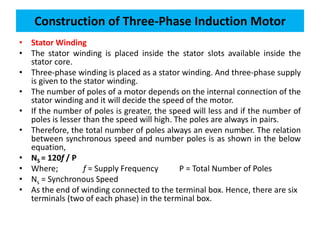
• Stator Winding
• The stator winding is placed inside the stator slots available inside the
stator core.
• Three-phase winding is placed as a stator winding. And three-phase supply
is given to the stator winding.
• The number of poles of a motor depends on the internal connection of the
stator winding and it will decide the speed of the motor.
• If the number of poles is greater, the speed will less and if the number of
poles is lesser than the speed will high. The poles are always in pairs.
• Therefore, the total number of poles always an even number. The relation
between synchronous speed and number poles is as shown in the below
equation,
• NS = 120f / P
• Where; f = Supply Frequency P = Total Number of Poles
• Ns = Synchronous Speed
• As the end of winding connected to the terminal box. Hence, there are six
terminals (two of each phase) in the terminal box.
Construction of Three-Phase Induction Motor
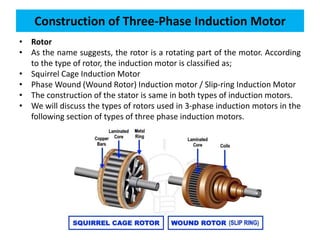
• Rotor
• As the name suggests, the rotor is a rotating part of the motor. According
to the type of rotor, the induction motor is classified as;
• Squirrel Cage Induction Motor
• Phase Wound (Wound Rotor) Induction motor / Slip-ring Induction Motor
• The construction of the stator is same in both types of induction motors.
• We will discuss the types of rotors used in 3-phase induction motors in the
following section of types of three phase induction motors.
Construction of Three-Phase Induction Motor
Applications of 3-Phase Induction Motor
• The slip-ring or wound-rotor 3-phase induction motors:
• suitable for loads requiring high starting torque and for applications where
the starting current is low.
• used for loads having high inertia, which results in very high rotor energy
losses during acceleration.
• used for loads which require a gradual build-up of load.
• They are used for loads that requires speed control.
• Typical applications of wound rotor or slip ring induction motors are
crushers, plunger pumps, cranes & hoists, elevators, compressors and
conveyors.
• Squirrel Cage Induction Motors:
• used for loads such as fans, blowers, machine tools and centrifugal pumps.
• used for driving the loads such as compressors, crushers, conveyors and
reciprocating pumps.
• used for driving intermittent loads requiring rapid acceleration and high
impact such as punch presses, bulldozers, die-stamping machines and
shears.
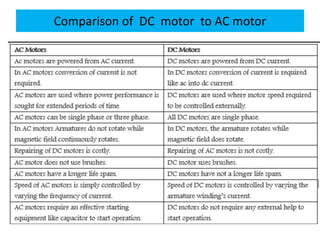
Comparison of DC motor to AC motor
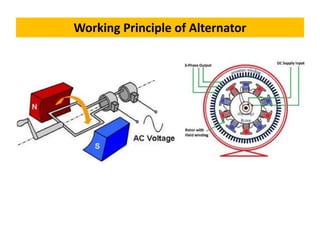
Working Principle of Alternator
• The working principle of an alternator is very simple.
• It is just like the basic principle of DC generator.
• It also depends upon Faraday’s law of electromagnetic induction which
says the current is induced in the conductor inside a magnetic field when
there is a relative motion between that conductor and the magnetic field.
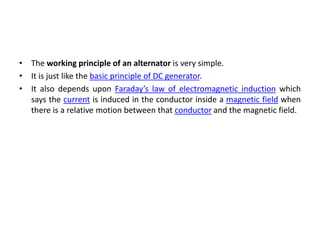
• For understanding working of alternator let us think about a single
rectangular turn placed in between two opposite magnetic poles as shown
below.
• Say this single turn loop ABCD can rotate against axis a-b.
• Suppose this loop starts rotating clockwise. After 90o rotation the side AB
or conductor AB of the loop comes in front of S-pole and conductor CD
comes in front of N-pole.
• At this position the tangential motion of the conductor AB is just
perpendicular to the magnetic flux lines from N to S pole. Hence, the rate
of flux cutting by the conductor AB is maximum here and for that flux
cutting there will be an induced current in the conductor AB and the
direction of the induced current can be determined by Fleming’s right-
hand rule.
• As per this rule the direction of this current will be from A to B. At the
same time conductor CD comes under N pole and here also if we apply
Fleming right-hand rule we will get the direction of induced current and it
will be from C to D.
• Now after clockwise rotation of another 90o the turn ABCD comes at the
vertical position as shown below.
• At this position tangential motion of conductor AB and CD is just parallel
to the magnetic flux lines, hence there will be no flux cutting that is no
current in the conductor.
• While the turn ABCD comes from a horizontal position to a vertical
position, the angle between flux lines and direction of motion of
conductor, reduces from 90o to 0o and consequently the induced current
in the turn is reduced to zero from its maximum value.
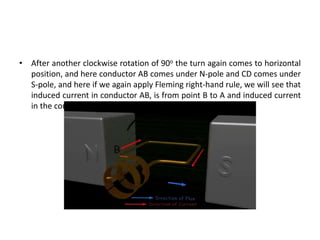
• After another clockwise rotation of 90o the turn again comes to horizontal
position, and here conductor AB comes under N-pole and CD comes under
S-pole, and here if we again apply Fleming right-hand rule, we will see that
induced current in conductor AB, is from point B to A and induced current
in the conductor CD is from D to C.
• As at this position the turn comes at a horizontal position from its vertical
position, the current in the conductors comes to its maximum value from
zero.
• That means current is circulating in the close turn from point B to A, from
A to D, from D to C and from C to B, provided the loop is closed although it
is not shown here.
• That means the current is in reverse of that of the previous horizontal
position when the current was circulating as A → B → C → D → A.
• While the turn further proceeds to its vertical position the current is again
reduced to zero.
• So if the turn continues to rotate the current in turn continually alternate
its direction. During every full revolution of the turn, the current in turn
gradually reaches to its maximum value then reduces to zero and then
again it comes to its maximum value but in opposite direction and again it
comes to zero.
• In this way, the current completes one full sine wave cycle during each
360o revolution of the turn. So, we have seen how alternating current is
produced in a turn is rotated inside a magnetic field.
• From this, we will now come to the actual working principle of an
alternator.
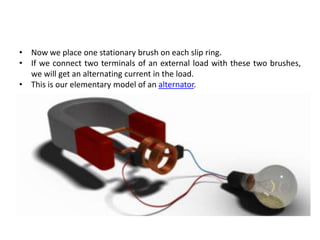
• Now we place one stationary brush on each slip ring.
• If we connect two terminals of an external load with these two brushes,
we will get an alternating current in the load.
• This is our elementary model of an alternator.
• Having understood the very basic principle of an alternator, let us now have an
insight into its basic operational principle of a practical alternator.
• During the discussion of the basic working principle of an alternator, we have
considered that the magnetic field is stationary and conductors (armature) is
rotating.
• But generally in practical construction of alternator, armature conductors are
stationary and field magnets rotate between them.
• The rotor of an alternator or a synchronous generator is mechanically coupled
to the shaft or the turbine blades, which is made to rotate at synchronous
speed Ns under some mechanical force results in magnetic flux cutting of the
stationary armature conductors housed on the stator.
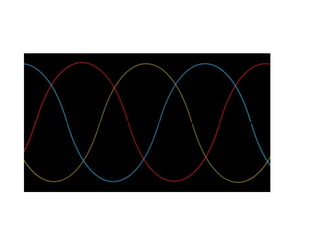
• As a direct consequence of this flux cutting an induced emf and current starts
to flow through the armature conductors which first flow in one direction for
the first half cycle and then in the other direction for the second half cycle for
each winding with a definite time lag of 120o due to the space displaced
arrangement of 120o between them as shown in the figure below.
• This particular phenomenon results in three-phase power flow out of the
alternator which is then transmitted to the distribution stations for domestic
and industrial uses.
Introduction
• A.C. system has a number of advantages over DC system.
• These days 3-phase AC system is being exclusively used for
generation, transmission and distribution of power.
• The machine which produces 3-phase power from mechanical
power is called an alternator or synchronous generator.
• Alternators are the primary source of all the electrical energy
we consume.
• These machines are the largest energy converters found in the
world.
• They convert mechanical energy into a.c. energy.
90
SURESH MIKKILI, ASSOCIATE PROFESSOR,
EEE DEPT
Alternator
• An alternator operates on the same fundamental principle of
electromagnetic induction as a d.c. generator i.e., when the flux linking a
conductor changes, an e.m.f. is induced in the conductor.
• Like a d.c. generator, an alternator also has an armature winding and a
field winding.
• But there is one important difference between the two.
• In a d.c. generator, the armature winding is placed on the rotor in order to
provide a way of converting alternating voltage generated in the winding
to a direct voltage at the terminals through the use of a rotating
commutator.
• The field poles are placed on the stationary part of the machine.
• Since no commutator is required in an alternator, it is usually more
convenient and advantageous to place the field winding on the rotating
part (i.e., rotor) and armature winding on the stationary part (i.e., stator)
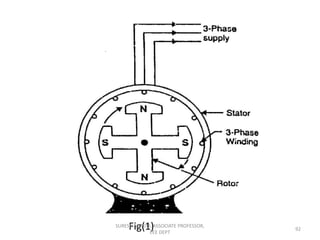
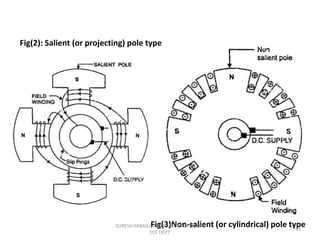
as shown in Fig. (1).
91
SURESH MIKKILI, ASSOCIATE PROFESSOR,
EEE DEPT
Fig(1) 92
SURESH MIKKILI, ASSOCIATE PROFESSOR,
EEE DEPT
Advantages of stationary armature
• The field winding of an alternator is placed on the rotor and is connected to
d.c. supply through two slip rings. The 3-phase armature winding is placed
on the stator.
• This arrangement has the following advantages:
(i) It is easier to insulate stationary winding for high voltages for which the
alternators are usually designed. Ii is because they are not subjected to
centrifugal forces and also extra space is available due to the stationary
arrangement of the armature.
(ii) The stationary 3-phase armature can be directly connected to load without
going through large, unreliable slip rings and brushes.
(iii) Only two slip rings are required for d.c. supply to the field winding on the
rotor. Since the exciting current is small, the slip rings and brush gear
required are of light construction.
(iv) Due to simple and robust construction of the rotor, higher speed of rotating
d.c. field is possible. This increases the output obtainable from a machine of
given dimensions.
93
SURESH MIKKILI, ASSOCIATE PROFESSOR,
EEE DEPT
Construction of Alternator
• An alternator has 3,-phase winding on the stator and a d.c. field winding on
the rotor.
1. Stator
• It is the stationary part of the machine and is built up of sheet-steel
laminations having slots on its inner periphery. A 3-phase winding is placed
in these slots and serves as the armature winding of the alternator. The
armature winding is always connected in star and the neutral is connected to
ground.
2. Rotor
• The rotor carries a field winding which is supplied with direct current
through two slip rings by a separate d.c. source. This d.c. source (called
exciter) is generally a small d.c. shunt or compound generator mounted on
the shaft of the alternator.
• Rotor construction is of two types, namely;
(i) Salient (or projecting) pole type (ii) Non-salient (or cylindrical) pole type
94
SURESH MIKKILI, ASSOCIATE PROFESSOR,
EEE DEPT
(i) Salient pole type
• In this type, salient or projecting poles are mounted on a large circular
steel frame which is fixed to the shaft of the alternator as shown in Fig.
(2). The individual field pole windings are connected in series in such a
way that when the field winding is energized by the d.c. exciter, adjacent
poles have opposite polarities.
• Low and medium-speed alternators (1200-1400 r.p.m.) such as those
driven by diesel engines or water turbines have salient pole type rotors
due to the following reasons:
(a) The salient field poles would cause .an excessive windage loss if driven at
high speed and would tend to produce noise.
(b) Salient-pole construction cannot be made strong enough to withstand the
mechanical stresses to which they may be subjected at higher speeds.
• Since a frequency of 50 Hz is required, we must use a large number of
poles on the rotor of slow-speed alternators. Low-speed rotors always
possess a large diameter to provide the necessary spate for the poles.
Consequently, salient-pole type rotors have large diameters and short
axial lengths.
95
SURESH MIKKILI, ASSOCIATE PROFESSOR,
EEE DEPT
Fig(2): Salient (or projecting) pole type
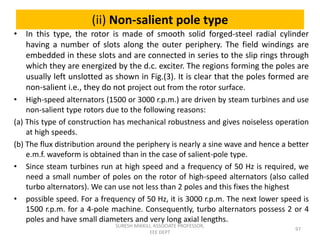
Fig(3)Non-salient (or cylindrical) pole type
96
SURESH MIKKILI, ASSOCIATE PROFESSOR,
EEE DEPT
(ii) Non-salient pole type
• In this type, the rotor is made of smooth solid forged-steel radial cylinder
having a number of slots along the outer periphery. The field windings are
embedded in these slots and are connected in series to the slip rings through
which they are energized by the d.c. exciter. The regions forming the poles are
usually left unslotted as shown in Fig.(3). It is clear that the poles formed are
non-salient i.e., they do not project out from the rotor surface.
• High-speed alternators (1500 or 3000 r.p.m.) are driven by steam turbines and use
non-salient type rotors due to the following reasons:
(a) This type of construction has mechanical robustness and gives noiseless operation
at high speeds.
(b) The flux distribution around the periphery is nearly a sine wave and hence a better
e.m.f. waveform is obtained than in the case of salient-pole type.
• Since steam turbines run at high speed and a frequency of 50 Hz is required, we
need a small number of poles on the rotor of high-speed alternators (also called
turbo alternators). We can use not less than 2 poles and this fixes the highest
• possible speed. For a frequency of 50 Hz, it is 3000 r.p.m. The next lower speed is
1500 r.p.m. for a 4-pole machine. Consequently, turbo alternators possess 2 or 4
poles and have small diameters and very long axial lengths.
97
SURESH MIKKILI, ASSOCIATE PROFESSOR,
EEE DEPT
Alternator Operation
• The rotor winding is energized from the d.c. exciter and alternate N and S
poles are developed on the rotor. When the rotor is rotated in anti-
clockwise direction by a prime mover, the stator or armature conductors are
cut by the magnetic flux of rotor poles.
• Consequently, e.m.f. is induced in the armature conductors due to
electromagnetic induction.
• The induced e.m.f. is alternating since N and S poles of rotor alternately
pass the armature conductors.
• The direction of induced e.m.f. can be found by Fleming’s right hand rule
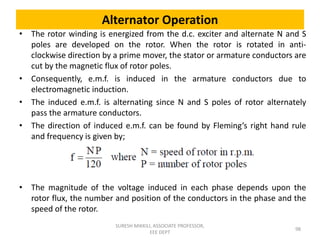
and frequency is given by;
• The magnitude of the voltage induced in each phase depends upon the
rotor flux, the number and position of the conductors in the phase and the
speed of the rotor.
98
SURESH MIKKILI, ASSOCIATE PROFESSOR,
EEE DEPT
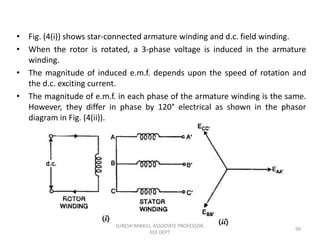
• Fig. (4(i)) shows star-connected armature winding and d.c. field winding.
• When the rotor is rotated, a 3-phase voltage is induced in the armature
winding.
• The magnitude of induced e.m.f. depends upon the speed of rotation and
the d.c. exciting current.
• The magnitude of e.m.f. in each phase of the armature winding is the same.
However, they differ in phase by 120° electrical as shown in the phasor
diagram in Fig. (4(ii)).
99
SURESH MIKKILI, ASSOCIATE PROFESSOR,
EEE DEPT
Frequency
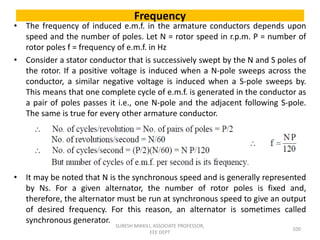
• The frequency of induced e.m.f. in the armature conductors depends upon
speed and the number of poles. Let N = rotor speed in r.p.m. P = number of
rotor poles f = frequency of e.m.f. in Hz
• Consider a stator conductor that is successively swept by the N and S poles of
the rotor. If a positive voltage is induced when a N-pole sweeps across the
conductor, a similar negative voltage is induced when a S-pole sweeps by.
This means that one complete cycle of e.m.f. is generated in the conductor as
a pair of poles passes it i.e., one N-pole and the adjacent following S-pole.
The same is true for every other armature conductor.
• It may be noted that N is the synchronous speed and is generally represented
by Ns. For a given alternator, the number of rotor poles is fixed and,
therefore, the alternator must be run at synchronous speed to give an output
of desired frequency. For this reason, an alternator is sometimes called
synchronous generator.
100
SURESH MIKKILI, ASSOCIATE PROFESSOR,
EEE DEPT
A.C. Armature Windings
• A.C. armature windings are always of the nonsalient-pole type and are usually
symmetrically distributed in slots around the complete circumference of the
armature. A.C. armature windings are generally open-circuit type i.e., both ends
are brought out. An open-circuit winding is one that does not close on itself i.e., a
closed circuit will not be formed until some external connection is made to a
source or load. The following are the general features of a.c. armature windings:
• (i) A.C. armature windings are generally distributed windings i.e., they are
symmetrically distributed in slots around the complete circumference of the
armature. A distributed winding has two principal advantages. First, a distributed
winding generates a voltage wave that is nearly a sine curve. Secondly, copper is
evenly distributed on the armature surface. Therefore, heating is more uniform
and this type of winding is more easily cooled.
• (ii) A.C. armature windings may use full-pitch coils or fractional-pitch coils. A coil
with a span of 180° electrical is called a full-pitch coil. In this case, the two sides
of the coil occupy identical positions under adjacent opposite poles and the e.m.f.
generated in the coil is maximum. A coil with a span of less than 180° electrical is
called a fractional-pitch coil. For example, a coil with a span of 150° electrical
would be called a 5/6 pitch coil. Although e.m.f. induced in a fractional-pitch coil
is less than that of a full-pitch coil, fractional-pitch coils are frequently used in a.c.
machines for two main reasons. First, less copper is required per coil and
secondly the waveform of the generated voltage is improved.
101
SURESH MIKKILI, ASSOCIATE PROFESSOR,
EEE DEPT
A.C. Armature Windings (Cont..)
• (iii) Most of a.c. machines use double layer armature windings. In a double
layer winding, one coil side lies in the upper half of one slot while the
other coil side lies in the lower half of another slot spaced about one-pole
pitch from the first one. This arrangement permits simpler end
connections and it is economical to manufacture.
• (iv) Since most of a.c. machines are of 3-phase type, the three windings of
the three phases are identical but spaced 120 electrical degrees apart.
• (v) A group of adjacent slots belonging to one phase under one pole pair is
known as phase belt. The angle subtended by a phase belt is known as
phase spread. The 3-phase windings are always designed for 60° phase
spread.
102
SURESH MIKKILI, ASSOCIATE PROFESSOR,
EEE DEPT
Armature Winding of Alternator
• With very few exceptions, alternators are 3-phase machines because of the
advantages of 3-phase service for generation, transmission and distribution.
• The windings for an alternator are much simpler than that of a d c. machine
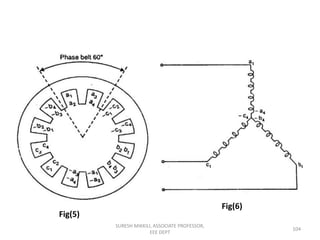
because no commutator is used. Fig.(5) shows a 2-pole, 3-phase double-
layer, full pitch, distributed winding for the stator of an alternator. There are
12 slots and each slot contains two coil sides. The coil sides that are placed
in adjacent slots belong to the same phase such as a1, a3 or a2, a4 constitute
a phase belt. Note that in a 3-phase machine, phase belt is always 60°
electrical. Since the winding has double-layer arrangement, one side of a
coil, such as a1, is placed at the bottom of a slot and the other side - a1 is
placed at the top of another slot spaced one pole pitch apart. Note that
each coil has a span of a full pole pitch or 180 electrical degrees. Therefore.
the winding is a full-pitch winding.
• Note that there are 12 total coils and each phase has four coils. The four
coils in each phase are connected in series so that their voltages aid. The
three phases then may be connected to form Y or Δ-connection. Fig. (6)
shows how the coils ire connected to form a Y-connection.
103
SURESH MIKKILI, ASSOCIATE PROFESSOR,
EEE DEPT
Fig(6)
Fig(5)
104
SURESH MIKKILI, ASSOCIATE PROFESSOR,
EEE DEPT
INTRODUCTION
Measurement:
• It is the act or result of quantitative comparison between a
predefined standard and an unknown quantity.
Instrument:
• It is a device or mechanism used to determine the present
value of a quantity under observation.
• The instruments may be classified as follow:
 Absolute and Secondary instruments
 Analog and Digital instruments
 Mechanical, Electrical and Electronics instruments
 Manual and automatic instruments
 Self-contained and remote indicating instruments
 Self-operated and power-operated instruments
 Deflection and null output instruments
M.SURESH, Associate Professor, EEE Dept
CLASSIFICATION OF INSTRUMENTS
Instruments may be classified into two ways:
1. Absolute instruments
2. Secondary instruments
• Absolute instruments indicate the value of the quantity being
measured in terms of constant of instruments and its deflection.
• No comparison with standard instrument is necessary.
• Example: tangent galvanometer, Rayleigh current balance.
• The secondary instruments need calibration with respect to the
absolute instruments.
• The secondary instruments determine the value of the quantity
being measured from the deflection of the instruments.
• Calibration is a must for secondary instrument, without calibration
the deflection obtained is meaningless.
• Example: Ammeter, voltmeter, wattmeter etc.
CLASSIFICATION OF INSTRUMENTS
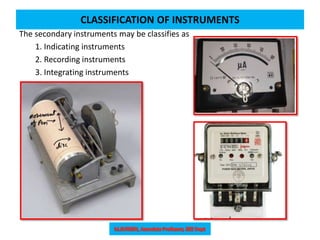
The secondary instruments may be classifies as
1. Indicating instruments
2. Recording instruments
3. Integrating instruments
CLASSIFICATION OF INSTRUMENTS(Cont..)
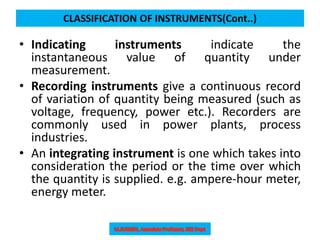
• Indicating instruments indicate the
instantaneous value of quantity under
measurement.
• Recording instruments give a continuous record
of variation of quantity being measured (such as
voltage, frequency, power etc.). Recorders are
commonly used in power plants, process
industries.
• An integrating instrument is one which takes into
consideration the period or the time over which
the quantity is supplied. e.g. ampere-hour meter,
energy meter.
OPERATING TORQUES
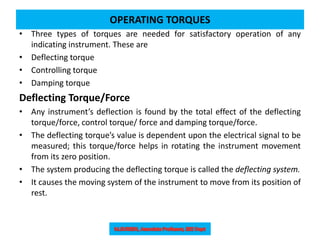
• Three types of torques are needed for satisfactory operation of any
indicating instrument. These are
• Deflecting torque
• Controlling torque
• Damping torque
Deflecting Torque/Force
• Any instrument’s deflection is found by the total effect of the deflecting
torque/force, control torque/ force and damping torque/force.
• The deflecting torque’s value is dependent upon the electrical signal to be
measured; this torque/force helps in rotating the instrument movement
from its zero position.
• The system producing the deflecting torque is called the deflecting system.
• It causes the moving system of the instrument to move from its position of
rest.
Operating Torques
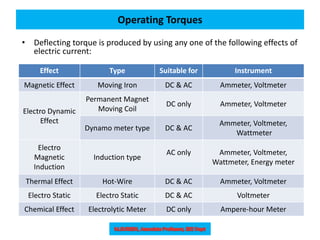
• Deflecting torque is produced by using any one of the following effects of
electric current:
Effect Type Suitable for Instrument
Magnetic Effect Moving Iron DC & AC Ammeter, Voltmeter
Electro Dynamic
Effect
Permanent Magnet
Moving Coil
DC only Ammeter, Voltmeter
Dynamo meter type DC & AC
Ammeter, Voltmeter,
Wattmeter
Electro
Magnetic
Induction
Induction type
AC only Ammeter, Voltmeter,
Wattmeter, Energy meter
Thermal Effect Hot-Wire DC & AC Ammeter, Voltmeter
Electro Static Electro Static DC & AC Voltmeter
Chemical Effect Electrolytic Meter DC only Ampere-hour Meter
Controlling Torque/Force
• The act of this torque/force is opposite to the deflecting torque/force.
• When the deflecting and controlling torques are equal in magnitude then
the movement will be in definite position or in equilibrium.
• Spiral springs or gravity is usually given to produce the controlling torque.
• The system which produces the controlling torque is called the controlling
system.
• At steady state, Deflecting torque = Controlling torque
The functions of the controlling system are
 To produce a torque equal and opposite to the deflecting torque at the
final steady position of the pointer in order to make the deflection of the
pointer definite for a particular magnitude of current
 To bring the moving system back to its zero position when the force causing
the instrument moving system to deflect is removed The controlling torque
in indicating instruments is almost always obtained by a spring, much less
commonly, by gravity.
Operating Torques
Operating Torques
Damping Torque/Force
• Due to deflecting torque, pointer moves in one direction while due to controlling torque
pointer moves in opposite direction.
• Due to these opposite torques, the pointer may oscillate in the forward and backward direction
if the damping torque is not present.
• Damping torque brings the moving system to rest quickly in its final position.
• Damping torque acts only when the moving system is actually moving.
• If moving system is at rest, damping torque is zero.
• A damping force generally works in an opposite direction to the movement of the moving
system.
• Air friction, fluid friction and eddy currents provide the damping torque/force to act.
• It must also be noted that not all damping force affects the steady-state deflection caused by a
given deflecting force or torque.
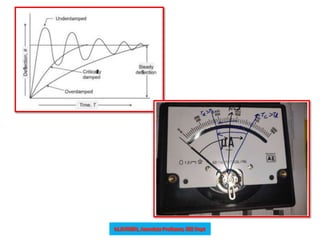
• When the deflecting torque is much greater than the controlling torque, the system is called
Underdamped.
• If the deflecting torque is equal to the controlling torque, it is called critically damped.
• When deflecting torque is much less than the controlling torque, the system is under
overdamped condition.
• Figure shows the variation of deflection (d) with time for underdamped, critically damped and
overdamped systems.
M.SURESH, Associate Professor, EEE Dept
Operating Torques
Spring Control (Cont…)
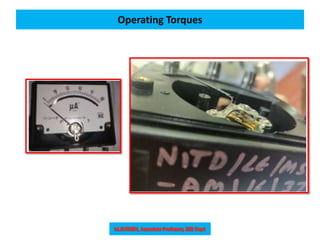
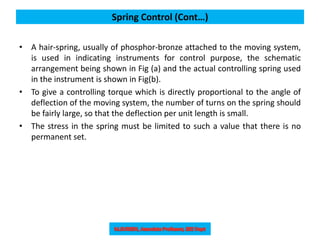
• A hair-spring, usually of phosphor-bronze attached to the moving system,
is used in indicating instruments for control purpose, the schematic
arrangement being shown in Fig (a) and the actual controlling spring used
in the instrument is shown in Fig(b).
• To give a controlling torque which is directly proportional to the angle of
deflection of the moving system, the number of turns on the spring should
be fairly large, so that the deflection per unit length is small.
• The stress in the spring must be limited to such a value that there is no
permanent set.
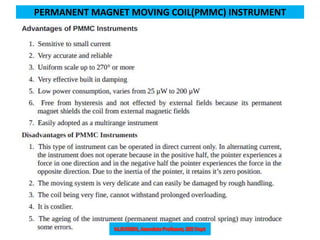
PERMANENT MAGNET MOVING COIL(PMMC) INSTRUMENT
or
D.ARSONVAL’S GALVANOMETER
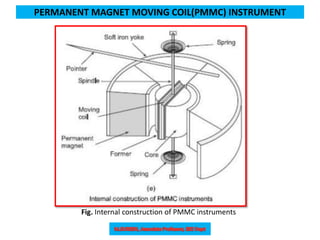
Fig. Internal construction of PMMC instruments
PERMANENT MAGNET MOVING COIL(PMMC) INSTRUMENT
PMMC Principle of Operation
• The principle on which a Permanent Magnet Moving Coil (PMMC) instrument
operates is that a torque is exerted on a current-carrying coil placed in the
field of a permanent magnet.
• A PMMC instrument is shown in Fig. The coil C has a number of turns of thin
insulated wires wound on a rectangular aluminium former F.
• The frame is carried on a spindle S mounted in jewel bearings J1, J2.
• A pointer PR is attached to the spindle so that it moves over a calibrated
scale.
• The whole of the moving system is made as light in weight as possible to keep
the friction at the bearing to a minimum.
• The coil is free to rotate in air gaps formed between the shaped soft-iron pole
piece (pp) of a permanent magnet PM and a fixed soft-iron cylindrical core IC
[Fig.(b)].
• The core serves two purposes;
(a) it intensifies the magnetic field by reducing the length of the air gap
(b) it makes the field radial and uniform in the air gap.
PMMC Principle of Operation (Cont..)
• Thus, the coil always moves at right angles to the magnetic field [Fig.(c)].
• Modern permanent magnets are made of steel alloys which are difficult to
machine.
• Soft-iron pole pieces (pp) are attached to the permanent magnet PM for
easy machining in order to adjust the length of the air gap.
• Fig.(d) shows the internal parts and Fig.(e) shows schematic of internal
parts of a moving-coil instrument.
• A soft-iron yoke (Y ) is used to complete the flux path and to provide
shielding from stray external fields.
PERMANENT MAGNET MOVING COIL(PMMC) INSTRUMENT
MOVING-IRON INSTRUMENTS
M.SURESH, Associate Professor, EEE Dept
MOVING-IRON INSTRUMENTS (Cont..)
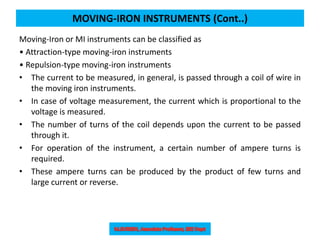
Moving-Iron or MI instruments can be classified as
• Attraction-type moving-iron instruments
• Repulsion-type moving-iron instruments
• The current to be measured, in general, is passed through a coil of wire in
the moving iron instruments.
• In case of voltage measurement, the current which is proportional to the
voltage is measured.
• The number of turns of the coil depends upon the current to be passed
through it.
• For operation of the instrument, a certain number of ampere turns is
required.
• These ampere turns can be produced by the product of few turns and
large current or reverse.
Attraction-type Moving-Iron Instruments
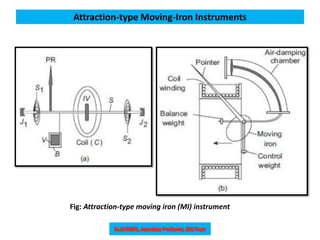
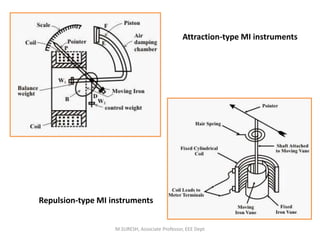
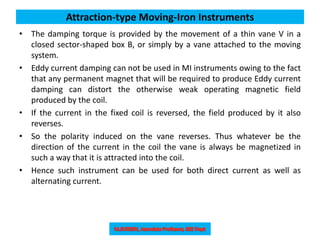
Fig: Attraction-type moving iron (MI) instrument
Attraction-type MI instruments
M.SURESH, Associate Professor, EEE Dept
Repulsion-type MI instruments
Attraction-type Moving-Iron Instruments
• The attraction type of MI instrument depends on the attraction of an iron
vane into a coil carrying current to be measured.
• Fig. shows a attraction-type MI instrument.
• A soft Iron Vane(IV) is attached to the moving system. When the current to
be measured is passed through the coil C, a magnetic field is produced.
• This field attracts the eccentrically mounted vane on the spindle towards
it.
• The spindle is supported at the two ends on a pair of jewel bearings.
• Thus, the pointer(PR), which is attached to the spindle S of the moving
system is deflected.
• The pointer moves over a calibrated scale.
• The control torque is provided by two hair springs S1 and S2 in the
same way as for a PMMC instrument; but in such instruments
springs are not used to carry any current.
• Gravity control can also be used for vertically mounted panel type
MI meters.
Attraction-type Moving-Iron Instruments
• The damping torque is provided by the movement of a thin vane V in a
closed sector-shaped box B, or simply by a vane attached to the moving
system.
• Eddy current damping can not be used in MI instruments owing to the fact
that any permanent magnet that will be required to produce Eddy current
damping can distort the otherwise weak operating magnetic field
produced by the coil.
• If the current in the fixed coil is reversed, the field produced by it also
reverses.
• So the polarity induced on the vane reverses. Thus whatever be the
direction of the current in the coil the vane is always be magnetized in
such a way that it is attracted into the coil.
• Hence such instrument can be used for both direct current as well as
alternating current.
Repulsion-type Moving-Iron Instruments
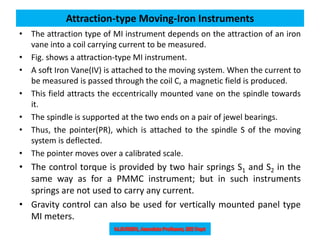
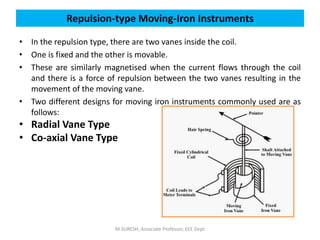
• In the repulsion type, there are two vanes inside the coil.
• One is fixed and the other is movable.
• These are similarly magnetised when the current flows through the coil
and there is a force of repulsion between the two vanes resulting in the
movement of the moving vane.
• Two different designs for moving iron instruments commonly used are as
follows:
• Radial Vane Type
• Co-axial Vane Type
M.SURESH, Associate Professor, EEE Dept
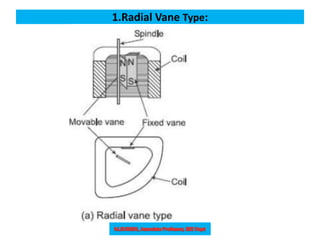
1.Radial Vane Type:
1.Radial Vane Type(Cont..):
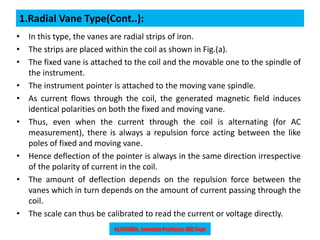
• In this type, the vanes are radial strips of iron.
• The strips are placed within the coil as shown in Fig.(a).
• The fixed vane is attached to the coil and the movable one to the spindle of
the instrument.
• The instrument pointer is attached to the moving vane spindle.
• As current flows through the coil, the generated magnetic field induces
identical polarities on both the fixed and moving vane.
• Thus, even when the current through the coil is alternating (for AC
measurement), there is always a repulsion force acting between the like
poles of fixed and moving vane.
• Hence deflection of the pointer is always in the same direction irrespective
of the polarity of current in the coil.
• The amount of deflection depends on the repulsion force between the
vanes which in turn depends on the amount of current passing through the
coil.
• The scale can thus be calibrated to read the current or voltage directly.
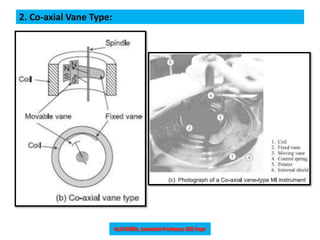
2. Co-axial Vane Type:
2. Co-axial Vane Type (Cont…) :
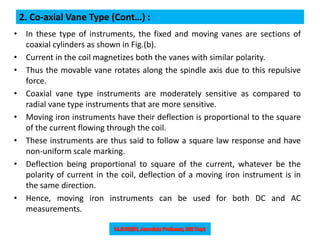
• In these type of instruments, the fixed and moving vanes are sections of
coaxial cylinders as shown in Fig.(b).
• Current in the coil magnetizes both the vanes with similar polarity.
• Thus the movable vane rotates along the spindle axis due to this repulsive
force.
• Coaxial vane type instruments are moderately sensitive as compared to
radial vane type instruments that are more sensitive.
• Moving iron instruments have their deflection is proportional to the square
of the current flowing through the coil.
• These instruments are thus said to follow a square law response and have
non-uniform scale marking.
• Deflection being proportional to square of the current, whatever be the
polarity of current in the coil, deflection of a moving iron instrument is in
the same direction.
• Hence, moving iron instruments can be used for both DC and AC
measurements.
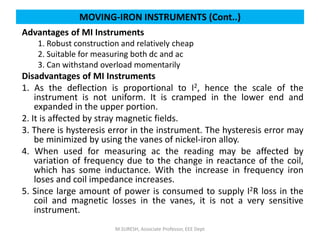
MOVING-IRON INSTRUMENTS (Cont..)
Advantages of MI Instruments
1. Robust construction and relatively cheap
2. Suitable for measuring both dc and ac
3. Can withstand overload momentarily
Disadvantages of MI Instruments
1. As the deflection is proportional to I2, hence the scale of the
instrument is not uniform. It is cramped in the lower end and
expanded in the upper portion.
2. It is affected by stray magnetic fields.
3. There is hysteresis error in the instrument. The hysteresis error may
be minimized by using the vanes of nickel-iron alloy.
4. When used for measuring ac the reading may be affected by
variation of frequency due to the change in reactance of the coil,
which has some inductance. With the increase in frequency iron
loses and coil impedance increases.
5. Since large amount of power is consumed to supply I2R loss in the
coil and magnetic losses in the vanes, it is not a very sensitive
instrument.
M.SURESH, Associate Professor, EEE Dept
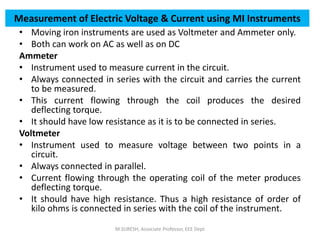
Measurement of Electric Voltage & Current using MI Instruments
• Moving iron instruments are used as Voltmeter and Ammeter only.
• Both can work on AC as well as on DC
Ammeter
• Instrument used to measure current in the circuit.
• Always connected in series with the circuit and carries the current
to be measured.
• This current flowing through the coil produces the desired
deflecting torque.
• It should have low resistance as it is to be connected in series.
Voltmeter
• Instrument used to measure voltage between two points in a
circuit.
• Always connected in parallel.
• Current flowing through the operating coil of the meter produces
deflecting torque.
• It should have high resistance. Thus a high resistance of order of
kilo ohms is connected in series with the coil of the instrument.
M.SURESH, Associate Professor, EEE Dept
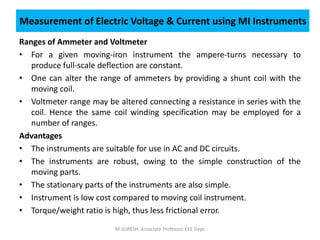
Measurement of Electric Voltage & Current using MI Instruments
Ranges of Ammeter and Voltmeter
• For a given moving-iron instrument the ampere-turns necessary to
produce full-scale deflection are constant.
• One can alter the range of ammeters by providing a shunt coil with the
moving coil.
• Voltmeter range may be altered connecting a resistance in series with the
coil. Hence the same coil winding specification may be employed for a
number of ranges.
Advantages
• The instruments are suitable for use in AC and DC circuits.
• The instruments are robust, owing to the simple construction of the
moving parts.
• The stationary parts of the instruments are also simple.
• Instrument is low cost compared to moving coil instrument.
• Torque/weight ratio is high, thus less frictional error.
M.SURESH, Associate Professor, EEE Dept
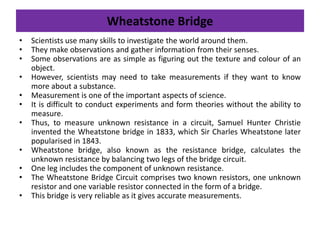
Wheatstone Bridge
• Scientists use many skills to investigate the world around them.
• They make observations and gather information from their senses.
• Some observations are as simple as figuring out the texture and colour of an
object.
• However, scientists may need to take measurements if they want to know
more about a substance.
• Measurement is one of the important aspects of science.
• It is difficult to conduct experiments and form theories without the ability to
measure.
• Thus, to measure unknown resistance in a circuit, Samuel Hunter Christie
invented the Wheatstone bridge in 1833, which Sir Charles Wheatstone later
popularised in 1843.
• Wheatstone bridge, also known as the resistance bridge, calculates the
unknown resistance by balancing two legs of the bridge circuit.
• One leg includes the component of unknown resistance.
• The Wheatstone Bridge Circuit comprises two known resistors, one unknown
resistor and one variable resistor connected in the form of a bridge.
• This bridge is very reliable as it gives accurate measurements.
Construction of Wheatstone Bridge
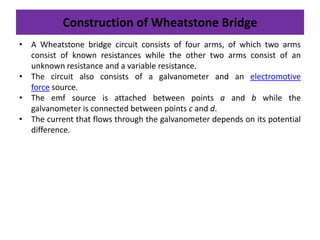
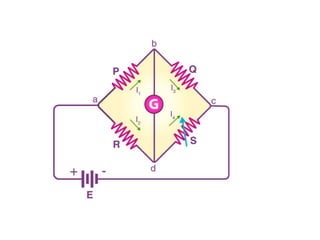
• A Wheatstone bridge circuit consists of four arms, of which two arms
consist of known resistances while the other two arms consist of an
unknown resistance and a variable resistance.
• The circuit also consists of a galvanometer and an electromotive
force source.
• The emf source is attached between points a and b while the
galvanometer is connected between points c and d.
• The current that flows through the galvanometer depends on its potential
difference.
Wheatstone Bridge Principle
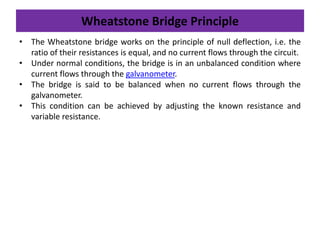
• The Wheatstone bridge works on the principle of null deflection, i.e. the
ratio of their resistances is equal, and no current flows through the circuit.
• Under normal conditions, the bridge is in an unbalanced condition where
current flows through the galvanometer.
• The bridge is said to be balanced when no current flows through the
galvanometer.
• This condition can be achieved by adjusting the known resistance and
variable resistance.
Wheatstone Bridge Derivation
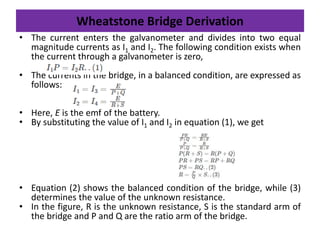
• The current enters the galvanometer and divides into two equal
magnitude currents as I1 and I2. The following condition exists when
the current through a galvanometer is zero,
• The currents in the bridge, in a balanced condition, are expressed as
follows:
• Here, E is the emf of the battery.
• By substituting the value of I1 and I2 in equation (1), we get
• Equation (2) shows the balanced condition of the bridge, while (3)
determines the value of the unknown resistance.
• In the figure, R is the unknown resistance, S is the standard arm of
the bridge and P and Q are the ratio arm of the bridge.
Wheatstone Bridge Application
• The Wheatstone bridge is used for the precise measurement of low
resistance.
• Wheatstone bridge and an operational amplifier are used to measure
physical parameters such as temperature, light, and strain.
• Quantities such as impedance, inductance, and capacitance can be
measured using variations on the Wheatstone bridge.
• Wheatstone Bridge Limitations
• For low resistance measurement, the resistance of the leads and contacts
becomes significant and introduces an error.
• For high resistance measurement, the measurement presented by the
bridge is so large that the galvanometer is insensitive to imbalance.
• The other drawback is the resistance change due to the current’s heating
effect through the resistance. Excessive current may even cause a
permanent change in the value of resistance.
BEEE UNIT-II (ELECTRICAL MACHINES & MEASUREMING INSTRUMENTS

BEEE UNIT-II (ELECTRICAL MACHINES & MEASUREMING INSTRUMENTS

  • 1.
    BASIC ELECTRICAL &ELECTRONICS ENGINEERING UNIT –II: Machines and Measuring Instruments M.SURESH M.Tech(NITW)., (Ph.D) Associate Professor EEE Department RISE Krishna Sai Prakasam Group of Institutions Ongole, Prakasam Dt. AP
  • 2.
    UNIT –II: Machinesand Measuring Instruments Content • Machines: • Construction, principle and operation  DC Motor  DC Generator  Single Phase Transformer  Three Phase Induction Motor  Alternator • Applications of electrical machines. • Measuring Instruments: • Construction and working principle  Permanent Magnet Moving Coil (PMMC),  Moving Iron (MI) Instruments • Wheat Stone bridge. M.SURESH, EEE Dept
  • 3.
    Introduction • The DCmachines are of two types namely DC generators and DC motors. • A DC generators converts mechanical energy into electrical energy whereas a DC motor converts the electrical energy into mechanical energy. • In order to understand the operating principle of a DC motor, it is necessary to understand how does a current carrying conductor experience a force, when kept in a magnetic field.
  • 4.
    1. Nature ofElectrical Supply Electrical Supply AC Supply 3-φ 3-φ, 3 Wire (Delta) RYB 440V, 50Hz 3-φ, 4 Wire (Star) RYB-N 440V, 50Hz 1-φ 230V, 50Hz DC Supply DC Supply 220V
  • 6.
    Nature of Drives M.SURESH,Associate Professor, EEE Dept Types of Motor AC Motor Induction Motor Synchronou s Motor DC Motor Series Motor Shunt Motor Compound Motor Special Type Motor Stepper Motor BLDC Motor Universal Motor Reluctance Motor
  • 7.
    • Force oncurrent carrying conductor: • If a straight conductor is placed in the magnetic field produced by a permanent magnet, the current flowing through a conductor in anti clockwise direction. • Due to the presence of two magnetic fields simultaneously, an interaction between them will take place as shown in fig.(1). Introduction
  • 8.
    • As shownin fig.(1), the flux lines produced by the magnet and the conductor are in opposite direction to each other at left side and hence cancel each other. Therefore the no of flux lines at left side will reduced. • At the right side, the individual fields are in the same direction, hence will add or strengthen each other. Therefore the no. of flux lines at right side will increase. Introduction
  • 9.
    • Magnitude ofForce: • The magnitude of the force experienced by the current carrying conductor placed in the magnetic field is given by, • F = Bil Newton • Where B = Flux density produced by Magnet I = current flowing through conductor l = Length of the conductor Introduction
  • 10.
    • Direction offorce: • The direction of rotation of a motor depends on the direction of force exerted on the the armature winding and the direction of force experienced by a current carrying conductor is given by Fleming’s left hand rule. • Statement of Fleming’s left hand rule: • It states that if the first three fingers of the left hand are held mutually at right angles to each other and if index finger indicates the direction of the magnetic field, and if middle finger indicates the direction of current flowing through the conductor, then thumb indicates the direction of force exerted on the conductor. This is shown in fig (2). Introduction
  • 11.
  • 12.
    • Windings inDC Machine • In any dc machines, there are two windings: • 1.Field winding 2. Armature winding • Out of these, the field winding is stationary which does not move at all and armature winding is mounted on a shaft. So it can rotate freely. • Connection of windings for operation as motor: • To operate the dc machine as a motor, the field winding and armature winding is connected across a dc power supply. Windings in DC Machine
  • 13.
    • Principle ofoperation: • When current carrying conductor is placed in a magnetic field, it experienced a force. • In case of DC motor, the magnetic field us developed by the field current i.e. current flowing in field winding and armature winding plays the role of current carrying conductor • So armature winding experienced a force and start rotating. DC Motor
  • 14.
    Construction of DCMotor Fig.(1): construction of DC motor
  • 15.
    • Important partsof DC Motor: • Yoke • Field winding • poles • Armature • Commutator, brushes & gear • Brushes
  • 16.
    1.Yoke:  It actsas the outer support of a DC motor.  It provides mechanical support for the poles. 2. Poles: • pole of a dc motor is an electromagnet. • The field winding is wound over the poles. • Poles produces magnetic flux when the filed winding is excited. 3. Field winding: • The coils wound around the pole are called field coils and they are connected in series with each other to form field winding. • When current passing through the field winding, magnetic flux produced in the air gap between pole and armature.
  • 17.
    4. Armature: • Armatureis a cylindrical drum mounted on shaft in which number of slots are provided. • Armature conductors are placed in these slots. • Theses armature conductors are interconnected to form the armature winding. 5. Commutator: • A commutatoris a cylindrical drum mounted on the shaft alonwiththe armature core. • It collects the current from the armature conductors and passed it to the external load via brushes.
  • 18.
    6. Brushes: • Commutatoris rotating. So it is not possible to connect the load directly to it. • Hence current is conducted from the armature to the external load by the carbon brushes which are held against the surface of commutatorby springs.
  • 20.
    Types of DCMotors • Depending on the way of connecting the armature and field windings of a d.c. motors are classified as follows:
  • 21.
    • DC ShuntMotor • •In DC shunt type motor, field and armature winding are connected in parallel as shown in fig.(1), and this combination is connected across a common dc power supply.  The resistance of shunt field winding (Rsh) is always much higher than that of armature winding (Ra).  This is because the number of turns for the field winding is more than that of armature winding. • The field current Ishalways remains constant. Since V and Rshboth are constant. Hence flux produced also remains constant. Because field current is responsible for generation of flux. • ∴ø ∝Ish • •This is why the shunt motor is also called as the constant flux motors.
  • 22.
    Fig.(1):DC shunt motorschematic diagram
  • 23.
    • DC SeriesMotor  In DC series motor, the armature and field windings are connected din series with each other as shown in fig.(1).  The resistance of the series field winding (Rs) is much smaller as compared to that of the armature resistance (Ra).  The flux produced is proportional to the field current. But in series motor, the field current is same as armature current. • ∴ø ∝Iaor • ∴ø ∝Is • The armature current Iaand hence field current Is will be dependent on the load. • Hence in DC series motor the flux does not remains constant.
  • 24.
    Fig.(1):DC series motorschematic diagram
  • 25.
    • DC CompoundMotor 1.Long Shunt Compound Motor: • As shown in fig.(1), in long shunt dc motor, shunt field winding is connected across the series combination of the armature and series field winding. 2. Short Shunt Compound Motor: • In short shunt compound motor, armature and field windings are connected in parallel with each other and this combination is connected din series with the series filed winding. This is shown in fig.(2). • The long shunt and short shunt compound motors are further classified as cumulative and differential compound motors
  • 26.
    Fig.(1): Long shuntcompound dc motor fig.(2):Short shunt compound dc motor
  • 27.
    Applications of DCMotor • Applications of DC Motor 1.Shunt motor applications:  Various machine tools such as lathe machines, drilling machines, milling machines etc.  Printing machines  Paper machines  Centrifugal and reciprocating pumps  Blowers and fans etc.
  • 28.
    • 2. Seriesmotor applications:  Electric trains  Diesel-electric locomotives  Cranes  Hoists  Trolley cars and trolley buses  Rapid transit systems  Conveyers etc. Applications of DC Motor
  • 29.
    3. Cumulative compoundmotor applications:  Elevators  Rolling mills  Planers  Punches  Shears 4. Differentials compound motors applications: • The speed of these motors will increase with increase in the load, which leads to an unstable operation. • Therefore we can not use this motor for any practical applications Applications of DC Motor
  • 30.
    Specifications of DCMotor • Some of important specifications of a DC motor:  Output power in horse power(H.P.)  Rated voltage  Type of field winding  Excitation voltage  Base speed in RPM  Current  Frame size  Rating
  • 32.
    D.C. Generators • Althougha far greater percentage of the electrical machines in service are A.C. machines, the D.C. machines are of considerable industrial importance. • The principal advantage of the D.C. machine, particularly the D.C. motor, is that it provides a fine control of speed. • Such an advantage is not claimed by any A.C. motor. • However, D.C. generators are not as common as they used to be, because direct current, when required, is mainly obtained from an A.C. supply by the use of rectifiers. • Nevertheless, an understanding of D.C. generator is important because it represents a logical introduction to the behaviour of d.c. motors. • Indeed many D.C. motors in industry actually operate as D.C. generators for a brief period. In this chapter, we shall deal with various aspects of D.C. generators.
  • 33.
    D.C. Generators • GeneratorPrinciple : • An electric generator is a machine that converts mechanical energy into electrical energy. • An electric generator is based on the principle that whenever flux is cut by a conductor, an e.m.f. is induced which will cause a current to flow if the conductor circuit is closed. • The direction of induced e.m.f. (and hence current) is given by Fleming’s right hand rule. • Therefore, the essential components of a generator are: (a) a magnetic field (b) conductor or a group of conductors (c) motion of conductor w.r.t. magnetic field.
  • 34.
  • 35.
    • Consider asingle turn loop ABCD rotating clockwise in a uniform magnetic field with a constant speed as shown in Fig.(1.1). • As the loop rotates, the flux linking the coil sides AB and CD changes continuously. • Hence the e.m.f. induced in these coil sides also changes but the e.m.f. induced in one coil side adds to that induced in the other.  When the loop is in position no. 1 [See Fig. 1.1], the generated e.m.f. is zero because the coil sides (AB and CD) are cutting no flux but are moving parallel to it  When the loop is in position no. 2, the coil sides are moving at an angle to the flux and, therefore, a low e.m.f. is generated as indicated by point 2 in Fig. (1.2). Simple Loop Generator
  • 36.
     When theloop is in position no. 3, the coil sides (AB and CD) are at right angle to the flux and are, therefore, cutting the flux at a maximum rate. Hence at this instant, the generated e.m.f. is maximum as indicated by point 3 in Fig. (1.2).  At position 4, the generated e.m.f. is less because the coil sides are cutting the flux at an angle.  At position 5, no magnetic lines are cut and hence induced e.m.f. is zero as indicated by point 5 in Fig. (1.2).  At position 6, the coil sides move under a pole of opposite polarity and hence the direction of generated e.m.f. is reversed.  The maximum e.m.f. in this direction (i.e., reverse direction, See Fig. 1.2) will be when the loop is at position 7 and zero when at position 1. This cycle repeats with each revolution of the coil. Simple Loop Generator
  • 37.
    • Note thate.m.f. generated in the loop is alternating one. It is because any coil side, say AB has e.m.f. in one direction when under the influence of N- pole and in the other direction when under the influence of S-pole. • If a load is connected across the ends of the loop, then alternating current will flow through the load. • The alternating voltage generated in the loop can be converted into direct voltage by a device called commutator. We then have the d.c. generator. • In fact, a commutator is a mechanical rectifier. Simple Loop Generator
  • 38.
    Action Of Commutator Fig.(1.3)Fig.(1.4) Fig.(1.5)
  • 39.
    • If, somehow,connection of the coil side to the external load is reversed at the same instant the current in the coil side reverses, the current through the load will be direct current. • This is what a commutator does. • Fig. (1.3) shows a commutator having two segments C1 and C2. • It consists of a cylindrical metal ring cut into two halves or segments C1 and C2 respectively separated by a thin sheet of mica. • The commutator is mounted on but insulated from the rotor shaft. • The ends of coil sides AB and CD are connected to the segments C1 and C2 respectively as shown in Fig. (1.4). • Two stationary carbon brushes rest on the commutator and lead current to the external load. • With this arrangement, the commutator at all times connects the coil side under S-pole to the +ve brush and that under N-pole to the -ve brush. Action Of Commutator
  • 40.
    • The variationof voltage across the brushes with the angular displacement of the loop will be as shown in Fig. (1.6). • This is not a steady direct voltage but has a pulsating character. It is because the voltage appearing across the brushes varies from zero to maximum value and back to zero twice for each revolution of the loop. • A pulsating direct voltage such as is produced by a single loop is not suitable for many commercial uses. • What we require is the steady direct voltage. • This can be achieved by using a large number of coils connected in series. • The resulting arrangement is known as armature winding. Fig. (1.6) Action Of Commutator
  • 41.
    Construction of DCGenerator • The d.c. generators and d.c. motors have the same general construction. • In fact, when the machine is being assembled, the workmen usually do not know whether it is a d.c. generator or motor. • Any d.c. generator can be run as a d.c. motor and vice-versa. • All d.c. machines have five principal components viz.,  field system  armature core  armature winding  commutator  brushes [See Fig. 1.7].
  • 43.
    Construction of DCGenerator Fig. (1.7) Fig. (1.8)
  • 44.
    Construction of DCGenerator Field system: • The function of the field system is to produce uniform magnetic field within which the armature rotates. • It consists of a number of salient poles (of course, even number) bolted to the inside of circular frame (generally called yoke). • The yoke is usually made of solid cast steel whereas the pole pieces are composed of stacked laminations. Field coils are mounted on the poles and carry the d.c. exciting current. • The field coils are connected in such a way that adjacent poles ave opposite polarity. • The m.m.f. developed by the field coils produces a magnetic flux that passes through the pole pieces, the air gap, the armature and the frame (See Fig. 1.8). • Practical d.c. machines have air gaps ranging from 0.5 mm to 1.5 mm. • Since armature and field systems are composed of materials that have high permeability, most of the m.m.f. of field coils is required to set up flux in the air gap. • By reducing the length of air gap, we can reduce the size of field coils (i.e. number of turns).
  • 45.
    Construction of DCGenerator Armature core: • The armature core is keyed to the machine shaft and rotates between the field poles. • It consists of slotted soft-iron laminations (about 0.4 to 0.6 mm thick) that are stacked to form a cylindrical core as shown in Fig (1.9). • The laminations (See Fig. 1.10) are individually coated with a thin insulating film so that they do not come in electrical contact with each other. • The purpose of laminating the core is to reduce the eddy current loss. • The laminations are slotted to accommodate and provide mechanical security to the armature winding and to give shorter air gap for the flux to cross between the pole face and the armature “teeth”. Fig. (1.9) Fig. (1.10)
  • 46.
    Construction of DCGenerator Armature winding: • The slots of the armature core hold insulated conductors that are connected in a suitable manner. This is known as armature winding. • This is the winding in which “working” e.m.f. is induced. • The armature conductors are connected in series-parallel; the conductors being connected in series so as to increase the voltage and in parallel paths so as to increase the current. • The armature winding of a d.c. machine is a closed-circuit winding; the conductors being connected in a symmetrical manner forming a closed loop or series of closed loops.
  • 47.
    Construction of DCGenerator Commutator: • A commutator is a mechanical rectifier which converts the alternating voltage generated in the armature winding into direct voltage across the brushes. • The commutator is made of copper segments insulated from each other by mica sheets and mounted on the shaft of the machine (See Fig 1.11). • The armature conductors are soldered to the commutator segments in a suitable manner to give rise to the armature winding. • Depending upon the manner in which the armature conductors are connected to the commutator segments, there are two types of armature winding in a d.c. machine viz., (a) lap winding (b) wave winding. • Great care is taken in building the commutator because any eccentricity will cause the brushes to bounce, producing unacceptable sparking. • The sparks may bum the brushes and overheat and carbonise the commutator.
  • 48.
    Construction of DCGenerator Brushes: • The purpose of brushes is to ensure electrical connections between the rotating commutator and stationary external load circuit. • The brushes are made of carbon and rest on the commutator. • The brush pressure is adjusted by means of adjustable springs (See Fig. 1.12). • If the brush pressure is very large, the friction produces heating of the commutator and the brushes. • On the other hand, if it is too weak, the imperfect contact with the commutator may produce sparking. • Multipole machines have as many brushes as they have poles. For example, a 4-pole machine has 4 brushes. As we go round the commutator, the successive brushes have positive and negative polarities. • Brushes having the same polarity are connected together so that we have two terminals viz., the +ve terminal and the -ve terminal.
  • 50.
    Applications of DCGenerators • Separately Excited DC Generators • generally used for testing purpose in the laboratories. • Systems of speed control. • Shunt Wound DC Generators • They are used for general lighting. • They are used to charge battery because they can be made to give constant output voltage. • They are used for giving the excitation to the alternators. • They are also used for small power supply (such as a portable generator).
  • 51.
    • Applications ofSeries Wound DC Generators • They are used for supplying field excitation current in DC locomotives for regenerative breaking. • This types of generators are used as boosters to compensate the voltage drop in the feeder in various types of distribution systems such as railway service. • In series arc lightening this type of generators are mainly used. • Applications of Compound Wound DC Generators • Long shunt/Cumulative compound wound generators are generally used for lighting, power supply purpose and for heavy power services • Cumulative compound wound generators are also used for driving a motor. • For small distance operation, such as power supply for hotels, offices, homes and lodges, the flat compounded generators are generally used. • The short shunt/differential compound wound generators are used for arc welding where huge voltage drop and constant current is required. Applications of DC Generators
  • 52.
  • 53.
  • 54.
    Transformer • A transformeris a static device used in the power transmission of electric energy. • It can transfer energy between two or more circuits. • The transmission current is AC. • It is commonly used to increase or decrease the supply voltage without a change in the frequency of AC between circuits. • The transformer works on the basic principles of Electromagnetic induction mutual induction.
  • 55.
    • Based onVoltage Levels • Commonly used transformer types, depending on the voltage, are classified as follows: • Step-up Transformer: They are used between the power generator and the power grid. The secondary output voltage is higher than the input voltage. • Step-down Transformer: These transformers are used to convert high- voltage primary supply to low-voltage secondary output. • Based on the Medium of Core Used • In a transformer, we will find different types of cores that are used. • Air Core Transformer: The flux linkage between primary and secondary winding is through the air. The coil or windings wound on the non- magnetic strip. • Iron Core Transformer: Windings are wound on multiple iron plates stacked together, which provides a perfect linkage path to generate flux. Transformer Types
  • 56.
    Transformer Types • Basedon the Winding Arrangement • Autotransformer: It will have only one winding wound over a laminated core. The primary and secondary share the same coil. Auto means “self” in the Greek language. • Based on Install Location • Power Transformer: It is used at power generation stations, as they are suitable for high voltage application • Distribution Transformer: It is mostly used at distribution lanes for domestic purposes. They are designed for carrying low voltages. It is very easy to install and characterised by low magnetic losses. • Measurement Transformers: They are mainly used for measuring voltage, current and power. • Protection Transformers: They are used for component protection purposes. In circuits, some components must be protected from voltage fluctuation, etc. Protection transformers ensure component protection.
  • 57.
    Working Principle ofa Transformer
  • 58.
    • The transformerworks on the principle of Faraday’s law of electromagnetic induction and mutual induction. • There are usually two coils – primary coil and secondary coil – on the transformer core. • The core laminations are joined in the form of strips. • The two coils have high mutual inductance. • When an alternating current passes through the primary coil, it creates a varying magnetic flux. • As per Faraday’s law of electromagnetic induction, this change in magnetic flux induces an EMF (electromotive force) in the secondary coil, which is linked to the core having a primary coil. This is mutual induction. • Overall, a transformer carries out the following operations: • Transfer of electrical energy from one circuit to another • Transfer of electrical power through electromagnetic induction • Electric power transfer without any change in frequency • Two circuits are linked with mutual induction Working Principle of a Transformer
  • 59.
    • The figureshows the formation of magnetic flux lines around a current- carrying wire. • The normal of the plane containing the flux lines is parallel to the normal of a cross-section of a wire. Working Principle of a Transformer
  • 60.
    • The figureshows the formation of varying magnetic flux lines around a wire wound. • The interesting part is that the reverse is also true; when a magnetic flux line fluctuates around a piece of wire, a current will be induced in it. • This was what Michael Faraday found in 1831, which is the fundamental working principle of electric generators, as well as transformers. Working Principle of a Transformer
  • 61.
    Construction of aSingle-phase Transformer
  • 62.
    • The majorparts of a single-phase transformer consist of 1. Core 2. Windings 3. Insulation 1. Core • The core acts as a support to the winding in the transformer. • It also provides a low reluctance path to the flow of magnetic flux. • The winding is wound on the core, as shown in the picture. • It is made up of a laminated soft iron core in order to reduce the losses in a transformer. • The factors, such as operating voltage, current, power, etc., decide core composition. • The core diameter is directly proportional to copper losses and inversely proportional to iron losses. Construction of a Single-phase Transformer
  • 63.
    2. Windings • Windingsare the set of copper wires wound over the transformer core. Copper wires are used due to the following: • The high conductivity of copper minimises the loss in a transformer because when the conductivity increases, resistance to current flow decreases. • The high ductility of copper is the property of metals that allows it to be made into very thin wires. • There are mainly two types of windings: primary windings and secondary windings. • Primary winding: The set of turns of windings to which the supply current is fed. • Secondary winding: The set of turns of winding from which output is taken. • The primary and secondary windings are insulated from each other using insulation coating agents. Construction of a Single-phase Transformer
  • 64.
    • 3. Insulation •Insulation is necessary for transformers to separate windings from each other and to avoid short circuits. • This facilitates mutual induction. Insulation agents have an influence on the durability and stability of a transformer. • The following are used as insulation mediums in a transformer: – Insulating oil – Insulating tape – Insulating paper – Wood-based lamination Construction of a Single-phase Transformer
  • 65.
    Applications of Transformers •Transformers are used in a variety of applications, including power generation, transmission and distribution, lighting, audio systems, and electronic equipment. • Power generation: Transformers are used in power plants to increase the voltage of the electricity generated by the plant before it is sent to the grid. • Transmission and distribution: Transformers are used in the transmission and distribution of electricity to increase or decrease the voltage of electricity as it is sent from power plants to homes and businesses. • Lighting: Transformers are used in lighting systems to decrease the voltage of electricity before it is sent to light bulbs. • Audio systems: Transformers are used in audio systems to increase or decrease the voltage of electricity before it is sent to speakers. • Electronic equipment: Transformers are used in a variety of electronic devices, including computers, TVs, radios, and cell phones.
  • 66.
    Three Phase InductionMotor • A Three Phase Induction Motor is an electromechanical energy conversion device which converts 3-phase input electrical power into output mechanical power. • A 3-phase induction motor consists of a stator and a rotor. • The stator carries a 3-phase stator winding while the rotor carries a short-circuited winding called rotor winding. • The stator winding is supplied from a 3-phase supply. • The rotor winding drives its voltage and power from the stator winding through electromagnetic induction and hence the name.
  • 67.
    Working Principle ofa 3-Phase Induction Motor
  • 68.
    • The workingprinciple of a 3-phase induction motor can be explained by considering a portion of it as follows− • When the 3-phase stator winding is fed from a balanced 3-phase supply, a rotating magnetic field (RMF) is produced in the motor. • This RMF rotates around the stator at synchronous speed which is given by, • The RMF passes through the air gap and cuts the rotor conductors, which as yet are stationary. • Due to the relative motion between the RMF and the stationary rotor conductors, EMFs are induced in the rotor conductors. • As the rotor circuit is closed with short-circuit so currents start flowing in the rotor conductors. Working Principle of a 3-Phase Induction Motor
  • 69.
    • Since thecurrent carrying rotor conductors are placed in the magnetic field produced by the stator winding. • As a result, the rotor conductors experience mechanical force. • The sum of the mechanical forces on all the rotor conductors produce a torque which moves the rotor in the same direction as the rotating magnetic field. • Hence, in such a way the three phase input electric power is converted into output mechanical power in a 3-phase induction motor. • Also, according to Lenz’s law, the rotor should move in the direction of the stator field, i.e., the direction of rotor currents would be such that they tend to oppose the cause producing them. • Here, the cause producing the rotor currents is the relative speed between the RMF and the rotor conductors. • Thus to reduce this relative speed, the rotor starts running in the same direction as that of the RMF. Working Principle of a 3-Phase Induction Motor
  • 70.
  • 71.
    • The constructionof an induction motor is very simple and robust. It has mainly two parts; • 1. Stator 2. Rotor • Stator • As the name suggests, the stator is a stationary part of the motor. The stator of the induction motor consists of three main parts; • Stator Frame Stator Core Stator Winding • Stator Frame • The stator frame is the outer part of the motor. The function of the stator frame is to provide support to the stator core and stator winding. • It provides mechanical strength to the inner parts of the motor. The frame has fins on the outer surface for heat dissipation and cooling of the motor. • The frame is casted for small machines and it is fabricated for a large machine. • According to the applications, the frame is made up of die-cast or fabricated steel, aluminum/ aluminum alloys, or stainless steel. Construction of Three-Phase Induction Motor
  • 72.
    • Stator Core •The function of the stator core is to carry the alternating magnetic flux which produces hysteresis and eddy current loss. • To minimize these losses, the core is laminated by high-grade steel stampings thickness of 0.3 to 0.6 mm. • These stampings are insulated from each other by varnish. • All stampings stamp together in the shape of the stator core and fixed it with the stator frame. • An inner layer of the stator core has a number of slots. Construction of Three-Phase Induction Motor
  • 73.
    • Stator Winding •The stator winding is placed inside the stator slots available inside the stator core. • Three-phase winding is placed as a stator winding. And three-phase supply is given to the stator winding. • The number of poles of a motor depends on the internal connection of the stator winding and it will decide the speed of the motor. • If the number of poles is greater, the speed will less and if the number of poles is lesser than the speed will high. The poles are always in pairs. • Therefore, the total number of poles always an even number. The relation between synchronous speed and number poles is as shown in the below equation, • NS = 120f / P • Where; f = Supply Frequency P = Total Number of Poles • Ns = Synchronous Speed • As the end of winding connected to the terminal box. Hence, there are six terminals (two of each phase) in the terminal box. Construction of Three-Phase Induction Motor
  • 74.
    • Rotor • Asthe name suggests, the rotor is a rotating part of the motor. According to the type of rotor, the induction motor is classified as; • Squirrel Cage Induction Motor • Phase Wound (Wound Rotor) Induction motor / Slip-ring Induction Motor • The construction of the stator is same in both types of induction motors. • We will discuss the types of rotors used in 3-phase induction motors in the following section of types of three phase induction motors. Construction of Three-Phase Induction Motor
  • 75.
    Applications of 3-PhaseInduction Motor • The slip-ring or wound-rotor 3-phase induction motors: • suitable for loads requiring high starting torque and for applications where the starting current is low. • used for loads having high inertia, which results in very high rotor energy losses during acceleration. • used for loads which require a gradual build-up of load. • They are used for loads that requires speed control. • Typical applications of wound rotor or slip ring induction motors are crushers, plunger pumps, cranes & hoists, elevators, compressors and conveyors. • Squirrel Cage Induction Motors: • used for loads such as fans, blowers, machine tools and centrifugal pumps. • used for driving the loads such as compressors, crushers, conveyors and reciprocating pumps. • used for driving intermittent loads requiring rapid acceleration and high impact such as punch presses, bulldozers, die-stamping machines and shears.
  • 76.
    Comparison of DCmotor to AC motor
  • 77.
  • 78.
    • The workingprinciple of an alternator is very simple. • It is just like the basic principle of DC generator. • It also depends upon Faraday’s law of electromagnetic induction which says the current is induced in the conductor inside a magnetic field when there is a relative motion between that conductor and the magnetic field.
  • 79.
    • For understandingworking of alternator let us think about a single rectangular turn placed in between two opposite magnetic poles as shown below.
  • 81.
    • Say thissingle turn loop ABCD can rotate against axis a-b. • Suppose this loop starts rotating clockwise. After 90o rotation the side AB or conductor AB of the loop comes in front of S-pole and conductor CD comes in front of N-pole. • At this position the tangential motion of the conductor AB is just perpendicular to the magnetic flux lines from N to S pole. Hence, the rate of flux cutting by the conductor AB is maximum here and for that flux cutting there will be an induced current in the conductor AB and the direction of the induced current can be determined by Fleming’s right- hand rule. • As per this rule the direction of this current will be from A to B. At the same time conductor CD comes under N pole and here also if we apply Fleming right-hand rule we will get the direction of induced current and it will be from C to D.
  • 82.
    • Now afterclockwise rotation of another 90o the turn ABCD comes at the vertical position as shown below. • At this position tangential motion of conductor AB and CD is just parallel to the magnetic flux lines, hence there will be no flux cutting that is no current in the conductor. • While the turn ABCD comes from a horizontal position to a vertical position, the angle between flux lines and direction of motion of conductor, reduces from 90o to 0o and consequently the induced current in the turn is reduced to zero from its maximum value.
  • 84.
    • After anotherclockwise rotation of 90o the turn again comes to horizontal position, and here conductor AB comes under N-pole and CD comes under S-pole, and here if we again apply Fleming right-hand rule, we will see that induced current in conductor AB, is from point B to A and induced current in the conductor CD is from D to C.
  • 85.
    • As atthis position the turn comes at a horizontal position from its vertical position, the current in the conductors comes to its maximum value from zero. • That means current is circulating in the close turn from point B to A, from A to D, from D to C and from C to B, provided the loop is closed although it is not shown here. • That means the current is in reverse of that of the previous horizontal position when the current was circulating as A → B → C → D → A.
  • 86.
    • While theturn further proceeds to its vertical position the current is again reduced to zero. • So if the turn continues to rotate the current in turn continually alternate its direction. During every full revolution of the turn, the current in turn gradually reaches to its maximum value then reduces to zero and then again it comes to its maximum value but in opposite direction and again it comes to zero. • In this way, the current completes one full sine wave cycle during each 360o revolution of the turn. So, we have seen how alternating current is produced in a turn is rotated inside a magnetic field. • From this, we will now come to the actual working principle of an alternator.
  • 87.
    • Now weplace one stationary brush on each slip ring. • If we connect two terminals of an external load with these two brushes, we will get an alternating current in the load. • This is our elementary model of an alternator.
  • 88.
    • Having understoodthe very basic principle of an alternator, let us now have an insight into its basic operational principle of a practical alternator. • During the discussion of the basic working principle of an alternator, we have considered that the magnetic field is stationary and conductors (armature) is rotating. • But generally in practical construction of alternator, armature conductors are stationary and field magnets rotate between them. • The rotor of an alternator or a synchronous generator is mechanically coupled to the shaft or the turbine blades, which is made to rotate at synchronous speed Ns under some mechanical force results in magnetic flux cutting of the stationary armature conductors housed on the stator. • As a direct consequence of this flux cutting an induced emf and current starts to flow through the armature conductors which first flow in one direction for the first half cycle and then in the other direction for the second half cycle for each winding with a definite time lag of 120o due to the space displaced arrangement of 120o between them as shown in the figure below. • This particular phenomenon results in three-phase power flow out of the alternator which is then transmitted to the distribution stations for domestic and industrial uses.
  • 90.
    Introduction • A.C. systemhas a number of advantages over DC system. • These days 3-phase AC system is being exclusively used for generation, transmission and distribution of power. • The machine which produces 3-phase power from mechanical power is called an alternator or synchronous generator. • Alternators are the primary source of all the electrical energy we consume. • These machines are the largest energy converters found in the world. • They convert mechanical energy into a.c. energy. 90 SURESH MIKKILI, ASSOCIATE PROFESSOR, EEE DEPT
  • 91.
    Alternator • An alternatoroperates on the same fundamental principle of electromagnetic induction as a d.c. generator i.e., when the flux linking a conductor changes, an e.m.f. is induced in the conductor. • Like a d.c. generator, an alternator also has an armature winding and a field winding. • But there is one important difference between the two. • In a d.c. generator, the armature winding is placed on the rotor in order to provide a way of converting alternating voltage generated in the winding to a direct voltage at the terminals through the use of a rotating commutator. • The field poles are placed on the stationary part of the machine. • Since no commutator is required in an alternator, it is usually more convenient and advantageous to place the field winding on the rotating part (i.e., rotor) and armature winding on the stationary part (i.e., stator) as shown in Fig. (1). 91 SURESH MIKKILI, ASSOCIATE PROFESSOR, EEE DEPT
  • 92.
    Fig(1) 92 SURESH MIKKILI,ASSOCIATE PROFESSOR, EEE DEPT
  • 93.
    Advantages of stationaryarmature • The field winding of an alternator is placed on the rotor and is connected to d.c. supply through two slip rings. The 3-phase armature winding is placed on the stator. • This arrangement has the following advantages: (i) It is easier to insulate stationary winding for high voltages for which the alternators are usually designed. Ii is because they are not subjected to centrifugal forces and also extra space is available due to the stationary arrangement of the armature. (ii) The stationary 3-phase armature can be directly connected to load without going through large, unreliable slip rings and brushes. (iii) Only two slip rings are required for d.c. supply to the field winding on the rotor. Since the exciting current is small, the slip rings and brush gear required are of light construction. (iv) Due to simple and robust construction of the rotor, higher speed of rotating d.c. field is possible. This increases the output obtainable from a machine of given dimensions. 93 SURESH MIKKILI, ASSOCIATE PROFESSOR, EEE DEPT
  • 94.
    Construction of Alternator •An alternator has 3,-phase winding on the stator and a d.c. field winding on the rotor. 1. Stator • It is the stationary part of the machine and is built up of sheet-steel laminations having slots on its inner periphery. A 3-phase winding is placed in these slots and serves as the armature winding of the alternator. The armature winding is always connected in star and the neutral is connected to ground. 2. Rotor • The rotor carries a field winding which is supplied with direct current through two slip rings by a separate d.c. source. This d.c. source (called exciter) is generally a small d.c. shunt or compound generator mounted on the shaft of the alternator. • Rotor construction is of two types, namely; (i) Salient (or projecting) pole type (ii) Non-salient (or cylindrical) pole type 94 SURESH MIKKILI, ASSOCIATE PROFESSOR, EEE DEPT
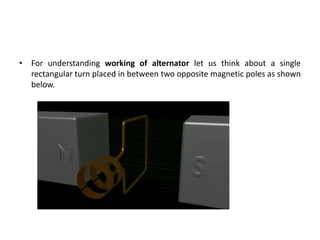
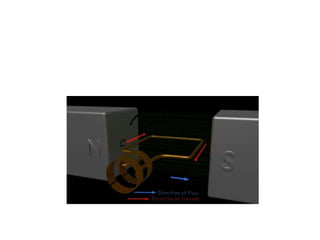
  • 95.
    (i) Salient poletype • In this type, salient or projecting poles are mounted on a large circular steel frame which is fixed to the shaft of the alternator as shown in Fig. (2). The individual field pole windings are connected in series in such a way that when the field winding is energized by the d.c. exciter, adjacent poles have opposite polarities. • Low and medium-speed alternators (1200-1400 r.p.m.) such as those driven by diesel engines or water turbines have salient pole type rotors due to the following reasons: (a) The salient field poles would cause .an excessive windage loss if driven at high speed and would tend to produce noise. (b) Salient-pole construction cannot be made strong enough to withstand the mechanical stresses to which they may be subjected at higher speeds. • Since a frequency of 50 Hz is required, we must use a large number of poles on the rotor of slow-speed alternators. Low-speed rotors always possess a large diameter to provide the necessary spate for the poles. Consequently, salient-pole type rotors have large diameters and short axial lengths. 95 SURESH MIKKILI, ASSOCIATE PROFESSOR, EEE DEPT
  • 96.
    Fig(2): Salient (orprojecting) pole type Fig(3)Non-salient (or cylindrical) pole type 96 SURESH MIKKILI, ASSOCIATE PROFESSOR, EEE DEPT
  • 97.
    (ii) Non-salient poletype • In this type, the rotor is made of smooth solid forged-steel radial cylinder having a number of slots along the outer periphery. The field windings are embedded in these slots and are connected in series to the slip rings through which they are energized by the d.c. exciter. The regions forming the poles are usually left unslotted as shown in Fig.(3). It is clear that the poles formed are non-salient i.e., they do not project out from the rotor surface. • High-speed alternators (1500 or 3000 r.p.m.) are driven by steam turbines and use non-salient type rotors due to the following reasons: (a) This type of construction has mechanical robustness and gives noiseless operation at high speeds. (b) The flux distribution around the periphery is nearly a sine wave and hence a better e.m.f. waveform is obtained than in the case of salient-pole type. • Since steam turbines run at high speed and a frequency of 50 Hz is required, we need a small number of poles on the rotor of high-speed alternators (also called turbo alternators). We can use not less than 2 poles and this fixes the highest • possible speed. For a frequency of 50 Hz, it is 3000 r.p.m. The next lower speed is 1500 r.p.m. for a 4-pole machine. Consequently, turbo alternators possess 2 or 4 poles and have small diameters and very long axial lengths. 97 SURESH MIKKILI, ASSOCIATE PROFESSOR, EEE DEPT
  • 98.
    Alternator Operation • Therotor winding is energized from the d.c. exciter and alternate N and S poles are developed on the rotor. When the rotor is rotated in anti- clockwise direction by a prime mover, the stator or armature conductors are cut by the magnetic flux of rotor poles. • Consequently, e.m.f. is induced in the armature conductors due to electromagnetic induction. • The induced e.m.f. is alternating since N and S poles of rotor alternately pass the armature conductors. • The direction of induced e.m.f. can be found by Fleming’s right hand rule and frequency is given by; • The magnitude of the voltage induced in each phase depends upon the rotor flux, the number and position of the conductors in the phase and the speed of the rotor. 98 SURESH MIKKILI, ASSOCIATE PROFESSOR, EEE DEPT
  • 99.
    • Fig. (4(i))shows star-connected armature winding and d.c. field winding. • When the rotor is rotated, a 3-phase voltage is induced in the armature winding. • The magnitude of induced e.m.f. depends upon the speed of rotation and the d.c. exciting current. • The magnitude of e.m.f. in each phase of the armature winding is the same. However, they differ in phase by 120° electrical as shown in the phasor diagram in Fig. (4(ii)). 99 SURESH MIKKILI, ASSOCIATE PROFESSOR, EEE DEPT
  • 100.
    Frequency • The frequencyof induced e.m.f. in the armature conductors depends upon speed and the number of poles. Let N = rotor speed in r.p.m. P = number of rotor poles f = frequency of e.m.f. in Hz • Consider a stator conductor that is successively swept by the N and S poles of the rotor. If a positive voltage is induced when a N-pole sweeps across the conductor, a similar negative voltage is induced when a S-pole sweeps by. This means that one complete cycle of e.m.f. is generated in the conductor as a pair of poles passes it i.e., one N-pole and the adjacent following S-pole. The same is true for every other armature conductor. • It may be noted that N is the synchronous speed and is generally represented by Ns. For a given alternator, the number of rotor poles is fixed and, therefore, the alternator must be run at synchronous speed to give an output of desired frequency. For this reason, an alternator is sometimes called synchronous generator. 100 SURESH MIKKILI, ASSOCIATE PROFESSOR, EEE DEPT
  • 101.
    A.C. Armature Windings •A.C. armature windings are always of the nonsalient-pole type and are usually symmetrically distributed in slots around the complete circumference of the armature. A.C. armature windings are generally open-circuit type i.e., both ends are brought out. An open-circuit winding is one that does not close on itself i.e., a closed circuit will not be formed until some external connection is made to a source or load. The following are the general features of a.c. armature windings: • (i) A.C. armature windings are generally distributed windings i.e., they are symmetrically distributed in slots around the complete circumference of the armature. A distributed winding has two principal advantages. First, a distributed winding generates a voltage wave that is nearly a sine curve. Secondly, copper is evenly distributed on the armature surface. Therefore, heating is more uniform and this type of winding is more easily cooled. • (ii) A.C. armature windings may use full-pitch coils or fractional-pitch coils. A coil with a span of 180° electrical is called a full-pitch coil. In this case, the two sides of the coil occupy identical positions under adjacent opposite poles and the e.m.f. generated in the coil is maximum. A coil with a span of less than 180° electrical is called a fractional-pitch coil. For example, a coil with a span of 150° electrical would be called a 5/6 pitch coil. Although e.m.f. induced in a fractional-pitch coil is less than that of a full-pitch coil, fractional-pitch coils are frequently used in a.c. machines for two main reasons. First, less copper is required per coil and secondly the waveform of the generated voltage is improved. 101 SURESH MIKKILI, ASSOCIATE PROFESSOR, EEE DEPT
  • 102.
    A.C. Armature Windings(Cont..) • (iii) Most of a.c. machines use double layer armature windings. In a double layer winding, one coil side lies in the upper half of one slot while the other coil side lies in the lower half of another slot spaced about one-pole pitch from the first one. This arrangement permits simpler end connections and it is economical to manufacture. • (iv) Since most of a.c. machines are of 3-phase type, the three windings of the three phases are identical but spaced 120 electrical degrees apart. • (v) A group of adjacent slots belonging to one phase under one pole pair is known as phase belt. The angle subtended by a phase belt is known as phase spread. The 3-phase windings are always designed for 60° phase spread. 102 SURESH MIKKILI, ASSOCIATE PROFESSOR, EEE DEPT
  • 103.
    Armature Winding ofAlternator • With very few exceptions, alternators are 3-phase machines because of the advantages of 3-phase service for generation, transmission and distribution. • The windings for an alternator are much simpler than that of a d c. machine because no commutator is used. Fig.(5) shows a 2-pole, 3-phase double- layer, full pitch, distributed winding for the stator of an alternator. There are 12 slots and each slot contains two coil sides. The coil sides that are placed in adjacent slots belong to the same phase such as a1, a3 or a2, a4 constitute a phase belt. Note that in a 3-phase machine, phase belt is always 60° electrical. Since the winding has double-layer arrangement, one side of a coil, such as a1, is placed at the bottom of a slot and the other side - a1 is placed at the top of another slot spaced one pole pitch apart. Note that each coil has a span of a full pole pitch or 180 electrical degrees. Therefore. the winding is a full-pitch winding. • Note that there are 12 total coils and each phase has four coils. The four coils in each phase are connected in series so that their voltages aid. The three phases then may be connected to form Y or Δ-connection. Fig. (6) shows how the coils ire connected to form a Y-connection. 103 SURESH MIKKILI, ASSOCIATE PROFESSOR, EEE DEPT
  • 104.
  • 105.
    INTRODUCTION Measurement: • It isthe act or result of quantitative comparison between a predefined standard and an unknown quantity. Instrument: • It is a device or mechanism used to determine the present value of a quantity under observation.
  • 106.
    • The instrumentsmay be classified as follow:  Absolute and Secondary instruments  Analog and Digital instruments  Mechanical, Electrical and Electronics instruments  Manual and automatic instruments  Self-contained and remote indicating instruments  Self-operated and power-operated instruments  Deflection and null output instruments M.SURESH, Associate Professor, EEE Dept CLASSIFICATION OF INSTRUMENTS
  • 107.
    CLASSIFICATION OF INSTRUMENTS Instrumentsmay be classified into two ways: 1. Absolute instruments 2. Secondary instruments • Absolute instruments indicate the value of the quantity being measured in terms of constant of instruments and its deflection. • No comparison with standard instrument is necessary. • Example: tangent galvanometer, Rayleigh current balance. • The secondary instruments need calibration with respect to the absolute instruments. • The secondary instruments determine the value of the quantity being measured from the deflection of the instruments. • Calibration is a must for secondary instrument, without calibration the deflection obtained is meaningless. • Example: Ammeter, voltmeter, wattmeter etc.
  • 108.
    CLASSIFICATION OF INSTRUMENTS Thesecondary instruments may be classifies as 1. Indicating instruments 2. Recording instruments 3. Integrating instruments
  • 109.
    CLASSIFICATION OF INSTRUMENTS(Cont..) •Indicating instruments indicate the instantaneous value of quantity under measurement. • Recording instruments give a continuous record of variation of quantity being measured (such as voltage, frequency, power etc.). Recorders are commonly used in power plants, process industries. • An integrating instrument is one which takes into consideration the period or the time over which the quantity is supplied. e.g. ampere-hour meter, energy meter.
  • 110.
    OPERATING TORQUES • Threetypes of torques are needed for satisfactory operation of any indicating instrument. These are • Deflecting torque • Controlling torque • Damping torque Deflecting Torque/Force • Any instrument’s deflection is found by the total effect of the deflecting torque/force, control torque/ force and damping torque/force. • The deflecting torque’s value is dependent upon the electrical signal to be measured; this torque/force helps in rotating the instrument movement from its zero position. • The system producing the deflecting torque is called the deflecting system. • It causes the moving system of the instrument to move from its position of rest.
  • 111.
    Operating Torques • Deflectingtorque is produced by using any one of the following effects of electric current: Effect Type Suitable for Instrument Magnetic Effect Moving Iron DC & AC Ammeter, Voltmeter Electro Dynamic Effect Permanent Magnet Moving Coil DC only Ammeter, Voltmeter Dynamo meter type DC & AC Ammeter, Voltmeter, Wattmeter Electro Magnetic Induction Induction type AC only Ammeter, Voltmeter, Wattmeter, Energy meter Thermal Effect Hot-Wire DC & AC Ammeter, Voltmeter Electro Static Electro Static DC & AC Voltmeter Chemical Effect Electrolytic Meter DC only Ampere-hour Meter
  • 112.
    Controlling Torque/Force • Theact of this torque/force is opposite to the deflecting torque/force. • When the deflecting and controlling torques are equal in magnitude then the movement will be in definite position or in equilibrium. • Spiral springs or gravity is usually given to produce the controlling torque. • The system which produces the controlling torque is called the controlling system. • At steady state, Deflecting torque = Controlling torque The functions of the controlling system are  To produce a torque equal and opposite to the deflecting torque at the final steady position of the pointer in order to make the deflection of the pointer definite for a particular magnitude of current  To bring the moving system back to its zero position when the force causing the instrument moving system to deflect is removed The controlling torque in indicating instruments is almost always obtained by a spring, much less commonly, by gravity. Operating Torques
  • 113.
  • 114.
    Damping Torque/Force • Dueto deflecting torque, pointer moves in one direction while due to controlling torque pointer moves in opposite direction. • Due to these opposite torques, the pointer may oscillate in the forward and backward direction if the damping torque is not present. • Damping torque brings the moving system to rest quickly in its final position. • Damping torque acts only when the moving system is actually moving. • If moving system is at rest, damping torque is zero. • A damping force generally works in an opposite direction to the movement of the moving system. • Air friction, fluid friction and eddy currents provide the damping torque/force to act. • It must also be noted that not all damping force affects the steady-state deflection caused by a given deflecting force or torque. • When the deflecting torque is much greater than the controlling torque, the system is called Underdamped. • If the deflecting torque is equal to the controlling torque, it is called critically damped. • When deflecting torque is much less than the controlling torque, the system is under overdamped condition. • Figure shows the variation of deflection (d) with time for underdamped, critically damped and overdamped systems. M.SURESH, Associate Professor, EEE Dept Operating Torques
  • 117.
    Spring Control (Cont…) •A hair-spring, usually of phosphor-bronze attached to the moving system, is used in indicating instruments for control purpose, the schematic arrangement being shown in Fig (a) and the actual controlling spring used in the instrument is shown in Fig(b). • To give a controlling torque which is directly proportional to the angle of deflection of the moving system, the number of turns on the spring should be fairly large, so that the deflection per unit length is small. • The stress in the spring must be limited to such a value that there is no permanent set.
  • 118.
    PERMANENT MAGNET MOVINGCOIL(PMMC) INSTRUMENT or D.ARSONVAL’S GALVANOMETER
  • 119.
    Fig. Internal constructionof PMMC instruments PERMANENT MAGNET MOVING COIL(PMMC) INSTRUMENT
  • 120.
    PMMC Principle ofOperation • The principle on which a Permanent Magnet Moving Coil (PMMC) instrument operates is that a torque is exerted on a current-carrying coil placed in the field of a permanent magnet. • A PMMC instrument is shown in Fig. The coil C has a number of turns of thin insulated wires wound on a rectangular aluminium former F. • The frame is carried on a spindle S mounted in jewel bearings J1, J2. • A pointer PR is attached to the spindle so that it moves over a calibrated scale. • The whole of the moving system is made as light in weight as possible to keep the friction at the bearing to a minimum. • The coil is free to rotate in air gaps formed between the shaped soft-iron pole piece (pp) of a permanent magnet PM and a fixed soft-iron cylindrical core IC [Fig.(b)]. • The core serves two purposes; (a) it intensifies the magnetic field by reducing the length of the air gap (b) it makes the field radial and uniform in the air gap.
  • 121.
    PMMC Principle ofOperation (Cont..) • Thus, the coil always moves at right angles to the magnetic field [Fig.(c)]. • Modern permanent magnets are made of steel alloys which are difficult to machine. • Soft-iron pole pieces (pp) are attached to the permanent magnet PM for easy machining in order to adjust the length of the air gap. • Fig.(d) shows the internal parts and Fig.(e) shows schematic of internal parts of a moving-coil instrument. • A soft-iron yoke (Y ) is used to complete the flux path and to provide shielding from stray external fields.
  • 122.
    PERMANENT MAGNET MOVINGCOIL(PMMC) INSTRUMENT
  • 123.
  • 124.
    MOVING-IRON INSTRUMENTS (Cont..) Moving-Ironor MI instruments can be classified as • Attraction-type moving-iron instruments • Repulsion-type moving-iron instruments • The current to be measured, in general, is passed through a coil of wire in the moving iron instruments. • In case of voltage measurement, the current which is proportional to the voltage is measured. • The number of turns of the coil depends upon the current to be passed through it. • For operation of the instrument, a certain number of ampere turns is required. • These ampere turns can be produced by the product of few turns and large current or reverse.
  • 125.
    Attraction-type Moving-Iron Instruments Fig:Attraction-type moving iron (MI) instrument
  • 126.
    Attraction-type MI instruments M.SURESH,Associate Professor, EEE Dept Repulsion-type MI instruments
  • 127.
    Attraction-type Moving-Iron Instruments •The attraction type of MI instrument depends on the attraction of an iron vane into a coil carrying current to be measured. • Fig. shows a attraction-type MI instrument. • A soft Iron Vane(IV) is attached to the moving system. When the current to be measured is passed through the coil C, a magnetic field is produced. • This field attracts the eccentrically mounted vane on the spindle towards it. • The spindle is supported at the two ends on a pair of jewel bearings. • Thus, the pointer(PR), which is attached to the spindle S of the moving system is deflected. • The pointer moves over a calibrated scale. • The control torque is provided by two hair springs S1 and S2 in the same way as for a PMMC instrument; but in such instruments springs are not used to carry any current. • Gravity control can also be used for vertically mounted panel type MI meters.
  • 128.
    Attraction-type Moving-Iron Instruments •The damping torque is provided by the movement of a thin vane V in a closed sector-shaped box B, or simply by a vane attached to the moving system. • Eddy current damping can not be used in MI instruments owing to the fact that any permanent magnet that will be required to produce Eddy current damping can distort the otherwise weak operating magnetic field produced by the coil. • If the current in the fixed coil is reversed, the field produced by it also reverses. • So the polarity induced on the vane reverses. Thus whatever be the direction of the current in the coil the vane is always be magnetized in such a way that it is attracted into the coil. • Hence such instrument can be used for both direct current as well as alternating current.
  • 129.
    Repulsion-type Moving-Iron Instruments •In the repulsion type, there are two vanes inside the coil. • One is fixed and the other is movable. • These are similarly magnetised when the current flows through the coil and there is a force of repulsion between the two vanes resulting in the movement of the moving vane. • Two different designs for moving iron instruments commonly used are as follows: • Radial Vane Type • Co-axial Vane Type M.SURESH, Associate Professor, EEE Dept
  • 130.
  • 131.
    1.Radial Vane Type(Cont..): •In this type, the vanes are radial strips of iron. • The strips are placed within the coil as shown in Fig.(a). • The fixed vane is attached to the coil and the movable one to the spindle of the instrument. • The instrument pointer is attached to the moving vane spindle. • As current flows through the coil, the generated magnetic field induces identical polarities on both the fixed and moving vane. • Thus, even when the current through the coil is alternating (for AC measurement), there is always a repulsion force acting between the like poles of fixed and moving vane. • Hence deflection of the pointer is always in the same direction irrespective of the polarity of current in the coil. • The amount of deflection depends on the repulsion force between the vanes which in turn depends on the amount of current passing through the coil. • The scale can thus be calibrated to read the current or voltage directly.
  • 132.
  • 133.
    2. Co-axial VaneType (Cont…) : • In these type of instruments, the fixed and moving vanes are sections of coaxial cylinders as shown in Fig.(b). • Current in the coil magnetizes both the vanes with similar polarity. • Thus the movable vane rotates along the spindle axis due to this repulsive force. • Coaxial vane type instruments are moderately sensitive as compared to radial vane type instruments that are more sensitive. • Moving iron instruments have their deflection is proportional to the square of the current flowing through the coil. • These instruments are thus said to follow a square law response and have non-uniform scale marking. • Deflection being proportional to square of the current, whatever be the polarity of current in the coil, deflection of a moving iron instrument is in the same direction. • Hence, moving iron instruments can be used for both DC and AC measurements.
  • 134.
    MOVING-IRON INSTRUMENTS (Cont..) Advantagesof MI Instruments 1. Robust construction and relatively cheap 2. Suitable for measuring both dc and ac 3. Can withstand overload momentarily Disadvantages of MI Instruments 1. As the deflection is proportional to I2, hence the scale of the instrument is not uniform. It is cramped in the lower end and expanded in the upper portion. 2. It is affected by stray magnetic fields. 3. There is hysteresis error in the instrument. The hysteresis error may be minimized by using the vanes of nickel-iron alloy. 4. When used for measuring ac the reading may be affected by variation of frequency due to the change in reactance of the coil, which has some inductance. With the increase in frequency iron loses and coil impedance increases. 5. Since large amount of power is consumed to supply I2R loss in the coil and magnetic losses in the vanes, it is not a very sensitive instrument. M.SURESH, Associate Professor, EEE Dept
  • 135.
    Measurement of ElectricVoltage & Current using MI Instruments • Moving iron instruments are used as Voltmeter and Ammeter only. • Both can work on AC as well as on DC Ammeter • Instrument used to measure current in the circuit. • Always connected in series with the circuit and carries the current to be measured. • This current flowing through the coil produces the desired deflecting torque. • It should have low resistance as it is to be connected in series. Voltmeter • Instrument used to measure voltage between two points in a circuit. • Always connected in parallel. • Current flowing through the operating coil of the meter produces deflecting torque. • It should have high resistance. Thus a high resistance of order of kilo ohms is connected in series with the coil of the instrument. M.SURESH, Associate Professor, EEE Dept
  • 136.
    Measurement of ElectricVoltage & Current using MI Instruments Ranges of Ammeter and Voltmeter • For a given moving-iron instrument the ampere-turns necessary to produce full-scale deflection are constant. • One can alter the range of ammeters by providing a shunt coil with the moving coil. • Voltmeter range may be altered connecting a resistance in series with the coil. Hence the same coil winding specification may be employed for a number of ranges. Advantages • The instruments are suitable for use in AC and DC circuits. • The instruments are robust, owing to the simple construction of the moving parts. • The stationary parts of the instruments are also simple. • Instrument is low cost compared to moving coil instrument. • Torque/weight ratio is high, thus less frictional error. M.SURESH, Associate Professor, EEE Dept
  • 137.
    Wheatstone Bridge • Scientistsuse many skills to investigate the world around them. • They make observations and gather information from their senses. • Some observations are as simple as figuring out the texture and colour of an object. • However, scientists may need to take measurements if they want to know more about a substance. • Measurement is one of the important aspects of science. • It is difficult to conduct experiments and form theories without the ability to measure. • Thus, to measure unknown resistance in a circuit, Samuel Hunter Christie invented the Wheatstone bridge in 1833, which Sir Charles Wheatstone later popularised in 1843. • Wheatstone bridge, also known as the resistance bridge, calculates the unknown resistance by balancing two legs of the bridge circuit. • One leg includes the component of unknown resistance. • The Wheatstone Bridge Circuit comprises two known resistors, one unknown resistor and one variable resistor connected in the form of a bridge. • This bridge is very reliable as it gives accurate measurements.
  • 138.
    Construction of WheatstoneBridge • A Wheatstone bridge circuit consists of four arms, of which two arms consist of known resistances while the other two arms consist of an unknown resistance and a variable resistance. • The circuit also consists of a galvanometer and an electromotive force source. • The emf source is attached between points a and b while the galvanometer is connected between points c and d. • The current that flows through the galvanometer depends on its potential difference.
  • 139.
    Wheatstone Bridge Principle •The Wheatstone bridge works on the principle of null deflection, i.e. the ratio of their resistances is equal, and no current flows through the circuit. • Under normal conditions, the bridge is in an unbalanced condition where current flows through the galvanometer. • The bridge is said to be balanced when no current flows through the galvanometer. • This condition can be achieved by adjusting the known resistance and variable resistance.
  • 141.
    Wheatstone Bridge Derivation •The current enters the galvanometer and divides into two equal magnitude currents as I1 and I2. The following condition exists when the current through a galvanometer is zero, • The currents in the bridge, in a balanced condition, are expressed as follows: • Here, E is the emf of the battery. • By substituting the value of I1 and I2 in equation (1), we get • Equation (2) shows the balanced condition of the bridge, while (3) determines the value of the unknown resistance. • In the figure, R is the unknown resistance, S is the standard arm of the bridge and P and Q are the ratio arm of the bridge.
  • 142.
    Wheatstone Bridge Application •The Wheatstone bridge is used for the precise measurement of low resistance. • Wheatstone bridge and an operational amplifier are used to measure physical parameters such as temperature, light, and strain. • Quantities such as impedance, inductance, and capacitance can be measured using variations on the Wheatstone bridge. • Wheatstone Bridge Limitations • For low resistance measurement, the resistance of the leads and contacts becomes significant and introduces an error. • For high resistance measurement, the measurement presented by the bridge is so large that the galvanometer is insensitive to imbalance. • The other drawback is the resistance change due to the current’s heating effect through the resistance. Excessive current may even cause a permanent change in the value of resistance.