Dr.C.Helen Sulochana
Prof/ECE
SXCCE
MEMORY DEVICES AND DIGITAL
INTEGRATED CIRCUITS
• UNIT V MEMORY DEVICES AND DIGITAL INTEGRATED
CIRCUITS
• Logic families- Propagation Delay, Fan - In and Fan - Out -
Noise Margin - RTL ,TTL,ECL, CMOS - Comparison of Logic
families - Implementation of combinational
logic/sequential logic design using standard ICs, PROM,
PLA and PAL, basic memory, static
ROM,PROM,EPROM,EEPROM EAPROM.
• Construct logic gates and use programmable
devices for digital applications
Course Outcomes
Digital integrated circuits
RTL-Resistor-transistor logic
DTL-Diode-transistor logic
TTL-Transistor-transistor logic
ECL-Emitter-coupled logic
MOS-Metal-oxide semiconductor
CMOS-Complementary metal-oxide semiconductor
IC digital logic families
IC - integrated circuit
 Assembly of electronic components, fabricated as a single unit
 combination of diodes, and transistors in a minimized form
Types of IC
1. Analog IC- Circuits deals with continuous analog signals
2. Digital IC-l Circuits deals with discrete digital signals
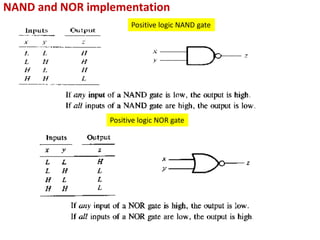
NAND and NOR implementation
Positive logic NAND gate
Positive logic NOR gate
Characteristics of digital IC
Used for the comparison of digital logic families
1. Fan-Out(loading)
 number of standard loads that can be connected to the
output of the gate without degrading its normal operation
 maximum number of inputs that can be connected to the
output of a gate
fan-out of the gate =
current source
current sink
High-level output
Low-level output
Example
fan-out of standard TTL is 10.
TTL gate can be connected to maximum of ten inputs of other gates in
the same logic family
Fan-in is a term that defines the maximum number of digital
inputs that a single logic gate can accept.
1. Fan-in
2. Power Dissipation
amount of power needed by the gate
power delivered to the gate from the power supply
Vcc - supply voltage
Icc - current drawn by the circuit
IccH- current drawn when output of the gate is in high-voltage level
IccL- current drawn when output of the gate is in low-voltage level
average current =
average power dissipation =
TTL NAND gate average power dissipation = 10 mW
four NAND gates dissipates a total of 10 x 4 = 40 mW.
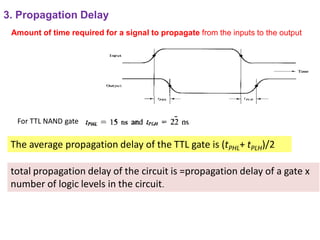
3. Propagation Delay
total propagation delay of the circuit is =propagation delay of a gate x
number of logic levels in the circuit.
Amount of time required for a signal to propagate from the inputs to the output
The average propagation delay of the TTL gate is (tPHL+ tPLH)/2
For TTL NAND gate
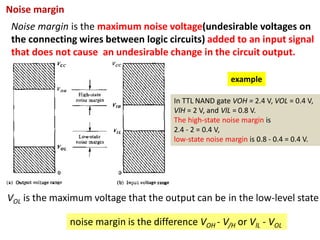
Noise margin is the maximum noise voltage(undesirable voltages on
the connecting wires between logic circuits) added to an input signal
that does not cause an undesirable change in the circuit output.
Noise margin
noise margin is the difference VOH - V/H or VlL - VOL
VOL is the maximum voltage that the output can be in the low-level state
example
In TTL NAND gate VOH = 2.4 V, VOL = 0.4 V,
VlH = 2 V, and VlL = 0.8 V.
The high-state noise margin is
2.4 - 2 = 0.4 V,
low-state noise margin is 0.8 - 0.4 = 0.4 V.
RTL Basic Gate
basic circuit of RTL family is NOR gate
0.2 V for the low level
1 to 3.6 V for the high level.
 If any one of the input(A or B or C) is high, the corresponding
transistor output will be low
 If all inputs are low, all transistors are cut off (VBE< 0.6 V). The
output of the circuit is high(VCC)
noise margin for low input
signal is 0.6 - 0.2 = 0.4 V
power dissipation-- 12 mW
propagation delay - 25 ns.
2. TRANSISTOR-TRANSISTOR LOGIC (TTL)
 most widely used family in the design of digital system(74 series)
 For comparing the various TTL series
speed-power product= propagation delay x power dissipation
types of output configuration
a. Open -collector output
b. Totem-pole output
c. Three-state (or tristate) output
designed with different resistor values to lower power dissipation and
higher speed
propagation delay decreases with decrease in storage time and RC time
constants
For lower resistances higher power dissipation
a. Open-Collector Output Gate
output
inputs
output high when Q 3 is off,
0.2 V for low level
2.4 to 5 V for high level.
Vcc is external to the IC package to pull the output to high voltage level when Q3 is off
otherwise, the output acts as an open circuit (output –low).
NAND gate
Used to drive a lamp or
relay
performing wired logic,
and for the construction of
a common-bus system.
Operation
If any one of the input is low, i.e A=0 or B=0 or C=0
Q1 is forward biased, The voltage across the base of Q2 is 0.9V
voltage need for Q3 to conduct is 1.8V.
Therefore Q3 is OFF, the voltage at the output Y is High
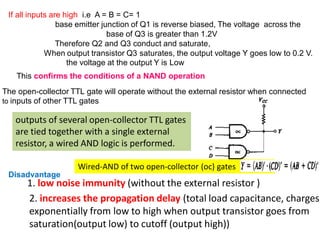
2. increases the propagation delay (total load capacitance, charges
exponentially from low to high when output transistor goes from
saturation(output low) to cutoff (output high))
Disadvantage
1. low noise immunity (without the external resistor )
If all inputs are high i.e A = B = C= 1
base emitter junction of Q1 is reverse biased, The voltage across the
base of Q3 is greater than 1.2V
Therefore Q2 and Q3 conduct and saturate,
When output transistor Q3 saturates, the output voltage Y goes low to 0.2 V.
the voltage at the output Y is Low
This confirms the conditions of a NAND operation
The open-collector TTL gate will operate without the external resistor when connected
to inputs of other TTL gates
outputs of several open-collector TTL gates
are tied together with a single external
resistor, a wired AND logic is performed.
Wired-AND of two open-collector (oc) gates
totem-pole output is the same as open-collector gate, except output
transistor Q4 and the diode DI.
B .Totem-pole output
Active pull-up circuit replacing the
passive pull-up resistor RL ,to reduce the
propagation delay .
totem-pole output - transistor Q4 "sits"
upon Q3.
Operation
If any one of the input is low, i.e A=0 or B=0 or C=0
Q1 is forward biased, The voltage across
the base of Q2 is 0.9V
voltage need for Q3 to conduct is 1.8V.
Therefore Q3 is OFF,
 . Q4 conducts because its base is connected to Vcc
 voltage at the output Y is High
 The reason for placing the diode in the circuit is to provide a diode drop in the
output path and thus ensure that Q4 is cut off when Q 3 is saturated
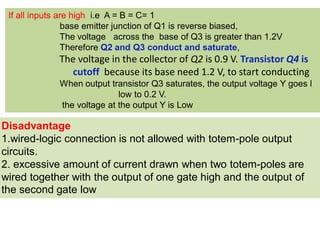
Disadvantage
1.wired-logic connection is not allowed with totem-pole output
circuits.
2. excessive amount of current drawn when two totem-poles are
wired together with the output of one gate high and the output of
the second gate low
If all inputs are high i.e A = B = C= 1
base emitter junction of Q1 is reverse biased,
The voltage across the base of Q3 is greater than 1.2V
Therefore Q2 and Q3 conduct and saturate,
The voltage in the collector of Q2 is 0.9 V. Transistor Q4 is
cutoff because its base need 1.2 V, to start conducting
When output transistor Q3 saturates, the output voltage Y goes l
low to 0.2 V.
the voltage at the output Y is Low
a special type of totem-pole gate that allows the wired
connection of outputs for the purpose of forming a common-bus
system
C. Three-state (or tristate) gate
three output states:
(1)a low-level state when the lower transistor in the totem-pole is on
and the upper transistor is off,
(2)a high-level state when the upper transistor in the totem-pole is on
and the lower transistor is off
(3) third state when both transistors in the totem-pole are off.
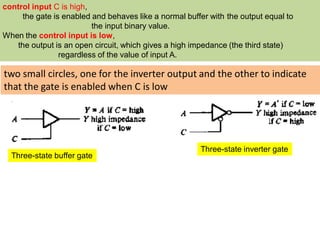
control input C is high,
the gate is enabled and behaves like a normal buffer with the output equal to
the input binary value.
When the control input is low,
the output is an open circuit, which gives a high impedance (the third state)
regardless of the value of input A.
Three-state buffer gate
Three-state inverter gate
two small circles, one for the inverter output and the other to indicate
that the gate is enabled when C is low
Three-state TTL gate
Transistors Q6, Q7, and Q8 associated with the control input form a circuit similar to the
open collector gate.
Transistors Q I-Q5, associated with the data input, form a totem-pole TTL circuit.
The two circuits are connected together through diode D 1.
When control input C is low , transistor Q8 turns off
diode DI is non- conducting,
transistor Q 8 has no effect on the operation of the gate
output Y depends only on the data input at A
When the control input is high, transistor Q 8 turns on,
current flowing from Vcc through diode D I causes transistor Q8 to
saturate.
The voltage at the base of Q 5 is equal to 0.9 V, turns off Q5 and Q4
low input to one of the emitters of Q I forces transistor Q3 and Q2 to
turn off.
both Q3 and Q4 in the totem-pole are turned off and the output of the
circuit behaves like an open circuit with a very high output
Emitter Coupled Logic (ECL)
 fastest of all digital logic families
 high-speed operation is achieved By preventing the transistor from entering
into saturation.
 Very small voltage swing is necessary to switch between the two different
voltage levels. This cannot be achieved in TTL, as the transistors enter into
saturation mode, while in operation.
2-input ECL circuit
-0.8 V for high
-1.8 V for low state
Advantages
Outputs provide both the OR and NOR functions
Each input is connected to the base of a transistor.
circuit consists of a differential amplifier,
a temperature· and voltage· compensated bias network,
and an emitter follower output.
emitter outputs require a pull·down resistor(input resistor) for current to flow
If any input is high, the corresponding transistor is turned on and Q 5 is
turned off
. The current in resistor RC2 flows into the base of Q8 (provided there is
a load resistor).
This current is so small that only a negligible voltage drop occurs across
RC2
The OR output of the gate is high state.
The current flowing through RCI and the conducting transistor causes a
low state at the NOR output
Operation
If all inputs are at low level, the corresponding transistor is turned OFF
and Q 5 is turned ON
RC2 draws current through Q 5 that make the OR output to
low level
current in RCI is negligible and the NOR output is at high level.
 It has noise immunity worst compare to both TTL and CMOS.
 It has power per gate of about 4 to 55 mW. This power consumption
figure is higher compare to both TTL and CMOS
Disadvantages
CMOS(COMPLEMENTARY METAL OXIDE SEMICONDUCTOR)
 both n-channel and p-channel devices can be fabricated on the
same substrate
 basic circuit is the inverter - consists of one p-channel transistor and
one n -channel transistor
Inverter
n-channel MOS conducts when its gate-to-source voltage is positive
The p-channel MOS conducts when its gate-to-source voltage is
negative.
Either type of device is turned off if its gate-to-source voltage is
zero
When the input is low, both gates arc at zero potential.
p-channel device is turned on and the n-channel device is turned off.
a low-impedance path from VDD to the output and a very high-impedance
path from output to ground.
output voltage approaches the high level
When the input is high, both gates are at VDD
The p-channel device is off and the n-channel device is on.
The output approaches the low level of 0 V.
 NAND gate consists of two p-type units in parallel
and two n-type units in series,
 If all inputs are high, both p-channel transistors
turn off and both n-channel transistors turn on.
 The output has a low impedance to ground and
produces a low state.
 If any input is low, the associated n-channel
transistor is turned off and the associated p-
channel transistor is turned on.
 The output is coupled to VDD and goes to the high
state.
NAND gate
NOR gate
NOR gate consists of two n-type units in parallel
and two p-type units in series
 When all inputs are low, both p-channel units
are on and both n-channel units are off.
 The output is coupled to VDD and goes to the
high state.
 If any input is high, the associated p-channel
transistor is turned off and the associated n-
channel transistor turns on.
 This connects the output to ground, causing a
low level output.
power dissipation is very low(always an off transistor in the current
path when the state of the circuit is not changing.)
reduces the propagation delay time and improves the noise margin,
The fan-out decreases with increase in frequency of operation
fabrication process is simpler than TTL
provides a greater packing density. more circuits can be placed on a
given area of silicon
Advantages
Basic memory structure
Primary memory(RAM and ROM)
Secondary memory(hard drive,CD,etc.).
Types of memory in Digital system
Memory unit: A device to which binary information is stored(write), and
from which information is retrieved(read) when needed for processing.
 memory unit is a collection of cells capable of storing a large
quantity of binary information
1. Read‐Only Memory (ROM).
2. Random‐Access Memory (RAM)
Read-only memory (ROM)
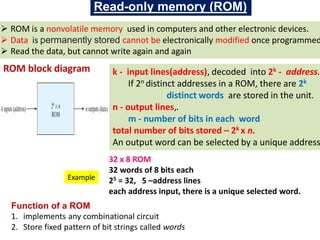
ROM block diagram k - input lines(address), decoded into 2k - address.
If 2n distinct addresses in a ROM, there are 2k
distinct words are stored in the unit.
n - output lines,.
m - number of bits in each word
total number of bits stored – 2k x n.
An output word can be selected by a unique address
32 x 8 ROM
32 words of 8 bits each
25 = 32, 5 –address lines
each address input, there is a unique selected word.
 ROM is a nonvolatile memory used in computers and other electronic devices.
 Data is permanently stored cannot be electronically modified once programmed
 Read the data, but cannot write again and again
Example
Function of a ROM
1. implements any combinational circuit
2. Store fixed pattern of bit strings called words
32 x 8 ROM
The blowing of the fuses is referred to as programming the ROM
Construction of ROM
 ROM includes both decoder and the OR gates within a single IC
package.
 k address lines are decoded in to 2k words. Each word is connected to
n output lines through OR gate and fuses
32 x 4 ROM
Types of ROMs
Programming ways of ROM
 Mask programming
-done by the manufacturer during fabrication process
- makes the corresponding mask for the paths to produce the I's and 0's
according to the customer's truth table.
- economical only if large quantities are to be manufactured.
 Programmable read-only memory
- allows the user to program the unit in the laboratory after
manufacturing
-more economical
1.Programmable read-only memory
2. EPROM (Erasable Programmable read only
memory)
3. EEPROM (Electrically erasable
programmable read only memory)
1. Programmable read-only memory
 fuses in the PROM are blown by application of current pulses through
the output terminals.
 A blown fuse defines one binary state and an unbroken link
represents the other state.
 It can be programmed by user. Once programmed, the data and
instructions in it cannot be changed.
The process of programming the PROM is called as burning the
PROM
 procedures for programming ROMs are hardware procedures, which
is irreversible
 non-volatile memory(retain the data even if there is no power)
 The data can be erased and reprogrammed by ultra violet light exposure for a
given length of time.
 The data on EPROM can be erased a limited number of times because excessive
erasing damages the silicon dioxide layer
2. EPROM (Erasable Programmable read only memory)
 previously programmed connections can be erased with an electrical signal
without removing it from its socket
3.EEPROM (Electrically erasable programmable read only memory)
S.NO PROM EPROM
1
Programmable read only
memory
Erasable Programmable read
only memory
2.
Non volatile
not reusable.
Non volatile
reusable multiple times.
3. inexpensive. costlier than PROM.
4.
irreversible, it’s memory is
permanent.
processes can be reversed.
5.
flexibility and scalable than
EPROM.
less flexibility and scalability.
Programmable Logic Devices
1.SPLDs (Simple Programmable Logic Devices)
ROM (Read-Only Memory)
PLA (Programmable Logic Array)
PAL (Programmable Array Logic)
2. HCPLD (High Capacity Programmable Logic Device)
FPGA (Field-Programmable Gate Array)
electronic component used to
build reconfigurable digital circuits.
classification
Combinational Logic Implementation using ROM
1.Implement the following Boolean function using ROM
Example . 1
solution
1.Write the Boolean
expression for output
2. ROM programming
ROM with AND-OR gates
8 x 2 ROM
ROM with AND-OR-INVERT gates
(product of sum)
ROM with AND-OR gates
(sum of product )
4 x 2 ROM
2.Design a combinational circuit using a ROM. The circuit accepts a 3-bit number and
generates an output binary number equal to the square of the input number
Example . 2
solution 1.Write the Truth & Boolean expression for output
B0 = A0
B1 = 0
Need 4 output lines
B2 to B5
ROM size 8 x 4
ROM truth table
ROM implementation
PROGRAMMABLE LOGIC ARRAY (PLA)
 PAL is similar to PROM(OR array –programmed) except
decoder(array of AND gates) can be programmed to generate the
required Boolean functions(minterms)
 AND and OR gates inside the PLA are initially fabricated with fuses
 Boolean functions are implemented in sum of products form by
blowing appropriate fuses and leaving the desired connections
PLA block diagram
size of the PLA =number of inputs, the number of product terms, and
the number of outputs
size =n x k x m
Internal structure of PLA
size =3 x 3 x 2
Both the true value and the complement of each function should be
simplified
Simplified function is expressed with fewer product terms and which
one provides product terms that are common to other functions
The output is inverted when the complement of the function is
implemented
The output does not complemented when true value of the function is
connected
Procedure for Boolean function implementation
Each input and its complement are connected through fuses to the
inputs of all AND gates.
outputs of the AND gates are connected through fuses to each input
of the OR gates.
Boolean functions are programmed by blowing selected fuses and
leaving others(unbroken)
Two more fuses are provided with the output inverters.
Implement the following two Boolean functions with a PLA
Example . 1
Step. 1- true value and the complement of the functions are simplified into
sum‐of‐products form.
solution
combination that gives minimum
number of product terms
Step. 2
𝐹1 ′ and 𝐹2
Form PLA programming table
Step. 3
PLA programming table
Form PLA programming table
Step. 3
F2
F1’ F1
PROGRAMMABLE ARRAY LOGIC(array logic)(PAL)
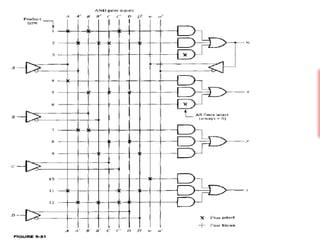
Device with a fixed OR array and a programmable AND array
easier to program, but not flexible as PLA
array logic symbols for a multiple-input AND gate
Conventional symbol
Array logic symbol
Three wide, indicate there are three programmable AND gates in each
section
 PAL integrated circuit may have eight inputs, eight outputs, and eight
sections, each consisting of an eight‐wide AND–OR array.
 The output terminals are sometimes connected to inverters.
typical PAL with four inputs and four outputs
Three wide
Implement the following Boolean functions with a PAL
Example . 1
solution
Simplifying the four functions to a minimum number of terms
Step. 1
Form the PAL programming table
Step. 2
Comparison between PLA and PAL

MEMORY DEVICES AND DIGITAL INTEGRATED CIRCUITS

  • 1.
  • 2.
    • UNIT VMEMORY DEVICES AND DIGITAL INTEGRATED CIRCUITS • Logic families- Propagation Delay, Fan - In and Fan - Out - Noise Margin - RTL ,TTL,ECL, CMOS - Comparison of Logic families - Implementation of combinational logic/sequential logic design using standard ICs, PROM, PLA and PAL, basic memory, static ROM,PROM,EPROM,EEPROM EAPROM.
  • 3.
    • Construct logicgates and use programmable devices for digital applications Course Outcomes
  • 4.
    Digital integrated circuits RTL-Resistor-transistorlogic DTL-Diode-transistor logic TTL-Transistor-transistor logic ECL-Emitter-coupled logic MOS-Metal-oxide semiconductor CMOS-Complementary metal-oxide semiconductor IC digital logic families IC - integrated circuit  Assembly of electronic components, fabricated as a single unit  combination of diodes, and transistors in a minimized form Types of IC 1. Analog IC- Circuits deals with continuous analog signals 2. Digital IC-l Circuits deals with discrete digital signals
  • 5.
    NAND and NORimplementation Positive logic NAND gate Positive logic NOR gate
  • 6.
    Characteristics of digitalIC Used for the comparison of digital logic families 1. Fan-Out(loading)  number of standard loads that can be connected to the output of the gate without degrading its normal operation  maximum number of inputs that can be connected to the output of a gate fan-out of the gate = current source current sink High-level output Low-level output
  • 7.
    Example fan-out of standardTTL is 10. TTL gate can be connected to maximum of ten inputs of other gates in the same logic family Fan-in is a term that defines the maximum number of digital inputs that a single logic gate can accept. 1. Fan-in
  • 8.
    2. Power Dissipation amountof power needed by the gate power delivered to the gate from the power supply Vcc - supply voltage Icc - current drawn by the circuit IccH- current drawn when output of the gate is in high-voltage level IccL- current drawn when output of the gate is in low-voltage level average current = average power dissipation = TTL NAND gate average power dissipation = 10 mW four NAND gates dissipates a total of 10 x 4 = 40 mW.
  • 9.
    3. Propagation Delay totalpropagation delay of the circuit is =propagation delay of a gate x number of logic levels in the circuit. Amount of time required for a signal to propagate from the inputs to the output The average propagation delay of the TTL gate is (tPHL+ tPLH)/2 For TTL NAND gate
  • 10.
    Noise margin isthe maximum noise voltage(undesirable voltages on the connecting wires between logic circuits) added to an input signal that does not cause an undesirable change in the circuit output. Noise margin noise margin is the difference VOH - V/H or VlL - VOL VOL is the maximum voltage that the output can be in the low-level state example In TTL NAND gate VOH = 2.4 V, VOL = 0.4 V, VlH = 2 V, and VlL = 0.8 V. The high-state noise margin is 2.4 - 2 = 0.4 V, low-state noise margin is 0.8 - 0.4 = 0.4 V.
  • 11.
    RTL Basic Gate basiccircuit of RTL family is NOR gate 0.2 V for the low level 1 to 3.6 V for the high level.  If any one of the input(A or B or C) is high, the corresponding transistor output will be low  If all inputs are low, all transistors are cut off (VBE< 0.6 V). The output of the circuit is high(VCC) noise margin for low input signal is 0.6 - 0.2 = 0.4 V power dissipation-- 12 mW propagation delay - 25 ns.
  • 12.
    2. TRANSISTOR-TRANSISTOR LOGIC(TTL)  most widely used family in the design of digital system(74 series)  For comparing the various TTL series speed-power product= propagation delay x power dissipation types of output configuration a. Open -collector output b. Totem-pole output c. Three-state (or tristate) output designed with different resistor values to lower power dissipation and higher speed propagation delay decreases with decrease in storage time and RC time constants For lower resistances higher power dissipation
  • 13.
    a. Open-Collector OutputGate output inputs output high when Q 3 is off, 0.2 V for low level 2.4 to 5 V for high level. Vcc is external to the IC package to pull the output to high voltage level when Q3 is off otherwise, the output acts as an open circuit (output –low). NAND gate Used to drive a lamp or relay performing wired logic, and for the construction of a common-bus system. Operation If any one of the input is low, i.e A=0 or B=0 or C=0 Q1 is forward biased, The voltage across the base of Q2 is 0.9V voltage need for Q3 to conduct is 1.8V. Therefore Q3 is OFF, the voltage at the output Y is High
  • 14.
    2. increases thepropagation delay (total load capacitance, charges exponentially from low to high when output transistor goes from saturation(output low) to cutoff (output high)) Disadvantage 1. low noise immunity (without the external resistor ) If all inputs are high i.e A = B = C= 1 base emitter junction of Q1 is reverse biased, The voltage across the base of Q3 is greater than 1.2V Therefore Q2 and Q3 conduct and saturate, When output transistor Q3 saturates, the output voltage Y goes low to 0.2 V. the voltage at the output Y is Low This confirms the conditions of a NAND operation The open-collector TTL gate will operate without the external resistor when connected to inputs of other TTL gates outputs of several open-collector TTL gates are tied together with a single external resistor, a wired AND logic is performed. Wired-AND of two open-collector (oc) gates
  • 15.
    totem-pole output isthe same as open-collector gate, except output transistor Q4 and the diode DI. B .Totem-pole output Active pull-up circuit replacing the passive pull-up resistor RL ,to reduce the propagation delay . totem-pole output - transistor Q4 "sits" upon Q3. Operation If any one of the input is low, i.e A=0 or B=0 or C=0 Q1 is forward biased, The voltage across the base of Q2 is 0.9V voltage need for Q3 to conduct is 1.8V. Therefore Q3 is OFF,  . Q4 conducts because its base is connected to Vcc  voltage at the output Y is High  The reason for placing the diode in the circuit is to provide a diode drop in the output path and thus ensure that Q4 is cut off when Q 3 is saturated
  • 16.
    Disadvantage 1.wired-logic connection isnot allowed with totem-pole output circuits. 2. excessive amount of current drawn when two totem-poles are wired together with the output of one gate high and the output of the second gate low If all inputs are high i.e A = B = C= 1 base emitter junction of Q1 is reverse biased, The voltage across the base of Q3 is greater than 1.2V Therefore Q2 and Q3 conduct and saturate, The voltage in the collector of Q2 is 0.9 V. Transistor Q4 is cutoff because its base need 1.2 V, to start conducting When output transistor Q3 saturates, the output voltage Y goes l low to 0.2 V. the voltage at the output Y is Low
  • 17.
    a special typeof totem-pole gate that allows the wired connection of outputs for the purpose of forming a common-bus system C. Three-state (or tristate) gate three output states: (1)a low-level state when the lower transistor in the totem-pole is on and the upper transistor is off, (2)a high-level state when the upper transistor in the totem-pole is on and the lower transistor is off (3) third state when both transistors in the totem-pole are off.
  • 18.
    control input Cis high, the gate is enabled and behaves like a normal buffer with the output equal to the input binary value. When the control input is low, the output is an open circuit, which gives a high impedance (the third state) regardless of the value of input A. Three-state buffer gate Three-state inverter gate two small circles, one for the inverter output and the other to indicate that the gate is enabled when C is low
  • 19.
  • 20.
    Transistors Q6, Q7,and Q8 associated with the control input form a circuit similar to the open collector gate. Transistors Q I-Q5, associated with the data input, form a totem-pole TTL circuit. The two circuits are connected together through diode D 1. When control input C is low , transistor Q8 turns off diode DI is non- conducting, transistor Q 8 has no effect on the operation of the gate output Y depends only on the data input at A When the control input is high, transistor Q 8 turns on, current flowing from Vcc through diode D I causes transistor Q8 to saturate. The voltage at the base of Q 5 is equal to 0.9 V, turns off Q5 and Q4 low input to one of the emitters of Q I forces transistor Q3 and Q2 to turn off. both Q3 and Q4 in the totem-pole are turned off and the output of the circuit behaves like an open circuit with a very high output
  • 21.
    Emitter Coupled Logic(ECL)  fastest of all digital logic families  high-speed operation is achieved By preventing the transistor from entering into saturation.  Very small voltage swing is necessary to switch between the two different voltage levels. This cannot be achieved in TTL, as the transistors enter into saturation mode, while in operation. 2-input ECL circuit -0.8 V for high -1.8 V for low state Advantages
  • 22.
    Outputs provide boththe OR and NOR functions Each input is connected to the base of a transistor. circuit consists of a differential amplifier, a temperature· and voltage· compensated bias network, and an emitter follower output. emitter outputs require a pull·down resistor(input resistor) for current to flow If any input is high, the corresponding transistor is turned on and Q 5 is turned off . The current in resistor RC2 flows into the base of Q8 (provided there is a load resistor). This current is so small that only a negligible voltage drop occurs across RC2 The OR output of the gate is high state. The current flowing through RCI and the conducting transistor causes a low state at the NOR output Operation
  • 23.
    If all inputsare at low level, the corresponding transistor is turned OFF and Q 5 is turned ON RC2 draws current through Q 5 that make the OR output to low level current in RCI is negligible and the NOR output is at high level.  It has noise immunity worst compare to both TTL and CMOS.  It has power per gate of about 4 to 55 mW. This power consumption figure is higher compare to both TTL and CMOS Disadvantages
  • 24.
    CMOS(COMPLEMENTARY METAL OXIDESEMICONDUCTOR)  both n-channel and p-channel devices can be fabricated on the same substrate  basic circuit is the inverter - consists of one p-channel transistor and one n -channel transistor Inverter n-channel MOS conducts when its gate-to-source voltage is positive The p-channel MOS conducts when its gate-to-source voltage is negative. Either type of device is turned off if its gate-to-source voltage is zero When the input is low, both gates arc at zero potential. p-channel device is turned on and the n-channel device is turned off. a low-impedance path from VDD to the output and a very high-impedance path from output to ground. output voltage approaches the high level When the input is high, both gates are at VDD The p-channel device is off and the n-channel device is on. The output approaches the low level of 0 V.
  • 25.
     NAND gateconsists of two p-type units in parallel and two n-type units in series,  If all inputs are high, both p-channel transistors turn off and both n-channel transistors turn on.  The output has a low impedance to ground and produces a low state.  If any input is low, the associated n-channel transistor is turned off and the associated p- channel transistor is turned on.  The output is coupled to VDD and goes to the high state. NAND gate NOR gate NOR gate consists of two n-type units in parallel and two p-type units in series  When all inputs are low, both p-channel units are on and both n-channel units are off.  The output is coupled to VDD and goes to the high state.  If any input is high, the associated p-channel transistor is turned off and the associated n- channel transistor turns on.  This connects the output to ground, causing a low level output.
  • 26.
    power dissipation isvery low(always an off transistor in the current path when the state of the circuit is not changing.) reduces the propagation delay time and improves the noise margin, The fan-out decreases with increase in frequency of operation fabrication process is simpler than TTL provides a greater packing density. more circuits can be placed on a given area of silicon Advantages
  • 27.
    Basic memory structure Primarymemory(RAM and ROM) Secondary memory(hard drive,CD,etc.). Types of memory in Digital system Memory unit: A device to which binary information is stored(write), and from which information is retrieved(read) when needed for processing.  memory unit is a collection of cells capable of storing a large quantity of binary information 1. Read‐Only Memory (ROM). 2. Random‐Access Memory (RAM)
  • 29.
    Read-only memory (ROM) ROMblock diagram k - input lines(address), decoded into 2k - address. If 2n distinct addresses in a ROM, there are 2k distinct words are stored in the unit. n - output lines,. m - number of bits in each word total number of bits stored – 2k x n. An output word can be selected by a unique address 32 x 8 ROM 32 words of 8 bits each 25 = 32, 5 –address lines each address input, there is a unique selected word.  ROM is a nonvolatile memory used in computers and other electronic devices.  Data is permanently stored cannot be electronically modified once programmed  Read the data, but cannot write again and again Example Function of a ROM 1. implements any combinational circuit 2. Store fixed pattern of bit strings called words
  • 30.
    32 x 8ROM The blowing of the fuses is referred to as programming the ROM Construction of ROM  ROM includes both decoder and the OR gates within a single IC package.  k address lines are decoded in to 2k words. Each word is connected to n output lines through OR gate and fuses
  • 31.
    32 x 4ROM
  • 32.
    Types of ROMs Programmingways of ROM  Mask programming -done by the manufacturer during fabrication process - makes the corresponding mask for the paths to produce the I's and 0's according to the customer's truth table. - economical only if large quantities are to be manufactured.  Programmable read-only memory - allows the user to program the unit in the laboratory after manufacturing -more economical 1.Programmable read-only memory 2. EPROM (Erasable Programmable read only memory) 3. EEPROM (Electrically erasable programmable read only memory)
  • 33.
    1. Programmable read-onlymemory  fuses in the PROM are blown by application of current pulses through the output terminals.  A blown fuse defines one binary state and an unbroken link represents the other state.  It can be programmed by user. Once programmed, the data and instructions in it cannot be changed. The process of programming the PROM is called as burning the PROM  procedures for programming ROMs are hardware procedures, which is irreversible
  • 34.
     non-volatile memory(retainthe data even if there is no power)  The data can be erased and reprogrammed by ultra violet light exposure for a given length of time.  The data on EPROM can be erased a limited number of times because excessive erasing damages the silicon dioxide layer 2. EPROM (Erasable Programmable read only memory)  previously programmed connections can be erased with an electrical signal without removing it from its socket 3.EEPROM (Electrically erasable programmable read only memory) S.NO PROM EPROM 1 Programmable read only memory Erasable Programmable read only memory 2. Non volatile not reusable. Non volatile reusable multiple times. 3. inexpensive. costlier than PROM. 4. irreversible, it’s memory is permanent. processes can be reversed. 5. flexibility and scalable than EPROM. less flexibility and scalability.
  • 35.
    Programmable Logic Devices 1.SPLDs(Simple Programmable Logic Devices) ROM (Read-Only Memory) PLA (Programmable Logic Array) PAL (Programmable Array Logic) 2. HCPLD (High Capacity Programmable Logic Device) FPGA (Field-Programmable Gate Array) electronic component used to build reconfigurable digital circuits. classification
  • 36.
    Combinational Logic Implementationusing ROM 1.Implement the following Boolean function using ROM Example . 1 solution 1.Write the Boolean expression for output 2. ROM programming ROM with AND-OR gates 8 x 2 ROM
  • 37.
    ROM with AND-OR-INVERTgates (product of sum) ROM with AND-OR gates (sum of product ) 4 x 2 ROM
  • 38.
    2.Design a combinationalcircuit using a ROM. The circuit accepts a 3-bit number and generates an output binary number equal to the square of the input number Example . 2 solution 1.Write the Truth & Boolean expression for output B0 = A0 B1 = 0 Need 4 output lines B2 to B5 ROM size 8 x 4 ROM truth table ROM implementation
  • 39.
    PROGRAMMABLE LOGIC ARRAY(PLA)  PAL is similar to PROM(OR array –programmed) except decoder(array of AND gates) can be programmed to generate the required Boolean functions(minterms)  AND and OR gates inside the PLA are initially fabricated with fuses  Boolean functions are implemented in sum of products form by blowing appropriate fuses and leaving the desired connections PLA block diagram size of the PLA =number of inputs, the number of product terms, and the number of outputs size =n x k x m
  • 40.
    Internal structure ofPLA size =3 x 3 x 2
  • 41.
    Both the truevalue and the complement of each function should be simplified Simplified function is expressed with fewer product terms and which one provides product terms that are common to other functions The output is inverted when the complement of the function is implemented The output does not complemented when true value of the function is connected Procedure for Boolean function implementation Each input and its complement are connected through fuses to the inputs of all AND gates. outputs of the AND gates are connected through fuses to each input of the OR gates. Boolean functions are programmed by blowing selected fuses and leaving others(unbroken) Two more fuses are provided with the output inverters.
  • 42.
    Implement the followingtwo Boolean functions with a PLA Example . 1 Step. 1- true value and the complement of the functions are simplified into sum‐of‐products form. solution combination that gives minimum number of product terms Step. 2 𝐹1 ′ and 𝐹2 Form PLA programming table Step. 3 PLA programming table
  • 43.
    Form PLA programmingtable Step. 3 F2 F1’ F1
  • 44.
    PROGRAMMABLE ARRAY LOGIC(arraylogic)(PAL) Device with a fixed OR array and a programmable AND array easier to program, but not flexible as PLA array logic symbols for a multiple-input AND gate Conventional symbol Array logic symbol Three wide, indicate there are three programmable AND gates in each section  PAL integrated circuit may have eight inputs, eight outputs, and eight sections, each consisting of an eight‐wide AND–OR array.  The output terminals are sometimes connected to inverters.
  • 45.
    typical PAL withfour inputs and four outputs Three wide
  • 46.
    Implement the followingBoolean functions with a PAL Example . 1 solution Simplifying the four functions to a minimum number of terms Step. 1 Form the PAL programming table Step. 2
  • 49.