Liquid Crystal
Types and Applications
Liquid Crystal
• Some organic molecules do not melt to give liquid directly
• They pass through intermediate state known as ‘liquid crystal state’
• These substance have long rod-shaped molecules
• E.g. p-oxyanisole
• Liquid crystal have structure between liquid and crystalline solid.
• As Liquid molecules can move randomly and solid crystal have ordered and fixed
arrangement while liquid crystals are arranged parallel to each other and they
can flow.
• Hence, liquid crystals have fluidity of liquid and optical property of solid
Types of liquid crystals
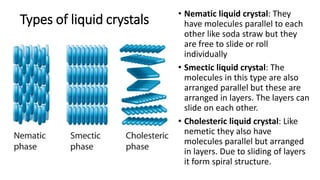
• Nematic liquid crystal: They
have molecules parallel to each
other like soda straw but they
are free to slide or roll
individually
• Smectic liquid crystal: The
molecules in this type are also
arranged parallel but these are
arranged in layers. The layers can
slide on each other.
• Cholesteric liquid crystal: Like
nemetic they also have
molecules parallel but arranged
in layers. Due to sliding of layers
it form spiral structure.
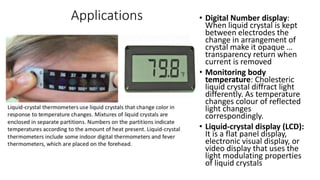
Applications • Digital Number display:
When liquid crystal is kept
between electrodes the
change in arrangement of
crystal make it opaque …
transparency return when
current is removed
• Monitoring body
temperature: Cholesteric
liquid crystal diffract light
differently. As temperature
changes colour of reflected
light changes
correspondingly.
• Liquid-crystal display (LCD):
It is a flat panel display,
electronic visual display, or
video display that uses the
light modulating properties
of liquid crystals
Reference
• Essentials of Physical Chemistry by Arun Bahl , BS Bahl and GD Tuli

Liquid crystal SB

  • 1.
  • 2.
    Liquid Crystal • Someorganic molecules do not melt to give liquid directly • They pass through intermediate state known as ‘liquid crystal state’ • These substance have long rod-shaped molecules • E.g. p-oxyanisole • Liquid crystal have structure between liquid and crystalline solid. • As Liquid molecules can move randomly and solid crystal have ordered and fixed arrangement while liquid crystals are arranged parallel to each other and they can flow. • Hence, liquid crystals have fluidity of liquid and optical property of solid
  • 3.
    Types of liquidcrystals • Nematic liquid crystal: They have molecules parallel to each other like soda straw but they are free to slide or roll individually • Smectic liquid crystal: The molecules in this type are also arranged parallel but these are arranged in layers. The layers can slide on each other. • Cholesteric liquid crystal: Like nemetic they also have molecules parallel but arranged in layers. Due to sliding of layers it form spiral structure.
  • 4.
    Applications • DigitalNumber display: When liquid crystal is kept between electrodes the change in arrangement of crystal make it opaque … transparency return when current is removed • Monitoring body temperature: Cholesteric liquid crystal diffract light differently. As temperature changes colour of reflected light changes correspondingly. • Liquid-crystal display (LCD): It is a flat panel display, electronic visual display, or video display that uses the light modulating properties of liquid crystals
  • 5.
    Reference • Essentials ofPhysical Chemistry by Arun Bahl , BS Bahl and GD Tuli