Liquid crystals (LCs)
are a state of matter that
have properties
between those of a
conventional liquid and
those of a solid crystal.
Yerra Bharath
G V S R Pavan Kumar
History
In 1888, Austrian botanical
physiologist Friedrich Reinitzer,
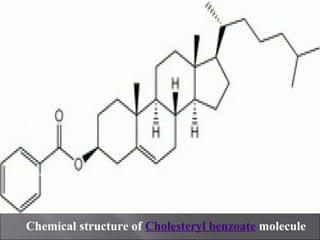
examined that Cholesteryl benzoate
had two distinct melting points.
145.5 °C (293.9 °F) it melts into a
cloudy liquid, and at 178.5 °C
(353.3 °F) ) it melts again and the
cloudy liquid becomes clear.
C
molecule
Chemical structure of Cholesteryl benzoate molecule
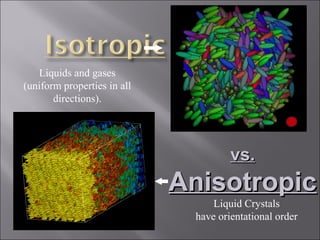
vs.vs.
AnisotropicAnisotropic
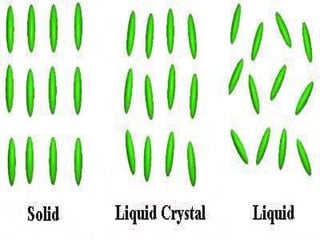
Liquids and gases
(uniform properties in all
directions).
Liquid Crystals
have orientational order
 Liquid crystals are highly
anisotropic fluids that exists
between the solid and
liquid phases.
 This dual physical
properties is referred to as
mesomorpism.
Characteristics of liquid crystals
1. Positional order
2. Orientational order
3. Bond orientational order
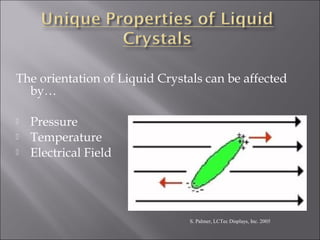
The orientation of Liquid Crystals can be affected
by…
 Pressure
 Temperature
 Electrical Field
S. Palmer, LCTec Displays, Inc. 2005
Classification
Based on breaking order of the solid
state
1. Thermotropic liquid
crystals
2. Lyotropic liquid crystals
Thermotropic phases are
those that occur in a certain
temperature range.
Types
1. Nematic
2. Cholesteric (Chiral
Nematic)
3. Smectic
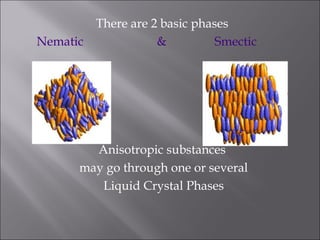
There are 2 basic phases
Nematic & Smectic
Anisotropic substances
may go through one or several
Liquid Crystal Phases
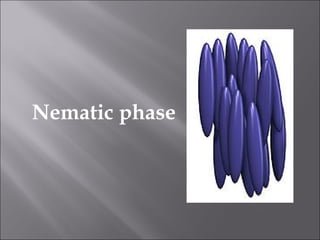
Nematic phase
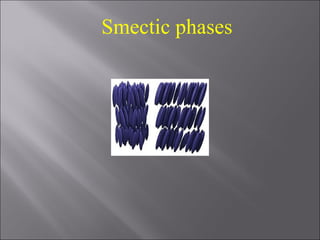
Smectic phases
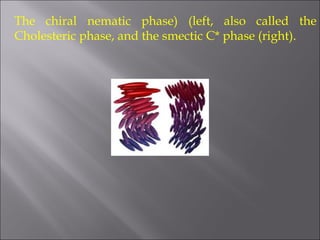
The chiral nematic phase) (left, also called the
Cholesteric phase, and the smectic C* phase (right).
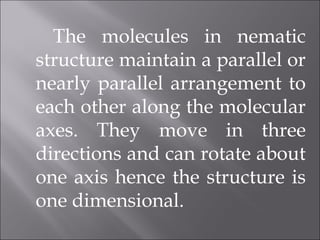
The molecules in nematic
structure maintain a parallel or
nearly parallel arrangement to
each other along the molecular
axes. They move in three
directions and can rotate about
one axis hence the structure is
one dimensional.
Cholesteric (Chiral Nematic)
It is modification of nematic
liquid crystal because many
compounds of this are
derivatives of cholesterol
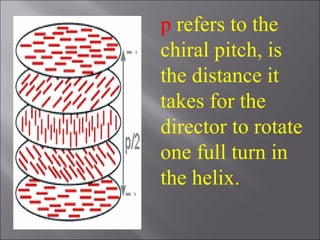
p refers to the
chiral pitch, is
the distance it
takes for the
director to rotate
one full turn in
the helix.
Smectic
The molecules in this phase show
a degree of translational order
which was not present in the
nematic.
Nearly 8 to 9 smetic phases are
labeled by alphabets.
Lyotropic liquid crystals
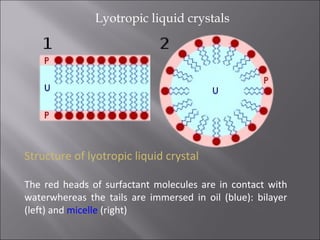
Structure of lyotropic liquid crystal
The red heads of surfactant molecules are in contact with
waterwhereas the tails are immersed in oil (blue): bilayer
(left) and micelle (right)
A lyotropic liquid crystal exhibit liquid-
crystalline properties in certain
concentration ranges.
Many amphiphilic molecules show
lyotropic liquid-crystalline phase
Examples:
1. Sodium laurate in water
2. Dhosphatidly Choline in water.
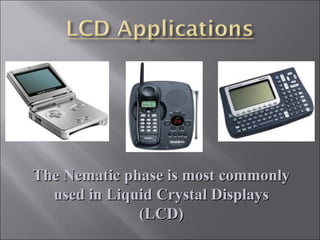
The Nematic phase is most commonlyThe Nematic phase is most commonly
used in Liquid Crystal Displaysused in Liquid Crystal Displays
(LCD)(LCD)
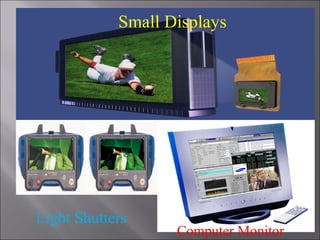
Computer Monitor
Light Shutters
Small Displays
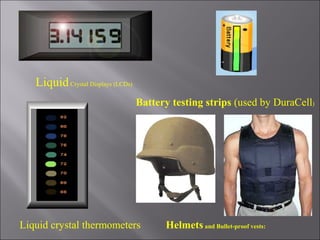
LiquidCrystal Displays (LCDs)
Liquid crystal thermometers Helmetsand Bullet-proof vests:
Battery testing strips (used by DuraCell)

Liquid crystals

  • 1.
    Liquid crystals (LCs) area state of matter that have properties between those of a conventional liquid and those of a solid crystal.
  • 2.
    Yerra Bharath G VS R Pavan Kumar
  • 4.
    History In 1888, Austrianbotanical physiologist Friedrich Reinitzer, examined that Cholesteryl benzoate had two distinct melting points. 145.5 °C (293.9 °F) it melts into a cloudy liquid, and at 178.5 °C (353.3 °F) ) it melts again and the cloudy liquid becomes clear.
  • 5.
    C molecule Chemical structure ofCholesteryl benzoate molecule
  • 6.
    vs.vs. AnisotropicAnisotropic Liquids and gases (uniformproperties in all directions). Liquid Crystals have orientational order
  • 7.
     Liquid crystalsare highly anisotropic fluids that exists between the solid and liquid phases.  This dual physical properties is referred to as mesomorpism.
  • 8.
    Characteristics of liquidcrystals 1. Positional order 2. Orientational order 3. Bond orientational order
  • 9.
    The orientation ofLiquid Crystals can be affected by…  Pressure  Temperature  Electrical Field S. Palmer, LCTec Displays, Inc. 2005
  • 10.
    Classification Based on breakingorder of the solid state 1. Thermotropic liquid crystals 2. Lyotropic liquid crystals
  • 11.
    Thermotropic phases are thosethat occur in a certain temperature range. Types 1. Nematic 2. Cholesteric (Chiral Nematic) 3. Smectic
  • 12.
    There are 2basic phases Nematic & Smectic Anisotropic substances may go through one or several Liquid Crystal Phases
  • 13.
  • 14.
  • 15.
    The chiral nematicphase) (left, also called the Cholesteric phase, and the smectic C* phase (right).
  • 16.
    The molecules innematic structure maintain a parallel or nearly parallel arrangement to each other along the molecular axes. They move in three directions and can rotate about one axis hence the structure is one dimensional.
  • 17.
    Cholesteric (Chiral Nematic) Itis modification of nematic liquid crystal because many compounds of this are derivatives of cholesterol
  • 18.
    p refers tothe chiral pitch, is the distance it takes for the director to rotate one full turn in the helix.
  • 19.
    Smectic The molecules inthis phase show a degree of translational order which was not present in the nematic. Nearly 8 to 9 smetic phases are labeled by alphabets.
  • 20.
    Lyotropic liquid crystals Structureof lyotropic liquid crystal The red heads of surfactant molecules are in contact with waterwhereas the tails are immersed in oil (blue): bilayer (left) and micelle (right)
  • 21.
    A lyotropic liquidcrystal exhibit liquid- crystalline properties in certain concentration ranges. Many amphiphilic molecules show lyotropic liquid-crystalline phase Examples: 1. Sodium laurate in water 2. Dhosphatidly Choline in water.
  • 22.
    The Nematic phaseis most commonlyThe Nematic phase is most commonly used in Liquid Crystal Displaysused in Liquid Crystal Displays (LCD)(LCD)
  • 23.
  • 25.
    LiquidCrystal Displays (LCDs) Liquidcrystal thermometers Helmetsand Bullet-proof vests: Battery testing strips (used by DuraCell)

Editor's Notes

  • #7 Do not follow patterns, Some phases are combined and orientation is NOT the only way to characterize