TOPIC:
LIQUID CRYSTALS
Mudassir malik
LEARNING OBJECTIVES
 History
 The structures of liquid crystals
 The different types of liquid crystal and their arrangement
 Properties of liquid crystal
 Applications of liquid crystals
 Conclusion
States of matters
 Solid
 Liquid
 Gas
 Liquid crystals
Solid
 All solids have fix shape, fix volume, ductile
and high melting and boiling point.
 It is due to solids have high attractive forces
among the atoms and molecules which holds
the atoms together.
Liquid
 Attractive forces between the molecules is
weak as compared to the solid but strong as
compare to gas.
 The molecules of liquids have more empty
spaces as compare to the solid, moves around
each other but molecules remain close to
each other so fluid do not have fix shape and
adapted the shape of container.
Gas
 Gases have less attractive forces among the
molecules.
 The molecules are far away from each other.
 Gases move randomly so the molecules of gas will
expand and fill the container.
Liquid crystals
 A liquid crystal is a phase between solid and liquid states(phases).
Liquid Intermediate
Phase
Crystal
Hea
t
Cool
Melt
Solidify
Heat
Cool
Examples
Crystals vs liquid crystals
 A crystal is a highly ordered structure which possesses long-range positional &
orientational order.
 For many substances these two types of order are destroyed simultaneously
when the crystal melts to form a liquid
 For some substances, these orders are destroyed in stages. These are liquid
crystals.
A Brief History of LCs
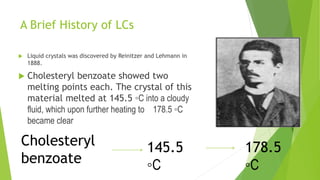
 Liquid crystals was discovered by Reinitzer and Lehmann in
1888.
 Cholesteryl benzoate showed two
melting points each. The crystal of this
material melted at 145.5 ◦C into a cloudy
fluid, which upon further heating to 178.5 ◦C
became clear
Cholesteryl
benzoate
145.5
◦C
178.5
◦C
In 1973 the discovery of the most technological and
commercial important class of liquid crystals ,
4-alkyl-4-cyanobiphenyl. This material found in
calculators or mobile phones.
Typical chemical structures
Types of liquid crystals
Structural phases of liquid crystals
 Nematic drived from the Greek word, ‘nema’ which means
“thread”.
 No positional order
 Molecules in same direction
 When temperature is increases molecules will be allign
immediately
 In nematic crystal phase molecules are arranged parallel
Nematic
 Nematic liquid crystals are widely used in electro-optic display devices
 The classical examples of LC displaying a nematic phase is the Cyanobiphenyl
Sematic
 Sematic phase occurs at temperature below nematic or
cholesteric.
 Molecules allign themselves approximately parallel &
tend to arrange in layers.
 Chiral sematic C liquid crystals are useful in LCDs
Cholesteric
 The first liquid crystal Cholesteric that was observed through a polarising
microscope is cholesteryl benzoate. Thus, CHOLESTERIC liquid crystal OR
chiral nematic liquid crystal
 E.g. cholesteric benzoate: LC 145C, isotropic 178C
 Cholesteric liquid crystals have great potential uses as
 Sensors
 Thermometer
 Fashion fabrics that change colour with temperature
 Display devices
Properties of liquid crystals
 Liquid crystal can flow like a liquid, due to loss of positional order.
 Liquid crystal is optically birefringent, due to its orientational order
 Transition from crystalline solids to liquid crystals caused by a change of temperature –
gives rise to THERMOTROPIC liquid crystals.
 Substances that are most likely to form a liquid crystal phase at a certain temperature are
molecules that are ELONGATED & have some degree of RIGIDITY.
Applications
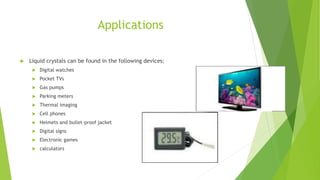
 Liquid crystals can be found in the following devices:
 Digital watches
 Pocket TVs
 Gas pumps
 Parking meters
 Thermal imaging
 Cell phones
 Helmets and bullet-proof jacket
 Digital signs
 Electronic games
 calculators
Conclusion
We know today that many chemical compounds can
exist in the liquid crystal state, such as cholesteryl
benzoate. The world can focus on ways to make this
product useful in society. Over the last century
many applications such as the detection of hot
points in microcircuits, the findings of fractures or
tumors in humans and the conversion of infrared
images have become accessible due to the
understanding of pitch in a liquid crystal.
Liqued crystals

Liqued crystals

  • 2.
  • 3.
    LEARNING OBJECTIVES  History The structures of liquid crystals  The different types of liquid crystal and their arrangement  Properties of liquid crystal  Applications of liquid crystals  Conclusion
  • 4.
    States of matters Solid  Liquid  Gas  Liquid crystals
  • 5.
    Solid  All solidshave fix shape, fix volume, ductile and high melting and boiling point.  It is due to solids have high attractive forces among the atoms and molecules which holds the atoms together.
  • 6.
    Liquid  Attractive forcesbetween the molecules is weak as compared to the solid but strong as compare to gas.  The molecules of liquids have more empty spaces as compare to the solid, moves around each other but molecules remain close to each other so fluid do not have fix shape and adapted the shape of container.
  • 7.
    Gas  Gases haveless attractive forces among the molecules.  The molecules are far away from each other.  Gases move randomly so the molecules of gas will expand and fill the container.
  • 8.
    Liquid crystals  Aliquid crystal is a phase between solid and liquid states(phases). Liquid Intermediate Phase Crystal Hea t Cool Melt Solidify Heat Cool
  • 9.
  • 10.
    Crystals vs liquidcrystals  A crystal is a highly ordered structure which possesses long-range positional & orientational order.  For many substances these two types of order are destroyed simultaneously when the crystal melts to form a liquid  For some substances, these orders are destroyed in stages. These are liquid crystals.
  • 11.
    A Brief Historyof LCs  Liquid crystals was discovered by Reinitzer and Lehmann in 1888.  Cholesteryl benzoate showed two melting points each. The crystal of this material melted at 145.5 ◦C into a cloudy fluid, which upon further heating to 178.5 ◦C became clear Cholesteryl benzoate 145.5 ◦C 178.5 ◦C
  • 12.
    In 1973 thediscovery of the most technological and commercial important class of liquid crystals , 4-alkyl-4-cyanobiphenyl. This material found in calculators or mobile phones.
  • 13.
  • 14.
  • 15.
    Structural phases ofliquid crystals  Nematic drived from the Greek word, ‘nema’ which means “thread”.  No positional order  Molecules in same direction  When temperature is increases molecules will be allign immediately  In nematic crystal phase molecules are arranged parallel Nematic
  • 16.
     Nematic liquidcrystals are widely used in electro-optic display devices  The classical examples of LC displaying a nematic phase is the Cyanobiphenyl
  • 17.
    Sematic  Sematic phaseoccurs at temperature below nematic or cholesteric.  Molecules allign themselves approximately parallel & tend to arrange in layers.  Chiral sematic C liquid crystals are useful in LCDs
  • 18.
    Cholesteric  The firstliquid crystal Cholesteric that was observed through a polarising microscope is cholesteryl benzoate. Thus, CHOLESTERIC liquid crystal OR chiral nematic liquid crystal  E.g. cholesteric benzoate: LC 145C, isotropic 178C  Cholesteric liquid crystals have great potential uses as  Sensors  Thermometer  Fashion fabrics that change colour with temperature  Display devices
  • 19.
    Properties of liquidcrystals  Liquid crystal can flow like a liquid, due to loss of positional order.  Liquid crystal is optically birefringent, due to its orientational order  Transition from crystalline solids to liquid crystals caused by a change of temperature – gives rise to THERMOTROPIC liquid crystals.  Substances that are most likely to form a liquid crystal phase at a certain temperature are molecules that are ELONGATED & have some degree of RIGIDITY.
  • 20.
    Applications  Liquid crystalscan be found in the following devices:  Digital watches  Pocket TVs  Gas pumps  Parking meters  Thermal imaging  Cell phones  Helmets and bullet-proof jacket  Digital signs  Electronic games  calculators
  • 21.
    Conclusion We know todaythat many chemical compounds can exist in the liquid crystal state, such as cholesteryl benzoate. The world can focus on ways to make this product useful in society. Over the last century many applications such as the detection of hot points in microcircuits, the findings of fractures or tumors in humans and the conversion of infrared images have become accessible due to the understanding of pitch in a liquid crystal.