IIIrd Semesester B. pharmacy
Physical Pharmaceutics-I
Unit-II
State of matter and properties
of matter (Part-7)
(Solid-crystalline, Amorphous and Polymorphism)
Miss. Pooja D. Bhandare
(Assistant professor)
Kandhar college of pharmacy
CRYSTALLINE SOLID
• Definition : A crystal or crystalline solid is a solid material whose
constituents (such as atoms, molecules or ions) are arranged in a highly
ordered microscopic structure, forming a crystal lattice that extends in
all directions.
• Or, Any solid material in which the component atoms are arranged in a
definite pattern and whose surface regularity reflects its internal
symmetry
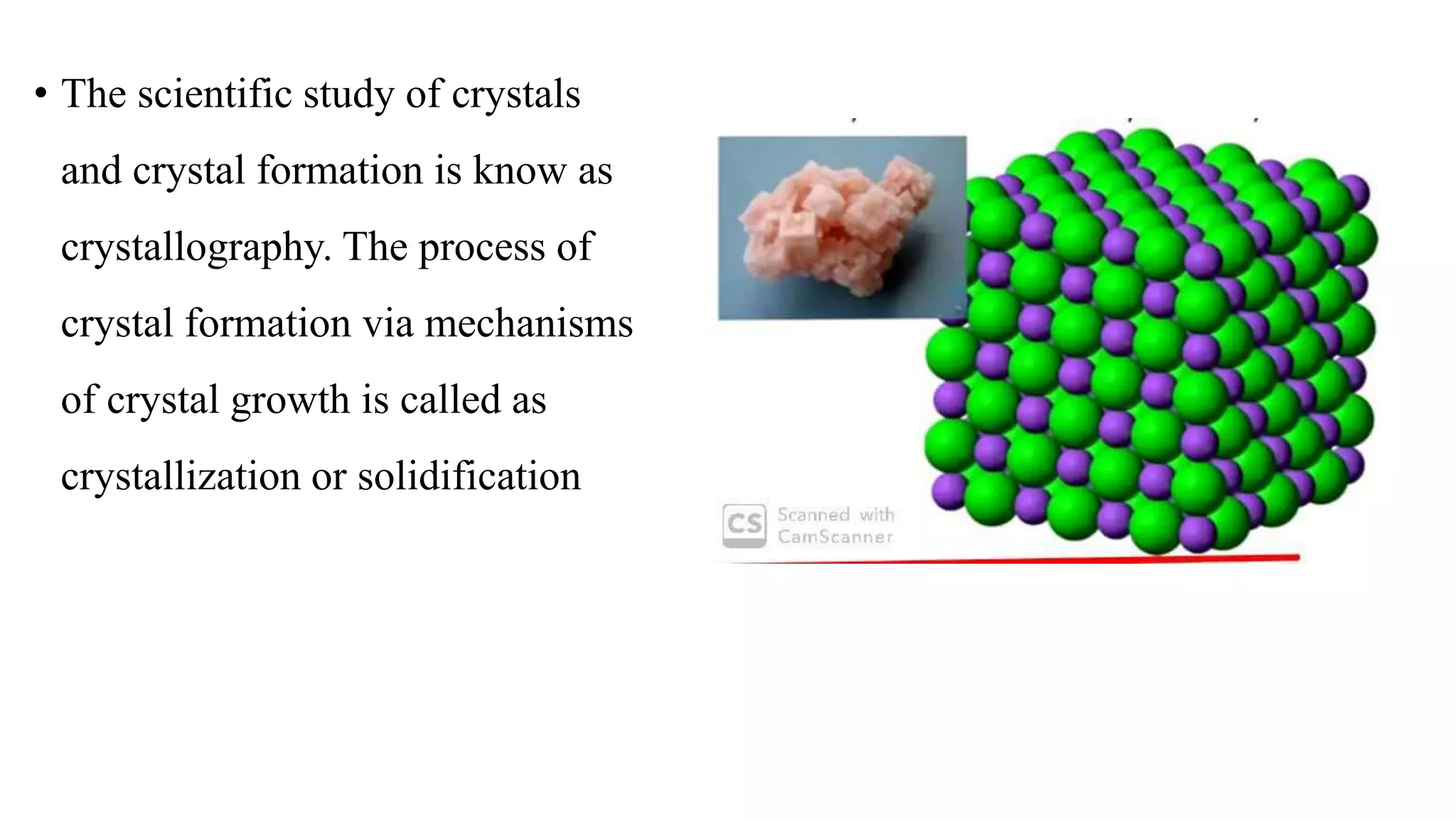
• The scientific study of crystals
and crystal formation is know as
crystallography. The process of
crystal formation via mechanisms
of crystal growth is called as
crystallization or solidification
Types of Crystalline solid
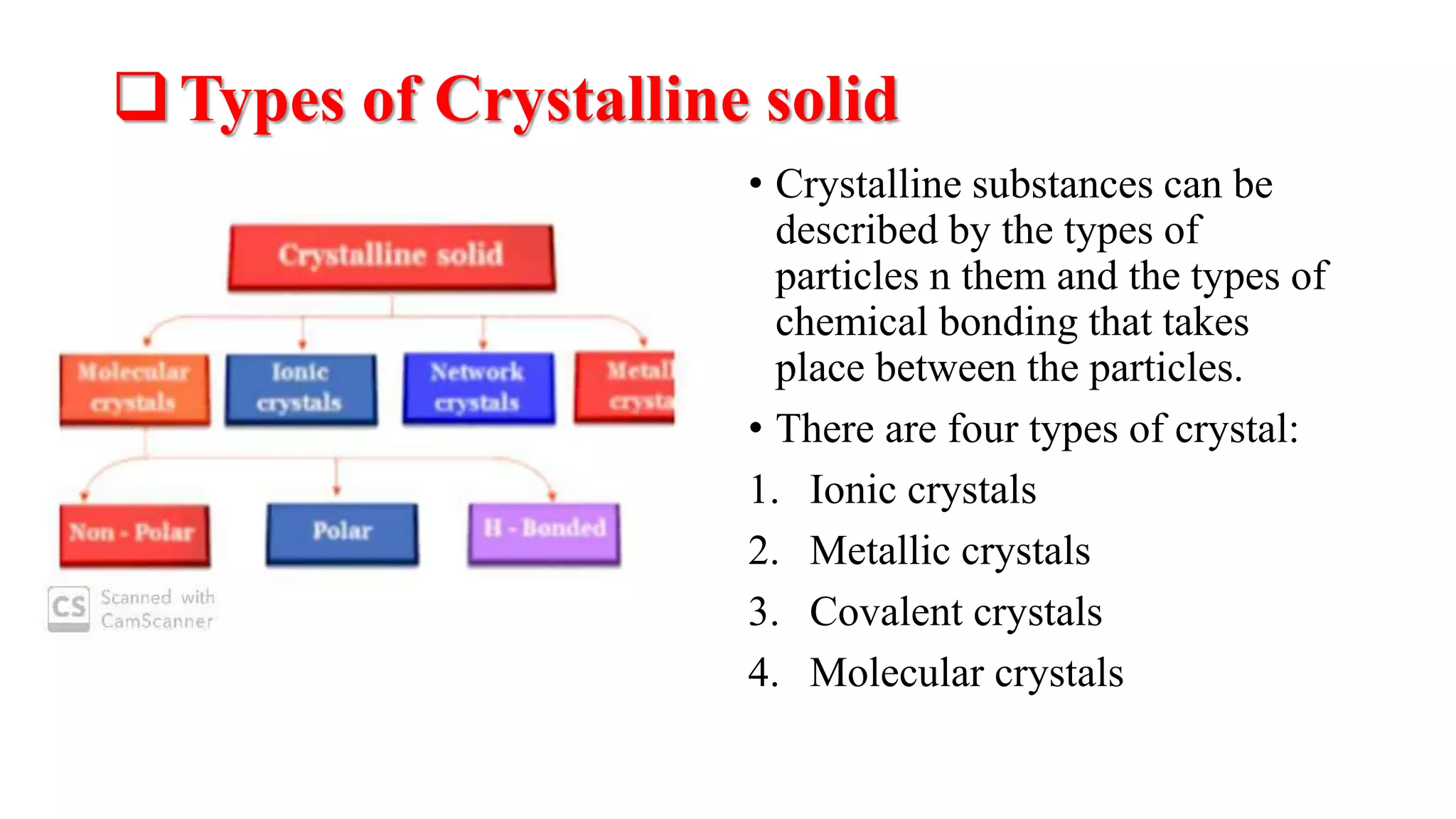
• Crystalline substances can be
described by the types of
particles n them and the types of
chemical bonding that takes
place between the particles.
• There are four types of crystal:
1. Ionic crystals
2. Metallic crystals
3. Covalent crystals
4. Molecular crystals
AMORPHOUS SOLID
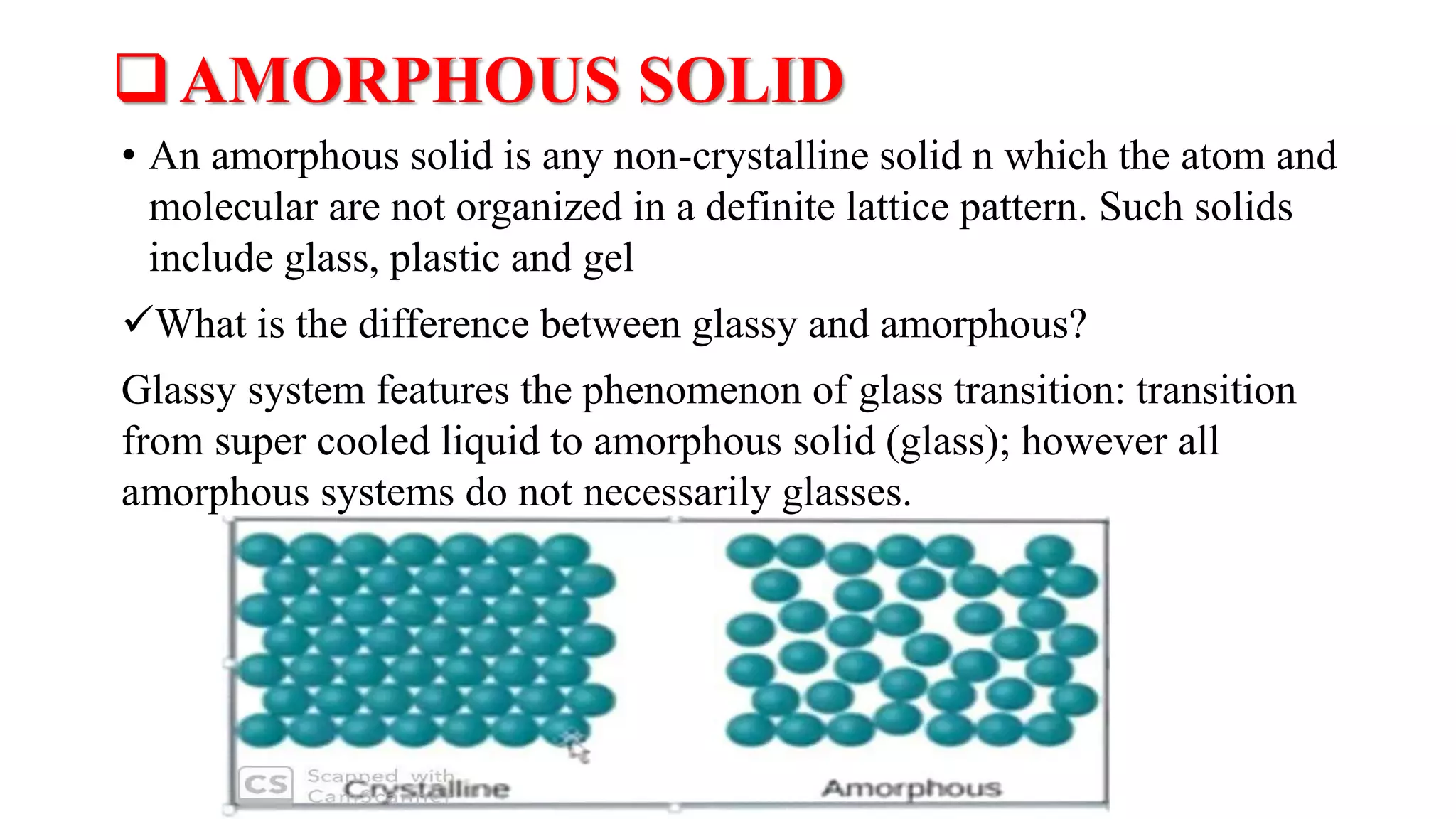
• An amorphous solid is any non-crystalline solid n which the atom and
molecular are not organized in a definite lattice pattern. Such solids
include glass, plastic and gel
What is the difference between glassy and amorphous?
Glassy system features the phenomenon of glass transition: transition
from super cooled liquid to amorphous solid (glass); however all
amorphous systems do not necessarily glasses.
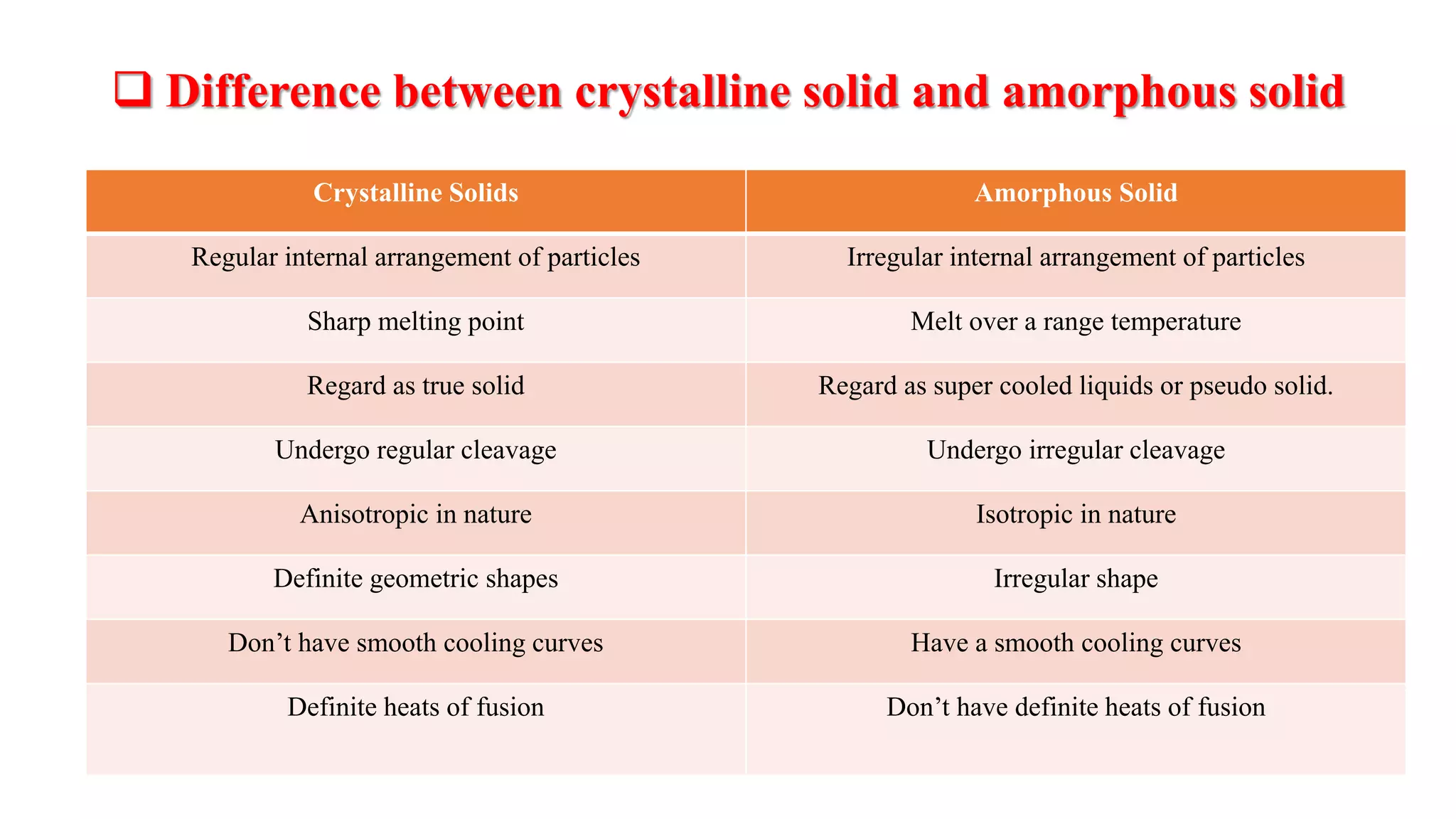
 Difference between crystalline solid and amorphous solid
Crystalline Solids Amorphous Solid
Regular internal arrangement of particles Irregular internal arrangement of particles
Sharp melting point Melt over a range temperature
Regard as true solid Regard as super cooled liquids or pseudo solid.
Undergo regular cleavage Undergo irregular cleavage
Anisotropic in nature Isotropic in nature
Definite geometric shapes Irregular shape
Don’t have smooth cooling curves Have a smooth cooling curves
Definite heats of fusion Don’t have definite heats of fusion
• Why does the amorphous form of drug have better bioavaibility that
crystalline couterpaerts?
oSolubility depends on the formation of intermolecular hydrogen bonds
between solvent molecules and the solute molecules. The crystalline
form is more stable than the amorphous form and has lower energy at the
molecular level with stronger bonding (mostly ionic bonds) between
molecules that require higher energy to break. So, higher solubility
means higher dissolution rate and better bioavailability.
Polymorphism
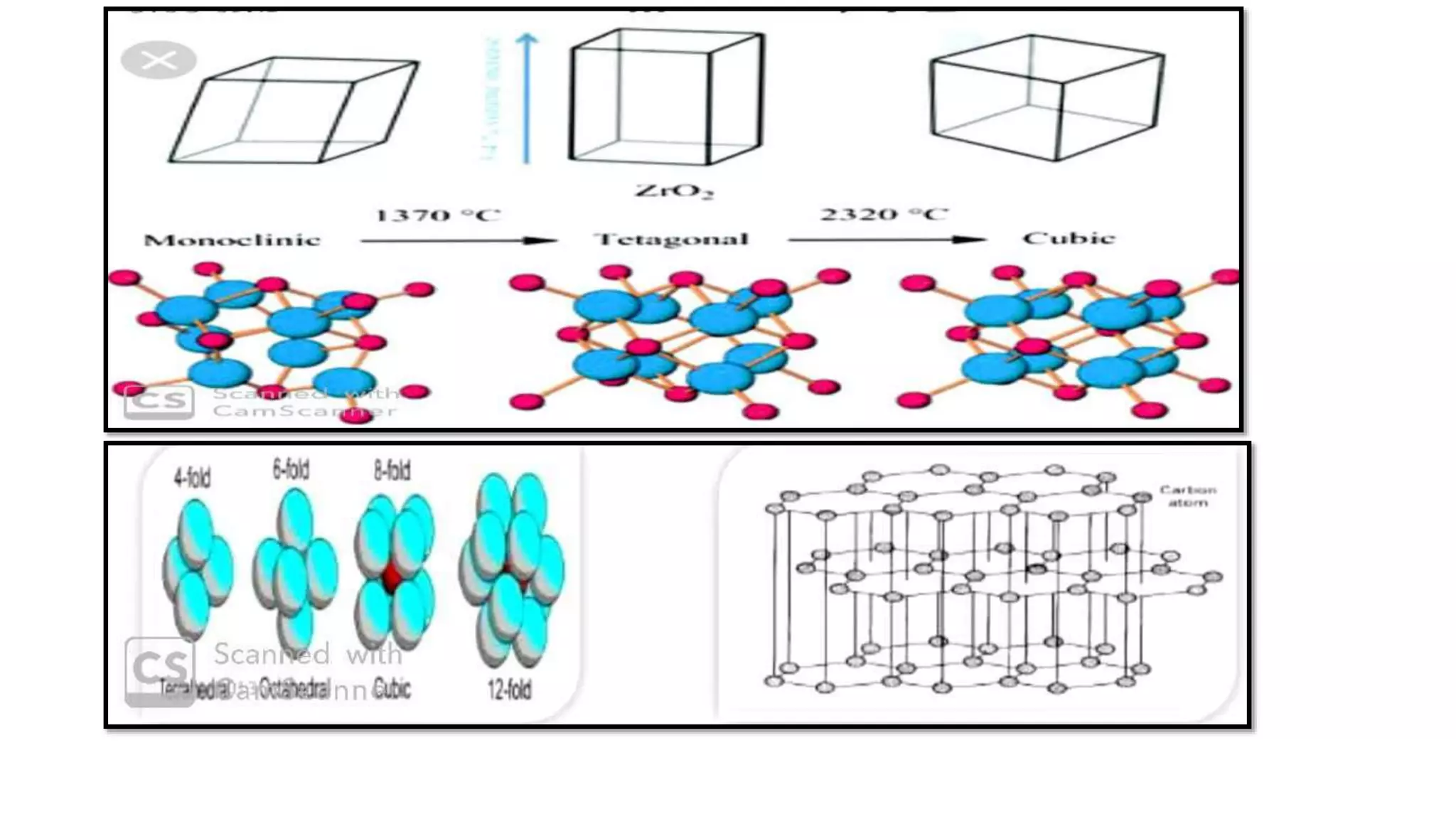
• Definition: Polymorphism is the ability of solid material to exist in two
or more crystalline forms with different arrangements or conformation
of the constituents in the crystal lattice.
• Or when a substance exists in more than one crystalline form, the
different form are desgned as polymorphs and the phenomenon as
polymorphism
• e.g., Carbon: diamond in cubic ( tetrahedral lattice arrangement)
• Graphite in sheet of hexagonal lattic
TYPES OF POLYMORPHISM
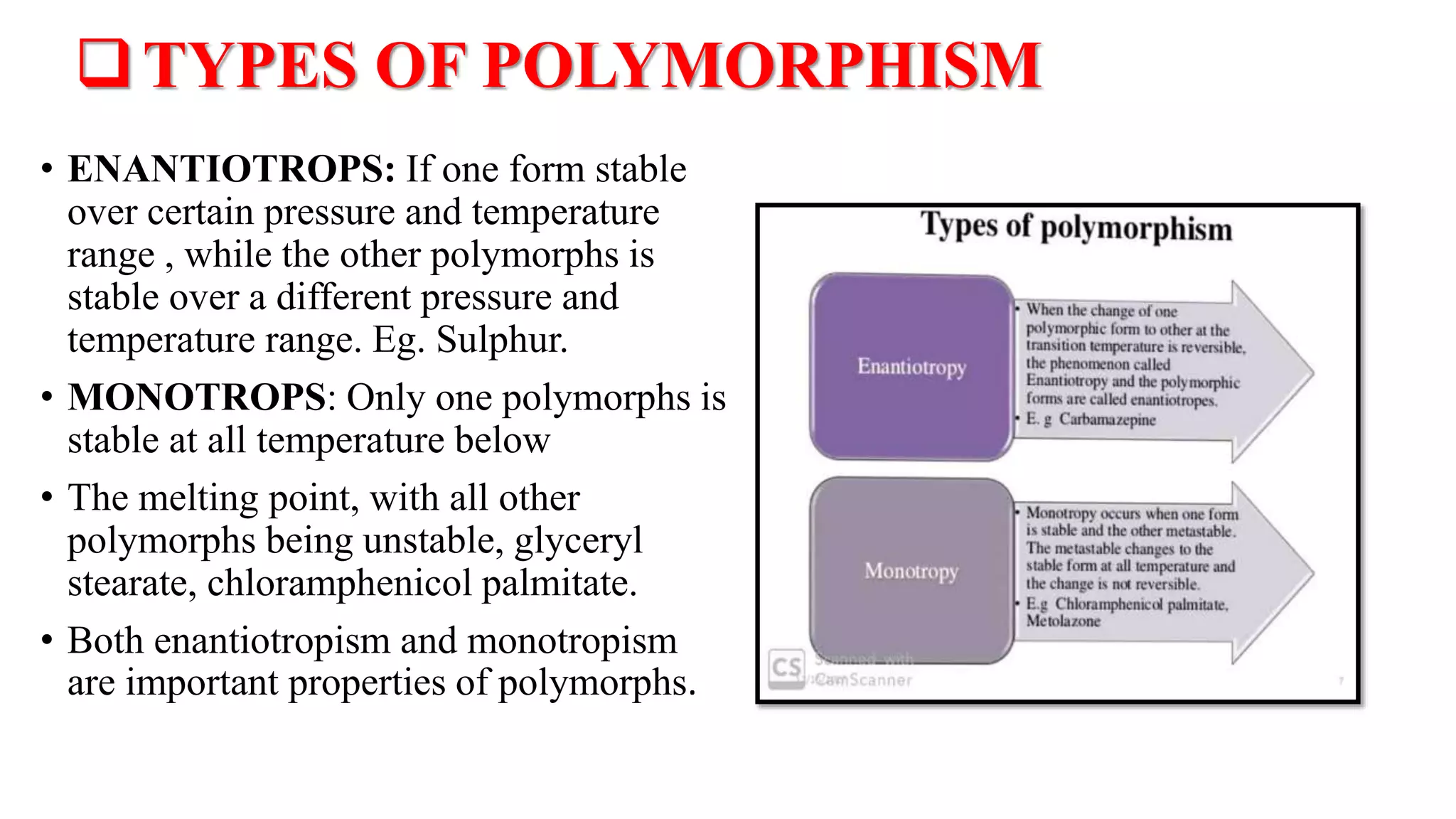
• ENANTIOTROPS: If one form stable
over certain pressure and temperature
range , while the other polymorphs is
stable over a different pressure and
temperature range. Eg. Sulphur.
• MONOTROPS: Only one polymorphs is
stable at all temperature below
• The melting point, with all other
polymorphs being unstable, glyceryl
stearate, chloramphenicol palmitate.
• Both enantiotropism and monotropism
are important properties of polymorphs.
PROPERTY OF POLYMORPHS
• Polymorphs show the same properties in liquid or gaseous state but they
behave differently in solid state.
• Polymorphs differ from each other with respect to physical properties like.
1. Melting and sublimation temperature.
2. Vapour pressure
3. Solubility and dissolution rate
4. Stability
5. Optical and electrical properties
6. Crystal habit
7. Hygroscopic
8. Solid- state reactions
9. Conductivity
10. Compression characterstics
Methods of preparation of Polymorphs.
• Solvent evaporation method
• Slow cooling approach
• Solvent diffusion technique
• Vapour diffusion method
• Vaccum sublimation
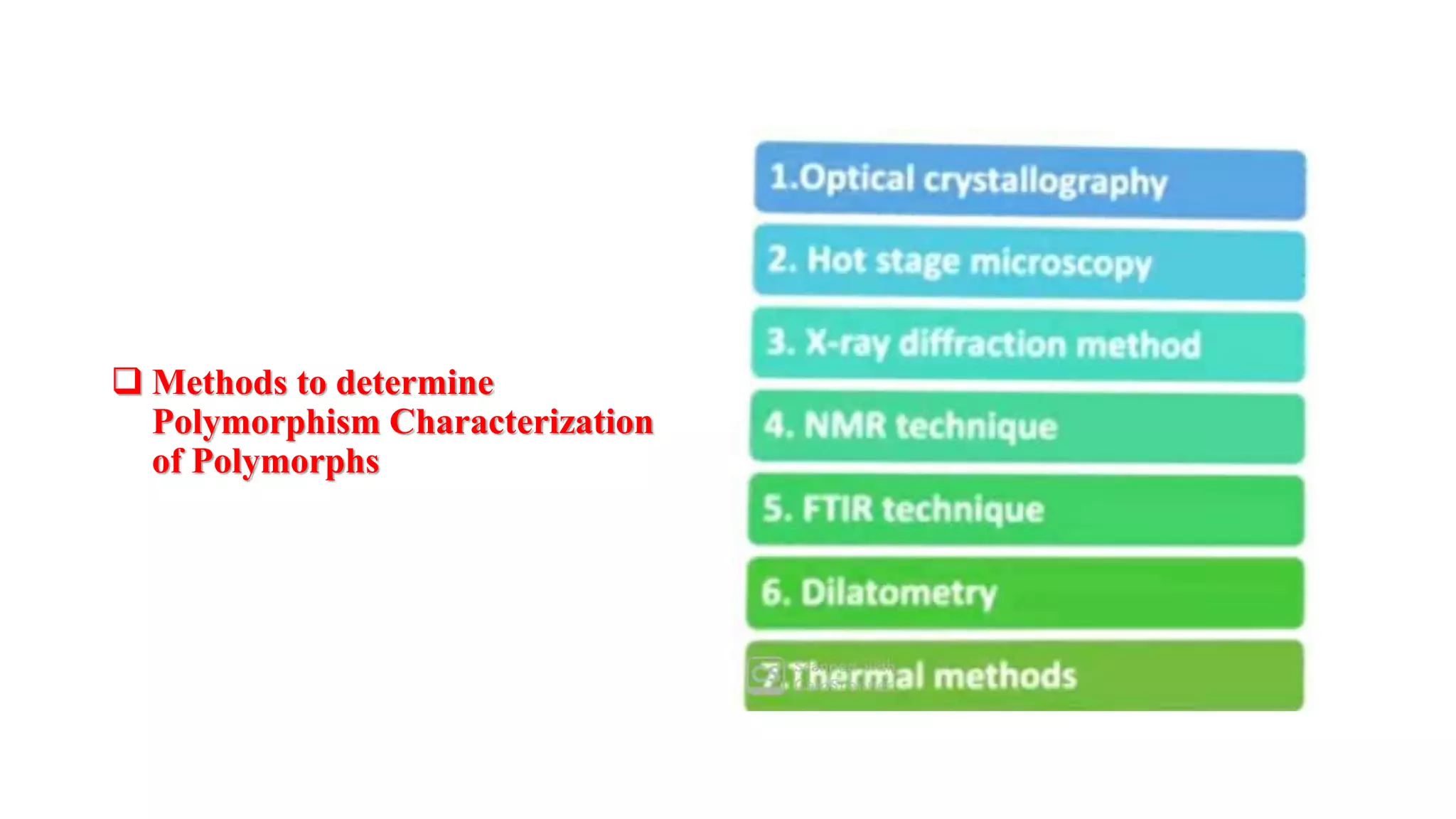
 Methods to determine
Polymorphism Characterization
of Polymorphs
Pharmaceutical Application
• Preparation of physically stable dosage form .
• Influence on solubility, dissolution and bioavailability.
• Influence on drug product manufacturability.
• Influence on stability
• Effect on tableting.
• Miscellaneous application.
Thank you!

State of matter and properties of matter (Part-7)(Solid-crystalline, Amorphous and Polymorphism)

  • 1.
    IIIrd Semesester B.pharmacy Physical Pharmaceutics-I Unit-II State of matter and properties of matter (Part-7) (Solid-crystalline, Amorphous and Polymorphism) Miss. Pooja D. Bhandare (Assistant professor) Kandhar college of pharmacy
  • 2.
    CRYSTALLINE SOLID • Definition: A crystal or crystalline solid is a solid material whose constituents (such as atoms, molecules or ions) are arranged in a highly ordered microscopic structure, forming a crystal lattice that extends in all directions. • Or, Any solid material in which the component atoms are arranged in a definite pattern and whose surface regularity reflects its internal symmetry
  • 3.
    • The scientificstudy of crystals and crystal formation is know as crystallography. The process of crystal formation via mechanisms of crystal growth is called as crystallization or solidification
  • 4.
    Types of Crystallinesolid • Crystalline substances can be described by the types of particles n them and the types of chemical bonding that takes place between the particles. • There are four types of crystal: 1. Ionic crystals 2. Metallic crystals 3. Covalent crystals 4. Molecular crystals
  • 5.
    AMORPHOUS SOLID • Anamorphous solid is any non-crystalline solid n which the atom and molecular are not organized in a definite lattice pattern. Such solids include glass, plastic and gel What is the difference between glassy and amorphous? Glassy system features the phenomenon of glass transition: transition from super cooled liquid to amorphous solid (glass); however all amorphous systems do not necessarily glasses.
  • 6.
     Difference betweencrystalline solid and amorphous solid Crystalline Solids Amorphous Solid Regular internal arrangement of particles Irregular internal arrangement of particles Sharp melting point Melt over a range temperature Regard as true solid Regard as super cooled liquids or pseudo solid. Undergo regular cleavage Undergo irregular cleavage Anisotropic in nature Isotropic in nature Definite geometric shapes Irregular shape Don’t have smooth cooling curves Have a smooth cooling curves Definite heats of fusion Don’t have definite heats of fusion
  • 7.
    • Why doesthe amorphous form of drug have better bioavaibility that crystalline couterpaerts? oSolubility depends on the formation of intermolecular hydrogen bonds between solvent molecules and the solute molecules. The crystalline form is more stable than the amorphous form and has lower energy at the molecular level with stronger bonding (mostly ionic bonds) between molecules that require higher energy to break. So, higher solubility means higher dissolution rate and better bioavailability.
  • 8.
    Polymorphism • Definition: Polymorphismis the ability of solid material to exist in two or more crystalline forms with different arrangements or conformation of the constituents in the crystal lattice. • Or when a substance exists in more than one crystalline form, the different form are desgned as polymorphs and the phenomenon as polymorphism • e.g., Carbon: diamond in cubic ( tetrahedral lattice arrangement) • Graphite in sheet of hexagonal lattic
  • 10.
    TYPES OF POLYMORPHISM •ENANTIOTROPS: If one form stable over certain pressure and temperature range , while the other polymorphs is stable over a different pressure and temperature range. Eg. Sulphur. • MONOTROPS: Only one polymorphs is stable at all temperature below • The melting point, with all other polymorphs being unstable, glyceryl stearate, chloramphenicol palmitate. • Both enantiotropism and monotropism are important properties of polymorphs.
  • 11.
    PROPERTY OF POLYMORPHS •Polymorphs show the same properties in liquid or gaseous state but they behave differently in solid state. • Polymorphs differ from each other with respect to physical properties like. 1. Melting and sublimation temperature. 2. Vapour pressure 3. Solubility and dissolution rate 4. Stability 5. Optical and electrical properties 6. Crystal habit 7. Hygroscopic 8. Solid- state reactions 9. Conductivity 10. Compression characterstics
  • 12.
    Methods of preparationof Polymorphs. • Solvent evaporation method • Slow cooling approach • Solvent diffusion technique • Vapour diffusion method • Vaccum sublimation
  • 13.
     Methods todetermine Polymorphism Characterization of Polymorphs
  • 14.
    Pharmaceutical Application • Preparationof physically stable dosage form . • Influence on solubility, dissolution and bioavailability. • Influence on drug product manufacturability. • Influence on stability • Effect on tableting. • Miscellaneous application.
  • 15.