Liquid Crystals and their Applications 
Muhammad Minhas Azeem 
Roll No 7616 
Govt College University Faisalabad 
Department of Applied Chemistry
Learning Objectives
States of mattters 
1: Solid 
2 : Liquid 
3: Gass 
4:Liquid crystals 
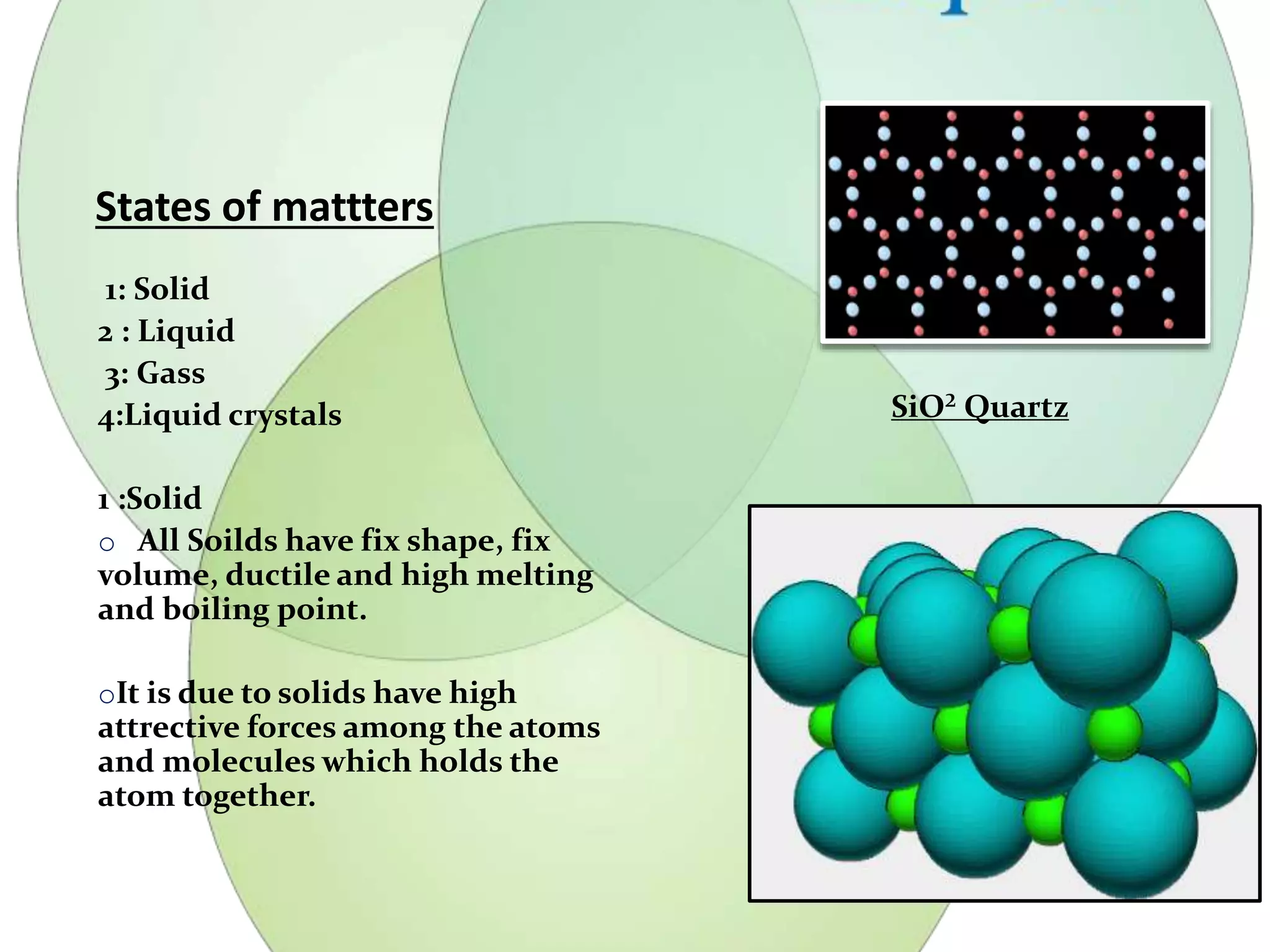
1 :Solid 
o All Soilds have fix shape, fix 
volume, ductile and high melting 
and boiling point. 
oIt is due to solids have high 
attrective forces among the atoms 
and molecules which holds the 
atom together. 
SiO² Quartz
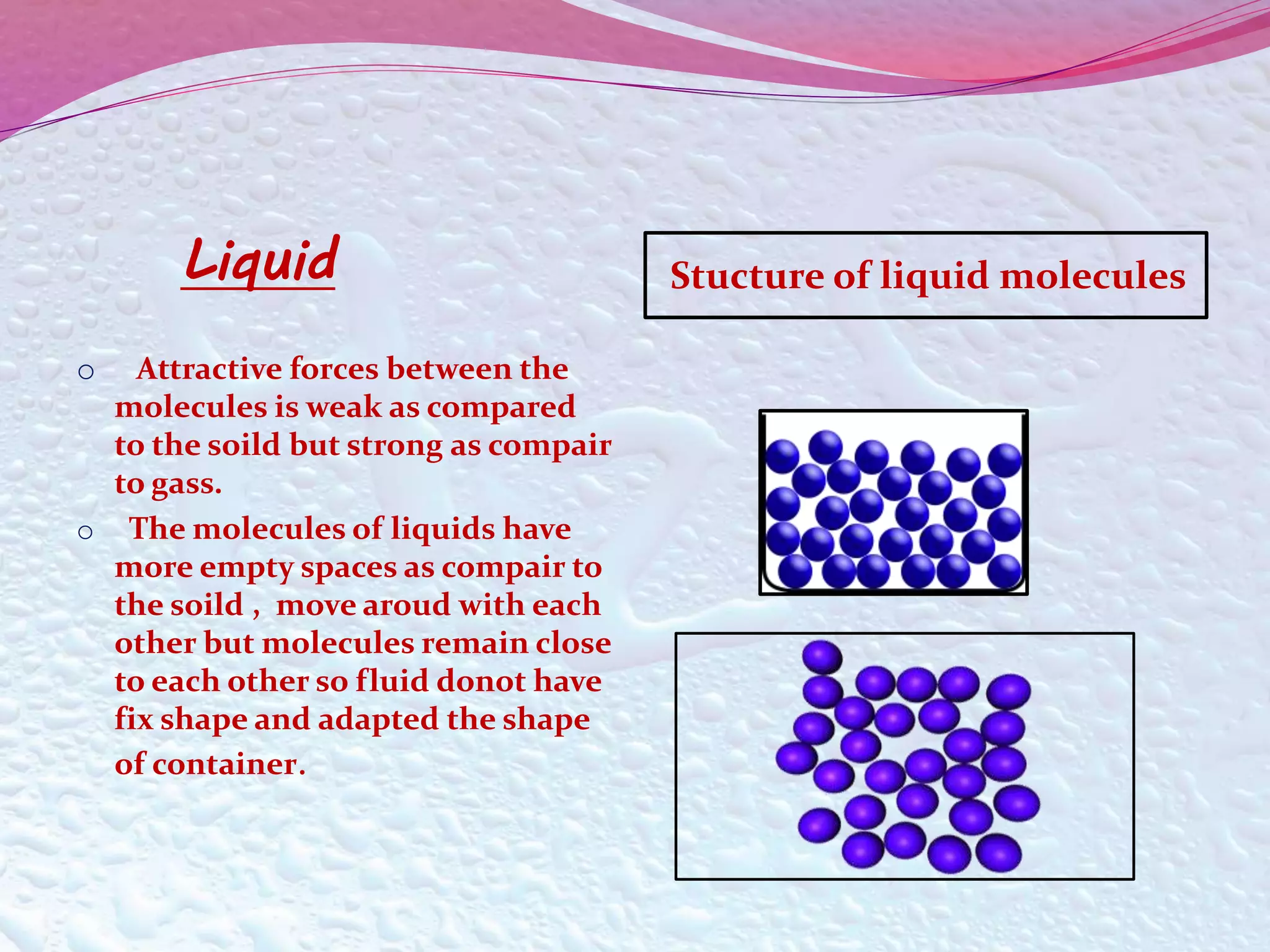
Liquid Stucture of liquid molecules 
o Attractive forces between the 
molecules is weak as compared 
to the soild but strong as compair 
to gass. 
o The molecules of liquids have 
more empty spaces as compair to 
the soild , move aroud with each 
other but molecules remain close 
to each other so fluid donot have 
fix shape and adapted the shape 
of container.
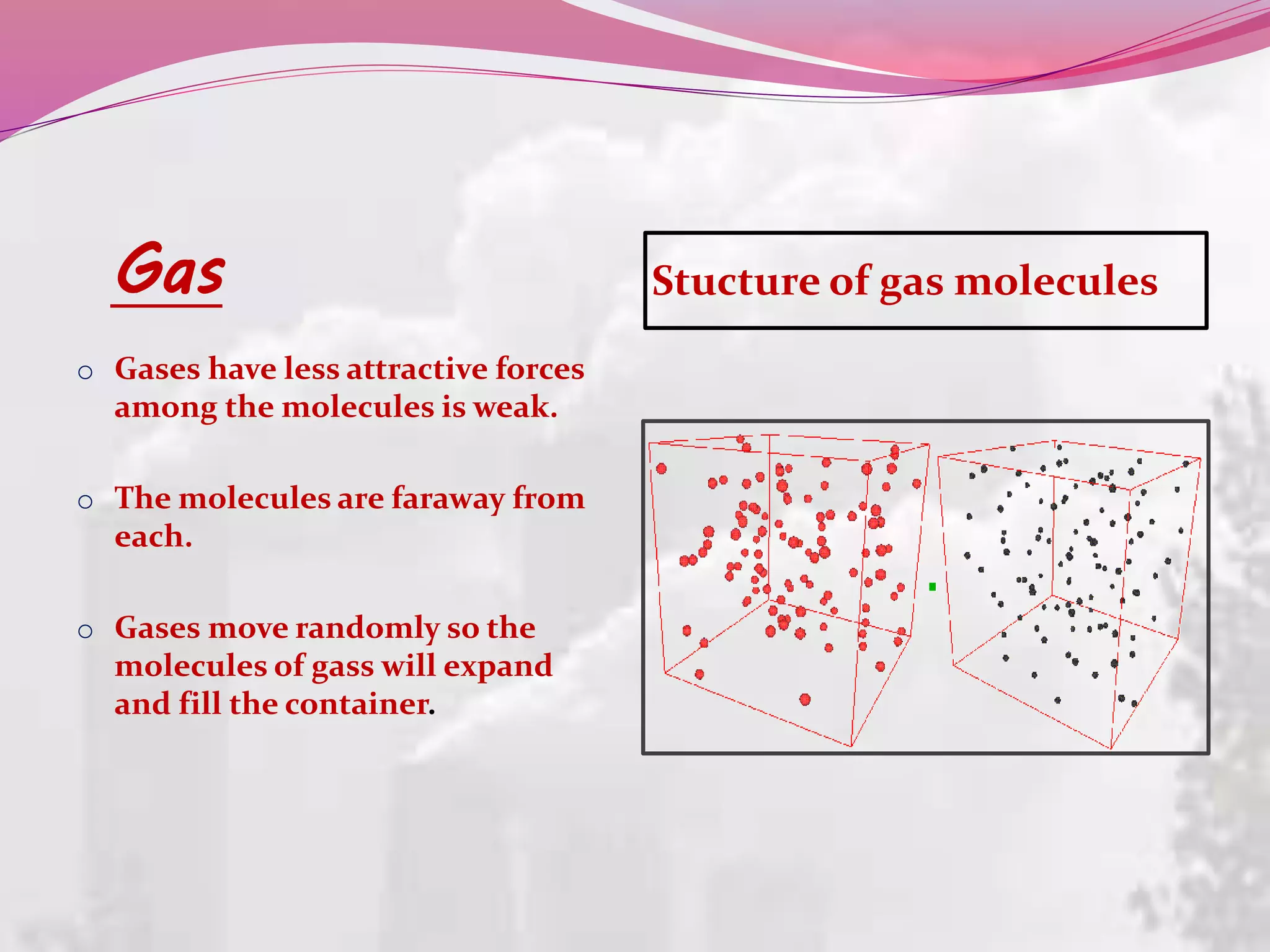
Gas Stucture of gas molecules 
o Gases have less attractive forces 
among the molecules is weak. 
o The molecules are faraway from 
each. 
o Gases move randomly so the 
molecules of gass will expand 
and fill the container.
Liquid Crystals 
What is a liquid crystal? 
What is so special about liquid crystals? 
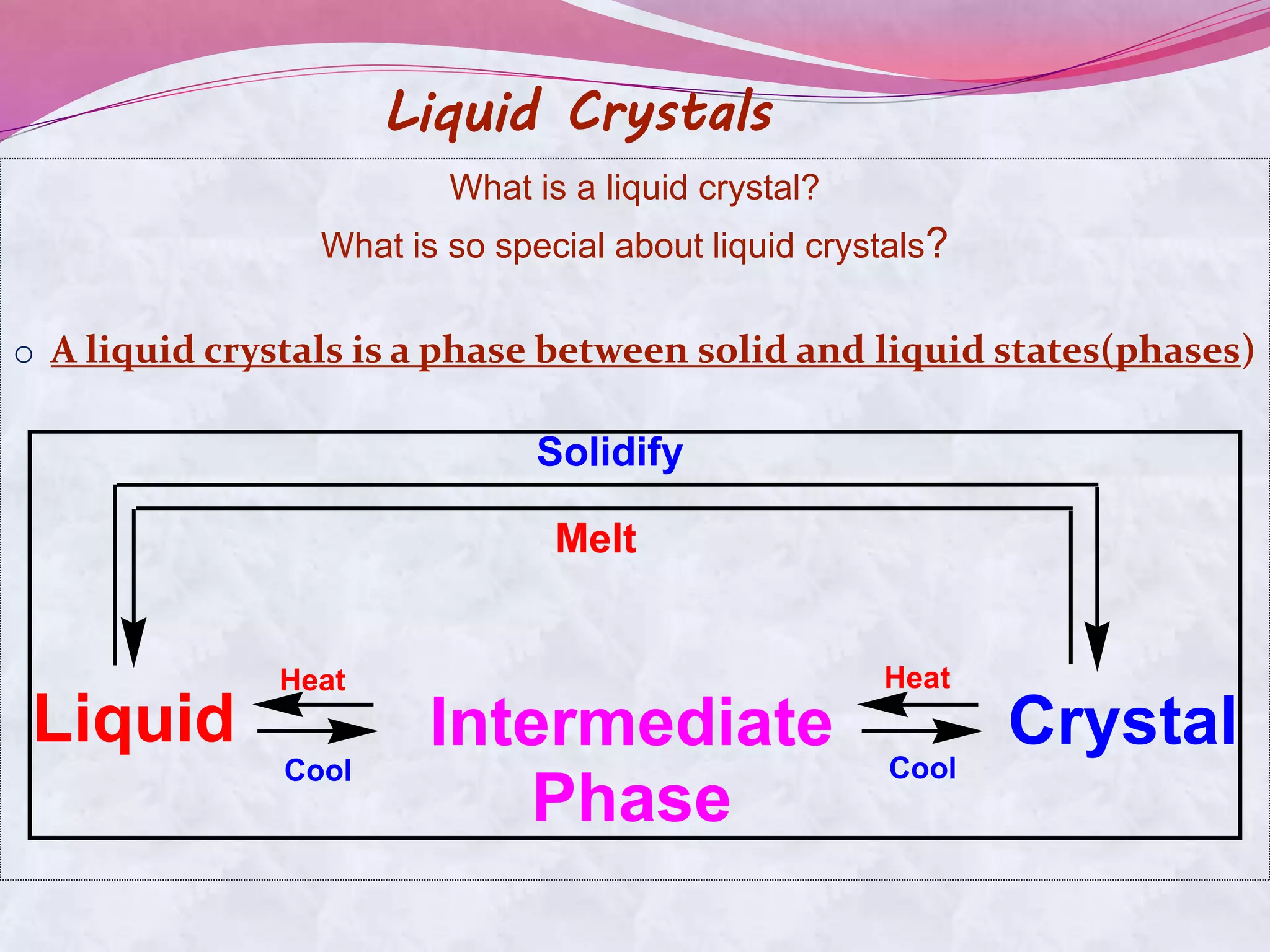
o A liquid crystals is a phase between solid and liquid states(phases) 
Solidify 
Melt 
Liquid Crystal 
Intermediate 
Phase 
Heat 
Cool 
Heat 
Cool
Examples 
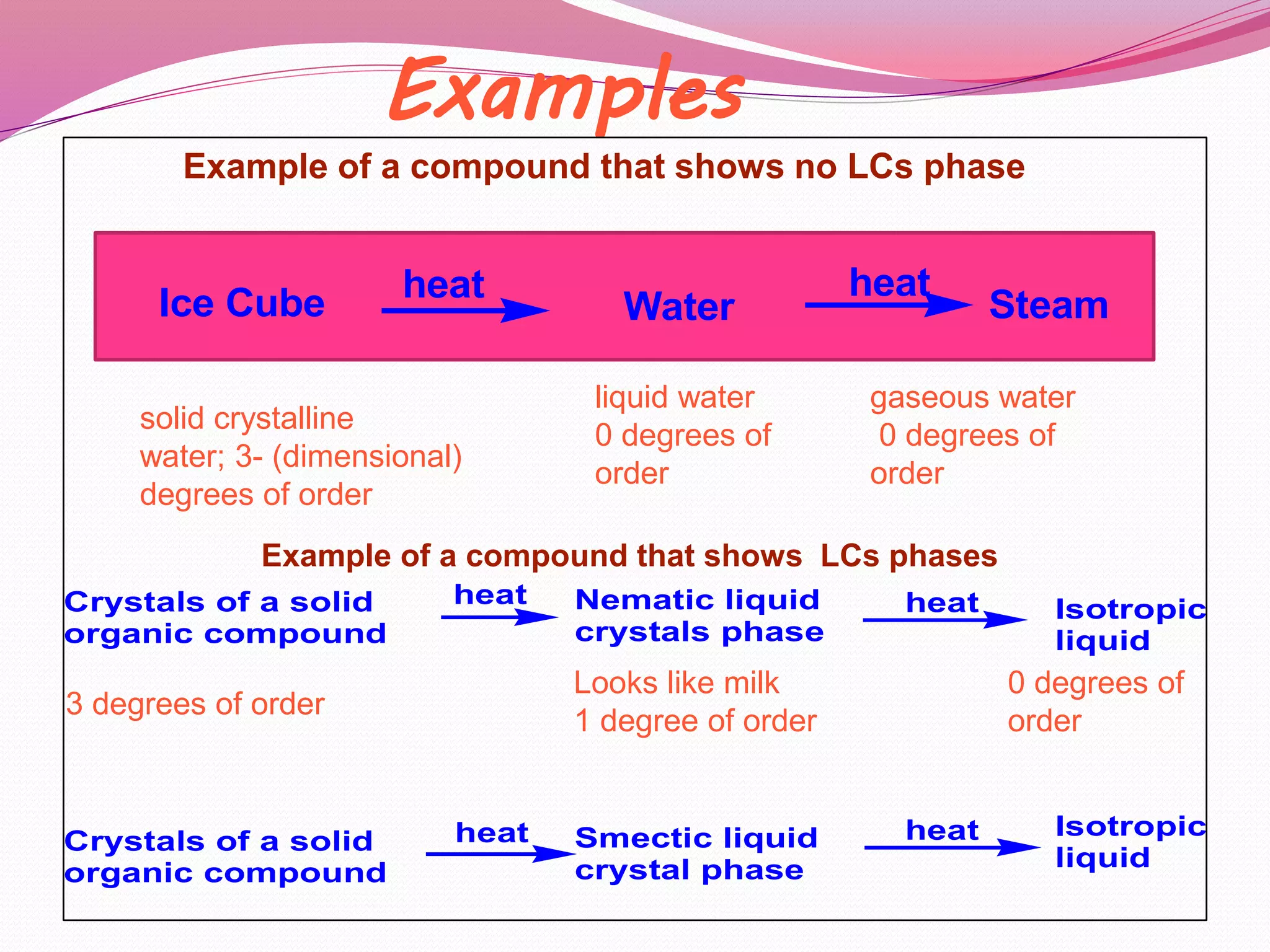
Example of a compound that shows no LCs phase 
heat heat 
Ice Cube Water Steam 
solid crystalline 
water; 3- (dimensional) 
degrees of order 
liquid water 
0 degrees of 
order 
gaseous water 
0 degrees of 
order 
Example of a compound that shows LCs phases 
Crystals of a solid 
organic compound 
Nematic liquid 
crystals phase 
Isotropic 
liquid 
Crystals of a solid 
organic compound 
Smectic liquid 
crystal phase 
Isotropic 
liquid 
heat heat 
heat heat 
3 degrees of order 
Looks like milk 
1 degree of order 
0 degrees of 
order
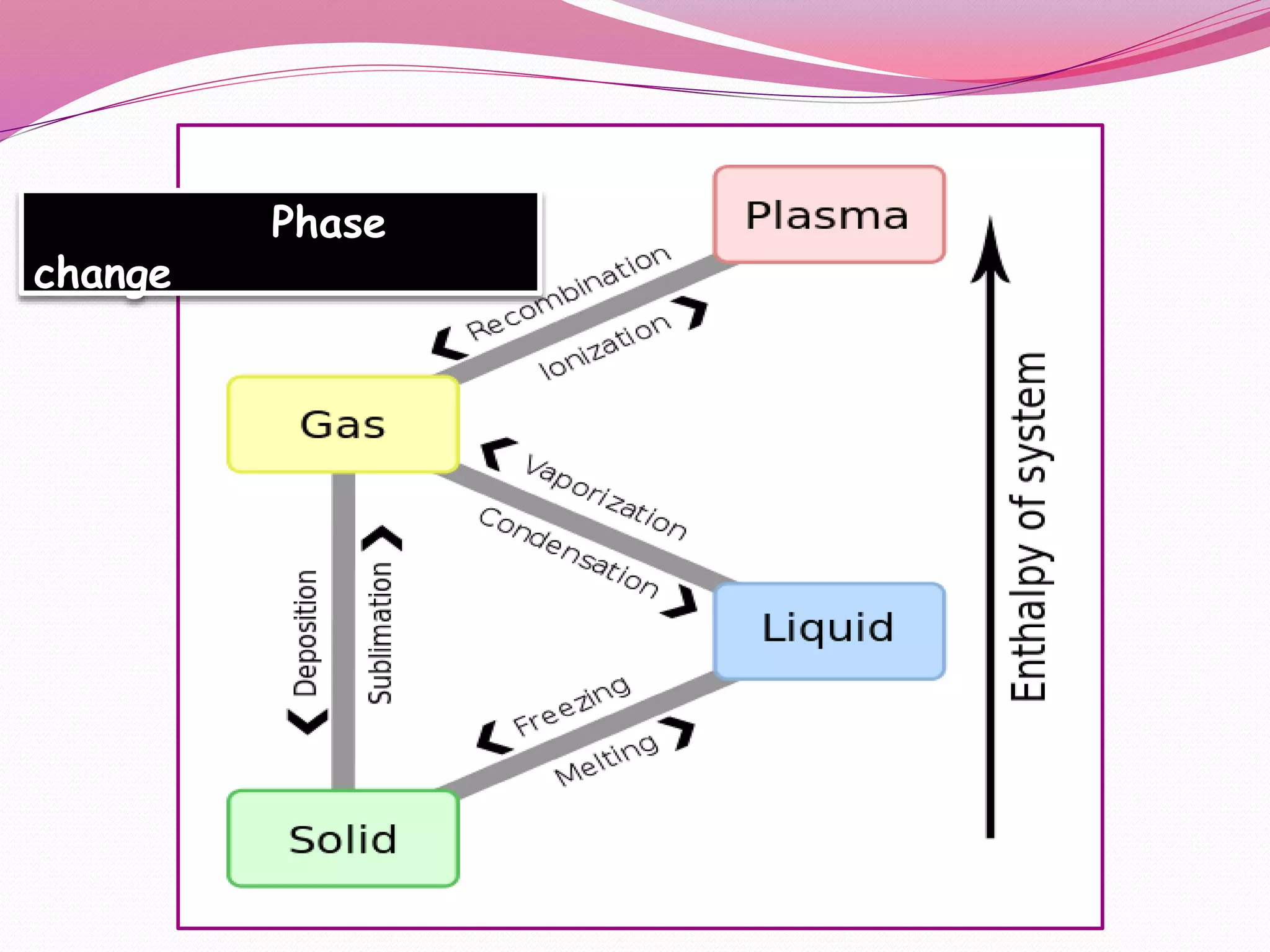
Phase 
change
A Brief History of LCs 
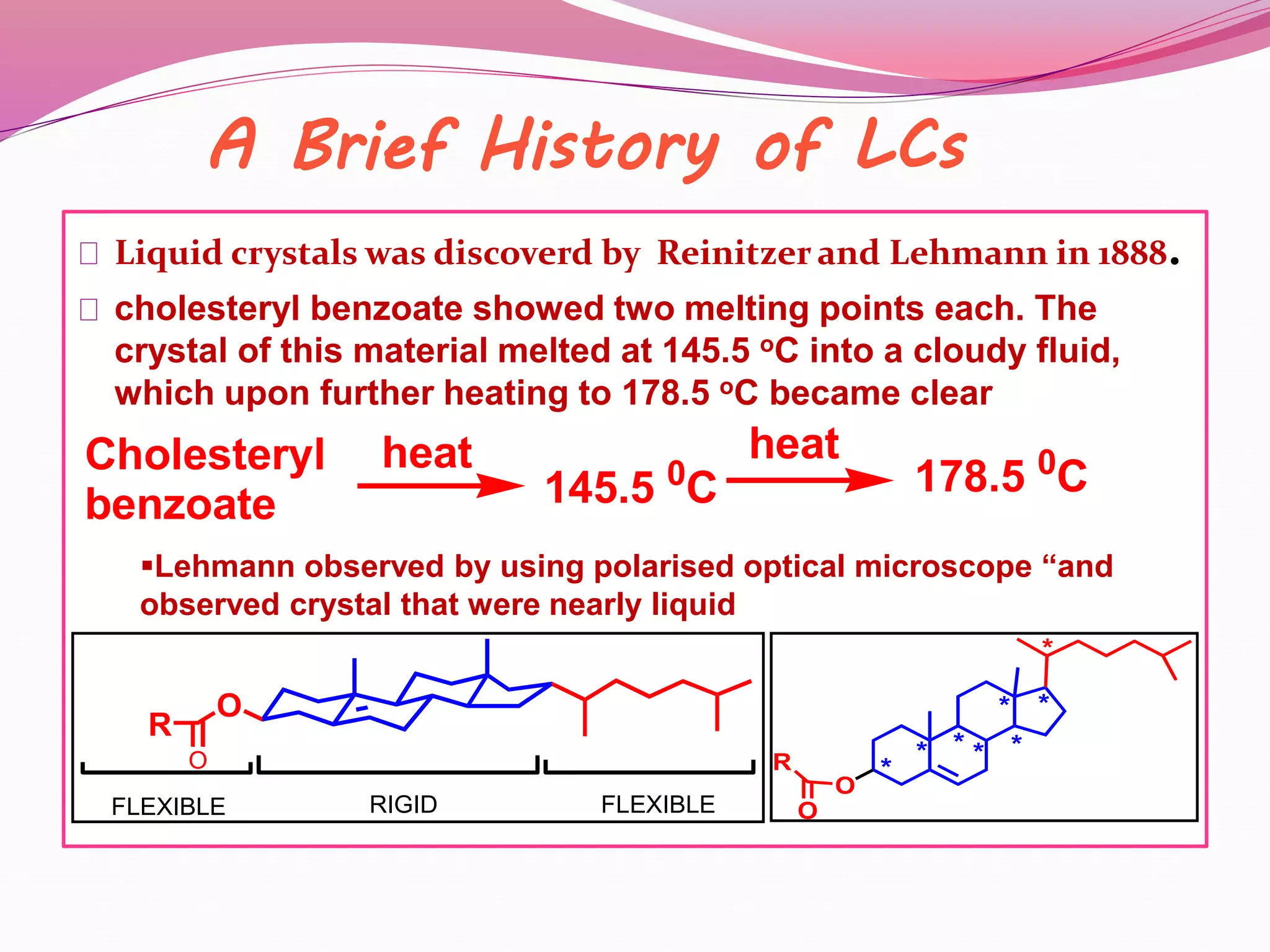
Liquid crystals was discoverd by Reinitzer and Lehmann in 1888. 
cholesteryl benzoate showed two melting points each. The 
crystal of this material melted at 145.5 oC into a cloudy fluid, 
which upon further heating to 178.5 oC became clear 
Cholesteryl 
heat heat 
145.5 0C 178.5 0C 
benzoate Lehmann observed by using polarised optical microscope “and 
observed crystal that were nearly liquid 
O 
O 
R 
FLEXIBLE RIGID FLEXIBLE 
O 
* * * * 
* 
* 
* 
* 
R 
O
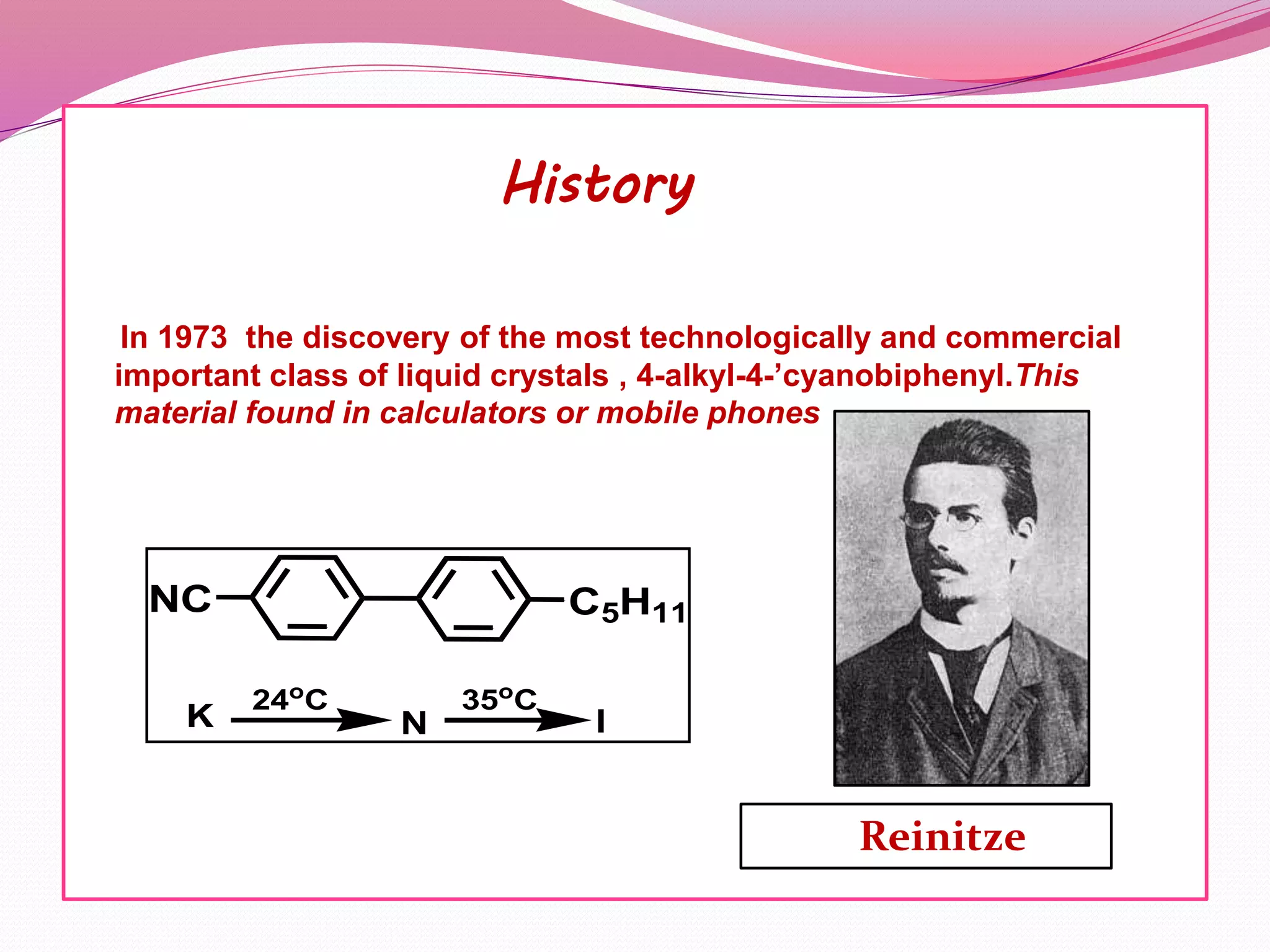
History 
In 1973 the discovery of the most technologically and commercial 
important class of liquid crystals , 4-alkyl-4-’cyanobiphenyl.This 
material found in calculators or mobile phones 
NC C5H11 
24oC 35oC 
K N I 
Reinitze
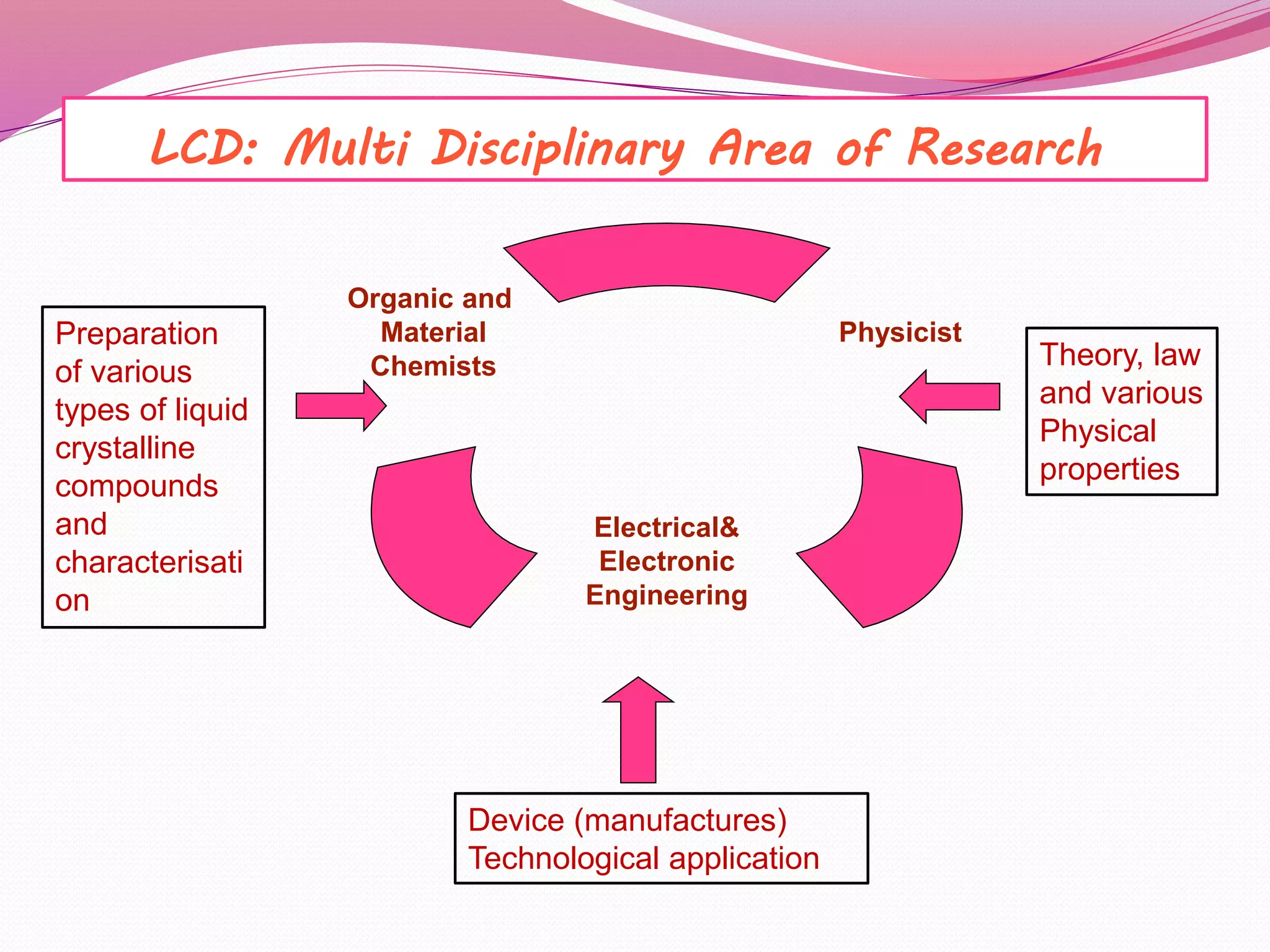
LCD: Multi Disciplinary Area of Research 
Physicist 
Electrical& 
Electronic 
Engineering 
Organic and 
Material 
Chemists Theory, law 
and various 
Physical 
properties 
Device (manufactures) 
Technological application 
Preparation 
of various 
types of liquid 
crystalline 
compounds 
and 
characterisati 
on
Crystals vs Liquid Crystals 
o A crystal is a highly ordered structure which 
possesses long-range positional & orientational order 
o For many substances these two types of order are 
destroyed simultaneously when the crystal melts to 
form a liquid 
o For some substances, these orders are destroyed in 
stages. These are liquid crystals
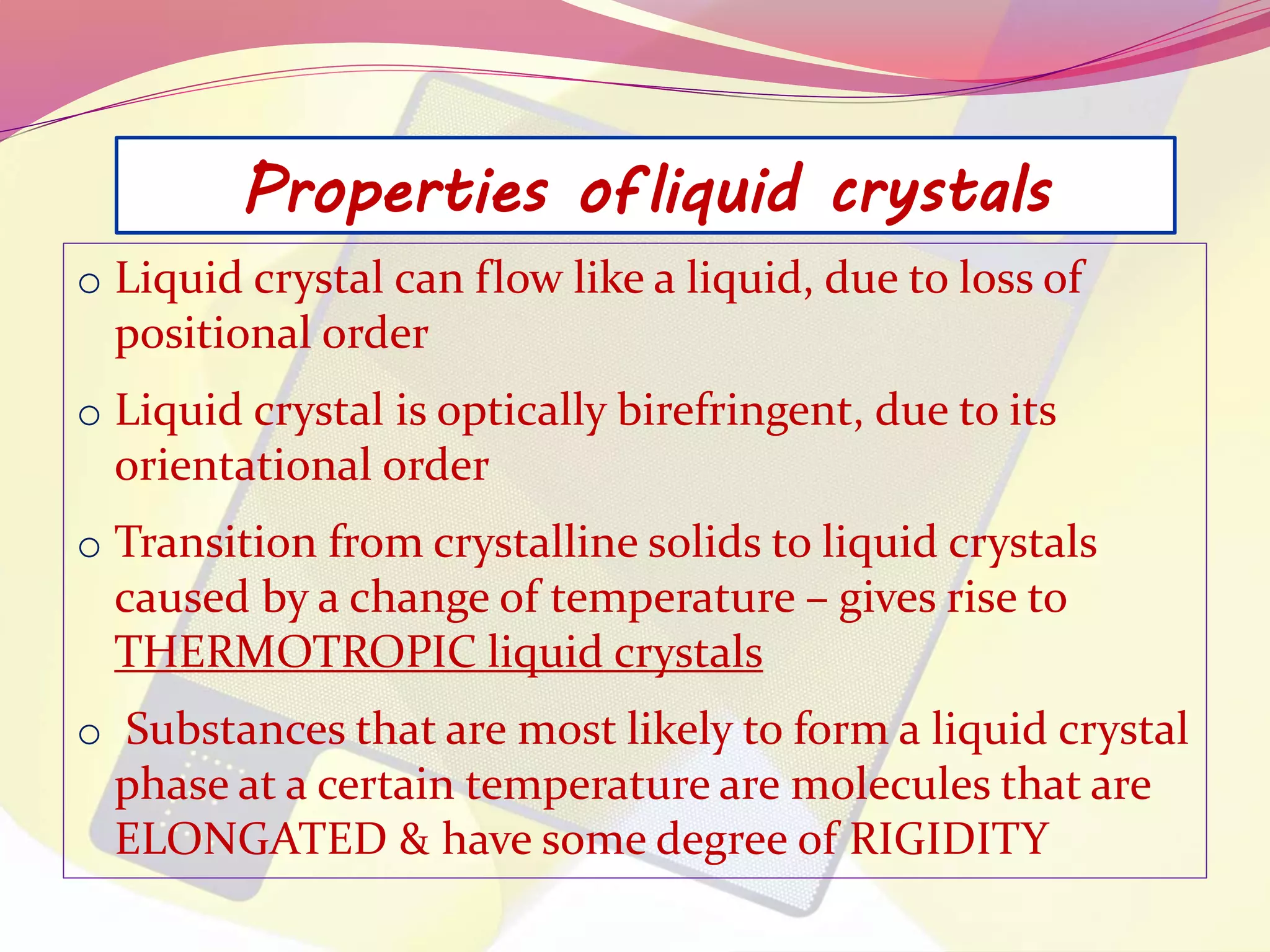
Properties of liquid crystals 
o Liquid crystal can flow like a liquid, due to loss of 
positional order 
o Liquid crystal is optically birefringent, due to its 
orientational order 
o Transition from crystalline solids to liquid crystals 
caused by a change of temperature – gives rise to 
THERMOTROPIC liquid crystals 
o Substances that are most likely to form a liquid crystal 
phase at a certain temperature are molecules that are 
ELONGATED & have some degree of RIGIDITY
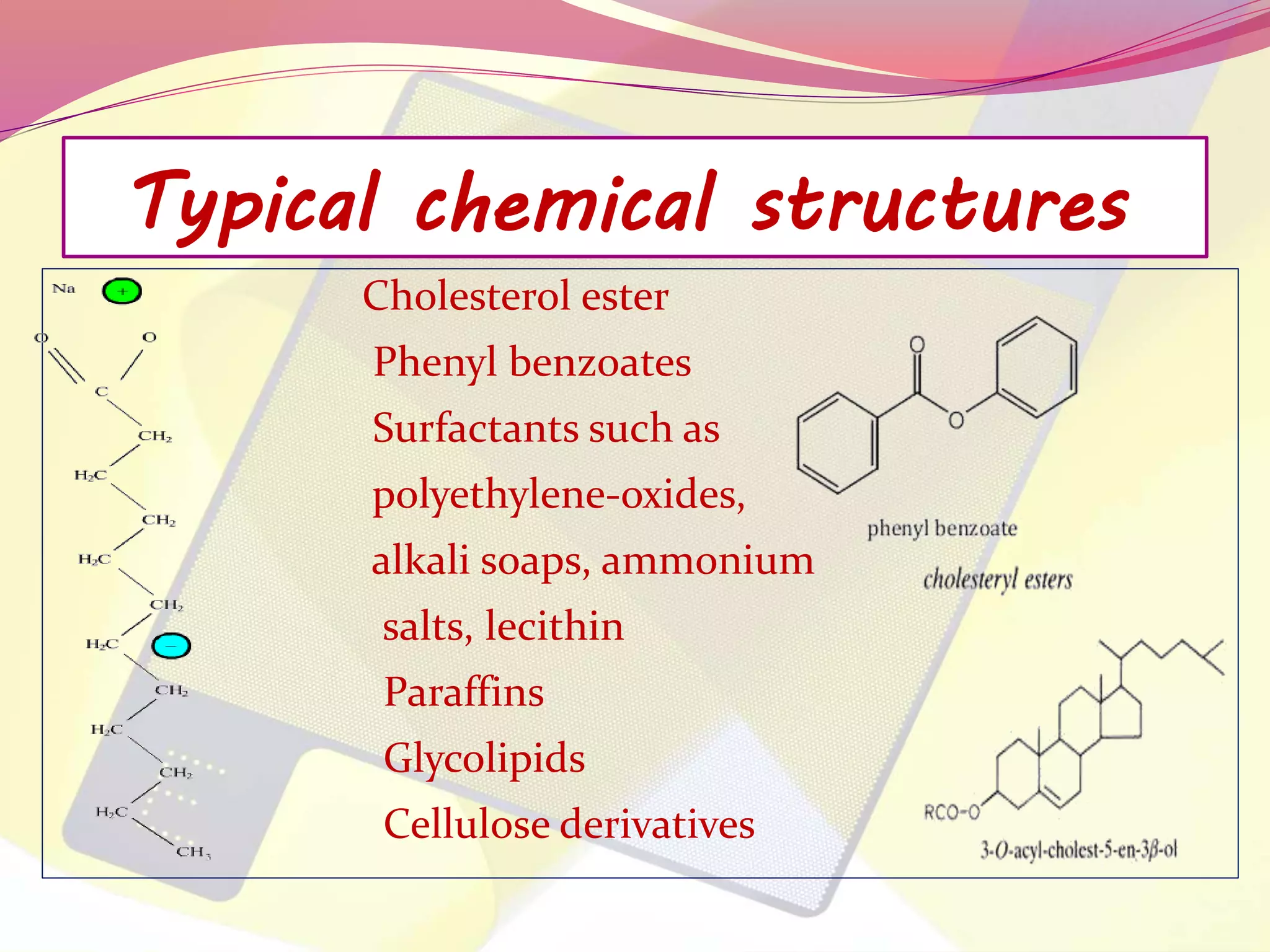
Typical chemical structures 
Cholesterol ester 
Phenyl benzoates 
Surfactants such as 
polyethylene-oxides, 
alkali soaps, ammonium 
salts, lecithin 
Paraffins 
Glycolipids 
Cellulose derivatives
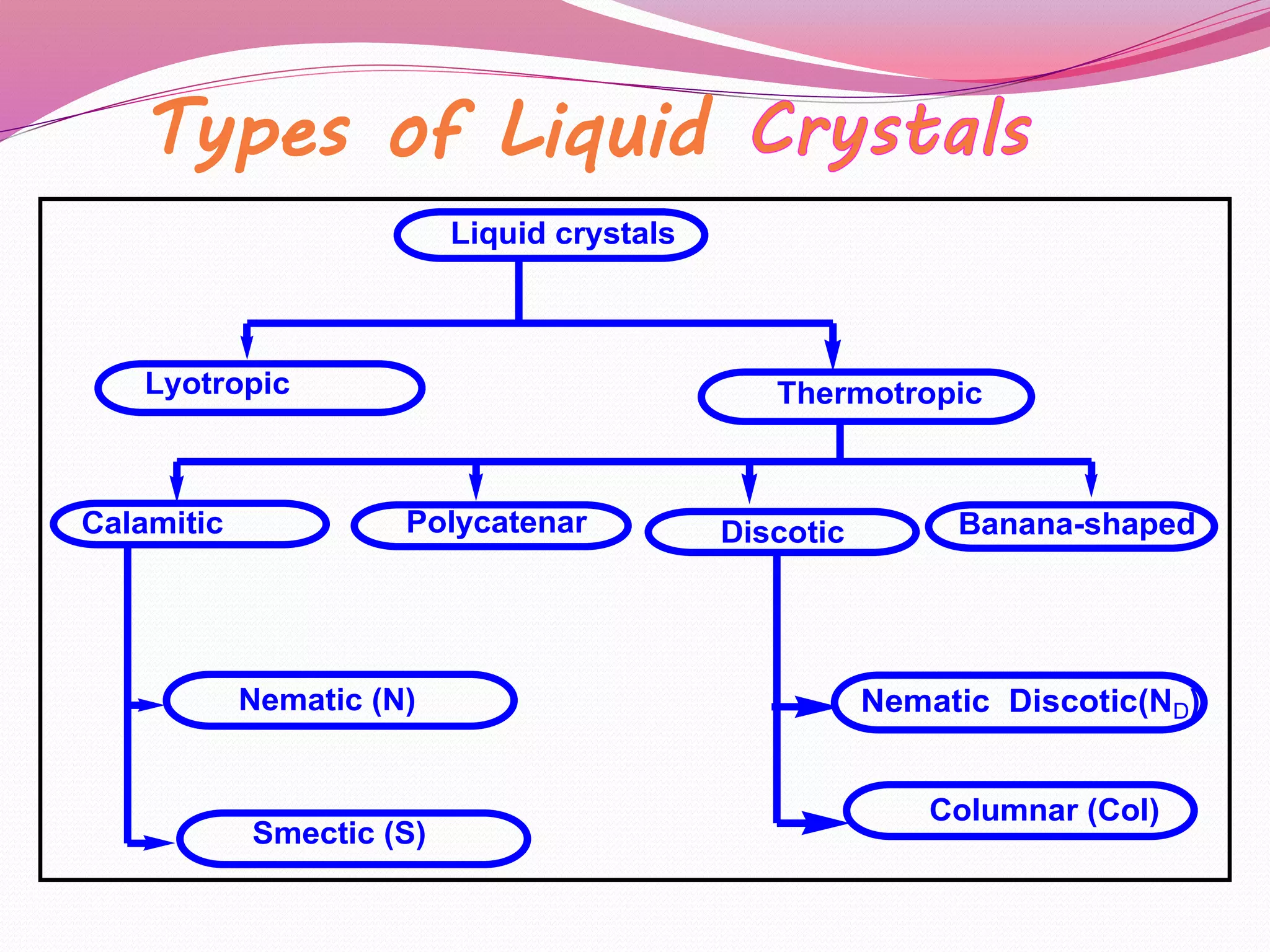
Types of Liquid 
Liquid crystals 
Lyotropic Thermotropic 
Calamitic Polycatenar Discotic Banana-shaped 
Nematic (N) 
Smectic (S) 
Nematic Discotic(ND) 
Columnar (Col)
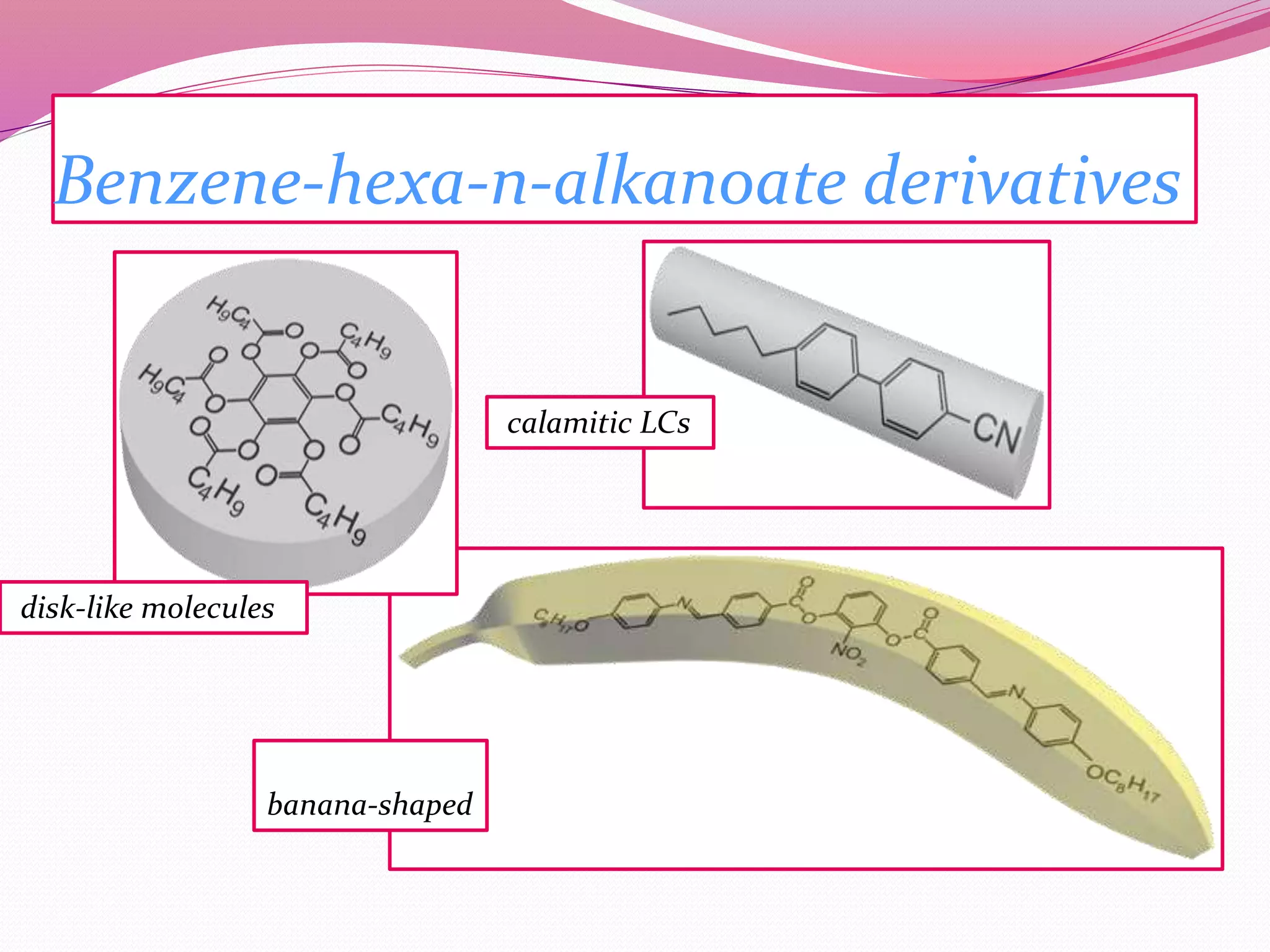
Benzene-hexa-n-alkanoate derivatives 
disk-like molecules 
banana-shaped 
calamitic LCs
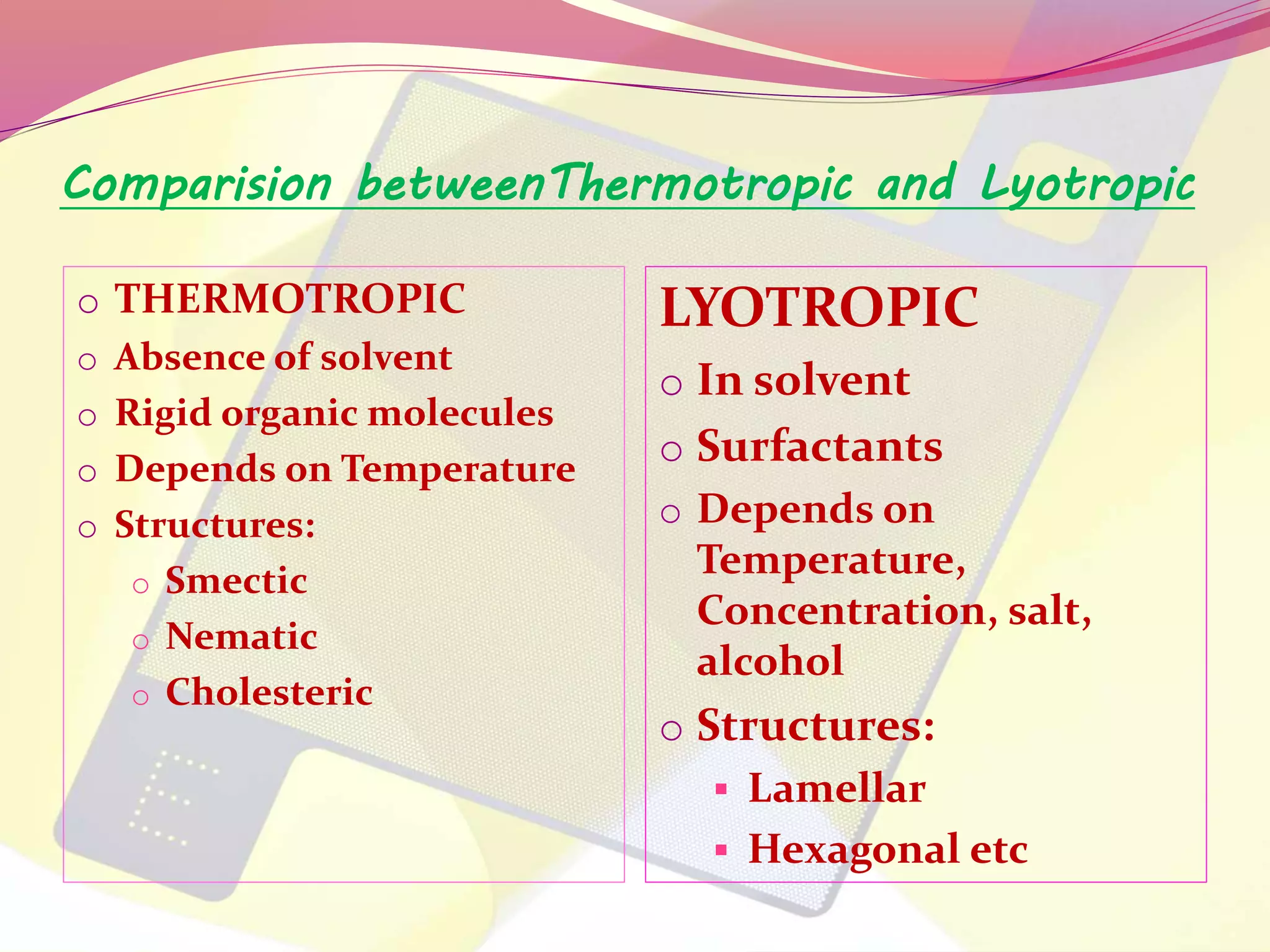
Comparision betweenThermotropic and Lyotropic 
o THERMOTROPIC 
o Absence of solvent 
o Rigid organic molecules 
o Depends on Temperature 
o Structures: 
o Smectic 
o Nematic 
o Cholesteric 
LYOTROPIC 
o In solvent 
o Surfactants 
o Depends on 
Temperature, 
Concentration, salt, 
alcohol 
o Structures: 
 Lamellar 
 Hexagonal etc
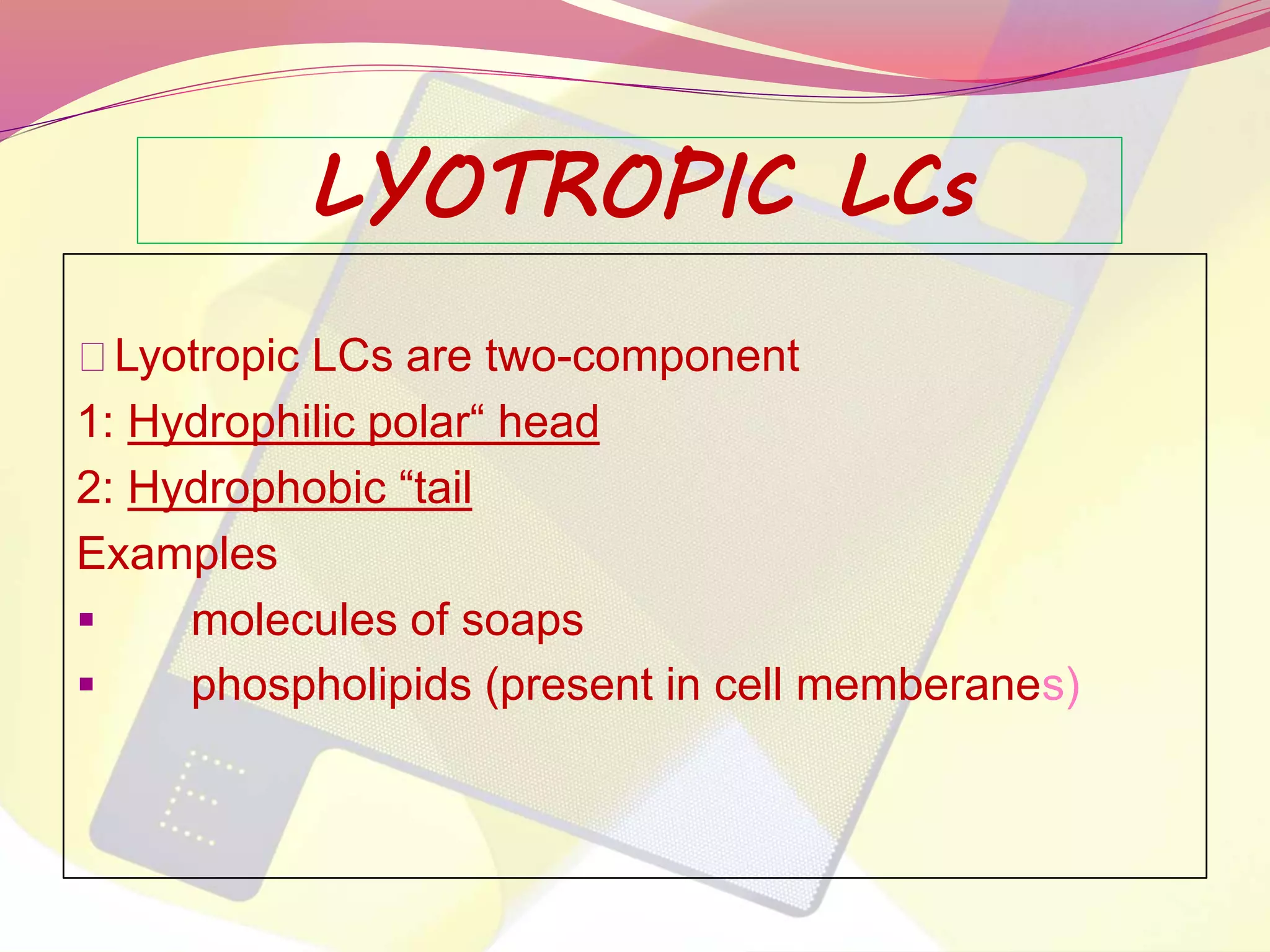
LYOTROPIC LCs 
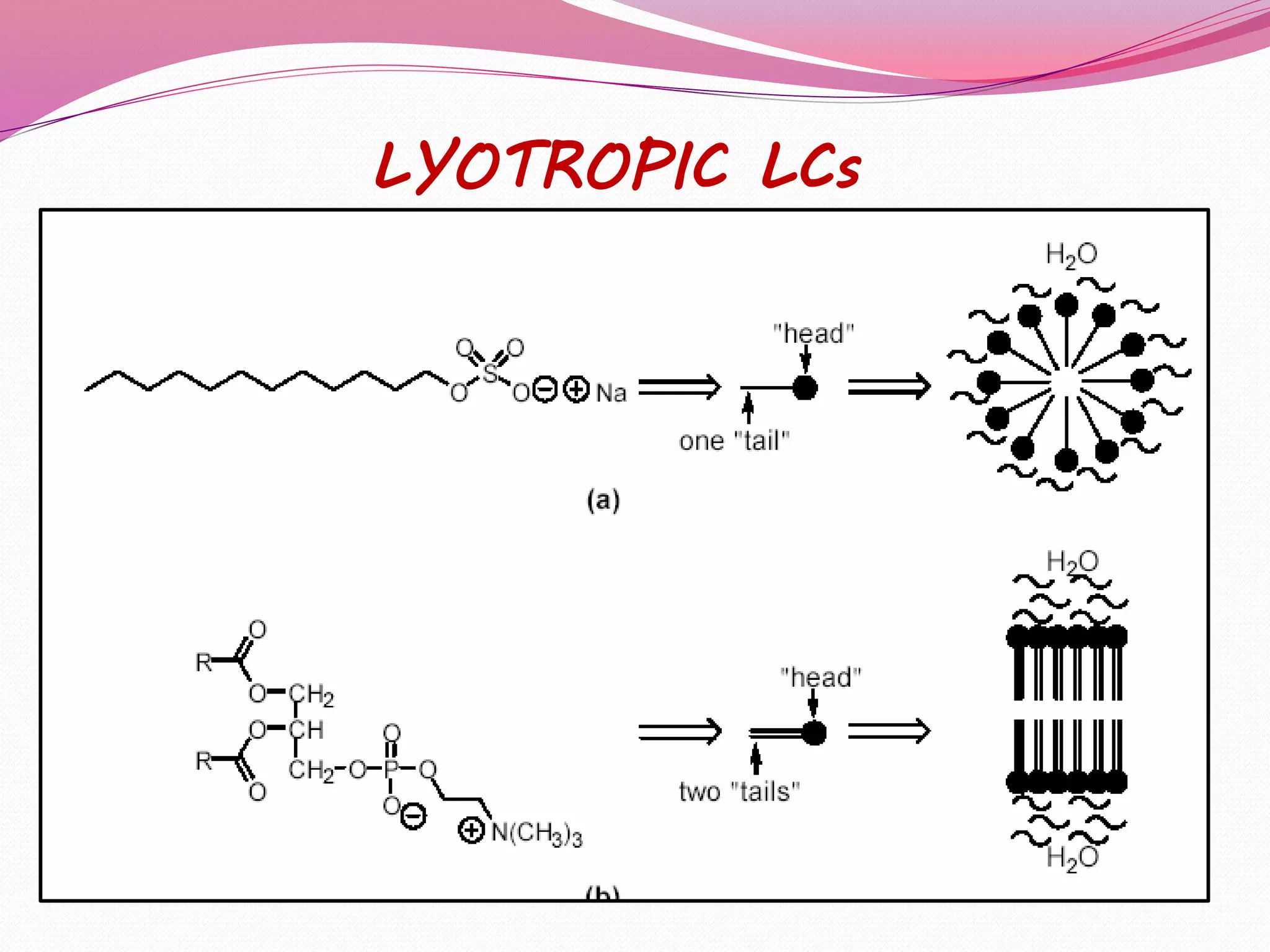
Lyotropic LCs are two-component 
1: Hydrophilic polar“ head 
2: Hydrophobic “tail 
Examples 
 molecules of soaps 
 phospholipids (present in cell memberanes)
LYOTROPIC LCs
As temperature increases… 
o The first liquid crystal phase is the smectic A, where 
there is layer-like arrangement as well as translational and 
rotational motion of the molecules. 
o A further increase in temperature leads to the nematic 
phase, where the molecules rapidly diffuse out of the 
initial lattice structure and from the layer-like arrangement 
as well. 
o At the highest temperatures, the material becomes an 
isotropic liquid where the motion of the molecules 
changes yet again.
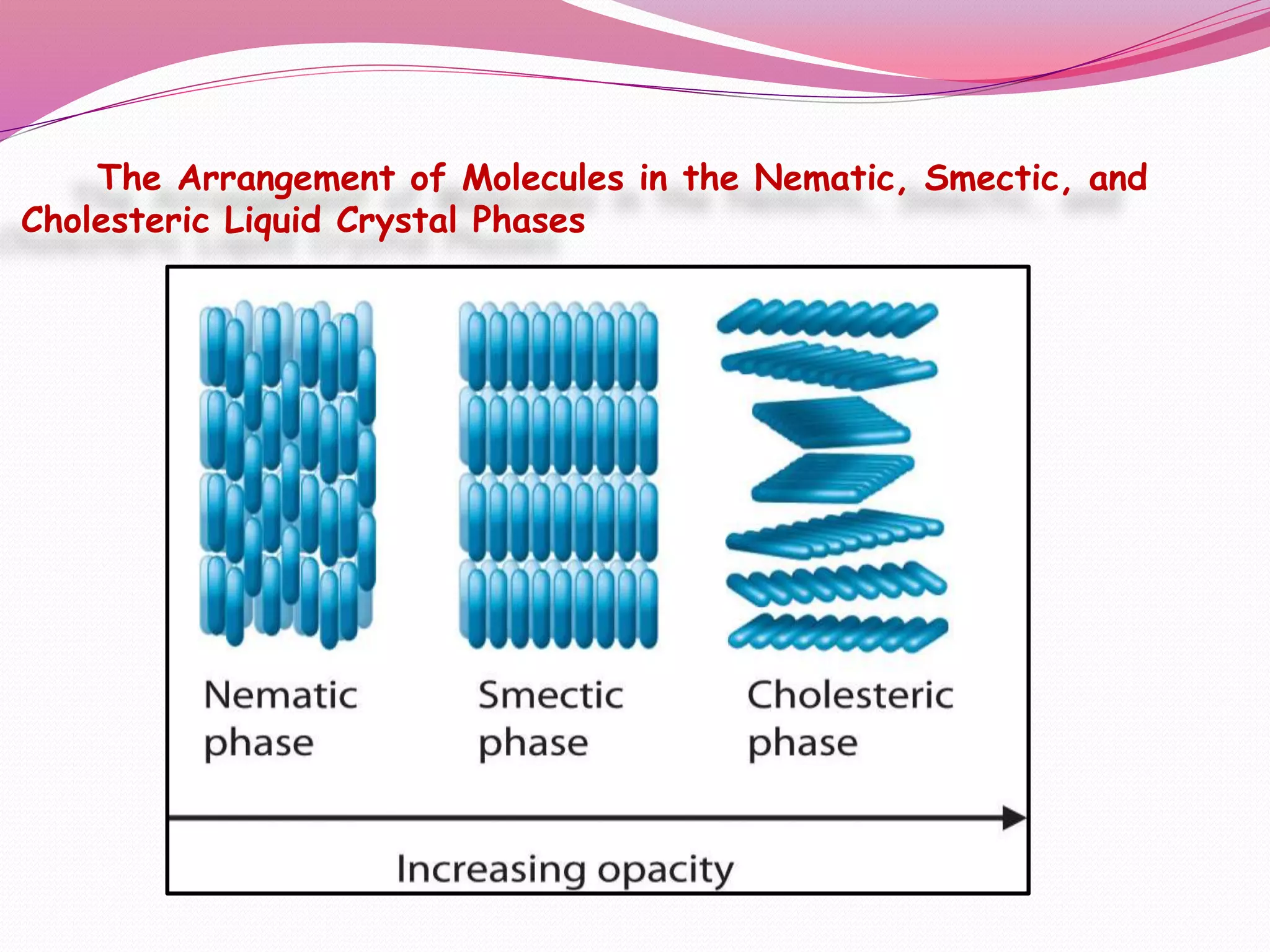
The Arrangement of Molecules in the Nematic, Smectic, and 
Cholesteric Liquid Crystal Phases
Stuctural phases of liquid crystal 
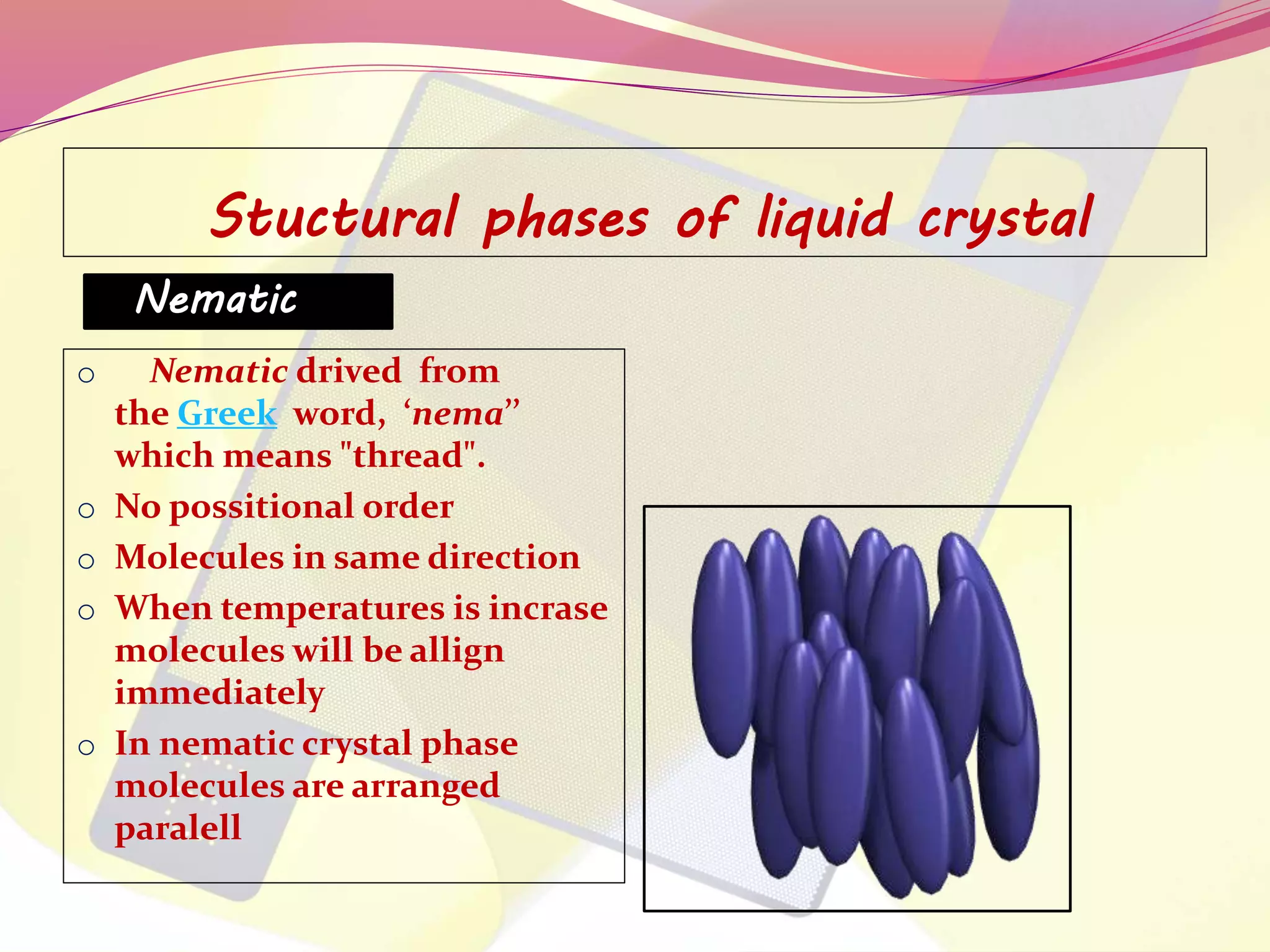
Nematic 
o Nematic drived from 
the Greek word, ‘nema’’ 
which means "thread". 
o No possitional order 
o Molecules in same direction 
o When temperatures is incrase 
molecules will be allign 
immediately 
o In nematic crystal phase 
molecules are arranged 
paralell
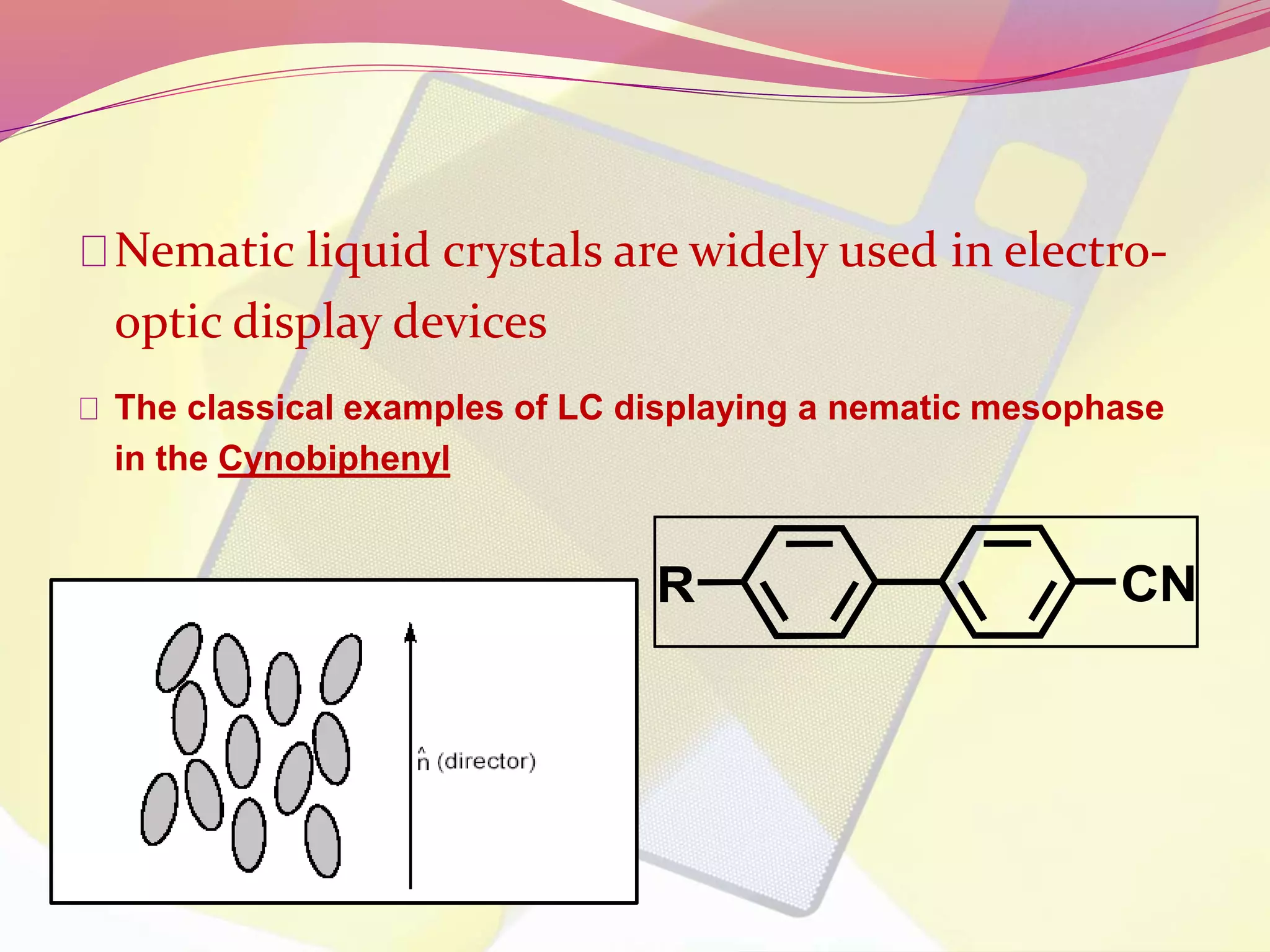
Nematic liquid crystals are widely used in electro-optic 
display devices 
The classical examples of LC displaying a nematic mesophase 
in the Cynobiphenyl 
R CN
Cholesteric 
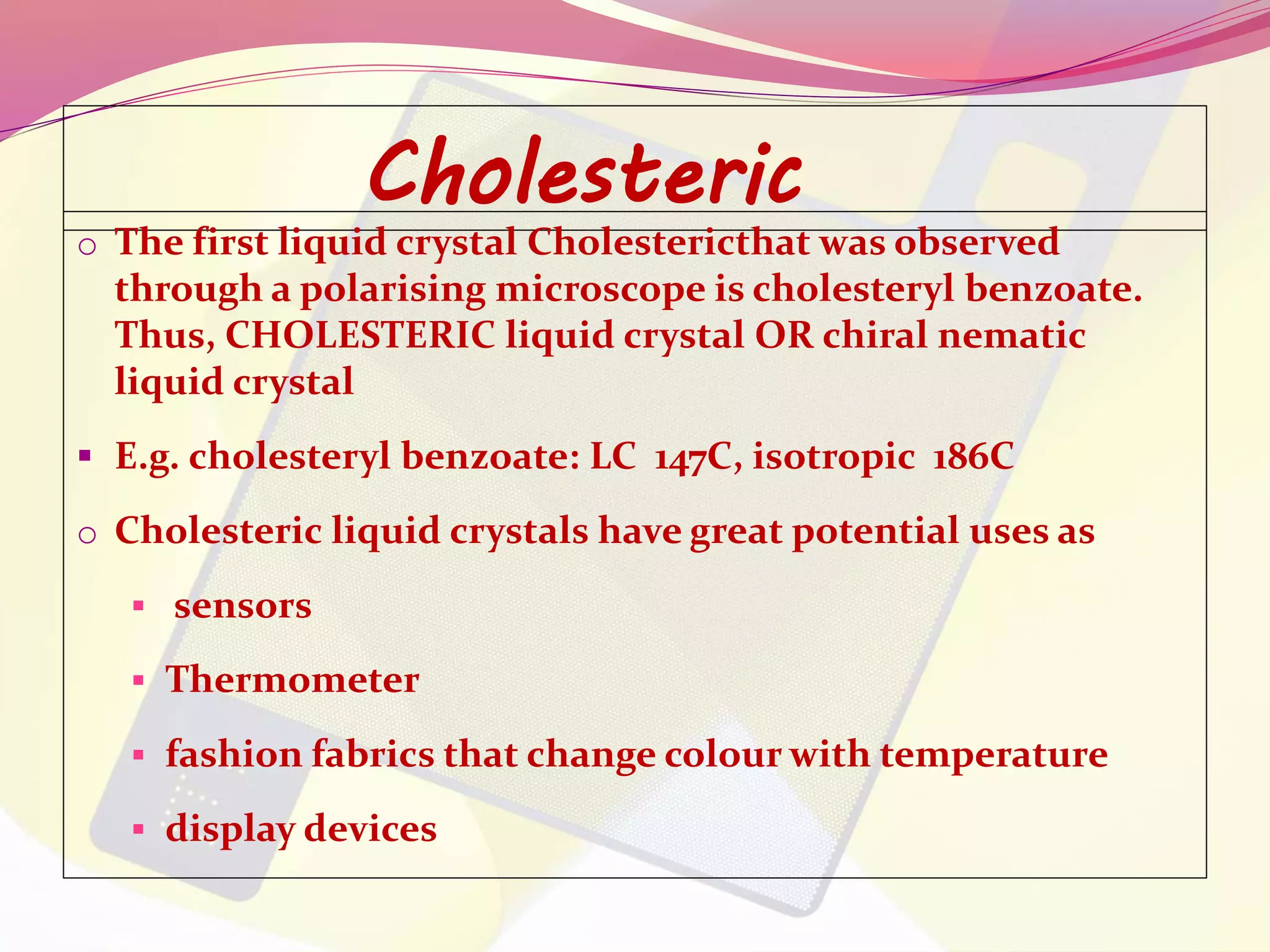
o The first liquid crystal Cholestericthat was observed 
through a polarising microscope is cholesteryl benzoate. 
Thus, CHOLESTERIC liquid crystal OR chiral nematic 
liquid crystal 
 E.g. cholesteryl benzoate: LC 147C, isotropic 186C 
o Cholesteric liquid crystals have great potential uses as 
 sensors 
 Thermometer 
 fashion fabrics that change colour with temperature 
 display devices
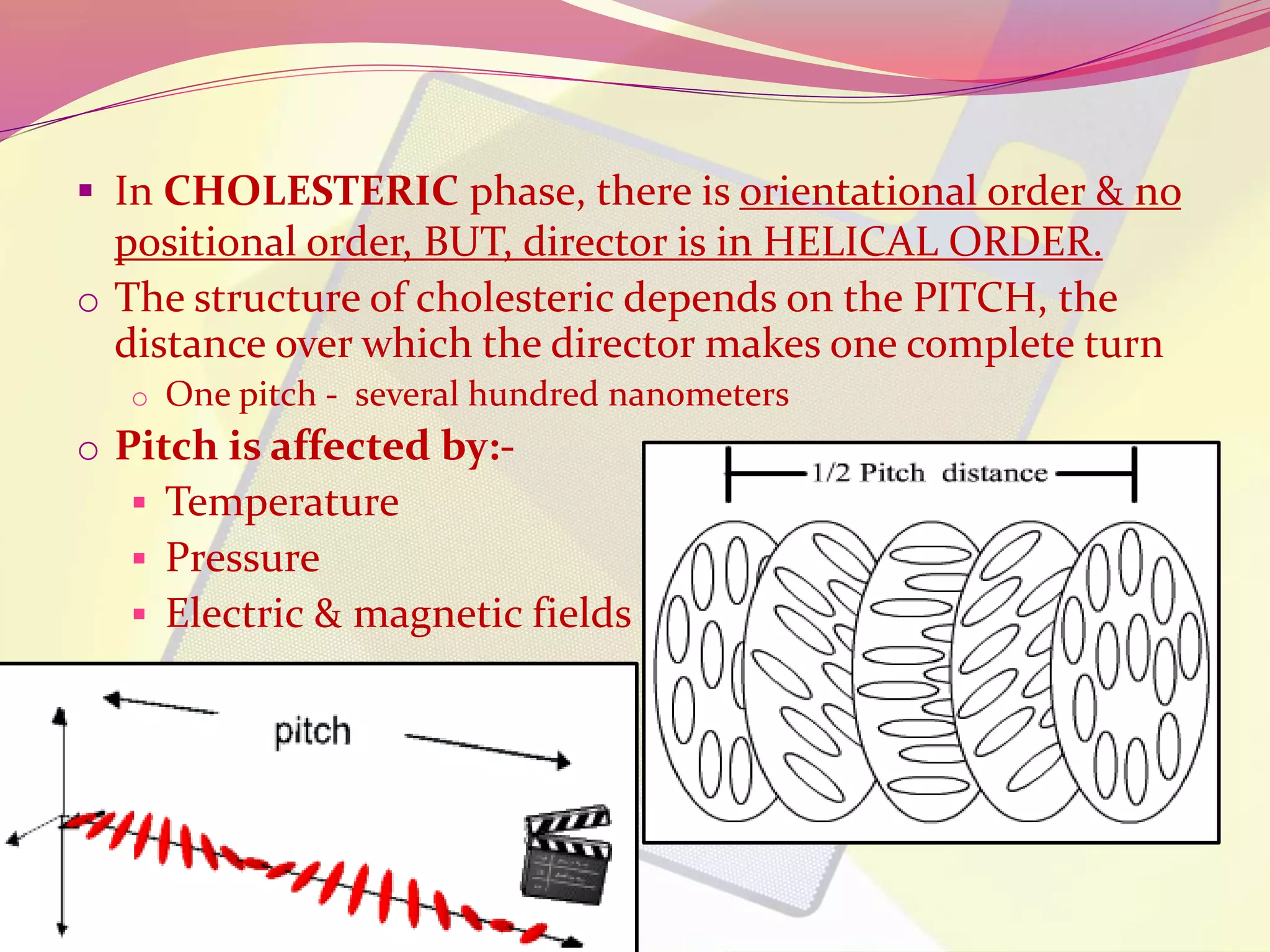
 In CHOLESTERIC phase, there is orientational order & no 
positional order, BUT, director is in HELICAL ORDER. 
o The structure of cholesteric depends on the PITCH, the 
distance over which the director makes one complete turn 
o One pitch - several hundred nanometers 
o Pitch is affected by:- 
 Temperature 
 Pressure 
 Electric & magnetic fields
SMECTIC 
o SMECTIC phase occurs at temperature below 
nematic or cholesteric 
oMolecules align themselves approx. parallel & tend 
to arrange in layers 
o Not all positional order is destroyed when a 
crystal melts to form a smectic liquid crystal 
o Chiral smectic C liquid crystals are useful in LCDS
Smectic 
o SMECTIC phase occurs at temperature 
below nematic or cholesteric 
o Molecules align themselves approx. parallel 
& tend to arrange in layers 
o Chiral smectic C liquid crystals are useful in 
LCDS 
Eample: 4,4’’’ – Bis-nonyloxy-[1,1’;1’’;4’’,1’’’] 
quaterphenyl (2)
LIQUID CRYSTAL POLYMERS 
o When liquid crystal polymers solidify, the liquid 
crystal structure ‘freeze in’ 
o This results in materials of high tensile strength & in 
some cases unusual electro-optical behaviour 
o E.g. Kevlar aramid fibre – bullet-proof vest & airplane 
bodies (aromatic polyamide)
Technological Application 
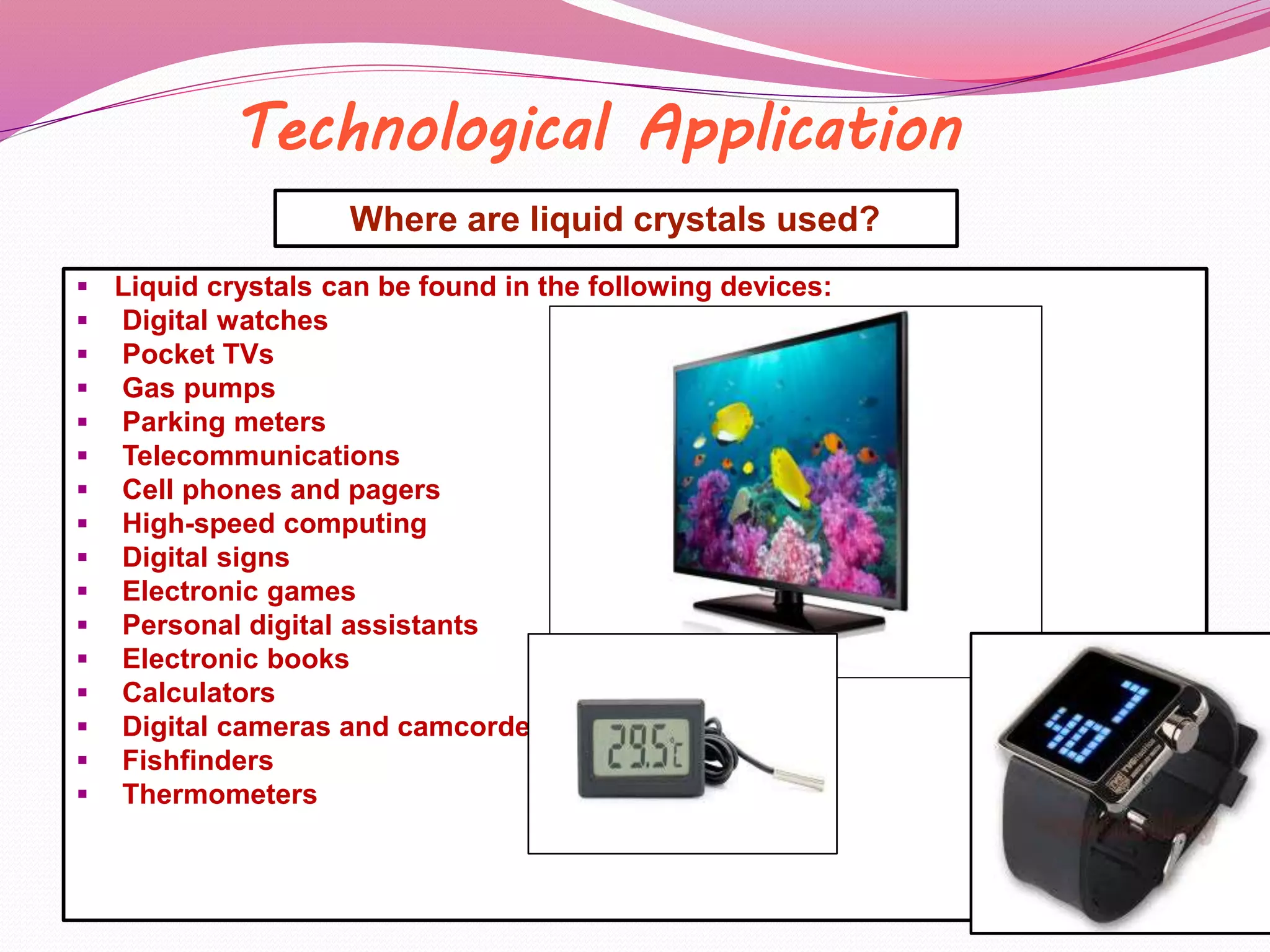
Where are liquid crystals used? 
 Liquid crystals can be found in the following devices: 
 Digital watches 
 Pocket TVs 
 Gas pumps 
 Parking meters 
 Telecommunications 
 Cell phones and pagers 
 High-speed computing 
 Digital signs 
 Electronic games 
 Personal digital assistants 
 Electronic books 
 Calculators 
 Digital cameras and camcorders 
 Fishfinders 
 Thermometers
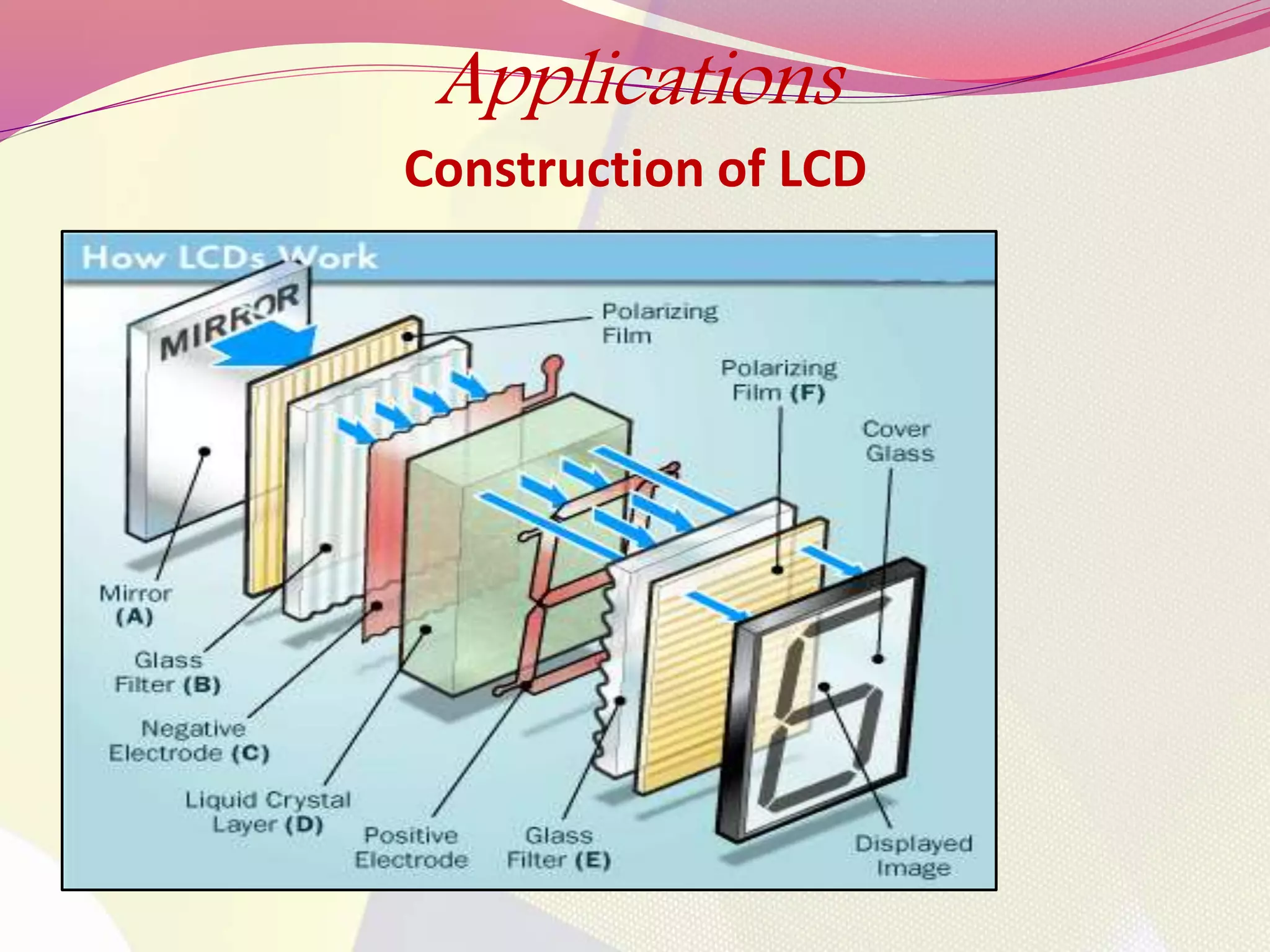
Applications 
Construction of LCD
Conclusion 
We know today that many chemical compounds can 
exist in the liquid crystal state, such as cholesteryl 
benzoate. The world can focus on ways to make this 
product useful in society. Over the last century many 
applications such as the detection of hot points in 
microcircuits, the findings of fractures or tumors in 
humans and the conversion of infared images have 
become accessible due to the understanding of pitch 
in a liquid crystal.
References 
1: P.G de Gennes, Port.j , 2010 “The Physics of Liquid Crystals”, ref 5. 
2: M. J. Stephen, Excellent review of basic properties 
3: J. P. Straley “Physics of liquid crystals”, Ref. [2]. 
4: D. Fincham, rotational motion of linear molecules, 1984 , 47–48. 
5: http://www.slideshare.net/Nawarajintermediate/liquid-crystal-and-its-application# 
6: Stegemeyer H, Blumel T, Hiltrop K, Onusseit H and Porsch F, Liq. Cryst. 1986,1-28. 
7: Tanimoto K and Crooker P,1985, Phys. Rev. A 32 1893-5. 
8: Tsvetkov V, Acta Physicicochim (USSR) , 1942 (16- 132). 
9: van der Meer B Wand Vertogen G, Phys. Lett, 1976. 59A( 279-81). 
10: Wright D C and Mermin N D, Phys. Rev, 1985. A 31 3498-500. 
11:Thoen J. 1988 Phys. Rev. A 37 1754-9 
12 Tsvetkov V 1942 Acta Physicicochim (USSR) 16 132 
13 Tanimoto K and Crooker P P 1984 Phys. Rev. A 29 1566-7 13 Tanimoto K, Crooker P P 
and Koch G C 1985 Phys. Rev. A 32 1893-5
liquid crystals and their applications

liquid crystals and their applications

  • 2.
    Liquid Crystals andtheir Applications Muhammad Minhas Azeem Roll No 7616 Govt College University Faisalabad Department of Applied Chemistry
  • 3.
  • 4.
    States of mattters 1: Solid 2 : Liquid 3: Gass 4:Liquid crystals 1 :Solid o All Soilds have fix shape, fix volume, ductile and high melting and boiling point. oIt is due to solids have high attrective forces among the atoms and molecules which holds the atom together. SiO² Quartz
  • 5.
    Liquid Stucture ofliquid molecules o Attractive forces between the molecules is weak as compared to the soild but strong as compair to gass. o The molecules of liquids have more empty spaces as compair to the soild , move aroud with each other but molecules remain close to each other so fluid donot have fix shape and adapted the shape of container.
  • 6.
    Gas Stucture ofgas molecules o Gases have less attractive forces among the molecules is weak. o The molecules are faraway from each. o Gases move randomly so the molecules of gass will expand and fill the container.
  • 7.
    Liquid Crystals Whatis a liquid crystal? What is so special about liquid crystals? o A liquid crystals is a phase between solid and liquid states(phases) Solidify Melt Liquid Crystal Intermediate Phase Heat Cool Heat Cool
  • 8.
    Examples Example ofa compound that shows no LCs phase heat heat Ice Cube Water Steam solid crystalline water; 3- (dimensional) degrees of order liquid water 0 degrees of order gaseous water 0 degrees of order Example of a compound that shows LCs phases Crystals of a solid organic compound Nematic liquid crystals phase Isotropic liquid Crystals of a solid organic compound Smectic liquid crystal phase Isotropic liquid heat heat heat heat 3 degrees of order Looks like milk 1 degree of order 0 degrees of order
  • 9.
  • 10.
    A Brief Historyof LCs Liquid crystals was discoverd by Reinitzer and Lehmann in 1888. cholesteryl benzoate showed two melting points each. The crystal of this material melted at 145.5 oC into a cloudy fluid, which upon further heating to 178.5 oC became clear Cholesteryl heat heat 145.5 0C 178.5 0C benzoate Lehmann observed by using polarised optical microscope “and observed crystal that were nearly liquid O O R FLEXIBLE RIGID FLEXIBLE O * * * * * * * * R O
  • 11.
    History In 1973the discovery of the most technologically and commercial important class of liquid crystals , 4-alkyl-4-’cyanobiphenyl.This material found in calculators or mobile phones NC C5H11 24oC 35oC K N I Reinitze
  • 12.
    LCD: Multi DisciplinaryArea of Research Physicist Electrical& Electronic Engineering Organic and Material Chemists Theory, law and various Physical properties Device (manufactures) Technological application Preparation of various types of liquid crystalline compounds and characterisati on
  • 13.
    Crystals vs LiquidCrystals o A crystal is a highly ordered structure which possesses long-range positional & orientational order o For many substances these two types of order are destroyed simultaneously when the crystal melts to form a liquid o For some substances, these orders are destroyed in stages. These are liquid crystals
  • 14.
    Properties of liquidcrystals o Liquid crystal can flow like a liquid, due to loss of positional order o Liquid crystal is optically birefringent, due to its orientational order o Transition from crystalline solids to liquid crystals caused by a change of temperature – gives rise to THERMOTROPIC liquid crystals o Substances that are most likely to form a liquid crystal phase at a certain temperature are molecules that are ELONGATED & have some degree of RIGIDITY
  • 15.
    Typical chemical structures Cholesterol ester Phenyl benzoates Surfactants such as polyethylene-oxides, alkali soaps, ammonium salts, lecithin Paraffins Glycolipids Cellulose derivatives
  • 17.
    Types of Liquid Liquid crystals Lyotropic Thermotropic Calamitic Polycatenar Discotic Banana-shaped Nematic (N) Smectic (S) Nematic Discotic(ND) Columnar (Col)
  • 18.
    Benzene-hexa-n-alkanoate derivatives disk-likemolecules banana-shaped calamitic LCs
  • 19.
    Comparision betweenThermotropic andLyotropic o THERMOTROPIC o Absence of solvent o Rigid organic molecules o Depends on Temperature o Structures: o Smectic o Nematic o Cholesteric LYOTROPIC o In solvent o Surfactants o Depends on Temperature, Concentration, salt, alcohol o Structures:  Lamellar  Hexagonal etc
  • 20.
    LYOTROPIC LCs LyotropicLCs are two-component 1: Hydrophilic polar“ head 2: Hydrophobic “tail Examples  molecules of soaps  phospholipids (present in cell memberanes)
  • 21.
  • 22.
    As temperature increases… o The first liquid crystal phase is the smectic A, where there is layer-like arrangement as well as translational and rotational motion of the molecules. o A further increase in temperature leads to the nematic phase, where the molecules rapidly diffuse out of the initial lattice structure and from the layer-like arrangement as well. o At the highest temperatures, the material becomes an isotropic liquid where the motion of the molecules changes yet again.
  • 23.
    The Arrangement ofMolecules in the Nematic, Smectic, and Cholesteric Liquid Crystal Phases
  • 24.
    Stuctural phases ofliquid crystal Nematic o Nematic drived from the Greek word, ‘nema’’ which means "thread". o No possitional order o Molecules in same direction o When temperatures is incrase molecules will be allign immediately o In nematic crystal phase molecules are arranged paralell
  • 25.
    Nematic liquid crystalsare widely used in electro-optic display devices The classical examples of LC displaying a nematic mesophase in the Cynobiphenyl R CN
  • 26.
    Cholesteric o Thefirst liquid crystal Cholestericthat was observed through a polarising microscope is cholesteryl benzoate. Thus, CHOLESTERIC liquid crystal OR chiral nematic liquid crystal  E.g. cholesteryl benzoate: LC 147C, isotropic 186C o Cholesteric liquid crystals have great potential uses as  sensors  Thermometer  fashion fabrics that change colour with temperature  display devices
  • 27.
     In CHOLESTERICphase, there is orientational order & no positional order, BUT, director is in HELICAL ORDER. o The structure of cholesteric depends on the PITCH, the distance over which the director makes one complete turn o One pitch - several hundred nanometers o Pitch is affected by:-  Temperature  Pressure  Electric & magnetic fields
  • 28.
    SMECTIC o SMECTICphase occurs at temperature below nematic or cholesteric oMolecules align themselves approx. parallel & tend to arrange in layers o Not all positional order is destroyed when a crystal melts to form a smectic liquid crystal o Chiral smectic C liquid crystals are useful in LCDS
  • 29.
    Smectic o SMECTICphase occurs at temperature below nematic or cholesteric o Molecules align themselves approx. parallel & tend to arrange in layers o Chiral smectic C liquid crystals are useful in LCDS Eample: 4,4’’’ – Bis-nonyloxy-[1,1’;1’’;4’’,1’’’] quaterphenyl (2)
  • 30.
    LIQUID CRYSTAL POLYMERS o When liquid crystal polymers solidify, the liquid crystal structure ‘freeze in’ o This results in materials of high tensile strength & in some cases unusual electro-optical behaviour o E.g. Kevlar aramid fibre – bullet-proof vest & airplane bodies (aromatic polyamide)
  • 31.
    Technological Application Whereare liquid crystals used?  Liquid crystals can be found in the following devices:  Digital watches  Pocket TVs  Gas pumps  Parking meters  Telecommunications  Cell phones and pagers  High-speed computing  Digital signs  Electronic games  Personal digital assistants  Electronic books  Calculators  Digital cameras and camcorders  Fishfinders  Thermometers
  • 32.
  • 33.
    Conclusion We knowtoday that many chemical compounds can exist in the liquid crystal state, such as cholesteryl benzoate. The world can focus on ways to make this product useful in society. Over the last century many applications such as the detection of hot points in microcircuits, the findings of fractures or tumors in humans and the conversion of infared images have become accessible due to the understanding of pitch in a liquid crystal.
  • 34.
    References 1: P.Gde Gennes, Port.j , 2010 “The Physics of Liquid Crystals”, ref 5. 2: M. J. Stephen, Excellent review of basic properties 3: J. P. Straley “Physics of liquid crystals”, Ref. [2]. 4: D. Fincham, rotational motion of linear molecules, 1984 , 47–48. 5: http://www.slideshare.net/Nawarajintermediate/liquid-crystal-and-its-application# 6: Stegemeyer H, Blumel T, Hiltrop K, Onusseit H and Porsch F, Liq. Cryst. 1986,1-28. 7: Tanimoto K and Crooker P,1985, Phys. Rev. A 32 1893-5. 8: Tsvetkov V, Acta Physicicochim (USSR) , 1942 (16- 132). 9: van der Meer B Wand Vertogen G, Phys. Lett, 1976. 59A( 279-81). 10: Wright D C and Mermin N D, Phys. Rev, 1985. A 31 3498-500. 11:Thoen J. 1988 Phys. Rev. A 37 1754-9 12 Tsvetkov V 1942 Acta Physicicochim (USSR) 16 132 13 Tanimoto K and Crooker P P 1984 Phys. Rev. A 29 1566-7 13 Tanimoto K, Crooker P P and Koch G C 1985 Phys. Rev. A 32 1893-5