LIQUID CRYSTAL
AND IT’S APPLICATION
ROLL NO. NAME OF STUDENT
1413037 KSHITIJ PATIL
1413040 VAIBHAV RAO
1413052 RINKOO SINGH
1413057 TANVI VISHWASRAW
1413058 SOURABH WALVEKAR
1413055 SIDDESH VILAS PAWAR
ROLL NO NAME OF STUDENT
1413033 TEJUL PANDIT
1413034 SHUBHAM PAREEK
1413035 VISHAL PATANGRAO
1413036 RAHUL PATEL
ROLL NO. NAME OF STUDENT
1413037 KSHITIJ PATIL
1413038 TRISHALA P PAWAR
1413039 VIPUL RAJDERKAR
1413040 VAIBHAV RAO
ROLL NO. NAME OF STUDENT
1413041 BHUSHAN SABADRA
1413042 MEHUL SANYASHIV
ROLL NO: NAME OF STUDENT
1413043 SIDDHESH SAWANT
1413044 CHIRAG SHAH
1413045 JANAVI SHAH
1413046 NIRAV SHAH
1413047 KUNJ SHAH
1413048 YASH SHAH
1413049 MOHAMED SHAYERWALA
ROLL NO: NAME OF STUDENT
1413050 RUTVI SHETH
1413051 ROHIT SHIVTHARE
1413052 RINKOO SINGH
1413053 AKASH SUMARIA
1413054 MONISH THAKKAR
1413055 SIDDESH PAWAR
1413056 KRUNAL VANI
1413057 TANVI VISHWASRAW
1413058 SOURABH WALVEKAR
1413059 VAIBHAV YADAV
1413060 CHIRAG THAKKAR
1413061 RAKSHIT RATHOD
1413062 SAPNA THAKKAR
1413063 MANSI SHAH
DEFINITION
Liquid crystals (LCs) are matter in a state that has
properties between those of conventional liquid and
those of solid crystal.
For instance, a liquid crystal may flow like a
liquid, but its molecules may be oriented in a
crystal-like way
Also defined on..
There are many different types of liquid-crystal
phases, which can be distinguished by their
different optical properties (such as
birefringence).
LIQUID CRYSTAL..
A state that occurs between a solid & a liquid
Possess properties characteristics of both
liquids & crystalline solids
Also possess properties not found in either
liquids or solids
May response to external perturbations & some
changes colour with temperature
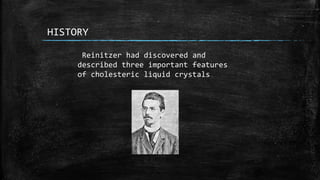
HISTORY
• In 1888, Austrian botanical physiologist Friedrich
Reinitzer, working at the Karl-Ferdinands-
Universitat, examined the physico-chemical properties
of various derivatives of cholesterol which now
belong to the class of materials known as cholesteric
liquid crystals.
• At 145.5 °C (293.9 °F) it melts into a cloudy liquid,
and at 178.5 °C (353.3 °F) it melts again and the
cloudy liquid becomes clear. The phenomenon is
reversible.
HISTORY
Reinitzer had discovered and
described three important features
of cholesteric liquid crystals
1.THERMOTROPIC PHASE
2.LYOTROPIC PHASE
3.METALLOTROPIC PHASE
THEY CAN BE DIVIDED INTO:
Thermotropic liquid crystals are divided as:
(Phase transition depends on temperature)
Nematic
Smectic
Cholesteric/ Chiral
Blue
Discotic
THERMOTROPIC
AS TEMPERATURE INCREASES...
▪ The first liquid crystal phase is the smectic A , where
there is layer-like arrangement as well as translational
and rotational motion of the molecules.
▪ A further increase in temperature leads to the nematic
phase, where the molecules rapidly diffuse out of the
initial lattice structure and from the layer-like
arrangement as well.
▪ At the highest temperatures, the material becomes an
isotropic liquid where the motion of the molecules
changes yet again
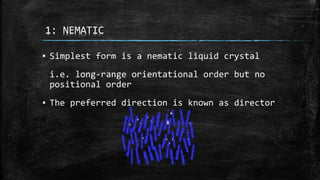
1: NEMATIC
▪ Simplest form is a nematic liquid crystal
i.e. long-range orientational order but no
positional order
▪ The preferred direction is known as director
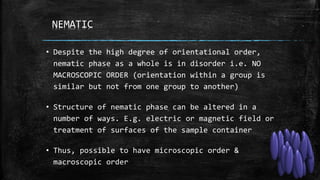
NEMATIC
• Despite the high degree of orientational order,
nematic phase as a whole is in disorder i.e. NO
MACROSCOPIC ORDER (orientation within a group is
similar but not from one group to another)
• Structure of nematic phase can be altered in a
number of ways. E.g. electric or magnetic field or
treatment of surfaces of the sample container
• Thus, possible to have microscopic order &
macroscopic order
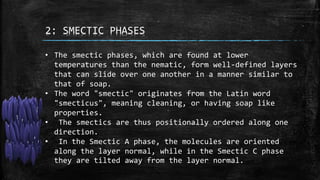
2: SMECTIC PHASES
• The smectic phases, which are found at lower
temperatures than the nematic, form well-defined layers
that can slide over one another in a manner similar to
that of soap.
• The word "smectic" originates from the Latin word
"smecticus", meaning cleaning, or having soap like
properties.
• The smectics are thus positionally ordered along one
direction.
• In the Smectic A phase, the molecules are oriented
along the layer normal, while in the Smectic C phase
they are tilted away from the layer normal.
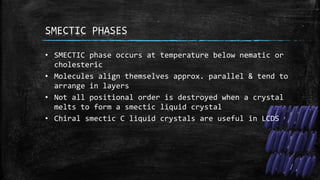
SMECTIC PHASES
• SMECTIC phase occurs at temperature below nematic or
cholesteric
• Molecules align themselves approx. parallel & tend to
arrange in layers
• Not all positional order is destroyed when a crystal
melts to form a smectic liquid crystal
• Chiral smectic C liquid crystals are useful in LCDS
3:CHIRAL PHASES
▪ THE CHIRAL NEMATIC PHASE EXHIBITS CHIRALITY
(HANDEDNESS). THIS PHASE IS OFTEN CALLED THE
CHOLESTERIC PHASE BECAUSE IT WAS FIRST OBSERVED FOR
CHOLESTEROL DERIVATIVES
▪ ONLY CHIRAL MOLECULES (I.E., THOSE THAT HAVE NO
INTERNAL PLANES OF SYMMETRY) CAN GIVE RISE TO SUCH
A PHASE. THIS PHASE EXHIBITS A TWISTING OF THE
MOLECULES PERPENDICULAR TO THE DIRECTOR, WITH THE
MOLECULAR AXIS PARALLEL TO THE DIRECTOR.
CHIRAL PHASES
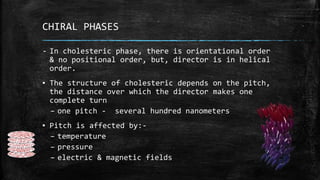
- In cholesteric phase, there is orientational order
& no positional order, but, director is in helical
order.
▪ The structure of cholesteric depends on the pitch,
the distance over which the director makes one
complete turn
– one pitch - several hundred nanometers
▪ Pitch is affected by:-
– temperature
– pressure
– electric & magnetic fields
4:BLUE PHASES
▪ Blue phases are liquid crystal phases that appear
in the temperature range between a chiral nematic
phase and an isotropic liquid phase.
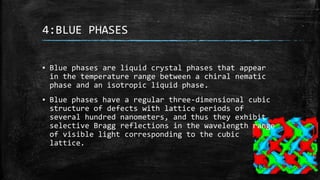
▪ Blue phases have a regular three-dimensional cubic
structure of defects with lattice periods of
several hundred nanometers, and thus they exhibit
selective Bragg reflections in the wavelength range
of visible light corresponding to the cubic
lattice.
4:BLUE PHASES
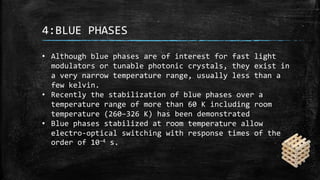
• Although blue phases are of interest for fast light
modulators or tunable photonic crystals, they exist in
a very narrow temperature range, usually less than a
few kelvin.
• Recently the stabilization of blue phases over a
temperature range of more than 60 K including room
temperature (260–326 K) has been demonstrated
• Blue phases stabilized at room temperature allow
electro-optical switching with response times of the
order of 10−4 s.
liquid crystals are divided as:
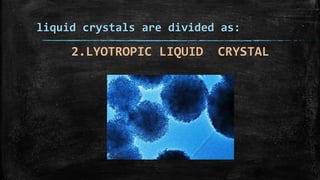
2.LYOTROPIC LIQUID CRYSTAL
LYOTROPIC LIQUID CRYSTAL
• A lyotropic liquid crystal consists of two or more
components that exhibit liquid-crystalline properties
in certain concentration ranges.
• In the lyotropic phases, solvent molecules fill the
space around the compounds to provide fluidity to the
system.
• In contrast to thermotropic liquid crystals, these
lyotropics have another degree of freedom of
concentration that enables them to induce a variety of
different phases.
LYOTROPIC LIQUID CRYSTAL
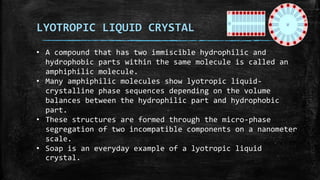
• A compound that has two immiscible hydrophilic and
hydrophobic parts within the same molecule is called an
amphiphilic molecule.
• Many amphiphilic molecules show lyotropic liquid-
crystalline phase sequences depending on the volume
balances between the hydrophilic part and hydrophobic
part.
• These structures are formed through the micro-phase
segregation of two incompatible components on a nanometer
scale.
• Soap is an everyday example of a lyotropic liquid
crystal.
LYOTROPIC LIQUID CRYSTAL
• A liquid crystalline material is called lyotropic if
phases having long-ranged orientational order are induced
by the addition of a solvent.
• Historically the term was used to describe materials
composed of amphiphilic molecules.
• Such molecules comprise a water-loving 'hydrophilic'
head-group (which may be ionic or non-ionic) attached to
a water-hating 'hydrophobic' group.
LYOTROPIC LIQUID CRYSTAL
• In principle, increasing the amphiphile concentration
beyond the point where lamellar phases are formed would
lead to the formation of the inverse topology lyotropic
phases, namely the inverse cubic phases, the inverse
hexagonal phase (HII) and the inverse micellar cubic
phase.
• In practice inverse topology phases are more readily
formed by amphiphiles that have at least two hyrocarbon
chains attached to a headgroup.
• The most abundant phospholipids that are found in cell
membranes of mammalian cells are examples of amphiphiles
that readily form inverse topology lyotropic phases.
liquid crystals are divided as:
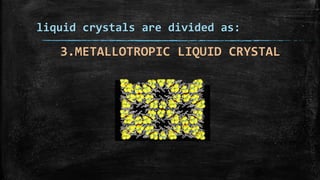
3.METALLOTROPIC LIQUID CRYSTAL
METALLOTROPIC LIQUID CRYSTAL
• Liquid crystal phases can also be based on low-melting
inorganic phases like ZnCl2 that have a structure formed
of linked tetrahedra and easily form glasses.
• The addition of long chain soap-like molecules leads to a
series of new phases that show a variety of liquid
crystalline behavior both as a function of the inorganic-
organic composition ratio and of temperature. This class
of materials has been named metallotropic.
METALLOTROPIC LIQUID CRYSTAL
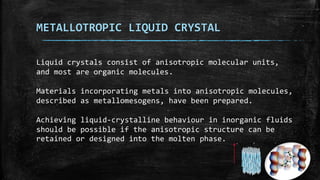
Liquid crystals consist of anisotropic molecular units,
and most are organic molecules.
Materials incorporating metals into anisotropic molecules,
described as metallomesogens, have been prepared.
Achieving liquid-crystalline behaviour in inorganic fluids
should be possible if the anisotropic structure can be
retained or designed into the molten phase.
PROPERTIES OF LIQUID CRYSTAL
▪ Liquid crystal can flow like a liquid, due to
loss of positional order
▪ Liquid crystal is optically birefringent, due to
its orientation order
▪ Transition from crystalline solids to liquid
crystals caused by a change of temperature –
gives rise to thermotropic liquid crystals
– substances that are most likely to form a liquid
crystal phase at a certain temperature are
molecules that are elongated & have some degree
of rigidity.
PROPERTIES OF LIQUID CRYSTAL
▪ Liquid crystal phases are generally
cloudy in appearance, which means that
they scatter light in much the same
way as colloids such as milk.
▪ This light scattering is a
consequence of fluctuating regions of
non-uniformity as small groups of
molecules form and disperse.
PROPERTIES OF LIQUID CRYSTAL
• The anisotropy of liquid crystals causes them to
exhibit birefringence. That is, light that enters
the crystal is broken up into two oppositely-polarized
rays that travel at different velocities.
• Observation of a birefringent materal between crossed
polarizing filters reveals striking patterns
and color effects.
PROPERTIES OF LIQUID CRYSTAL
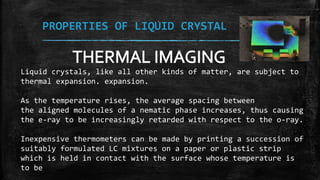
Liquid crystals, like all other kinds of matter, are subject to
thermal expansion. expansion.
As the temperature rises, the average spacing between
the aligned molecules of a nematic phase increases, thus causing
the e-ray to be increasingly retarded with respect to the o-ray.
Inexpensive thermometers can be made by printing a succession of
suitably formulated LC mixtures on a paper or plastic strip
which is held in contact with the surface whose temperature is
to be
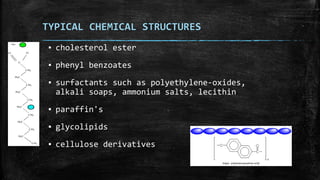
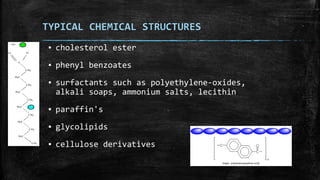
TYPICAL CHEMICAL STRUCTURES
▪ cholesterol ester
▪ phenyl benzoates
▪ surfactants such as polyethylene-oxides,
alkali soaps, ammonium salts, lecithin
▪ paraffin's
▪ glycolipids
▪ cellulose derivatives
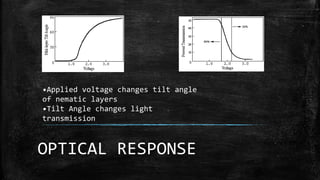
OPTICAL RESPONSE
•Applied voltage changes tilt angle
of nematic layers
•Tilt Angle changes light
transmission
•Abrupt tilt angle change with 270o
twist
•On/Off response faster
•210o used for grayscale
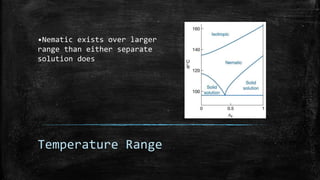
•Nematic exists over larger
range than either separate
solution does
Temperature Range
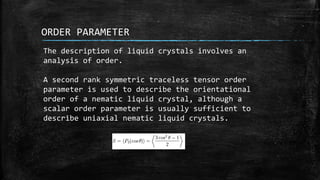
ORDER PARAMETER
The description of liquid crystals involves an
analysis of order.
A second rank symmetric traceless tensor order
parameter is used to describe the orientational
order of a nematic liquid crystal, although a
scalar order parameter is usually sufficient to
describe uniaxial nematic liquid crystals.
TYPICAL CHEMICAL STRUCTURES
▪ cholesterol ester
▪ phenyl benzoates
▪ surfactants such as polyethylene-oxides,
alkali soaps, ammonium salts, lecithin
▪ paraffin's
▪ glycolipids
▪ cellulose derivatives
TYPICAL APPLICATIONS...
Many more....
MAKING IT HAPPEN
• LCD displays
• dyes (cholesterics)
• advanced materials (Kevlar)
• membranes
• temperature measurement (by
changing colors)
• solvents for GC, NMR,
reactions, etc.
• Drug delivery
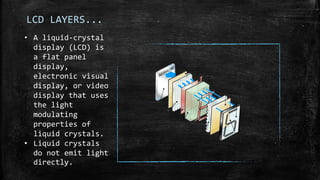
LCD LAYERS...
• A liquid-crystal
display (LCD) is
a flat panel
display,
electronic visual
display, or video
display that uses
the light
modulating
properties of
liquid crystals.
• Liquid crystals
do not emit light
directly.
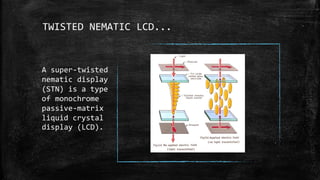
TWISTED NEMATIC LCD...
A super-twisted
nematic display
(STN) is a type
of monochrome
passive-matrix
liquid crystal
display (LCD).
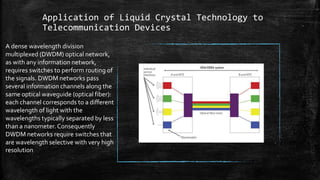
Application of Liquid Crystal Technology to
Telecommunication Devices
A dense wavelength division
multiplexed (DWDM) optical network,
as with any information network,
requires switches to perform routing of
the signals. DWDM networks pass
several information channels along the
same optical waveguide (optical fiber):
each channel corresponds to a different
wavelength of light with the
wavelengths typically separated by less
than a nanometer. Consequently
DWDM networks require switches that
are wavelength selective with very high
resolution
© 2014 E.X.T.C SOMAIYA COLLEGE OF ENGINEERING

Liquid crystal

  • 1.
  • 2.
    ROLL NO. NAMEOF STUDENT 1413037 KSHITIJ PATIL 1413040 VAIBHAV RAO 1413052 RINKOO SINGH 1413057 TANVI VISHWASRAW 1413058 SOURABH WALVEKAR 1413055 SIDDESH VILAS PAWAR
  • 3.
    ROLL NO NAMEOF STUDENT 1413033 TEJUL PANDIT 1413034 SHUBHAM PAREEK 1413035 VISHAL PATANGRAO 1413036 RAHUL PATEL ROLL NO. NAME OF STUDENT 1413037 KSHITIJ PATIL 1413038 TRISHALA P PAWAR 1413039 VIPUL RAJDERKAR 1413040 VAIBHAV RAO ROLL NO. NAME OF STUDENT 1413041 BHUSHAN SABADRA 1413042 MEHUL SANYASHIV
  • 4.
    ROLL NO: NAMEOF STUDENT 1413043 SIDDHESH SAWANT 1413044 CHIRAG SHAH 1413045 JANAVI SHAH 1413046 NIRAV SHAH 1413047 KUNJ SHAH 1413048 YASH SHAH 1413049 MOHAMED SHAYERWALA ROLL NO: NAME OF STUDENT 1413050 RUTVI SHETH 1413051 ROHIT SHIVTHARE 1413052 RINKOO SINGH 1413053 AKASH SUMARIA 1413054 MONISH THAKKAR 1413055 SIDDESH PAWAR 1413056 KRUNAL VANI 1413057 TANVI VISHWASRAW 1413058 SOURABH WALVEKAR 1413059 VAIBHAV YADAV 1413060 CHIRAG THAKKAR 1413061 RAKSHIT RATHOD 1413062 SAPNA THAKKAR 1413063 MANSI SHAH
  • 5.
    DEFINITION Liquid crystals (LCs)are matter in a state that has properties between those of conventional liquid and those of solid crystal. For instance, a liquid crystal may flow like a liquid, but its molecules may be oriented in a crystal-like way
  • 6.
    Also defined on.. Thereare many different types of liquid-crystal phases, which can be distinguished by their different optical properties (such as birefringence).
  • 7.
    LIQUID CRYSTAL.. A statethat occurs between a solid & a liquid Possess properties characteristics of both liquids & crystalline solids Also possess properties not found in either liquids or solids May response to external perturbations & some changes colour with temperature
  • 8.
    HISTORY • In 1888,Austrian botanical physiologist Friedrich Reinitzer, working at the Karl-Ferdinands- Universitat, examined the physico-chemical properties of various derivatives of cholesterol which now belong to the class of materials known as cholesteric liquid crystals. • At 145.5 °C (293.9 °F) it melts into a cloudy liquid, and at 178.5 °C (353.3 °F) it melts again and the cloudy liquid becomes clear. The phenomenon is reversible.
  • 9.
    HISTORY Reinitzer had discoveredand described three important features of cholesteric liquid crystals
  • 10.
  • 11.
    Thermotropic liquid crystalsare divided as: (Phase transition depends on temperature) Nematic Smectic Cholesteric/ Chiral Blue Discotic THERMOTROPIC
  • 12.
    AS TEMPERATURE INCREASES... ▪The first liquid crystal phase is the smectic A , where there is layer-like arrangement as well as translational and rotational motion of the molecules. ▪ A further increase in temperature leads to the nematic phase, where the molecules rapidly diffuse out of the initial lattice structure and from the layer-like arrangement as well. ▪ At the highest temperatures, the material becomes an isotropic liquid where the motion of the molecules changes yet again
  • 13.
    1: NEMATIC ▪ Simplestform is a nematic liquid crystal i.e. long-range orientational order but no positional order ▪ The preferred direction is known as director
  • 14.
    NEMATIC • Despite thehigh degree of orientational order, nematic phase as a whole is in disorder i.e. NO MACROSCOPIC ORDER (orientation within a group is similar but not from one group to another) • Structure of nematic phase can be altered in a number of ways. E.g. electric or magnetic field or treatment of surfaces of the sample container • Thus, possible to have microscopic order & macroscopic order
  • 15.
    2: SMECTIC PHASES •The smectic phases, which are found at lower temperatures than the nematic, form well-defined layers that can slide over one another in a manner similar to that of soap. • The word "smectic" originates from the Latin word "smecticus", meaning cleaning, or having soap like properties. • The smectics are thus positionally ordered along one direction. • In the Smectic A phase, the molecules are oriented along the layer normal, while in the Smectic C phase they are tilted away from the layer normal.
  • 16.
    SMECTIC PHASES • SMECTICphase occurs at temperature below nematic or cholesteric • Molecules align themselves approx. parallel & tend to arrange in layers • Not all positional order is destroyed when a crystal melts to form a smectic liquid crystal • Chiral smectic C liquid crystals are useful in LCDS
  • 17.
    3:CHIRAL PHASES ▪ THECHIRAL NEMATIC PHASE EXHIBITS CHIRALITY (HANDEDNESS). THIS PHASE IS OFTEN CALLED THE CHOLESTERIC PHASE BECAUSE IT WAS FIRST OBSERVED FOR CHOLESTEROL DERIVATIVES ▪ ONLY CHIRAL MOLECULES (I.E., THOSE THAT HAVE NO INTERNAL PLANES OF SYMMETRY) CAN GIVE RISE TO SUCH A PHASE. THIS PHASE EXHIBITS A TWISTING OF THE MOLECULES PERPENDICULAR TO THE DIRECTOR, WITH THE MOLECULAR AXIS PARALLEL TO THE DIRECTOR.
  • 18.
    CHIRAL PHASES - Incholesteric phase, there is orientational order & no positional order, but, director is in helical order. ▪ The structure of cholesteric depends on the pitch, the distance over which the director makes one complete turn – one pitch - several hundred nanometers ▪ Pitch is affected by:- – temperature – pressure – electric & magnetic fields
  • 19.
    4:BLUE PHASES ▪ Bluephases are liquid crystal phases that appear in the temperature range between a chiral nematic phase and an isotropic liquid phase. ▪ Blue phases have a regular three-dimensional cubic structure of defects with lattice periods of several hundred nanometers, and thus they exhibit selective Bragg reflections in the wavelength range of visible light corresponding to the cubic lattice.
  • 20.
    4:BLUE PHASES • Althoughblue phases are of interest for fast light modulators or tunable photonic crystals, they exist in a very narrow temperature range, usually less than a few kelvin. • Recently the stabilization of blue phases over a temperature range of more than 60 K including room temperature (260–326 K) has been demonstrated • Blue phases stabilized at room temperature allow electro-optical switching with response times of the order of 10−4 s.
  • 21.
    liquid crystals aredivided as: 2.LYOTROPIC LIQUID CRYSTAL
  • 22.
    LYOTROPIC LIQUID CRYSTAL •A lyotropic liquid crystal consists of two or more components that exhibit liquid-crystalline properties in certain concentration ranges. • In the lyotropic phases, solvent molecules fill the space around the compounds to provide fluidity to the system. • In contrast to thermotropic liquid crystals, these lyotropics have another degree of freedom of concentration that enables them to induce a variety of different phases.
  • 23.
    LYOTROPIC LIQUID CRYSTAL •A compound that has two immiscible hydrophilic and hydrophobic parts within the same molecule is called an amphiphilic molecule. • Many amphiphilic molecules show lyotropic liquid- crystalline phase sequences depending on the volume balances between the hydrophilic part and hydrophobic part. • These structures are formed through the micro-phase segregation of two incompatible components on a nanometer scale. • Soap is an everyday example of a lyotropic liquid crystal.
  • 24.
    LYOTROPIC LIQUID CRYSTAL •A liquid crystalline material is called lyotropic if phases having long-ranged orientational order are induced by the addition of a solvent. • Historically the term was used to describe materials composed of amphiphilic molecules. • Such molecules comprise a water-loving 'hydrophilic' head-group (which may be ionic or non-ionic) attached to a water-hating 'hydrophobic' group.
  • 25.
    LYOTROPIC LIQUID CRYSTAL •In principle, increasing the amphiphile concentration beyond the point where lamellar phases are formed would lead to the formation of the inverse topology lyotropic phases, namely the inverse cubic phases, the inverse hexagonal phase (HII) and the inverse micellar cubic phase. • In practice inverse topology phases are more readily formed by amphiphiles that have at least two hyrocarbon chains attached to a headgroup. • The most abundant phospholipids that are found in cell membranes of mammalian cells are examples of amphiphiles that readily form inverse topology lyotropic phases.
  • 26.
    liquid crystals aredivided as: 3.METALLOTROPIC LIQUID CRYSTAL
  • 27.
    METALLOTROPIC LIQUID CRYSTAL •Liquid crystal phases can also be based on low-melting inorganic phases like ZnCl2 that have a structure formed of linked tetrahedra and easily form glasses. • The addition of long chain soap-like molecules leads to a series of new phases that show a variety of liquid crystalline behavior both as a function of the inorganic- organic composition ratio and of temperature. This class of materials has been named metallotropic.
  • 28.
    METALLOTROPIC LIQUID CRYSTAL Liquidcrystals consist of anisotropic molecular units, and most are organic molecules. Materials incorporating metals into anisotropic molecules, described as metallomesogens, have been prepared. Achieving liquid-crystalline behaviour in inorganic fluids should be possible if the anisotropic structure can be retained or designed into the molten phase.
  • 29.
    PROPERTIES OF LIQUIDCRYSTAL ▪ Liquid crystal can flow like a liquid, due to loss of positional order ▪ Liquid crystal is optically birefringent, due to its orientation order ▪ Transition from crystalline solids to liquid crystals caused by a change of temperature – gives rise to thermotropic liquid crystals – substances that are most likely to form a liquid crystal phase at a certain temperature are molecules that are elongated & have some degree of rigidity.
  • 30.
    PROPERTIES OF LIQUIDCRYSTAL ▪ Liquid crystal phases are generally cloudy in appearance, which means that they scatter light in much the same way as colloids such as milk. ▪ This light scattering is a consequence of fluctuating regions of non-uniformity as small groups of molecules form and disperse.
  • 31.
    PROPERTIES OF LIQUIDCRYSTAL • The anisotropy of liquid crystals causes them to exhibit birefringence. That is, light that enters the crystal is broken up into two oppositely-polarized rays that travel at different velocities. • Observation of a birefringent materal between crossed polarizing filters reveals striking patterns and color effects.
  • 32.
    PROPERTIES OF LIQUIDCRYSTAL Liquid crystals, like all other kinds of matter, are subject to thermal expansion. expansion. As the temperature rises, the average spacing between the aligned molecules of a nematic phase increases, thus causing the e-ray to be increasingly retarded with respect to the o-ray. Inexpensive thermometers can be made by printing a succession of suitably formulated LC mixtures on a paper or plastic strip which is held in contact with the surface whose temperature is to be
  • 33.
    TYPICAL CHEMICAL STRUCTURES ▪cholesterol ester ▪ phenyl benzoates ▪ surfactants such as polyethylene-oxides, alkali soaps, ammonium salts, lecithin ▪ paraffin's ▪ glycolipids ▪ cellulose derivatives
  • 34.
    OPTICAL RESPONSE •Applied voltagechanges tilt angle of nematic layers •Tilt Angle changes light transmission
  • 35.
    •Abrupt tilt anglechange with 270o twist •On/Off response faster •210o used for grayscale
  • 36.
    •Nematic exists overlarger range than either separate solution does Temperature Range
  • 37.
    ORDER PARAMETER The descriptionof liquid crystals involves an analysis of order. A second rank symmetric traceless tensor order parameter is used to describe the orientational order of a nematic liquid crystal, although a scalar order parameter is usually sufficient to describe uniaxial nematic liquid crystals.
  • 38.
    TYPICAL CHEMICAL STRUCTURES ▪cholesterol ester ▪ phenyl benzoates ▪ surfactants such as polyethylene-oxides, alkali soaps, ammonium salts, lecithin ▪ paraffin's ▪ glycolipids ▪ cellulose derivatives
  • 39.
    TYPICAL APPLICATIONS... Many more.... MAKINGIT HAPPEN • LCD displays • dyes (cholesterics) • advanced materials (Kevlar) • membranes • temperature measurement (by changing colors) • solvents for GC, NMR, reactions, etc. • Drug delivery
  • 40.
    LCD LAYERS... • Aliquid-crystal display (LCD) is a flat panel display, electronic visual display, or video display that uses the light modulating properties of liquid crystals. • Liquid crystals do not emit light directly.
  • 41.
    TWISTED NEMATIC LCD... Asuper-twisted nematic display (STN) is a type of monochrome passive-matrix liquid crystal display (LCD).
  • 42.
    Application of LiquidCrystal Technology to Telecommunication Devices A dense wavelength division multiplexed (DWDM) optical network, as with any information network, requires switches to perform routing of the signals. DWDM networks pass several information channels along the same optical waveguide (optical fiber): each channel corresponds to a different wavelength of light with the wavelengths typically separated by less than a nanometer. Consequently DWDM networks require switches that are wavelength selective with very high resolution
  • 43.
    © 2014 E.X.T.CSOMAIYA COLLEGE OF ENGINEERING

Editor's Notes

  • #7 Adequate medical supplies are already a problem for many developing countries like India, but disposal of biomedical waste is another, more serious matter
  • #8 Adequate medical supplies are already a problem for many developing countries like India, but disposal of biomedical waste is another, more serious matter
  • #12 Adequate medical supplies are already a problem for many developing countries like India, but disposal of biomedical waste is another, more serious matter
  • #13 Adequate medical supplies are already a problem for many developing countries like India, but disposal of biomedical waste is another, more serious matter
  • #22 Adequate medical supplies are already a problem for many developing countries like India, but disposal of biomedical waste is another, more serious matter
  • #23 Adequate medical supplies are already a problem for many developing countries like India, but disposal of biomedical waste is another, more serious matter
  • #24 Adequate medical supplies are already a problem for many developing countries like India, but disposal of biomedical waste is another, more serious matter
  • #25 Adequate medical supplies are already a problem for many developing countries like India, but disposal of biomedical waste is another, more serious matter
  • #26 Adequate medical supplies are already a problem for many developing countries like India, but disposal of biomedical waste is another, more serious matter
  • #27 Adequate medical supplies are already a problem for many developing countries like India, but disposal of biomedical waste is another, more serious matter
  • #28 Adequate medical supplies are already a problem for many developing countries like India, but disposal of biomedical waste is another, more serious matter
  • #29 Adequate medical supplies are already a problem for many developing countries like India, but disposal of biomedical waste is another, more serious matter
  • #30 Adequate medical supplies are already a problem for many developing countries like India, but disposal of biomedical waste is another, more serious matter
  • #31 Adequate medical supplies are already a problem for many developing countries like India, but disposal of biomedical waste is another, more serious matter
  • #32 Adequate medical supplies are already a problem for many developing countries like India, but disposal of biomedical waste is another, more serious matter
  • #33 Adequate medical supplies are already a problem for many developing countries like India, but disposal of biomedical waste is another, more serious matter
  • #34 Adequate medical supplies are already a problem for many developing countries like India, but disposal of biomedical waste is another, more serious matter
  • #39 Adequate medical supplies are already a problem for many developing countries like India, but disposal of biomedical waste is another, more serious matter