LIPIDS
Dipesh Tamrakar
M.Sc. Clinical Biochemistry
1
OVERVIEW
WAX
TRIGLYCERIDE
PHOSPHOLIPIDS :
Glycerophospholipids,
Sphingophospholipids
GLYCOLIPIDS:
Neutral glycosphingolipids
Acidic glycosphingolipids
LIPOPROTEINS
2
Waxes
Esters of fatty acids with higher alcohols other than glycerol
Waxes are made by combining long chain fatty acids with long chain
alcohols. (60-100 carbon atoms)
Biological waxes are esters of long-chain (C14 to C36) saturated and
unsaturated fatty acids with long-chain (C16 to C30) alcohols
Commonest waxes in human body are esters of cholesterol
3 types:
True waxes: esters of higher fatty acids with acetyl alcohol or other
higher straight chain alcohol
Cholesterol esters
Vit A & D esters
3
Waxes
Waxes are very hydrophobic and are used by plants and animals for
protective, water-proof coatings
Their melting points (60 to 100◦ C) are generally higher than those of
triacylglycerols.
14-36 carbons 16-30 carbons
4
Function of waxes
1. Waxes serve as protective coatings on skin, fur and feathers of animals &
birds
2. On fruit and leaves of plants, protective shiny appearance is due to waxes.
3. Waxes act as water barrier for animals, birds and insects. Further wax is hard
in cold climate and soft in hot climate.
4. Since wool is a wax, woolen clothing provides protection against cold.
Marine organisms use wax as source of energy.
5. Used in the manufacture of lotions, ointments, and polishes
5
NEUTRAL FATS
(TRIGLYCERIDES OR TRIACYLGLYCEROL)
• Triacylglycerols are composed of three fatty
acids each in ester linkage with a single glycerol
• Triacylglycerols are primarily storage fats or main
constituents of vegetable oil.
• Naturally occurring fats and oils are mixtures of
triglycerides.
6
Types
1. Simple Triacylglycerol: If all the three hydroxyl groups of the glycerol are
esterified to the same fatty acid, a simple triacylglycerol is formed, e.g.
Tripalmitin, Triolein, tristearin
2. Mixed Triacylglycerol: this is formed, when different fatty acids are
esterified to the hydroxyl groups of glycerol. Eg; oleodipalmitin,
oleopalmitostearin
7
Physical Properties of Triacylglycerols
Colourless, odourless and tasteless
Hydrophobic and insoluble in water but soluble in organic fat solvents.
Specific gravity is less than 1.0, consequently all fats float in water
Oils are Liquid at 20ºc - they are Triacyl glycerol which contain higher
proportion of unsaturated fatty acid or short chain.
Fats are solid at room temperature they contain mainly saturated long
chain fatty acids.
Fat containing Medium chain triglyceride or unsaturated fatty acid are soft
fat. E.g. Butter, coconut oil. Coconut oil contains mainly medium chain TAG,
e.g. Lauric and Myristic acids.
8
Hydrolysis of Triglyceride
Triglycerides in the body are hydrolysed by enzyme Lipases.
Triacylglycerol is sequentially hydrolysed to diacyl glycerol and monoacyl
glycerol and finally glycerol plus 3 fatty acids
9
Triacylglycerols Provide Stored Energy and Insulation
In vertebrates; adipocytes or fat cells store large amounts of
triacylglycerols as fat droplets
Triacylglycerols are also stored as oils in the seeds of many types of plants,
providing energy and biosynthetic precursors during seed germination
Significant advantages to using triacylglycerols as stored fuels, rather than
polysaccharides such as glycogen and starch is that, the carbon atoms of
fatty acids are more reduced than those of sugars, and oxidation of
triacylglycerols yields more than twice as much energy, as the oxidation of
carbohydrates
In some animals like polar bears; triacylglycerols stored under the skin
serve not only as energy stores but as insulation against low temperatures.
10
Identification of fats and oils
11
Identification of fats and oils(Contd.)
12
Compound Lipids/complex lipids
Esters of fatty acid containing other group in addition to alcohol and fatty
acid
Compounds lipids are also divided into:
A. Phospholipids :
1. Glycerophospholipids,
2. Sphingophospholipids
B. Glycolipids:
1. Neutral glycosphingolipids
2. Acidic glycosphingolipids
13
Compound Lipids
• Phospholipids
Most abundant membrane lipids (Structural component)
Phospholipids are polar, ionic compounds composed of an alcohol that is
attached by a phosphodiester bond to either diacylglycerol (DAG) or
sphingosine.
Phospholipids may be regarded as derivatives of phosphatidic acid , in
which the phosphate is esterified with the —OH of a suitable alcohol.
Differ from Tg in possessing usually 1 hydrophilic polar head group and 2
hydrophobic nonpolar tails (POLAR LIPIDS)
14
Structure of phospholipids
• They contain two molecules of fatty
acids esterified to first and second
hydroxyl groups of glycerol.
• The third hydroxyl group of glycerol is
esterified to phosphoric acid.
• Further a nitrogen base or second
alcohol is also esterified to phosphoric
acid
• Glycerophospholipid without second
alcohol is known as phosphatidic acid
15
phosphatidic acid
• In Phosphatidic acid:
In glycerol backbone- two fatty acids are linked with ester bonds with 1st
and 2nd carbons and 3rd carbon is attached to phosphoric acid
Fig: Phosphatidic acid
phosphoric acid
16
Classification of phospholipids
A. Glycerophospholipids-
Phospholipids that contains
glycerol as the alcohol group
Examples-
o Phosphatidyl choline (Lecithins )
o Phosphatidyl ethanolamine
(Cephalin)
o Phosphatidyl serine
o Phosphatidyl inositol (Lipositols)
o Cardiolipin
o Plasmalogen
o Platelet activating factor
o Phosphatidyl Glycerol
B. Phosphoingosides:
Phospholipids that contains
Sphingol (sphingosine) as the
alcohol group
Example-
• Sphingomyelin
C. Phosphoinisitides
Phospholipids that contains
inositol as the alcohol group
Based on type of alcohol: (Folch & Sperry- 1955)
17
A. Glycerophospholipids
1) Phosphatidylcholines (Lecithins )
Structure:
Phosphatidylcholines = Phosphatidic acid + Choline
 On hydrolysis, lecithin yields: (a) glycerol, (b) fatty acids, (c) phosphoric
acid and (d) nitrogenous base choline.
 Depending on the position of phosphoric acid-choline complex, on α or β
carbon, α-lecithin and β-lecithin can form. 18
Phosphatidylcholines (Lecithins )
widely distributed in animals in liver, brain, nerve tissues, sperm and egg-
yolk, having both metabolic and structural functions
the most abundant phospholipids of the cell membrane
Choline is important in nervous transmission, as acetylcholine, and as a
store of labile methyl groups
Dipalmitoyl lecithin (DPL) is a very effective surface-active agent and a
major constituent of the lung surfactant preventing adherence, due to
surface tension, of the inner surfaces of the lungs. Its absence from the
lungs of premature infants causes respiratory distress syndrome(RDS).
Premature infants have a higher incidence of RDS because the immature
lungs do not synthesize enough DPL.
19
Lecithin Sphingomyelin ratio(L/S )
L/S Ratio in amniotic fluid is used for the evaluation of fetal lung maturity
Prior to 34 weeks gestation, lecithin and sphingomyelin concentrations are
equal but afterwards there is marked increase in Lecithin concentration.
L/S ratio of > 2 indicates adequate fetal lung maturity
Delivery of a premature, low birth weight baby with low L/S ratio (1 or<1)
predisposes the child to respiratory distress syndrome (RDS), which is a
common cause of neonatal morbidity.
20
Glycerophospholipids (Contd…)
2) Phosphatidyl ethanolamine (cephalin)
Phosphatidyl ethanolamine= Phosphatidic acid + Ethanolamine
 Structurally similar to Lecithin with the exception that the base
Ethanolamine replaces choline
 Both α and β cephalins are known.
 Brain and nervous tissue are rich in Cephalin
21
Glycerophospholipids (Contd…)
3) Phosphatidyl Serine (PS)
 serine is attached to Phosphatidic acid to form phosphatidylserine
Serine + PA → phosphatidylserine
 found in brain and nervous tissues and small amount in other tissues.
Also found in blood.
22
Glycerophospholipids (Contd…)
4) Phosphatidy linositol (Lipositols)
Inositol + PA → phosphatidylinositol (PI)
The inositol is present in
phosphatidylinositol as the
stereoisomer, myoinositol.
The action of certain hormones (eg oxytocin, vasopressin) is mediated
through phosphatidylinositol
Inositol is an alcohol, a cyclic compound hexa hydroxy cyclohexane with
molecular formula C6H12O6.
Later, it was found to occur in brain and nervous tissues, moderately in
soybeans, and also occurs in plant phospholipids.
23
Glycerophospholipids (Contd...)
5) Cardiolipin
• Two molecules of Phosphatidic Acids held by an additional glycerol through
phosphate groups;cardiolipin or diphosphatidylglycerol
• On Hydrolysis, Cardiolipin yields: 4 mols of fatty acids + 2 mols of phosphoric acid
+ 3 mols of glycerol
• This the only phosphoglyceride that possesses antigenic properties
• found in inner membrane of mitochondria and bacterial wall.
• Decreased cardiolipin level leads to mitochondrial dysfunction, and is accounted
for heart failure,
Fig: Cardiolipin (diphosphatidyl glycerol) 24
Glycerophospholipids (Contd...)
6) Plasmalogens
When the fatty acid at carbon 1 of a
glycerophospholipid is replaced by an
unsaturated alkyl group attached by an ether
(rather than by an ester) linkage to the core
glycerol molecule, an ether
phosphoglyceride known as a plasmalogen is
produced.
Typically, the alkyl radical is an unsaturated
alcohol .
Plasmalogens are found in biomembranes in
brain and muscle.
25
Plasmalogens
Examples:
phosphatidalethanolamine, which is abundant in nerve tissue is the
plasmalogen that is similar in structure to phosphatidylethanolamine.
Phosphatidalcholine (abundant in heart muscle) is the other
quantitatively significant ether lipid in mammals. [constitute as much as
10% of the phospholipids of brain and muscle.
In some instances, choline, serine or inositol may be substituted for
ethanolamine.
26
Glycerophospholipids (Contd…)
7) Platelet activating factor (PAF)
Also an Ether glycerophospholipid
Contains a saturated alkyl group in an ether link
to carbon 1 and an acetyl residue (rather than a
fatty acid) at carbon 2 of the glycerol backbone
Synthesized and released by various cell types
PAF activates inflammatory cells and mediates
hypersensitivity, acute inflammatory and
anaphylactic reactions
It causes platelets to aggregate and degranulate
and neutrophils and alveolar macrophages to
generate superoxide radicals to kill bacteria 27
Glycerophospholipids (Contd…)
8) Phosphatidyl Glycerol-
Formed by esterification of phosphatidic acid with glycerol
Diphosphatidyl glycerol, cardiolipin is found in the mitochondrial
membrane
Phosphatidic acid is important as an intermediate in the synthesis of TG
and phospholipids, but is not found in any great quantities in tissues
28
B. Sphingophospholipids
Sphingomyelin
The backbone of sphingomyelin is the 18C
unsaturated amino alcohol sphingosine
A long-chain fatty acid is attached to the amino
group of sphingosine through an amide linkage,
producing a ceramide, which can also serve as a
precursor of glycolipids
The alcohol group at carbon 1 of sphingosine is
esterified to Phosphoryl choline, producing
sphingomyelin.
Sphingomyelin is an important component of myelin of nerve fibers, that
insulates and protects neuronal fibers CNS
Because of its amphipathic nature sphingomyelin can act as an emulsifying agent
and detergent.
Fig: Sphingomyelin
29
Functions of Phospholipids
Components of cell membrane, mitochondrial membrane , the myelin
sheath, and lipoproteins
Participate in lipid absorption and
transportation from intestine and liver
Play important role in blood coagulation
 Required for enzyme action- especially in mitochondrial electron transport
chain
Choline acts as a lipotropic agent, as it can prevent formation of fatty liver
Membrane phospholipids acts as source of Arachidonic acid
30
Functions of Phospholipids
Act as reservoir of second messenger- Phosphatidyl Inositol
Act as cofactor for the activity of Lipoprotein lipase
Phospholipids of myelin sheath provide insulation around the nerve
fibers
Dipalmitoyl lecithin acts as a lung surfactant
Lecithin lowers the surface tension of water and aids in emulsification of
lipid water mixtures, which helps in digestion and absorption of lipids
from GI tract
31
2) Glycolipids(Glycosphingolipids)
Glycolipids are molecules that contain both carbohydrate and lipid
components.
 Like the phospholipid sphingomyelin, glycolipids are derivatives of
ceramides in which a long-chain fatty acid is attached to the amino alcohol
sphingosine.
 They are, therefore, more precisely called glycosphingolipids.
Glycolipids differ from sphingomyelins in that they do not contain
phosphoric acid and the polar head function is provided by monosaccharide
or oligosaccharide attached directly to ceramide by an O- glycosidic linkage.
32
Glycolipids(Glycosphingolipids)
Located in the outer leaflet of the plasma membrane
The number and type of carbohydrate moieties present, determine the
type of glycosphingolipid.
 There are two types of Glycolipids-
1. Neutral glycosphingolipids
Cerebrosides
Globosides
2. Acidic glycosphingolipids
Gangliosides
Sulfatides
33
1. Neutral Glycosphingolipids
Cerebrosides
They are the simplest neutral (uncharged) glycosphingolipids
These are ceramide monosaccharides that contain either a molecule of;
Galactose (forming ceramide-galactose or galactocerebroside) or
Glucose (forming ceramide-glucose or Glucocerebroside)
Ceramide + Glucose → Gluco cerebroside
 Ceramide + Galactose→ Galacto cerebroside
Found predominantly in the white matter of brain and nervous tissue
with high concentration in myelin sheath
34
Fig: Galactocerebroside
Fig: Cerebrosides
35
Neutral Glycosphingolipids contd…
Globoside
Globosides are Ceramide oligosaccharides which are produced by
attaching additional monosaccharides to Glucocerebroside.
Example:
Lactosyl ceramide- which contains lactose (Galactose and Glucose
attached to ceramide)
Ceramide+ galactose+Glucose= Lactosyl ceramide
Lactosyl ceramide is a component of erythrocyte membrane.
36
2. Acidic Glycosphingolipids
• They are negatively charged at physiological pH.
Gangliosides
• The negative charge is imparted by N- acetyl
Neuraminic acid (NANA) or Sialic acid
• They are formed when ceramide oligo-
saccharides have at least one molecule of NANA
(N-acetyl neuraminic acid) (sialic acid) attached
to them.
• These are the most complex glycosphingolipids
and are found primarily in the ganglion cells of
the CNS, particularly at the nerve endings.
(highest concentrations are found in gray matter
of brain)
37
Brain gangliosides may contain up to four Sialic acid residues and based on
that they are-GM, GD, GT and GQ, where subscript M, D,T, or Q indicate
whether there is one (mono), two (di), three (tri), or four (quatro)
molecules of NANA in the ganglioside, respectively
Four important types of Gm series are-
GM1, GM2, GM3 and GD3
GM1 is complex of all
Gangliosides contribute to stability of paranodal junctions and ion channel
clusters in myelinated nerve fibers
Serves as specific membrane binding sites (receptor sites) for circulating
hormones
Autoantibodies to GM1 disrupt lipid rafts, paranodal or nodal structures,
and ion channel clusters in peripheral motor nerves.
Are of medical interest because several lipid storage disease involve the
accumulation of NANA containing glycolipid 38
Acidic Glycosphingolipids contd..
Sulfatides
They are cerebrosides that contain sulfated
galactosyl residues
negatively charged at physiologic pH. (by
sulphate groups)
Sulfate present in ester linkage at C3 of
galactose portion
Sulfatides are found predominantly in the
white matter of brain and in kidneys.
Failure of degradation causes them to
accumulate in nervous tissues
39
Functions of Glycosphingolipids
They occur particularly in the outer leaflet of the plasma membrane,
where they contribute to cell surface carbohydrates.
They act as cell surface receptors for various hormones, and growth factors
Play important role in cellular interactions, growth and development
They are source of blood group antigens and various embryonic antigens
GM1 acts as a receptor for cholera toxin in human intestine
40
Disease Enzyme deficiency Lipid accumulating
Niemann-Pick disease Sphingomyelinase • Cer + p-choline sphingomyelin
Gaucher’s disease β-glucosidase Cer + Glc glycosylceramide
Tay-Sachs disease Hexosaminidase B Cer – Glc – Gal(NeuAc) + Gal NAC
Metachromatic leukodystrophy Arylsulphatase A Cer – Gal – Gal + O SO3 3
sulfogalactosyl ceramide
Fabry’s disease α-Galactosidase Cer – Glc – Gal + Gal Globotriaosyl
ceramide
Krabbe’s disease β-Galactosidase Cer + Gal galactosyl ceramide
Key : Cer – Ceramide
Glc – Glucose
Gal – Galactase
Neu-Ac – N-acetyl neuraminic acid
41
LIPOPROTEINS
They are lipid protein complexes found in plasma.
They consist of a non polar core and a single surface layer of amphipathic lipids.
Non polar core consists of mainly triacylglycerol and cholesteryl ester
Surface layer comprise of amphipathic phospholipid and cholesterol
The protein part of lipoprotein is called as apolipoprotein or apoprotein.
The apoprotein and lipids are held together by non-covalent forces.
42
43
44
45
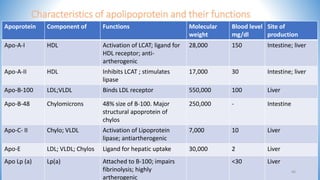
Characteristics of apolipoprotein and their functions
Apoprotein Component of Functions Molecular
weight
Blood level
mg/dl
Site of
production
Apo-A-I HDL Activation of LCAT; ligand for
HDL receptor; anti-
artherogenic
28,000 150 Intestine; liver
Apo-A-II HDL Inhibits LCAT ; stimulates
lipase
17,000 30 Intestine; liver
Apo-B-100 LDL;VLDL Binds LDL receptor 550,000 100 Liver
Apo-B-48 Chylomicrons 48% size of B-100. Major
structural apoprotein of
chylos
250,000 - Intestine
Apo-C- II Chylo; VLDL Activation of Lipoprotein
lipase; antiartherogenic
7,000 10 Liver
Apo-E LDL; VLDL; Chylos Ligand for hepatic uptake 30,000 2 Liver
Apo Lp (a) Lp(a) Attached to B-100; impairs
fibrinolysis; highly
artherogenic
<30 Liver
46
47

Lipoprotein

  • 1.
  • 2.
  • 3.
    Waxes Esters of fattyacids with higher alcohols other than glycerol Waxes are made by combining long chain fatty acids with long chain alcohols. (60-100 carbon atoms) Biological waxes are esters of long-chain (C14 to C36) saturated and unsaturated fatty acids with long-chain (C16 to C30) alcohols Commonest waxes in human body are esters of cholesterol 3 types: True waxes: esters of higher fatty acids with acetyl alcohol or other higher straight chain alcohol Cholesterol esters Vit A & D esters 3
  • 4.
    Waxes Waxes are veryhydrophobic and are used by plants and animals for protective, water-proof coatings Their melting points (60 to 100◦ C) are generally higher than those of triacylglycerols. 14-36 carbons 16-30 carbons 4
  • 5.
    Function of waxes 1.Waxes serve as protective coatings on skin, fur and feathers of animals & birds 2. On fruit and leaves of plants, protective shiny appearance is due to waxes. 3. Waxes act as water barrier for animals, birds and insects. Further wax is hard in cold climate and soft in hot climate. 4. Since wool is a wax, woolen clothing provides protection against cold. Marine organisms use wax as source of energy. 5. Used in the manufacture of lotions, ointments, and polishes 5
  • 6.
    NEUTRAL FATS (TRIGLYCERIDES ORTRIACYLGLYCEROL) • Triacylglycerols are composed of three fatty acids each in ester linkage with a single glycerol • Triacylglycerols are primarily storage fats or main constituents of vegetable oil. • Naturally occurring fats and oils are mixtures of triglycerides. 6
  • 7.
    Types 1. Simple Triacylglycerol:If all the three hydroxyl groups of the glycerol are esterified to the same fatty acid, a simple triacylglycerol is formed, e.g. Tripalmitin, Triolein, tristearin 2. Mixed Triacylglycerol: this is formed, when different fatty acids are esterified to the hydroxyl groups of glycerol. Eg; oleodipalmitin, oleopalmitostearin 7
  • 8.
    Physical Properties ofTriacylglycerols Colourless, odourless and tasteless Hydrophobic and insoluble in water but soluble in organic fat solvents. Specific gravity is less than 1.0, consequently all fats float in water Oils are Liquid at 20ºc - they are Triacyl glycerol which contain higher proportion of unsaturated fatty acid or short chain. Fats are solid at room temperature they contain mainly saturated long chain fatty acids. Fat containing Medium chain triglyceride or unsaturated fatty acid are soft fat. E.g. Butter, coconut oil. Coconut oil contains mainly medium chain TAG, e.g. Lauric and Myristic acids. 8
  • 9.
    Hydrolysis of Triglyceride Triglyceridesin the body are hydrolysed by enzyme Lipases. Triacylglycerol is sequentially hydrolysed to diacyl glycerol and monoacyl glycerol and finally glycerol plus 3 fatty acids 9
  • 10.
    Triacylglycerols Provide StoredEnergy and Insulation In vertebrates; adipocytes or fat cells store large amounts of triacylglycerols as fat droplets Triacylglycerols are also stored as oils in the seeds of many types of plants, providing energy and biosynthetic precursors during seed germination Significant advantages to using triacylglycerols as stored fuels, rather than polysaccharides such as glycogen and starch is that, the carbon atoms of fatty acids are more reduced than those of sugars, and oxidation of triacylglycerols yields more than twice as much energy, as the oxidation of carbohydrates In some animals like polar bears; triacylglycerols stored under the skin serve not only as energy stores but as insulation against low temperatures. 10
  • 11.
  • 12.
    Identification of fatsand oils(Contd.) 12
  • 13.
    Compound Lipids/complex lipids Estersof fatty acid containing other group in addition to alcohol and fatty acid Compounds lipids are also divided into: A. Phospholipids : 1. Glycerophospholipids, 2. Sphingophospholipids B. Glycolipids: 1. Neutral glycosphingolipids 2. Acidic glycosphingolipids 13
  • 14.
    Compound Lipids • Phospholipids Mostabundant membrane lipids (Structural component) Phospholipids are polar, ionic compounds composed of an alcohol that is attached by a phosphodiester bond to either diacylglycerol (DAG) or sphingosine. Phospholipids may be regarded as derivatives of phosphatidic acid , in which the phosphate is esterified with the —OH of a suitable alcohol. Differ from Tg in possessing usually 1 hydrophilic polar head group and 2 hydrophobic nonpolar tails (POLAR LIPIDS) 14
  • 15.
    Structure of phospholipids •They contain two molecules of fatty acids esterified to first and second hydroxyl groups of glycerol. • The third hydroxyl group of glycerol is esterified to phosphoric acid. • Further a nitrogen base or second alcohol is also esterified to phosphoric acid • Glycerophospholipid without second alcohol is known as phosphatidic acid 15
  • 16.
    phosphatidic acid • InPhosphatidic acid: In glycerol backbone- two fatty acids are linked with ester bonds with 1st and 2nd carbons and 3rd carbon is attached to phosphoric acid Fig: Phosphatidic acid phosphoric acid 16
  • 17.
    Classification of phospholipids A.Glycerophospholipids- Phospholipids that contains glycerol as the alcohol group Examples- o Phosphatidyl choline (Lecithins ) o Phosphatidyl ethanolamine (Cephalin) o Phosphatidyl serine o Phosphatidyl inositol (Lipositols) o Cardiolipin o Plasmalogen o Platelet activating factor o Phosphatidyl Glycerol B. Phosphoingosides: Phospholipids that contains Sphingol (sphingosine) as the alcohol group Example- • Sphingomyelin C. Phosphoinisitides Phospholipids that contains inositol as the alcohol group Based on type of alcohol: (Folch & Sperry- 1955) 17
  • 18.
    A. Glycerophospholipids 1) Phosphatidylcholines(Lecithins ) Structure: Phosphatidylcholines = Phosphatidic acid + Choline  On hydrolysis, lecithin yields: (a) glycerol, (b) fatty acids, (c) phosphoric acid and (d) nitrogenous base choline.  Depending on the position of phosphoric acid-choline complex, on α or β carbon, α-lecithin and β-lecithin can form. 18
  • 19.
    Phosphatidylcholines (Lecithins ) widelydistributed in animals in liver, brain, nerve tissues, sperm and egg- yolk, having both metabolic and structural functions the most abundant phospholipids of the cell membrane Choline is important in nervous transmission, as acetylcholine, and as a store of labile methyl groups Dipalmitoyl lecithin (DPL) is a very effective surface-active agent and a major constituent of the lung surfactant preventing adherence, due to surface tension, of the inner surfaces of the lungs. Its absence from the lungs of premature infants causes respiratory distress syndrome(RDS). Premature infants have a higher incidence of RDS because the immature lungs do not synthesize enough DPL. 19
  • 20.
    Lecithin Sphingomyelin ratio(L/S) L/S Ratio in amniotic fluid is used for the evaluation of fetal lung maturity Prior to 34 weeks gestation, lecithin and sphingomyelin concentrations are equal but afterwards there is marked increase in Lecithin concentration. L/S ratio of > 2 indicates adequate fetal lung maturity Delivery of a premature, low birth weight baby with low L/S ratio (1 or<1) predisposes the child to respiratory distress syndrome (RDS), which is a common cause of neonatal morbidity. 20
  • 21.
    Glycerophospholipids (Contd…) 2) Phosphatidylethanolamine (cephalin) Phosphatidyl ethanolamine= Phosphatidic acid + Ethanolamine  Structurally similar to Lecithin with the exception that the base Ethanolamine replaces choline  Both α and β cephalins are known.  Brain and nervous tissue are rich in Cephalin 21
  • 22.
    Glycerophospholipids (Contd…) 3) PhosphatidylSerine (PS)  serine is attached to Phosphatidic acid to form phosphatidylserine Serine + PA → phosphatidylserine  found in brain and nervous tissues and small amount in other tissues. Also found in blood. 22
  • 23.
    Glycerophospholipids (Contd…) 4) Phosphatidylinositol (Lipositols) Inositol + PA → phosphatidylinositol (PI) The inositol is present in phosphatidylinositol as the stereoisomer, myoinositol. The action of certain hormones (eg oxytocin, vasopressin) is mediated through phosphatidylinositol Inositol is an alcohol, a cyclic compound hexa hydroxy cyclohexane with molecular formula C6H12O6. Later, it was found to occur in brain and nervous tissues, moderately in soybeans, and also occurs in plant phospholipids. 23
  • 24.
    Glycerophospholipids (Contd...) 5) Cardiolipin •Two molecules of Phosphatidic Acids held by an additional glycerol through phosphate groups;cardiolipin or diphosphatidylglycerol • On Hydrolysis, Cardiolipin yields: 4 mols of fatty acids + 2 mols of phosphoric acid + 3 mols of glycerol • This the only phosphoglyceride that possesses antigenic properties • found in inner membrane of mitochondria and bacterial wall. • Decreased cardiolipin level leads to mitochondrial dysfunction, and is accounted for heart failure, Fig: Cardiolipin (diphosphatidyl glycerol) 24
  • 25.
    Glycerophospholipids (Contd...) 6) Plasmalogens Whenthe fatty acid at carbon 1 of a glycerophospholipid is replaced by an unsaturated alkyl group attached by an ether (rather than by an ester) linkage to the core glycerol molecule, an ether phosphoglyceride known as a plasmalogen is produced. Typically, the alkyl radical is an unsaturated alcohol . Plasmalogens are found in biomembranes in brain and muscle. 25
  • 26.
    Plasmalogens Examples: phosphatidalethanolamine, which isabundant in nerve tissue is the plasmalogen that is similar in structure to phosphatidylethanolamine. Phosphatidalcholine (abundant in heart muscle) is the other quantitatively significant ether lipid in mammals. [constitute as much as 10% of the phospholipids of brain and muscle. In some instances, choline, serine or inositol may be substituted for ethanolamine. 26
  • 27.
    Glycerophospholipids (Contd…) 7) Plateletactivating factor (PAF) Also an Ether glycerophospholipid Contains a saturated alkyl group in an ether link to carbon 1 and an acetyl residue (rather than a fatty acid) at carbon 2 of the glycerol backbone Synthesized and released by various cell types PAF activates inflammatory cells and mediates hypersensitivity, acute inflammatory and anaphylactic reactions It causes platelets to aggregate and degranulate and neutrophils and alveolar macrophages to generate superoxide radicals to kill bacteria 27
  • 28.
    Glycerophospholipids (Contd…) 8) PhosphatidylGlycerol- Formed by esterification of phosphatidic acid with glycerol Diphosphatidyl glycerol, cardiolipin is found in the mitochondrial membrane Phosphatidic acid is important as an intermediate in the synthesis of TG and phospholipids, but is not found in any great quantities in tissues 28
  • 29.
    B. Sphingophospholipids Sphingomyelin The backboneof sphingomyelin is the 18C unsaturated amino alcohol sphingosine A long-chain fatty acid is attached to the amino group of sphingosine through an amide linkage, producing a ceramide, which can also serve as a precursor of glycolipids The alcohol group at carbon 1 of sphingosine is esterified to Phosphoryl choline, producing sphingomyelin. Sphingomyelin is an important component of myelin of nerve fibers, that insulates and protects neuronal fibers CNS Because of its amphipathic nature sphingomyelin can act as an emulsifying agent and detergent. Fig: Sphingomyelin 29
  • 30.
    Functions of Phospholipids Componentsof cell membrane, mitochondrial membrane , the myelin sheath, and lipoproteins Participate in lipid absorption and transportation from intestine and liver Play important role in blood coagulation  Required for enzyme action- especially in mitochondrial electron transport chain Choline acts as a lipotropic agent, as it can prevent formation of fatty liver Membrane phospholipids acts as source of Arachidonic acid 30
  • 31.
    Functions of Phospholipids Actas reservoir of second messenger- Phosphatidyl Inositol Act as cofactor for the activity of Lipoprotein lipase Phospholipids of myelin sheath provide insulation around the nerve fibers Dipalmitoyl lecithin acts as a lung surfactant Lecithin lowers the surface tension of water and aids in emulsification of lipid water mixtures, which helps in digestion and absorption of lipids from GI tract 31
  • 32.
    2) Glycolipids(Glycosphingolipids) Glycolipids aremolecules that contain both carbohydrate and lipid components.  Like the phospholipid sphingomyelin, glycolipids are derivatives of ceramides in which a long-chain fatty acid is attached to the amino alcohol sphingosine.  They are, therefore, more precisely called glycosphingolipids. Glycolipids differ from sphingomyelins in that they do not contain phosphoric acid and the polar head function is provided by monosaccharide or oligosaccharide attached directly to ceramide by an O- glycosidic linkage. 32
  • 33.
    Glycolipids(Glycosphingolipids) Located in theouter leaflet of the plasma membrane The number and type of carbohydrate moieties present, determine the type of glycosphingolipid.  There are two types of Glycolipids- 1. Neutral glycosphingolipids Cerebrosides Globosides 2. Acidic glycosphingolipids Gangliosides Sulfatides 33
  • 34.
    1. Neutral Glycosphingolipids Cerebrosides Theyare the simplest neutral (uncharged) glycosphingolipids These are ceramide monosaccharides that contain either a molecule of; Galactose (forming ceramide-galactose or galactocerebroside) or Glucose (forming ceramide-glucose or Glucocerebroside) Ceramide + Glucose → Gluco cerebroside  Ceramide + Galactose→ Galacto cerebroside Found predominantly in the white matter of brain and nervous tissue with high concentration in myelin sheath 34
  • 35.
  • 36.
    Neutral Glycosphingolipids contd… Globoside Globosidesare Ceramide oligosaccharides which are produced by attaching additional monosaccharides to Glucocerebroside. Example: Lactosyl ceramide- which contains lactose (Galactose and Glucose attached to ceramide) Ceramide+ galactose+Glucose= Lactosyl ceramide Lactosyl ceramide is a component of erythrocyte membrane. 36
  • 37.
    2. Acidic Glycosphingolipids •They are negatively charged at physiological pH. Gangliosides • The negative charge is imparted by N- acetyl Neuraminic acid (NANA) or Sialic acid • They are formed when ceramide oligo- saccharides have at least one molecule of NANA (N-acetyl neuraminic acid) (sialic acid) attached to them. • These are the most complex glycosphingolipids and are found primarily in the ganglion cells of the CNS, particularly at the nerve endings. (highest concentrations are found in gray matter of brain) 37
  • 38.
    Brain gangliosides maycontain up to four Sialic acid residues and based on that they are-GM, GD, GT and GQ, where subscript M, D,T, or Q indicate whether there is one (mono), two (di), three (tri), or four (quatro) molecules of NANA in the ganglioside, respectively Four important types of Gm series are- GM1, GM2, GM3 and GD3 GM1 is complex of all Gangliosides contribute to stability of paranodal junctions and ion channel clusters in myelinated nerve fibers Serves as specific membrane binding sites (receptor sites) for circulating hormones Autoantibodies to GM1 disrupt lipid rafts, paranodal or nodal structures, and ion channel clusters in peripheral motor nerves. Are of medical interest because several lipid storage disease involve the accumulation of NANA containing glycolipid 38
  • 39.
    Acidic Glycosphingolipids contd.. Sulfatides Theyare cerebrosides that contain sulfated galactosyl residues negatively charged at physiologic pH. (by sulphate groups) Sulfate present in ester linkage at C3 of galactose portion Sulfatides are found predominantly in the white matter of brain and in kidneys. Failure of degradation causes them to accumulate in nervous tissues 39
  • 40.
    Functions of Glycosphingolipids Theyoccur particularly in the outer leaflet of the plasma membrane, where they contribute to cell surface carbohydrates. They act as cell surface receptors for various hormones, and growth factors Play important role in cellular interactions, growth and development They are source of blood group antigens and various embryonic antigens GM1 acts as a receptor for cholera toxin in human intestine 40
  • 41.
    Disease Enzyme deficiencyLipid accumulating Niemann-Pick disease Sphingomyelinase • Cer + p-choline sphingomyelin Gaucher’s disease β-glucosidase Cer + Glc glycosylceramide Tay-Sachs disease Hexosaminidase B Cer – Glc – Gal(NeuAc) + Gal NAC Metachromatic leukodystrophy Arylsulphatase A Cer – Gal – Gal + O SO3 3 sulfogalactosyl ceramide Fabry’s disease α-Galactosidase Cer – Glc – Gal + Gal Globotriaosyl ceramide Krabbe’s disease β-Galactosidase Cer + Gal galactosyl ceramide Key : Cer – Ceramide Glc – Glucose Gal – Galactase Neu-Ac – N-acetyl neuraminic acid 41
  • 42.
    LIPOPROTEINS They are lipidprotein complexes found in plasma. They consist of a non polar core and a single surface layer of amphipathic lipids. Non polar core consists of mainly triacylglycerol and cholesteryl ester Surface layer comprise of amphipathic phospholipid and cholesterol The protein part of lipoprotein is called as apolipoprotein or apoprotein. The apoprotein and lipids are held together by non-covalent forces. 42
  • 43.
  • 44.
  • 45.
  • 46.
    Characteristics of apolipoproteinand their functions Apoprotein Component of Functions Molecular weight Blood level mg/dl Site of production Apo-A-I HDL Activation of LCAT; ligand for HDL receptor; anti- artherogenic 28,000 150 Intestine; liver Apo-A-II HDL Inhibits LCAT ; stimulates lipase 17,000 30 Intestine; liver Apo-B-100 LDL;VLDL Binds LDL receptor 550,000 100 Liver Apo-B-48 Chylomicrons 48% size of B-100. Major structural apoprotein of chylos 250,000 - Intestine Apo-C- II Chylo; VLDL Activation of Lipoprotein lipase; antiartherogenic 7,000 10 Liver Apo-E LDL; VLDL; Chylos Ligand for hepatic uptake 30,000 2 Liver Apo Lp (a) Lp(a) Attached to B-100; impairs fibrinolysis; highly artherogenic <30 Liver 46
  • 47.