STOICHIOMETRY
STOICHIOMETRY
• Is the relationship of the masses of the
reactants and products in a chemical reaction.
• The amount obtained from a balanced
equation are called stoichiometric amounts.
LAW OF CONSERVATION OF MASS
• The Law of Conservation of Mass dates from
Antoine Lavoisier's 1789 * =His discovery
that mass is neither created nor destroyed in
chemical reactions.
• In other words, the mass of any one element
at the beginning of a reaction will equal the
mass of that element at the end of the
reaction.
EXAMPLE;
• ammonia gas (NH3) can be produced by reacting nitrogen gas
and hydrogen gas. If 5.00g of nitrogen is to be used in the
reaction find
a. The mass of hydrogen gas that will react completely with the
given amount of nitrogen gas.
b. The amount of ammonia gas that will be produced.
N2 + H2 NH3
• REFER TO THE EQUATION BELOW!!!!!!!
Ba(OH)2 + Al(NO3)2 Ba (NO3)2 + Al
(OH)3
a.How many grams of Ba (OH)2 are needed to produce 20.0 g
of Al (OH)3?
b.How many moles of Ba (OH)2 will produce 5.00 moles of Al
(OH)3?
c. How many grams of Ba (OH)2 will react completely with
1.20 moles of Al ( NO3)3?
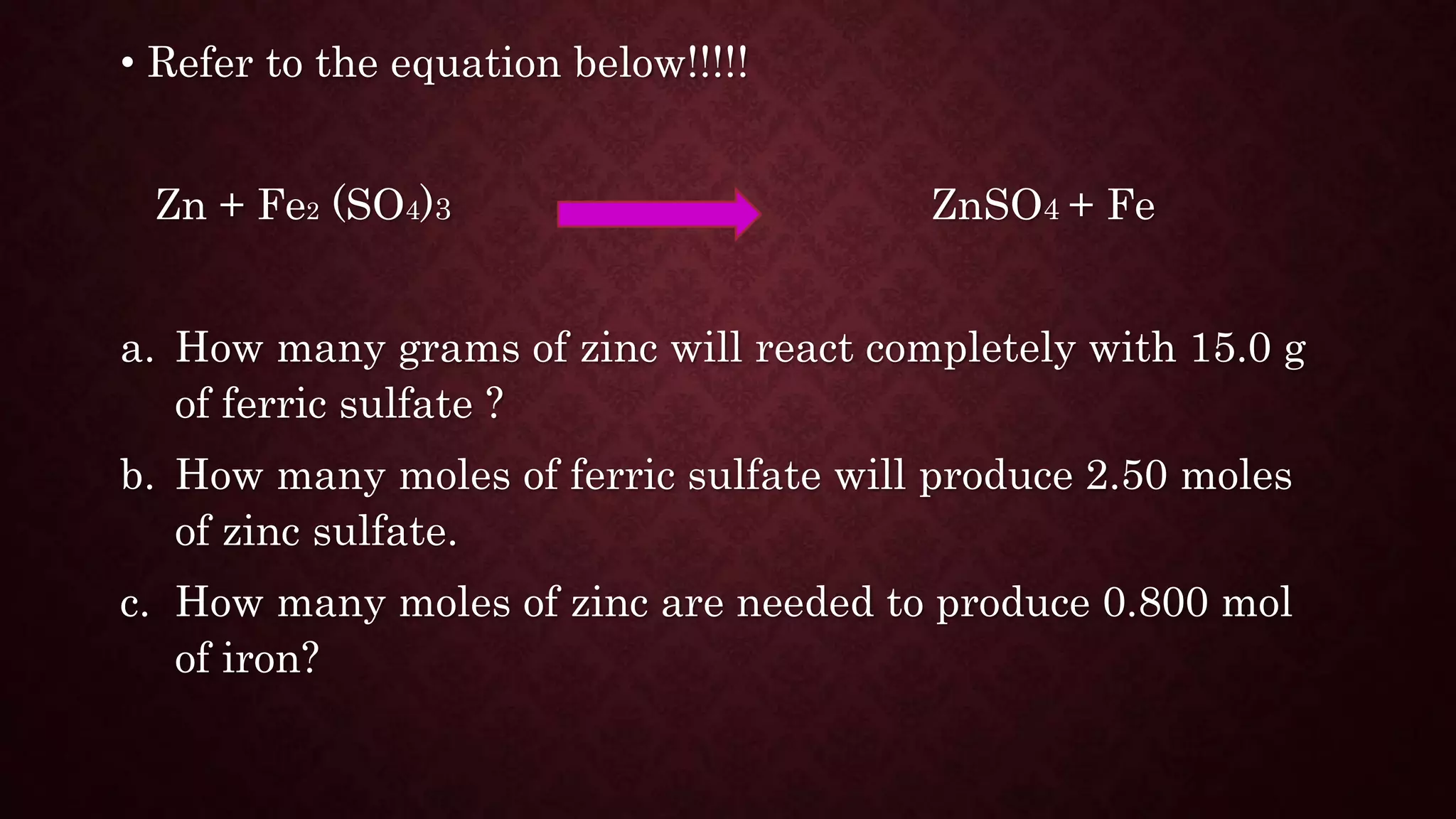
• Refer to the equation below!!!!!
Zn + Fe2 (SO4)3 ZnSO4 + Fe
a. How many grams of zinc will react completely with 15.0 g
of ferric sulfate ?
b. How many moles of ferric sulfate will produce 2.50 moles
of zinc sulfate.
c. How many moles of zinc are needed to produce 0.800 mol
of iron?
LIMITING AND EXCESS
REAGENT
OBJECTIVE!!!!
•Explain the concept of limiting reagent in
a chemical reaction ; identify the excess
reagent(s).
MRS. SANTOS ASK YOU TO BUY AND INGREDIENTS
FOR HUMBUGER.YOU BOUGHT 50 SLICES OF BREAD ,
20 HUMBURGER PATTIES + 15 SLICES OF CHEESSE,
HOW MANY HUMBUGER WILL U MAKE OUT OF THE
INGREDIETS THAT YOU BOUGHT?
• Assuming that the ratio of the ingredients in making
HUMBURGER are:
2 slices of bread: 2hamburger patties: 1 slice of cheese
1. How many humburger will you make out of
the ingredients that you bought?
2. Out of the ingredients bought, which do you
think is the limiting reagent?
3. How about the excess reagent?
LIMITING REAGENT(REACTANT)
•A reactant that is consumed first in a
reaction.
•The amount of the limiting reagent limits
the extent of the reaction ,thereby, it
determines the amount of product.
EXCESS REAGENT(S)/REACTANT
•The reactant left after the reaction
.
•A reactant which is not totally
consumed
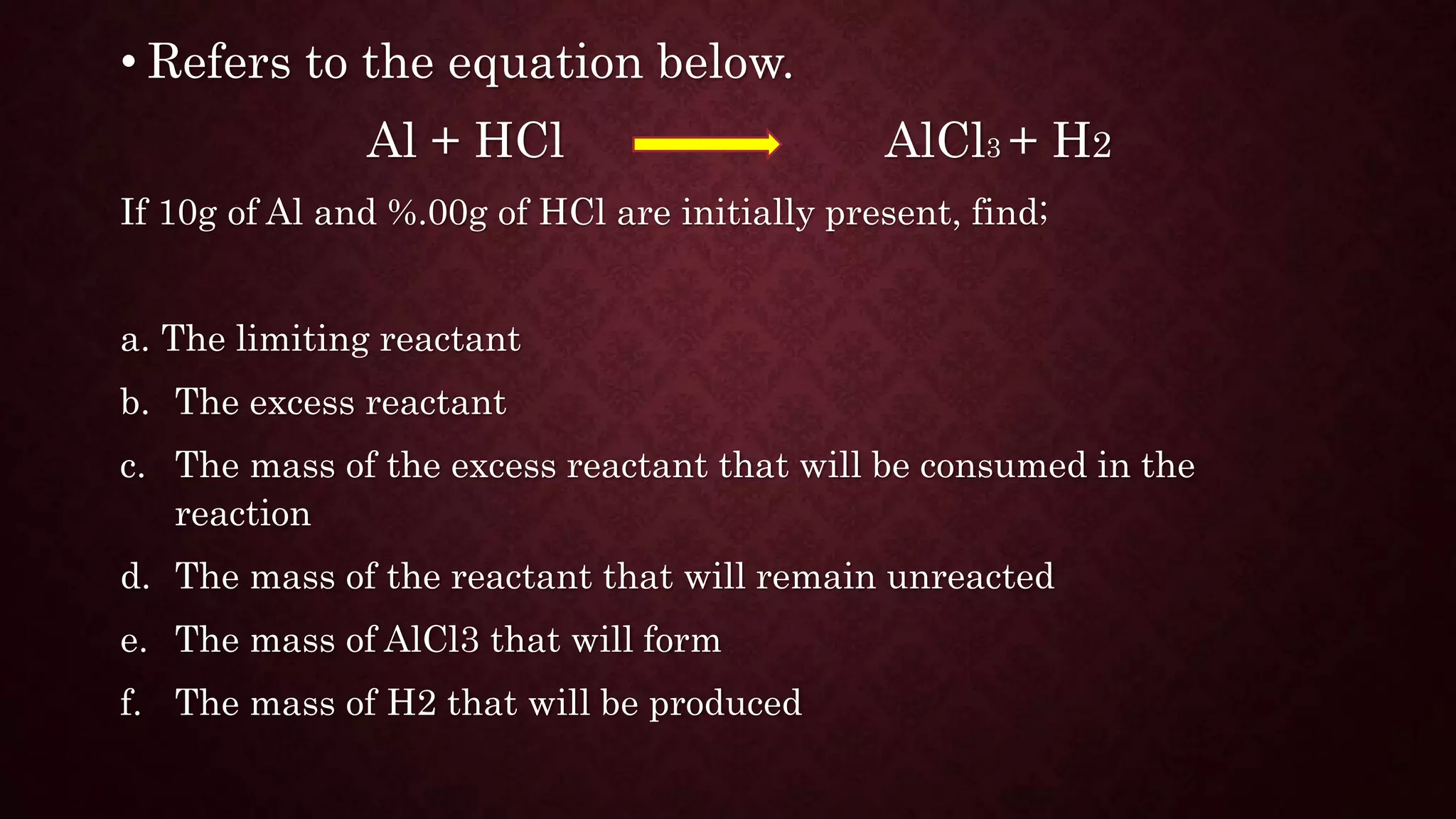
• Refers to the equation below.
Al + HCl AlCl3 + H2
If 10g of Al and %.00g of HCl are initially present, find;
a. The limiting reactant
b. The excess reactant
c. The mass of the excess reactant that will be consumed in the
reaction
d. The mass of the reactant that will remain unreacted
e. The mass of AlCl3 that will form
f. The mass of H2 that will be produced
We are going to use two methods in determining the limiting and
excess reagent.
First Method:
1. We convert first the given amounts of the reactant into moles.
2. Then we divide the actual number of moles of the reactants by their respective
coefficients in the balance equation. The one that gives the lesser value is the limiting
reactant.
Second Mehthod:
1. We get the stoichiometric amount of a certain product from each of the given amounts of
the reactants. The one that gives the lesser value is the limiting reactant.
limiting and  excess reagent.pptx

limiting and excess reagent.pptx

  • 1.
  • 2.
    STOICHIOMETRY • Is therelationship of the masses of the reactants and products in a chemical reaction. • The amount obtained from a balanced equation are called stoichiometric amounts.
  • 3.
    LAW OF CONSERVATIONOF MASS • The Law of Conservation of Mass dates from Antoine Lavoisier's 1789 * =His discovery that mass is neither created nor destroyed in chemical reactions. • In other words, the mass of any one element at the beginning of a reaction will equal the mass of that element at the end of the reaction.
  • 4.
    EXAMPLE; • ammonia gas(NH3) can be produced by reacting nitrogen gas and hydrogen gas. If 5.00g of nitrogen is to be used in the reaction find a. The mass of hydrogen gas that will react completely with the given amount of nitrogen gas. b. The amount of ammonia gas that will be produced. N2 + H2 NH3
  • 5.
    • REFER TOTHE EQUATION BELOW!!!!!!! Ba(OH)2 + Al(NO3)2 Ba (NO3)2 + Al (OH)3 a.How many grams of Ba (OH)2 are needed to produce 20.0 g of Al (OH)3? b.How many moles of Ba (OH)2 will produce 5.00 moles of Al (OH)3? c. How many grams of Ba (OH)2 will react completely with 1.20 moles of Al ( NO3)3?
  • 7.
    • Refer tothe equation below!!!!! Zn + Fe2 (SO4)3 ZnSO4 + Fe a. How many grams of zinc will react completely with 15.0 g of ferric sulfate ? b. How many moles of ferric sulfate will produce 2.50 moles of zinc sulfate. c. How many moles of zinc are needed to produce 0.800 mol of iron?
  • 8.
  • 9.
    OBJECTIVE!!!! •Explain the conceptof limiting reagent in a chemical reaction ; identify the excess reagent(s).
  • 10.
    MRS. SANTOS ASKYOU TO BUY AND INGREDIENTS FOR HUMBUGER.YOU BOUGHT 50 SLICES OF BREAD , 20 HUMBURGER PATTIES + 15 SLICES OF CHEESSE, HOW MANY HUMBUGER WILL U MAKE OUT OF THE INGREDIETS THAT YOU BOUGHT? • Assuming that the ratio of the ingredients in making HUMBURGER are: 2 slices of bread: 2hamburger patties: 1 slice of cheese
  • 11.
    1. How manyhumburger will you make out of the ingredients that you bought? 2. Out of the ingredients bought, which do you think is the limiting reagent? 3. How about the excess reagent?
  • 12.
    LIMITING REAGENT(REACTANT) •A reactantthat is consumed first in a reaction. •The amount of the limiting reagent limits the extent of the reaction ,thereby, it determines the amount of product.
  • 13.
    EXCESS REAGENT(S)/REACTANT •The reactantleft after the reaction . •A reactant which is not totally consumed
  • 14.
    • Refers tothe equation below. Al + HCl AlCl3 + H2 If 10g of Al and %.00g of HCl are initially present, find; a. The limiting reactant b. The excess reactant c. The mass of the excess reactant that will be consumed in the reaction d. The mass of the reactant that will remain unreacted e. The mass of AlCl3 that will form f. The mass of H2 that will be produced
  • 15.
    We are goingto use two methods in determining the limiting and excess reagent. First Method: 1. We convert first the given amounts of the reactant into moles. 2. Then we divide the actual number of moles of the reactants by their respective coefficients in the balance equation. The one that gives the lesser value is the limiting reactant. Second Mehthod: 1. We get the stoichiometric amount of a certain product from each of the given amounts of the reactants. The one that gives the lesser value is the limiting reactant.

Editor's Notes

  • #3 The Law of Conservation of Mass dates from Antoine Lavoisier's 1789 discovery that mass is neither created nor destroyed in chemical reactions. In other words, the mass of any one element at the beginning of a reaction will equal the mass of that element at the end of the reaction
  • #5 Balance first the equation Next find the molar mass of n2 and h2 Mole ration 1;3;2 Get mass of h2.