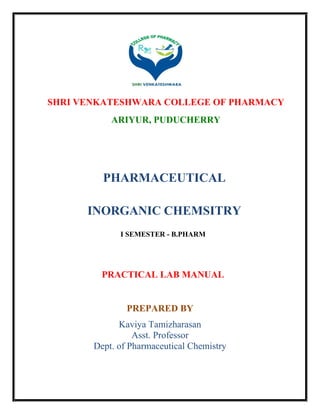
SHRI VENKATESHWARA COLLEGE OF PHARMACY
ARIYUR, PUDUCHERRY
PHARMACEUTICAL
INORGANIC CHEMSITRY
I SEMESTER - B.PHARM
PRACTICAL LAB MANUAL
PREPARED BY
Kaviya Tamizharasan
Asst. Professor
Dept. of Pharmaceutical Chemistry
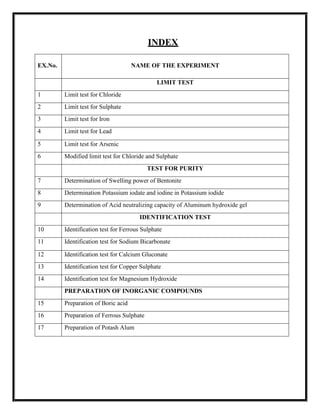
INDEX
EX.No. NAME OF THE EXPERIMENT
LIMIT TEST
1 Limit test for Chloride
2 Limit test for Sulphate
3 Limit test for Iron
4 Limit test for Lead
5 Limit test for Arsenic
6 Modified limit test for Chloride and Sulphate
TEST FOR PURITY
7 Determination of Swelling power of Bentonite
8 Determination Potassium iodate and iodine in Potassium iodide
9 Determination of Acid neutralizing capacity of Aluminum hydroxide gel
IDENTIFICATION TEST
10 Identification test for Ferrous Sulphate
11 Identification test for Sodium Bicarbonate
12 Identification test for Calcium Gluconate
13 Identification test for Copper Sulphate
14 Identification test for Magnesium Hydroxide
PREPARATION OF INORGANIC COMPOUNDS
15 Preparation of Boric acid
16 Preparation of Ferrous Sulphate
17 Preparation of Potash Alum
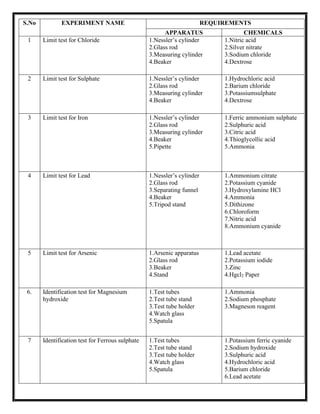
S.No EXPERIMENT NAME REQUIREMENTS
APPARATUS CHEMICALS
1 Limit test for Chloride 1.Nessler’s cylinder
2.Glass rod
3.Measuring cylinder
4.Beaker
1.Nitric acid
2.Silver nitrate
3.Sodium chloride
4.Dextrose
2 Limit test for Sulphate 1.Nessler’s cylinder
2.Glass rod
3.Measuring cylinder
4.Beaker
1.Hydrochloric acid
2.Barium chloride
3.Potassiumsulphate
4.Dextrose
3 Limit test for Iron 1.Nessler’s cylinder
2.Glass rod
3.Measuring cylinder
4.Beaker
5.Pipette
1.Ferric ammonium sulphate
2.Sulphuric acid
3.Citric acid
4.Thioglycollic acid
5.Ammonia
4 Limit test for Lead 1.Nessler’s cylinder
2.Glass rod
3.Separating funnel
4.Beaker
5.Tripod stand
1.Ammonium citrate
2.Potassium cyanide
3.Hydroxylamine HCl
4.Ammonia
5.Dithizone
6.Chloroform
7.Nitric acid
8.Ammonium cyanide
5 Limit test for Arsenic 1.Arsenic apparatus
2.Glass rod
3.Beaker
4.Stand
1.Lead acetate
2.Potassium iodide
3.Zinc
4.Hgcl2 Paper
6. Identification test for Magnesium
hydroxide
1.Test tubes
2.Test tube stand
3.Test tube holder
4.Watch glass
5.Spatula
1.Ammonia
2.Sodium phosphate
3.Magneson reagent
7 Identification test for Ferrous sulphate 1.Test tubes
2.Test tube stand
3.Test tube holder
4.Watch glass
5.Spatula
1.Potassium ferric cyanide
2.Sodium hydroxide
3.Sulphuric acid
4.Hydrochloric acid
5.Barium chloride
6.Lead acetate
8 Identification test for Sodium
bicarbonate
1.Test tubes
2.Test tube stand
3.Test tube holder
4.Watch glass
5.Spatula
1.Hydrochloric acid
2.Potassium carbonate
3.Potassium antimonite
4.Acetic acid
5.Magnesium uranyl acetate
6.Sodium bicarbonate
7.Magnesium sulphate
8.Barium sulphate
9 Identification test for Calcium
gluconate
1.Test tubes
2.Test tube stand
3.Test tube holder
4.Watch glass
5.Spatula
1.Ammonium chloride
2.Hydrochloric acid
3.Sodium hydroxide
4.Ammonium carbonate
5.Glacial acetic acid
6.Potassium Ferro cyanide
7.Ferric chloride
10 Identification test for Copper sulphate 1.Test tubes
2.Test tube stand
3.Test tube holder
4.Watch glass
5.Spatula
1.Potassium iodide
2.Ammonia
3.Ferrocyanide
4.Hydrochloric acid
5.Barium chloride
6.Lead acetate
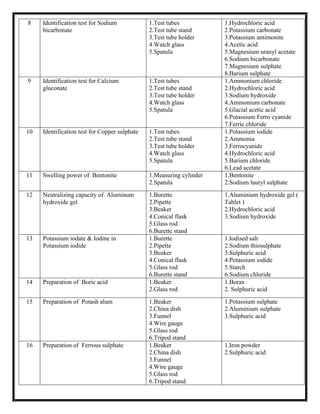
11 Swelling power of Bentonite 1.Measuring cylinder
2.Spatula
1.Bentonite
2.Sodium lauryl sulphate
12 Neutralizing capacity of Aluminum
hydroxide gel
1.Burette
2.Pipette
3.Beaker
4.Conical flask
5.Glass rod
6.Burette stand
1.Aluminium hydroxide gel (
Tablet )
2.Hydrochloric acid
3.Sodium hydroxide
13 Potassium iodate & Iodine in
Potassium iodide
1.Burette
2.Pipette
3.Beaker
4.Conical flask
5.Glass rod
6.Burette stand
1.Iodised salt
2.Sodium thiosulphate
3.Sulphuric acid
4.Potassium iodide
5.Starch
6.Sodium chloride
14 Preparation of Boric acid 1.Beaker
2.Glass rod
1.Borax
2. Sulphuric acid
15 Preparation of Potash alum 1.Beaker
2.China dish
3.Funnel
4.Wire gauge
5.Glass rod
6.Tripod stand
1.Potassium sulphate
2.Aluminium sulphate
3.Sulphuric acid
16 Preparation of Ferrous sulphate 1.Beaker
2.China dish
3.Funnel
4.Wire gauge
5.Glass rod
6.Tripod stand
1.Iron powder
2.Sulphuric acid
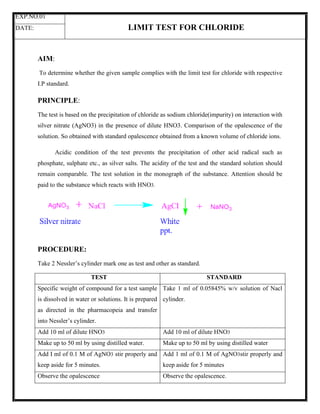
AIM:
To determine whether the given sample complies with the limit test for chloride with respective
I.P standard.
PRINCIPLE:
The test is based on the precipitation of chloride as sodium chloride(impurity) on interaction with
silver nitrate (AgNO3) in the presence of dilute HNO3. Comparison of the opalescence of the
solution. So obtained with standard opalescence obtained from a known volume of chloride ions.
Acidic condition of the test prevents the precipitation of other acid radical such as
phosphate, sulphate etc., as silver salts. The acidity of the test and the standard solution should
remain comparable. The test solution in the monograph of the substance. Attention should be
paid to the substance which reacts with HNO3.
PROCEDURE:
Take 2 Nessler’s cylinder mark one as test and other as standard.
TEST STANDARD
Specific weight of compound for a test sample
is dissolved in water or solutions. It is prepared
as directed in the pharmacopeia and transfer
into Nessler’s cylinder.
Take 1 ml of 0.05845% w/v solution of Nacl
cylinder.
Add 10 ml of dilute HNO3 Add 10 ml of dilute HNO3
Make up to 50 ml by using distilled water. Make up to 50 ml by using distilled water
Add I ml of 0.1 M of AgNO3 stir properly and
keep aside for 5 minutes.
Add 1 ml of 0.1 M of AgNO3stir properly and
keep aside for 5 minutes
Observe the opalescence Observe the opalescence.
EXP.NO.01
LIMIT TEST FOR CHLORIDE
DATE:
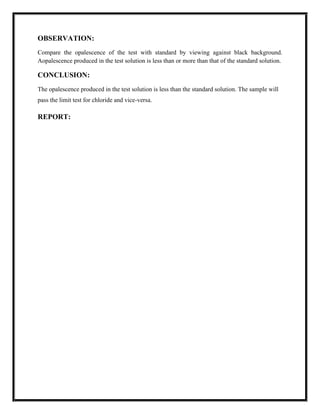
OBSERVATION:
Compare the opalescence of the test with standard by viewing against black background.
Aopalescence produced in the test solution is less than or more than that of the standard solution.
CONCLUSION:
The opalescence produced in the test solution is less than the standard solution. The sample will
pass the limit test for chloride and vice-versa.
REPORT:
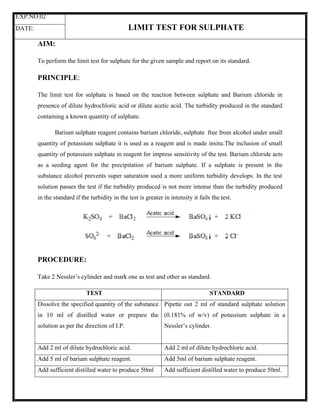
AIM:
To perform the limit test for sulphate for the given sample and report on its standard.
PRINCIPLE:
The limit test for sulphate is based on the reaction between sulphate and Barium chloride in
presence of dilute hydrochloric acid or dilute acetic acid. The turbidity produced in the standard
containing a known quantity of sulphate.
Barium sulphate reagent contains barium chloride, sulphate free from alcohol under small
quantity of potassium sulphate it is used as a reagent and is made insitu.The inclusion of small
quantity of potassium sulphate in reagent for impress sensitivity of the test. Barium chloride acts
as a seeding agent for the precipitation of barium sulphate. If a sulphate is present in the
substance alcohol prevents super saturation used a more uniform turbidity develops. In the test
solution passes the test if the turbidity produced is not more intense than the turbidity produced
in the standard if the turbidity in the test is greater in intensity it fails the test.
PROCEDURE:
Take 2 Nessler’s cylinder and mark one as test and other as standard.
TEST STANDARD
Dissolve the specified quantity of the substance
in 10 ml of distilled water or prepare the
solution as per the direction of I.P.
Pipette out 2 ml of standard sulphate solution
(0.181% of w/v) of potassium sulphate in a
Nessler’s cylinder.
Add 2 ml of dilute hydrochloric acid. Add 2 ml of dilute hydrochloric acid.
Add 5 ml of barium sulphate reagent. Add 5ml of barium sulphate reagent.
Add sufficient distilled water to produce 50ml Add sufficient distilled water to produce 50ml.
EXP.NO.02
LIMIT TEST FOR SULPHATE
DATE:
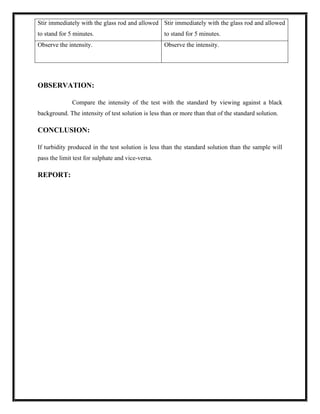
Stir immediately with the glass rod and allowed
to stand for 5 minutes.
Stir immediately with the glass rod and allowed
to stand for 5 minutes.
Observe the intensity. Observe the intensity.
OBSERVATION:
Compare the intensity of the test with the standard by viewing against a black
background. The intensity of test solution is less than or more than that of the standard solution.
CONCLUSION:
If turbidity produced in the test solution is less than the standard solution than the sample will
pass the limit test for sulphate and vice-versa.
REPORT:
AIM:
To perform the limit test for iron for the test sample and report on the standard.
PRINCIPLE:
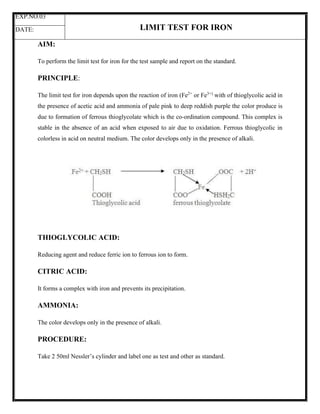
The limit test for iron depends upon the reaction of iron (Fe2+
or Fe3+)
with of thioglycolic acid in
the presence of acetic acid and ammonia of pale pink to deep reddish purple the color produce is
due to formation of ferrous thioglycolate which is the co-ordination compound. This complex is
stable in the absence of an acid when exposed to air due to oxidation. Ferrous thioglycolic in
colorless in acid on neutral medium. The color develops only in the presence of alkali.
THIOGLYCOLIC ACID:
Reducing agent and reduce ferric ion to ferrous ion to form.
CITRIC ACID:
It forms a complex with iron and prevents its precipitation.
AMMONIA:
The color develops only in the presence of alkali.
PROCEDURE:
Take 2 50ml Nessler’s cylinder and label one as test and other as standard.
EXP.NO.03
LIMIT TEST FOR IRON
DATE:
TEST STANDARD
Dissolve the specified quantity of substance in
40ml of distilled water.
Dilute 2ml of standard ion solution(0.1726%
w/v) solution of ferric ammonia sulphate with
40ml of distilled water in nessler’s cylinder.
Add 2ml of 20% w/v solution of iron free citric
acid.
Add 2ml of 20%w/v solution of iron free citric
acid.
Add 0.1 ml of thioglycolic acid and mix well . Add 0.1 ml of thioglycolic acid and mix well.
Make alkaline with iron free ammonia
solution.
Make alkaline with iron free ammonia
solution.
Make up the volume to 50ml by using distilled
water stir well and allow to stand for 5
minutes.
Make up the volume to 50ml by using distilled
water stir well and allow to stand for 5
minutes.
OBSERVATION:
After the 5 minutes compare the intensity of color produced in the test with standard and report
the purity of sample.
If the intensity of the color produced in the test is not more intense than the standard
than the sample will passes the limit test for iron. If the color in the test is more intense than the
standard then the sample fails the limit test for iron.
CONCLUSION:
The color produced in the test is less intense then the standard. So, the sample passes limit test
for iron and vice versa
REPORT:
AIM:
To perform the limit test for lead for the given sample and report.
PRINCIPLE:
The principle involve with the limit test for lead is based upon the reaction between lead and
dithizone (diphenyl thiocarpozone) forms a complex lead dithizonate. Dithizone dissolve in
chloroform and the solution is green in colour. It has the ability to extract lead as a complex from
substance containing lead as an impurity. If the substance is dissolved in water and made
alkaline.
PROCEDURE:
1. Transfer the volume of prepared sample directed in the monograph to a separate. Add 6 ml of
ammonium citrate solution, 2 ml of potassium cyanide solution, 2 ml of hydroxyl ammine,
hydrochloride solution.
2. Add 2 drops of phenol red solution and make the solution just alkaline by the addition of NH3
solution.
3. Immediately, extract the solution with the 5 ml of diphenyl thiocarpozone draining off each
extract into another separating funnel until diphenyl thiocarpozone solution in green.
4. Shake the combined diphenyl thiocarpazone solution.
5. For 30 seconds with 30 ml of 1%, HNO acid and discard the chloroform layer.
6. Add the acid solution exactly 5ml of standard diphenyl thiocarpazone solution and 40 ml of
ammonium cyanide solution and shake for 30 seconds.
7. Thecolour of chloroform layer is of no deeper shade of violet than that of standard. Made with
volume of lead solution.Equivalent to the amount of lead permitted in the sample under
examination.
EXP.NO.04
LIMIT TEST FOR LEAD
DATE:
AIM:
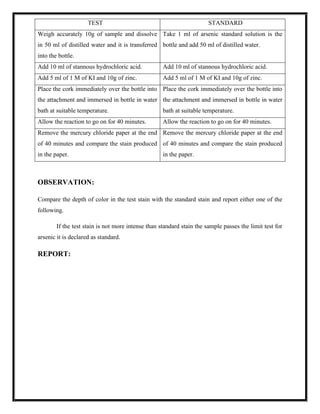
To perform the test for arsenic for the given sample and report on its standard.
PRINCIPLE:
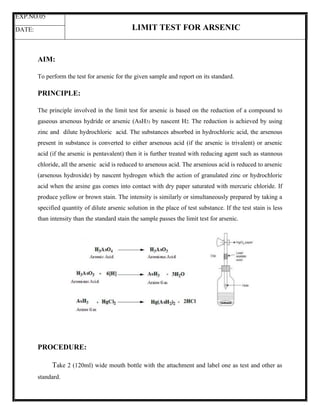
The principle involved in the limit test for arsenic is based on the reduction of a compound to
gaseous arsenous hydride or arsenic (AsH3) by nascent H2. The reduction is achieved by using
zinc and dilute hydrochloric acid. The substances absorbed in hydrochloric acid, the arsenous
present in substance is converted to either arsenous acid (if the arsenic is trivalent) or arsenic
acid (if the arsenic is pentavalent) then it is further treated with reducing agent such as stannous
chloride, all the arsenic acid is reduced to arsenous acid. The arsenious acid is reduced to arsenic
(arsenous hydroxide) by nascent hydrogen which the action of granulated zinc or hydrochloric
acid when the arsine gas comes into contact with dry paper saturated with mercuric chloride. If
produce yellow or brown stain. The intensity is similarly or simultaneously prepared by taking a
specified quantity of dilute arsenic solution in the place of test substance. If the test stain is less
than intensity than the standard stain the sample passes the limit test for arsenic.
PROCEDURE:
Take 2 (120ml) wide mouth bottle with the attachment and label one as test and other as
standard.
EXP.NO.05
LIMIT TEST FOR ARSENIC
DATE:
TEST STANDARD
Weigh accurately 10g of sample and dissolve
in 50 ml of distilled water and it is transferred
into the bottle.
Take 1 ml of arsenic standard solution is the
bottle and add 50 ml of distilled water.
Add 10 ml of stannous hydrochloric acid. Add 10 ml of stannous hydrochloric acid.
Add 5 ml of 1 M of KI and 10g of zinc. Add 5 ml of 1 M of KI and 10g of zinc.
Place the cork immediately over the bottle into
the attachment and immersed in bottle in water
bath at suitable temperature.
Place the cork immediately over the bottle into
the attachment and immersed in bottle in water
bath at suitable temperature.
Allow the reaction to go on for 40 minutes. Allow the reaction to go on for 40 minutes.
Remove the mercury chloride paper at the end
of 40 minutes and compare the stain produced
in the paper.
Remove the mercury chloride paper at the end
of 40 minutes and compare the stain produced
in the paper.
OBSERVATION:
Compare the depth of color in the test stain with the standard stain and report either one of the
following.
If the test stain is not more intense than standard stain the sample passes the limit test for
arsenic it is declared as standard.
REPORT:
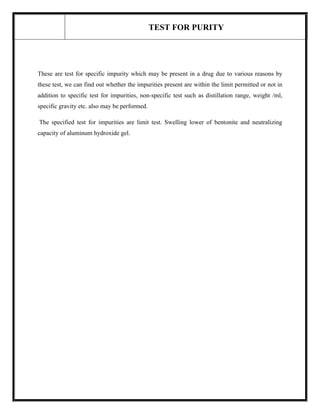
These are test for specific impurity which may be present in a drug due to various reasons by
these test, we can find out whether the impurities present are within the limit permitted or not in
addition to specific test for impurities, non-specific test such as distillation range, weight /ml,
specific gravity etc. also may be performed.
The specified test for impurities are limit test. Swelling lower of bentonite and neutralizing
capacity of aluminum hydroxide gel.
TEST FOR PURITY
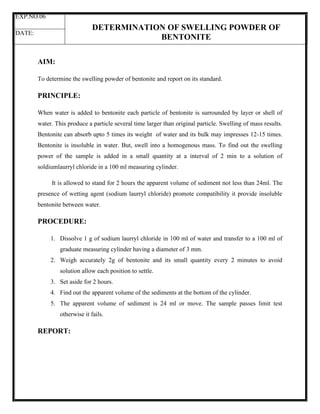
AIM:
To determine the swelling powder of bentonite and report on its standard.
PRINCIPLE:
When water is added to bentonite each particle of bentonite is surrounded by layer or shell of
water. This produce a particle several time larger than original particle. Swelling of mass results.
Bentonite can absorb upto 5 times its weight of water and its bulk may impresses 12-15 times.
Bentonite is insoluble in water. But, swell into a homogenous mass. To find out the swelling
power of the sample is added in a small quantity at a interval of 2 min to a solution of
soldiumlaurryl chloride in a 100 ml measuring cylinder.
It is allowed to stand for 2 hours the apparent volume of sediment not less than 24ml. The
presence of wetting agent (sodium laurryl chloride) promote compatibility it provide insoluble
bentonite between water.
PROCEDURE:
1. Dissolve 1 g of sodium laurryl chloride in 100 ml of water and transfer to a 100 ml of
graduate measuring cylinder having a diameter of 3 mm.
2. Weigh accurately 2g of bentonite and its small quantity every 2 minutes to avoid
solution allow each position to settle.
3. Set aside for 2 hours.
4. Find out the apparent volume of the sediments at the bottom of the cylinder.
5. The apparent volume of sediment is 24 ml or move. The sample passes limit test
otherwise it fails.
REPORT:
EXP.NO.06
DETERMINATION OF SWELLING POWDER OF
BENTONITE
DATE:
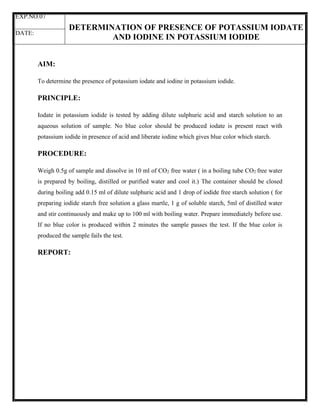
AIM:
To determine the presence of potassium iodate and iodine in potassium iodide.
PRINCIPLE:
Iodate in potassium iodide is tested by adding dilute sulphuric acid and starch solution to an
aqueous solution of sample. No blue color should be produced iodate is present react with
potassium iodide in presence of acid and liberate iodine which gives blue color which starch.
PROCEDURE:
Weigh 0.5g of sample and dissolve in 10 ml of CO2 free water ( in a boiling tube CO2 free water
is prepared by boiling, distilled or purified water and cool it.) The container should be closed
during boiling add 0.15 ml of dilute sulphuric acid and 1 drop of iodide free starch solution ( for
preparing iodide starch free solution a glass martle, 1 g of soluble starch, 5ml of distilled water
and stir continuously and make up to 100 ml with boiling water. Prepare immediately before use.
If no blue color is produced within 2 minutes the sample passes the test. If the blue color is
produced the sample fails the test.
REPORT:
EXP.NO.07
DETERMINATION OF PRESENCE OF POTASSIUM IODATE
AND IODINE IN POTASSIUM IODIDE
DATE:
AIM:
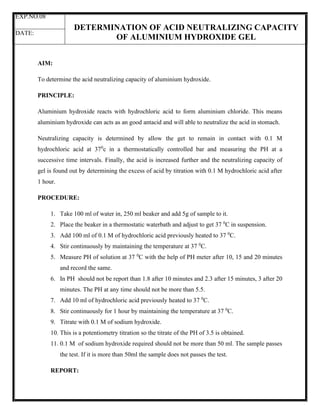
To determine the acid neutralizing capacity of aluminium hydroxide.
PRINCIPLE:
Aluminium hydroxide reacts with hydrochloric acid to form aluminium chloride. This means
aluminium hydroxide can acts as an good antacid and will able to neutralize the acid in stomach.
Neutralizing capacity is determined by allow the get to remain in contact with 0.1 M
hydrochloric acid at 370
c in a thermostatically controlled bar and measuring the PH at a
successive time intervals. Finally, the acid is increased further and the neutralizing capacity of
gel is found out by determining the excess of acid by titration with 0.1 M hydrochloric acid after
1 hour.
PROCEDURE:
1. Take 100 ml of water in, 250 ml beaker and add 5g of sample to it.
2. Place the beaker in a thermostatic waterbath and adjust to get 37 0
C in suspension.
3. Add 100 ml of 0.1 M of hydrochloric acid previously heated to 37 0
C.
4. Stir continuously by maintaining the temperature at 37 0
C.
5. Measure PH of solution at 37 0
C with the help of PH meter after 10, 15 and 20 minutes
and record the same.
6. In PH should not be report than 1.8 after 10 minutes and 2.3 after 15 minutes, 3 after 20
minutes. The PH at any time should not be more than 5.5.
7. Add 10 ml of hydrochloric acid previously heated to 37 0
C.
8. Stir continuously for 1 hour by maintaining the temperature at 37 0
C.
9. Titrate with 0.1 M of sodium hydroxide.
10. This is a potentiometry titration so the titrate of the PH of 3.5 is obtained.
11. 0.1 M of sodium hydroxide required should not be more than 50 ml. The sample passes
the test. If it is more than 50ml the sample does not passes the test.
REPORT:
EXP.NO.08
DETERMINATION OF ACID NEUTRALIZING CAPACITY
OF ALUMINIUM HYDROXIDE GEL
DATE:
AIM:
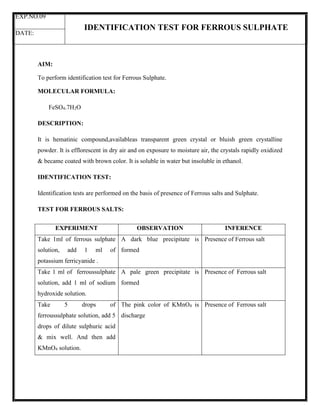
To perform identification test for Ferrous Sulphate.
MOLECULAR FORMULA:
FeSO4.7H2O
DESCRIPTION:
It is hematinic compound,availableas transparent green crystal or bluish green crystalline
powder. It is efflorescent in dry air and on exposure to moisture air, the crystals rapidly oxidized
& became coated with brown color. It is soluble in water but insoluble in ethanol.
IDENTIFICATION TEST:
Identification tests are performed on the basis of presence of Ferrous salts and Sulphate.
TEST FOR FERROUS SALTS:
EXP.NO.09
IDENTIFICATION TEST FOR FERROUS SULPHATE
DATE:
EXPERIMENT OBSERVATION INFERENCE
Take 1ml of ferrous sulphate
solution, add 1 ml of
potassium ferricyanide .
A dark blue precipitate is
formed
Presence of Ferrous salt
Take 1 ml of ferroussulphate
solution, add 1 ml of sodium
hydroxide solution.
A pale green precipitate is
formed
Presence of Ferrous salt
Take 5 drops of
ferroussulphate solution, add 5
drops of dilute sulphuric acid
& mix well. And then add
KMnO4 solution.
The pink color of KMnO4 is
discharge
Presence of Ferrous salt
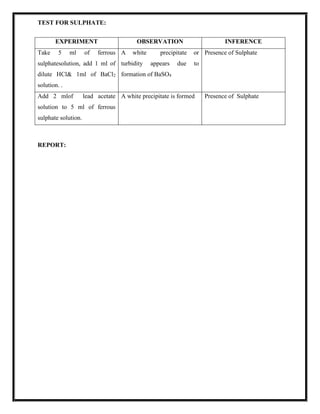
TEST FOR SULPHATE:
REPORT:
EXPERIMENT OBSERVATION INFERENCE
Take 5 ml of ferrous
sulphatesolution, add 1 ml of
dilute HCl& 1ml of BaCl2
solution. .
A white precipitate or
turbidity appears due to
formation of BaSO4
Presence of Sulphate
Add 2 mlof lead acetate
solution to 5 ml of ferrous
sulphate solution.
A white precipitate is formed Presence of Sulphate
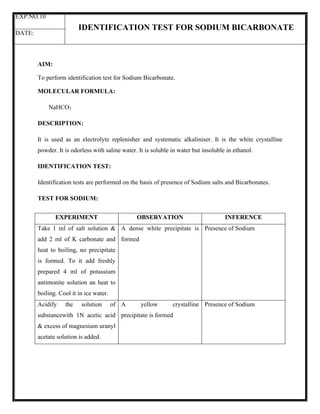
AIM:
To perform identification test for Sodium Bicarbonate.
MOLECULAR FORMULA:
NaHCO3
DESCRIPTION:
It is used as an electrolyte replenisher and systematic alkaliniser. It is the white crystalline
powder. It is odorless with saline water. It is soluble in water but insoluble in ethanol.
IDENTIFICATION TEST:
Identification tests are performed on the basis of presence of Sodium salts and Bicarbonates.
TEST FOR SODIUM:
EXP.NO.10
IDENTIFICATION TEST FOR SODIUM BICARBONATE
DATE:
EXPERIMENT OBSERVATION INFERENCE
Take 1 ml of salt solution &
add 2 ml of K carbonate and
heat to boiling, no precipitate
is formed. To it add freshly
prepared 4 ml of potassium
antimonite solution an heat to
boiling. Cool it in ice water.
A dense white precipitate is
formed
Presence of Sodium
Acidify the solution of
substancewith 1N acetic acid
& excess of magnesium uranyl
acetate solution is added.
A yellow crystalline
precipitate is formed
Presence of Sodium
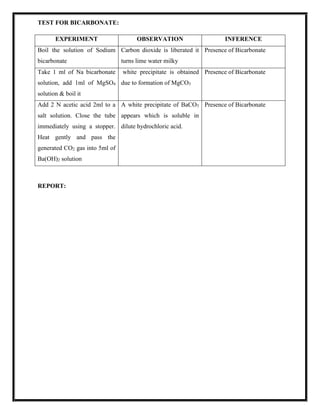
TEST FOR BICARBONATE:
EXPERIMENT OBSERVATION INFERENCE
Boil the solution of Sodium
bicarbonate
Carbon dioxide is liberated it
turns lime water milky
Presence of Bicarbonate
Take 1 ml of Na bicarbonate
solution, add 1ml of MgSO4
solution & boil it
white precipitate is obtained
due to formation of MgCO3
Presence of Bicarbonate
Add 2 N acetic acid 2ml to a
salt solution. Close the tube
immediately using a stopper.
Heat gently and pass the
generated CO2 gas into 5ml of
Ba(OH)2 solution
A white precipitate of BaCO3
appears which is soluble in
dilute hydrochloric acid.
Presence of Bicarbonate
REPORT:
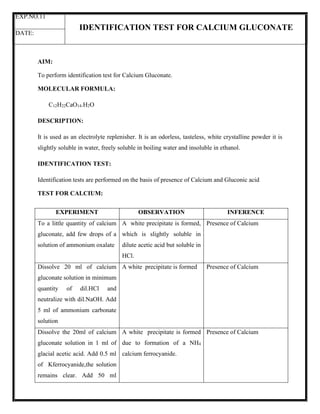
AIM:
To perform identification test for Calcium Gluconate.
MOLECULAR FORMULA:
C12H22CaO14.H2O
DESCRIPTION:
It is used as an electrolyte replenisher. It is an odorless, tasteless, white crystalline powder it is
slightly soluble in water, freely soluble in boiling water and insoluble in ethanol.
IDENTIFICATION TEST:
Identification tests are performed on the basis of presence of Calcium and Gluconic acid
TEST FOR CALCIUM:
EXP.NO.11
IDENTIFICATION TEST FOR CALCIUM GLUCONATE
DATE:
EXPERIMENT OBSERVATION INFERENCE
To a little quantity of calcium
gluconate, add few drops of a
solution of ammonium oxalate
A white precipitate is formed,
which is slightly soluble in
dilute acetic acid but soluble in
HCl.
Presence of Calcium
Dissolve 20 ml of calcium
gluconate solution in minimum
quantity of dil.HCl and
neutralize with dil.NaOH. Add
5 ml of ammonium carbonate
solution
A white precipitate is formed Presence of Calcium
Dissolve the 20ml of calcium
gluconate solution in 1 ml of
glacial acetic acid. Add 0.5 ml
of Kferrocyanide,the solution
remains clear. Add 50 ml
A white precipitate is formed
due to formation of a NH4
calcium ferrocyanide.
Presence of Calcium
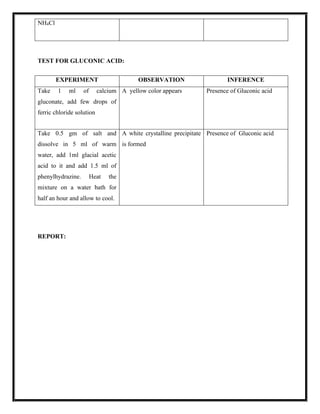
TEST FOR GLUCONIC ACID:
REPORT:
NH4Cl
EXPERIMENT OBSERVATION INFERENCE
Take 1 ml of calcium
gluconate, add few drops of
ferric chloride solution
A yellow color appears Presence of Gluconic acid
Take 0.5 gm of salt and
dissolve in 5 ml of warm
water, add 1ml glacial acetic
acid to it and add 1.5 ml of
phenylhydrazine. Heat the
mixture on a water bath for
half an hour and allow to cool.
A white crystalline precipitate
is formed
Presence of Gluconic acid
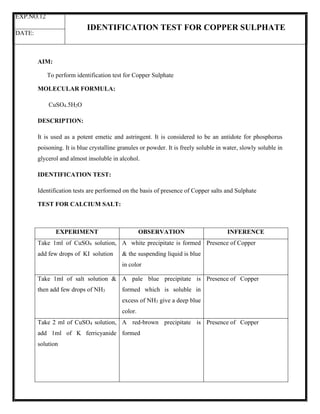
AIM:
To perform identification test for Copper Sulphate
MOLECULAR FORMULA:
CuSO4.5H2O
DESCRIPTION:
It is used as a potent emetic and astringent. It is considered to be an antidote for phosphorus
poisoning. It is blue crystalline granules or powder. It is freely soluble in water, slowly soluble in
glycerol and almost insoluble in alcohol.
IDENTIFICATION TEST:
Identification tests are performed on the basis of presence of Copper salts and Sulphate
TEST FOR CALCIUM SALT:
EXP.NO.12
IDENTIFICATION TEST FOR COPPER SULPHATE
DATE:
EXPERIMENT OBSERVATION INFERENCE
Take 1ml of CuSO4 solution,
add few drops of KI solution
A white precipitate is formed
& the suspending liquid is blue
in color
Presence of Copper
Take 1ml of salt solution &
then add few drops of NH3
A pale blue precipitate is
formed which is soluble in
excess of NH3 give a deep blue
color.
Presence of Copper
Take 2 ml of CuSO4 solution,
add 1ml of K ferricyanide
solution
A red-brown precipitate is
formed
Presence of Copper
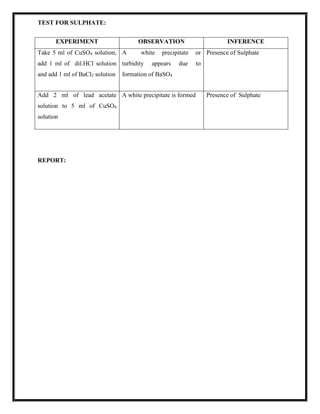
TEST FOR SULPHATE:
REPORT:
EXPERIMENT OBSERVATION INFERENCE
Take 5 ml of CuSO4 solution,
add 1 ml of dil.HCl solution
and add 1 ml of BaCl2 solution
A white precipitate or
turbidity appears due to
formation of BaSO4
Presence of Sulphate
Add 2 ml of lead acetate
solution to 5 ml of CuSO4
solution
A white precipitate is formed Presence of Sulphate
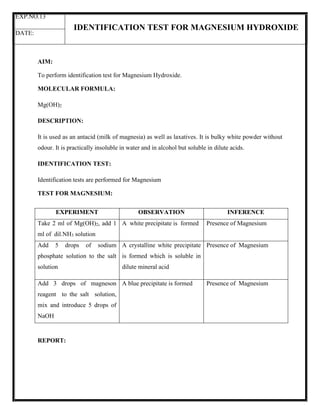
AIM:
To perform identification test for Magnesium Hydroxide.
MOLECULAR FORMULA:
Mg(OH)2
DESCRIPTION:
It is used as an antacid (milk of magnesia) as well as laxatives. It is bulky white powder without
odour. It is practically insoluble in water and in alcohol but soluble in dilute acids.
IDENTIFICATION TEST:
Identification tests are performed for Magnesium
TEST FOR MAGNESIUM:
REPORT:
EXP.NO.13
IDENTIFICATION TEST FOR MAGNESIUM HYDROXIDE
DATE:
EXPERIMENT OBSERVATION INFERENCE
Take 2 ml of Mg(OH)2, add 1
ml of dil.NH3 solution
A white precipitate is formed Presence of Magnesium
Add 5 drops of sodium
phosphate solution to the salt
solution
A crystalline white precipitate
is formed which is soluble in
dilute mineral acid
Presence of Magnesium
Add 3 drops of magneson
reagent to the salt solution,
mix and introduce 5 drops of
NaOH
A blue precipitate is formed Presence of Magnesium
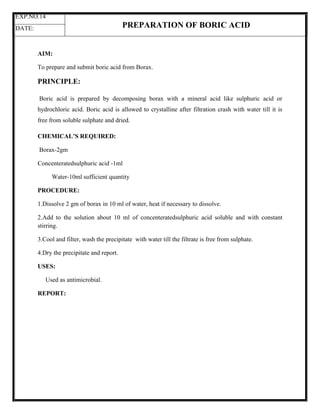
AIM:
To prepare and submit boric acid from Borax.
PRINCIPLE:
Boric acid is prepared by decomposing borax with a mineral acid like sulphuric acid or
hydrochloric acid. Boric acid is allowed to crystalline after filtration crash with water till it is
free from soluble sulphate and dried.
CHEMICAL’S REQUIRED:
Borax-2gm
Concenteratedsulphuric acid -1ml
Water-10ml sufficient quantity
PROCEDURE:
1.Dissolve 2 gm of borax in 10 ml of water, heat if necessary to dissolve.
2.Add to the solution about 10 ml of concenteratedsulphuric acid soluble and with constant
stirring.
3.Cool and filter, wash the precipitate with water till the filtrate is free from sulphate.
4.Dry the precipitate and report.
USES:
Used as antimicrobial.
REPORT:
EXP.NO.14
PREPARATION OF BORIC ACID
DATE:
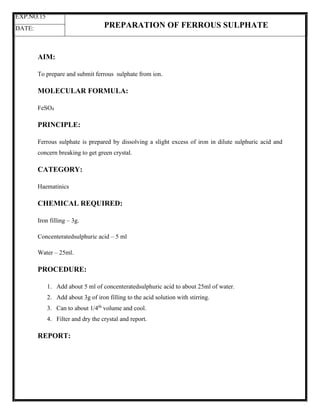
AIM:
To prepare and submit ferrous sulphate from ion.
MOLECULAR FORMULA:
FeSO4
PRINCIPLE:
Ferrous sulphate is prepared by dissolving a slight excess of iron in dilute sulphuric acid and
concern breaking to get green crystal.
CATEGORY:
Haematinics
CHEMICAL REQUIRED:
Iron filling – 3g.
Concenteratedsulphuric acid – 5 ml
Water – 25ml.
PROCEDURE:
1. Add about 5 ml of concenteratedsulphuric acid to about 25ml of water.
2. Add about 3g of iron filling to the acid solution with stirring.
3. Can to about 1/4th
volume and cool.
4. Filter and dry the crystal and report.
REPORT:
EXP.NO.15
PREPARATION OF FERROUS SULPHATE
DATE:
AIM:
To prepare and submit potash alum from potassium sulphate and aluminium sulphate.
MOLECULAR FORMULA:
KAl (SO4).12H2O.
CATEGORY: Astringent.
PRINCIPLE:
Alum is a double salt of univalent and trivalent ion with 12 molecules of water. There are
different alum, they include potash alum, ammonium alum, sodium alum, is most common alum
used and has a quick range of application. It is prepared by the reaction of KSO4 with Al2SO4.
CHEMICAL’S REQUIRED:
Potash alum – 1.1g
Aluminium sulphate – 6.3g
Water – Quantity sufficient
PROCEDURE:
1. Dissolve 6.3g of aluminum sulphate in 45ml of water in a beaker.
2. In another beaker dissolves 1.1g of potassium sulphate in 10 ml of water.
3. The two solution are heated separately until the salt dissolve completely. The hot
solution of potassium sulphate is added to solution of aluminium sulphate. Heating is
continued until the volume becomes half of the volume.
4. The solution is cooled and kept aside for some time.
5. Crystal of potash alum separate out.
6. Filter the product and report.
REPORT:
EXP.NO.16
PREPARATION OF POTASH ALUM
DATE: