Thermogravimetric Analysis
Presented by : Dr. Vijaya U. Barge
(Vice Principal & Professor)
Pune District Education
Association’s Shankarrao Ursal
College of Pharmaceutical
Sciences & Research Centre.
Contents:
•Introduction
•Types
•Principal
•TGACurve
•Instrumentation
•Factors affecting results
•Advantages
•Limitations
•Pharmaceutical applications
Thermogravimetric analysis(TGA)
•Thermogravimetric analysis or
thermal gravimetric analysis (TGA) is a
method of thermal analysis in which the
mass of a sample is measured over time
as the temperature changes.
• This
information
measurement
about
provides
physical
phenomena, such as phase transitions,
absorption and desorption as well as
chemical phenomena including
chemisorptions, thermal
decomposition, and solid-gas reactions
(e.g.,oxidation or reduction)
Threetypesof thermogravimetry:
1.Isothermal or static
thermogravimetry: In this technique the
sample weight is recorded as function of
time at constant temperature.
2.Quasistatic thermogravimetry: In this
technique the sample is heated to constant
weight at each of series of increasing
temperatures.
3.Dynamic thermogravimetry: In this
technique the sample is heated in an
environment whose temperature is
changing in a predetermined manner
generally at linear rate. This type is
generally used.
Principle ofTGA:
•In thermo-gravimetric analysis, the
sample is heated in a given environment
(air, N2, CO2, He, Ar, etc.) at controlled rate.
The change in the weight of the substance
is recorded as a function of temperature or
time.
•The temperature is increased at a
constant rate for a known initial weight of
the substance and the changes in weights
are recorded as a function of temperature
at different time interval.
•This plot of weight change against
temperature is called thermo-gravimetric
curve or thermo-gram, this is the basic
principle of TGA.
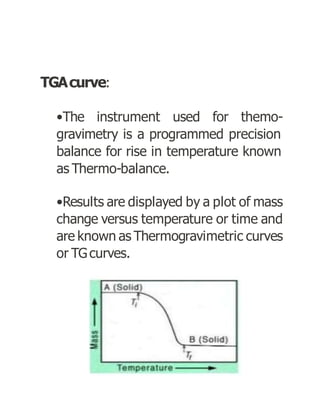
TGAcurve:
•The instrument used for themo-
gravimetry is a programmed precision
balance for rise in temperature known
as Thermo-balance.
•Results are displayed by a plot of mass
change versus temperature or time and
are known as Thermogravimetric curves
or TGcurves.
TGAcurve:
•TG curves are normally plotted with
the mass change (Dm) in percentage on
the y-axisand temperature (T)ortime(t)
on the x-axis.
•There are two temperatures in the
reaction, Ti(procedural decomposition
temp.) and Tf(final temp.) representing
the lowest temperature at which the
onset of a mass change is seen and the
lowest temperature at which the
process has been completed
respectively.
•The reaction temperature and interval
(Tf-Ti) depend on the experimental
condition; therefore, they do not have
any fixed value.
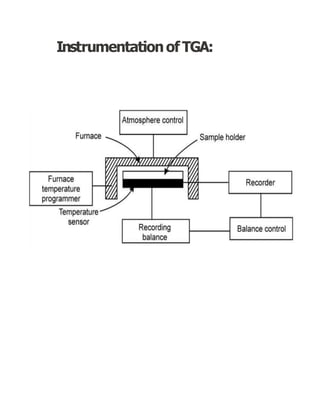
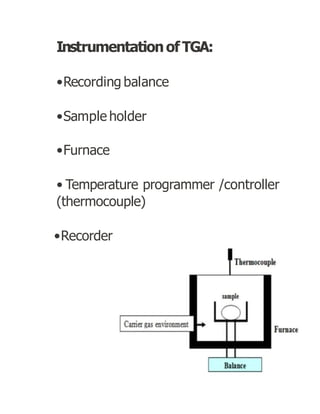
Instrumentationof TGA:
•Recording balance
•Sample holder
•Furnace
• Temperature programmer /controller
(thermocouple)
•Recorder
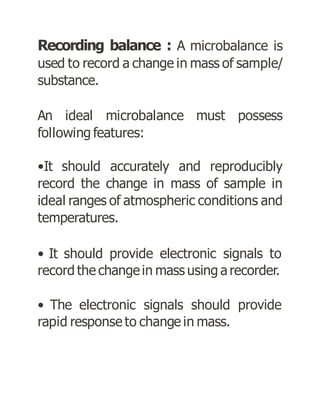
Recording balance : A microbalance is
used to record a change in mass of sample/
substance.
An ideal microbalance must possess
following features:
•It should accurately and reproducibly
record the change in mass of sample in
ideal ranges of atmospheric conditions and
temperatures.
• It should provide electronic signals to
record the changein mass using a recorder.
• The electronic signals should provide
rapid response to change in mass.
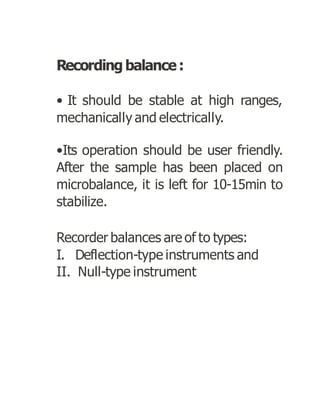
Recordingbalance:
• It should be stable at high ranges,
mechanically and electrically.
•Its operation should be user friendly.
After the sample has been placed on
microbalance, it is left for 10-15min to
stabilize.
Recorder balances are of to types:
I. Deflection-type instruments and
II. Null-type instrument
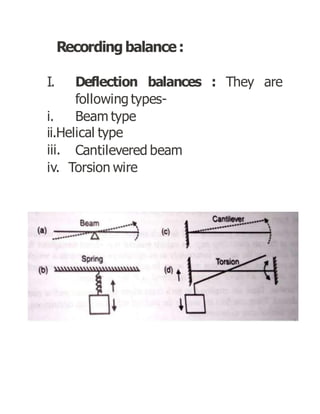
Recordingbalance:
I. Deflection balances : They are
following types-
i. Beam type
ii.Helical type
iii. Cantilevered beam
iv. Torsion wire
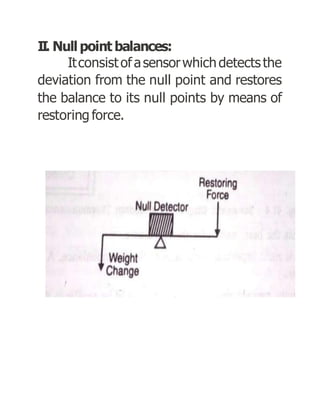
II. Null point balances:
Itconsistofasensorwhichdetectsthe
deviation from the null point and restores
the balance to its null points by means of
restoring force.
Sample holder:
•The sample to be studied is placed in
sample holder or crucible. It is attached to
the weighing arm of microbalance.
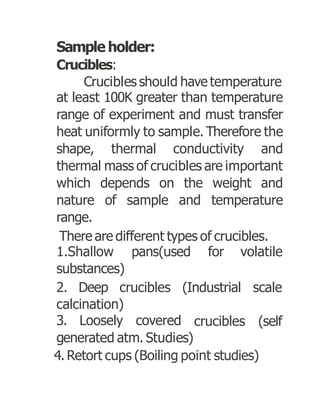
•There are different varieties of crucibles
used. Some differ in shape and size while
some differ in materials used.
•They are made up from platinum,
aluminum, quartz or alumina and some
other materials like graphite, stainless
steel,glass,etc
Sample holder:
Crucibles:
Crucibles should have temperature
at least 100K greater than temperature
range of experiment and must transfer
heat uniformly to sample. Therefore the
shape, thermal conductivity and
thermal mass of crucibles are important
which depends on the weight and
nature of sample and temperature
range.
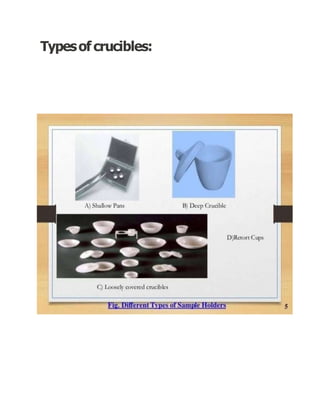
There are different types of crucibles.
1.Shallow pans(used for volatile
substances)
2. Deep crucibles (Industrial scale
calcination)
3. Loosely covered
generated atm. Studies)
crucibles (self
4. Retort cups (Boiling point studies)
Typesof crucibles:
Furnace :
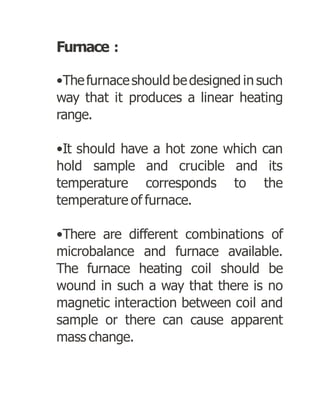
•Thefurnaceshould bedesigned in such
way that it produces a linear heating
range.
•It should have a hot zone which can
hold sample and crucible and its
temperature corresponds to the
temperature of furnace.
•There are different combinations of
microbalance and furnace available.
The furnace heating coil should be
wound in such a way that there is no
magnetic interaction between coil and
sample or there can cause apparent
mass change.
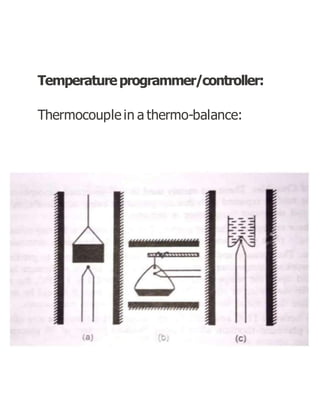
Temperatureprogrammer/controller:
•Temperature measurement is done in
no. of ways thermocouple is the most
common technique.
•The position of the temperature
measuring device relative to the sample
is very important.
•The major types are:
a . The thermocouple is placed near
the sample container and it has no
contact with the sample container. This
isn’t a good arrangement where low-
pressure are employed.
Temperatureprogrammer/controller:
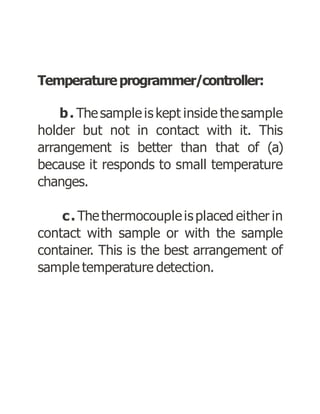
b. Thesample is kept inside thesample
holder but not in contact with it. This
arrangement is better than that of (a)
because it responds to small temperature
changes.
c. Thethermocoupleisplaced either in
contact with sample or with the sample
container. This is the best arrangement of
sample temperature detection.
Temperatureprogrammer/controller:
Thermocouple in a thermo-balance:
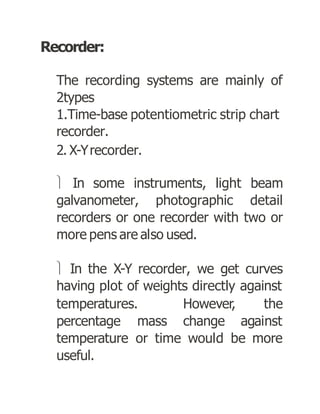
Recorder:
The recording systems are mainly of
2types
1.Time-base potentiometric strip chart
recorder.
2. X-Yrecorder.
 In some instruments, light beam
galvanometer, photographic detail
recorders or one recorder with two or
more pens are also used.
 In the X-Y recorder, we get curves
having plot of weights directly against
temperatures. However,
percentage mass change
the
against
temperature or time would be more
useful.
FactorsaffectingTGA:
The factors which may affect the TGA
curves are classified into two main
groups.:
(1)Instrumental factors:
(a)Furnace heatingrate
(b)Furnace atmosphere
(2)Sample characteristicsincludes:
(a) Weight of the sample
(b)Sample particle size
FactorsaffectingTGA:
1.Instrumental factors:
a.Furnace Heating rate: The temperature
at which the compound (or sample)
decompose depends upon the heating rate.
When the heating rate is high, the
decomposition temperature is also high. A
heating rate of 3.5°C per minute is usually
recommended for reliable and
reproducibleTGA.
b.Furnace atmosphere: The atmosphere
inside the furnace surrounding the sample
has a profound effect on the decomposition
temperature of the sample. A pure N2 gas
from a cylinder passed through the furnace
which provides an inert atmosphere.
FactorsaffectingTGA:
2.Samplecharacteristics:
a.Weight of the sample: A small weight of
the sample is recommended using a small
weight eliminates the existence of
temperature gradient throughout the
sample.
b.Particle size of the sample: The particle
size of the sample should be small and
uniform. The use of large particle or crystal
may result in apparent, very rapid weight
loss during heating.25
OtherfactorsaffectingTGAcurve:
•Sample holder
•Heat of reaction
•Compactness of sample
•Previous history of the sample
AdvantagesofTGA:
• A relatively small set of data is to be
treated.
•Continuous recording of weight loss as a
function of temperature ensures Equal
weightage to examination over the whole
range of study.
•As a single sample is analyzed over the
whole range of temperature, the variation
in the value of the kinetic parameters, if
any,will be indicated.
Limitations ofTGA:
• The Chemical or physical changes
which are not accompanied by the
change in mass on heating are not
indicated in thermo- gravimetric
analysis.
•During TGA, Pure fusion reaction,
crystalline transition, glass transition,
crystallization and solid state reaction
with no volatile product would not be
indicated because they provide no
change in mass of the specimen.
Applications ofTGA:
•From TGA,wecan determine the purity
and thermal stability of both primary
and secondary standard.
•Determination of the composition of
complex mixture and decomposition of
complex OR composition of complex
systems.
• For studying the sublimation
behaviour of various substances.
•TGA is used to study the kinetics of the
reaction rate constant.
• The effect of reactive or corrosive
atmosphere on materials.
•Analysis of the dosage form.
•Used in the study of catalyst: The
change in the chemical states of the
catalyst may be studied by TGA
techniques. (Zn- ZnCrO4) Zinc-Zinc
chromate is used as the catalyst in the
synthesis of methanol.
•Oxidative stability of materials.
•Estimated lifetime of a product.
• Moisture and volatiles contents on
materials.
•TGA is often used to measure residual
solvents and moisture, but can also be
used to determine solubility of
pharmaceutical materials in solvents.
TGA.pptx principle, instrumentation, theory

TGA.pptx principle, instrumentation, theory

  • 1.
    Thermogravimetric Analysis Presented by: Dr. Vijaya U. Barge (Vice Principal & Professor) Pune District Education Association’s Shankarrao Ursal College of Pharmaceutical Sciences & Research Centre.
  • 2.
  • 3.
    Thermogravimetric analysis(TGA) •Thermogravimetric analysisor thermal gravimetric analysis (TGA) is a method of thermal analysis in which the mass of a sample is measured over time as the temperature changes. • This information measurement about provides physical phenomena, such as phase transitions, absorption and desorption as well as chemical phenomena including chemisorptions, thermal decomposition, and solid-gas reactions (e.g.,oxidation or reduction)
  • 4.
    Threetypesof thermogravimetry: 1.Isothermal orstatic thermogravimetry: In this technique the sample weight is recorded as function of time at constant temperature. 2.Quasistatic thermogravimetry: In this technique the sample is heated to constant weight at each of series of increasing temperatures. 3.Dynamic thermogravimetry: In this technique the sample is heated in an environment whose temperature is changing in a predetermined manner generally at linear rate. This type is generally used.
  • 5.
    Principle ofTGA: •In thermo-gravimetricanalysis, the sample is heated in a given environment (air, N2, CO2, He, Ar, etc.) at controlled rate. The change in the weight of the substance is recorded as a function of temperature or time. •The temperature is increased at a constant rate for a known initial weight of the substance and the changes in weights are recorded as a function of temperature at different time interval. •This plot of weight change against temperature is called thermo-gravimetric curve or thermo-gram, this is the basic principle of TGA.
  • 6.
    TGAcurve: •The instrument usedfor themo- gravimetry is a programmed precision balance for rise in temperature known as Thermo-balance. •Results are displayed by a plot of mass change versus temperature or time and are known as Thermogravimetric curves or TGcurves.
  • 7.
    TGAcurve: •TG curves arenormally plotted with the mass change (Dm) in percentage on the y-axisand temperature (T)ortime(t) on the x-axis. •There are two temperatures in the reaction, Ti(procedural decomposition temp.) and Tf(final temp.) representing the lowest temperature at which the onset of a mass change is seen and the lowest temperature at which the process has been completed respectively. •The reaction temperature and interval (Tf-Ti) depend on the experimental condition; therefore, they do not have any fixed value.
  • 8.
  • 9.
    Instrumentationof TGA: •Recording balance •Sampleholder •Furnace • Temperature programmer /controller (thermocouple) •Recorder
  • 10.
    Recording balance :A microbalance is used to record a change in mass of sample/ substance. An ideal microbalance must possess following features: •It should accurately and reproducibly record the change in mass of sample in ideal ranges of atmospheric conditions and temperatures. • It should provide electronic signals to record the changein mass using a recorder. • The electronic signals should provide rapid response to change in mass.
  • 11.
    Recordingbalance: • It shouldbe stable at high ranges, mechanically and electrically. •Its operation should be user friendly. After the sample has been placed on microbalance, it is left for 10-15min to stabilize. Recorder balances are of to types: I. Deflection-type instruments and II. Null-type instrument
  • 12.
    Recordingbalance: I. Deflection balances: They are following types- i. Beam type ii.Helical type iii. Cantilevered beam iv. Torsion wire
  • 13.
    II. Null pointbalances: Itconsistofasensorwhichdetectsthe deviation from the null point and restores the balance to its null points by means of restoring force.
  • 14.
    Sample holder: •The sampleto be studied is placed in sample holder or crucible. It is attached to the weighing arm of microbalance. •There are different varieties of crucibles used. Some differ in shape and size while some differ in materials used. •They are made up from platinum, aluminum, quartz or alumina and some other materials like graphite, stainless steel,glass,etc
  • 15.
    Sample holder: Crucibles: Crucibles shouldhave temperature at least 100K greater than temperature range of experiment and must transfer heat uniformly to sample. Therefore the shape, thermal conductivity and thermal mass of crucibles are important which depends on the weight and nature of sample and temperature range. There are different types of crucibles. 1.Shallow pans(used for volatile substances) 2. Deep crucibles (Industrial scale calcination) 3. Loosely covered generated atm. Studies) crucibles (self 4. Retort cups (Boiling point studies)
  • 16.
  • 17.
    Furnace : •Thefurnaceshould bedesignedin such way that it produces a linear heating range. •It should have a hot zone which can hold sample and crucible and its temperature corresponds to the temperature of furnace. •There are different combinations of microbalance and furnace available. The furnace heating coil should be wound in such a way that there is no magnetic interaction between coil and sample or there can cause apparent mass change.
  • 18.
    Temperatureprogrammer/controller: •Temperature measurement isdone in no. of ways thermocouple is the most common technique. •The position of the temperature measuring device relative to the sample is very important. •The major types are: a . The thermocouple is placed near the sample container and it has no contact with the sample container. This isn’t a good arrangement where low- pressure are employed.
  • 19.
    Temperatureprogrammer/controller: b. Thesample iskept inside thesample holder but not in contact with it. This arrangement is better than that of (a) because it responds to small temperature changes. c. Thethermocoupleisplaced either in contact with sample or with the sample container. This is the best arrangement of sample temperature detection.
  • 20.
  • 21.
    Recorder: The recording systemsare mainly of 2types 1.Time-base potentiometric strip chart recorder. 2. X-Yrecorder.  In some instruments, light beam galvanometer, photographic detail recorders or one recorder with two or more pens are also used.  In the X-Y recorder, we get curves having plot of weights directly against temperatures. However, percentage mass change the against temperature or time would be more useful.
  • 22.
    FactorsaffectingTGA: The factors whichmay affect the TGA curves are classified into two main groups.: (1)Instrumental factors: (a)Furnace heatingrate (b)Furnace atmosphere (2)Sample characteristicsincludes: (a) Weight of the sample (b)Sample particle size
  • 23.
    FactorsaffectingTGA: 1.Instrumental factors: a.Furnace Heatingrate: The temperature at which the compound (or sample) decompose depends upon the heating rate. When the heating rate is high, the decomposition temperature is also high. A heating rate of 3.5°C per minute is usually recommended for reliable and reproducibleTGA. b.Furnace atmosphere: The atmosphere inside the furnace surrounding the sample has a profound effect on the decomposition temperature of the sample. A pure N2 gas from a cylinder passed through the furnace which provides an inert atmosphere.
  • 24.
    FactorsaffectingTGA: 2.Samplecharacteristics: a.Weight of thesample: A small weight of the sample is recommended using a small weight eliminates the existence of temperature gradient throughout the sample. b.Particle size of the sample: The particle size of the sample should be small and uniform. The use of large particle or crystal may result in apparent, very rapid weight loss during heating.25
  • 25.
    OtherfactorsaffectingTGAcurve: •Sample holder •Heat ofreaction •Compactness of sample •Previous history of the sample
  • 26.
    AdvantagesofTGA: • A relativelysmall set of data is to be treated. •Continuous recording of weight loss as a function of temperature ensures Equal weightage to examination over the whole range of study. •As a single sample is analyzed over the whole range of temperature, the variation in the value of the kinetic parameters, if any,will be indicated.
  • 27.
    Limitations ofTGA: • TheChemical or physical changes which are not accompanied by the change in mass on heating are not indicated in thermo- gravimetric analysis. •During TGA, Pure fusion reaction, crystalline transition, glass transition, crystallization and solid state reaction with no volatile product would not be indicated because they provide no change in mass of the specimen.
  • 28.
    Applications ofTGA: •From TGA,wecandetermine the purity and thermal stability of both primary and secondary standard. •Determination of the composition of complex mixture and decomposition of complex OR composition of complex systems. • For studying the sublimation behaviour of various substances. •TGA is used to study the kinetics of the reaction rate constant. • The effect of reactive or corrosive atmosphere on materials.
  • 29.
    •Analysis of thedosage form. •Used in the study of catalyst: The change in the chemical states of the catalyst may be studied by TGA techniques. (Zn- ZnCrO4) Zinc-Zinc chromate is used as the catalyst in the synthesis of methanol. •Oxidative stability of materials. •Estimated lifetime of a product. • Moisture and volatiles contents on materials. •TGA is often used to measure residual solvents and moisture, but can also be used to determine solubility of pharmaceutical materials in solvents.