Presented by:
Mr. Akshay. S. Dhole
M. Pharm- I Year
Roll No. 03
Guided by:
Mrs. Jaya Kamble.
(Associate Professor)
Department of Quality Assurance
Vasantidevi Patil Institute of
Pharmacy, Kodoli
• Ion Source
•Ionization Techniques
•Methods of Ionization
a) Gas phase
b) Desorption
c) Evaporative
The ion source converts molecules into gaseous
ions.
The most involves bombarding the sample with a
beam of energetics from an ion gun.
 Ionization Techniques can be categorised into
two parts:-
1) Hard Ionization Techniques:-
High energy will be involved, In that no. of
fragments ion will be Higher and no. of
Molecular ion will be low.
2) Soft Ionization Techniques:-
Low energy, low fragmentation, high
molecule ion.
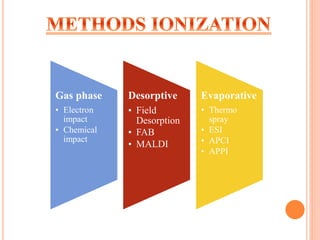
Gas phase
• Electron
impact
• Chemical
impact
Desorptive
• Field
Desorption
• FAB
• MALDI
Evaporative
• Thermo
spray
• ESI
• APCI
• APPI
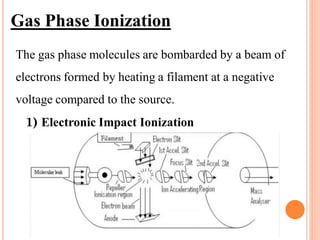
Gas Phase Ionization
The gas phase molecules are bombarded by a beam of
electrons formed by heating a filament at a negative
voltage compared to the source.
1) Electronic Impact Ionization
INTRODUCTION
Electron impact (EI) is the classical ionization method in mass
spectrometry.
It is the most widely used and highly developed method.
It is also known as Electron bombardment or Electron Ionization.
CONSTRUCTION & WORKING:
1) Electron impact ionization source consists of a ionizing chamber which
is maintained at a pressure of 0.005 torr and temperature of 200Âą0.25
degrees.
2) Electron gun is located perpendicular to chamber.
3) Electrons are emitted from a glowing filament (tungsten or rhenium) by
thermionic emission and accelerated by a potential of 70 V applied
between the filament and anode.
4) These electrons are drawn in the ionization chamber through positively
charged slits.
5) The number of electrons is controlled by filament temperature and
energy of energy is controlled by filament potential.
ADVANTAGES
Gives molecular mass and also the fragmentation pattern of the
sample.
Extensive fragmentation and consequent large number of
peaks gives structural information.
Gives reproducible mass spectra.
DISADVANTAGES
Sample must be thermally stable and volatile.
A small amount of sample is ionized (1 in 1000 molecules).
Unstable molecular ion fragments are formed so readily that
are absent from mass spectrum.
2) Chemical Impact Ionization
INTRODUCTION
In chemical ionization, the ionization of the analyte is achieved by
interaction of it's molecules →with ions of a reagent gas in the
chamber or source.
CONSTRUCTION & WORKING:
1. Chemical ionization is carried out in an instrument similar to
electron impact ion source.
2. It is a two part process.
In the first step-
✓A reagent gas is ionized by Electron Impact ionization in the
source.
✓ The primary ions of reagent gas react with additional gas to
produce stabilized reagent ion.
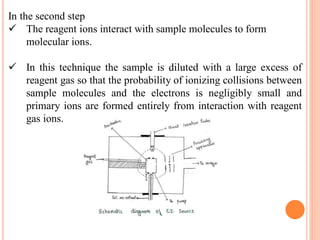
In the second step
 The reagent ions interact with sample molecules to form
molecular ions.
 In this technique the sample is diluted with a large excess of
reagent gas so that the probability of ionizing collisions between
sample molecules and the electrons is negligibly small and
primary ions are formed entirely from interaction with reagent
gas ions.
ADVANTAGES
✓ Used for high molecular weight compounds.
✓ Used for samples which undergo rapid fragmentation in EI.
LIMITATIONS
✓ Not suitable for thermally unstable and non-volatile samples.
✓ Relative less sensitive then EI ionization.
Desorptive Ionization
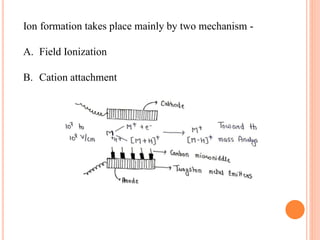
1) Field Desorption
It is a type of desorption ionization technique which involves
direct conversion of Solid / liquid molecules into gaseous ion
directly.
This technique low Volatile Sample and used to produce
Stable molecular ions.
Samples are loaded on the Surface of the Carbon microniddle
by dipping in the Sample Solution.
Carbon microniddle will Produce high gradient Voltage on
their tips. that is why sharp tips is used.
Ion formation takes place mainly by two mechanism -
A. Field Ionization
B. Cation attachment
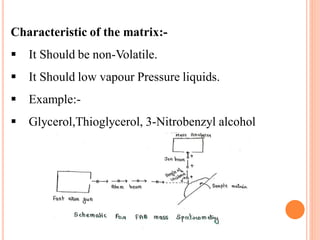
2) Fast atom bombardment [FAB]
•It is a soft ionization method classified under desorption method.
•FAB is used to determine the molecular weight of the
Compound having the Size from 300 to 6000 Daltons-.
•Generally used to determine molecular weight of Peptides.
•Methodology:-
Characteristic of the matrix:-
 It Should be non-Volatile.
 It Should low vapour Pressure liquids.
 Example:-
 Glycerol,Thioglycerol, 3-Nitrobenzyl alcohol
ADVANTAGES
• Used for ionization of polar high molecular weight samples.
• Provides rapid heating of samples and reduces sample
fragmentation.
• Rapid ionization.
DISADVANTAGES
• Difficult to distinguish between low molecular weight
compounds.
• Compounds must be soluble in liquid matrix.
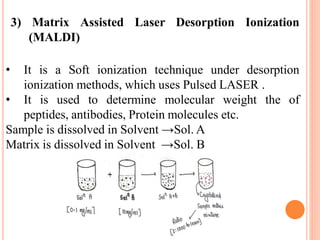
• It is a Soft ionization technique under desorption
ionization methods, which uses Pulsed LASER .
• It is used to determine molecular weight the of
peptides, antibodies, Protein molecules etc.
Sample is dissolved in Solvent →Sol. A
Matrix is dissolved in Solvent →Sol. B
3) Matrix Assisted Laser Desorption Ionization
(MALDI)
Matrix
• Matrix is used in MALDI to Absorb the laser energy.
• Prevent analyte agglomeration.(stability, flowability,
dispersability.)
• Protect analyte from being destroyed by direct laser
beam.
APPLICATIONS
 Estimation of DNA, RNA and oligosaccharides.
 Used in analysis of lipids, phosphopeptides and
synthetic polymers.
Evaporative Ionization
1) Atmospheric Pressure chemical Ionization [APCI]
 It is a type of soft Ionization technique based on the mechanism
of evaporation and Carried out the atmospheric Pressure.
 Actually APCI is Combination of chemical Ionization [CI] and
electrospray Ionization (ESI) with Some deviation.
2) Atmospheric Pressure Photo Ionization [APPI]
• It is a type of soft ionization technique.
• Based on the mechanism of evaporation and Carried
out at atmospheric Pressure.
• APPI is Similar to APCI but ionization is APPI is due
to photons generated by UV.
Ionization Techniques In Mass Spectroscopy

Ionization Techniques In Mass Spectroscopy

  • 1.
    Presented by: Mr. Akshay.S. Dhole M. Pharm- I Year Roll No. 03 Guided by: Mrs. Jaya Kamble. (Associate Professor) Department of Quality Assurance Vasantidevi Patil Institute of Pharmacy, Kodoli
  • 2.
    • Ion Source •IonizationTechniques •Methods of Ionization a) Gas phase b) Desorption c) Evaporative
  • 3.
    The ion sourceconverts molecules into gaseous ions. The most involves bombarding the sample with a beam of energetics from an ion gun.
  • 4.
     Ionization Techniquescan be categorised into two parts:- 1) Hard Ionization Techniques:- High energy will be involved, In that no. of fragments ion will be Higher and no. of Molecular ion will be low. 2) Soft Ionization Techniques:- Low energy, low fragmentation, high molecule ion.
  • 5.
    Gas phase • Electron impact •Chemical impact Desorptive • Field Desorption • FAB • MALDI Evaporative • Thermo spray • ESI • APCI • APPI
  • 6.
    Gas Phase Ionization Thegas phase molecules are bombarded by a beam of electrons formed by heating a filament at a negative voltage compared to the source. 1) Electronic Impact Ionization
  • 7.
    INTRODUCTION Electron impact (EI)is the classical ionization method in mass spectrometry. It is the most widely used and highly developed method. It is also known as Electron bombardment or Electron Ionization. CONSTRUCTION & WORKING: 1) Electron impact ionization source consists of a ionizing chamber which is maintained at a pressure of 0.005 torr and temperature of 200¹0.25 degrees. 2) Electron gun is located perpendicular to chamber. 3) Electrons are emitted from a glowing filament (tungsten or rhenium) by thermionic emission and accelerated by a potential of 70 V applied between the filament and anode. 4) These electrons are drawn in the ionization chamber through positively charged slits. 5) The number of electrons is controlled by filament temperature and energy of energy is controlled by filament potential.
  • 8.
    ADVANTAGES Gives molecular massand also the fragmentation pattern of the sample. Extensive fragmentation and consequent large number of peaks gives structural information. Gives reproducible mass spectra. DISADVANTAGES Sample must be thermally stable and volatile. A small amount of sample is ionized (1 in 1000 molecules). Unstable molecular ion fragments are formed so readily that are absent from mass spectrum.
  • 9.
    2) Chemical ImpactIonization INTRODUCTION In chemical ionization, the ionization of the analyte is achieved by interaction of it's molecules →with ions of a reagent gas in the chamber or source. CONSTRUCTION & WORKING: 1. Chemical ionization is carried out in an instrument similar to electron impact ion source. 2. It is a two part process. In the first step- ✓A reagent gas is ionized by Electron Impact ionization in the source. ✓ The primary ions of reagent gas react with additional gas to produce stabilized reagent ion.
  • 10.
    In the secondstep  The reagent ions interact with sample molecules to form molecular ions.  In this technique the sample is diluted with a large excess of reagent gas so that the probability of ionizing collisions between sample molecules and the electrons is negligibly small and primary ions are formed entirely from interaction with reagent gas ions.
  • 11.
    ADVANTAGES ✓ Used forhigh molecular weight compounds. ✓ Used for samples which undergo rapid fragmentation in EI. LIMITATIONS ✓ Not suitable for thermally unstable and non-volatile samples. ✓ Relative less sensitive then EI ionization.
  • 12.
    Desorptive Ionization 1) FieldDesorption It is a type of desorption ionization technique which involves direct conversion of Solid / liquid molecules into gaseous ion directly. This technique low Volatile Sample and used to produce Stable molecular ions. Samples are loaded on the Surface of the Carbon microniddle by dipping in the Sample Solution. Carbon microniddle will Produce high gradient Voltage on their tips. that is why sharp tips is used.
  • 13.
    Ion formation takesplace mainly by two mechanism - A. Field Ionization B. Cation attachment
  • 14.
    2) Fast atombombardment [FAB] •It is a soft ionization method classified under desorption method. •FAB is used to determine the molecular weight of the Compound having the Size from 300 to 6000 Daltons-. •Generally used to determine molecular weight of Peptides. •Methodology:-
  • 15.
    Characteristic of thematrix:-  It Should be non-Volatile.  It Should low vapour Pressure liquids.  Example:-  Glycerol,Thioglycerol, 3-Nitrobenzyl alcohol
  • 16.
    ADVANTAGES • Used forionization of polar high molecular weight samples. • Provides rapid heating of samples and reduces sample fragmentation. • Rapid ionization. DISADVANTAGES • Difficult to distinguish between low molecular weight compounds. • Compounds must be soluble in liquid matrix.
  • 17.
    • It isa Soft ionization technique under desorption ionization methods, which uses Pulsed LASER . • It is used to determine molecular weight the of peptides, antibodies, Protein molecules etc. Sample is dissolved in Solvent →Sol. A Matrix is dissolved in Solvent →Sol. B 3) Matrix Assisted Laser Desorption Ionization (MALDI)
  • 18.
    Matrix • Matrix isused in MALDI to Absorb the laser energy. • Prevent analyte agglomeration.(stability, flowability, dispersability.) • Protect analyte from being destroyed by direct laser beam.
  • 19.
    APPLICATIONS  Estimation ofDNA, RNA and oligosaccharides.  Used in analysis of lipids, phosphopeptides and synthetic polymers.
  • 20.
    Evaporative Ionization 1) AtmosphericPressure chemical Ionization [APCI]  It is a type of soft Ionization technique based on the mechanism of evaporation and Carried out the atmospheric Pressure.  Actually APCI is Combination of chemical Ionization [CI] and electrospray Ionization (ESI) with Some deviation.
  • 21.
    2) Atmospheric PressurePhoto Ionization [APPI] • It is a type of soft ionization technique. • Based on the mechanism of evaporation and Carried out at atmospheric Pressure. • APPI is Similar to APCI but ionization is APPI is due to photons generated by UV.