INFRARED
SPECTROSCOPY
by
P. viji
M.Pharm I year
(Pharmaceutics)
INTRODUCTION
Infrared spectroscopy or vibrational spectroscopy is
concerned with the study of absorption of infrared
radiation, which results in vibrational transitions.
It is also known as vibrational spectroscopy.
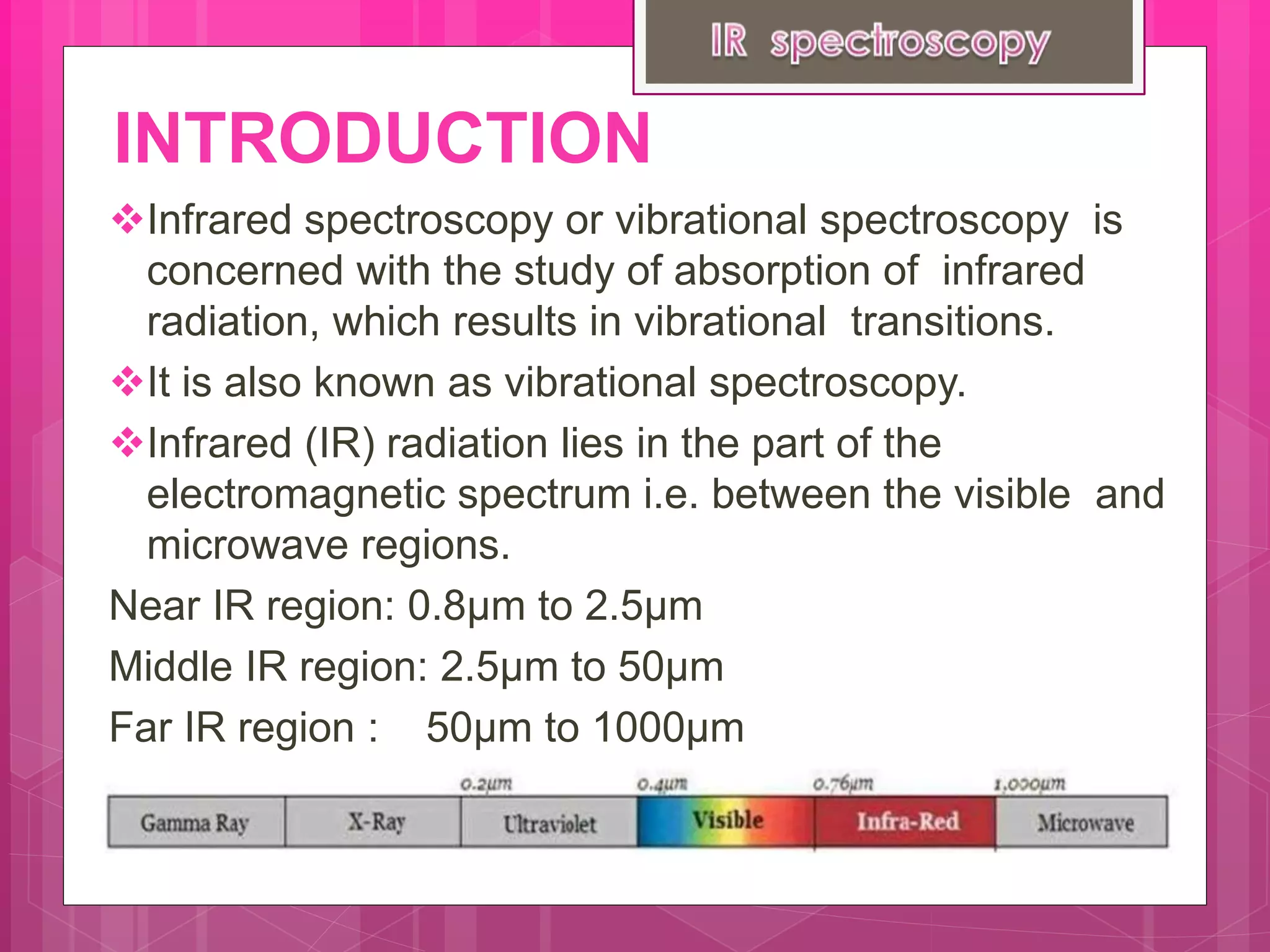
Infrared (IR) radiation lies in the part of the
electromagnetic spectrum i.e. between the visible and
microwave regions.
Near IR region: 0.8μm to 2.5μm
Middle IR region: 2.5μm to 50μm
Far IR region : 50μm to 1000μm
PRINCIPLE
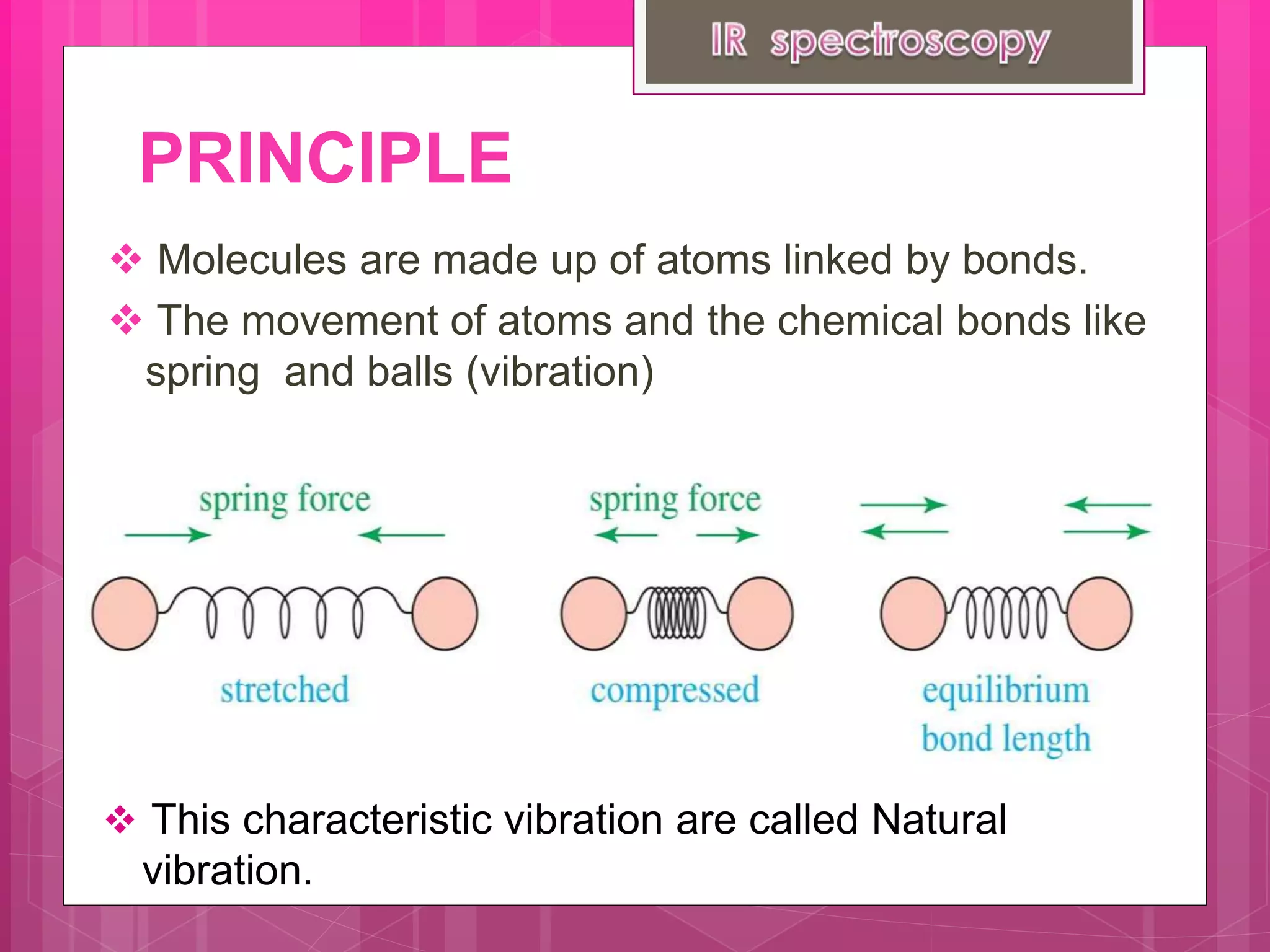
 Molecules are made up of atoms linked by bonds.
 The movement of atoms and the chemical bonds like
spring and balls (vibration)
 This characteristic vibration are called Natural
vibration.
When IR is applied then it causes the vibration between
the atoms of the molecules when,
Applied infrared frequency = Natural frequency of
vibration
Then, Absorption of IR radiation takes place and a peak
is observed.
Example : Infrared vibrations of ethanol.
Every bond or portion of a molecule or functional group
requires different frequency of absorption. Hence
characteristic peak is observed for every functional
group or part of the molecule.
In other words, IR spectra is nothing but a finger print
region of a molecule.
Fingerprint Region
Absorption band in the region 1500-500 cm‾¹.
Useful for establishing the identity of a compound.
It consists of :
 Region 1500-1350 cm‾¹ :Appearance of doublet
near 1380 cm‾¹ and 1365cm‾¹ shows the presence
of 3º butyl group.
 Region 1350-1000 cm‾¹ : All classes of compound
viz. alcohol, esters, lactones shows absorptions in
the region due to C-O stretching.
 Region below 1000 cm‾¹ : This region distinguishes
between cis and trans alkene.
CRITERIA FOR A COMPOUND TO
ABSORB IR RADIATION
 Dipole Moment:
The bonds in a molecule can absorb IR
radiation only when there is a change in dipole moment
due to electric field of IR radiation.
 Applied IR frequency should be equal to the natural
frequency of radiation, otherwise compounds do not
give IR peaks
TYPES OF VIBRATIONS
1. Stretching vibrations:
Vibration along the line of bond.
Change in bond length.
2 types:
a) Symmetrical stretching
b) Asymmetrical stretching
a) Symmetrical stretching
 Both bonds increase or decrease in length
simultaneously.
b) Asymmetrical stretching
 In this, one bond length is increased and other is
decreased.
2. Bending vibrations
 Vibration not along the line of bond.
 In this, bond angle is altered.
2 types:
a)In plane bending:
i. scissoring
ii.rocking
b)Out plane bending:
i. wagging
ii.twisting
a)In plane bending:
i. scissoring :
 This is an in plane blending
 Bond angles are decrease
ii. Rocking :
 Bond angle is maintained.
 Movement of atoms take place in the same
direction.
b) OUT PLANE BENDING
vibrations takes place outside the plane of molecule.
i. Wagging:
 both atoms move to
one side of the plane.
ii. Twisting:
 One atom moves above the plane and another atom
moves below the plane
INSTRUMENTATION
The main parts of IR spectrometer are as
follows :
1. IR radiation sources
2. Monochromators
3. Sample cells and sampling of substances
4. Detectors
5. recorders
1.IR radiation sources
Incandescent lamp
Nernst glower
Globar Source
a) Incandescent Wire Source
b) The Nernst Glower
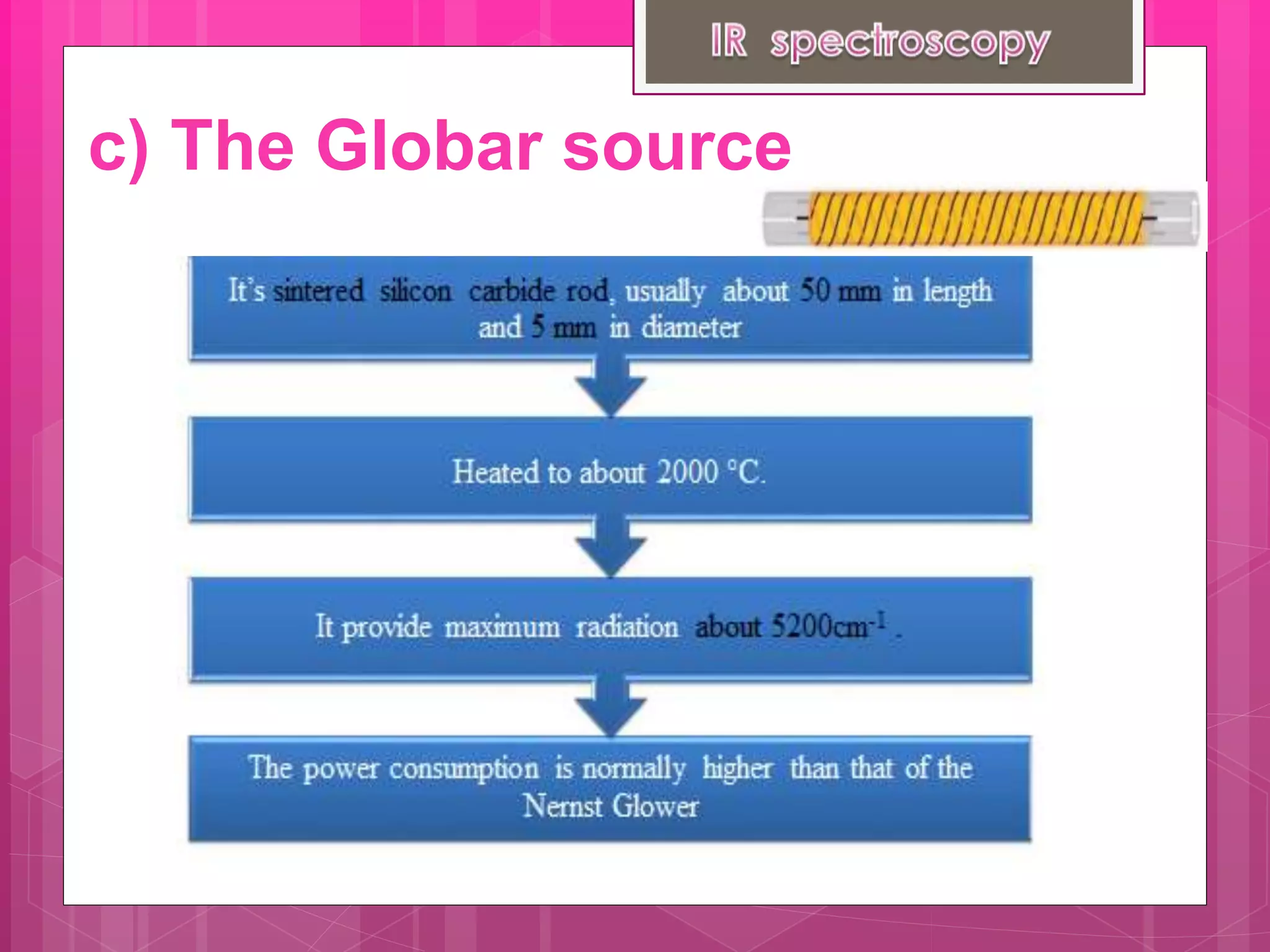
c) The Globar source
2.Monochromators
A.Prism:-
 Used as dispersive element.
 Constructed of various metal halide salts.
 Sodium chloride is most commonly prism salt used.
B. Grating
 Grating are nothing but rulings made on some
materials like glass, quartz or alkylhalides depending
upon the instrument.
 The mechanism is that diffraction produces
reinforcement.
 The rays which are incident upon the gratings gets
reinforced with the reflected rays.
3.SAMPLE CELL
 Made up of alkali halides like NaCl or KBr .
 Aqueous solvents cannot be used - they
dissolve alkali halides.
 Only organic solvents like chloroform is used.
Sample handling
a) Sampling of solids
 Solids run in solution
 Mull technique
 Pressed pellet technique
 Solids films
i.) Solids run in solution
 Dissolve solid sample in non -aqueous solvent and
place a drop of this solution in alkali metal disc and
allow to evaporate, leaving a thin film which is then
mounted on a spectrometer.
 E.g. of solvents – acetone, cyclohexane, chloroform
carbon tetrachloride etc.
ii. Solid films
 Here amorphous solid is dissolved in volatile
solvents and this solution is poured on a
rock salt plate (NaCl or KBr), then the
solvent is evaporated by gentle heating.
iii. Mull technique:
 In this technique a small quantity of sample is
thoroughly ground in a clean mortar until the powder is
very fine.
 After grinding, the mulling agent (mineral oil or Nujol) is
introduced in small quantities just sufficient to take up
the powder (mixture approximates the consistency of
a toothpaste).
 The mixture is then transferred to the mull plates & the
plates are squeezed together to adjust the thickness
of the sample between IR transmitting windows.
 This is then mounted in a path of IR beam and the
spectrum is run.
iv. Pressed pellet technique:
 In this technique a small amount of finely ground solid
sample is intimately mixed with about 100 times its
weight of powdered Potassium bromide, in a vibrating
ball mill.
 This finely ground mixture is then pressed under very
high pressure (25000 p sig) in evacuable die or
minipress to form a small pellet (about 1-2 mm thick
and 1cm in diameter).
 The resulting pellet is transparent to IR radiation and is
run as such.
b) Sampling of liquids
 Liquids sample can be sandwiched between two alkali
halide salt plates ( NaCl , KBr , CaF2 ) .
 The sample cell thickness is 0.01-0.05mm.
c) Sampling of gases
 Here the spectrum of gas can be obtained by gases
sample or low boiling i.e. volatile liquid is introduced
into a glass evacuated cell made up of NaCl.
 Very few organic compounds can be examined as
gases.
 E.g. : 1 , 4-dioxane
4) DETECTOR
TYPES OF DETECTOR:
 Bolometers detector
 Thermocouple and
thermopile detector
 Pyro electric detector
 Golay cell
a) Thermocouple detector
b) Bolometer
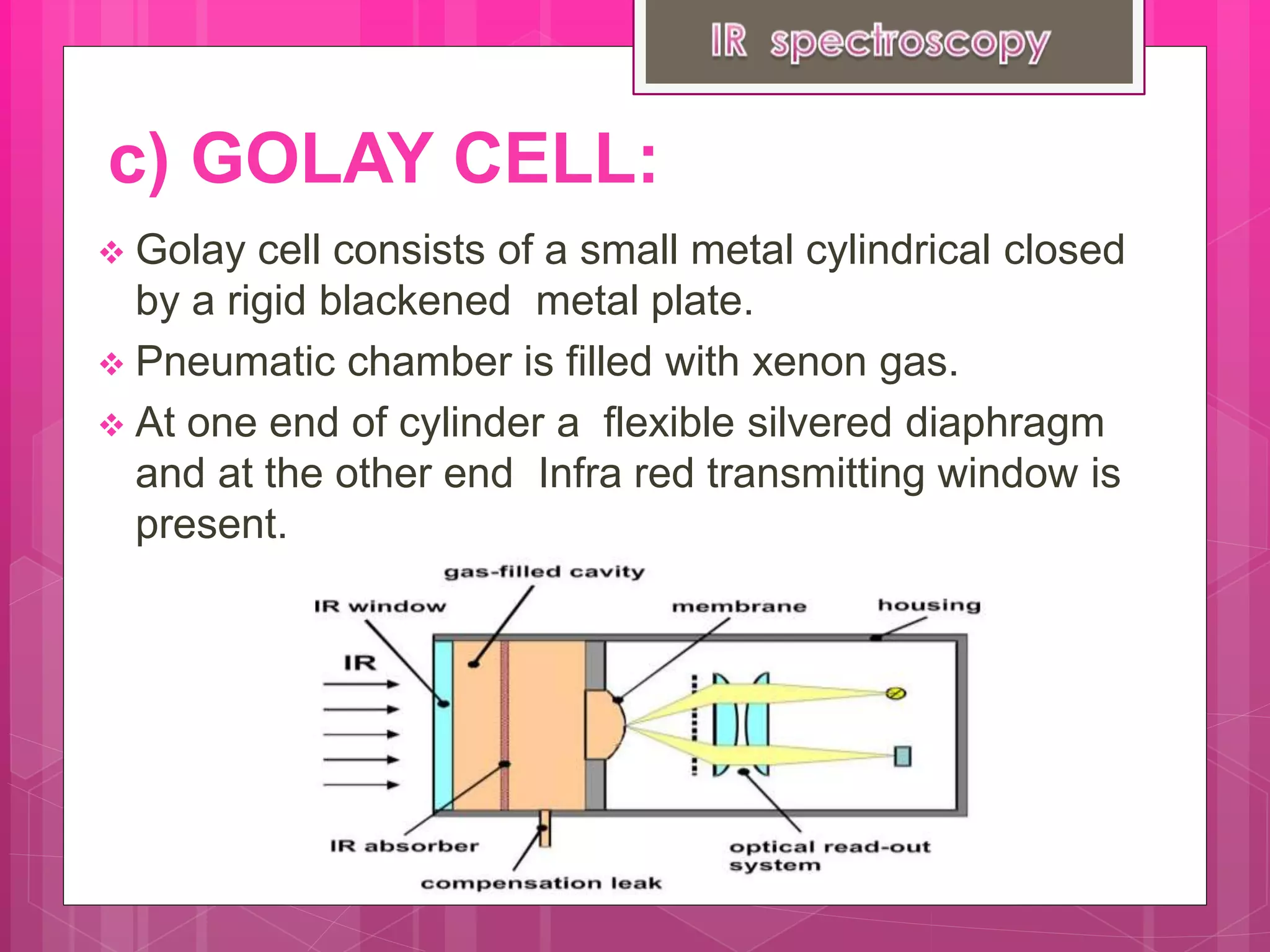
c) GOLAY CELL:
 Golay cell consists of a small metal cylindrical closed
by a rigid blackened metal plate.
 Pneumatic chamber is filled with xenon gas.
 At one end of cylinder a flexible silvered diaphragm
and at the other end Infra red transmitting window is
present.
 When infra red radiation is passed through infrared
transmitting window the blackened plate absorbs the
heat. By this heat the xenon gas causes expand
 The resulting pressure of gas will cause deformation
of diaphragm. This motion of the diaphragm detects
how much IR radiation falls on metal plate.
 Light is made to fall on diaphragm which reflects light
on photocell
d) Pyroelectric Detectors
 Pyroelectric detector contain certain crystal Such as
lithium tantalate, barium titanate and triglycine sulfate
i.e. they produce temperature sensitive dipole
moments.
 To construct a pyroelectric detector , a pyroelectric
substance is placed between two electrodes .
 Two electrodes are connected to each other via a
voltmeter.
 one of which has IR transparent window .
 When the IR radiation falls upon a pyroelectric
substance , it absorbs energy from the radiation .
5) Recorder:
 The radiant energy received by detector is converted
into measurable electrical signal and is amplified by
amplifier.
 The amplified signals are recorded and plotted.
TYPES OF INSTRUMENTATION
 There are 2 types of infrared spectrophotometer
characterized by the manner in which the IR
frequencies are handled.
1) dispersive type (IR)
2) Interferometric type(FTIR)
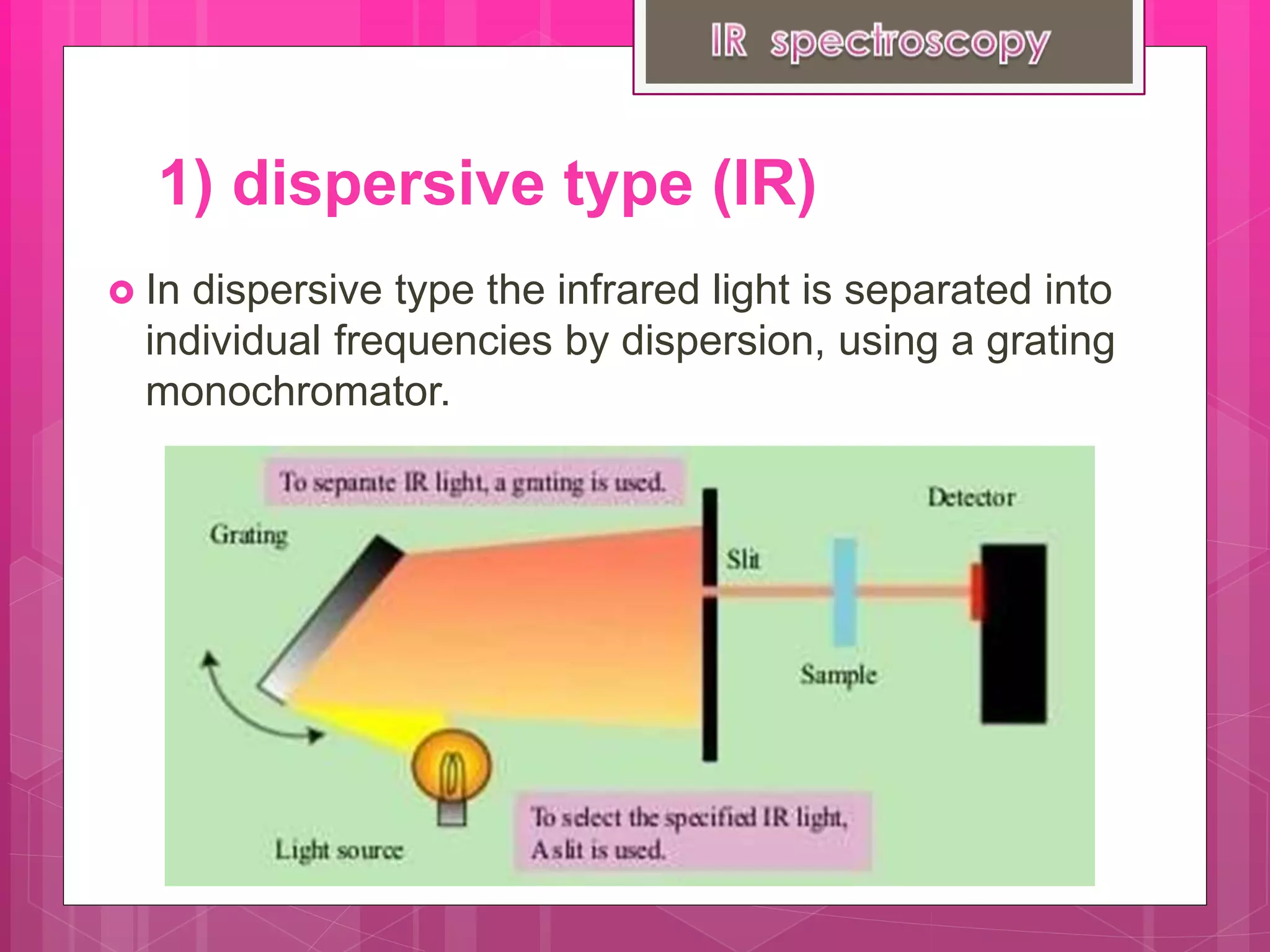
1) dispersive type (IR)
 In dispersive type the infrared light is separated into
individual frequencies by dispersion, using a grating
monochromator.
2) Interferometric type(FTIR)
 In interferometric type the ir frequencies are allowed to
interact to produce an interference pattern and this
pattern is then analyzed, to determine individual
frequencies and their intensities.
APPLICATIONS
 Identification of functional group and structural
elucidation.
 Identification of drug substances.
 Identifying impurities in drug sample.
 Study of hydrogen bonding.
 Study of polymers.
 Identify ratio of cis-trans isomers in a mixture of
compounds.
 Quantitative analysis.
 To find out difference between hydrogen bonding.

Infrared spectroscopy

  • 1.
  • 2.
    INTRODUCTION Infrared spectroscopy orvibrational spectroscopy is concerned with the study of absorption of infrared radiation, which results in vibrational transitions. It is also known as vibrational spectroscopy. Infrared (IR) radiation lies in the part of the electromagnetic spectrum i.e. between the visible and microwave regions. Near IR region: 0.8μm to 2.5μm Middle IR region: 2.5μm to 50μm Far IR region : 50μm to 1000μm
  • 3.
    PRINCIPLE  Molecules aremade up of atoms linked by bonds.  The movement of atoms and the chemical bonds like spring and balls (vibration)  This characteristic vibration are called Natural vibration.
  • 4.
    When IR isapplied then it causes the vibration between the atoms of the molecules when, Applied infrared frequency = Natural frequency of vibration Then, Absorption of IR radiation takes place and a peak is observed. Example : Infrared vibrations of ethanol.
  • 5.
    Every bond orportion of a molecule or functional group requires different frequency of absorption. Hence characteristic peak is observed for every functional group or part of the molecule. In other words, IR spectra is nothing but a finger print region of a molecule.
  • 6.
    Fingerprint Region Absorption bandin the region 1500-500 cm‾¹. Useful for establishing the identity of a compound. It consists of :  Region 1500-1350 cm‾¹ :Appearance of doublet near 1380 cm‾¹ and 1365cm‾¹ shows the presence of 3º butyl group.  Region 1350-1000 cm‾¹ : All classes of compound viz. alcohol, esters, lactones shows absorptions in the region due to C-O stretching.  Region below 1000 cm‾¹ : This region distinguishes between cis and trans alkene.
  • 7.
    CRITERIA FOR ACOMPOUND TO ABSORB IR RADIATION  Dipole Moment: The bonds in a molecule can absorb IR radiation only when there is a change in dipole moment due to electric field of IR radiation.  Applied IR frequency should be equal to the natural frequency of radiation, otherwise compounds do not give IR peaks
  • 8.
  • 9.
    1. Stretching vibrations: Vibrationalong the line of bond. Change in bond length. 2 types: a) Symmetrical stretching b) Asymmetrical stretching
  • 10.
    a) Symmetrical stretching Both bonds increase or decrease in length simultaneously. b) Asymmetrical stretching  In this, one bond length is increased and other is decreased.
  • 11.
    2. Bending vibrations Vibration not along the line of bond.  In this, bond angle is altered. 2 types: a)In plane bending: i. scissoring ii.rocking b)Out plane bending: i. wagging ii.twisting
  • 12.
    a)In plane bending: i.scissoring :  This is an in plane blending  Bond angles are decrease ii. Rocking :  Bond angle is maintained.  Movement of atoms take place in the same direction.
  • 13.
    b) OUT PLANEBENDING vibrations takes place outside the plane of molecule. i. Wagging:  both atoms move to one side of the plane. ii. Twisting:  One atom moves above the plane and another atom moves below the plane
  • 14.
    INSTRUMENTATION The main partsof IR spectrometer are as follows : 1. IR radiation sources 2. Monochromators 3. Sample cells and sampling of substances 4. Detectors 5. recorders
  • 15.
    1.IR radiation sources Incandescentlamp Nernst glower Globar Source
  • 16.
  • 17.
  • 19.
  • 20.
    2.Monochromators A.Prism:-  Used asdispersive element.  Constructed of various metal halide salts.  Sodium chloride is most commonly prism salt used.
  • 21.
    B. Grating  Gratingare nothing but rulings made on some materials like glass, quartz or alkylhalides depending upon the instrument.  The mechanism is that diffraction produces reinforcement.  The rays which are incident upon the gratings gets reinforced with the reflected rays.
  • 22.
    3.SAMPLE CELL  Madeup of alkali halides like NaCl or KBr .  Aqueous solvents cannot be used - they dissolve alkali halides.  Only organic solvents like chloroform is used.
  • 23.
    Sample handling a) Samplingof solids  Solids run in solution  Mull technique  Pressed pellet technique  Solids films
  • 24.
    i.) Solids runin solution  Dissolve solid sample in non -aqueous solvent and place a drop of this solution in alkali metal disc and allow to evaporate, leaving a thin film which is then mounted on a spectrometer.  E.g. of solvents – acetone, cyclohexane, chloroform carbon tetrachloride etc.
  • 25.
    ii. Solid films Here amorphous solid is dissolved in volatile solvents and this solution is poured on a rock salt plate (NaCl or KBr), then the solvent is evaporated by gentle heating.
  • 26.
    iii. Mull technique: In this technique a small quantity of sample is thoroughly ground in a clean mortar until the powder is very fine.  After grinding, the mulling agent (mineral oil or Nujol) is introduced in small quantities just sufficient to take up the powder (mixture approximates the consistency of a toothpaste).  The mixture is then transferred to the mull plates & the plates are squeezed together to adjust the thickness of the sample between IR transmitting windows.  This is then mounted in a path of IR beam and the spectrum is run.
  • 27.
    iv. Pressed pellettechnique:  In this technique a small amount of finely ground solid sample is intimately mixed with about 100 times its weight of powdered Potassium bromide, in a vibrating ball mill.  This finely ground mixture is then pressed under very high pressure (25000 p sig) in evacuable die or minipress to form a small pellet (about 1-2 mm thick and 1cm in diameter).  The resulting pellet is transparent to IR radiation and is run as such.
  • 29.
    b) Sampling ofliquids  Liquids sample can be sandwiched between two alkali halide salt plates ( NaCl , KBr , CaF2 ) .  The sample cell thickness is 0.01-0.05mm.
  • 30.
    c) Sampling ofgases  Here the spectrum of gas can be obtained by gases sample or low boiling i.e. volatile liquid is introduced into a glass evacuated cell made up of NaCl.  Very few organic compounds can be examined as gases.  E.g. : 1 , 4-dioxane
  • 31.
    4) DETECTOR TYPES OFDETECTOR:  Bolometers detector  Thermocouple and thermopile detector  Pyro electric detector  Golay cell
  • 32.
  • 35.
  • 37.
    c) GOLAY CELL: Golay cell consists of a small metal cylindrical closed by a rigid blackened metal plate.  Pneumatic chamber is filled with xenon gas.  At one end of cylinder a flexible silvered diaphragm and at the other end Infra red transmitting window is present.
  • 38.
     When infrared radiation is passed through infrared transmitting window the blackened plate absorbs the heat. By this heat the xenon gas causes expand  The resulting pressure of gas will cause deformation of diaphragm. This motion of the diaphragm detects how much IR radiation falls on metal plate.  Light is made to fall on diaphragm which reflects light on photocell
  • 39.
    d) Pyroelectric Detectors Pyroelectric detector contain certain crystal Such as lithium tantalate, barium titanate and triglycine sulfate i.e. they produce temperature sensitive dipole moments.  To construct a pyroelectric detector , a pyroelectric substance is placed between two electrodes .  Two electrodes are connected to each other via a voltmeter.  one of which has IR transparent window .
  • 40.
     When theIR radiation falls upon a pyroelectric substance , it absorbs energy from the radiation .
  • 41.
    5) Recorder:  Theradiant energy received by detector is converted into measurable electrical signal and is amplified by amplifier.  The amplified signals are recorded and plotted.
  • 42.
    TYPES OF INSTRUMENTATION There are 2 types of infrared spectrophotometer characterized by the manner in which the IR frequencies are handled. 1) dispersive type (IR) 2) Interferometric type(FTIR)
  • 43.
    1) dispersive type(IR)  In dispersive type the infrared light is separated into individual frequencies by dispersion, using a grating monochromator.
  • 44.
    2) Interferometric type(FTIR) In interferometric type the ir frequencies are allowed to interact to produce an interference pattern and this pattern is then analyzed, to determine individual frequencies and their intensities.
  • 45.
    APPLICATIONS  Identification offunctional group and structural elucidation.  Identification of drug substances.  Identifying impurities in drug sample.  Study of hydrogen bonding.  Study of polymers.  Identify ratio of cis-trans isomers in a mixture of compounds.  Quantitative analysis.  To find out difference between hydrogen bonding.