Light Follower Bot

ANURAG YADAV
C O N T E N T
Introduction

Basic
Principle

Designing

• What is Light Following Robot?

• Basic concept of Working of light Following Robot

• What are the requirements of designing
Designing

Application

Summary

• Circuit Diagram

• Where this technology can be applied & recent
developments.
• What are the advantage & disadvantages
Introduction

• It is a robot that senses the light &
follows it. A user can shine a flashlight at
its front and it will respond by following
the light source. This robot uses a
microcontroller for processing the sensor
readings and responds by controlling the
motors & it can also be designed without
using micro controller. So basically it is a
robot that responses according to light.
C O N C E P T
When A LDR (light
dependent resistor )
Subjected to white
light then the
resistance Varies
.According to this
variation Op-Amp &
Transistor circuit gives
response to drive the
motor.

Light incident on LDR

Resistance Of LDR Changes
Op-Amp Sends Signal to
transistor
Transistor activates
Corresponding driving Motor
D E S I G N I N G
•
•
•
•
•

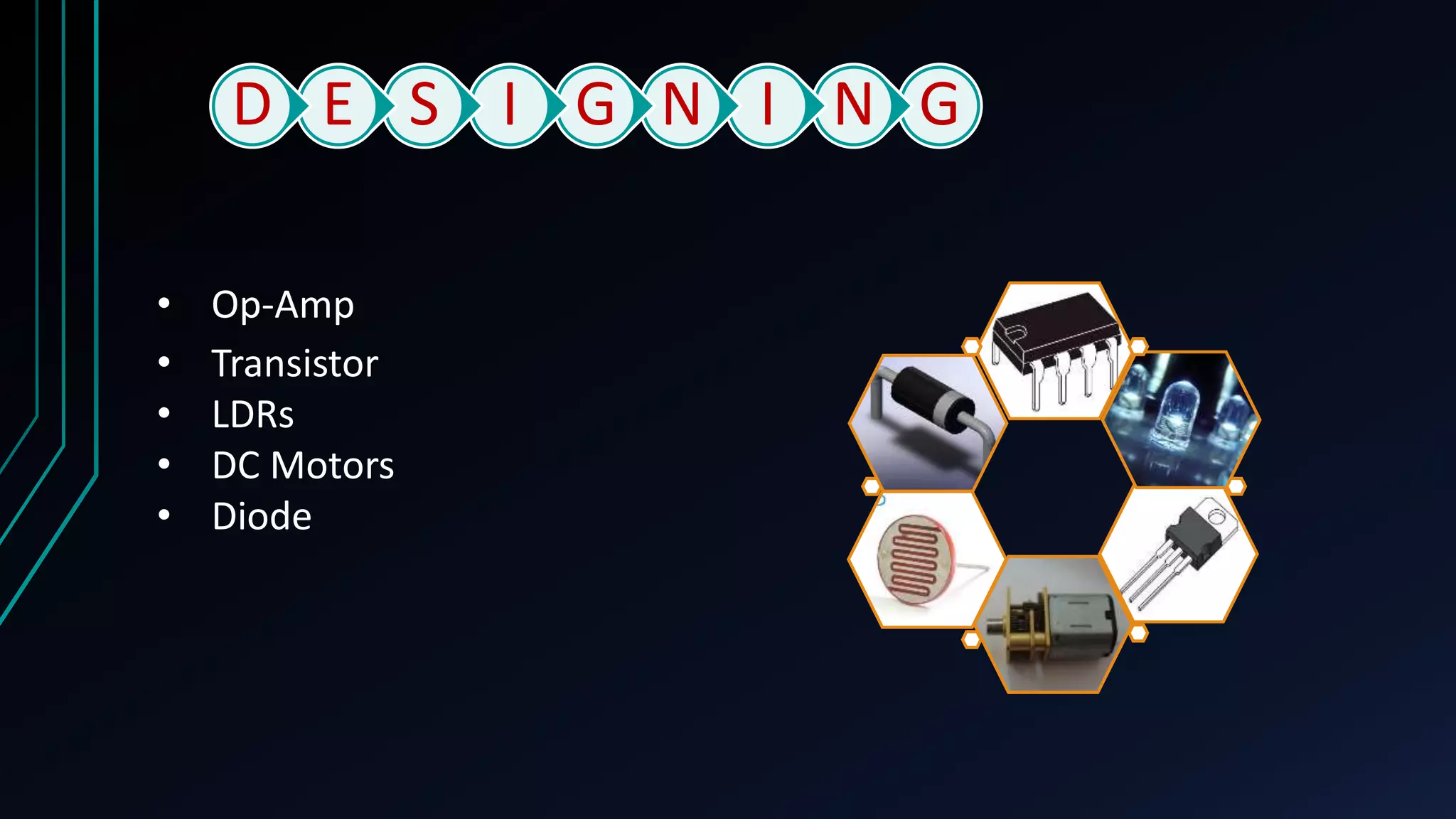
Op-Amp
Transistor
LDRs
DC Motors
Diode
C I R CU I T
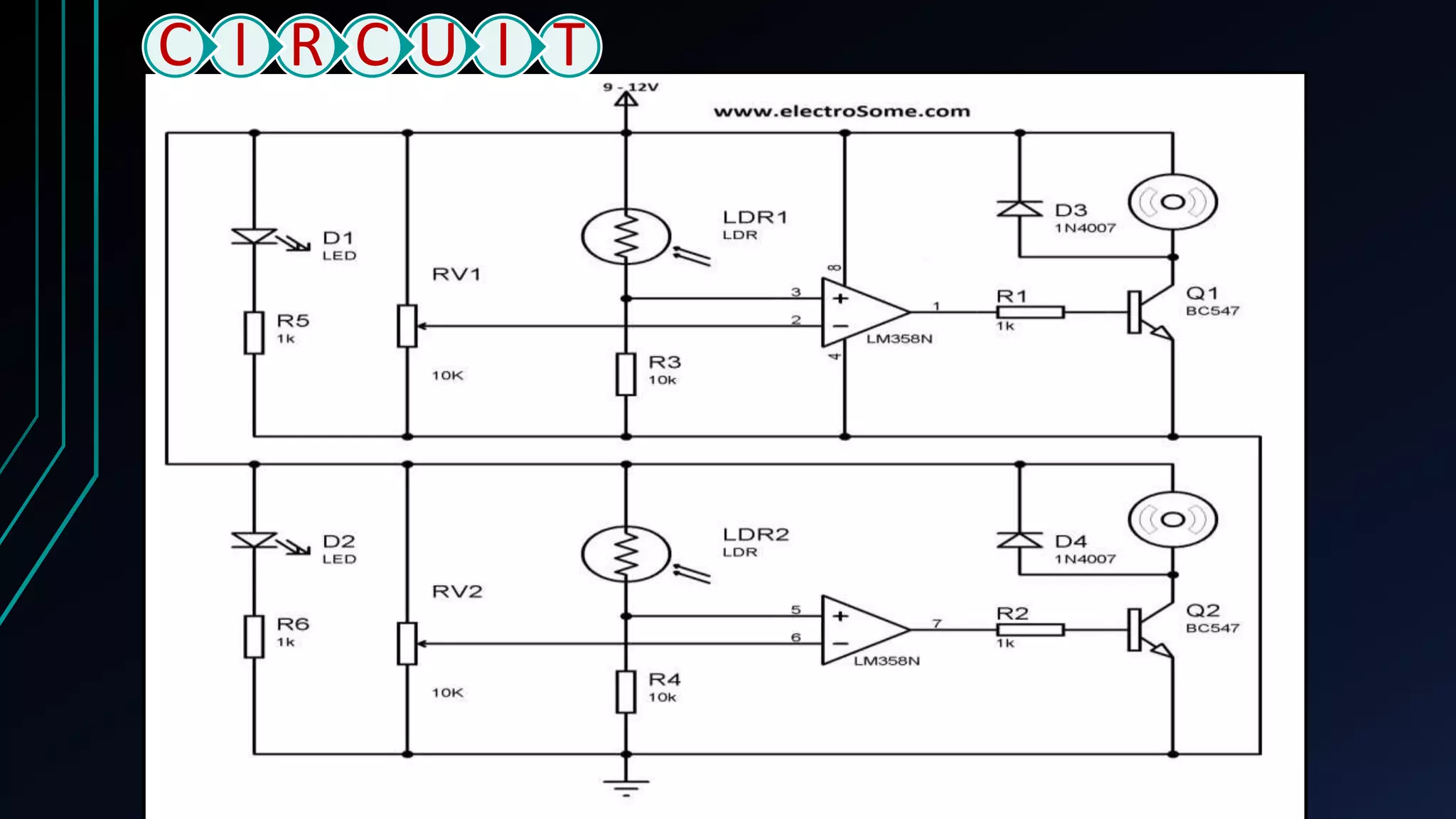
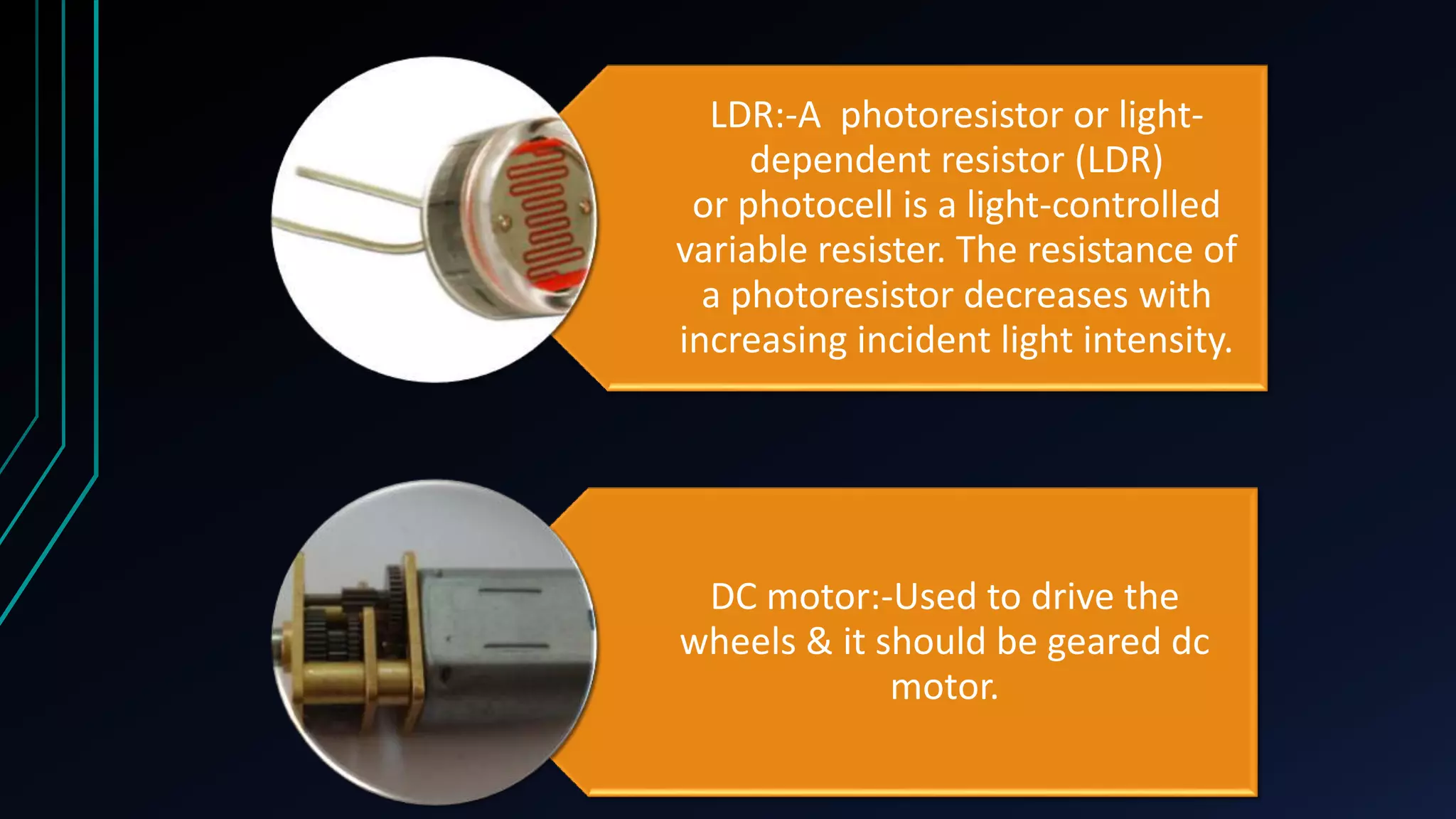
LDR:-A photoresistor or lightdependent resistor (LDR)
or photocell is a light-controlled
variable resister. The resistance of
a photoresistor decreases with
increasing incident light intensity.

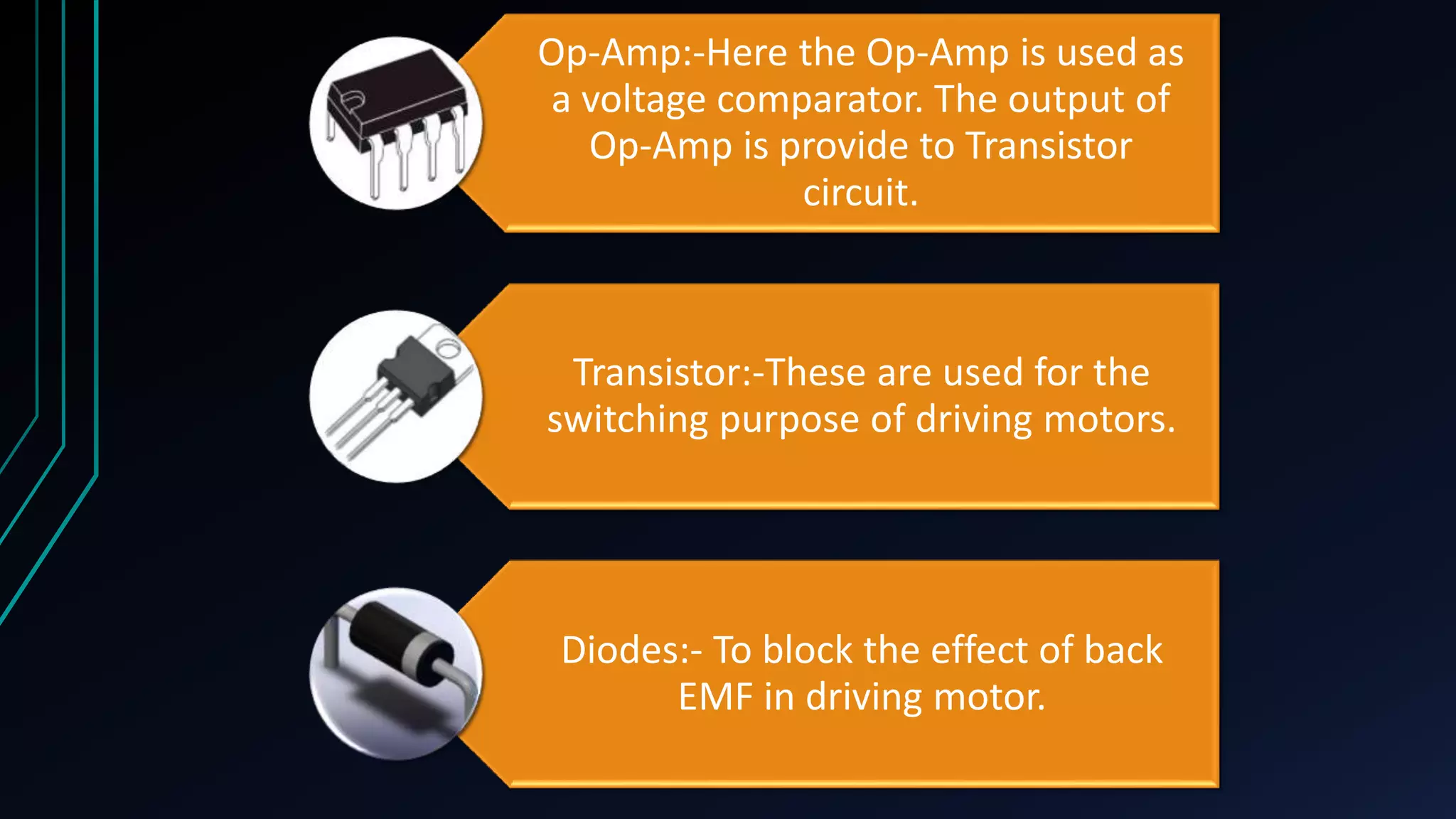
DC motor:-Used to drive the
wheels & it should be geared dc
motor.
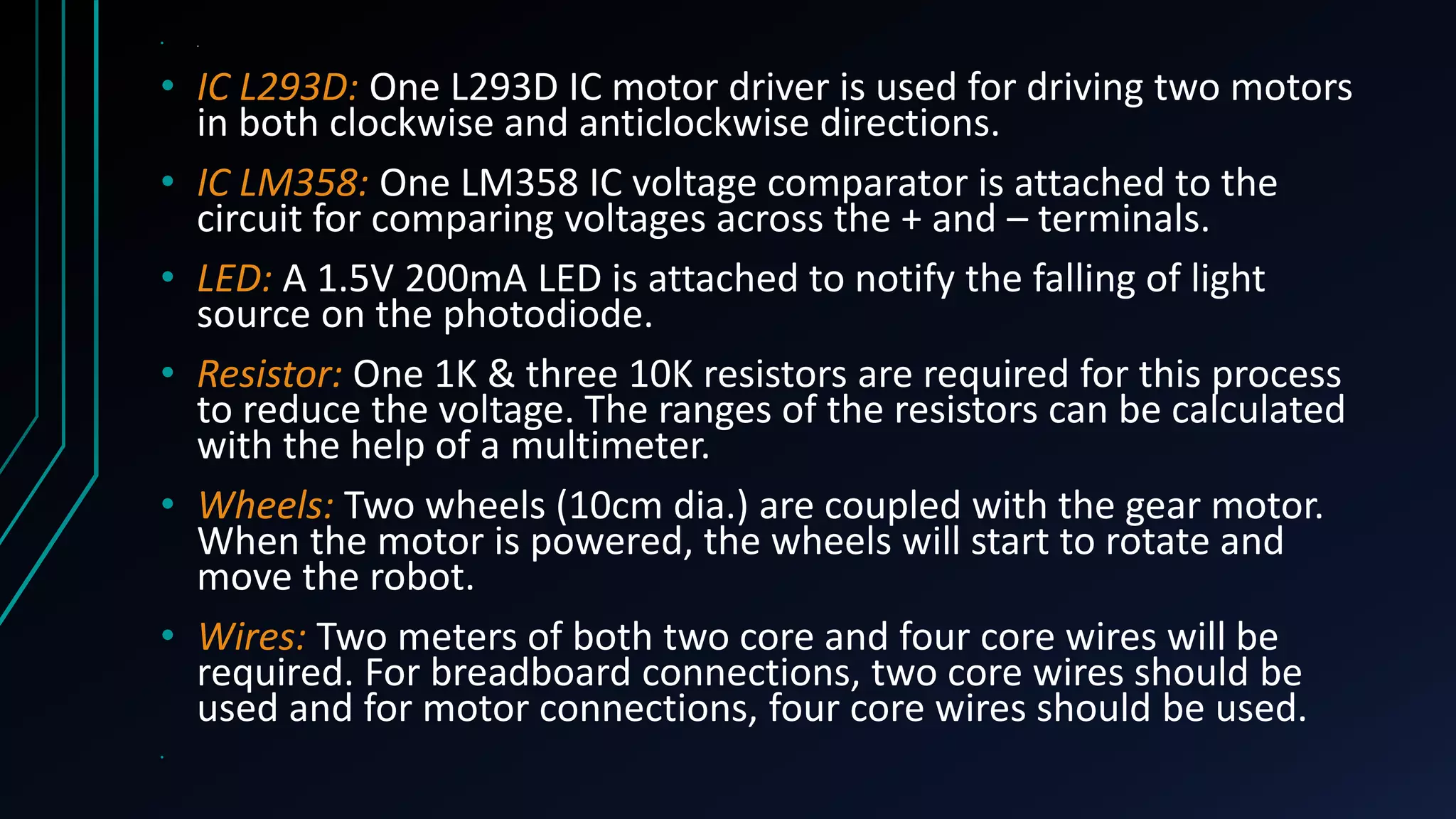
Op-Amp:-Here the Op-Amp is used as
a voltage comparator. The output of
Op-Amp is provide to Transistor
circuit.

Transistor:-These are used for the
switching purpose of driving motors.

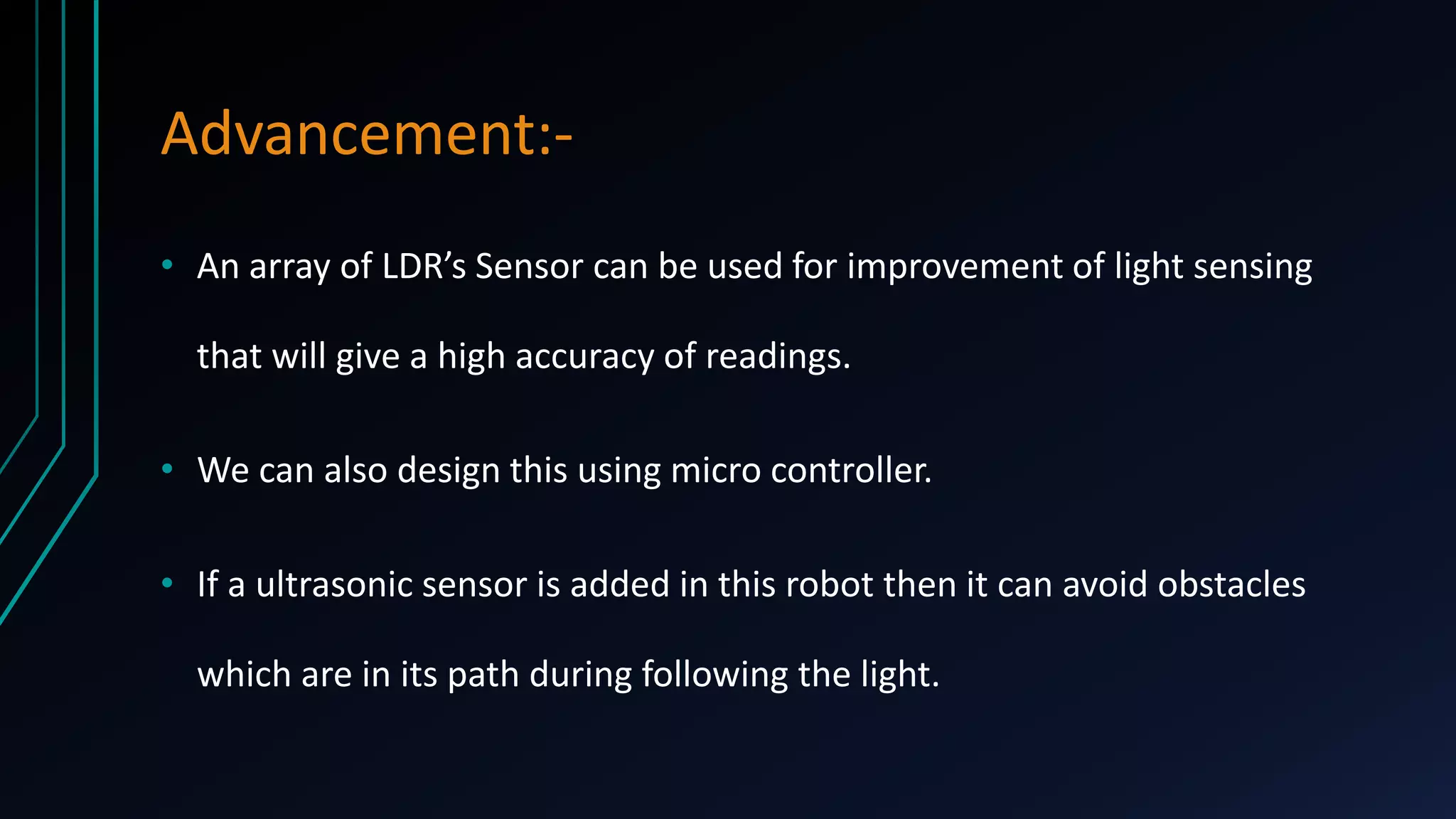
Diodes:- To block the effect of back
EMF in driving motor.
C I R CU I T
• Battery: One 9V battery will be sufficient for powering the robot. For more
usages, two pairs of 9V battery may be required.
• Battery holder: It is used to connect the battery with the circuit.
• Breadboard: One breadboard is used for designing the circuit. The
electronic components are connected by inserting it in the holes of the
breadboard.

• Capacitor: Two 10uf capacitors are implemented to store the current,
equalize the power output, filter, and so on.
• Castor Wheel: One castor wheel is mounted in front of the hard board for
providing easy and comfortable moving of the robot.
• Gear Motor: Two 300rpm gear motors are connected with the wheel for
moving the robot.
• IC 7805: One IC 7805 voltage regulator is incorporated for allowing 5V of
power supply to the circuit instead of 9V
•

.

• IC L293D: One L293D IC motor driver is used for driving two motors
in both clockwise and anticlockwise directions.
• IC LM358: One LM358 IC voltage comparator is attached to the
circuit for comparing voltages across the + and – terminals.
• LED: A 1.5V 200mA LED is attached to notify the falling of light
source on the photodiode.
• Resistor: One 1K & three 10K resistors are required for this process
to reduce the voltage. The ranges of the resistors can be calculated
with the help of a multimeter.
• Wheels: Two wheels (10cm dia.) are coupled with the gear motor.
When the motor is powered, the wheels will start to rotate and
move the robot.
• Wires: Two meters of both two core and four core wires will be
required. For breadboard connections, two core wires should be
used and for motor connections, four core wires should be used.
•
Advancement:• An array of LDR’s Sensor can be used for improvement of light sensing
that will give a high accuracy of readings.
• We can also design this using micro controller.
• If a ultrasonic sensor is added in this robot then it can avoid obstacles
which are in its path during following the light.
Application:• Street lights
• Alarm devices

• This technology can also be used to measure light intensity for
applications that require greater precision.

• Cameras can use this technology to determine the proper exposure
time; laptops may use in a circuit that varies screen brightness
according to ambient lighting conditions.
Advantage & Disadvantage:There is no specific advantage or disadvantage of this
technology it depends on the how this technology is used
THANK YOU

light follower robot

  • 1.
  • 2.
    C O NT E N T Introduction Basic Principle Designing • What is Light Following Robot? • Basic concept of Working of light Following Robot • What are the requirements of designing
  • 3.
    Designing Application Summary • Circuit Diagram •Where this technology can be applied & recent developments. • What are the advantage & disadvantages
  • 4.
    Introduction • It isa robot that senses the light & follows it. A user can shine a flashlight at its front and it will respond by following the light source. This robot uses a microcontroller for processing the sensor readings and responds by controlling the motors & it can also be designed without using micro controller. So basically it is a robot that responses according to light.
  • 5.
    C O NC E P T When A LDR (light dependent resistor ) Subjected to white light then the resistance Varies .According to this variation Op-Amp & Transistor circuit gives response to drive the motor. Light incident on LDR Resistance Of LDR Changes Op-Amp Sends Signal to transistor Transistor activates Corresponding driving Motor
  • 6.
    D E SI G N I N G • • • • • Op-Amp Transistor LDRs DC Motors Diode
  • 7.
    C I RCU I T
  • 8.
    LDR:-A photoresistor orlightdependent resistor (LDR) or photocell is a light-controlled variable resister. The resistance of a photoresistor decreases with increasing incident light intensity. DC motor:-Used to drive the wheels & it should be geared dc motor.
  • 9.
    Op-Amp:-Here the Op-Ampis used as a voltage comparator. The output of Op-Amp is provide to Transistor circuit. Transistor:-These are used for the switching purpose of driving motors. Diodes:- To block the effect of back EMF in driving motor.
  • 10.
    C I RCU I T
  • 11.
    • Battery: One9V battery will be sufficient for powering the robot. For more usages, two pairs of 9V battery may be required. • Battery holder: It is used to connect the battery with the circuit. • Breadboard: One breadboard is used for designing the circuit. The electronic components are connected by inserting it in the holes of the breadboard. • Capacitor: Two 10uf capacitors are implemented to store the current, equalize the power output, filter, and so on. • Castor Wheel: One castor wheel is mounted in front of the hard board for providing easy and comfortable moving of the robot. • Gear Motor: Two 300rpm gear motors are connected with the wheel for moving the robot. • IC 7805: One IC 7805 voltage regulator is incorporated for allowing 5V of power supply to the circuit instead of 9V
  • 12.
    • . • IC L293D:One L293D IC motor driver is used for driving two motors in both clockwise and anticlockwise directions. • IC LM358: One LM358 IC voltage comparator is attached to the circuit for comparing voltages across the + and – terminals. • LED: A 1.5V 200mA LED is attached to notify the falling of light source on the photodiode. • Resistor: One 1K & three 10K resistors are required for this process to reduce the voltage. The ranges of the resistors can be calculated with the help of a multimeter. • Wheels: Two wheels (10cm dia.) are coupled with the gear motor. When the motor is powered, the wheels will start to rotate and move the robot. • Wires: Two meters of both two core and four core wires will be required. For breadboard connections, two core wires should be used and for motor connections, four core wires should be used. •
  • 13.
    Advancement:• An arrayof LDR’s Sensor can be used for improvement of light sensing that will give a high accuracy of readings. • We can also design this using micro controller. • If a ultrasonic sensor is added in this robot then it can avoid obstacles which are in its path during following the light.
  • 14.
    Application:• Street lights •Alarm devices • This technology can also be used to measure light intensity for applications that require greater precision. • Cameras can use this technology to determine the proper exposure time; laptops may use in a circuit that varies screen brightness according to ambient lighting conditions.
  • 15.
    Advantage & Disadvantage:Thereis no specific advantage or disadvantage of this technology it depends on the how this technology is used
  • 16.