ULTRASONIC NAVIGATION SYSTEM
FOR THE BLIND
Submitted by
ABHISHEK DIXIT
GAGANDEEP SINGH
MOHIT KUMAR
PRAVIN KUMAR
Under guidance of
PROF. A.K. SINGH
SUPERVISOR
PROF. Y.K. MISHRA
HEAD OF DEPARTMENT
PROF. S.P. GANGWAR
PROJECT INCHARGE
DEPARTMENT OF ELECTRONICS ENGINEERING
KAMLA NEHRU INSTITUTE OF TECHNOLOGY
SULTANPUR-228118(U.P.)
DR. A. P. J. ABDUL KALAM TECHNICAL UNIVERSITY,
LUCKNOW (U.P.), INDIA
CONTENTS
• INTRODUCTION
• BASIC LOGIC
• COMPONENTS
• PROTOTYPE OF OUR STICK
• USAGE OF DIFFERENT SENSORS
• ATMEGA 16
• ULTRASONIC SENSOR
• IR SENSOR
• WATER SENSOR
• FIRE SENSOR
• LIGHT SENSOR
• OUTPUT DEVICES
• SOFTWARE USED
• INTERFACING WITH CONTROLLER
• CONCLUSION
• FUTURE SCOPE
• REFERENCES
INTRODUCTION
Vision is the most important part of human
physiology as 83% of information human being gets
from the environment is via sight. The 2011 statistics
by the World Health Organization (WHO) estimates
that there are 285 billion people in world with visual
impairment, 39 billion of which are blind and 246
with low vision.
Presently, blind people use a white stick as a tool for
directing them when they move or walk.
Here, we develop a tool which can serve as a blind
stick being more efficient and helpful than the
conventional one.
This will assist the blind persons during the walk and
provides an alarm if any hurdle is detected within the
set range.
BASIC LOGIC
• Five different sensors with microcontroller
interface are used which are connected to
buzzer and vibrator.
• ATMEGA 16 as the main microcontroller is
used.
COMPONENTS
• Microcontroller ATMEGA 16
• Sensors
• Buzzer
• Vibrator
BLOCK DIAGRAM
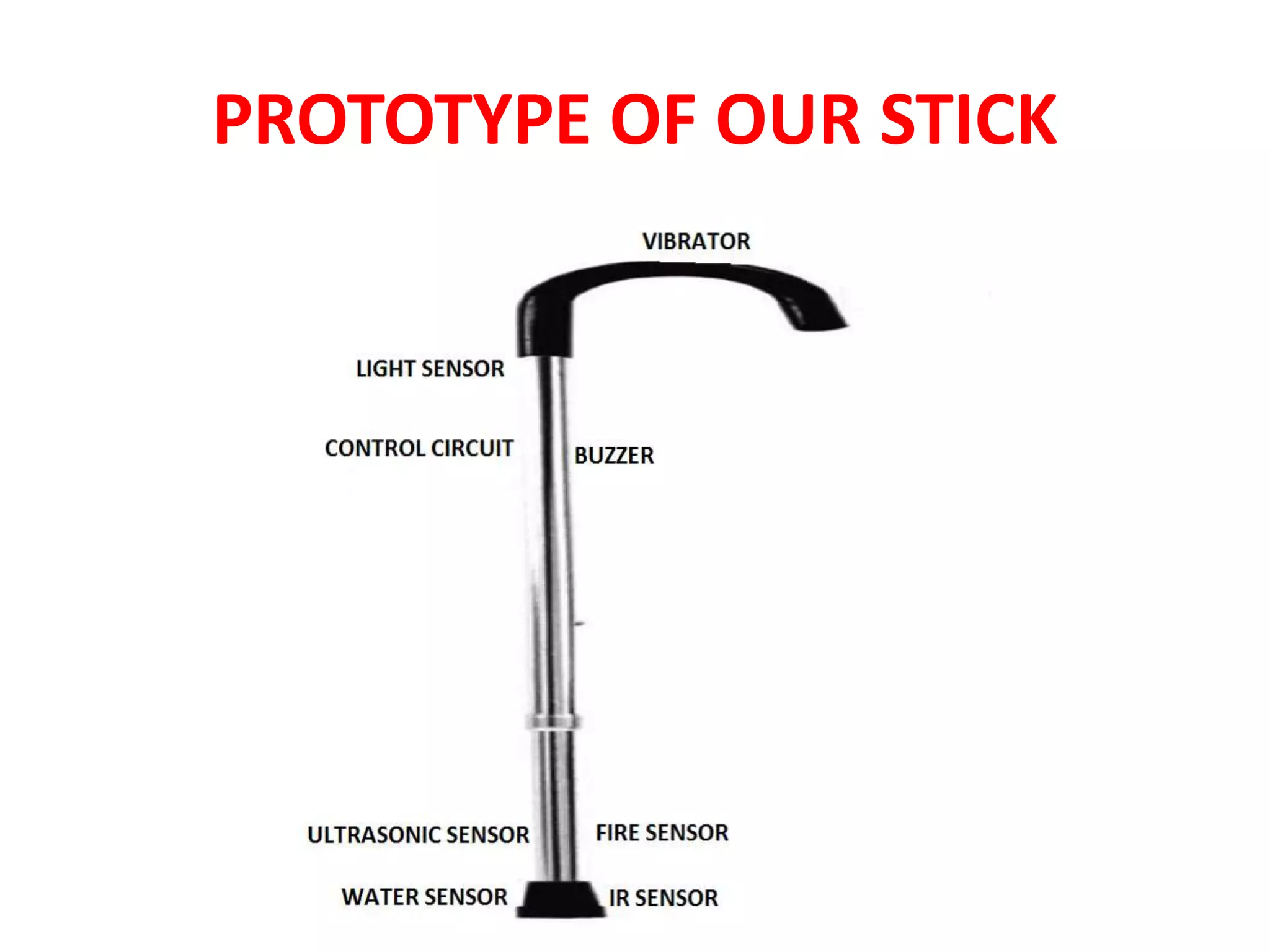
PROTOTYPE OF OUR STICK
USAGE OF DIFFERENT SENSORS
• Ultrasonic sensor is used for obstacle avoidance. The vibrator vibrates
when an obstacle is encountered which helps in alerting the blind person
and allows enough time to change their path.
• IR sensor is used for pit and staircase detection.
• Water sensor is used to detect the presence of water and provide an alert
in time for path change so as to avoid slipping.
• Fire sensor is used for avoiding fire.
• Light sensor is useful at night. It alerts the people in the surrounding area
that a blind person is walking and to allow space so that the blind person
can walk easily.
ATMEGA 16
• ATmega16 is a 40 pin
microcontroller. There are 32 I/O
(input/output) lines which are
divided into four 8-bit ports
designated as PORTA, PORTB,
PORTC and PORTD.
• ATmega16 has various in-built
peripherals like USART, ADC, Analog
Comparator, SPI, JTAG etc. Each I/O
pin has an alternative task related
to in-built peripherals.
ULTRASONIC SENSOR
Ultrasonic sensors works on a principle
similar to radar or sonar which evaluates
attributes of a target by interpreting the
echoes from radio or sound waves
respectively. Ultrasonic sensors generate
high frequency sound waves and evaluate
the echo which is received back by the
sensor.
WORKING OF ULTRASONIC SENSOR
IR SENSOR
• Infrared sensors can measure the
heat of an object, as well as detect
motion.
• IR sensor work on the principal in
which IR LED emits IR radiation
and Photodiode sense that IR
radiation.
FIRE SENSOR
• Thermistors usually have
negative temperature
coefficients which means
the resistance of the
thermistor decreases as the
temperature increases.
• Buzzer is used for output.
WATER SENSOR
• A water sensor is an
electronic device that is
designed to detect the
presence of water and provide
an alert in time to allow the
prevention of water damage.
• A common design is a small
cable or device that lies flat on
a floor and relies on the
electrical conductivity of
water to decrease the
resistance across two
contacts.
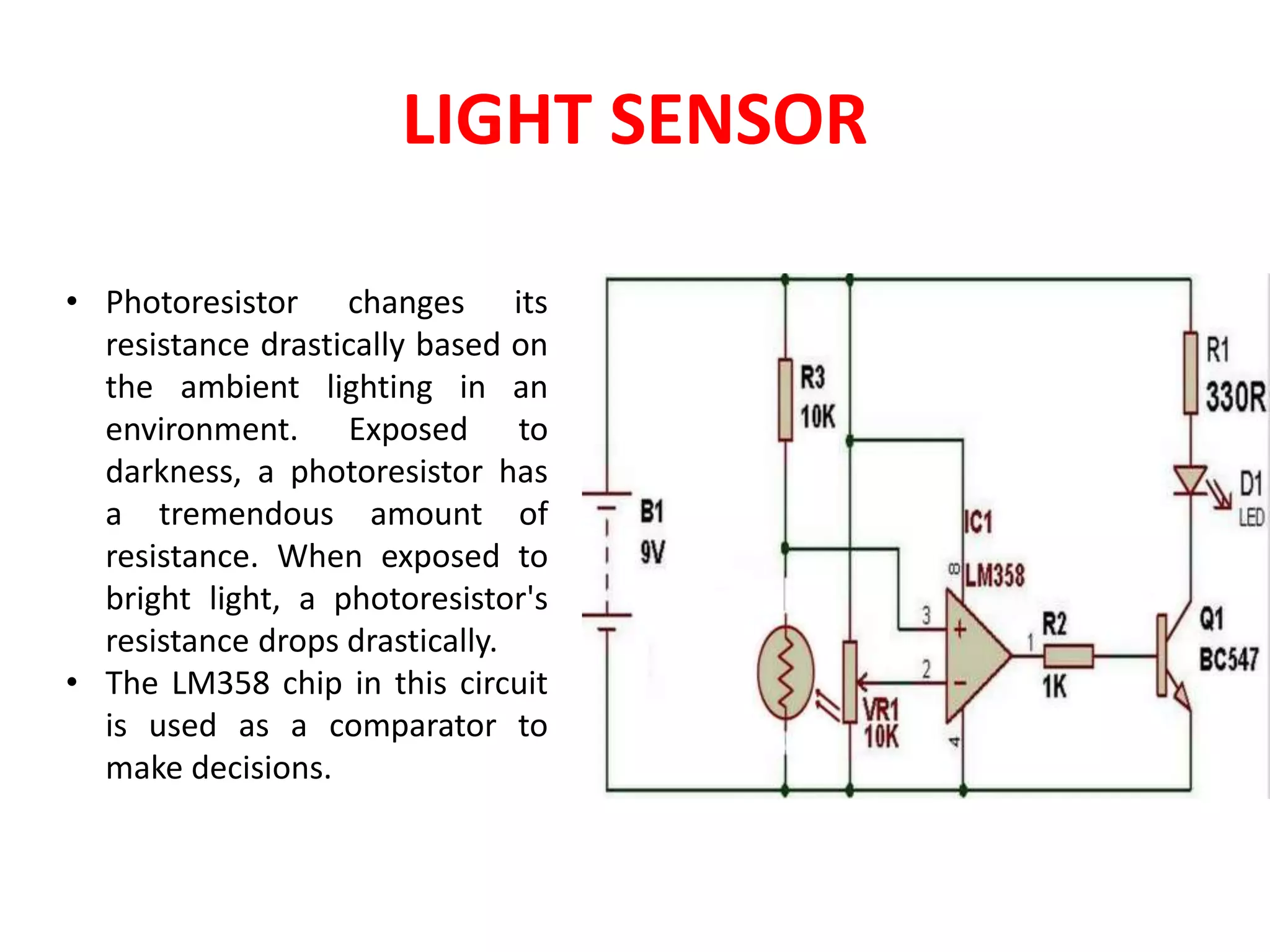
LIGHT SENSOR
• Photoresistor changes its
resistance drastically based on
the ambient lighting in an
environment. Exposed to
darkness, a photoresistor has
a tremendous amount of
resistance. When exposed to
bright light, a photoresistor's
resistance drops drastically.
• The LM358 chip in this circuit
is used as a comparator to
make decisions.
OUTPUT DEVICES
BUZZER
It consists of piezo crystals between
two conductors. When a potential is
applied across these crystals they push
on one conductor and pull on the
other. This, push and pull action,
results in a sound wave.
LED
It is a p–n junction diode, which
emits light when activated. When a
suitable voltage is applied to the
leads, electrons are able to
recombine with electron holes
within the device, releasing energy in
the form of photons. This effect is
called electroluminescence, and the
color of the light is determined by
the energy band gap of the
semiconductor.
OUTPUT DEVICES
• A vibrating motor is essentially a motor that is improperly balanced. In
other words, there is an off-centered weight attached to the motor's
rotational shaft that causes the motor to wobble. The amount of wobble
can be changed by the amount of weight attached, the weight's distance
from the shaft, and the speed at which the motor spins.
• Vibrating motors can be found inside cell phones, pagers, gaming
controllers, and personal massagers
VIBRATOR
SOFTWARES USED
• AVR STUDIO 4
• AVR LOADER V2.0
• PROTEUS DESIGN SUITE
INTERFACING WITH CONTROLLER
CONCLUSION
• The project proposed the design and architecture of a new concept of
Smart Electronic Guiding Stick for blind people. The advantage of the
system lies in the fact that it can prove to be very low cost solution to
millions of blind person worldwide. The proposed combination of various
working units makes a real-time system that monitors position of the user
and provides dual feedback making navigation more safe and secure.
• It can be further improved to have more decision taking capabilities by
employing varied types of sensors and thus could be used for different
applications. It aims to solve the problems faced by the blind people in
their daily life. The system also takes measures to ensure their safety.
FUTURE SCOPE
• It can be further enhanced by using VLSI technology to design the PCB
unit. This makes the system further more compact. Also, use of active RFID
tags will transmit the location information automatically to the PCB unit,
when the intelligent stick is in its range. The RFID sensor doesn’t have to
read it explicitly.
• The global position of the user is obtained using the global positioning
system (GPS), and their current position and guidance to their destination
will be given to the user by voice.
REFRENCES
• Mohd Helmy Abd Wahab, Amirul A. Talib, Herdawatie A.Kadir, Ayob Johari, A.Noraziah,
Roslina M. Sidek, Ariffin A. , “Smart cane: assistive cane for visually impaired people”
IJCSI, Vol.8 Issue 4, July 2011.
• Yuan, D.; Manduchi, R., “Dynamic environment exploration using a virtual white cane”, in
Computer Vision and Pattern Recognition, CVPR 2005 IEEE Computer Society
Conference,2005.
• F. van der Heijden, P.P.L. Regtien, “Wearable navigation assistance - a tool for the blind”
MEASUREMENT SCIENCE REVIEW, Volume 5, Section 2, 2005 .
• Larisa Dunai, Guillermo Peris Fajarnes, Victor Santiago Praderas, Beatriz Defez Garcia,
Ismael Lengua Lengua , “Real–Time Assistance Prototype – a new Navigation Aid for blind
people” 978-1-4244-5226-2/10/$26.00 ©2010 IEEE. 1998
REFRENCES
• Abhishek Choubey, Dattatray Patil, “RFID Based Cognition Device for Assistance to
Blind and Visually Challenged Persons for Indoor Use”, International Journal of
Engineering and Innovative Technology (IJEIT) Volume 1, Issue 6, June 2012.
• João José, Miguel Farrajota, João M.F. Rodrigues, J.M. Hans du Buf, “The Smart Vision
Local Navigation Aid for Blind and Visually Impaired Persons‖ International Journal of
Digital Content Technology and its Applications” Vol.5 No.5, May 2011.
• Calder, David J, “Curtin .An obstacle signaling system for the blind ,Digital Ecosystems
and Technologies Conference (DEST)” 5th IEEE International Conference ,30 June 2011
• Bouvrie J . V ., “ Visual Object Concept Discovery: Observation in Congeniality Blind
Children , and a Computational Approach”, Elsevier Science, USA, 2007
• . Mazo M. and Rodriguez F. J., “ Wheelchair for Physical Disable People With Voice
,Ultrasonic and Infrared Control”, Autonomous Robots, Vol. 2, pp. 203-224,
Thank You !!

Sensor Based Blind Stick

  • 1.
    ULTRASONIC NAVIGATION SYSTEM FORTHE BLIND Submitted by ABHISHEK DIXIT GAGANDEEP SINGH MOHIT KUMAR PRAVIN KUMAR Under guidance of PROF. A.K. SINGH SUPERVISOR PROF. Y.K. MISHRA HEAD OF DEPARTMENT PROF. S.P. GANGWAR PROJECT INCHARGE DEPARTMENT OF ELECTRONICS ENGINEERING KAMLA NEHRU INSTITUTE OF TECHNOLOGY SULTANPUR-228118(U.P.) DR. A. P. J. ABDUL KALAM TECHNICAL UNIVERSITY, LUCKNOW (U.P.), INDIA
  • 2.
    CONTENTS • INTRODUCTION • BASICLOGIC • COMPONENTS • PROTOTYPE OF OUR STICK • USAGE OF DIFFERENT SENSORS • ATMEGA 16 • ULTRASONIC SENSOR • IR SENSOR • WATER SENSOR • FIRE SENSOR • LIGHT SENSOR • OUTPUT DEVICES • SOFTWARE USED • INTERFACING WITH CONTROLLER • CONCLUSION • FUTURE SCOPE • REFERENCES
  • 3.
    INTRODUCTION Vision is themost important part of human physiology as 83% of information human being gets from the environment is via sight. The 2011 statistics by the World Health Organization (WHO) estimates that there are 285 billion people in world with visual impairment, 39 billion of which are blind and 246 with low vision. Presently, blind people use a white stick as a tool for directing them when they move or walk. Here, we develop a tool which can serve as a blind stick being more efficient and helpful than the conventional one. This will assist the blind persons during the walk and provides an alarm if any hurdle is detected within the set range.
  • 4.
    BASIC LOGIC • Fivedifferent sensors with microcontroller interface are used which are connected to buzzer and vibrator. • ATMEGA 16 as the main microcontroller is used.
  • 5.
    COMPONENTS • Microcontroller ATMEGA16 • Sensors • Buzzer • Vibrator
  • 6.
  • 7.
  • 8.
    USAGE OF DIFFERENTSENSORS • Ultrasonic sensor is used for obstacle avoidance. The vibrator vibrates when an obstacle is encountered which helps in alerting the blind person and allows enough time to change their path. • IR sensor is used for pit and staircase detection. • Water sensor is used to detect the presence of water and provide an alert in time for path change so as to avoid slipping. • Fire sensor is used for avoiding fire. • Light sensor is useful at night. It alerts the people in the surrounding area that a blind person is walking and to allow space so that the blind person can walk easily.
  • 9.
    ATMEGA 16 • ATmega16is a 40 pin microcontroller. There are 32 I/O (input/output) lines which are divided into four 8-bit ports designated as PORTA, PORTB, PORTC and PORTD. • ATmega16 has various in-built peripherals like USART, ADC, Analog Comparator, SPI, JTAG etc. Each I/O pin has an alternative task related to in-built peripherals.
  • 10.
    ULTRASONIC SENSOR Ultrasonic sensorsworks on a principle similar to radar or sonar which evaluates attributes of a target by interpreting the echoes from radio or sound waves respectively. Ultrasonic sensors generate high frequency sound waves and evaluate the echo which is received back by the sensor.
  • 11.
  • 12.
    IR SENSOR • Infraredsensors can measure the heat of an object, as well as detect motion. • IR sensor work on the principal in which IR LED emits IR radiation and Photodiode sense that IR radiation.
  • 13.
    FIRE SENSOR • Thermistorsusually have negative temperature coefficients which means the resistance of the thermistor decreases as the temperature increases. • Buzzer is used for output.
  • 14.
    WATER SENSOR • Awater sensor is an electronic device that is designed to detect the presence of water and provide an alert in time to allow the prevention of water damage. • A common design is a small cable or device that lies flat on a floor and relies on the electrical conductivity of water to decrease the resistance across two contacts.
  • 15.
    LIGHT SENSOR • Photoresistorchanges its resistance drastically based on the ambient lighting in an environment. Exposed to darkness, a photoresistor has a tremendous amount of resistance. When exposed to bright light, a photoresistor's resistance drops drastically. • The LM358 chip in this circuit is used as a comparator to make decisions.
  • 16.
    OUTPUT DEVICES BUZZER It consistsof piezo crystals between two conductors. When a potential is applied across these crystals they push on one conductor and pull on the other. This, push and pull action, results in a sound wave. LED It is a p–n junction diode, which emits light when activated. When a suitable voltage is applied to the leads, electrons are able to recombine with electron holes within the device, releasing energy in the form of photons. This effect is called electroluminescence, and the color of the light is determined by the energy band gap of the semiconductor.
  • 17.
    OUTPUT DEVICES • Avibrating motor is essentially a motor that is improperly balanced. In other words, there is an off-centered weight attached to the motor's rotational shaft that causes the motor to wobble. The amount of wobble can be changed by the amount of weight attached, the weight's distance from the shaft, and the speed at which the motor spins. • Vibrating motors can be found inside cell phones, pagers, gaming controllers, and personal massagers VIBRATOR
  • 18.
    SOFTWARES USED • AVRSTUDIO 4 • AVR LOADER V2.0 • PROTEUS DESIGN SUITE
  • 19.
  • 20.
    CONCLUSION • The projectproposed the design and architecture of a new concept of Smart Electronic Guiding Stick for blind people. The advantage of the system lies in the fact that it can prove to be very low cost solution to millions of blind person worldwide. The proposed combination of various working units makes a real-time system that monitors position of the user and provides dual feedback making navigation more safe and secure. • It can be further improved to have more decision taking capabilities by employing varied types of sensors and thus could be used for different applications. It aims to solve the problems faced by the blind people in their daily life. The system also takes measures to ensure their safety.
  • 21.
    FUTURE SCOPE • Itcan be further enhanced by using VLSI technology to design the PCB unit. This makes the system further more compact. Also, use of active RFID tags will transmit the location information automatically to the PCB unit, when the intelligent stick is in its range. The RFID sensor doesn’t have to read it explicitly. • The global position of the user is obtained using the global positioning system (GPS), and their current position and guidance to their destination will be given to the user by voice.
  • 22.
    REFRENCES • Mohd HelmyAbd Wahab, Amirul A. Talib, Herdawatie A.Kadir, Ayob Johari, A.Noraziah, Roslina M. Sidek, Ariffin A. , “Smart cane: assistive cane for visually impaired people” IJCSI, Vol.8 Issue 4, July 2011. • Yuan, D.; Manduchi, R., “Dynamic environment exploration using a virtual white cane”, in Computer Vision and Pattern Recognition, CVPR 2005 IEEE Computer Society Conference,2005. • F. van der Heijden, P.P.L. Regtien, “Wearable navigation assistance - a tool for the blind” MEASUREMENT SCIENCE REVIEW, Volume 5, Section 2, 2005 . • Larisa Dunai, Guillermo Peris Fajarnes, Victor Santiago Praderas, Beatriz Defez Garcia, Ismael Lengua Lengua , “Real–Time Assistance Prototype – a new Navigation Aid for blind people” 978-1-4244-5226-2/10/$26.00 ©2010 IEEE. 1998
  • 23.
    REFRENCES • Abhishek Choubey,Dattatray Patil, “RFID Based Cognition Device for Assistance to Blind and Visually Challenged Persons for Indoor Use”, International Journal of Engineering and Innovative Technology (IJEIT) Volume 1, Issue 6, June 2012. • João José, Miguel Farrajota, João M.F. Rodrigues, J.M. Hans du Buf, “The Smart Vision Local Navigation Aid for Blind and Visually Impaired Persons‖ International Journal of Digital Content Technology and its Applications” Vol.5 No.5, May 2011. • Calder, David J, “Curtin .An obstacle signaling system for the blind ,Digital Ecosystems and Technologies Conference (DEST)” 5th IEEE International Conference ,30 June 2011 • Bouvrie J . V ., “ Visual Object Concept Discovery: Observation in Congeniality Blind Children , and a Computational Approach”, Elsevier Science, USA, 2007 • . Mazo M. and Rodriguez F. J., “ Wheelchair for Physical Disable People With Voice ,Ultrasonic and Infrared Control”, Autonomous Robots, Vol. 2, pp. 203-224,
  • 24.