STEPPER MOTOR
Aim: To Make a Robotic Car using assembly language in embedded system.
Submitted By:-
Akshay Parmar
Sandeep Kumar
(ECE)
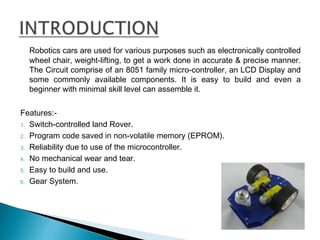
Robotics cars are used for various purposes such as electronically controlled
wheel chair, weight-lifting, to get a work done in accurate & precise manner.
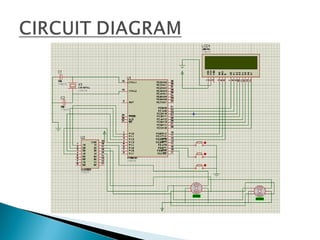
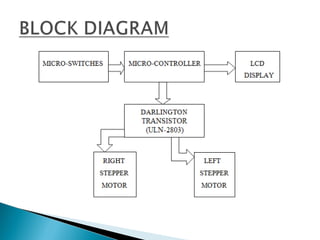
The Circuit comprise of an 8051 family micro-controller, an LCD Display and
some commonly available components. It is easy to build and even a
beginner with minimal skill level can assemble it.
Features:-
1. Switch-controlled land Rover.
2. Program code saved in non-volatile memory (EPROM).
3. Reliability due to use of the microcontroller.
4. No mechanical wear and tear.
5. Easy to build and use.
6. Gear System.
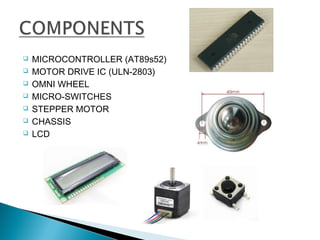
 MICROCONTROLLER (AT89s52)
 MOTOR DRIVE IC (ULN-2803)
 OMNI WHEEL
 MICRO-SWITCHES
 STEPPER MOTOR
 CHASSIS
 LCD
 It can be used for Monitoring places where people can’t go to
monitor events.
 For Security Purposes
 Weight Lifting
 Used for Military Purposes
 Detecting Purposes
THANK YOU!!

Robotic car project presentation

  • 1.
    STEPPER MOTOR Aim: ToMake a Robotic Car using assembly language in embedded system. Submitted By:- Akshay Parmar Sandeep Kumar (ECE)
  • 2.
    Robotics cars areused for various purposes such as electronically controlled wheel chair, weight-lifting, to get a work done in accurate & precise manner. The Circuit comprise of an 8051 family micro-controller, an LCD Display and some commonly available components. It is easy to build and even a beginner with minimal skill level can assemble it. Features:- 1. Switch-controlled land Rover. 2. Program code saved in non-volatile memory (EPROM). 3. Reliability due to use of the microcontroller. 4. No mechanical wear and tear. 5. Easy to build and use. 6. Gear System.
  • 3.
     MICROCONTROLLER (AT89s52) MOTOR DRIVE IC (ULN-2803)  OMNI WHEEL  MICRO-SWITCHES  STEPPER MOTOR  CHASSIS  LCD
  • 6.
     It canbe used for Monitoring places where people can’t go to monitor events.  For Security Purposes  Weight Lifting  Used for Military Purposes  Detecting Purposes
  • 7.