SHRI GOVINDRAM SEKSARIA INSTITUTE OF
TECHNOLOGY AND SCIENCE INDORE
Project
Line Following Robot
DEPARMENT OF BIOMEDICAL
ENGINEERING
SESSION: July-Dec2016
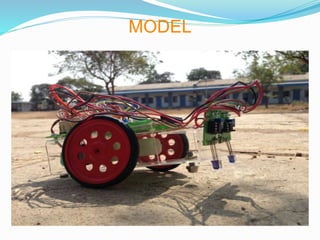
MODEL
ROBOT
 A robot is a mechanical or virtual artificial agent, usually an electro-
mechanical machine which performs a variety of tasks that is guided by
a computer program or electronic circuitry.
 Types- Stationary robot, Mobile robot.
 Constitution of robot- locomotive system, power supply, actuators,
sensory devices for feedback, control system.
 Applications- Manufacturing industry, medical science, robots in
space, national defense, transportation, agriculture etc…
WHY ROBOTICS ?
 Robotics inspires to make connections across several disciplines
rather than learning topics in isolation as it combines mechanical,
electronic, electrical and programming skills.
 It gives visual grasp of math and science
 It builds logical thinking
 It brings out innovation and creativity
 It enhances problem solving skills.
 As technology becomes increasingly important in today's world, it is
invaluable to not only learn how to use technology, but also to
understand how to create it.
INTRODUCTION
we are going to use IR to sence the
line
it consists three IR sensor pair.
IR sensor pair consist of two diodes
one of the sends IR ray and another
one must receive it.
WORKING MODEL
 The working model of a line follower consists of two motors,circuit board,
two wheels, three IR sensors, LEDs, wires and power supply.
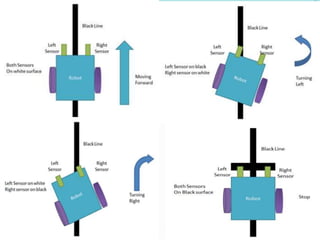
 The IR sensors get the input and according to the program the LEDs
glow depending on the input. The two motors rotate together in one
direction to go forward or backward. For taking a right turn, the motor at
right side stops and left side one continues to rotate. This rotation
depends on instructions to the motor depending on the input that sensor
gives.
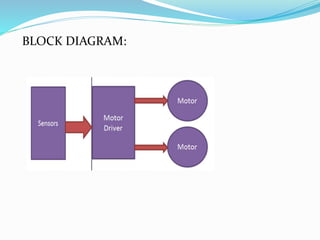
 IR sensors provide the input, motors give the output and the wheels
make the robot to follow a line.
 Follower robot is a mobile machine that can follow a path. The path can
be a visible black line on a white surface.
 The IR sensors receive an analog signal that depends on the intensity
of light reflected by the black line of emitted beam by the LEDs.
 These signals are sent to the ADC comparator which creates digital
signals that are sent to L293D
 The L293d gives instructions to motor to perform work.
WORKING MODEL
BLOCK DIAGRAM:
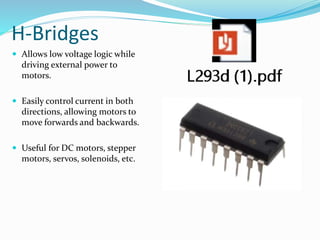
H-Bridges
 Allows low voltage logic while
driving external power to
motors.
 Easily control current in both
directions, allowing motors to
move forwards and backwards.
 Useful for DC motors, stepper
motors, servos, solenoids, etc.
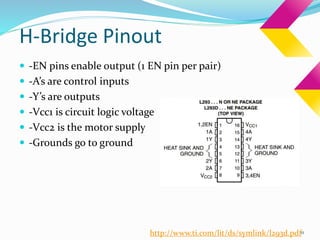
H-Bridge Pinout
 -EN pins enable output (1 EN pin per pair)
 -A’s are control inputs
 -Y’s are outputs
 -Vcc1 is circuit logic voltage
 -Vcc2 is the motor supply
 -Grounds go to ground
11http://www.ti.com/lit/ds/symlink/l293d.pdf
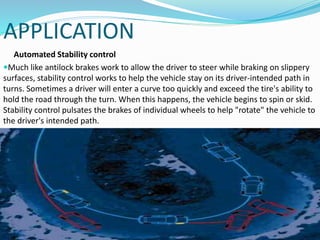
Automated Stability control
Much like antilock brakes work to allow the driver to steer while braking on slippery
surfaces, stability control works to help the vehicle stay on its driver-intended path in
turns. Sometimes a driver will enter a curve too quickly and exceed the tire's ability to
hold the road through the turn. When this happens, the vehicle begins to spin or skid.
Stability control pulsates the brakes of individual wheels to help "rotate" the vehicle to
the driver's intended path.
APPLICATION
1.Industrial application:-
these robot can be used as automated equipment
carriers in industries replacing traditional conveyer
belts.
2.Automobile application:-
these robot can also be used as automatic cars running
on roads with embedded magnets.
3.Domestic application:-
These can also be used at homes for domestic purpose
like floor cleaning etc.
4.Guidance application:-
These can be used in public museums etc to provide
path guidance.
Object following concept:-
According to our research, this is an advanced concept.
A properly programmed system may
identify and extract some useful features from the
images and use those characteristics to
follow the object.
Ex:
A baggage carrier that follows the passenger in the
airport
An automated car that follows the previous car in
traffic jam.
CONCLUSIONS :-
The Line follower robot works successfully
to track on the black line. Above the white
surface (art paper) there are some black
lines in different directions. The robot still
good enough to sense the line and follows
the track. Also the robot is capable to
carry some load likely 500gm.
FUTURE WORK
The line follower robot is made by op-amps and transistors, where the motor is
directly on or off using the signal of the comparator. Now the techniques can be
replaced by PWM using more sensor, microcontroller and H-Bridge motor
controller IC i.e. L293D. I want to try it earlier but failure in some cases. I have
compiled some programs of microcontroller. Also instead of LDR it can be used
phototransistor whose response is much better than LDR. There are 2 line
sensors used here so the fluctuation of line is a fact. Using more than 2 sensor
likely 5 sensor array may be used to detect the black line quickly. Also using
microcontroller it can draw the reverse direction as well as obstacle avoiding
turning the motor 180º. The block diagram may be represented as follows. Also
using color sensors the robot can sense different colors. It can be used in the
robotic game competition and other fields. So the development features in brief:
• Appling PWM technique
• Use of Microcontroller
• Use of color sensor
• Obstacle avoiding
Basic Electronics
http://www.kpsec.freeuk.com/
Williamson Labs
Nice animated tutorials, articles and project ideas.
http://www.williamson-labs.com/home.htm
Small Robot Sensors
http://www.andrew.cmu.edu/user/rjg/websensors/robot_sensors2.html
Robotics India
An Indian site devoted to robotics.
http://www.roboticsindia.com/
THANK YOU !

Presentation1

  • 1.
    SHRI GOVINDRAM SEKSARIAINSTITUTE OF TECHNOLOGY AND SCIENCE INDORE Project Line Following Robot DEPARMENT OF BIOMEDICAL ENGINEERING SESSION: July-Dec2016
  • 2.
  • 3.
    ROBOT  A robotis a mechanical or virtual artificial agent, usually an electro- mechanical machine which performs a variety of tasks that is guided by a computer program or electronic circuitry.  Types- Stationary robot, Mobile robot.  Constitution of robot- locomotive system, power supply, actuators, sensory devices for feedback, control system.  Applications- Manufacturing industry, medical science, robots in space, national defense, transportation, agriculture etc…
  • 4.
    WHY ROBOTICS ? Robotics inspires to make connections across several disciplines rather than learning topics in isolation as it combines mechanical, electronic, electrical and programming skills.  It gives visual grasp of math and science  It builds logical thinking  It brings out innovation and creativity  It enhances problem solving skills.  As technology becomes increasingly important in today's world, it is invaluable to not only learn how to use technology, but also to understand how to create it.
  • 5.
    INTRODUCTION we are goingto use IR to sence the line it consists three IR sensor pair. IR sensor pair consist of two diodes one of the sends IR ray and another one must receive it.
  • 6.
    WORKING MODEL  Theworking model of a line follower consists of two motors,circuit board, two wheels, three IR sensors, LEDs, wires and power supply.  The IR sensors get the input and according to the program the LEDs glow depending on the input. The two motors rotate together in one direction to go forward or backward. For taking a right turn, the motor at right side stops and left side one continues to rotate. This rotation depends on instructions to the motor depending on the input that sensor gives.  IR sensors provide the input, motors give the output and the wheels make the robot to follow a line.
  • 7.
     Follower robotis a mobile machine that can follow a path. The path can be a visible black line on a white surface.  The IR sensors receive an analog signal that depends on the intensity of light reflected by the black line of emitted beam by the LEDs.  These signals are sent to the ADC comparator which creates digital signals that are sent to L293D  The L293d gives instructions to motor to perform work. WORKING MODEL
  • 9.
  • 10.
    H-Bridges  Allows lowvoltage logic while driving external power to motors.  Easily control current in both directions, allowing motors to move forwards and backwards.  Useful for DC motors, stepper motors, servos, solenoids, etc.
  • 11.
    H-Bridge Pinout  -ENpins enable output (1 EN pin per pair)  -A’s are control inputs  -Y’s are outputs  -Vcc1 is circuit logic voltage  -Vcc2 is the motor supply  -Grounds go to ground 11http://www.ti.com/lit/ds/symlink/l293d.pdf
  • 12.
    Automated Stability control Muchlike antilock brakes work to allow the driver to steer while braking on slippery surfaces, stability control works to help the vehicle stay on its driver-intended path in turns. Sometimes a driver will enter a curve too quickly and exceed the tire's ability to hold the road through the turn. When this happens, the vehicle begins to spin or skid. Stability control pulsates the brakes of individual wheels to help "rotate" the vehicle to the driver's intended path. APPLICATION
  • 13.
    1.Industrial application:- these robotcan be used as automated equipment carriers in industries replacing traditional conveyer belts. 2.Automobile application:- these robot can also be used as automatic cars running on roads with embedded magnets. 3.Domestic application:- These can also be used at homes for domestic purpose like floor cleaning etc. 4.Guidance application:- These can be used in public museums etc to provide path guidance.
  • 14.
    Object following concept:- Accordingto our research, this is an advanced concept. A properly programmed system may identify and extract some useful features from the images and use those characteristics to follow the object. Ex: A baggage carrier that follows the passenger in the airport An automated car that follows the previous car in traffic jam.
  • 15.
    CONCLUSIONS :- The Linefollower robot works successfully to track on the black line. Above the white surface (art paper) there are some black lines in different directions. The robot still good enough to sense the line and follows the track. Also the robot is capable to carry some load likely 500gm.
  • 16.
    FUTURE WORK The linefollower robot is made by op-amps and transistors, where the motor is directly on or off using the signal of the comparator. Now the techniques can be replaced by PWM using more sensor, microcontroller and H-Bridge motor controller IC i.e. L293D. I want to try it earlier but failure in some cases. I have compiled some programs of microcontroller. Also instead of LDR it can be used phototransistor whose response is much better than LDR. There are 2 line sensors used here so the fluctuation of line is a fact. Using more than 2 sensor likely 5 sensor array may be used to detect the black line quickly. Also using microcontroller it can draw the reverse direction as well as obstacle avoiding turning the motor 180º. The block diagram may be represented as follows. Also using color sensors the robot can sense different colors. It can be used in the robotic game competition and other fields. So the development features in brief: • Appling PWM technique • Use of Microcontroller • Use of color sensor • Obstacle avoiding
  • 17.
    Basic Electronics http://www.kpsec.freeuk.com/ Williamson Labs Niceanimated tutorials, articles and project ideas. http://www.williamson-labs.com/home.htm Small Robot Sensors http://www.andrew.cmu.edu/user/rjg/websensors/robot_sensors2.html Robotics India An Indian site devoted to robotics. http://www.roboticsindia.com/
  • 18.

Editor's Notes

  • #12 In most applications, HIGH is driven to the enable pins. Drive Vcc1 with logical HIGH (typically 5V). Drive Vcc2 with motor supply HIGH. Inputs are the A’s, outputs are the Y’s.