1
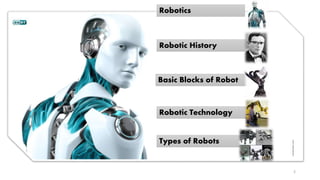
Robotics
Robotic History
Robotic Technology
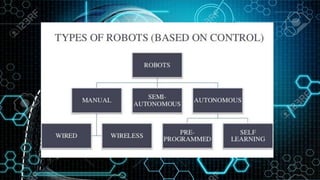
Types of Robots
Basic Blocks of Robot
2
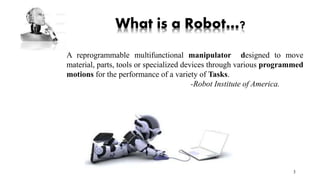
What is a Robot…?
A reprogrammable multifunctional manipulator designed to move
material, parts, tools or specialized devices through various programmed
motions for the performance of a variety of Tasks.
-Robot Institute of America.
3
Robotics is science of designing or building an
application of robots. Simply ,Robotics may be
defines as “The Study of Robots”. The aim of
robotics is to design an efficient robot.
•Speed
• Can work in hazardous/dangerous temperature
• Can do repetitive tasks
• Can do work with accuracy
4
5
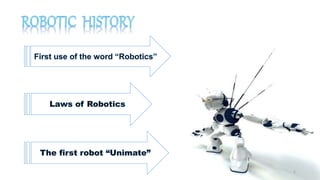
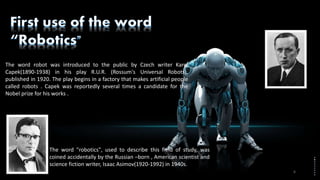
The word robot was introduced to the public by Czech writer Karel
Capek(1890-1938) in his play R.U.R. (Rossum's Universal Robots),
published in 1920. The play begins in a factory that makes artificial people
called robots . Capek was reportedly several times a candidate for the
Nobel prize for his works .
The word "robotics", used to describe this field of study, was
coined accidentally by the Russian –born , American scientist and
science fiction writer, Isaac Asimov(1920-1992) in 1940s.
6
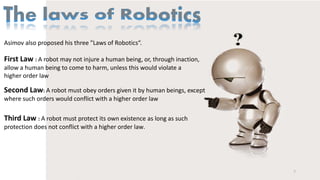
Asimov also proposed his three "Laws of Robotics“.
First Law : A robot may not injure a human being, or, through inaction,
allow a human being to come to harm, unless this would violate a
higher order law
Second Law: A robot must obey orders given it by human beings, except
where such orders would conflict with a higher order law
Third Law : A robot must protect its own existence as long as such
protection does not conflict with a higher order law.
7
8
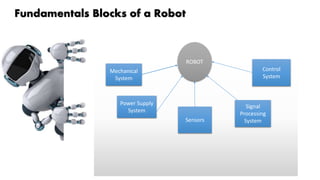
Fundamentals Blocks of a Robot
9
ROBOT
Mechanical
System
Sensors
Signal
Processing
System
Control
System
Power Supply
System
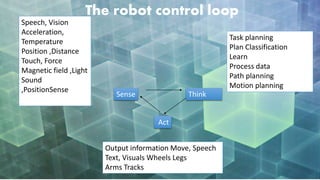
The robot control loop
Output information Move, Speech
Text, Visuals Wheels Legs
Arms Tracks
Speech, Vision
Acceleration,
Temperature
Position ,Distance
Touch, Force
Magnetic field ,Light
Sound
,PositionSense
Task planning
Plan Classification
Learn
Process data
Path planning
Motion planning
ThinkSense
Act
The robot control loop
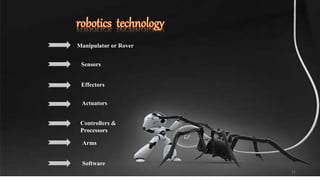
Sensors
Effectors
Actuators
Controllers &
Processors
Arms
Manipulator or Rover
Software
11
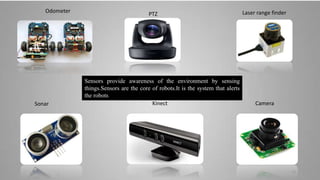
Laser range finder
KinectSonar
PTZ
Odometer
Camera
Sensors provide awareness of the environment by sensing
things.Sensors are the core of robots.It is the system that alerts
the robots
12
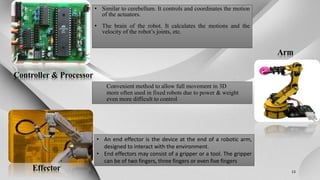
Controller & Processor
Arm
Effector
• An end effector is the device at the end of a robotic arm,
designed to interact with the environment.
• End effectors may consist of a gripper or a tool. The gripper
can be of two fingers, three fingers or even five fingers
• Similar to cerebellum. It controls and coordinates the motion
of the actuators.
• The brain of the robot. It calculates the motions and the
velocity of the robot’s joints, etc.
Convenient method to allow full movement in 3D
more often used in fixed robots due to power & weight
even more difficult to control
13
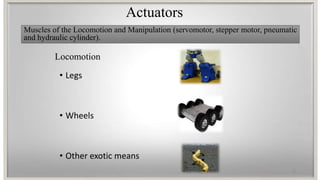
Actuators
Locomotion
• Legs
• Wheels
• Other exotic means
Muscles of the Locomotion and Manipulation (servomotor, stepper motor, pneumatic
and hydraulic cylinder).
14
15
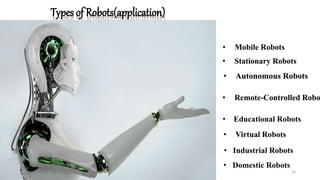
Types of Robots(application)
• Mobile Robots
• Autonomous Robots
• Virtual Robots
• Remote-Controlled Robo
• Stationary Robots
• Industrial Robots
• Educational Robots
• Domestic Robots
16
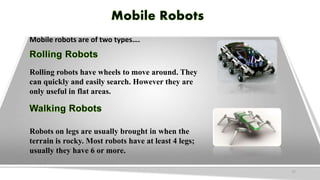
Mobile robots are of two types….
Rolling robots have wheels to move around. They
can quickly and easily search. However they are
only useful in flat areas.
Robots on legs are usually brought in when the
terrain is rocky. Most robots have at least 4 legs;
usually they have 6 or more.
17
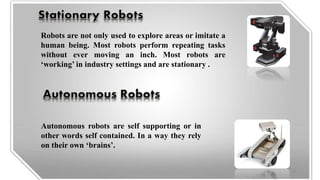
Autonomous robots are self supporting or in
other words self contained. In a way they rely
on their own ‘brains’.
Robots are not only used to explore areas or imitate a
human being. Most robots perform repeating tasks
without ever moving an inch. Most robots are
‘working’ in industry settings and are stationary .
18
A person can guide a robot by remote control. A
person can perform difficult and usually
dangerous tasks without being at the spot where
the tasks are performed.
Virtual robots don’t exits In real life. Virtual robots are
just programs, building blocks of software inside a
computer.
19
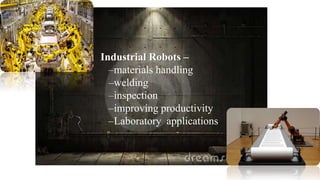
Industrial Robots –
–materials handling
–welding
–inspection
–improving productivity
–Laboratory applications
20
21
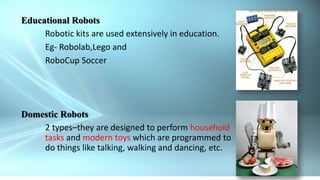
Educational Robots
Robotic kits are used extensively in education.
Eg- Robolab,Lego and
RoboCup Soccer
Domestic Robots
2 types–they are designed to perform household
tasks and modern toys which are programmed to
do things like talking, walking and dancing, etc.
22
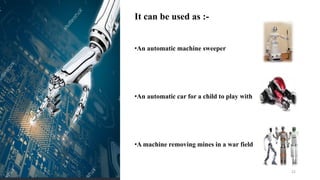
It can be used as :-
•An automatic machine sweeper
•An automatic car for a child to play with
•A machine removing mines in a war field
23
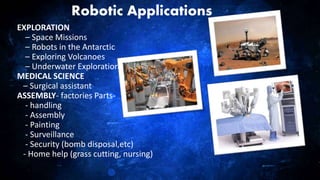
Robotic Applications
EXPLORATION
– Space Missions
– Robots in the Antarctic
– Exploring Volcanoes
– Underwater Exploration
MEDICAL SCIENCE
– Surgical assistant
ASSEMBLY- factories Parts-
- handling
- Assembly
- Painting
- Surveillance
- Security (bomb disposal,etc)
- Home help (grass cutting, nursing)
• Going to far away planets.
• Going far down into the unknown waters and mines where humans would be
crushed
• Giving us information that humans can't get
• Working at places 24/7 without any salary and food. Plus they don't get bored
• They can perform tasks faster than humans and much more consistently and
accurately
• Most of them are automatic so they can go around by themselves without any
human interference.
• People can lose jobs in factories
• It needs a supply of power
• It needs maintenance to keep it running .
• It costs money to make or buy a robot
24
25

Introduction to robotics

  • 1.
  • 2.
    Robotics Robotic History Robotic Technology Typesof Robots Basic Blocks of Robot 2
  • 3.
    What is aRobot…? A reprogrammable multifunctional manipulator designed to move material, parts, tools or specialized devices through various programmed motions for the performance of a variety of Tasks. -Robot Institute of America. 3
  • 4.
    Robotics is scienceof designing or building an application of robots. Simply ,Robotics may be defines as “The Study of Robots”. The aim of robotics is to design an efficient robot. •Speed • Can work in hazardous/dangerous temperature • Can do repetitive tasks • Can do work with accuracy 4
  • 5.
  • 6.
    The word robotwas introduced to the public by Czech writer Karel Capek(1890-1938) in his play R.U.R. (Rossum's Universal Robots), published in 1920. The play begins in a factory that makes artificial people called robots . Capek was reportedly several times a candidate for the Nobel prize for his works . The word "robotics", used to describe this field of study, was coined accidentally by the Russian –born , American scientist and science fiction writer, Isaac Asimov(1920-1992) in 1940s. 6
  • 7.
    Asimov also proposedhis three "Laws of Robotics“. First Law : A robot may not injure a human being, or, through inaction, allow a human being to come to harm, unless this would violate a higher order law Second Law: A robot must obey orders given it by human beings, except where such orders would conflict with a higher order law Third Law : A robot must protect its own existence as long as such protection does not conflict with a higher order law. 7
  • 8.
  • 9.
    Fundamentals Blocks ofa Robot 9 ROBOT Mechanical System Sensors Signal Processing System Control System Power Supply System
  • 10.
    The robot controlloop Output information Move, Speech Text, Visuals Wheels Legs Arms Tracks Speech, Vision Acceleration, Temperature Position ,Distance Touch, Force Magnetic field ,Light Sound ,PositionSense Task planning Plan Classification Learn Process data Path planning Motion planning ThinkSense Act The robot control loop
  • 11.
  • 12.
    Laser range finder KinectSonar PTZ Odometer Camera Sensorsprovide awareness of the environment by sensing things.Sensors are the core of robots.It is the system that alerts the robots 12
  • 13.
    Controller & Processor Arm Effector •An end effector is the device at the end of a robotic arm, designed to interact with the environment. • End effectors may consist of a gripper or a tool. The gripper can be of two fingers, three fingers or even five fingers • Similar to cerebellum. It controls and coordinates the motion of the actuators. • The brain of the robot. It calculates the motions and the velocity of the robot’s joints, etc. Convenient method to allow full movement in 3D more often used in fixed robots due to power & weight even more difficult to control 13
  • 14.
    Actuators Locomotion • Legs • Wheels •Other exotic means Muscles of the Locomotion and Manipulation (servomotor, stepper motor, pneumatic and hydraulic cylinder). 14
  • 15.
  • 16.
    Types of Robots(application) •Mobile Robots • Autonomous Robots • Virtual Robots • Remote-Controlled Robo • Stationary Robots • Industrial Robots • Educational Robots • Domestic Robots 16
  • 17.
    Mobile robots areof two types…. Rolling robots have wheels to move around. They can quickly and easily search. However they are only useful in flat areas. Robots on legs are usually brought in when the terrain is rocky. Most robots have at least 4 legs; usually they have 6 or more. 17
  • 18.
    Autonomous robots areself supporting or in other words self contained. In a way they rely on their own ‘brains’. Robots are not only used to explore areas or imitate a human being. Most robots perform repeating tasks without ever moving an inch. Most robots are ‘working’ in industry settings and are stationary . 18
  • 19.
    A person canguide a robot by remote control. A person can perform difficult and usually dangerous tasks without being at the spot where the tasks are performed. Virtual robots don’t exits In real life. Virtual robots are just programs, building blocks of software inside a computer. 19
  • 20.
    Industrial Robots – –materialshandling –welding –inspection –improving productivity –Laboratory applications 20
  • 21.
    21 Educational Robots Robotic kitsare used extensively in education. Eg- Robolab,Lego and RoboCup Soccer Domestic Robots 2 types–they are designed to perform household tasks and modern toys which are programmed to do things like talking, walking and dancing, etc.
  • 22.
    22 It can beused as :- •An automatic machine sweeper •An automatic car for a child to play with •A machine removing mines in a war field
  • 23.
    23 Robotic Applications EXPLORATION – SpaceMissions – Robots in the Antarctic – Exploring Volcanoes – Underwater Exploration MEDICAL SCIENCE – Surgical assistant ASSEMBLY- factories Parts- - handling - Assembly - Painting - Surveillance - Security (bomb disposal,etc) - Home help (grass cutting, nursing)
  • 24.
    • Going tofar away planets. • Going far down into the unknown waters and mines where humans would be crushed • Giving us information that humans can't get • Working at places 24/7 without any salary and food. Plus they don't get bored • They can perform tasks faster than humans and much more consistently and accurately • Most of them are automatic so they can go around by themselves without any human interference. • People can lose jobs in factories • It needs a supply of power • It needs maintenance to keep it running . • It costs money to make or buy a robot 24
  • 25.