CHRIST COLLEGE
JAGDALPUR
 TOPIC - LIGATION OF
VECTOR &
PASSENGER DNA
SYNOPSIS
INTRODUCTION
STICKY OR COHESIVE
END LIGATION METHOD
BLUNT END LIGATION
HOMOPOLYMER TAILING
METHOD
CONCLUSION
REFRENCE
INTRODUCTION
 After isolating a foreign
DNA fragments one has to
join it to its cloning vector to
create a recombinant –DNA
.
 The cloning vector is
isolated and then cleaved
using restriction enzyme ,
the vector so cleaved may
be either sticky or blunt
end.
 The cleaved vectors are
enabled to join with isolated
DNA fragments.
There are three methods
used for ligation of
Passenger DNA & Vector
STICKY OR COHESIVE END
LIGATION METHOD
BLUNT END LIGATION
METHOD
HOMOPOLYMER TAILING
METHOD
STICKY  COHESIVE
END LIGATION
METHOD
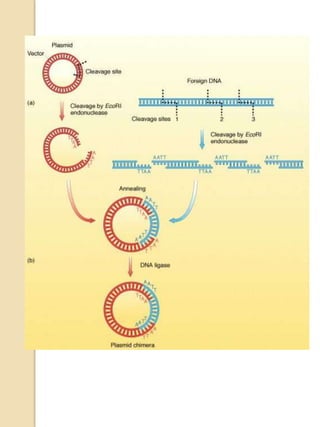
 This is relatively efficient process
& has been used extremely to
create recombinant DNAs in-
vitro.
 The foreign DNA fragment&
cloning vector have
complementary sequences &
complementary termini of both
join each other by nicks.
 These nicks are sealed by the
action of the enzyme DNA
Ligase resulting in an intact
recombinant DNA double strand.
BLUNT-END LIGATION
METHOD
 The joining of foreign DNA
fragment & its cloning vector,
which are blunt-ended, relies
upon the ability of T4 DNA
ligase.
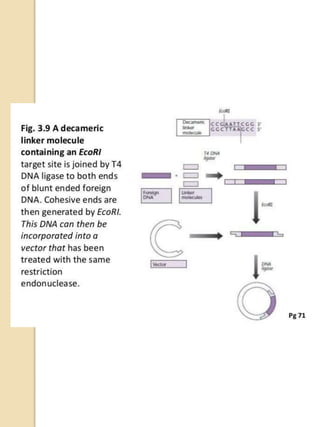
 The linkers are first ligated to
both ends blunt ended foreign
DNA fragment with the help of T4
DNA ligase & then treated with a
restriction enzyme to produce
sticky ends in them thus
converting blunt ended DNA
fragment into sticky ended one.
BLUNT END
LIGATION
 Later are now joined with
appropriate DNA Ligase into
cloning vector that bears
complementary sticky ends
as a result of the action of
same restriction enzyme.
 This produces a recombinant
–DNA.
 Such a blunt end ligation
procedure in which linker as
well as cloning vector are
treated with Eco RI restriction
enzyme to generate sticky
ends complementary to each
other.
HOMOPOLYMER
TAILING METHOD
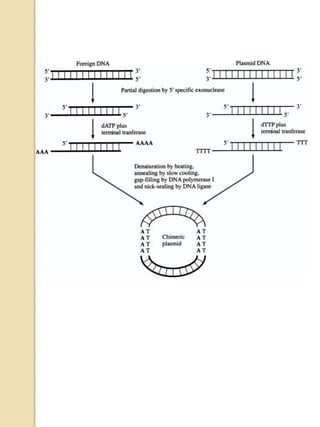
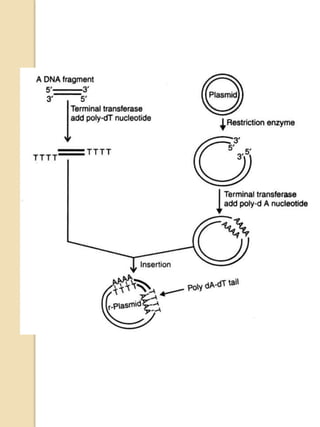
 Homo polymer sequences
can be synthesised by the
enzyme terminal transferase
which is obtained from calf
thymus.
 In this method the
complementary homo
polymer sequence are added
to the ends of DNA molecules
of interest.
 For instance , by adding oligo
(dA) sequences to the 3’end
of one DNA molecule
population & oligo (dT)
sequences to the 3’ ends of
another, the two type of DNA
molecules can be enabled to
join each other resulting in
CONCLUSION
 In molecular biology, ligation is the
joining of two nucleic acid fragments
through the action of an enzyme .
 It is essential laboratory procedure in
the molecular cloning of DNA where
by DNA fragments are joined
together to create recombinant DNA
molecules , such as when a foreign
DNA fragments are inserted into a
plasmid .
 The ends of DNA fragments are joined
together by formation of phospho
diester bond between the 3’-Hydroxyl
of one DNA terminus with the 5’-
Phosphoryl of another.
REFRENCE
 GENETIC ENGINEERING
OF BIOTECHNOLOGY
 INTERNET
THANK YOU