RDNATECHNOLOGY
Jasmitha S K
I M Pharm
Dept of Pharmacology
1
The deliberate modification in genetic material
of an organism by changing the nucleic acid
directly is called gene manipulation or genetic
engineering or gene cloning and is
accomplished by several methods which are
collectively known as rDNA technology.
Recombinant DNA is a form of artificial DNA
that is made through the combination or
insertion of one or more DNA strands, therefore
combining DNA sequences as per our
requirement .
2
cloning is carried out in‐vitro where a specific
fragment of DNA is isolated from an organism
‘donor’ and introduced into a ‘plasmid’ that
replicates in a ‘host’ cell making multiple copies
of that DNA fragment.
3
Isolation of specific DNA
Selection of vectors
Preparation of rDNA
Transfer of rDNA to host cell
Identification and isolation of rDNA
4
Mechanical shearing
Random fragments of source DNA can be
obtained by mechanical shearing of bacterial,
plant or animal cells.
Mechanical shearing caused by high speed mixing
at 1500 rpm for 30 min. This gives fragments of
8kb mean size.
Short single stranded regions- termini or blunt
end fragments are formed.
Sonication can reduce the length of the fragments
to about 300 nucleotide pairs.
Shearing does not necessarily produce 5’
phosphate and3’ ends . There for the end of the
fragments must be repaired.
5
Restriction endonucleasedigestion
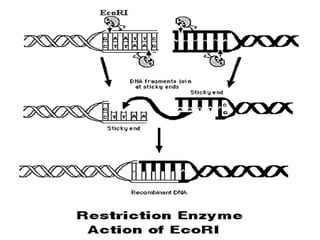
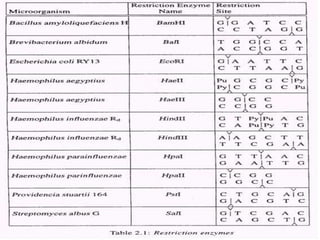
Large number of restriction enzymes which
recognize and cut DNA with in target sites of
nucleotides are known.
Depending upon the number of target sites
present, DNA may be cut into too small or too big
size fragments.
Generally the same restriction enzyme is used for
vector and the DNA of interest.
The digestion carried out may be light ,moderate or
heavy producing from small number to large
number of fragments which are reproducible.
6
7
8
DNA ligases
These were originally isolated from viruses, also
occur in E.coli & eukaryotic cells.
The cut DNA fragments are covalently joined
together by DNA ligases.
DNA ligase joins the DNA fragments by forming a
phosphodiester bond b/n the phosphate group of
5’-carbon of one deoxyribose with the hydroxyl
group of 3’-carbon of another deoxyribose
9
Reverse transcriptasemethod
If eukaryotic gene is to be cloned and expressed in
prokaryotic cell, the difference in gene organization has
to be considered.
The introns present in eukaryotic genes are transcribed
into mRNA. Such precursor mRNA in eukaryotic cell
undergoes post transcriptional modification and removal
of introns occurs to give rise to processed mRNA.
Mature mRNA molecules from animal cell do not contain
sequences complementary to introns as they are removed
by processing.
These molecules then can be directly transcribed into DNA
using an enzyme reverse transcriptase.
cDNA thus produced for a particular protein can be joined
to appropriate vector and cloned into a host.
10
Hybridization method
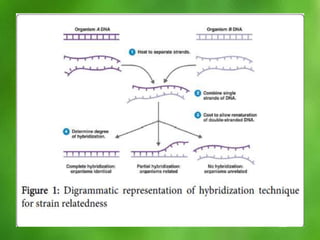
Hybridization method depends on the principle that on
mRNA forms a complex with complementary DNA
segments from which it has been transcribed.
This method is possible if protein encoding gene does
not have introns.
DNA from the donor organism is first isolated. This ds
DNA is treated with heat or alkali and is converted to
ss DNA by denaturation .
Strands are then mixed with mRNA transcribed by the
gene . mRNA pairs with cDNA portion to form DNA-
RNA complex
This complex is then isolated and DNA separated from
RNA.
Ss DNA thus obtained can be converted to ds DNA by
DNA polymerase I.
11
12
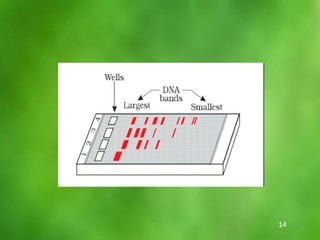
The cutting of DNA by different isolation
methods, these fragments can be separated by
a technique known as gel electrophoresis
13
14
Vectors are used to transform DNA material into
the host cell
Types of vectors
Cloning vectors and expression vectors
Cloning vectors: propagation of DNA inserts
Expression vectors: production of proteins
15
Selection of cloning vectors depends on
Objective of cloning experiment
Ease of working
Knowledge existing about the vector
Suitability
reliability
16
Properties of vectors:
Able to self replicate in the host
Easy to isolate
Non toxic to host cells
Have space for foreign inserts
Have unique restriction sites for common
restriction enzymes.
17
Practical features of DNA cloning
vectors:
Size
Origin of replication
Multiple cloning sites
Selectable marker genes
RNA polymerase promoter sequence
DNA sequencing primers
18
Types of Vector:
Plasmids
bacteriophages
Cosmids
YACs – Yeast artificial chromosomes
BACs – Bacterial artificial chromosomes
19
Plasmid vector
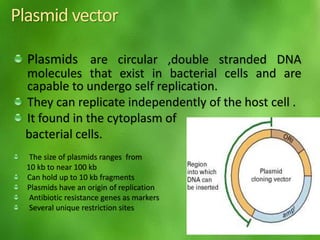
Plasmids are circular ,double stranded DNA
molecules that exist in bacterial cells and are
capable to undergo self replication.
They can replicate independently of the host cell .
It found in the cytoplasm of
bacterial cells.
The size of plasmids ranges from
10 kb to near 100 kb
Can hold up to 10 kb fragments
Plasmids have an origin of replication
Antibiotic resistance genes as markers
Several unique restriction sites
20
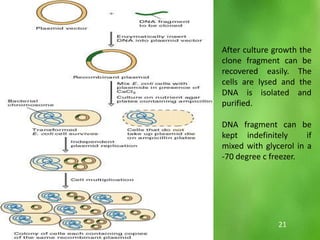
After culture growth the
clone fragment can be
recovered easily. The
cells are lysed and the
DNA is isolated and
purified.
DNA fragment can be
kept indefinitely if
mixed with glycerol in a
-70 degree c freezer.
21
• Cannot accept large fragments
• Sizes range from 0- 10 kb
• Standard methods of transformation are inefficient
•Requires the preparation of competent host cell
Disadvantages using plasmids
22
Fragments up to 23 kb can be accommodated
by a phage vector .
Lambda is most common phage.
60% of the genome is needed for lytic pathway.
Segments of the lambda DNA is removed and a
stuffer fragment is put in.
The stuffer fragment keeps the vector at a
correct size and carries marker genes that are
removed when foreign DNA is inserted into the
vector.
Example: charon 4A lambda
Bacterio phage
23
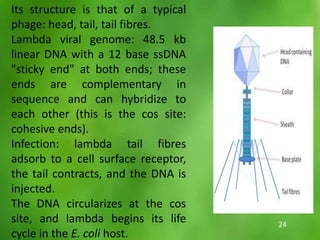
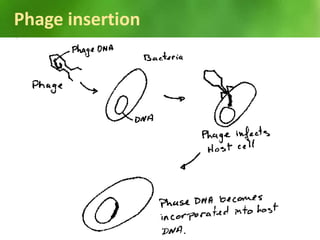
Its structure is that of a typical
phage: head, tail, tail fibres.
Lambda viral genome: 48.5 kb
linear DNA with a 12 base ssDNA
"sticky end" at both ends; these
ends are complementary in
sequence and can hybridize to
each other (this is the cos site:
cohesive ends).
Infection: lambda tail fibres
adsorb to a cell surface receptor,
the tail contracts, and the DNA is
injected.
The DNA circularizes at the cos
site, and lambda begins its life
cycle in the E. coli host.
24
Phage insertion
25
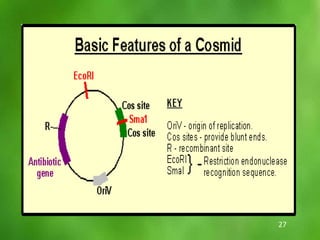
Fragments from 30 to 46kb can be accommodated by
a cosmid vector.
Cosmids combine essential elements of a plasmid and
lambda systems.
Cosmids are extracted from bacteria and mixed with
restriction endonucleases.
Cleaved cosmids are mixed with foreign DNA that has
been cleaved with the same endonucleases.
Recombinant cosmids are packaged into lambda
Recombinant cosmid is injected into the bacterial cell
where the rcosmids arranges into a circle and replicates
as a plasmid. It can be maintained recovered just as
plasmids.
Cosmids
26
27
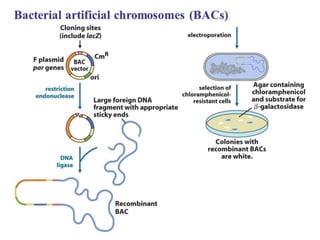
Bacterial artificial chromosomes
(BACs)
BACs can hold up to 300 kbs
The F factor of E.coli is capable of handling large
segments of DNA.
RECOMBINANT BACs are introduced into E.coli
by electroportation once in the cell the rBAC
replicates like an F factor.
28
29
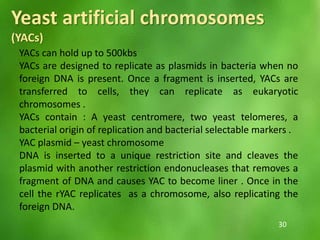
YACs can hold up to 500kbs
YACs are designed to replicate as plasmids in bacteria when no
foreign DNA is present. Once a fragment is inserted, YACs are
transferred to cells, they can replicate as eukaryotic
chromosomes .
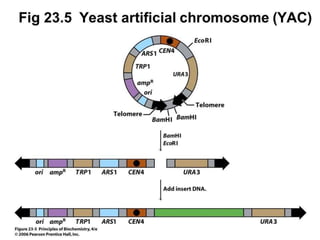
YACs contain : A yeast centromere, two yeast telomeres, a
bacterial origin of replication and bacterial selectable markers .
YAC plasmid – yeast chromosome
DNA is inserted to a unique restriction site and cleaves the
plasmid with another restriction endonucleases that removes a
fragment of DNA and causes YAC to become liner . Once in the
cell the rYAC replicates as a chromosome, also replicating the
foreign DNA.
Yeast artificial chromosomes
(YACs)
30
31
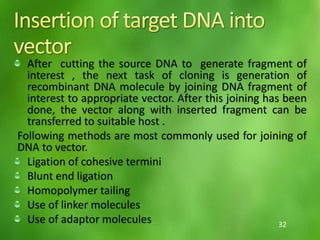
After cutting the source DNA to generate fragment of
interest , the next task of cloning is generation of
recombinant DNA molecule by joining DNA fragment of
interest to appropriate vector. After this joining has been
done, the vector along with inserted fragment can be
transferred to suitable host .
Following methods are most commonly used for joining of
DNA to vector.
Ligation of cohesive termini
Blunt end ligation
Homopolymer tailing
Use of linker molecules
Use of adaptor molecules 32
Ligation ofcohesivetermini
Cohesive termini can be joined with the help of either
E.coli ligase or phage T4 ligase . The optimum
temperature for ligating cohesive termini is 4-15oc.
Blunt end ligation
When same or different restriction enzyme which is used
to cut vector DNA and foreign DNA produces blunt ends
the two can be ligated with the help of T4 DNA ligase but
not E. coli DNA ligase .
Blunt end ligation becomes a powerful technique
because any cut end can be converted into a blunt end .
The drawback of blunt end ligation is two heterologous
DNA once joined cannot be separated also the blunt end
ligation is less efficient.
33
Homopolymer tailing
In this method oligo sequences are added to 3’ end of one
population of DNA molecules and oligo to the 3’ end of the
DNA population . Terminal deoxynucleotidal transferase
enzyme from calfthymus is used to add these extensions.
Pretreatment of target DNA with exonuclease is useful for
action of terminal deoxynucleotide transferase. For stability
of recombinants formed number of added nucleotides are 20
for Dg-dC joints and approximately 100 for dA-dTtailing .
Anneling of homopolymer tails occurs on mixing the two DNA
populations .Homopolymer tailing is most effectively used
in conjunction with a Pst 1 site for insertion of target
molecule into a vector .cDNA is tailed with oligo while
pBR322 vector is cut with pst 1 and tailed with oligo. In
recombinant molecules produced Pst1 site is reconstructed
which makes excising of inserted DNA easier.
34
Useof linkermolecules
Linkers are synthetic oligonucleotides that
contain preformed restriction sequence. Linkers
single or double are ligated to blunt ended
target DNA fragments and then restriction is
used to produce sticky ends which are similar to
those for vector used. Linker terminated DNA
then can be ligated to vector.
35
Transfer of rDNA to host cell
Recombinant DNA is allowed to enter into a
suitable host cell for expression of foreign DNA
.The recombinant vector is mainly introduced
into Escherichia coli to select the recombinant
from the unchanged vector and to obtain many
copies of the DNA insert or recombinant vector.
The specific method is selected for
transformation,it depends on types of vectors
and host cells.
36
Transformation
The recombinant plasmids are introduced into
host cells by the process called transformation .
Plasmid DNA and host cells are mixed and
pretreated with CaCl2 at low temperature to
enter plasmid DNA into bacterial cell . The
transformed bacterial cells are spread on
surface of agar plates for growth.
37
Transfection
lambda phage is used to transfer the foreign
DNA into echerichia coli cell by the process
called transfection . The vectors containing
lambda phage cos sequences are invitro
packaged into empty lambda phage heads and
forms complete lambda particles are used to
infect Escherichia coli cells . the vectors are also
used to transform E.coli cells directly as naked
DNA . Infection by phage particles containing
DNA insert is more efficient than direct
transformation .
38
Transduction
The transfer of bacterial genes by a phage.
Conjugation
The union of cells and the DNA
39
The main objective of cloning experiment is to
isolate the cells that contain recombinant vector
from non transformed cells. Recombinant cells
express the characters while the non recombinants
do not express the characters or traits .Different
methods are used for screening or selection of
recombinats.
Direct selection
Many times cloned DNA itself codes for resistance to
the antibiotic ampicillin and the recombinants can be
allowed to grow on minimal medium containing
ampicillin . Such recombinants contain ampr gene on
its plasmid vector .
40
Hybridarrestedtranslation
In this method the portion of mixture is used for in
vitro translation and it serves as the control . The
remaining portion of the mRNA mixture is
subdivided and mixed with denatured
recombinant molecule. The mixture is incubated
under suitable conditions favouring annealing .
The DNA insert present in a given clone is hybridize
with the complementary mRNA . The mRNA
mixture is used for in vitro translation and the
resulting mixture of polypeptides is subjected to
electrophoresis. The protein bands obtained in
each sample are compared with those obtained
from the control mRNA. The DNA insert causing
the absence of desired protein are identified and
isolated.
41
Hybridselection
In hybrid selection method recombinant
vectors are purified ,denatured and fixed
separately to a solid support . The DNA
attached to each disc is isolated separately and
used for invitro translation . The resulting
polypeptides are identified by electrophoresis.
The identification of specific polypeptide may
be facilitated by using antibodies specific to it
the antibodies may be used for western
blotting or RNA blotting methods.
42
Colony hybridization
This method is used to identify those bacterial colonies
in a petri plate which contain specific DNA sequence
.The bacterial colonies are replica placed or phage
plaques are directly lifted on nitrocellulose filters . The
filter disc is removed and put on blotting paper soaked
with 0.5N NaOH solution .The alkali diffuses into filters,
lyses bacterial cells and denatures their DNA .The disc is
neutralized by tris amino methane HCl buffer by
maintaining high concentrations of the salt. The cDNA is
fixed properly by baking at 80 0c. The disc is incubated
with a solution containing radioactive chemical labelled
probe at suitable conditions . The probe hybridizes any
bound dna that contains sequences complementary to
probe. The unhybridized probe is removed by washing.
Colonies that develop positive x ray image are compared
with water plate and these colonies are picked up for
further studies.
43
Agriculture: growing crops of our choice,
pesticide resistant crops, fruits with attractive
colors.
Pharmacology: artificial insulin production,
drug delivery to target sites.
Medicine: gene therapy, antiviral therapy,
vaccination, synthesizing clotting factors.
Other uses: fluorescent fishes, glowing plants
etc
44
•Provide substantial quantity
•No need for natural or organic factors
•Tailor made product that you can control
•Unlimited utilizations
•Cheap
•Resistant to natural inhibitors
45
•Effects natural immune system of the body
•Can destroy natural ecosystem that relies on
organic cycle
•Prone to cause mutation that could have
harmful effects
•Major international concern: manufacturing of
biological weapons such as botulism & anthrax to
target humans with specific genotype
46
 Pharmaceutical biotechnology by
Dr. Chandrakant R. Kokare 9.1-9.22
 Gene biotechnology by S.N Jogdnand 138-
150
 Internet source
References
47
48

molecular biology

  • 1.
    RDNATECHNOLOGY Jasmitha S K IM Pharm Dept of Pharmacology 1
  • 2.
    The deliberate modificationin genetic material of an organism by changing the nucleic acid directly is called gene manipulation or genetic engineering or gene cloning and is accomplished by several methods which are collectively known as rDNA technology. Recombinant DNA is a form of artificial DNA that is made through the combination or insertion of one or more DNA strands, therefore combining DNA sequences as per our requirement . 2
  • 3.
    cloning is carriedout in‐vitro where a specific fragment of DNA is isolated from an organism ‘donor’ and introduced into a ‘plasmid’ that replicates in a ‘host’ cell making multiple copies of that DNA fragment. 3
  • 4.
    Isolation of specificDNA Selection of vectors Preparation of rDNA Transfer of rDNA to host cell Identification and isolation of rDNA 4
  • 5.
    Mechanical shearing Random fragmentsof source DNA can be obtained by mechanical shearing of bacterial, plant or animal cells. Mechanical shearing caused by high speed mixing at 1500 rpm for 30 min. This gives fragments of 8kb mean size. Short single stranded regions- termini or blunt end fragments are formed. Sonication can reduce the length of the fragments to about 300 nucleotide pairs. Shearing does not necessarily produce 5’ phosphate and3’ ends . There for the end of the fragments must be repaired. 5
  • 6.
    Restriction endonucleasedigestion Large numberof restriction enzymes which recognize and cut DNA with in target sites of nucleotides are known. Depending upon the number of target sites present, DNA may be cut into too small or too big size fragments. Generally the same restriction enzyme is used for vector and the DNA of interest. The digestion carried out may be light ,moderate or heavy producing from small number to large number of fragments which are reproducible. 6
  • 7.
  • 8.
  • 9.
    DNA ligases These wereoriginally isolated from viruses, also occur in E.coli & eukaryotic cells. The cut DNA fragments are covalently joined together by DNA ligases. DNA ligase joins the DNA fragments by forming a phosphodiester bond b/n the phosphate group of 5’-carbon of one deoxyribose with the hydroxyl group of 3’-carbon of another deoxyribose 9
  • 10.
    Reverse transcriptasemethod If eukaryoticgene is to be cloned and expressed in prokaryotic cell, the difference in gene organization has to be considered. The introns present in eukaryotic genes are transcribed into mRNA. Such precursor mRNA in eukaryotic cell undergoes post transcriptional modification and removal of introns occurs to give rise to processed mRNA. Mature mRNA molecules from animal cell do not contain sequences complementary to introns as they are removed by processing. These molecules then can be directly transcribed into DNA using an enzyme reverse transcriptase. cDNA thus produced for a particular protein can be joined to appropriate vector and cloned into a host. 10
  • 11.
    Hybridization method Hybridization methoddepends on the principle that on mRNA forms a complex with complementary DNA segments from which it has been transcribed. This method is possible if protein encoding gene does not have introns. DNA from the donor organism is first isolated. This ds DNA is treated with heat or alkali and is converted to ss DNA by denaturation . Strands are then mixed with mRNA transcribed by the gene . mRNA pairs with cDNA portion to form DNA- RNA complex This complex is then isolated and DNA separated from RNA. Ss DNA thus obtained can be converted to ds DNA by DNA polymerase I. 11
  • 12.
  • 13.
    The cutting ofDNA by different isolation methods, these fragments can be separated by a technique known as gel electrophoresis 13
  • 14.
  • 15.
    Vectors are usedto transform DNA material into the host cell Types of vectors Cloning vectors and expression vectors Cloning vectors: propagation of DNA inserts Expression vectors: production of proteins 15
  • 16.
    Selection of cloningvectors depends on Objective of cloning experiment Ease of working Knowledge existing about the vector Suitability reliability 16
  • 17.
    Properties of vectors: Ableto self replicate in the host Easy to isolate Non toxic to host cells Have space for foreign inserts Have unique restriction sites for common restriction enzymes. 17
  • 18.
    Practical features ofDNA cloning vectors: Size Origin of replication Multiple cloning sites Selectable marker genes RNA polymerase promoter sequence DNA sequencing primers 18
  • 19.
    Types of Vector: Plasmids bacteriophages Cosmids YACs– Yeast artificial chromosomes BACs – Bacterial artificial chromosomes 19
  • 20.
    Plasmid vector Plasmids arecircular ,double stranded DNA molecules that exist in bacterial cells and are capable to undergo self replication. They can replicate independently of the host cell . It found in the cytoplasm of bacterial cells. The size of plasmids ranges from 10 kb to near 100 kb Can hold up to 10 kb fragments Plasmids have an origin of replication Antibiotic resistance genes as markers Several unique restriction sites 20
  • 21.
    After culture growththe clone fragment can be recovered easily. The cells are lysed and the DNA is isolated and purified. DNA fragment can be kept indefinitely if mixed with glycerol in a -70 degree c freezer. 21
  • 22.
    • Cannot acceptlarge fragments • Sizes range from 0- 10 kb • Standard methods of transformation are inefficient •Requires the preparation of competent host cell Disadvantages using plasmids 22
  • 23.
    Fragments up to23 kb can be accommodated by a phage vector . Lambda is most common phage. 60% of the genome is needed for lytic pathway. Segments of the lambda DNA is removed and a stuffer fragment is put in. The stuffer fragment keeps the vector at a correct size and carries marker genes that are removed when foreign DNA is inserted into the vector. Example: charon 4A lambda Bacterio phage 23
  • 24.
    Its structure isthat of a typical phage: head, tail, tail fibres. Lambda viral genome: 48.5 kb linear DNA with a 12 base ssDNA "sticky end" at both ends; these ends are complementary in sequence and can hybridize to each other (this is the cos site: cohesive ends). Infection: lambda tail fibres adsorb to a cell surface receptor, the tail contracts, and the DNA is injected. The DNA circularizes at the cos site, and lambda begins its life cycle in the E. coli host. 24
  • 25.
  • 26.
    Fragments from 30to 46kb can be accommodated by a cosmid vector. Cosmids combine essential elements of a plasmid and lambda systems. Cosmids are extracted from bacteria and mixed with restriction endonucleases. Cleaved cosmids are mixed with foreign DNA that has been cleaved with the same endonucleases. Recombinant cosmids are packaged into lambda Recombinant cosmid is injected into the bacterial cell where the rcosmids arranges into a circle and replicates as a plasmid. It can be maintained recovered just as plasmids. Cosmids 26
  • 27.
  • 28.
    Bacterial artificial chromosomes (BACs) BACscan hold up to 300 kbs The F factor of E.coli is capable of handling large segments of DNA. RECOMBINANT BACs are introduced into E.coli by electroportation once in the cell the rBAC replicates like an F factor. 28
  • 29.
  • 30.
    YACs can holdup to 500kbs YACs are designed to replicate as plasmids in bacteria when no foreign DNA is present. Once a fragment is inserted, YACs are transferred to cells, they can replicate as eukaryotic chromosomes . YACs contain : A yeast centromere, two yeast telomeres, a bacterial origin of replication and bacterial selectable markers . YAC plasmid – yeast chromosome DNA is inserted to a unique restriction site and cleaves the plasmid with another restriction endonucleases that removes a fragment of DNA and causes YAC to become liner . Once in the cell the rYAC replicates as a chromosome, also replicating the foreign DNA. Yeast artificial chromosomes (YACs) 30
  • 31.
  • 32.
    After cutting thesource DNA to generate fragment of interest , the next task of cloning is generation of recombinant DNA molecule by joining DNA fragment of interest to appropriate vector. After this joining has been done, the vector along with inserted fragment can be transferred to suitable host . Following methods are most commonly used for joining of DNA to vector. Ligation of cohesive termini Blunt end ligation Homopolymer tailing Use of linker molecules Use of adaptor molecules 32
  • 33.
    Ligation ofcohesivetermini Cohesive terminican be joined with the help of either E.coli ligase or phage T4 ligase . The optimum temperature for ligating cohesive termini is 4-15oc. Blunt end ligation When same or different restriction enzyme which is used to cut vector DNA and foreign DNA produces blunt ends the two can be ligated with the help of T4 DNA ligase but not E. coli DNA ligase . Blunt end ligation becomes a powerful technique because any cut end can be converted into a blunt end . The drawback of blunt end ligation is two heterologous DNA once joined cannot be separated also the blunt end ligation is less efficient. 33
  • 34.
    Homopolymer tailing In thismethod oligo sequences are added to 3’ end of one population of DNA molecules and oligo to the 3’ end of the DNA population . Terminal deoxynucleotidal transferase enzyme from calfthymus is used to add these extensions. Pretreatment of target DNA with exonuclease is useful for action of terminal deoxynucleotide transferase. For stability of recombinants formed number of added nucleotides are 20 for Dg-dC joints and approximately 100 for dA-dTtailing . Anneling of homopolymer tails occurs on mixing the two DNA populations .Homopolymer tailing is most effectively used in conjunction with a Pst 1 site for insertion of target molecule into a vector .cDNA is tailed with oligo while pBR322 vector is cut with pst 1 and tailed with oligo. In recombinant molecules produced Pst1 site is reconstructed which makes excising of inserted DNA easier. 34
  • 35.
    Useof linkermolecules Linkers aresynthetic oligonucleotides that contain preformed restriction sequence. Linkers single or double are ligated to blunt ended target DNA fragments and then restriction is used to produce sticky ends which are similar to those for vector used. Linker terminated DNA then can be ligated to vector. 35
  • 36.
    Transfer of rDNAto host cell Recombinant DNA is allowed to enter into a suitable host cell for expression of foreign DNA .The recombinant vector is mainly introduced into Escherichia coli to select the recombinant from the unchanged vector and to obtain many copies of the DNA insert or recombinant vector. The specific method is selected for transformation,it depends on types of vectors and host cells. 36
  • 37.
    Transformation The recombinant plasmidsare introduced into host cells by the process called transformation . Plasmid DNA and host cells are mixed and pretreated with CaCl2 at low temperature to enter plasmid DNA into bacterial cell . The transformed bacterial cells are spread on surface of agar plates for growth. 37
  • 38.
    Transfection lambda phage isused to transfer the foreign DNA into echerichia coli cell by the process called transfection . The vectors containing lambda phage cos sequences are invitro packaged into empty lambda phage heads and forms complete lambda particles are used to infect Escherichia coli cells . the vectors are also used to transform E.coli cells directly as naked DNA . Infection by phage particles containing DNA insert is more efficient than direct transformation . 38
  • 39.
    Transduction The transfer ofbacterial genes by a phage. Conjugation The union of cells and the DNA 39
  • 40.
    The main objectiveof cloning experiment is to isolate the cells that contain recombinant vector from non transformed cells. Recombinant cells express the characters while the non recombinants do not express the characters or traits .Different methods are used for screening or selection of recombinats. Direct selection Many times cloned DNA itself codes for resistance to the antibiotic ampicillin and the recombinants can be allowed to grow on minimal medium containing ampicillin . Such recombinants contain ampr gene on its plasmid vector . 40
  • 41.
    Hybridarrestedtranslation In this methodthe portion of mixture is used for in vitro translation and it serves as the control . The remaining portion of the mRNA mixture is subdivided and mixed with denatured recombinant molecule. The mixture is incubated under suitable conditions favouring annealing . The DNA insert present in a given clone is hybridize with the complementary mRNA . The mRNA mixture is used for in vitro translation and the resulting mixture of polypeptides is subjected to electrophoresis. The protein bands obtained in each sample are compared with those obtained from the control mRNA. The DNA insert causing the absence of desired protein are identified and isolated. 41
  • 42.
    Hybridselection In hybrid selectionmethod recombinant vectors are purified ,denatured and fixed separately to a solid support . The DNA attached to each disc is isolated separately and used for invitro translation . The resulting polypeptides are identified by electrophoresis. The identification of specific polypeptide may be facilitated by using antibodies specific to it the antibodies may be used for western blotting or RNA blotting methods. 42
  • 43.
    Colony hybridization This methodis used to identify those bacterial colonies in a petri plate which contain specific DNA sequence .The bacterial colonies are replica placed or phage plaques are directly lifted on nitrocellulose filters . The filter disc is removed and put on blotting paper soaked with 0.5N NaOH solution .The alkali diffuses into filters, lyses bacterial cells and denatures their DNA .The disc is neutralized by tris amino methane HCl buffer by maintaining high concentrations of the salt. The cDNA is fixed properly by baking at 80 0c. The disc is incubated with a solution containing radioactive chemical labelled probe at suitable conditions . The probe hybridizes any bound dna that contains sequences complementary to probe. The unhybridized probe is removed by washing. Colonies that develop positive x ray image are compared with water plate and these colonies are picked up for further studies. 43
  • 44.
    Agriculture: growing cropsof our choice, pesticide resistant crops, fruits with attractive colors. Pharmacology: artificial insulin production, drug delivery to target sites. Medicine: gene therapy, antiviral therapy, vaccination, synthesizing clotting factors. Other uses: fluorescent fishes, glowing plants etc 44
  • 45.
    •Provide substantial quantity •Noneed for natural or organic factors •Tailor made product that you can control •Unlimited utilizations •Cheap •Resistant to natural inhibitors 45
  • 46.
    •Effects natural immunesystem of the body •Can destroy natural ecosystem that relies on organic cycle •Prone to cause mutation that could have harmful effects •Major international concern: manufacturing of biological weapons such as botulism & anthrax to target humans with specific genotype 46
  • 47.
     Pharmaceutical biotechnologyby Dr. Chandrakant R. Kokare 9.1-9.22  Gene biotechnology by S.N Jogdnand 138- 150  Internet source References 47
  • 48.