Chapter 4: Middle Childhood Module 4.3  Social and Personality Development in Middle Childhood
Erikson – Psychosocial Development Industry vs. Inferiority 6 to 12 years of age Industry  = feelings of mastery and proficiency and a growing sense of competence Inferiority  = feelings of failure and inadequacy Characterized by a focus on efforts to attain competence in meeting the challenges related to: Parents Peers School Other complexities of the modern world
School Age Children During middle childhood, children begin to view themselves: Less in terms of external physical attributes  More in terms of psychological traits Children realize they are  good  at some things and  not so good  at others Self-concept and self-esteem continue to develop
Development of Self-esteem Children look to others who are similar to themselves Children increasingly compare themselves to others  Children are developing their own standards
Development of Self-esteem Overall, self-esteem increases during middle childhood: As children progress into the middle childhood years, however, their self-esteem is higher for some areas and lower in others. For example, a boy’s overall self-esteem may be composed of positive self-esteem in some areas (such as the positive feelings he gets from his artistic ability) and more negative self-esteem in others (such as the unhappiness he feels over his athletic skills). On the other hand, students with high self-esteem travel a more positive path, falling into a cycle of success. Having higher expectations leads to increased effort and lower anxiety, increasing the probability of success. In turn, this helps affirm their higher self-esteem that began the cycle.
Promoting Development of Self-esteem Use  authoritative  child-rearing style: Authoritative parents are warm and emotionally supportive, while still setting clear limits for their children’s behavior. In contrast, other parenting styles have less positive effects on self-esteem. Parents who are highly punitive and controlling send a message to their children that they are untrustworthy and unable to make good decisions—a message that can undermine children’s sense of adequacy.  Highly indulgent parents, who indiscriminately praise and reinforce their children regardless of their actual performance, can create a false sense of self-esteem in their children, which ultimately may be just as damaging to children.
Race and Self-Esteem  Early research found that African Americans had lower self-esteem than whites - Set of pioneering studies a generation ago found that African American children shown black and white dolls preferred the white dolls over the black ones (Clark & Clark, 1947). Picture is more complex regarding relative levels of self-esteem between members of different racial and ethnic groups: White children initially show higher self-esteem than black children, black children begin to show slightly higher self-esteem than white children around the age of 11. This shift occurs as African-American children become more identified with their racial group, develop more complex views of racial identity, and increasingly view the positive aspects of their group membership. Hispanic children, also show an increase in self-esteem toward the end of middle childhood, although even in adolescence their self-esteem still trails that of whites. In contrast, Asian-American children show the opposite pattern: their self-esteem in elementary school is higher than whites and blacks, but by the end childhood, their self-esteem is lower than that of whites.
Social Identity Theory  Members of a minority group accept negative views held by majority group  only  if they perceive little realistic possibility of changing power and status differences between groups If minority group members feel that prejudice and discrimination can be reduced, and they blame society for the prejudice and not themselves, self-esteem should not differ between majority and minority groups. As group pride and ethnic awareness on the part of minority group members has grown, differences in self-esteem between members of different ethnic groups have narrowed.
Children of Immigrant Families More than 13 million children in the U.S. are either foreign born or the children of immigrants—some one-fifth of the total population of children. Tend to have equal or better grades than children with US born parents Often more highly motivated to succeed and place greater value on education than do children in nonimmigrant families  Show similar levels of self-esteem to nonimmigrant children Report feeling less popular and less in control of their lives The story is less clear, however, when immigrant children reach adolescence and adulthood.
Moral Development: Kohlberg Proposes series of fixed stages in development of moral reasoning Uses moral dilemmas to assess moral reasoning Provides good account of moral judgment but not adequate at predicting moral behavior
Kohlberg Stages Preconventional Morality  (stages 1 & 2): people follow unvarying rules based on rewards and punishments Conventional Morality  (stages 3 & 4) is where people approach problems in terms of their own position as good, responsible members of society Postconventional Morality  (stages  5  & 6) is where universal moral principles are invoked and considered broader than a particular society
Kohlberg Criticisms Based solely on observations of members of Western cultures  Theory initially based largely on data from males
Carol Gilligan Way boys and girls raised leads to differences in moral reasoning: Boys view morality primarily in terms of justice and fairness. Girls see morality in terms of responsibility and compassion toward individuals and a willingness to sacrifice for relationships. Suggests Kohlberg’s theory inadequate and places girls’ moral reasoning at lower level than boys’
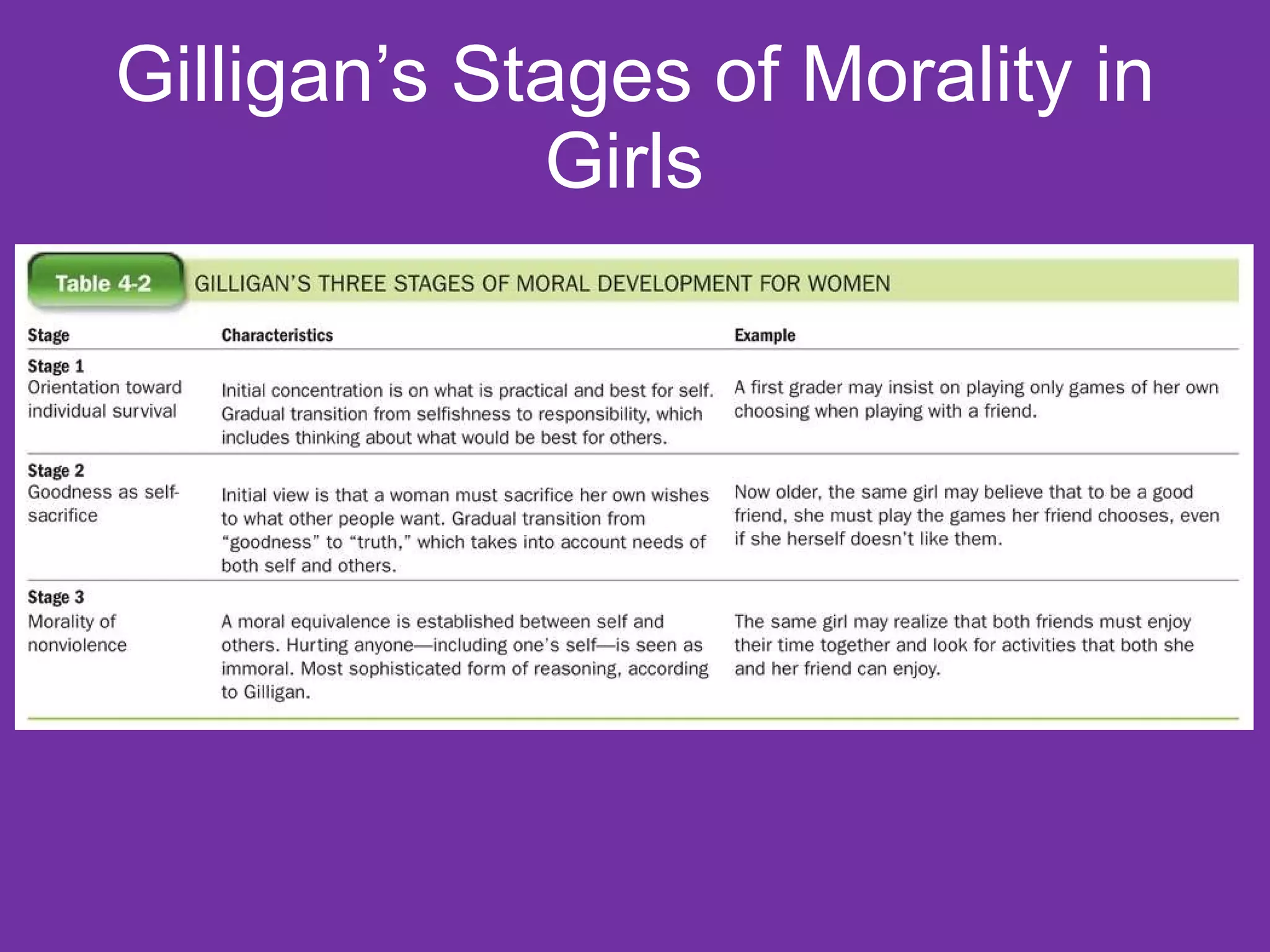
Gilligan’s Stages of Morality in Girls
Friends in Middle Childhood Provide emotional support and help kids to handle stress Teach children how to manage and control their emotions Teach about communication with others Foster intellectual growth Allow children to practice relationship skills
Damon’s Stages of Friendship Stage 1 (ages 4-7 years) Children see friends as like themselves Children see friends as people to share toys and activities with Children do not take into account personal traits
Damon’s Stages of Friendship Stage 2 (ages 8-10 years) Children now begin to take other’s personal qualities and traits into consideration Friends are viewed in terms of kinds of rewards they provide Friendships are based on mutual trust
Damon’s Stages of Friendship Stage 3 (ages 11-15 years) Friendships become based on intimacy and loyalty Friendships involve mutual disclosure and exclusivity
Status Hierarchies Children’s friendships show clear hierarchies in terms of STATUS  STATUS is the evaluation of a role or person by other relevant members of a group
High Status Children Form friendships with high status children More likely to form exclusive and desirable cliques  Tend to play with a greater number of children Have greater access to resources such as games, toys, books, and information
Low Status Children Form friendships with other lower status children Tend to play with a lower number of children than higher status children Are more likely to play with younger or less popular children Tend to follow the lead of higher status children
Social Competence Social Competence -  A collection of individual social skills that permit children to perform successfully in social settings. High social competence correlated with popularity
Popular Children Helpful and cooperative Good sense of humor Good emotional understanding Ask for help when necessary Not overly reliant on others Adaptive to social situations Social problem-solving skill competence Exception: Although generally popular children are friendly, open, and cooperative, one subset of popular boys displays an array of negative behaviors, including being aggressive, disruptive, and causing trouble. Despite these behaviors, they may be viewed as cool and tough by their peers, and they are often remarkably popular. This popularity may occur in part because they are seen as boldly breaking rules that others feel constrained to follow.
Unpopular Children Lack social competence Immature or inappropriately silly Overly aggressive and overbearing Withdrawn or shy Unattractive, handicapped, obese, or slow academically
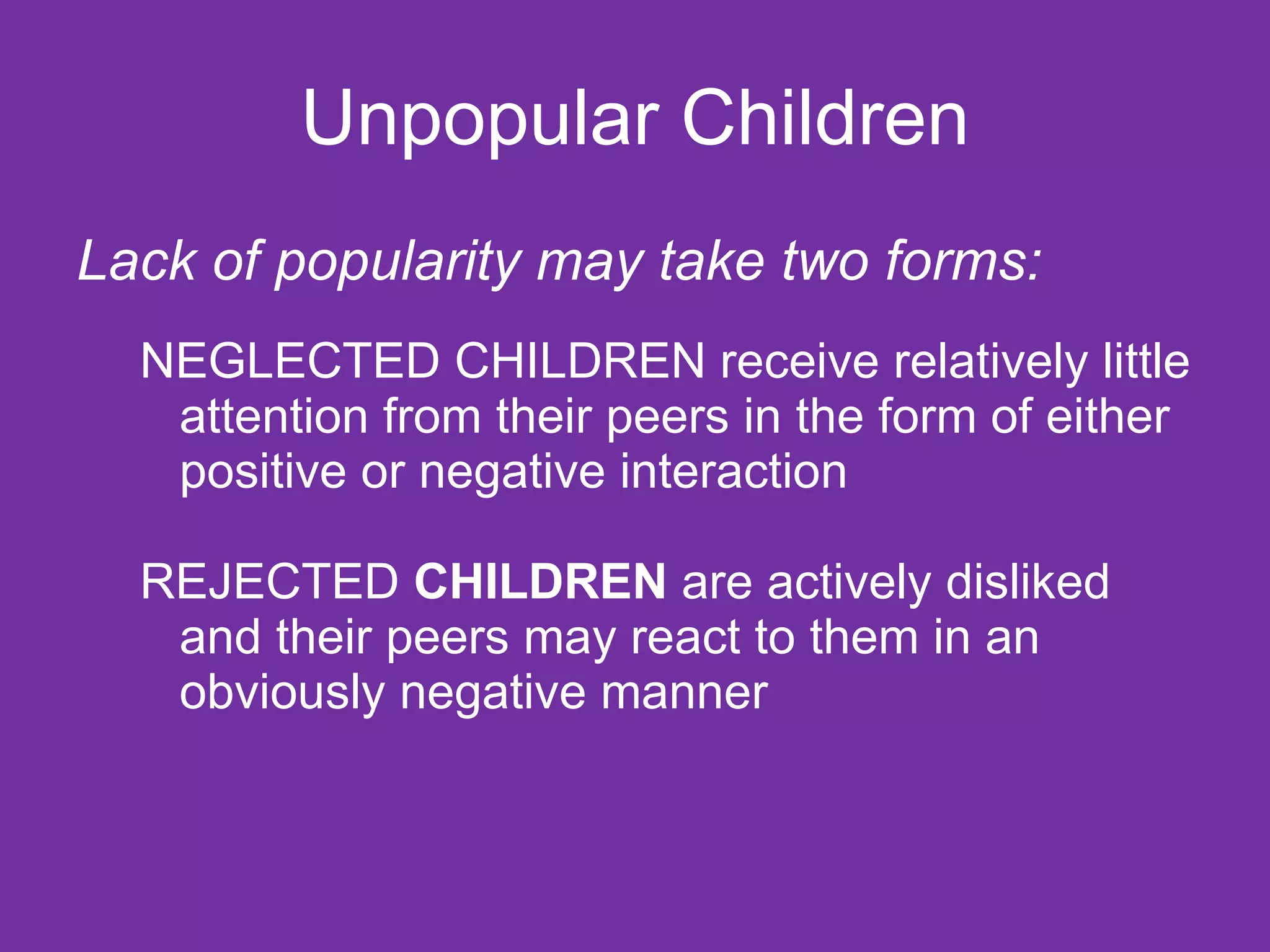
Unpopular Children Lack of popularity may take two forms: NEGLECTED CHILDREN receive relatively little attention from their peers in the form of either positive or negative interaction REJECTED  CHILDREN  are actively disliked and their peers may react to them in an obviously negative manner
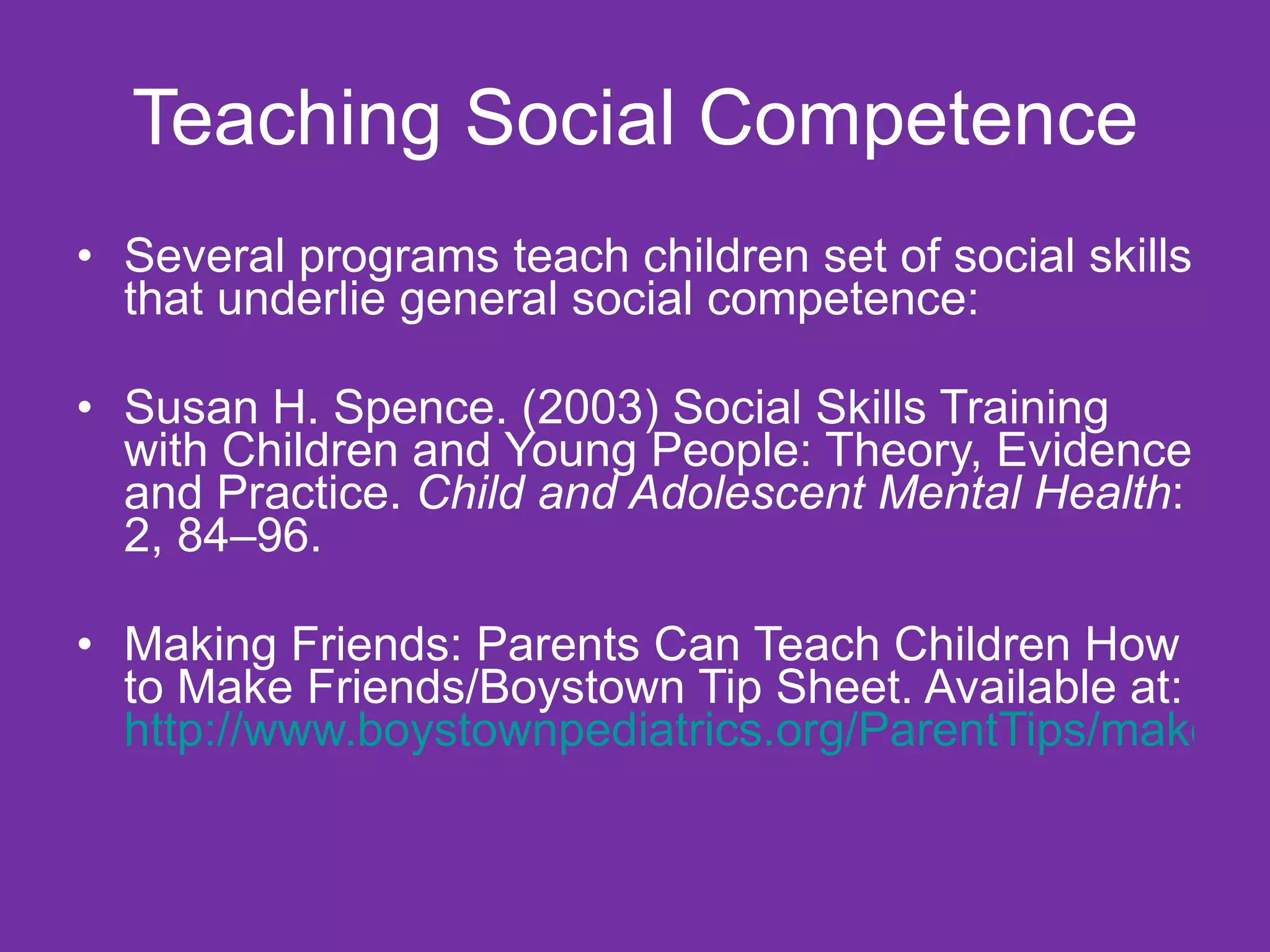
Teaching Social Competence Several programs teach children set of social skills that underlie general social competence: Susan H. Spence. (2003) Social Skills Training with Children and Young People: Theory, Evidence and Practice.  Child and Adolescent Mental Health : 2, 84–96. Making Friends: Parents Can Teach Children How to Make Friends/Boystown Tip Sheet. Available at:  http://www.boystownpediatrics.org/ParentTips/makefriends.asp
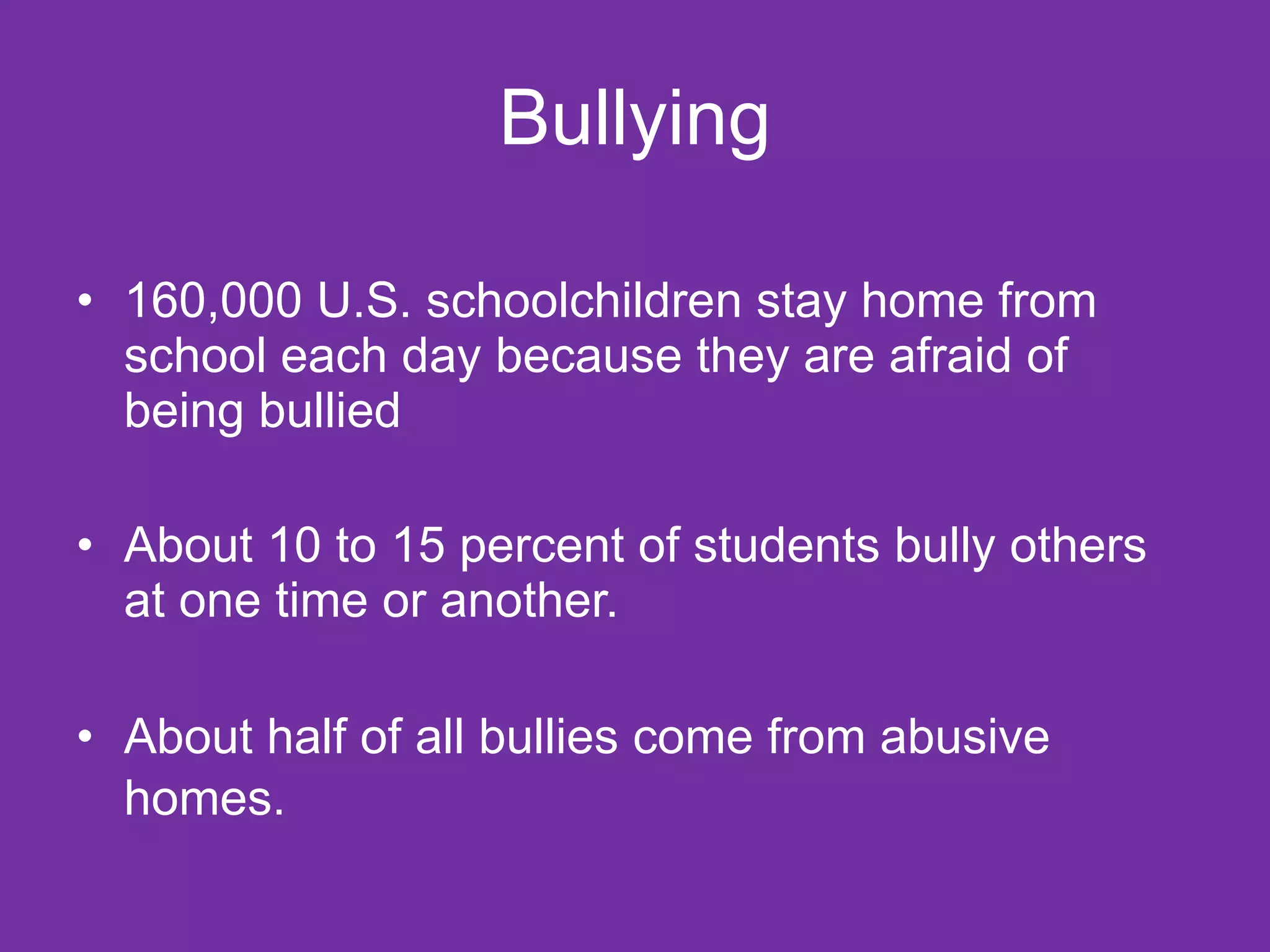
Bullying 160,000 U.S. schoolchildren stay home from school each day because they are afraid of being bullied About 10 to 15 percent of students bully others at one time or another. About half of all bullies come from abusive homes.
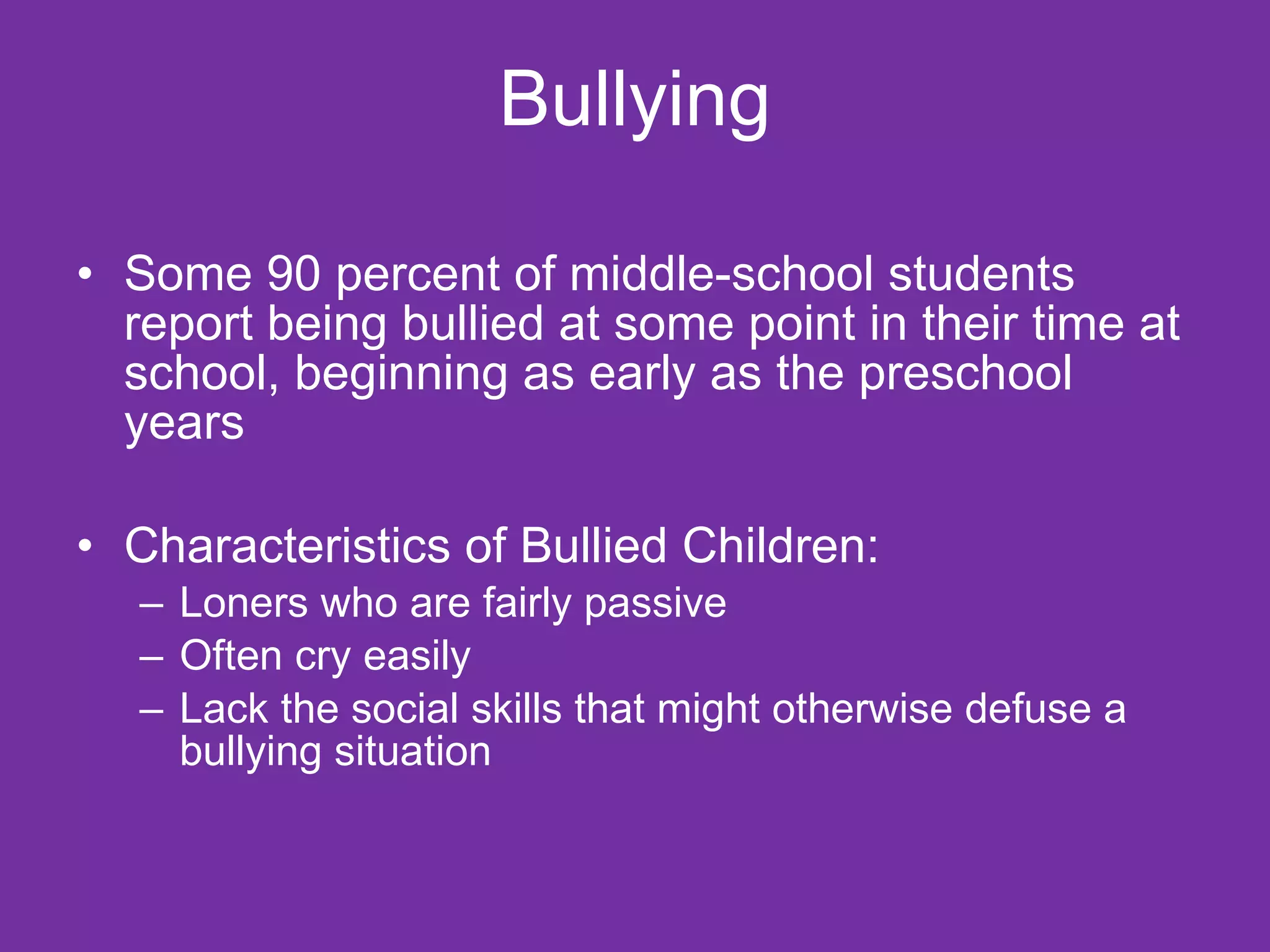
Bullying Some 90 percent of middle-school students report being bullied at some point in their time at school, beginning as early as the preschool years Characteristics of Bullied Children: Loners who are fairly passive Often cry easily Lack the social skills that might otherwise defuse a bullying situation
Bullying Suggested Reading: The Bully, the Bullied, and the Bystander: From Preschool to High School--How Parents and Teachers Can Help Break the Cycle of Violence Barbara Coloroso
Bullying - Relational Aggression Among Girls Suggested reading: Odd Girl Speaks Out: Girls Write about Bullies, Cliques, Popularity, and Jealousy Rachel Simmons Mean Chicks, Cliques, and Dirty Tricks: A Real Girl's Guide to Getting Through the Day With Smarts and Style Erika V Shearin Karres GirlWise: How to Be Confident, Capable, Cool, and in Control Julia Devillers Mean Girls Grown Up: Adult Women Who Are Still Queen Bees, Middle Bees, and Afraid-to-Bees Cheryl Dellasega Surviving Ophelia: Mothers Share Their Wisdom in Navigating the Tumultuous Teenage Years Cheryl Dellasega
Sex-Segregated Friendships Avoidance of opposite sex becomes very pronounced during middle childhood Children’s friendships are almost entirely sex-segregated When sexes interact it is called “border work”, it is often romantic, and helps emphasize clear boundaries between sexes
Boys and Friendship  Larger networks of friends than girls do Strict  DOMINANCE HIERARCHY -  which is composed of rankings that represent the relative social power of those in a group hierarchy. Attempt to maintain and improve status in hierarchy, makes for a style of play known as  restrictive play  where interactions are interrupted when status is challenged.
Girls and Friendships Focus on one or two “best friends” of relatively equal status Conflicts solved by compromise, ignoring situation, or giving in Can be confrontational with other girls not their friends Language is less confrontational and direct than boys’
Cross-Race Friendships Closest friendships largely with others of same race Decline with age in number and depth of friendships outside own racial group By the time they are 11 or 12, it appears that African American children become particularly aware of and sensitive to the prejudice and discrimination directed toward members of their race. At that point, they are more like to make distinctions between members of ingroups (groups to which people feel they belong) and members of outgroups.  A good deal of research supports the notion that contact between majority and minority group members can reduce prejudice and discrimination (Kerner & Aboud, 1998; Hewstone, 2003).
Cross-Race Friendships Reducing prejudice through contact between groups: Must occur in equal status settings Enhanced through cooperative activities that are important to children Must promote equality and disconfirm negative stereotypes
What Parents and Teachers can do to increase social competence: It is clear that building and maintaining friendships is critical in children’s lives: Encourage social interaction.  Teachers can devise ways in which children are led to take part in group activities, and parents can encourage membership in such groups as Brownies and Cub Scouts or participation in team sports. Teach listening skills to children.  Show them how to listen carefully and respond to the underlying meaning of a communication as well as its overt content. Make children aware that people display emotions and moods nonverbally  and that consequently they should pay attention to others’ nonverbal behavior, not just to what they are saying on a verbal level. Teach conversational skills, including the importance of asking questions and self-disclosure.  Encourage students to use “I” statements in which they clarify their own feelings or opinions, and avoid making generalizations about others. Don’t ask children to choose teams or groups publicly.  Instead, assign children randomly: It works just as well in ensuring a distribution of abilities across groups and avoids the public embarrassment of a situation in which some children are chosen last.
Middle Childhood in the 21 st  Century Increasing independence Co-regulation with parents - children and parents jointly control behavior. Sibling relationships and rivalry - Although brothers and sisters can provide support, companionship, and a sense of security, they can also be a source of strife. increase in the number of parents who both work outside of the home increase in divorce rate increase in single-parent families
When Both Parents Work Outside the Home  In most cases, children fare quite well When parents  Are loving Are sensitive to their children’s needs Provide appropriate substitute care Good adjustment of children relates to psychological adjustment of parents, especially mothers: In general, women who are satisfied with their lives tend to be more nurturing with their children.  When work provides a high level of satisfaction, then, mothers who work outside of the home may be more psychologically supportive of their children. Children with mothers and fathers who work full-time spend essentially the same amount of time with family, in class, with friends, and alone as children in families where one parent stays at home.
Self-Care Children Youngsters who let themselves into their homes after school and wait alone until their parents return from work Consequences of being a latchkey child are not all harmful Some children report being lonely Some children develop a sense of independence and competence Some research shows latchkey children have higher self-esteem because they are helping family
Divorce Only half of children in the U.S. will pass through childhood living with both parents each of whom has been married only once School-age children tend to blame themselves for the breakup By the age of 10, children feel pressure to choose sides, taking the position of either the mother or the father. Because of this, they experience some degree of divided loyalty. For many children, there are minimal long-term consequences.
Immediately after the Divorce Both children and parents may show several types of psychological maladjustments for 6 months to 2 years Anxiety Depression Sleep disturbances Phobias
Rediscovering the Status Quo After 18 months to 2 years, most children return to their predivorce psychological adjustment Twice as many children of divorced parents require psychological counseling as do children from intact families For some children, living in a home with unhappy marriage and which is high in conflict has stronger negative consequences than divorce How children react to divorce depends on several factors. One is the economic standing of the family the child is living with. In many cases, divorce brings a decline in both parents' standards of living. When this occurs, children may be thrown into poverty.
Single Parents Almost one-quarter of all children under 18 in the U.S. live with only one parent Numbers are higher for minority children 60% of African-American children live in single parent homes 35% of Hispanic children live in single parent homes
Single Parents In majority of cases, single parent is mother Consequences of living in single parent home depend on: Whether other parent ever lived at home Economic status Amount of time that the parent is able to spend with the child Degree of stress in the household
Multigenerational Families  Opportunity for rich experiences and conflicts Greater among African Americans than among Caucasians In some families, cultural norms tend to be highly supportive of grandparents taking an active role
Grandparents Raising Grandchildren In 1980, 2.3 million (4%) children under 18 were living in a grandparent(s)' home Now around 4 million (6%) living with grandparents   Age: 48% of grandparent caregivers range between 50 and 64 years 33% under the age of 50 and 19% over the age of 65
Blended Families I nclude remarried couple that has at least one stepchild living with them Experts predict that by 2000, over 50 percent of children born in the last decade will be stepchildren Living in blended family involves  role ambiguity,  in which roles and expectations are unclear
Blended Families School-age children often adjust relatively smoothly to a blended family: Financial status of family improves More people to share household chore More social interaction and attention But…not all children adjust well, especially if the new relationship is threatening
Families with Gay and Lesbian Parents  Between one and five million US families headed by two lesbians or two gay parents - some 6 million children have lesbian or gay parents. Growing body of research suggests that there is little developmental difference between children whose parents are gay and lesbian and heterosexual parents. Most studies find children: Develop similarly to children of heterosexual families Have sexual orientation unrelated to their parents Have no more or less gender-typed behavior Seem equally well adjusted  Have similar relationships with their peers and adults Have romantic relationships and sexual behavior that are no different from those of adolescents living with opposite-sex parents  What is clearly different for children with same-sex parents is the possibility of discrimination and prejudice due to their parents’ homosexuality.  As U.S. citizens engage in an ongoing and highly-politicized debate regarding the legality of gay and lesbian marriage, children of such unions may feel singled out and victimized because of societal stereotypes and discrimination.
Race and Family Life  African-American families: Frequently willing to offer welcome and support to extended family members in their homes. Relatively high proportion of families headed by older adults, such as grandparents, and some studies find that children in grandmother-headed households are particularly well adjusted. Particularly strong sense of family  Hispanic families: Children are taught to value their ties to their families, and they come to see themselves as a central part of an extended family.  Ultimately, their sense of who they are becomes tied to the family. Hispanic families also tend to be relatively larger, with an average size of 3.71.  Stress importance of family life, community, and religious organizations Asian-American families: Although relatively little research has been conducted on Asian-American families, emerging findings suggest that fathers are more apt to be powerful figures, maintaining discipline.  In keeping with the more collectivist orientation of Asian cultures, children tend to believe that family needs have a higher priority than personal needs, and males, in particular, are expected to care for their parents throughout their lifetimes.
Poverty and Family Life  Poor families  Fewer basic everyday resources More disruptions in children’s lives  Higher likelihood of stress The stress of difficult family environments, along with other stress in the lives of poor children—such as living in unsafe neighborhoods with high rates of violence and attending inferior schools—ultimately takes its toll.  Economically disadvantaged children are at risk for poorer academic performance, higher rates of aggression, and conduct problems. In addition, declines in economic well-being have been linked to mental health problems.
Group Homes Term “orphanage” replaced by  group home  or  residential treatment center Group homes used for youngsters whose parents are no longer able to care for them adequately The number of children in group care has grown over 50 percent About three-quarters of children in group homes are victims of abuse and neglect Most will eventually return home, however, one-fourth will be in group care throughout childhood
Group Homes Experts disagree on advantages and disadvantages of group care Some see them as solution to unwed mothers who become dependent on welfare Many who work in these homes say they cannot provide adequate love and support as family could Group homes cost ten times as much as foster care or welfare

Lifespan psychology lecture 4.3

  • 1.
    Chapter 4: MiddleChildhood Module 4.3 Social and Personality Development in Middle Childhood
  • 2.
    Erikson – PsychosocialDevelopment Industry vs. Inferiority 6 to 12 years of age Industry = feelings of mastery and proficiency and a growing sense of competence Inferiority = feelings of failure and inadequacy Characterized by a focus on efforts to attain competence in meeting the challenges related to: Parents Peers School Other complexities of the modern world
  • 3.
    School Age ChildrenDuring middle childhood, children begin to view themselves: Less in terms of external physical attributes More in terms of psychological traits Children realize they are good at some things and not so good at others Self-concept and self-esteem continue to develop
  • 4.
    Development of Self-esteemChildren look to others who are similar to themselves Children increasingly compare themselves to others Children are developing their own standards
  • 5.
    Development of Self-esteemOverall, self-esteem increases during middle childhood: As children progress into the middle childhood years, however, their self-esteem is higher for some areas and lower in others. For example, a boy’s overall self-esteem may be composed of positive self-esteem in some areas (such as the positive feelings he gets from his artistic ability) and more negative self-esteem in others (such as the unhappiness he feels over his athletic skills). On the other hand, students with high self-esteem travel a more positive path, falling into a cycle of success. Having higher expectations leads to increased effort and lower anxiety, increasing the probability of success. In turn, this helps affirm their higher self-esteem that began the cycle.
  • 6.
    Promoting Development ofSelf-esteem Use authoritative child-rearing style: Authoritative parents are warm and emotionally supportive, while still setting clear limits for their children’s behavior. In contrast, other parenting styles have less positive effects on self-esteem. Parents who are highly punitive and controlling send a message to their children that they are untrustworthy and unable to make good decisions—a message that can undermine children’s sense of adequacy. Highly indulgent parents, who indiscriminately praise and reinforce their children regardless of their actual performance, can create a false sense of self-esteem in their children, which ultimately may be just as damaging to children.
  • 7.
    Race and Self-Esteem Early research found that African Americans had lower self-esteem than whites - Set of pioneering studies a generation ago found that African American children shown black and white dolls preferred the white dolls over the black ones (Clark & Clark, 1947). Picture is more complex regarding relative levels of self-esteem between members of different racial and ethnic groups: White children initially show higher self-esteem than black children, black children begin to show slightly higher self-esteem than white children around the age of 11. This shift occurs as African-American children become more identified with their racial group, develop more complex views of racial identity, and increasingly view the positive aspects of their group membership. Hispanic children, also show an increase in self-esteem toward the end of middle childhood, although even in adolescence their self-esteem still trails that of whites. In contrast, Asian-American children show the opposite pattern: their self-esteem in elementary school is higher than whites and blacks, but by the end childhood, their self-esteem is lower than that of whites.
  • 8.
    Social Identity Theory Members of a minority group accept negative views held by majority group only if they perceive little realistic possibility of changing power and status differences between groups If minority group members feel that prejudice and discrimination can be reduced, and they blame society for the prejudice and not themselves, self-esteem should not differ between majority and minority groups. As group pride and ethnic awareness on the part of minority group members has grown, differences in self-esteem between members of different ethnic groups have narrowed.
  • 9.
    Children of ImmigrantFamilies More than 13 million children in the U.S. are either foreign born or the children of immigrants—some one-fifth of the total population of children. Tend to have equal or better grades than children with US born parents Often more highly motivated to succeed and place greater value on education than do children in nonimmigrant families Show similar levels of self-esteem to nonimmigrant children Report feeling less popular and less in control of their lives The story is less clear, however, when immigrant children reach adolescence and adulthood.
  • 10.
    Moral Development: KohlbergProposes series of fixed stages in development of moral reasoning Uses moral dilemmas to assess moral reasoning Provides good account of moral judgment but not adequate at predicting moral behavior
  • 11.
    Kohlberg Stages PreconventionalMorality (stages 1 & 2): people follow unvarying rules based on rewards and punishments Conventional Morality (stages 3 & 4) is where people approach problems in terms of their own position as good, responsible members of society Postconventional Morality (stages 5 & 6) is where universal moral principles are invoked and considered broader than a particular society
  • 12.
    Kohlberg Criticisms Basedsolely on observations of members of Western cultures Theory initially based largely on data from males
  • 13.
    Carol Gilligan Wayboys and girls raised leads to differences in moral reasoning: Boys view morality primarily in terms of justice and fairness. Girls see morality in terms of responsibility and compassion toward individuals and a willingness to sacrifice for relationships. Suggests Kohlberg’s theory inadequate and places girls’ moral reasoning at lower level than boys’
  • 14.
    Gilligan’s Stages ofMorality in Girls
  • 15.
    Friends in MiddleChildhood Provide emotional support and help kids to handle stress Teach children how to manage and control their emotions Teach about communication with others Foster intellectual growth Allow children to practice relationship skills
  • 16.
    Damon’s Stages ofFriendship Stage 1 (ages 4-7 years) Children see friends as like themselves Children see friends as people to share toys and activities with Children do not take into account personal traits
  • 17.
    Damon’s Stages ofFriendship Stage 2 (ages 8-10 years) Children now begin to take other’s personal qualities and traits into consideration Friends are viewed in terms of kinds of rewards they provide Friendships are based on mutual trust
  • 18.
    Damon’s Stages ofFriendship Stage 3 (ages 11-15 years) Friendships become based on intimacy and loyalty Friendships involve mutual disclosure and exclusivity
  • 19.
    Status Hierarchies Children’sfriendships show clear hierarchies in terms of STATUS STATUS is the evaluation of a role or person by other relevant members of a group
  • 20.
    High Status ChildrenForm friendships with high status children More likely to form exclusive and desirable cliques Tend to play with a greater number of children Have greater access to resources such as games, toys, books, and information
  • 21.
    Low Status ChildrenForm friendships with other lower status children Tend to play with a lower number of children than higher status children Are more likely to play with younger or less popular children Tend to follow the lead of higher status children
  • 22.
    Social Competence SocialCompetence - A collection of individual social skills that permit children to perform successfully in social settings. High social competence correlated with popularity
  • 23.
    Popular Children Helpfuland cooperative Good sense of humor Good emotional understanding Ask for help when necessary Not overly reliant on others Adaptive to social situations Social problem-solving skill competence Exception: Although generally popular children are friendly, open, and cooperative, one subset of popular boys displays an array of negative behaviors, including being aggressive, disruptive, and causing trouble. Despite these behaviors, they may be viewed as cool and tough by their peers, and they are often remarkably popular. This popularity may occur in part because they are seen as boldly breaking rules that others feel constrained to follow.
  • 24.
    Unpopular Children Lacksocial competence Immature or inappropriately silly Overly aggressive and overbearing Withdrawn or shy Unattractive, handicapped, obese, or slow academically
  • 25.
    Unpopular Children Lackof popularity may take two forms: NEGLECTED CHILDREN receive relatively little attention from their peers in the form of either positive or negative interaction REJECTED CHILDREN are actively disliked and their peers may react to them in an obviously negative manner
  • 26.
    Teaching Social CompetenceSeveral programs teach children set of social skills that underlie general social competence: Susan H. Spence. (2003) Social Skills Training with Children and Young People: Theory, Evidence and Practice. Child and Adolescent Mental Health : 2, 84–96. Making Friends: Parents Can Teach Children How to Make Friends/Boystown Tip Sheet. Available at: http://www.boystownpediatrics.org/ParentTips/makefriends.asp
  • 27.
    Bullying 160,000 U.S.schoolchildren stay home from school each day because they are afraid of being bullied About 10 to 15 percent of students bully others at one time or another. About half of all bullies come from abusive homes.
  • 28.
    Bullying Some 90percent of middle-school students report being bullied at some point in their time at school, beginning as early as the preschool years Characteristics of Bullied Children: Loners who are fairly passive Often cry easily Lack the social skills that might otherwise defuse a bullying situation
  • 29.
    Bullying Suggested Reading:The Bully, the Bullied, and the Bystander: From Preschool to High School--How Parents and Teachers Can Help Break the Cycle of Violence Barbara Coloroso
  • 30.
    Bullying - RelationalAggression Among Girls Suggested reading: Odd Girl Speaks Out: Girls Write about Bullies, Cliques, Popularity, and Jealousy Rachel Simmons Mean Chicks, Cliques, and Dirty Tricks: A Real Girl's Guide to Getting Through the Day With Smarts and Style Erika V Shearin Karres GirlWise: How to Be Confident, Capable, Cool, and in Control Julia Devillers Mean Girls Grown Up: Adult Women Who Are Still Queen Bees, Middle Bees, and Afraid-to-Bees Cheryl Dellasega Surviving Ophelia: Mothers Share Their Wisdom in Navigating the Tumultuous Teenage Years Cheryl Dellasega
  • 31.
    Sex-Segregated Friendships Avoidanceof opposite sex becomes very pronounced during middle childhood Children’s friendships are almost entirely sex-segregated When sexes interact it is called “border work”, it is often romantic, and helps emphasize clear boundaries between sexes
  • 32.
    Boys and Friendship Larger networks of friends than girls do Strict DOMINANCE HIERARCHY - which is composed of rankings that represent the relative social power of those in a group hierarchy. Attempt to maintain and improve status in hierarchy, makes for a style of play known as restrictive play where interactions are interrupted when status is challenged.
  • 33.
    Girls and FriendshipsFocus on one or two “best friends” of relatively equal status Conflicts solved by compromise, ignoring situation, or giving in Can be confrontational with other girls not their friends Language is less confrontational and direct than boys’
  • 34.
    Cross-Race Friendships Closestfriendships largely with others of same race Decline with age in number and depth of friendships outside own racial group By the time they are 11 or 12, it appears that African American children become particularly aware of and sensitive to the prejudice and discrimination directed toward members of their race. At that point, they are more like to make distinctions between members of ingroups (groups to which people feel they belong) and members of outgroups. A good deal of research supports the notion that contact between majority and minority group members can reduce prejudice and discrimination (Kerner & Aboud, 1998; Hewstone, 2003).
  • 35.
    Cross-Race Friendships Reducingprejudice through contact between groups: Must occur in equal status settings Enhanced through cooperative activities that are important to children Must promote equality and disconfirm negative stereotypes
  • 36.
    What Parents andTeachers can do to increase social competence: It is clear that building and maintaining friendships is critical in children’s lives: Encourage social interaction. Teachers can devise ways in which children are led to take part in group activities, and parents can encourage membership in such groups as Brownies and Cub Scouts or participation in team sports. Teach listening skills to children. Show them how to listen carefully and respond to the underlying meaning of a communication as well as its overt content. Make children aware that people display emotions and moods nonverbally and that consequently they should pay attention to others’ nonverbal behavior, not just to what they are saying on a verbal level. Teach conversational skills, including the importance of asking questions and self-disclosure. Encourage students to use “I” statements in which they clarify their own feelings or opinions, and avoid making generalizations about others. Don’t ask children to choose teams or groups publicly. Instead, assign children randomly: It works just as well in ensuring a distribution of abilities across groups and avoids the public embarrassment of a situation in which some children are chosen last.
  • 37.
    Middle Childhood inthe 21 st Century Increasing independence Co-regulation with parents - children and parents jointly control behavior. Sibling relationships and rivalry - Although brothers and sisters can provide support, companionship, and a sense of security, they can also be a source of strife. increase in the number of parents who both work outside of the home increase in divorce rate increase in single-parent families
  • 38.
    When Both ParentsWork Outside the Home In most cases, children fare quite well When parents Are loving Are sensitive to their children’s needs Provide appropriate substitute care Good adjustment of children relates to psychological adjustment of parents, especially mothers: In general, women who are satisfied with their lives tend to be more nurturing with their children. When work provides a high level of satisfaction, then, mothers who work outside of the home may be more psychologically supportive of their children. Children with mothers and fathers who work full-time spend essentially the same amount of time with family, in class, with friends, and alone as children in families where one parent stays at home.
  • 39.
    Self-Care Children Youngsterswho let themselves into their homes after school and wait alone until their parents return from work Consequences of being a latchkey child are not all harmful Some children report being lonely Some children develop a sense of independence and competence Some research shows latchkey children have higher self-esteem because they are helping family
  • 40.
    Divorce Only halfof children in the U.S. will pass through childhood living with both parents each of whom has been married only once School-age children tend to blame themselves for the breakup By the age of 10, children feel pressure to choose sides, taking the position of either the mother or the father. Because of this, they experience some degree of divided loyalty. For many children, there are minimal long-term consequences.
  • 41.
    Immediately after theDivorce Both children and parents may show several types of psychological maladjustments for 6 months to 2 years Anxiety Depression Sleep disturbances Phobias
  • 42.
    Rediscovering the StatusQuo After 18 months to 2 years, most children return to their predivorce psychological adjustment Twice as many children of divorced parents require psychological counseling as do children from intact families For some children, living in a home with unhappy marriage and which is high in conflict has stronger negative consequences than divorce How children react to divorce depends on several factors. One is the economic standing of the family the child is living with. In many cases, divorce brings a decline in both parents' standards of living. When this occurs, children may be thrown into poverty.
  • 43.
    Single Parents Almostone-quarter of all children under 18 in the U.S. live with only one parent Numbers are higher for minority children 60% of African-American children live in single parent homes 35% of Hispanic children live in single parent homes
  • 44.
    Single Parents Inmajority of cases, single parent is mother Consequences of living in single parent home depend on: Whether other parent ever lived at home Economic status Amount of time that the parent is able to spend with the child Degree of stress in the household
  • 45.
    Multigenerational Families Opportunity for rich experiences and conflicts Greater among African Americans than among Caucasians In some families, cultural norms tend to be highly supportive of grandparents taking an active role
  • 46.
    Grandparents Raising GrandchildrenIn 1980, 2.3 million (4%) children under 18 were living in a grandparent(s)' home Now around 4 million (6%) living with grandparents   Age: 48% of grandparent caregivers range between 50 and 64 years 33% under the age of 50 and 19% over the age of 65
  • 47.
    Blended Families Include remarried couple that has at least one stepchild living with them Experts predict that by 2000, over 50 percent of children born in the last decade will be stepchildren Living in blended family involves role ambiguity, in which roles and expectations are unclear
  • 48.
    Blended Families School-agechildren often adjust relatively smoothly to a blended family: Financial status of family improves More people to share household chore More social interaction and attention But…not all children adjust well, especially if the new relationship is threatening
  • 49.
    Families with Gayand Lesbian Parents Between one and five million US families headed by two lesbians or two gay parents - some 6 million children have lesbian or gay parents. Growing body of research suggests that there is little developmental difference between children whose parents are gay and lesbian and heterosexual parents. Most studies find children: Develop similarly to children of heterosexual families Have sexual orientation unrelated to their parents Have no more or less gender-typed behavior Seem equally well adjusted Have similar relationships with their peers and adults Have romantic relationships and sexual behavior that are no different from those of adolescents living with opposite-sex parents What is clearly different for children with same-sex parents is the possibility of discrimination and prejudice due to their parents’ homosexuality. As U.S. citizens engage in an ongoing and highly-politicized debate regarding the legality of gay and lesbian marriage, children of such unions may feel singled out and victimized because of societal stereotypes and discrimination.
  • 50.
    Race and FamilyLife African-American families: Frequently willing to offer welcome and support to extended family members in their homes. Relatively high proportion of families headed by older adults, such as grandparents, and some studies find that children in grandmother-headed households are particularly well adjusted. Particularly strong sense of family Hispanic families: Children are taught to value their ties to their families, and they come to see themselves as a central part of an extended family. Ultimately, their sense of who they are becomes tied to the family. Hispanic families also tend to be relatively larger, with an average size of 3.71. Stress importance of family life, community, and religious organizations Asian-American families: Although relatively little research has been conducted on Asian-American families, emerging findings suggest that fathers are more apt to be powerful figures, maintaining discipline. In keeping with the more collectivist orientation of Asian cultures, children tend to believe that family needs have a higher priority than personal needs, and males, in particular, are expected to care for their parents throughout their lifetimes.
  • 51.
    Poverty and FamilyLife Poor families Fewer basic everyday resources More disruptions in children’s lives Higher likelihood of stress The stress of difficult family environments, along with other stress in the lives of poor children—such as living in unsafe neighborhoods with high rates of violence and attending inferior schools—ultimately takes its toll. Economically disadvantaged children are at risk for poorer academic performance, higher rates of aggression, and conduct problems. In addition, declines in economic well-being have been linked to mental health problems.
  • 52.
    Group Homes Term“orphanage” replaced by group home or residential treatment center Group homes used for youngsters whose parents are no longer able to care for them adequately The number of children in group care has grown over 50 percent About three-quarters of children in group homes are victims of abuse and neglect Most will eventually return home, however, one-fourth will be in group care throughout childhood
  • 53.
    Group Homes Expertsdisagree on advantages and disadvantages of group care Some see them as solution to unwed mothers who become dependent on welfare Many who work in these homes say they cannot provide adequate love and support as family could Group homes cost ten times as much as foster care or welfare