
Middle Childhood (Part 3)
Self-Development Industry v. Inferiority The focus is on competence in meeting challenges presented by parents, peers, school, etc. Understanding One’s Self One’s self-concept is divided into personal & academic areas Social Comparison Evaluating one’s behavior,  abilities, expertise, & opinions  by comparing them with others’
Self-esteem Overall & Specific + & - Self-evaluation The self-concept reflects beliefs & thoughts about oneself; self-esteem is more emotionally oriented Self-esteem becomes more diversified at this time High in some areas, low in  others Change & Stability in Self-esteem Increases during this time with a brief decline around 12 years Parenting needs to become more authoritative
Race & Self-esteem Racial Differences African Americans show slightly higher self-esteem around age 11 than Whites Hispanics show increase in self-esteem toward the end of middle childhood Asian self-esteem is higher in elementary school but lower than Whites by the end of childhood Social identity theory Members of a minority group are  likely to accept the negative  views of the majority group only  if they perceive that there is little  realistic possibility of changing  the power & status differences  between the groups
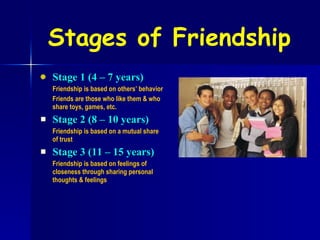
Stages of Friendship Stage 1 (4 – 7 years) Friendship is based on others’ behavior Friends are those who like them & who share toys, games, etc. Stage 2 (8 – 10 years) Friendship is based on a mutual share of trust Stage 3 (11 – 15 years) Friendship is based on feelings of closeness through sharing personal thoughts & feelings
Popularity Characteristics Social competence Collection of individual  social skills that permit  individuals to perform  successfully in social  settings Popular children are high in social competence Social problem-solving Use of strategies for  solving social conflicts in  ways that are satisfactory  both to oneself & others Better at interpreting the meaning of others’ behaviors
Gender & Race Friendships Gender Friendships Dominance hierarchy Rankings that present the relative social power of those in the  group Middle childhood friendships tend to be restricted to the same sex Boys tend to be concerned with placement in the group Girls tend to have 1 or 2 “best friends” of relatively equal status Conflicts are resolved through compromise Cross-race Friendships Closest friends tend to be of the same race There are more cross-race best friends around 3 rd  grade than 10th
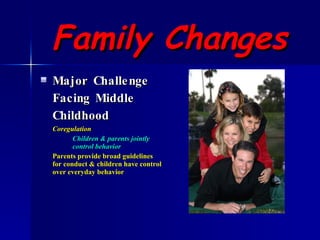
Family Changes Major Challenge Facing Middle Childhood Coregulation Children & parents jointly  control behavior Parents provide broad guidelines for conduct & children have control over everyday behavior
Family Life Siblings’ Influence Important during middle childhood Can provide support, companionship, & sense of security as well as strife Working Parents Good adjustment of children whose parents both work relates to psychological adjustment of parents, esp. mothers The more satisfaction at  work, the more  supportive of the children Home Alone Self-care child Children who let  themselves into their  homes after school &  wait until their parents  return from work There are few differences between self-care children & those whose parents are at home when they get there There are some negative  experiences but they’re  not emotionally damaged Staying at home can avoid  some problematic activities
Divorce Divorce Rate: 50% Reaction to Divorce Depends on the age at divorce From 6 months to 2 years after it can show maladjustment problems The quality of mother & child relationship declines 2X as many children of divorced parents enter psychological counseling as children from intact families
Single-Parent Families ¼ Under 18 in US Live with 1 Parent Not negative or positive The consequences depends of many factors including economics, quality time, & household stress
Remarriage Blended Families Remarried couples with at least 1 step-child living with them 17% of children live in blended families in U.S. Role ambiguity Roles & expectations  unclear Gay & Lesbian Parents Children develop similarly to heterosexual households
Orphanages “ Group Home” or “Residential Treatment Center” 300,000 removed from homes each year ¾ return home Other ¼ so psychologically damage due to abuse, etc. they are left in group care & remain there
School Success & Failure Attributions Theory Dispositional factors (I’m not so smart) or situational factor contribute (I didn’t get enough sleep) Cultural Comparisons Different experiences give different perceptions of how things should be Subcultural differences in  behaviors related to  achievement & what it is Asian performance In U.S. attribute school  performance to stable,  internal causes In Asia, it is temporary,  situational factors

Middle Childhood (Pt 3)

  • 1.
  • 2.
    Self-Development Industry v.Inferiority The focus is on competence in meeting challenges presented by parents, peers, school, etc. Understanding One’s Self One’s self-concept is divided into personal & academic areas Social Comparison Evaluating one’s behavior, abilities, expertise, & opinions by comparing them with others’
  • 3.
    Self-esteem Overall &Specific + & - Self-evaluation The self-concept reflects beliefs & thoughts about oneself; self-esteem is more emotionally oriented Self-esteem becomes more diversified at this time High in some areas, low in others Change & Stability in Self-esteem Increases during this time with a brief decline around 12 years Parenting needs to become more authoritative
  • 4.
    Race & Self-esteemRacial Differences African Americans show slightly higher self-esteem around age 11 than Whites Hispanics show increase in self-esteem toward the end of middle childhood Asian self-esteem is higher in elementary school but lower than Whites by the end of childhood Social identity theory Members of a minority group are likely to accept the negative views of the majority group only if they perceive that there is little realistic possibility of changing the power & status differences between the groups
  • 5.
    Stages of FriendshipStage 1 (4 – 7 years) Friendship is based on others’ behavior Friends are those who like them & who share toys, games, etc. Stage 2 (8 – 10 years) Friendship is based on a mutual share of trust Stage 3 (11 – 15 years) Friendship is based on feelings of closeness through sharing personal thoughts & feelings
  • 6.
    Popularity Characteristics Socialcompetence Collection of individual social skills that permit individuals to perform successfully in social settings Popular children are high in social competence Social problem-solving Use of strategies for solving social conflicts in ways that are satisfactory both to oneself & others Better at interpreting the meaning of others’ behaviors
  • 7.
    Gender & RaceFriendships Gender Friendships Dominance hierarchy Rankings that present the relative social power of those in the group Middle childhood friendships tend to be restricted to the same sex Boys tend to be concerned with placement in the group Girls tend to have 1 or 2 “best friends” of relatively equal status Conflicts are resolved through compromise Cross-race Friendships Closest friends tend to be of the same race There are more cross-race best friends around 3 rd grade than 10th
  • 8.
    Family Changes MajorChallenge Facing Middle Childhood Coregulation Children & parents jointly control behavior Parents provide broad guidelines for conduct & children have control over everyday behavior
  • 9.
    Family Life Siblings’Influence Important during middle childhood Can provide support, companionship, & sense of security as well as strife Working Parents Good adjustment of children whose parents both work relates to psychological adjustment of parents, esp. mothers The more satisfaction at work, the more supportive of the children Home Alone Self-care child Children who let themselves into their homes after school & wait until their parents return from work There are few differences between self-care children & those whose parents are at home when they get there There are some negative experiences but they’re not emotionally damaged Staying at home can avoid some problematic activities
  • 10.
    Divorce Divorce Rate:50% Reaction to Divorce Depends on the age at divorce From 6 months to 2 years after it can show maladjustment problems The quality of mother & child relationship declines 2X as many children of divorced parents enter psychological counseling as children from intact families
  • 11.
    Single-Parent Families ¼Under 18 in US Live with 1 Parent Not negative or positive The consequences depends of many factors including economics, quality time, & household stress
  • 12.
    Remarriage Blended FamiliesRemarried couples with at least 1 step-child living with them 17% of children live in blended families in U.S. Role ambiguity Roles & expectations unclear Gay & Lesbian Parents Children develop similarly to heterosexual households
  • 13.
    Orphanages “ GroupHome” or “Residential Treatment Center” 300,000 removed from homes each year ¾ return home Other ¼ so psychologically damage due to abuse, etc. they are left in group care & remain there
  • 14.
    School Success &Failure Attributions Theory Dispositional factors (I’m not so smart) or situational factor contribute (I didn’t get enough sleep) Cultural Comparisons Different experiences give different perceptions of how things should be Subcultural differences in behaviors related to achievement & what it is Asian performance In U.S. attribute school performance to stable, internal causes In Asia, it is temporary, situational factors