Chapter 9:  Death and Dying Module 9.1 Dying and Death Across the Life Span
What is death? Functional death  is defined by an absence of heartbeat and breathing. Although this definition seems unambiguous, it is not completely straightforward.  Brain death   occurs when all signs of brain activity, as measured by electrical brain waves, have ceased.  Legal definition  of death in most localities in the United States relies on the absence of brain functioning, although some laws still include a definition relating to the absence of respiration and heartbeat.  The difficulty in establishing legal and medical definitions of death may reflect some of the changes in understanding and attitudes about death that occur over the course of people’s lives.
Death across the Life Span  Infancy and childhood Miscarriage Still birth Sudden infant death Accidents Homicides Although the rate has declined since the mid-1960s, the United States ranks behind 35 other countries in the proportion of infants who die during the first year of life. During childhood, the most frequent cause of death is accidents, most of them due to motor vehicle crashes, fires, and drowning.  However, a substantial number of children in the United States are victims of homicides, which have nearly tripled in number since 1960.  By the early 1990s, death by homicide had become the fourth leading cause of death for children between the ages of 1 and 9 (Finkelhor, 1997; Centers for Disease Control, 2004).
Death in Infancy and Childhood Parent reactions: Death of a child produces the most profound sense of loss and grief. In fact, there is no worse death in the eyes of most parents, including the loss of a spouse or of one’s own parents.  Parents’ extreme reaction is partly based on the sense that the natural order of the world, in which children “should” outlive their parents, has somehow collapsed. Their reaction is often coupled with the feeling that it is their primary responsibility to protect their children from any harm, and they may feel that they have failed in this task when a child dies (Gilbert, 1997; Strength, 1999). Parents are almost never well equipped to deal with the death of a child, and they may obsessively ask themselves afterward, over and over, why the death occurred. Because the bond between children and parents is so strong, parents sometimes feel that a part of themselves has died as well.  The stress is so profound that the loss of a child significantly increases the chances of admission to a hospital for a mental disorder.
Death across the Life Span Childhood No concept of death until around the age of 5 Around the age of 5, better understanding of finality and irreversibility of death By about age 9, acceptance of universality and finality of death  By middle childhood, understanding of some customs involved with death (e.g., funerals, cremation, and cemeteries)
Death across the Life Span Adolescence View of death are often unrealistic: Sense of invincibility Personal fable Imaginary audience Terminal Illness – Common Reactions:  Denial Depression
Death across the Life Span Young Adulthood Prime time of life Death seems unthinkable Creates feelings of anger and impatience Terminal Illness Concerns Desire to develop intimate relationships and express sexuality  Future planning
Death across the Life Span Middle Adulthood Life-threatening disease not surprising Fear of death often greatest at this age Most Frequent Causes Heart attack or stroke
Death across the Life Span Late adulthood Realize death is imminent Face an increasing number of deaths in their environment  Less anxious about dying  Causes Cancer, stroke, and heart disease Terminal death Terminal decline,  a significant drop in performance in cognitive areas such as memory and reading may foreshadow death within the next few years.
Suicide in Later Life Rate for men climbs steadily during late adulthood No age group has a higher rate of suicide than white men over the age of 85 Severe depression Some form of dementia Loss of a spouse
Differing Conceptions of Death Reactions to death are diverse Dependent on practices and values of culture and subculture Some societies view death as a punishment or as a judgment about one’s contributions to the world. Others see death as redemption from an earthly life of travail. Some view death as the start of an eternal life, while others believe that there is no heaven or hell and that an earthly life is all there is. Christian and Jewish 10-year-olds tended to view death from a more “scientific” vantage point (in terms of the cessation of physical activity in the body) than Sunni Moslem and Druze children of the same age, who are more likely to see death in spiritual terms. For members of Native American tribes, death is seen as a continuation of life.
Death Education Thanatologists ,  people who study death and dying, have suggested that death education should be an important component of everyone’s schooling. Death education  encompasses programs that teach about death, dying, and grief Crisis intervention education   Routine death education   Education for members of the helping professions
Chapter 9:  Death and Dying Module 9.2 Confronting Death
Are there steps toward death? Kübler-Ross  Developed a theory of death and dying Built on extensive interviews with people who were dying With input from those who cared for them
Kübler-Ross Theory
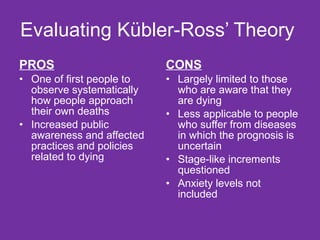
Evaluating Kübler-Ross’ Theory  PROS One of first people to observe systematically how people approach their own deaths  Increased public awareness and affected practices and policies related to dying CONS Largely limited to those who are aware that they are dying  Less applicable to people who suffer from diseases in which the prognosis is uncertain Stage-like increments questioned Anxiety levels not included
Other Theorists Edwin Shneidman  “ Themes” in people’s reactions to dying that occur—and recur—in any order throughout the dying process Themes include such feelings and thoughts as incredulity, a sense of unfairness, fear of pain or even general terror, and fantasies of being rescued (Leenaars & Shneidman, 1999). Charles Corr  People who are dying face a set of psychological tasks Tasks include minimizing physical stress, maintaining the richness of life, continuing or deepening their relationships with other people, and fostering hope, often through spiritual searching.
Choosing the Nature of Death DNR:  DNR signifies that rather than administering any and every procedure that might possibly keep a patient alive, no extraordinary means are to be taken.  Issues: Differentiates of “extreme” and “extraordinary” measures from those that are simply routine Determines of individual’s current quality of life and whether it will be improved or diminished by a particular medical intervention Determines of decision-maker role
Doctors and Decisions Medical personnel are reluctant to suspend aggressive treatment.  Physicians often claim to be unaware of patients’ wishes  Physicians and other health care providers may be reluctant to act on DNR requests  Trained to save patients To avoid legal liability issues
Living Wills Living will:  legal document that designates the medical treatments a person does or does not want if the person cannot express his or her wishes. Some people designate a specific person, called a  health  care proxy, to act as their representative in making health care decisions. Health care proxies are authorized either in living wills or in a legal document known as  durable power of attorney.
Euthanasia and Assisted Suicide  Assisted suicide,  in which a person provides the means for a terminally ill individual to commit suicide. Euthanasia:  the practice of assisting terminally ill people to die more quickly. Popularly known as “mercy killing,” euthanasia can take a range of forms. Passive euthanasia  involves removing respirators or other medical equipment that may be sustaining a patient’s life, to allow them to die naturally. This happens when medical staff follow a DNR order, for example.  In  voluntary active euthanasia  caregivers or medical staff act to end a person’s life before death would normally occur, perhaps by administering a dose of pain medication that they know will be fatal. Assisted suicide, as we have seen, lies between passive and voluntary active euthanasia.
Euthanasia and Assisted Suicide  SUPPORT: the Study to Understand Prognoses and Preferences for Outcomes and Risks of Treatment—found that patients often outlive physicians’ predictions of when they will die. In fact, in some cases, patients have lived for years after being given no more than a 50 percent chance of living for 6 more months. Even if patients ask or sometimes beg health care providers to help them die, they may be suffering from a form of deep depression. PROS Does the right belong solely to an individual, a person’s physicians, his or her dependents, the government, or some deity?  In the United States, it is assumed that all have the absolute right to create lives by bringing children into the world, some people argue that we should also have the absolute right to end our lives. CONS Practice is morally wrong.  Prematurely ending someone’s life, no matter how willing that person may be, is the equivalent of murder.  Physicians are often inaccurate in predicting how long a person’s life will last. Emotional state of the patient may be unstable.
Caring for the Terminally Ill Place of Death: In  home care ,  dying people stay in their homes and receive treatment from their families and visiting medical staff. Many dying patients prefer home care, because they can spend their final days in a familiar environment, with people they love and a lifetime accumulation of treasures around them.  Hospice care  is care for the dying provided in institutions devoted to those who are terminally ill; hospices are designed to provide a warm, supportive environment for the dying. They do not focus on extending people’s lives, but rather on making their final days pleasant and meaningful.  Hospital care
Chapter 9: Death and Dying Module 9.3 Grief and Bereavement
Mourning and Funerals Costs Average funeral and burial costs $7,000 Funeral is not only a public acknowledgment that an individual has died, but recognition of everyone’s ultimate mortality and an acceptance of the cycle of life. Survivors are susceptible to suggestions to “provide the best” for deceased  Determined by social norms and customs
Cultural Differences in Grieving Western societal rituals (some variations) Prior to the funeral, body is prepared and dressed in special clothing. Celebration of a religious rite, the delivery of a eulogy, a procession of some sort, and some formal period, which relatives and friends visit the mourning family and pay their respects.  Military funerals typically include the firing of weapons and a flag draped over the coffin.
Cultural Differences in Grieving Non-western rituals: Examples: Shave heads, let hair and beard grow Noisy celebration and silence High emotional display of emotion and no display of emotion
Funerals Feldman concludes that all funerals basically serve the same underlying function.  They serve as a way to mark the endpoint for the life of the person who has died—and provide a formal forum for the feelings of the survivors, a place where they can come together and share their grief and comfort one another.
Bereavement and Grief Bereavement  is acknowledgment of the objective fact that one has experienced a death, while  grief  is the emotional response to one’s loss.
Grieving in the Western World 1 st  stage : grief typically entails shock, numbness, disbelief, or outright denial 2 nd  stage : people begin to confront the death and realize extent of their loss 3 rd  stage : people reach accommodation stage Ultimately, most people are able to emerge from the grieving process and live new lives, independent from the person who has died. They form new relationships, and some even find that coping with the death has helped them to grow as individuals. They become more self-reliant and more appreciative of life.
Death of Long-term Spouse Strength of relationship with spouse can have effect on grieving process Almost always traumatic experience that is usually followed by intense grief and anguish
Death of a Long-term Spouse Almost half of those who reported having satisfying marriages were able to get past their grief within six months of the death of their spouses  People who enjoy close and happy marriages tend to have strong interpersonal skills on which to rely during their time of loss. They may be better equipped to call upon friends, family, and even a professional counselor if necessary to assist them through their grieving period.  Surviving partners of strained marriages might feel more sadness over never having achieved a desired level of closeness, or they might regret not having an opportunity to resolve lingering conflicts, or they might feel guilty about not working harder to make their marriage better when they had the chance.  Surviving spouses who enjoyed a close marriage are more likely to have settled lingering issues and to have talked through what would happen after either of them died; they therefore are more likely to feel secure in knowing what their departed would have wanted for them in widowhood. Finally, spouses who have a close and secure relationship may simply have a better opportunity to say their final goodbyes as one of the partners’ heath fails.
When Grief Goes Awry No particular timetable for grieving For some people (but not all) grieving may take considerably longer than a year Only 15 to 30 percent of people show relatively deep depression following loss of loved one Those who show most intense distress immediately after a death are most apt to have adjustment difficulties and health problems later on
Consequences of Grief and Bereavement  Negative Widowed people are particularly at risk of death  More negative consequences if person is already insecure, anxious, or fearful, overly dependent, or lacking in social support Positive Remarriage lowers risk of death for survivors, especially for widowers
Helping a Child Cope with Grief   Be honest  Encourage expressions of grief Reassure children that they are not to blame for the death  Understand that children’s grief may surface in unanticipated ways Children may respond to books for young persons about death

Lifespan psychology chapter 9 - 2010

  • 1.
    Chapter 9: Death and Dying Module 9.1 Dying and Death Across the Life Span
  • 2.
    What is death?Functional death is defined by an absence of heartbeat and breathing. Although this definition seems unambiguous, it is not completely straightforward. Brain death occurs when all signs of brain activity, as measured by electrical brain waves, have ceased. Legal definition of death in most localities in the United States relies on the absence of brain functioning, although some laws still include a definition relating to the absence of respiration and heartbeat. The difficulty in establishing legal and medical definitions of death may reflect some of the changes in understanding and attitudes about death that occur over the course of people’s lives.
  • 3.
    Death across theLife Span Infancy and childhood Miscarriage Still birth Sudden infant death Accidents Homicides Although the rate has declined since the mid-1960s, the United States ranks behind 35 other countries in the proportion of infants who die during the first year of life. During childhood, the most frequent cause of death is accidents, most of them due to motor vehicle crashes, fires, and drowning. However, a substantial number of children in the United States are victims of homicides, which have nearly tripled in number since 1960. By the early 1990s, death by homicide had become the fourth leading cause of death for children between the ages of 1 and 9 (Finkelhor, 1997; Centers for Disease Control, 2004).
  • 4.
    Death in Infancyand Childhood Parent reactions: Death of a child produces the most profound sense of loss and grief. In fact, there is no worse death in the eyes of most parents, including the loss of a spouse or of one’s own parents. Parents’ extreme reaction is partly based on the sense that the natural order of the world, in which children “should” outlive their parents, has somehow collapsed. Their reaction is often coupled with the feeling that it is their primary responsibility to protect their children from any harm, and they may feel that they have failed in this task when a child dies (Gilbert, 1997; Strength, 1999). Parents are almost never well equipped to deal with the death of a child, and they may obsessively ask themselves afterward, over and over, why the death occurred. Because the bond between children and parents is so strong, parents sometimes feel that a part of themselves has died as well. The stress is so profound that the loss of a child significantly increases the chances of admission to a hospital for a mental disorder.
  • 5.
    Death across theLife Span Childhood No concept of death until around the age of 5 Around the age of 5, better understanding of finality and irreversibility of death By about age 9, acceptance of universality and finality of death By middle childhood, understanding of some customs involved with death (e.g., funerals, cremation, and cemeteries)
  • 6.
    Death across theLife Span Adolescence View of death are often unrealistic: Sense of invincibility Personal fable Imaginary audience Terminal Illness – Common Reactions: Denial Depression
  • 7.
    Death across theLife Span Young Adulthood Prime time of life Death seems unthinkable Creates feelings of anger and impatience Terminal Illness Concerns Desire to develop intimate relationships and express sexuality Future planning
  • 8.
    Death across theLife Span Middle Adulthood Life-threatening disease not surprising Fear of death often greatest at this age Most Frequent Causes Heart attack or stroke
  • 9.
    Death across theLife Span Late adulthood Realize death is imminent Face an increasing number of deaths in their environment Less anxious about dying Causes Cancer, stroke, and heart disease Terminal death Terminal decline, a significant drop in performance in cognitive areas such as memory and reading may foreshadow death within the next few years.
  • 10.
    Suicide in LaterLife Rate for men climbs steadily during late adulthood No age group has a higher rate of suicide than white men over the age of 85 Severe depression Some form of dementia Loss of a spouse
  • 11.
    Differing Conceptions ofDeath Reactions to death are diverse Dependent on practices and values of culture and subculture Some societies view death as a punishment or as a judgment about one’s contributions to the world. Others see death as redemption from an earthly life of travail. Some view death as the start of an eternal life, while others believe that there is no heaven or hell and that an earthly life is all there is. Christian and Jewish 10-year-olds tended to view death from a more “scientific” vantage point (in terms of the cessation of physical activity in the body) than Sunni Moslem and Druze children of the same age, who are more likely to see death in spiritual terms. For members of Native American tribes, death is seen as a continuation of life.
  • 12.
    Death Education Thanatologists, people who study death and dying, have suggested that death education should be an important component of everyone’s schooling. Death education encompasses programs that teach about death, dying, and grief Crisis intervention education Routine death education Education for members of the helping professions
  • 13.
    Chapter 9: Death and Dying Module 9.2 Confronting Death
  • 14.
    Are there stepstoward death? Kübler-Ross Developed a theory of death and dying Built on extensive interviews with people who were dying With input from those who cared for them
  • 15.
  • 16.
    Evaluating Kübler-Ross’ Theory PROS One of first people to observe systematically how people approach their own deaths Increased public awareness and affected practices and policies related to dying CONS Largely limited to those who are aware that they are dying Less applicable to people who suffer from diseases in which the prognosis is uncertain Stage-like increments questioned Anxiety levels not included
  • 17.
    Other Theorists EdwinShneidman “ Themes” in people’s reactions to dying that occur—and recur—in any order throughout the dying process Themes include such feelings and thoughts as incredulity, a sense of unfairness, fear of pain or even general terror, and fantasies of being rescued (Leenaars & Shneidman, 1999). Charles Corr People who are dying face a set of psychological tasks Tasks include minimizing physical stress, maintaining the richness of life, continuing or deepening their relationships with other people, and fostering hope, often through spiritual searching.
  • 18.
    Choosing the Natureof Death DNR: DNR signifies that rather than administering any and every procedure that might possibly keep a patient alive, no extraordinary means are to be taken. Issues: Differentiates of “extreme” and “extraordinary” measures from those that are simply routine Determines of individual’s current quality of life and whether it will be improved or diminished by a particular medical intervention Determines of decision-maker role
  • 19.
    Doctors and DecisionsMedical personnel are reluctant to suspend aggressive treatment. Physicians often claim to be unaware of patients’ wishes Physicians and other health care providers may be reluctant to act on DNR requests Trained to save patients To avoid legal liability issues
  • 20.
    Living Wills Livingwill: legal document that designates the medical treatments a person does or does not want if the person cannot express his or her wishes. Some people designate a specific person, called a health care proxy, to act as their representative in making health care decisions. Health care proxies are authorized either in living wills or in a legal document known as durable power of attorney.
  • 21.
    Euthanasia and AssistedSuicide Assisted suicide, in which a person provides the means for a terminally ill individual to commit suicide. Euthanasia: the practice of assisting terminally ill people to die more quickly. Popularly known as “mercy killing,” euthanasia can take a range of forms. Passive euthanasia involves removing respirators or other medical equipment that may be sustaining a patient’s life, to allow them to die naturally. This happens when medical staff follow a DNR order, for example. In voluntary active euthanasia caregivers or medical staff act to end a person’s life before death would normally occur, perhaps by administering a dose of pain medication that they know will be fatal. Assisted suicide, as we have seen, lies between passive and voluntary active euthanasia.
  • 22.
    Euthanasia and AssistedSuicide SUPPORT: the Study to Understand Prognoses and Preferences for Outcomes and Risks of Treatment—found that patients often outlive physicians’ predictions of when they will die. In fact, in some cases, patients have lived for years after being given no more than a 50 percent chance of living for 6 more months. Even if patients ask or sometimes beg health care providers to help them die, they may be suffering from a form of deep depression. PROS Does the right belong solely to an individual, a person’s physicians, his or her dependents, the government, or some deity? In the United States, it is assumed that all have the absolute right to create lives by bringing children into the world, some people argue that we should also have the absolute right to end our lives. CONS Practice is morally wrong. Prematurely ending someone’s life, no matter how willing that person may be, is the equivalent of murder. Physicians are often inaccurate in predicting how long a person’s life will last. Emotional state of the patient may be unstable.
  • 23.
    Caring for theTerminally Ill Place of Death: In home care , dying people stay in their homes and receive treatment from their families and visiting medical staff. Many dying patients prefer home care, because they can spend their final days in a familiar environment, with people they love and a lifetime accumulation of treasures around them. Hospice care is care for the dying provided in institutions devoted to those who are terminally ill; hospices are designed to provide a warm, supportive environment for the dying. They do not focus on extending people’s lives, but rather on making their final days pleasant and meaningful. Hospital care
  • 24.
    Chapter 9: Deathand Dying Module 9.3 Grief and Bereavement
  • 25.
    Mourning and FuneralsCosts Average funeral and burial costs $7,000 Funeral is not only a public acknowledgment that an individual has died, but recognition of everyone’s ultimate mortality and an acceptance of the cycle of life. Survivors are susceptible to suggestions to “provide the best” for deceased Determined by social norms and customs
  • 26.
    Cultural Differences inGrieving Western societal rituals (some variations) Prior to the funeral, body is prepared and dressed in special clothing. Celebration of a religious rite, the delivery of a eulogy, a procession of some sort, and some formal period, which relatives and friends visit the mourning family and pay their respects. Military funerals typically include the firing of weapons and a flag draped over the coffin.
  • 27.
    Cultural Differences inGrieving Non-western rituals: Examples: Shave heads, let hair and beard grow Noisy celebration and silence High emotional display of emotion and no display of emotion
  • 28.
    Funerals Feldman concludesthat all funerals basically serve the same underlying function. They serve as a way to mark the endpoint for the life of the person who has died—and provide a formal forum for the feelings of the survivors, a place where they can come together and share their grief and comfort one another.
  • 29.
    Bereavement and GriefBereavement is acknowledgment of the objective fact that one has experienced a death, while grief is the emotional response to one’s loss.
  • 30.
    Grieving in theWestern World 1 st stage : grief typically entails shock, numbness, disbelief, or outright denial 2 nd stage : people begin to confront the death and realize extent of their loss 3 rd stage : people reach accommodation stage Ultimately, most people are able to emerge from the grieving process and live new lives, independent from the person who has died. They form new relationships, and some even find that coping with the death has helped them to grow as individuals. They become more self-reliant and more appreciative of life.
  • 31.
    Death of Long-termSpouse Strength of relationship with spouse can have effect on grieving process Almost always traumatic experience that is usually followed by intense grief and anguish
  • 32.
    Death of aLong-term Spouse Almost half of those who reported having satisfying marriages were able to get past their grief within six months of the death of their spouses People who enjoy close and happy marriages tend to have strong interpersonal skills on which to rely during their time of loss. They may be better equipped to call upon friends, family, and even a professional counselor if necessary to assist them through their grieving period. Surviving partners of strained marriages might feel more sadness over never having achieved a desired level of closeness, or they might regret not having an opportunity to resolve lingering conflicts, or they might feel guilty about not working harder to make their marriage better when they had the chance. Surviving spouses who enjoyed a close marriage are more likely to have settled lingering issues and to have talked through what would happen after either of them died; they therefore are more likely to feel secure in knowing what their departed would have wanted for them in widowhood. Finally, spouses who have a close and secure relationship may simply have a better opportunity to say their final goodbyes as one of the partners’ heath fails.
  • 33.
    When Grief GoesAwry No particular timetable for grieving For some people (but not all) grieving may take considerably longer than a year Only 15 to 30 percent of people show relatively deep depression following loss of loved one Those who show most intense distress immediately after a death are most apt to have adjustment difficulties and health problems later on
  • 34.
    Consequences of Griefand Bereavement Negative Widowed people are particularly at risk of death More negative consequences if person is already insecure, anxious, or fearful, overly dependent, or lacking in social support Positive Remarriage lowers risk of death for survivors, especially for widowers
  • 35.
    Helping a ChildCope with Grief Be honest Encourage expressions of grief Reassure children that they are not to blame for the death Understand that children’s grief may surface in unanticipated ways Children may respond to books for young persons about death

Editor's Notes