Chapter 5:  Adolescence Module 5.2  Cognitive Development in Adolescence
Cognitive Development Approaches Piaget Information processing  Adolescent egocentrism
Piagetian Perspective Fixed sequence of qualitatively different stages Fundamentally different than child thinking Utilized in variety of settings and situations Incorporates new, more advanced, and more adaptive form of reasoning Occurs when biological readiness and increasingly complex environmental demands create cognitive disequilibrium
Piagetian Stages Related to Adolescence Concrete operations 6-11 years Mastery of logic Development of rational thinking Formal operations 11+ years  Development of abstract and hypothetical reasoning Development of propositional logic
Piaget – Videos Summary demonstrations of all stages : http://www.youtube.com/watch?v=9yhXjJVFA14 Formal Operations: http://www.youtube.com/watch?v=zjJdcXA1KH8
Developmental of Formal Operations Emergent Early adolescence Variable usage depends on conditions surrounding assessment Established Late adolescence Consolidated and integrated into general approach to reasoning
Information Processing View Study of cognitive development in component processes Incorporates same techniques to understanding human reasoning that computer scientists employ in writing programs
Changes in Information Processing Gains during adolescence help to explain developmental differences in abstract, multidimensional, and hypothetical thinking
Changes Include five basic areas: Attention Memory Information processing speed Organizational strategies Metacognition
Thinking about Thinking… Metacognition improves during adolescence Thinks about own thoughts   self-consciousness Monitors own learning processes more efficiently Paces own studying
Adolescent Egocentrism Imaginary audience Belief that one is center of everyone else's concern and attention What is an imaginary audience?  Can you think of a time during your adolescence when you or your friends/school peers demonstrated this?  What purpose does the Imaginary Audience serve in adolescent development?  How do you know? Personal fables Egocentric belief that one’s experiences are unique
Imaginary Audience and Personal Fable videos http://www.youtube.com/watch?v=Mn37ns89j3w http://www.youtube.com/watch?v=r_DYRAIgbcc
School and Adolescence The mean grade point average for college-bound seniors was 3.3 (out of a scale of 4), compared with 3.1 a decade ago. More than 40 percent of seniors reported average grades of A+, A, or A- (College Board, 2005). Independent measures of achievement, such as SAT scores, have not risen. Consequently, a more likely explanation for the higher grades is the phenomenon of grade inflation. According to this view, it is not that students have changed. Instead, instructors have become more lenient awarding higher grades for the same performance. What consequences does this have (potentially) for college-bound students?
Socioeconomic Status and School Performance Children living in poverty lack many advantages: Their nutrition and health may be less adequate. Often living in crowded conditions and attending inadequate schools, they may have few places to do homework.  Their homes may lack the books and computers commonplace in more economically advantaged households. Later school success builds heavily on basic skills presumably learned or not learned early in school
Ethnic and Racial Differences in School Achievement Significant achievement differences between ethnic and racial groups On average, African American and Hispanic students tend to perform at lower levels, receive lower grades, and score lower on standardized tests of achievement than Caucasian students  Asian American students tend to receive higher grades than Caucasian students
What is the source of such ethnic and racial differences in academic achievement?  Much of the difference is due to socioeconomic factors. More African American and Hispanic families live in poverty so their economic disadvantage may be reflected in their school performance. Members of certain minority groups may perceive school success as relatively unimportant: may believe that societal prejudice in workplace will dictate that they will not succeed, no matter how much effort they expend. Process of involuntary immigration apparently leaves lasting scars, reducing the motivation to succeed in subsequent generations.
Drop Out Risk Most students complete high school, but some half million students each year drop out prior to graduating. The consequences of dropping out are severe. High school dropouts earn 42 percent less than high school graduates, and the unemployment rate for dropouts is 50 percent. Adolescents who leave school do so for a variety of reasons. Some leave because of pregnancy or problems with the English language. Some must leave for economic reasons, needing to support themselves or their families. Dropout rates differ according to gender and ethnicity. Poverty plays a large role in determining whether a student completes high school. Students from lower-income households are three times more likely to drop out than middle- and upper-income households. Because economic success is so dependent on education, dropping out often perpetuates a cycle of poverty.
Adolescents Online  See: Adolescents in Cyberspace: Exploring a New Social Universe: http://www.selfhelpmagazine.com/articles/teens/adolescents.html Widespread availability of Internet and World Wide Web is producing significant changes in lives of many adolescents. Educational promise of Internet is significant. It is not yet obvious how this will change education or whether impact will be uniformly positive.  To obtain the full benefits of Internet, then, students must obtain ability to search, choose, and integrate information to create new knowledge.
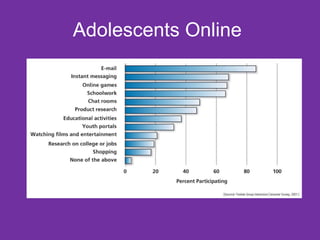
Adolescents Online
Adolescents Online Potential Problems: Objectionable material available Growing problem of Internet gambling  Safety Digital divide: Poorer adolescents and members of minority groups have less access to computers than more affluent adolescents and members of socially-advantaged groups.

Lifespan psychology lecture - 5.2

  • 1.
    Chapter 5: Adolescence Module 5.2 Cognitive Development in Adolescence
  • 2.
    Cognitive Development ApproachesPiaget Information processing Adolescent egocentrism
  • 3.
    Piagetian Perspective Fixedsequence of qualitatively different stages Fundamentally different than child thinking Utilized in variety of settings and situations Incorporates new, more advanced, and more adaptive form of reasoning Occurs when biological readiness and increasingly complex environmental demands create cognitive disequilibrium
  • 4.
    Piagetian Stages Relatedto Adolescence Concrete operations 6-11 years Mastery of logic Development of rational thinking Formal operations 11+ years Development of abstract and hypothetical reasoning Development of propositional logic
  • 5.
    Piaget – VideosSummary demonstrations of all stages : http://www.youtube.com/watch?v=9yhXjJVFA14 Formal Operations: http://www.youtube.com/watch?v=zjJdcXA1KH8
  • 6.
    Developmental of FormalOperations Emergent Early adolescence Variable usage depends on conditions surrounding assessment Established Late adolescence Consolidated and integrated into general approach to reasoning
  • 7.
    Information Processing ViewStudy of cognitive development in component processes Incorporates same techniques to understanding human reasoning that computer scientists employ in writing programs
  • 8.
    Changes in InformationProcessing Gains during adolescence help to explain developmental differences in abstract, multidimensional, and hypothetical thinking
  • 9.
    Changes Include fivebasic areas: Attention Memory Information processing speed Organizational strategies Metacognition
  • 10.
    Thinking about Thinking…Metacognition improves during adolescence Thinks about own thoughts  self-consciousness Monitors own learning processes more efficiently Paces own studying
  • 11.
    Adolescent Egocentrism Imaginaryaudience Belief that one is center of everyone else's concern and attention What is an imaginary audience? Can you think of a time during your adolescence when you or your friends/school peers demonstrated this? What purpose does the Imaginary Audience serve in adolescent development? How do you know? Personal fables Egocentric belief that one’s experiences are unique
  • 12.
    Imaginary Audience andPersonal Fable videos http://www.youtube.com/watch?v=Mn37ns89j3w http://www.youtube.com/watch?v=r_DYRAIgbcc
  • 13.
    School and AdolescenceThe mean grade point average for college-bound seniors was 3.3 (out of a scale of 4), compared with 3.1 a decade ago. More than 40 percent of seniors reported average grades of A+, A, or A- (College Board, 2005). Independent measures of achievement, such as SAT scores, have not risen. Consequently, a more likely explanation for the higher grades is the phenomenon of grade inflation. According to this view, it is not that students have changed. Instead, instructors have become more lenient awarding higher grades for the same performance. What consequences does this have (potentially) for college-bound students?
  • 14.
    Socioeconomic Status andSchool Performance Children living in poverty lack many advantages: Their nutrition and health may be less adequate. Often living in crowded conditions and attending inadequate schools, they may have few places to do homework. Their homes may lack the books and computers commonplace in more economically advantaged households. Later school success builds heavily on basic skills presumably learned or not learned early in school
  • 15.
    Ethnic and RacialDifferences in School Achievement Significant achievement differences between ethnic and racial groups On average, African American and Hispanic students tend to perform at lower levels, receive lower grades, and score lower on standardized tests of achievement than Caucasian students Asian American students tend to receive higher grades than Caucasian students
  • 16.
    What is thesource of such ethnic and racial differences in academic achievement? Much of the difference is due to socioeconomic factors. More African American and Hispanic families live in poverty so their economic disadvantage may be reflected in their school performance. Members of certain minority groups may perceive school success as relatively unimportant: may believe that societal prejudice in workplace will dictate that they will not succeed, no matter how much effort they expend. Process of involuntary immigration apparently leaves lasting scars, reducing the motivation to succeed in subsequent generations.
  • 17.
    Drop Out RiskMost students complete high school, but some half million students each year drop out prior to graduating. The consequences of dropping out are severe. High school dropouts earn 42 percent less than high school graduates, and the unemployment rate for dropouts is 50 percent. Adolescents who leave school do so for a variety of reasons. Some leave because of pregnancy or problems with the English language. Some must leave for economic reasons, needing to support themselves or their families. Dropout rates differ according to gender and ethnicity. Poverty plays a large role in determining whether a student completes high school. Students from lower-income households are three times more likely to drop out than middle- and upper-income households. Because economic success is so dependent on education, dropping out often perpetuates a cycle of poverty.
  • 18.
    Adolescents Online See: Adolescents in Cyberspace: Exploring a New Social Universe: http://www.selfhelpmagazine.com/articles/teens/adolescents.html Widespread availability of Internet and World Wide Web is producing significant changes in lives of many adolescents. Educational promise of Internet is significant. It is not yet obvious how this will change education or whether impact will be uniformly positive. To obtain the full benefits of Internet, then, students must obtain ability to search, choose, and integrate information to create new knowledge.
  • 19.
  • 20.
    Adolescents Online PotentialProblems: Objectionable material available Growing problem of Internet gambling Safety Digital divide: Poorer adolescents and members of minority groups have less access to computers than more affluent adolescents and members of socially-advantaged groups.