Chapter 5:  Adolescence Module 5.3  Social and Personality Development in Adolescence
Identity: Asking "Who Am I?"  During adolescence, self consciousness takes center stage: Teens focus on wondering “Who am I?” and “Where do I belong in the world?” WHY? Teens begin to become more like adults intellectually.  Realize the importance of establishing self in society, and shaping their individuality. Teens become more like adults physically. Dramatic changes during puberty make teens acutely aware of their own bodies. This broader view of themselves is one aspect of adolescents’ increasing understanding of who they are. They can see various aspects of the self simultaneously, and this view of the self becomes more organized and coherent. They look at the self from a psychological perspective, viewing traits not as concrete entities but as abstractions.
Self Concept: What Am I Like? View broadens:  One's own assessment of who they are  Others' views More organized and coherent: View self in terms of traits and multiple aspects – can be very confusing at first!
Self-esteem: How Do I Like Myself? Increasingly accurate in understanding self Gender - especially in early adolescence, girls have lower self-esteem. SES - - higher SES leads to more self-esteem (especially in late adolescence when one can buy things of value). The increase in self-concept does not mean that they like themselves any better ( self esteem  may still be low). The same cognitive sophistication that allows adolescents to differentiate various aspects of the self also leads them to evaluate those aspects in different ways (Chan, 1997; Cohen, J., 1999). For instance, an adolescent may have high self-esteem in terms of academic performance, but lower self-esteem in terms of relationships with others. Or it may be just the opposite.
Influences on Self-Esteem Traditional research Prejudice is incorporated into minority adolescents' self-concepts Recent research African-American adolescents have same levels of self-esteem as Caucasians One explanation is that social movements within African American community that bolster racial pride help support African American adolescents. In fact, research finds that a stronger sense of racial identity is related to higher level of self-esteem in African Americans and Hispanics.
“ Ethgender” Joint influence of race and gender (“ethgender”) Findings indicate that:  African-American and Hispanic males had highest self-esteem Asian and Native American females had lowest levels
Erikson: Identity vs. Identity Confusion Identity: Awareness of uniqueness of self; knowledge of roles  Identity Confusion: Inability to identity appropriate roles in life Can take 10 years or more! (Some people have trouble ever establishing identity) We modify our  identity constantly through out our lives
Erikson: Identity vs. Identity Confusion Erik Erikson asserted that adolescents may encounter substantial psychological difficulties in their search for identity (“the adolescent identity crisis”). Those who do not find a suitable identity, tend to follow a dysfunctional path because their sense of self is "diffuse".  There are a lot of social pressures to achieve a secure identity (or at least have clear career or major goals):  Which job track to follow? Attend college? Which one? Now, adolescents rely more on friends and peers than adults.
Erikson: Identity vs. Identity Confusion Erikson suggests that adolescents pursue a  psychological moratorium  to let go of responsibilities for awhile and explore new roles and possibilities.  For many, this experimentation period is an economic impossibility.  Probably no lasting, negative psychological affects. Some benefits (satisfaction from working, independence, etc.).
Video about Identity Formation http://www.youtube.com/watch?v=wJMXk5ibkQk
Erikson: Identity vs. Identity Confusion Societal pressures high during identity versus identity confusion stage Reliance on peers to help adolescents define their identities and learn to form relationships is the link between this stage of psychosocial development and the next stage Erikson proposed, known as intimacy versus isolation. Males are more likely to proceed through the social development stages in the order, developing stable identity before committing to an intimate relationship with another person. Females reverse order, seeking intimate relationships and then defining their identities through these relationships.
Limitations of Erikson’s Theory  Erikson saw males as developing intimacy only after they have achieved a stable identity, which is viewed as the normative pattern. To critics, Erikson’s view is based on male-oriented concepts of individuality and competitiveness. Carol Gilligan has suggested that women develop identity through the establishment of relationships. In this view, a key component of a woman’s identity is the building of caring networks between herself and others
Marcia’s Approach to Identity Development James Marcia suggests four categories within which either:  A crisis  (a period of identity development in which an adolescent consciously chooses between various alternatives and makes decisions) or  A commitment  (a psychological investment in a course of action or an ideology), takes place. 1) IDENTITY ACHIEVEMENT IDENTITY FORECLOSURE 3) IDENTITY DIFFUSION 4) MORATORIUM
Marcia’s Approach to Identity Development IDENTITY ACHIEVEMENT  - where adolescents consider and explore various alternatives without commitment.
Marcia’s Approach to Identity Developme nt IDENTITY FORECLOSURE  - adolescents here did not do adequate personal exploration but made a commitment (usually following others' directives).
Marcia’s Approach to Identity Development IDENTITY DIFFUSION  -  adolescents explore various options but never commit to one
Marcia’s Approach to Identity Development MORATORIUM  -  adolescents explore and do not commit to an option and that creates anxiety and conflict. An identity is usually defined later, after a struggle.
Identity, Race and Ethnicity Forming an identity presents a particular challenge for members of ethnic and racial backgrounds because of contradictory societal values. Cultural assimilation model  holds that individual cultural identities should be assimilated into a unified culture (“melting pot model”).   Society should be color blind, race and ethnic background should not affect opportunity or achievement. Pluralistic society model  suggests that the U.S. society is made up of diverse, coequal cultural groups that should preserve their individual cultural features ( “ tossed salad model ” ).  Research suggests that the cultural assimilation model denigrates the cultural heritage of minorities and lowers self esteem. Racial and ethnic factors should be a central part of teenagers ’  identities. Bicultural identity  suggests that adolescents can draw from their own culture and integrate themselves into the dominant culture (“the middle ground model”). Suggests that the teen live as a member of two cultures, and have two cultural identities without having to choose one.
Psychological Difficulties in Adolescence  Depression and Suicide: More than one-quarter of adolescents report periods of feeling sad and hopeless for two or more weeks in a row. But only a small number (3 percent) experience a  major depression,  a full-blown psychological disorder in which depression is severe and lingers for long periods.
Psychological Difficulties in Adolescence  Depression has several causes, including biological, environmental, and social factors.  Genetic predisposition Death of loved one Depressed parent Unpopular Few close friends Experiencing rejection Girls have higher incidences of depression than boys but the cause is not clear.  Are there more stresses on the female gender role?  Is this the results of girls' tendencies to react to stress by turning inward, thus experiencing helplessness and hopelessness?  Little evidence that hormones are a factor. African-Americans and Native Americans also have higher depression rates (same suspected reasons as for girls).
Adolescent Suicide Adolescent suicide rates have tripled in the last 30 years - it is the 3rd most common cause of death for teenagers.  The current rate is one teenage suicide every 90 minutes.  More girls attempt suicide than boys but more boys succeed.  Males tend to use more violent methods.  There are estimates of as many as 200  attempts  for every successful suicide.
Adolescent Suicide Other factors in adolescent suicide:  Depression  Family conflicts  History of abuse and/or neglect  Drug and alcohol abuse
What contributes most to the increased suicide rate among US adolescents today? The most obvious explanation is that the stress experienced by teenagers has increased, leading those who are most vulnerable to be more likely to commit suicide Increase in depression. Depressed teenagers who are experiencing a profound sense of hopelessness are at greater risk of committing suicide. Social inhibition, perfectionism, and a high level of stress and anxiety are related to a greater risk of suicide. Easy availability of guns—which are more prevalent in the U.S. than in other industrialized nations—also contributes to the suicide rate Some cases of suicide are associated with family conflicts and relationship or school difficulties. Some stem from a history of abuse and neglect. Rate of suicide among drug and alcohol abusers is also relatively high.
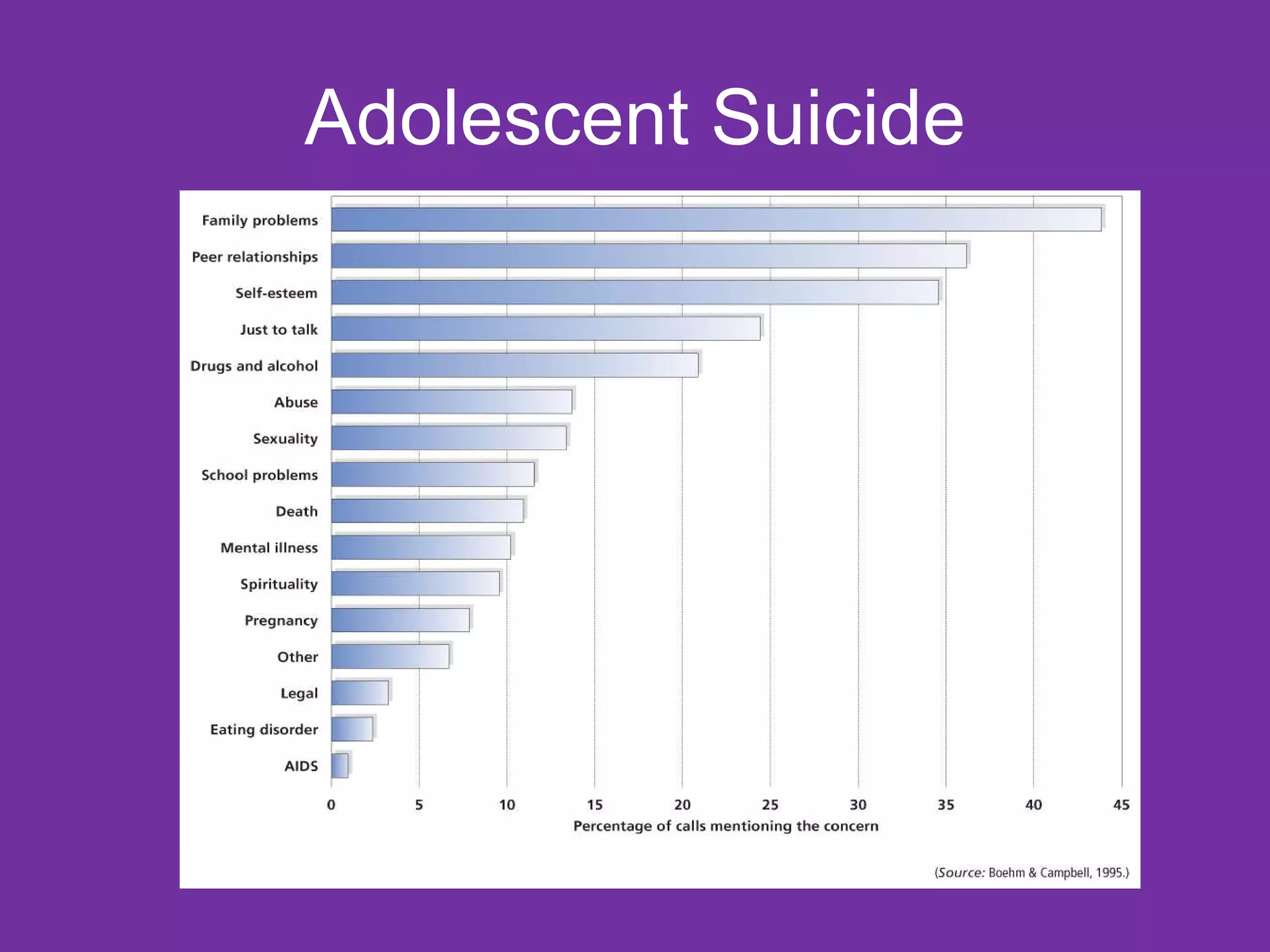
Adolescent Suicide
Warning Signs of Suicide Attempt  Direct or indirect talk  I wish I were dead.” “ Don’t worry, I’ll be out of your hair soon.” School difficulties Missed classes, drop in grades Writing a will Changes in eating habits General depression Sleep habits, lack of energy, uncommunicative Dramatic behavior changes Preoccupation with death Art, music, conversation
Preventing Adolescent Suicide  What you can do Talk to the person, listen without judging, and give the person an understanding forum in which to try to talk things through. Talk specifically about suicidal thoughts, asking such questions as: Does the person have a plan? Has he or she bought a gun? Where is it? Has he or she stockpiled pills? Where are they? The Public Health Service notes that, “contrary to popular belief, such candor will not give a person dangerous ideas or encourage a suicidal act.” Evaluate the situation, trying to distinguish between general upset and more serious danger, as when suicide plans  have  been made. If the crisis is acute,  do not leave the person alone. Be supportive, let the person know you care, and try to break down his or her feelings of isolation. Take charge of finding help, without concern about invading the person’s privacy. Do not try to handle the problem alone; get professional help immediately. Make the environment safe, removing from the premises (not just hiding) weapons such as guns, razors, scissors, medication, and other potentially dangerous household items. Do not keep suicide talk or threats secret; these are calls for help and call for immediate action. Do not challenge, dare, or use verbal shock treatment on the person in an effort to make them realize the errors in their thinking. These can have tragic effects. Make a contract with the person, getting a promise or commitment, preferably in writing, not to make any suicidal attempt until you have talked further. Don’t be overly reassured by a sudden improvement of mood. Such seemingly quick recoveries sometimes reflect the relief of finally deciding to commit suicide or the temporary release of talking to someone, but most likely the underlying problems have not been resolved.
For immediate help with a suicide-related problem, call:  (800) 784-2433 or (800) 621-4000 ,  national hotlines staffed with trained counselors
Adolescents and Family Roles Family relationships change when adolescents begin to question, and sometimes rebel, against their parents' views. Shift in roles because of the quest for adulthood and autonomy by people that were considered children until recently. Cultural factors play a rule in the degree of autonomy achieved by adolescents and the degree in which adolescents feel obligated to family duties and support.
The Quest for Autonomy  Adolescents increasingly seek  autonomy,  independence and a sense of control: Primary developmental task Grows gradually over course of adolescence  Consists of changes in relational symmetry At the start of adolescence, the relationship tends to be asymmetrical: Parents hold most of the power and influence over the relationship. By the end of adolescence, however, power and influence have become more balanced, and parents and children end up in a more symmetrical, or egalitarian, relationship. Power and influence are shared, although parents typically retain the upper hand.
Culture and Autonomy  Cultural and gender factors play an important role: In Western societies, which tend to value individualism, adolescents seek autonomy at a relatively early stage of adolescence. Asian societies are collectivistic; they promote the idea that the well-being of the group is more important than that of the individual. In such societies, adolescents’ aspirations to achieve autonomy are less pronounced. Adolescents from different cultural backgrounds also vary in degree of felt family obligation In general, male adolescents are permitted more autonomy at earlier age than female adolescents
The Myth of the Generation Gap GENERATION GAP: a divide between parents and adolescents in attitudes, values, aspirations, and worldviews, is  mostly a myth - adolescents and their parents tend to share the same major values.   On social, political, and religious issues, parents and teens are mostly in synch. The difference in values and attitudes between teens is greater than the difference between parent and teen. Most parents and teens get along well.
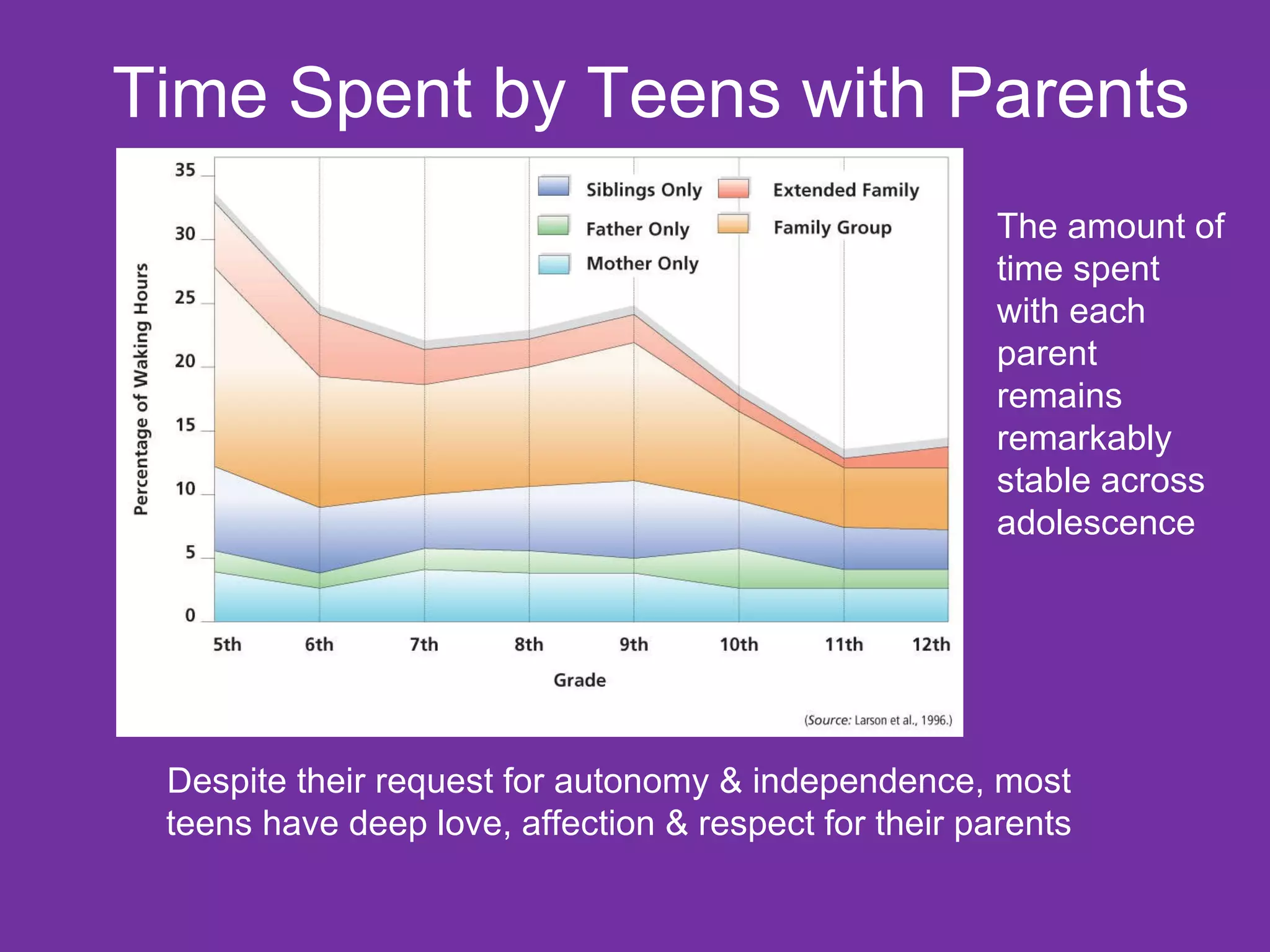
Time Spent by Teens with Parents Despite their request for autonomy & independence, most teens have deep love, affection & respect for their parents The amount of time spent with each parent remains remarkably stable across adolescence
Conflicts with Parents Conflicts likely to arise during early adolescence. Parents trying to discern what is appropriate conduct, children more likely to be argumentative and assertive. As parents trust more, combativeness declines. Most teenagers have stable family relationships, but as many as 20 percent have a rough time.
Culture and Conflict with Parents Less conflict in “traditional,” unindustrialized countries than in developed countries. Adolescents expect more independence and individualism in industrialized cultures. In more traditional societies, individualism, and thus independence, not as highly valued.
Relationships with Peers:  The Importance of Belonging Peer relationships: Critical during adolescence  Provide opportunity for social comparison and information  Reference groups: A group of people with whom one compares oneself.  Reference groups present a set of norms or standards, against which adolescents judge their social success.
Cliques and Crowds: Belonging to a Group  CLIQUES   are 2 to 12 people who have frequent interaction. CROWDS   are larger groups where people share some characteristic but often don't interact with each other. Membership in cliques and crowds determined by degree of similarity with members in a group. Stereotypes: jocks, brains, druggies There are strong expectations that people in a particular crowd behave in specific ways. (Is it a self-fulfilling prophesy?)  Gender relations change during the period of adolescence. SEX CLEAVAGE  is characteristic of  early  adolescence where girls play with girls, boys with boys .  With puberty, there is hormonal and social pressure to interact and eventually most adolescents are in mixed-sex cliques.  At the end of adolescence, cliques become less powerful and male-female relationships become the focus.
Peers and Race Segregation  Adolescents of different ethnicities and races interact very little:  Decline begins in elementary school Moreover, even if they have a friend of a different ethnicity within the confines of a school, most adolescents don’t interact with that friend outside of school
Why does racial and ethnic segregation often exist, even in schools that have been desegregated for some time?  Minority students may actively seek support from others who share their minority status (where “minority” is used in its sociological sense to indicate a subordinate group whose members lack power, compared to members of a dominant group). By associating primarily with other members of their own group, members of minority groups they are able to affirm their own identity. Members of different racial and ethnic groups may be segregated in the classroom. Because members of groups that have been historically discriminated against, they tend to experience less school success than members of the majority group. It may be that ethnic and racial segregation in high school is based not on ethnicity itself, but on academic achievement. Lack of contact among students of different racial and ethnic backgrounds in school may also reflect prejudice, both perceived and real, toward members of other group.
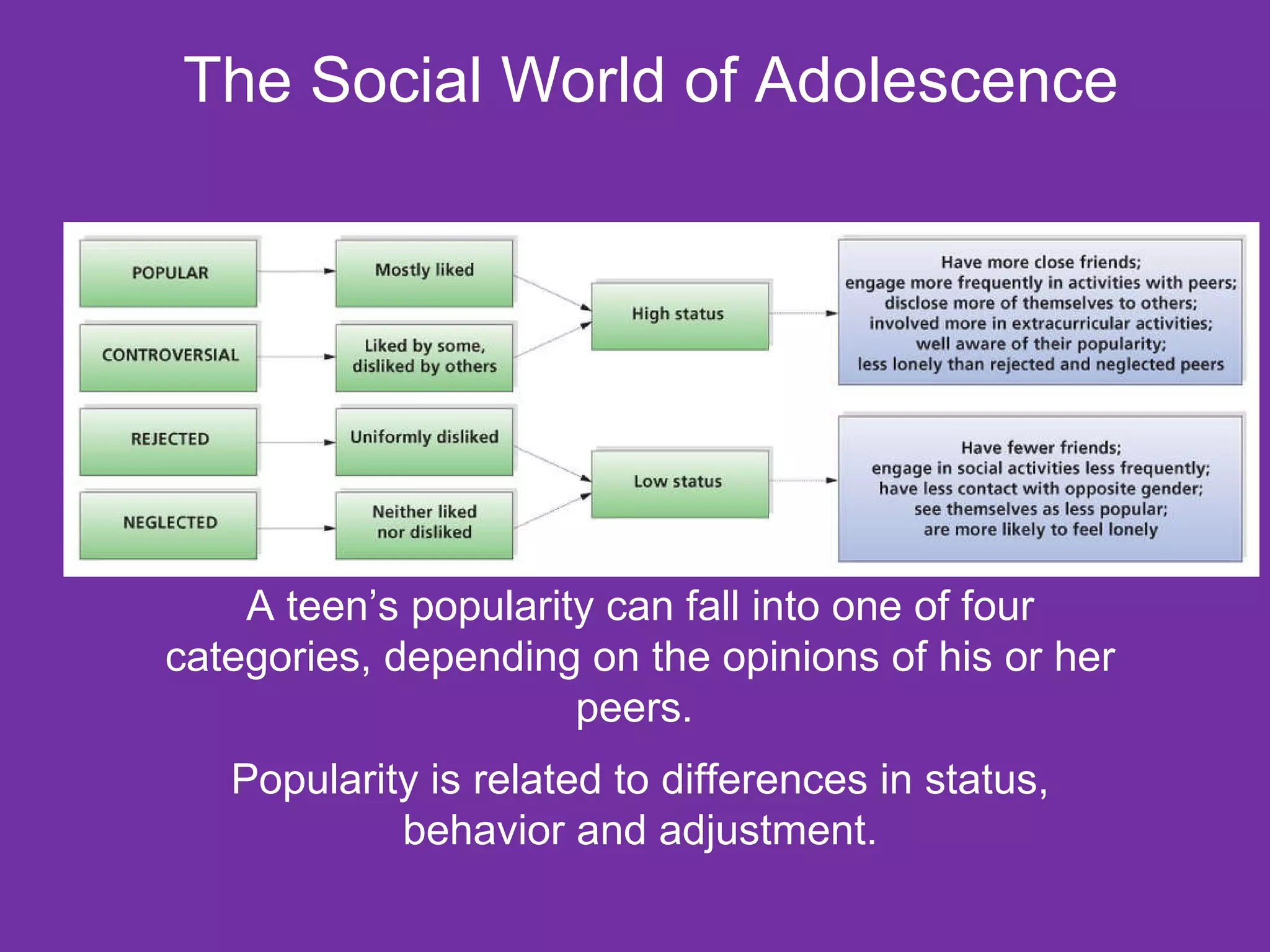
The Social World of Adolescence Adolescent social world is complex High status categories: Popular adolescents, who are most liked. Controversial adolescents, who are like by some and disliked by others. Low status categories: Rejected teens, who are uniformly disliked. Neglected teens adolescents, who are neither liked nor disliked.
The Social World of Adolescence Some adolescents are controversial; in contrast to  popular adolescents , who are mostly liked,  controversial adolescents  are liked by some and disliked by others. A controversial adolescent may be highly popular within a particular group such as the string orchestra, but not popular among other classmates. There are  rejected adolescents ,  who are uniformly disliked, and  neglected adolescents ,  who are neither liked nor disliked.  Neglected adolescents are the forgotten students—the ones whose status is so low that they are overlooked by almost everyone.
The Social World of Adolescence A teen’s popularity can fall into one of four categories, depending on the opinions of his or her peers.  Popularity is related to differences in status, behavior and adjustment.
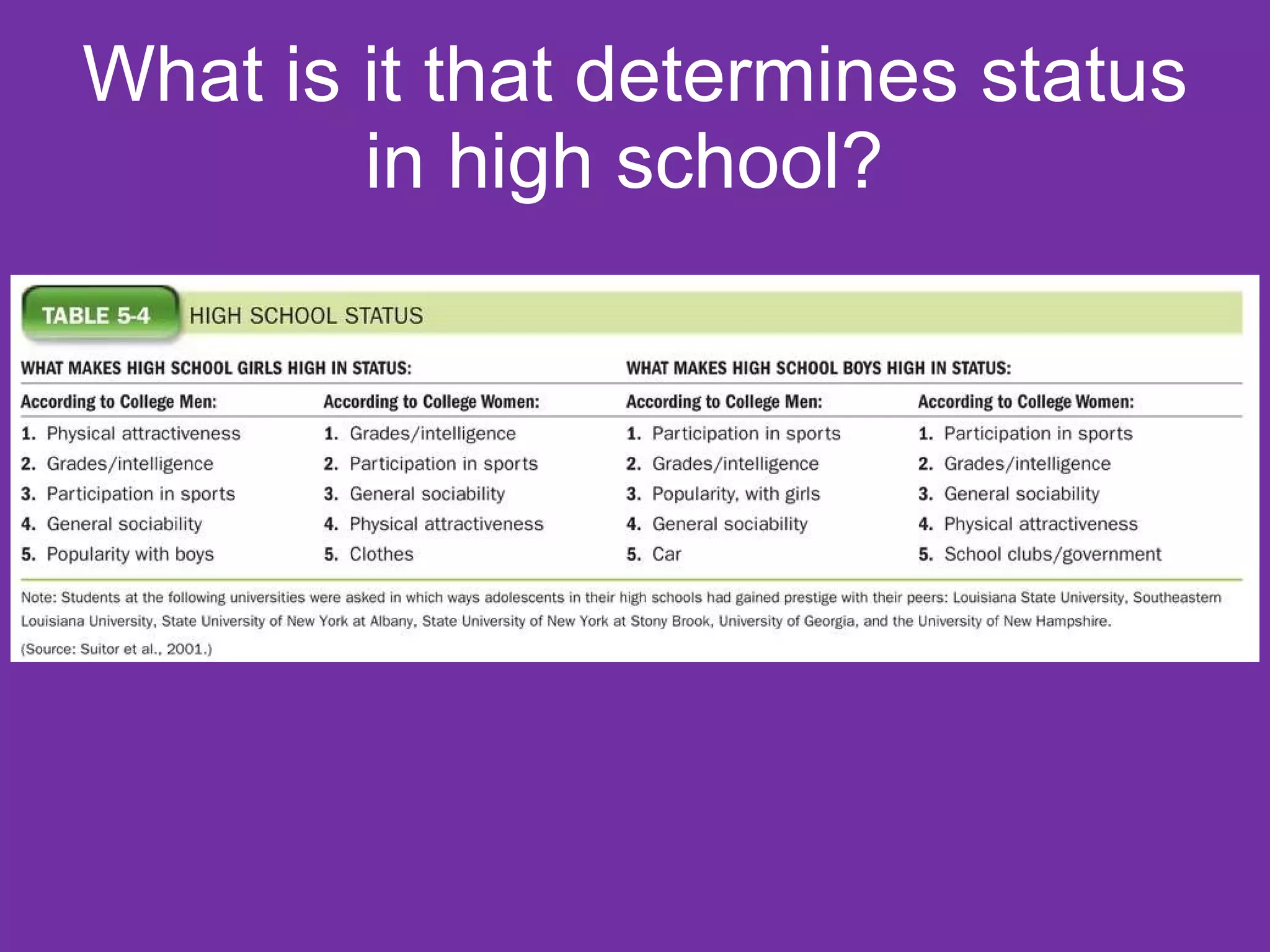
What is it that determines status in high school?
Peer Pressure in Adolescence Some teens are highly susceptible to peer pressure, the influence of one's peers to conform to their behavior and attitudes. Peer pressure can be positive as well as negative Susceptibility to peer pressure does not rise in adolescence; in fact conformity decreases as adolescents increase their own autonomy. Ultimately, adolescents conform less to both peers and adults, as they grow in confidence in the ability to make their own decisions.
Delinquency in Adolescence Overall violent crimes by juveniles decreasing, but 16 percent of arrests for serious crimes involved juveniles. Why do teens become involved in criminal activity? UNDERSOCIALIZED DELINQUENTS  are raised with little parental supervision or discipline: they have not been appropriately socialized .  They tend to be relatively aggressive and violent early in life; rejected by peers; likely to have ADHD; and are usually less intelligent than average.  They are relatively unlikely to be rehabilitated. SOCIALIZED DELINQUENTS  are adolescent delinquents who know and subscribe to the norms of society, and who are fairly normal psychologically.   They are usually influenced by a group & their criminal behavior is usually committed with a group.   Crimes by this group tend to be minor.
Dating Adolescents today talk more of “hooking up”, which means anything from kissing to sexual intercourse. Dating - is a common form of social interaction that serves developmental functions: Learning to establish intimacy Learning to engage in entertainment Shaping identity Cultural influences affect dating patterns -especially if the concept of dating is unfamiliar to the parents (often more control, attempts to maintain cultural patterns).
What are the functions of dating?  Pattern of courtship that lead to marriage Way to learn to establish intimacy  Mechanism to provide entertainment and prestige Resource to develop a sense of one’s own identity
Dating and the Development of Psychological Intimacy Dating in early and middle adolescence is not terribly successful at facilitating intimacy. On the contrary, dating is often a superficial activity in which the participants so rarely let down their guards that they never become truly close and never expose themselves emotionally to each other. Psychological intimacy may be lacking even when sexual activity is part of the relationship. For homosexual adolescents, dating presents special challenges. In some cases, blatant homophobic prejudice expressed by classmates may lead gays and lesbians to date members of the other sex in efforts to fit in. If they do seek relationships with other gays and lesbians, they may find it difficult to find partners, who may not openly express their sexual orientation. Homosexual couples who do openly date face possible harassment, making the development of a relationship all the more difficult. True intimacy becomes more common during later adolescence. At that point, the dating relationship may be taken more seriously by both participants, and it may be seen as a way to select a mate and as a potential prelude to marriage.
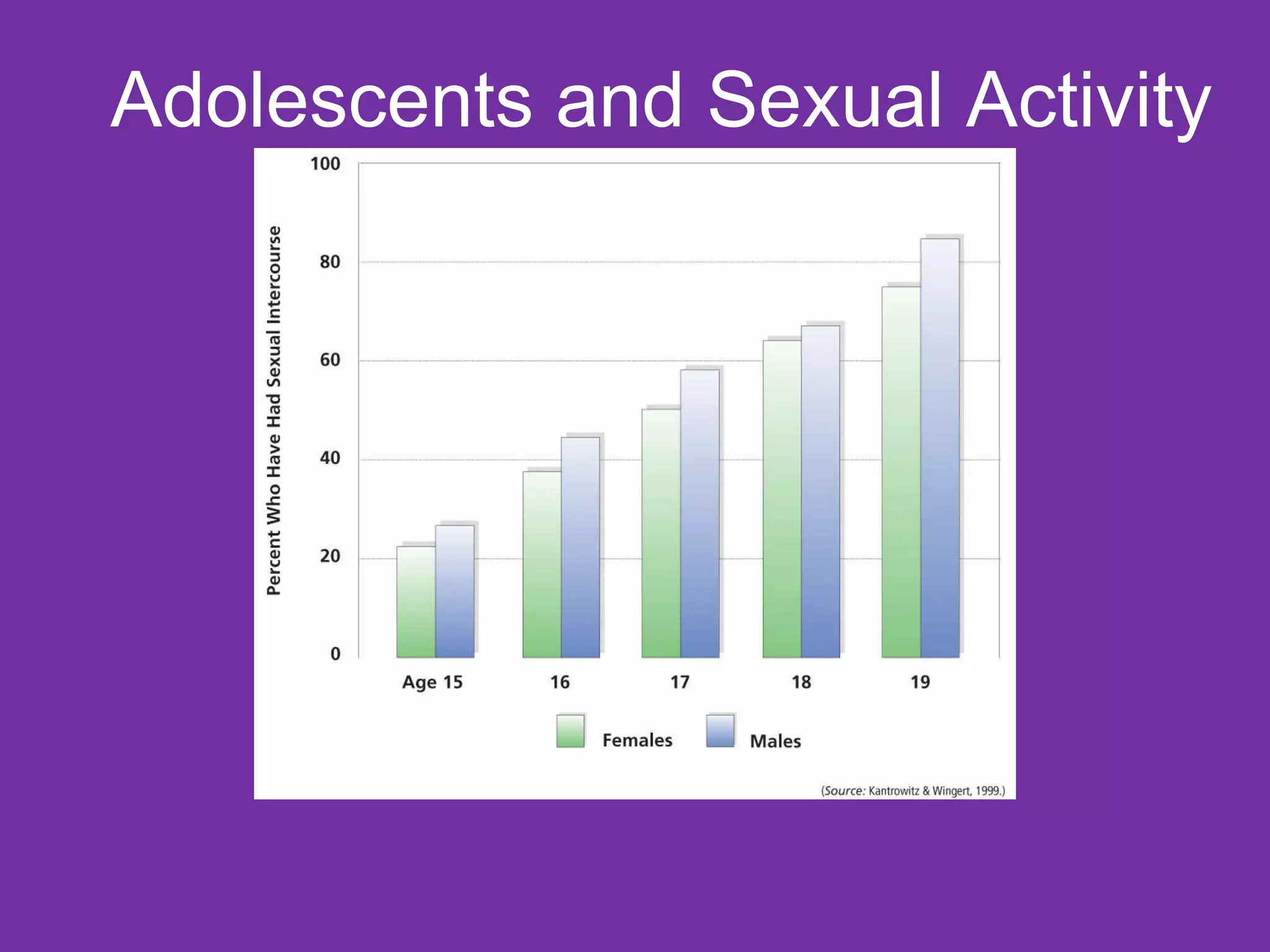
Sexual Relationships The maturation of sexual organs during the teen years creates a whole new world of relationship issues and possibilities for teens. Research shows that teens think about sex a substantial amount of time each day. For most adolescents, their initiation into sexuality begins with masturbation (self stimulation). Unfortunately - masturbation often produces feelings of shame and guilt in the American culture.  Experts view masturbation as normal and harmless – helpful for sexual relations later on Ages for sexual intercourse have been declining: The average age at which adolescents first have sexual intercourse has been steadily declining over the last 50 years, and about one in five adolescents have had sex before the age of 15.  Around one in five of teens have had sex before the age of 15, 80 percent have had sex before the age of 20. At the same time, though, many teenagers are postponing sex, and the number of adolescents who say they have never had sexual intercourse increased by nearly 10 percent from 1991 to 2001, largely as a response to the threat of infection by the virus that causes AIDS.  Today, premarital intercourse is viewed as acceptable for males and females, no more “double standard.”
Adolescents and Sexual Activity
Permissiveness with Affection In past, gender-related double standard for premarital sexual activity Women were told by society that “nice girls don’t,” while men heard that premarital sex was permissible—although they should be sure to marry virgins. Today premarital intercourse is viewed as permissible for both men and women if it occurs in the context of long-term, committed, or loving relationship  Significant cultural and subcultural variation about premarital sex
Sexual Orientation Sexual orientation questions occur at adolescence: Heterosexuality  - sexual attraction and behavior directed at someone of the opposite sex Homosexuality  -attracted to same sex Bisexuality  – attracted to both
Sexual Orientation About 25% of boys and 10% of girls have had at least one same-sex encounter. Far fewer numbers become exclusively homosexual, maybe 4 to 10 percent. Sexual orientation relates to sexual interests, while gender identity refers to ones psychological orientation, of feeling, behaving, like assigned sex.
What Determines Sexual Orientation? Very Complicated – Multi – Factor Theory: Genetic and biological factors: Genes - Identical twins are more likely to both be homosexual. Hormones may play a factor. Family and peers: Inappropriate identification with same sex parent? Belief systems Learning theory plays a role: Pleasurable, rewarding sexual experiences
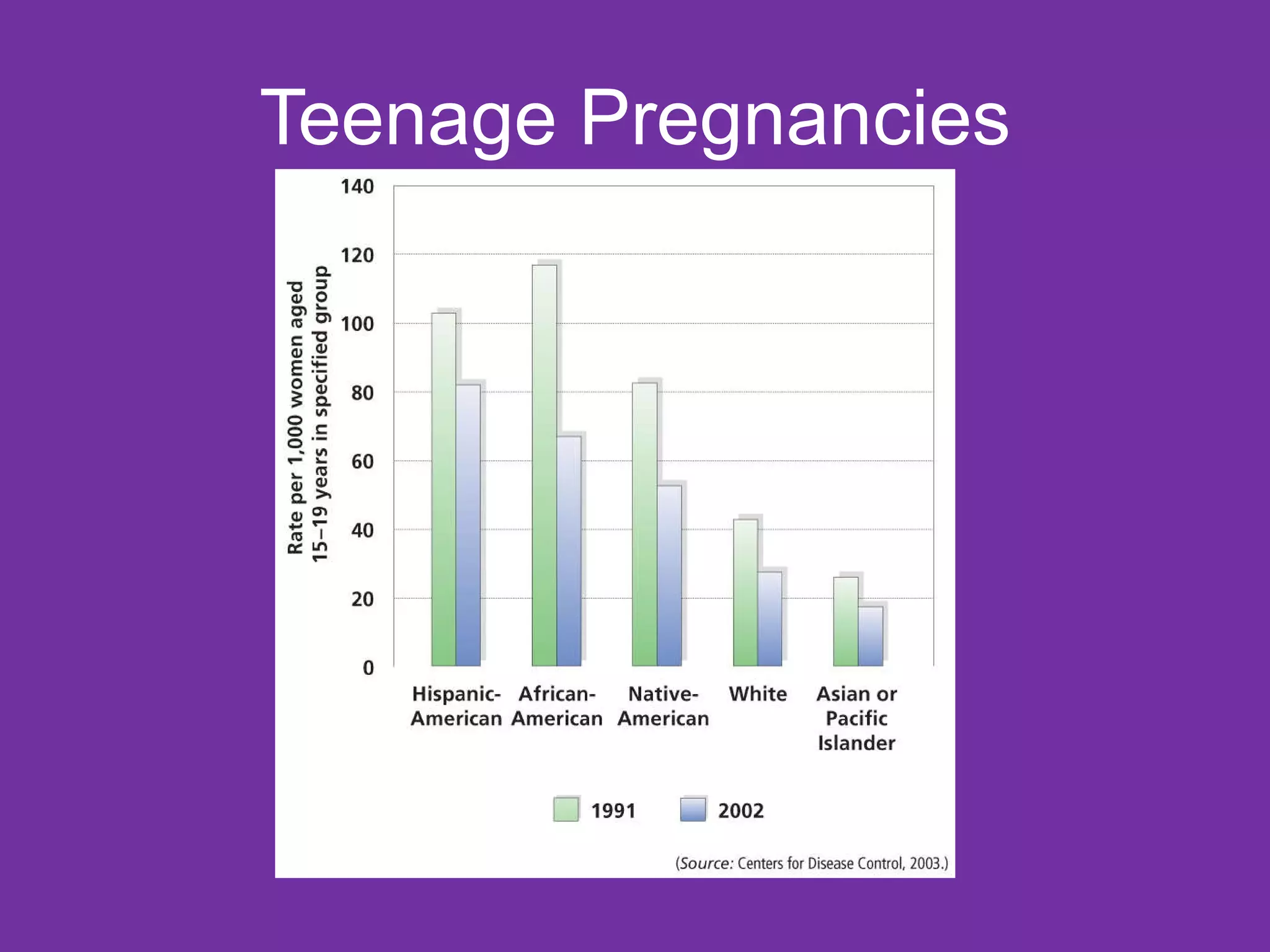
Teenage Pregnancies
What contributes to the decline in teenage pregnancy? New initiatives have raised awareness among teenagers of the risks of unprotected sex ( Comprehensive  Sexual Education courses in school) The rates of sexual intercourse among teenagers has declined  The use of condoms and other forms of contraception has increased  Substitutes for sexual intercourse may be more prevalent
Abstinence Education Not effective at preventing teen pregnancy and may increase risk of STI’s. Public pledges to refrain from premarital sex—a centerpiece of some forms of sex education—apparently are ineffective. For example, in one study of 12,000 teenagers, 88 percent reported eventually having sexual intercourse. However, pledges did delay the start of sex an average of 18 months.

Lifespan psychology lecture - 5.3

  • 1.
    Chapter 5: Adolescence Module 5.3 Social and Personality Development in Adolescence
  • 2.
    Identity: Asking "WhoAm I?" During adolescence, self consciousness takes center stage: Teens focus on wondering “Who am I?” and “Where do I belong in the world?” WHY? Teens begin to become more like adults intellectually. Realize the importance of establishing self in society, and shaping their individuality. Teens become more like adults physically. Dramatic changes during puberty make teens acutely aware of their own bodies. This broader view of themselves is one aspect of adolescents’ increasing understanding of who they are. They can see various aspects of the self simultaneously, and this view of the self becomes more organized and coherent. They look at the self from a psychological perspective, viewing traits not as concrete entities but as abstractions.
  • 3.
    Self Concept: WhatAm I Like? View broadens: One's own assessment of who they are Others' views More organized and coherent: View self in terms of traits and multiple aspects – can be very confusing at first!
  • 4.
    Self-esteem: How DoI Like Myself? Increasingly accurate in understanding self Gender - especially in early adolescence, girls have lower self-esteem. SES - - higher SES leads to more self-esteem (especially in late adolescence when one can buy things of value). The increase in self-concept does not mean that they like themselves any better ( self esteem may still be low). The same cognitive sophistication that allows adolescents to differentiate various aspects of the self also leads them to evaluate those aspects in different ways (Chan, 1997; Cohen, J., 1999). For instance, an adolescent may have high self-esteem in terms of academic performance, but lower self-esteem in terms of relationships with others. Or it may be just the opposite.
  • 5.
    Influences on Self-EsteemTraditional research Prejudice is incorporated into minority adolescents' self-concepts Recent research African-American adolescents have same levels of self-esteem as Caucasians One explanation is that social movements within African American community that bolster racial pride help support African American adolescents. In fact, research finds that a stronger sense of racial identity is related to higher level of self-esteem in African Americans and Hispanics.
  • 6.
    “ Ethgender” Jointinfluence of race and gender (“ethgender”) Findings indicate that: African-American and Hispanic males had highest self-esteem Asian and Native American females had lowest levels
  • 7.
    Erikson: Identity vs.Identity Confusion Identity: Awareness of uniqueness of self; knowledge of roles Identity Confusion: Inability to identity appropriate roles in life Can take 10 years or more! (Some people have trouble ever establishing identity) We modify our identity constantly through out our lives
  • 8.
    Erikson: Identity vs.Identity Confusion Erik Erikson asserted that adolescents may encounter substantial psychological difficulties in their search for identity (“the adolescent identity crisis”). Those who do not find a suitable identity, tend to follow a dysfunctional path because their sense of self is "diffuse". There are a lot of social pressures to achieve a secure identity (or at least have clear career or major goals): Which job track to follow? Attend college? Which one? Now, adolescents rely more on friends and peers than adults.
  • 9.
    Erikson: Identity vs.Identity Confusion Erikson suggests that adolescents pursue a psychological moratorium to let go of responsibilities for awhile and explore new roles and possibilities. For many, this experimentation period is an economic impossibility. Probably no lasting, negative psychological affects. Some benefits (satisfaction from working, independence, etc.).
  • 10.
    Video about IdentityFormation http://www.youtube.com/watch?v=wJMXk5ibkQk
  • 11.
    Erikson: Identity vs.Identity Confusion Societal pressures high during identity versus identity confusion stage Reliance on peers to help adolescents define their identities and learn to form relationships is the link between this stage of psychosocial development and the next stage Erikson proposed, known as intimacy versus isolation. Males are more likely to proceed through the social development stages in the order, developing stable identity before committing to an intimate relationship with another person. Females reverse order, seeking intimate relationships and then defining their identities through these relationships.
  • 12.
    Limitations of Erikson’sTheory Erikson saw males as developing intimacy only after they have achieved a stable identity, which is viewed as the normative pattern. To critics, Erikson’s view is based on male-oriented concepts of individuality and competitiveness. Carol Gilligan has suggested that women develop identity through the establishment of relationships. In this view, a key component of a woman’s identity is the building of caring networks between herself and others
  • 13.
    Marcia’s Approach toIdentity Development James Marcia suggests four categories within which either: A crisis (a period of identity development in which an adolescent consciously chooses between various alternatives and makes decisions) or A commitment (a psychological investment in a course of action or an ideology), takes place. 1) IDENTITY ACHIEVEMENT IDENTITY FORECLOSURE 3) IDENTITY DIFFUSION 4) MORATORIUM
  • 14.
    Marcia’s Approach toIdentity Development IDENTITY ACHIEVEMENT - where adolescents consider and explore various alternatives without commitment.
  • 15.
    Marcia’s Approach toIdentity Developme nt IDENTITY FORECLOSURE - adolescents here did not do adequate personal exploration but made a commitment (usually following others' directives).
  • 16.
    Marcia’s Approach toIdentity Development IDENTITY DIFFUSION - adolescents explore various options but never commit to one
  • 17.
    Marcia’s Approach toIdentity Development MORATORIUM - adolescents explore and do not commit to an option and that creates anxiety and conflict. An identity is usually defined later, after a struggle.
  • 18.
    Identity, Race andEthnicity Forming an identity presents a particular challenge for members of ethnic and racial backgrounds because of contradictory societal values. Cultural assimilation model holds that individual cultural identities should be assimilated into a unified culture (“melting pot model”). Society should be color blind, race and ethnic background should not affect opportunity or achievement. Pluralistic society model suggests that the U.S. society is made up of diverse, coequal cultural groups that should preserve their individual cultural features ( “ tossed salad model ” ). Research suggests that the cultural assimilation model denigrates the cultural heritage of minorities and lowers self esteem. Racial and ethnic factors should be a central part of teenagers ’ identities. Bicultural identity suggests that adolescents can draw from their own culture and integrate themselves into the dominant culture (“the middle ground model”). Suggests that the teen live as a member of two cultures, and have two cultural identities without having to choose one.
  • 19.
    Psychological Difficulties inAdolescence Depression and Suicide: More than one-quarter of adolescents report periods of feeling sad and hopeless for two or more weeks in a row. But only a small number (3 percent) experience a major depression, a full-blown psychological disorder in which depression is severe and lingers for long periods.
  • 20.
    Psychological Difficulties inAdolescence Depression has several causes, including biological, environmental, and social factors. Genetic predisposition Death of loved one Depressed parent Unpopular Few close friends Experiencing rejection Girls have higher incidences of depression than boys but the cause is not clear. Are there more stresses on the female gender role? Is this the results of girls' tendencies to react to stress by turning inward, thus experiencing helplessness and hopelessness? Little evidence that hormones are a factor. African-Americans and Native Americans also have higher depression rates (same suspected reasons as for girls).
  • 21.
    Adolescent Suicide Adolescentsuicide rates have tripled in the last 30 years - it is the 3rd most common cause of death for teenagers. The current rate is one teenage suicide every 90 minutes. More girls attempt suicide than boys but more boys succeed. Males tend to use more violent methods. There are estimates of as many as 200 attempts for every successful suicide.
  • 22.
    Adolescent Suicide Otherfactors in adolescent suicide: Depression Family conflicts History of abuse and/or neglect Drug and alcohol abuse
  • 23.
    What contributes mostto the increased suicide rate among US adolescents today? The most obvious explanation is that the stress experienced by teenagers has increased, leading those who are most vulnerable to be more likely to commit suicide Increase in depression. Depressed teenagers who are experiencing a profound sense of hopelessness are at greater risk of committing suicide. Social inhibition, perfectionism, and a high level of stress and anxiety are related to a greater risk of suicide. Easy availability of guns—which are more prevalent in the U.S. than in other industrialized nations—also contributes to the suicide rate Some cases of suicide are associated with family conflicts and relationship or school difficulties. Some stem from a history of abuse and neglect. Rate of suicide among drug and alcohol abusers is also relatively high.
  • 24.
  • 25.
    Warning Signs ofSuicide Attempt Direct or indirect talk I wish I were dead.” “ Don’t worry, I’ll be out of your hair soon.” School difficulties Missed classes, drop in grades Writing a will Changes in eating habits General depression Sleep habits, lack of energy, uncommunicative Dramatic behavior changes Preoccupation with death Art, music, conversation
  • 26.
    Preventing Adolescent Suicide What you can do Talk to the person, listen without judging, and give the person an understanding forum in which to try to talk things through. Talk specifically about suicidal thoughts, asking such questions as: Does the person have a plan? Has he or she bought a gun? Where is it? Has he or she stockpiled pills? Where are they? The Public Health Service notes that, “contrary to popular belief, such candor will not give a person dangerous ideas or encourage a suicidal act.” Evaluate the situation, trying to distinguish between general upset and more serious danger, as when suicide plans have been made. If the crisis is acute, do not leave the person alone. Be supportive, let the person know you care, and try to break down his or her feelings of isolation. Take charge of finding help, without concern about invading the person’s privacy. Do not try to handle the problem alone; get professional help immediately. Make the environment safe, removing from the premises (not just hiding) weapons such as guns, razors, scissors, medication, and other potentially dangerous household items. Do not keep suicide talk or threats secret; these are calls for help and call for immediate action. Do not challenge, dare, or use verbal shock treatment on the person in an effort to make them realize the errors in their thinking. These can have tragic effects. Make a contract with the person, getting a promise or commitment, preferably in writing, not to make any suicidal attempt until you have talked further. Don’t be overly reassured by a sudden improvement of mood. Such seemingly quick recoveries sometimes reflect the relief of finally deciding to commit suicide or the temporary release of talking to someone, but most likely the underlying problems have not been resolved.
  • 27.
    For immediate helpwith a suicide-related problem, call: (800) 784-2433 or (800) 621-4000 , national hotlines staffed with trained counselors
  • 28.
    Adolescents and FamilyRoles Family relationships change when adolescents begin to question, and sometimes rebel, against their parents' views. Shift in roles because of the quest for adulthood and autonomy by people that were considered children until recently. Cultural factors play a rule in the degree of autonomy achieved by adolescents and the degree in which adolescents feel obligated to family duties and support.
  • 29.
    The Quest forAutonomy Adolescents increasingly seek autonomy, independence and a sense of control: Primary developmental task Grows gradually over course of adolescence Consists of changes in relational symmetry At the start of adolescence, the relationship tends to be asymmetrical: Parents hold most of the power and influence over the relationship. By the end of adolescence, however, power and influence have become more balanced, and parents and children end up in a more symmetrical, or egalitarian, relationship. Power and influence are shared, although parents typically retain the upper hand.
  • 30.
    Culture and Autonomy Cultural and gender factors play an important role: In Western societies, which tend to value individualism, adolescents seek autonomy at a relatively early stage of adolescence. Asian societies are collectivistic; they promote the idea that the well-being of the group is more important than that of the individual. In such societies, adolescents’ aspirations to achieve autonomy are less pronounced. Adolescents from different cultural backgrounds also vary in degree of felt family obligation In general, male adolescents are permitted more autonomy at earlier age than female adolescents
  • 31.
    The Myth ofthe Generation Gap GENERATION GAP: a divide between parents and adolescents in attitudes, values, aspirations, and worldviews, is mostly a myth - adolescents and their parents tend to share the same major values. On social, political, and religious issues, parents and teens are mostly in synch. The difference in values and attitudes between teens is greater than the difference between parent and teen. Most parents and teens get along well.
  • 32.
    Time Spent byTeens with Parents Despite their request for autonomy & independence, most teens have deep love, affection & respect for their parents The amount of time spent with each parent remains remarkably stable across adolescence
  • 33.
    Conflicts with ParentsConflicts likely to arise during early adolescence. Parents trying to discern what is appropriate conduct, children more likely to be argumentative and assertive. As parents trust more, combativeness declines. Most teenagers have stable family relationships, but as many as 20 percent have a rough time.
  • 34.
    Culture and Conflictwith Parents Less conflict in “traditional,” unindustrialized countries than in developed countries. Adolescents expect more independence and individualism in industrialized cultures. In more traditional societies, individualism, and thus independence, not as highly valued.
  • 35.
    Relationships with Peers: The Importance of Belonging Peer relationships: Critical during adolescence Provide opportunity for social comparison and information Reference groups: A group of people with whom one compares oneself. Reference groups present a set of norms or standards, against which adolescents judge their social success.
  • 36.
    Cliques and Crowds:Belonging to a Group CLIQUES are 2 to 12 people who have frequent interaction. CROWDS are larger groups where people share some characteristic but often don't interact with each other. Membership in cliques and crowds determined by degree of similarity with members in a group. Stereotypes: jocks, brains, druggies There are strong expectations that people in a particular crowd behave in specific ways. (Is it a self-fulfilling prophesy?) Gender relations change during the period of adolescence. SEX CLEAVAGE is characteristic of early adolescence where girls play with girls, boys with boys . With puberty, there is hormonal and social pressure to interact and eventually most adolescents are in mixed-sex cliques. At the end of adolescence, cliques become less powerful and male-female relationships become the focus.
  • 37.
    Peers and RaceSegregation Adolescents of different ethnicities and races interact very little: Decline begins in elementary school Moreover, even if they have a friend of a different ethnicity within the confines of a school, most adolescents don’t interact with that friend outside of school
  • 38.
    Why does racialand ethnic segregation often exist, even in schools that have been desegregated for some time? Minority students may actively seek support from others who share their minority status (where “minority” is used in its sociological sense to indicate a subordinate group whose members lack power, compared to members of a dominant group). By associating primarily with other members of their own group, members of minority groups they are able to affirm their own identity. Members of different racial and ethnic groups may be segregated in the classroom. Because members of groups that have been historically discriminated against, they tend to experience less school success than members of the majority group. It may be that ethnic and racial segregation in high school is based not on ethnicity itself, but on academic achievement. Lack of contact among students of different racial and ethnic backgrounds in school may also reflect prejudice, both perceived and real, toward members of other group.
  • 39.
    The Social Worldof Adolescence Adolescent social world is complex High status categories: Popular adolescents, who are most liked. Controversial adolescents, who are like by some and disliked by others. Low status categories: Rejected teens, who are uniformly disliked. Neglected teens adolescents, who are neither liked nor disliked.
  • 40.
    The Social Worldof Adolescence Some adolescents are controversial; in contrast to popular adolescents , who are mostly liked, controversial adolescents are liked by some and disliked by others. A controversial adolescent may be highly popular within a particular group such as the string orchestra, but not popular among other classmates. There are rejected adolescents , who are uniformly disliked, and neglected adolescents , who are neither liked nor disliked. Neglected adolescents are the forgotten students—the ones whose status is so low that they are overlooked by almost everyone.
  • 41.
    The Social Worldof Adolescence A teen’s popularity can fall into one of four categories, depending on the opinions of his or her peers. Popularity is related to differences in status, behavior and adjustment.
  • 42.
    What is itthat determines status in high school?
  • 43.
    Peer Pressure inAdolescence Some teens are highly susceptible to peer pressure, the influence of one's peers to conform to their behavior and attitudes. Peer pressure can be positive as well as negative Susceptibility to peer pressure does not rise in adolescence; in fact conformity decreases as adolescents increase their own autonomy. Ultimately, adolescents conform less to both peers and adults, as they grow in confidence in the ability to make their own decisions.
  • 44.
    Delinquency in AdolescenceOverall violent crimes by juveniles decreasing, but 16 percent of arrests for serious crimes involved juveniles. Why do teens become involved in criminal activity? UNDERSOCIALIZED DELINQUENTS are raised with little parental supervision or discipline: they have not been appropriately socialized . They tend to be relatively aggressive and violent early in life; rejected by peers; likely to have ADHD; and are usually less intelligent than average. They are relatively unlikely to be rehabilitated. SOCIALIZED DELINQUENTS are adolescent delinquents who know and subscribe to the norms of society, and who are fairly normal psychologically. They are usually influenced by a group & their criminal behavior is usually committed with a group. Crimes by this group tend to be minor.
  • 45.
    Dating Adolescents todaytalk more of “hooking up”, which means anything from kissing to sexual intercourse. Dating - is a common form of social interaction that serves developmental functions: Learning to establish intimacy Learning to engage in entertainment Shaping identity Cultural influences affect dating patterns -especially if the concept of dating is unfamiliar to the parents (often more control, attempts to maintain cultural patterns).
  • 46.
    What are thefunctions of dating? Pattern of courtship that lead to marriage Way to learn to establish intimacy Mechanism to provide entertainment and prestige Resource to develop a sense of one’s own identity
  • 47.
    Dating and theDevelopment of Psychological Intimacy Dating in early and middle adolescence is not terribly successful at facilitating intimacy. On the contrary, dating is often a superficial activity in which the participants so rarely let down their guards that they never become truly close and never expose themselves emotionally to each other. Psychological intimacy may be lacking even when sexual activity is part of the relationship. For homosexual adolescents, dating presents special challenges. In some cases, blatant homophobic prejudice expressed by classmates may lead gays and lesbians to date members of the other sex in efforts to fit in. If they do seek relationships with other gays and lesbians, they may find it difficult to find partners, who may not openly express their sexual orientation. Homosexual couples who do openly date face possible harassment, making the development of a relationship all the more difficult. True intimacy becomes more common during later adolescence. At that point, the dating relationship may be taken more seriously by both participants, and it may be seen as a way to select a mate and as a potential prelude to marriage.
  • 48.
    Sexual Relationships Thematuration of sexual organs during the teen years creates a whole new world of relationship issues and possibilities for teens. Research shows that teens think about sex a substantial amount of time each day. For most adolescents, their initiation into sexuality begins with masturbation (self stimulation). Unfortunately - masturbation often produces feelings of shame and guilt in the American culture. Experts view masturbation as normal and harmless – helpful for sexual relations later on Ages for sexual intercourse have been declining: The average age at which adolescents first have sexual intercourse has been steadily declining over the last 50 years, and about one in five adolescents have had sex before the age of 15. Around one in five of teens have had sex before the age of 15, 80 percent have had sex before the age of 20. At the same time, though, many teenagers are postponing sex, and the number of adolescents who say they have never had sexual intercourse increased by nearly 10 percent from 1991 to 2001, largely as a response to the threat of infection by the virus that causes AIDS. Today, premarital intercourse is viewed as acceptable for males and females, no more “double standard.”
  • 49.
  • 50.
    Permissiveness with AffectionIn past, gender-related double standard for premarital sexual activity Women were told by society that “nice girls don’t,” while men heard that premarital sex was permissible—although they should be sure to marry virgins. Today premarital intercourse is viewed as permissible for both men and women if it occurs in the context of long-term, committed, or loving relationship Significant cultural and subcultural variation about premarital sex
  • 51.
    Sexual Orientation Sexualorientation questions occur at adolescence: Heterosexuality - sexual attraction and behavior directed at someone of the opposite sex Homosexuality -attracted to same sex Bisexuality – attracted to both
  • 52.
    Sexual Orientation About25% of boys and 10% of girls have had at least one same-sex encounter. Far fewer numbers become exclusively homosexual, maybe 4 to 10 percent. Sexual orientation relates to sexual interests, while gender identity refers to ones psychological orientation, of feeling, behaving, like assigned sex.
  • 53.
    What Determines SexualOrientation? Very Complicated – Multi – Factor Theory: Genetic and biological factors: Genes - Identical twins are more likely to both be homosexual. Hormones may play a factor. Family and peers: Inappropriate identification with same sex parent? Belief systems Learning theory plays a role: Pleasurable, rewarding sexual experiences
  • 54.
  • 55.
    What contributes tothe decline in teenage pregnancy? New initiatives have raised awareness among teenagers of the risks of unprotected sex ( Comprehensive Sexual Education courses in school) The rates of sexual intercourse among teenagers has declined The use of condoms and other forms of contraception has increased Substitutes for sexual intercourse may be more prevalent
  • 56.
    Abstinence Education Noteffective at preventing teen pregnancy and may increase risk of STI’s. Public pledges to refrain from premarital sex—a centerpiece of some forms of sex education—apparently are ineffective. For example, in one study of 12,000 teenagers, 88 percent reported eventually having sexual intercourse. However, pledges did delay the start of sex an average of 18 months.

Editor's Notes

  • #6 African Americans and Hispanics, researchers’ explained, had lower self esteem than Caucasians because prejudicial attitudes in society made them feel disliked and rejected, and this feeling was incorporated into their self-concepts. One explanation is that social movements within African American community that bolster racial pride help support African American adolescents. In fact, research finds that a stronger sense of racial identity is related to higher level of self-esteem in African Americans and Hispanics.