Chapter 11 Physical and Cognitive Development in Adolescence Development Across the Life Span, 4/E Robert S. Feldman   © 2006 Pearson Education/Prentice-Hall Publishing
Adolescence Developmental stage between childhood and adulthood.  Beginning and ending ages are imprecise
Physical Maturation Growth Spurt Extreme changes in height and weight are common  Almost matches the growth rate of infancy Average/year: Boys grow 4.1 inches  Girls 3.5 inches. Gender Differences: Girls begin about 2 years earlier. By age 13, boys catch up—are taller
Puberty: The Start of Sexual Maturation PUBERTY  is the period when sexual organs mature, beginning earlier for girls than for boys.  Pituitary gland (master gland) kicks it off Girls begin puberty about 11 or 12; boys begin at 13 or 14.
What triggers puberty?   Environment Cultural factors  MENARCHE 1 st  menstruation varies in age beginning SES, nutrition Body fat to muscle ratio Environmental Stress Secular trend
PRIMARY SEX CHARACTERISTICS   involves organs and structures of the body related to reproduction.  SECONDARY SEX CHARACTERISTICS involve visible signs of sexual maturity not involved with the sex organs directly. Process of Puberty
Body Image: Reactions to Physical Changes in Adolescence Involves adolescent's reactions to the physical changes.  Most tend to be happy with their development Timing of puberty is key in adolescent reaction
The Timing of Puberty Girls: Early maturation is often difficult Tend to be more popular (maybe too popular)  Reactions depend on cultural norms (country and community). Late maturing girls the picture is complicated.  Can be overlooked  low social status at first However, when they catch up their self-esteem is high.
The Timing of Puberty (continued) Boys: Early maturation is generally positive  Tend to be better at athletics More popular Positive self-esteem Grow up to be more cooperative and responsible.  But also are more likely to have school difficulties and become more involved. Late maturation is difficult for boys.  Smaller boys    less attractive  disadvantage in sports Can lead to declines in self-concept which can extend into adulthood.
Nutrition, Food & Eating Disorders During Adolescence Growth spurt requires an increase in food (especially key nutrients such as calcium and iron).  Obesity is a common concern during adolescence. 1 in 3 adolescents are overweight; 1 in 20 are obese (body weight 20 % above average) Psychological consequences of body image  Potential health consequences  High blood pressure; diabetes; likely to be obese adults.
Anorexia Nervosa and Bulimia ANOREXIA NERVOSA   severe eating disorder  individuals refuse to eat Denial of behavior and appearance    “normal”  Primarily affects white women:  Control BULIMIA   Eating disorder  Characterized by binge and purge behavior Vomiting or the use of laxatives Leads to a chemical imbalance with serious effects, including heart failure.
Brain Development Prefrontal cortex  involved in impulse control, thinking, planning, evaluating, making decisions Completely developed in early 20s May explain adolescent’s inability to control impulses and reckless behavior
Cognitive Development and Schooling FORMAL OPERATIONS PERIOD   develop the ability to think abstractly and  hypothetically.  Enter at about 12 Full capabilities unfold gradually throughout early adolescence (approximately ages 12 to 15) Not everyone achieves formal operational skills  some studies estimate that 25  to 50 % of college students do not
Consequences of Using Formal Operations (continued) Changes in everyday behavior (use thinking skills): question parents and other authority figures Become more argumentative Poke holes in others explanations Use critical thinking to challenge and see other perspectives Can be challenging for parents
Egocentrism in Adolescent Thinking ADOLESCENT EGOCENTRISM   stage of self-absorption where the world is seen only from one's own perspective Characteristics of: highly critical of authority figures unwilling to accept criticism quick to find fault with others.  Helps explain why teens often think they’re the focus of everyone’s attention.
IMAGINARY AUDIENCE where adolescents think they are the focus of everyone else's attention. PERSONAL FABLES the belief that the adolescent is unique and exceptional and shared by no one else . No one understands me Risk taking behavior Distortions due to Adolescent Egocentrism
Threats to Adolescents’ Well-Being Illegal drug use: Very prevalent and rising In 1990's drug use rose, after decline in the 1980's.  Marijuana 20 % of 8 th  graders; 40 % of seniors said smoked at least once in the last year.  50%+ seniors have used an illegal drug at least once
Illegal Drugs Why do teens use illegal drugs? Perceived pleasurable experience.  Escape from daily pressures. The thrill of doing something illegal.  A number of role-models use drugs. Peer pressure.
Smoking  declined, but still substantial Reasons why: Messages from society—advertisements  Biological and psychological dependency (10   habit) Pleasant emotional state  Modeling:  Parents’ and peer smoking increases  Will prematurely kill 200 million children & teens (worldwide) Tobacco: The Dangers of Smoking
Sexually Transmitted Diseases   AIDS (Acquired Immunodeficiency Syndrome)  Sexually transmitted disease Produced by the HIV virus No cure; ultimately causes death Transmission:  exchange of bodily fluids (usually sexual contact) AIDS is one of the leading causes of death among young people.
AIDS and Adolescent Behavior Difficult to motivate adolescents to practice safe sex and change their sexual behavior.  Feelings of invulnerability Embarrassment Sense of privacy Forgetfulness
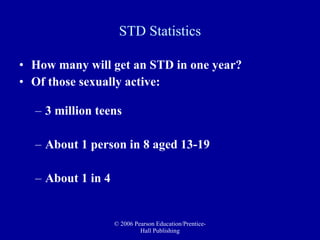
STD Statistics How many will get an STD in one year?  Of those sexually active:  3 million teens About 1 person in 8 aged 13-19 About 1 in 4
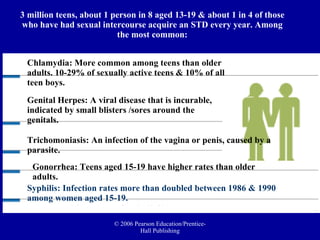
3 million teens, about 1 person in 8 aged 13-19 & about 1 in 4 of those who have had sexual intercourse acquire an STD every year. Among the most common: Chlamydia: More common among teens than older adults. 10-29% of sexually active teens & 10% of all teen boys. Genital Herpes: A viral disease that is incurable, indicated by small blisters /sores around the genitals.  Trichomoniasis: An infection of the vagina or penis, caused by a parasite. Gonorrhea: Teens aged 15-19 have higher rates than older adults. Syphilis: Infection rates more than doubled between 1986 & 1990 among women aged 15-19.
Abstinence is the only certain way to avoid STDs Adolescents need to be encouraged to practice safer sex Use condoms. Avoid high risk behaviors. Know your partner’s sexual history. Consider abstinence.
 
Chapter 12 Social and Personality Development in Adolescence Development Across the Life Span, 4/E Robert S. Feldman  © 2006 Pearson Education/Prentice-Hall Publishing
Identity: Asking "Who Am I?"   Self consciousness takes center stage Focus on “Who am I?” and “Where do I belong in the world?” WHY? Teens become more like adults intellectually and physically
Self Concept:  What Am I Like? Broadens to include both self assessment and others' views.  View becomes more organized and coherent Able to see multiple aspects of themselves (which can be confusing at first).
Identity Formation: Crisis or Change? Erik Erikson  Possible psychological difficulties in their search for identity  “ the adolescent identity crisis” IDENTITY-VERSUS-IDENTITY-CONFUSION STAGE Adolescents seek to determine what is unique and distinctive about themselves.
Erikson's IDENTITY-VERSUS-IDENTITY-CONFUSION STAGE If no identity is found: Sense of self is "diffuse".  Social pressure to achieve a secure identity Parents, teachers, etc. Think of the questions high school seniors get asked: Which job track to follow? Attend college? Which one?
Marcia’s Approach to Identity Development James Marcia suggests four categories within which either:  A crisis   a process of consciously choosing between various alternatives and makes decisions  A commitment   a psychological investment in a course of action or an ideology takes place.
Marcia’s categories of adolescent identity IDENTITY ACHIEVEMENT –  adolescents consider and explore various alternatives  Commitment to one IDENTITY FORECLOSURE –  Inadequate or no exploration Commitment made (usually following others' directives).
Marcia’s categories of  adolescent identity (continued) IDENTITY DIFFUSION  –  adolescents explore various options  never commit to one MORATORIUM  – adolescents explore  no commitment made  creates anxiety and conflict
Marcia’s Categories (continued) Although adolescents are not stuck in one category, research indicates that identity gels by the age of 18.  For some, identity formation takes place beyond the adolescent period.
Teen Depression Depression has several causes, including biological, environmental, and social factors.  Genetic predisposition Death of loved one Depressed parent Unpopular Few close friends Experiencing rejection
Girls have higher incidences of depression than boys but the cause is not clear.  More stresses on the female gender role?  Reactions to stress? Possible that hormones are a factor.
Adolescent Suicide Rates have tripled in the last 30 years  3rd most common cause of death  Currently, 1 teenage suicide every 90 minutes Gender Differences: More girls attempt suicide More boys succeed Estimated: 200  attempts  for every successful suicide.
Adolescent Suicide Other factors in adolescent suicide:  Depression  Family conflicts  History of abuse and/or neglect  Drug and alcohol abuse
Warning Signs   Direct or indirect talk  I wish I were dead.” “ Don’t worry, I’ll be out of your hair soon.” School difficulties  Missed classes, drop in grades Writing a will Changes in eating habits General depression Sleep habits, lack of energy, uncommunicative Dramatic behavior changes Preoccupation with death Art, music, conversation
Relationships: Family and Friends Family relationships change  adolescents begin to question, and sometimes rebel, against their parents' views. Role shift:  quest for adulthood and autonomy  Adolescents feel obligated to family duties and support.
Conflicts with Parents Conflicts likely in early adolescence Parents try to discern appropriate conduct Adolescence become argumentative and assertive With trust more, combativeness declines Most family relationships are stable, but about 20% have a rough time
Relationships with Peers:  The Importance of Belonging More critical to adolescents than any other time of life.  Provide opportunity for social comparison  REFERENCE GROUP,  a group of people with whom one compares oneself.   Present a set of norms or standards, against which adolescents judge their social success.
Cliques and Crowds CLIQUES   2 to 12 people who have frequent interaction CROWDS   larger groups where people share some characteristic  often don't interact with each other Membership determined by degree of similarity with members in a group Stereotypes: jocks, brains, druggies. Expectations that people behave in specific ways.
Conformity: Peer Pressure in Adolescence Some highly susceptible to peer pressure Does not rise in adolescence Conformity decreases as adolescents increase their own autonomy Grow in confidence and more able to make decisions Failure to resist conformation can mean trouble
Dating, Sexual Behavior, and Teen Pregnancy “Hooking Up” Varied meaning: kissing to sexual intercourse Dating serves developmental functions: Learning how to establish intimacy Learning how to engage in entertainment Contributes to an identity in progress Cultural influences effect dating patterns
Sexual Relationships Puberty creates a new world of relationship issues and possibilities for teens Research shows that teens think about sex a substantial amount of time each day
Sexual Relationships For most, initiation into sexuality begins with masturbation (self stimulation). Masturbation often produces feelings of shame and guilt in the American culture.  Experts view masturbation as normal and harmless.
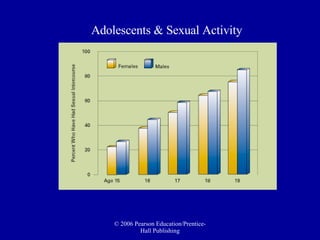
Sexual Intercourse Ages for sexual intercourse have been declining 1 in 5 teens have had sex before the age of 15 80 percent have had sex before the age of 20 Premarital intercourse is viewed as acceptable  Males and females, no more “double standard.”
Adolescents & Sexual Activity
Teen Pregnancy Teen pregnancy rate is declining Still higher  rates in U.S. than in other industrialized countries Teenage mothers do not fare well: Poor health Poor school performance Their children more likely to be teen parents themselves.
Teen Pregnancy As the U.S. is relatively intolerant of premarital sex, there are not enough education programs. Key factors in preventing/breaking the poverty-pregnancy cycle are: Completing high school Postponing future births Require education, supportive family, and  increase in social programs.

Chapter 11 12 Feldman

  • 1.
    Chapter 11 Physicaland Cognitive Development in Adolescence Development Across the Life Span, 4/E Robert S. Feldman © 2006 Pearson Education/Prentice-Hall Publishing
  • 2.
    Adolescence Developmental stagebetween childhood and adulthood. Beginning and ending ages are imprecise
  • 3.
    Physical Maturation GrowthSpurt Extreme changes in height and weight are common Almost matches the growth rate of infancy Average/year: Boys grow 4.1 inches Girls 3.5 inches. Gender Differences: Girls begin about 2 years earlier. By age 13, boys catch up—are taller
  • 4.
    Puberty: The Startof Sexual Maturation PUBERTY is the period when sexual organs mature, beginning earlier for girls than for boys. Pituitary gland (master gland) kicks it off Girls begin puberty about 11 or 12; boys begin at 13 or 14.
  • 5.
    What triggers puberty? Environment Cultural factors MENARCHE 1 st menstruation varies in age beginning SES, nutrition Body fat to muscle ratio Environmental Stress Secular trend
  • 6.
    PRIMARY SEX CHARACTERISTICS involves organs and structures of the body related to reproduction. SECONDARY SEX CHARACTERISTICS involve visible signs of sexual maturity not involved with the sex organs directly. Process of Puberty
  • 7.
    Body Image: Reactionsto Physical Changes in Adolescence Involves adolescent's reactions to the physical changes. Most tend to be happy with their development Timing of puberty is key in adolescent reaction
  • 8.
    The Timing ofPuberty Girls: Early maturation is often difficult Tend to be more popular (maybe too popular) Reactions depend on cultural norms (country and community). Late maturing girls the picture is complicated. Can be overlooked low social status at first However, when they catch up their self-esteem is high.
  • 9.
    The Timing ofPuberty (continued) Boys: Early maturation is generally positive Tend to be better at athletics More popular Positive self-esteem Grow up to be more cooperative and responsible. But also are more likely to have school difficulties and become more involved. Late maturation is difficult for boys. Smaller boys  less attractive disadvantage in sports Can lead to declines in self-concept which can extend into adulthood.
  • 10.
    Nutrition, Food &Eating Disorders During Adolescence Growth spurt requires an increase in food (especially key nutrients such as calcium and iron). Obesity is a common concern during adolescence. 1 in 3 adolescents are overweight; 1 in 20 are obese (body weight 20 % above average) Psychological consequences of body image Potential health consequences High blood pressure; diabetes; likely to be obese adults.
  • 11.
    Anorexia Nervosa andBulimia ANOREXIA NERVOSA severe eating disorder individuals refuse to eat Denial of behavior and appearance  “normal” Primarily affects white women: Control BULIMIA Eating disorder Characterized by binge and purge behavior Vomiting or the use of laxatives Leads to a chemical imbalance with serious effects, including heart failure.
  • 12.
    Brain Development Prefrontalcortex involved in impulse control, thinking, planning, evaluating, making decisions Completely developed in early 20s May explain adolescent’s inability to control impulses and reckless behavior
  • 13.
    Cognitive Development andSchooling FORMAL OPERATIONS PERIOD develop the ability to think abstractly and hypothetically. Enter at about 12 Full capabilities unfold gradually throughout early adolescence (approximately ages 12 to 15) Not everyone achieves formal operational skills some studies estimate that 25 to 50 % of college students do not
  • 14.
    Consequences of UsingFormal Operations (continued) Changes in everyday behavior (use thinking skills): question parents and other authority figures Become more argumentative Poke holes in others explanations Use critical thinking to challenge and see other perspectives Can be challenging for parents
  • 15.
    Egocentrism in AdolescentThinking ADOLESCENT EGOCENTRISM stage of self-absorption where the world is seen only from one's own perspective Characteristics of: highly critical of authority figures unwilling to accept criticism quick to find fault with others. Helps explain why teens often think they’re the focus of everyone’s attention.
  • 16.
    IMAGINARY AUDIENCE whereadolescents think they are the focus of everyone else's attention. PERSONAL FABLES the belief that the adolescent is unique and exceptional and shared by no one else . No one understands me Risk taking behavior Distortions due to Adolescent Egocentrism
  • 17.
    Threats to Adolescents’Well-Being Illegal drug use: Very prevalent and rising In 1990's drug use rose, after decline in the 1980's. Marijuana 20 % of 8 th graders; 40 % of seniors said smoked at least once in the last year. 50%+ seniors have used an illegal drug at least once
  • 18.
    Illegal Drugs Whydo teens use illegal drugs? Perceived pleasurable experience. Escape from daily pressures. The thrill of doing something illegal. A number of role-models use drugs. Peer pressure.
  • 19.
    Smoking declined,but still substantial Reasons why: Messages from society—advertisements Biological and psychological dependency (10  habit) Pleasant emotional state Modeling: Parents’ and peer smoking increases Will prematurely kill 200 million children & teens (worldwide) Tobacco: The Dangers of Smoking
  • 20.
    Sexually Transmitted Diseases AIDS (Acquired Immunodeficiency Syndrome) Sexually transmitted disease Produced by the HIV virus No cure; ultimately causes death Transmission: exchange of bodily fluids (usually sexual contact) AIDS is one of the leading causes of death among young people.
  • 21.
    AIDS and AdolescentBehavior Difficult to motivate adolescents to practice safe sex and change their sexual behavior. Feelings of invulnerability Embarrassment Sense of privacy Forgetfulness
  • 22.
    STD Statistics Howmany will get an STD in one year? Of those sexually active: 3 million teens About 1 person in 8 aged 13-19 About 1 in 4
  • 23.
    3 million teens,about 1 person in 8 aged 13-19 & about 1 in 4 of those who have had sexual intercourse acquire an STD every year. Among the most common: Chlamydia: More common among teens than older adults. 10-29% of sexually active teens & 10% of all teen boys. Genital Herpes: A viral disease that is incurable, indicated by small blisters /sores around the genitals. Trichomoniasis: An infection of the vagina or penis, caused by a parasite. Gonorrhea: Teens aged 15-19 have higher rates than older adults. Syphilis: Infection rates more than doubled between 1986 & 1990 among women aged 15-19.
  • 24.
    Abstinence is theonly certain way to avoid STDs Adolescents need to be encouraged to practice safer sex Use condoms. Avoid high risk behaviors. Know your partner’s sexual history. Consider abstinence.
  • 25.
  • 26.
    Chapter 12 Socialand Personality Development in Adolescence Development Across the Life Span, 4/E Robert S. Feldman © 2006 Pearson Education/Prentice-Hall Publishing
  • 27.
    Identity: Asking "WhoAm I?" Self consciousness takes center stage Focus on “Who am I?” and “Where do I belong in the world?” WHY? Teens become more like adults intellectually and physically
  • 28.
    Self Concept: What Am I Like? Broadens to include both self assessment and others' views. View becomes more organized and coherent Able to see multiple aspects of themselves (which can be confusing at first).
  • 29.
    Identity Formation: Crisisor Change? Erik Erikson Possible psychological difficulties in their search for identity “ the adolescent identity crisis” IDENTITY-VERSUS-IDENTITY-CONFUSION STAGE Adolescents seek to determine what is unique and distinctive about themselves.
  • 30.
    Erikson's IDENTITY-VERSUS-IDENTITY-CONFUSION STAGEIf no identity is found: Sense of self is "diffuse". Social pressure to achieve a secure identity Parents, teachers, etc. Think of the questions high school seniors get asked: Which job track to follow? Attend college? Which one?
  • 31.
    Marcia’s Approach toIdentity Development James Marcia suggests four categories within which either: A crisis a process of consciously choosing between various alternatives and makes decisions A commitment a psychological investment in a course of action or an ideology takes place.
  • 32.
    Marcia’s categories ofadolescent identity IDENTITY ACHIEVEMENT – adolescents consider and explore various alternatives Commitment to one IDENTITY FORECLOSURE – Inadequate or no exploration Commitment made (usually following others' directives).
  • 33.
    Marcia’s categories of adolescent identity (continued) IDENTITY DIFFUSION – adolescents explore various options never commit to one MORATORIUM – adolescents explore no commitment made creates anxiety and conflict
  • 34.
    Marcia’s Categories (continued)Although adolescents are not stuck in one category, research indicates that identity gels by the age of 18. For some, identity formation takes place beyond the adolescent period.
  • 35.
    Teen Depression Depressionhas several causes, including biological, environmental, and social factors. Genetic predisposition Death of loved one Depressed parent Unpopular Few close friends Experiencing rejection
  • 36.
    Girls have higherincidences of depression than boys but the cause is not clear. More stresses on the female gender role? Reactions to stress? Possible that hormones are a factor.
  • 37.
    Adolescent Suicide Rateshave tripled in the last 30 years 3rd most common cause of death Currently, 1 teenage suicide every 90 minutes Gender Differences: More girls attempt suicide More boys succeed Estimated: 200 attempts for every successful suicide.
  • 38.
    Adolescent Suicide Otherfactors in adolescent suicide: Depression Family conflicts History of abuse and/or neglect Drug and alcohol abuse
  • 39.
    Warning Signs Direct or indirect talk I wish I were dead.” “ Don’t worry, I’ll be out of your hair soon.” School difficulties Missed classes, drop in grades Writing a will Changes in eating habits General depression Sleep habits, lack of energy, uncommunicative Dramatic behavior changes Preoccupation with death Art, music, conversation
  • 40.
    Relationships: Family andFriends Family relationships change adolescents begin to question, and sometimes rebel, against their parents' views. Role shift: quest for adulthood and autonomy Adolescents feel obligated to family duties and support.
  • 41.
    Conflicts with ParentsConflicts likely in early adolescence Parents try to discern appropriate conduct Adolescence become argumentative and assertive With trust more, combativeness declines Most family relationships are stable, but about 20% have a rough time
  • 42.
    Relationships with Peers: The Importance of Belonging More critical to adolescents than any other time of life. Provide opportunity for social comparison REFERENCE GROUP, a group of people with whom one compares oneself. Present a set of norms or standards, against which adolescents judge their social success.
  • 43.
    Cliques and CrowdsCLIQUES 2 to 12 people who have frequent interaction CROWDS larger groups where people share some characteristic often don't interact with each other Membership determined by degree of similarity with members in a group Stereotypes: jocks, brains, druggies. Expectations that people behave in specific ways.
  • 44.
    Conformity: Peer Pressurein Adolescence Some highly susceptible to peer pressure Does not rise in adolescence Conformity decreases as adolescents increase their own autonomy Grow in confidence and more able to make decisions Failure to resist conformation can mean trouble
  • 45.
    Dating, Sexual Behavior,and Teen Pregnancy “Hooking Up” Varied meaning: kissing to sexual intercourse Dating serves developmental functions: Learning how to establish intimacy Learning how to engage in entertainment Contributes to an identity in progress Cultural influences effect dating patterns
  • 46.
    Sexual Relationships Pubertycreates a new world of relationship issues and possibilities for teens Research shows that teens think about sex a substantial amount of time each day
  • 47.
    Sexual Relationships Formost, initiation into sexuality begins with masturbation (self stimulation). Masturbation often produces feelings of shame and guilt in the American culture. Experts view masturbation as normal and harmless.
  • 48.
    Sexual Intercourse Agesfor sexual intercourse have been declining 1 in 5 teens have had sex before the age of 15 80 percent have had sex before the age of 20 Premarital intercourse is viewed as acceptable Males and females, no more “double standard.”
  • 49.
  • 50.
    Teen Pregnancy Teenpregnancy rate is declining Still higher rates in U.S. than in other industrialized countries Teenage mothers do not fare well: Poor health Poor school performance Their children more likely to be teen parents themselves.
  • 51.
    Teen Pregnancy Asthe U.S. is relatively intolerant of premarital sex, there are not enough education programs. Key factors in preventing/breaking the poverty-pregnancy cycle are: Completing high school Postponing future births Require education, supportive family, and increase in social programs.