Part III Early Childhood: Psychosocial Development Chapter Ten Emotional Development Play Challenges for Parents Moral Development Becoming Boys and Girls
Learning when and how to express emotions is the preeminent psychosocial accomplishment between ages 2 and 6. emotional regulation:  ability to control when and how emotions are expressed Emotional Development
Initiative Versus Guilt Initiative: saying something new extending a skill  beginning a project Guilt makes child afraid to try new activities. If parents dismiss child’s emotional expressions, children may not learn emotional regulation.
self-esteem:  person’s evaluation of his or her own worth intelligence attractiveness  overall self-concept:  person’s understanding of who he or she is in relation to: self-esteem  personality various traits
Guilt more mature emotion than shame. comes from within the person Shame can be based on what one is, rather than on something one has done. comes from outside and depends on others’ awareness Both help children develop moral values, a topic discussed later in this chapter.
Motivation intrinsic motivation:  drive or reason to pursue a goal that comes from inside a person the need to feel smart or competent extrinsic motivation:  drive or reason to pursue a goal that arises from the need to have one’s achievements rewarded from outside receiving material possessions or another person’s esteem
An Experiment in Motivation In a classic experiment, preschool children are given markers and paper and assigned to one of three groups:  no award expected award (told  before  they had drawn anything) unexpected award ( after  they had drawn) The interpretation was that extrinsic motivation (condition 2) undercut intrinsic motivation.
Externalizing and Internalizing Problems externalizing problems:  expressing powerful feelings through uncontrolled physical or verbal outbursts internalizing problems:  turning one’s emotional distress inward feeling excessively guilty ashamed worthless
Although inborn brain patterns important, the quality of early caregiving makes a difference in children’s ability to regulate their emotions.  A parent who comforts them and helps to calm them down is teaching emotion regulation.
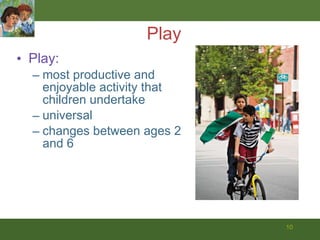
Play Play: most productive and enjoyable activity that children undertake universal changes between ages 2 and 6
Peers and Parents Young children play best with peers Provide practice in:  Emotional regulation Empathy Social Understanding
Cultural Differences in Play Play varies by culture, gender, and age. Play is an ideal means for children to learn whatever social skills are required in the social context.  Chinese children fly kites. Alaskan natives tell dreams and stories. Lapp children pretend to be reindeer.
Solitary play Child plays alone, unaware of any other children playing nearby. Onlooker play Child watches other children play. Parallel play Children play with similar toys in similar ways, but not together. Associative play Children interact, observing each other and sharing material, but not mutual and reciprocal. Cooperative play Children play together, creating and elaborating a joint activity or taking turns. Five Kinds of Play
Rough-and-Tumble Play rough-and-tumble play:  mimics aggression through: wrestling chasing hitting no intent to harm
Drama and Pretending Sociodramatic play allows children to: explore and rehearse social roles enacted around them. test their ability to explain and to convince playmates of their ideas. practice regulating their emotions by pretending to be afraid, angry, brave. develop a self-concept in a nonthreatening context.
Challenges for Parents Parents differ a great deal in what they believe about children and how they should act toward them. Tend to follow the child-rearing patterns of their own parents. Need to decide on a parenting style.
Parenting Styles Expressions of warmth very affectionate or cold and critical Strategies for discipline  how they explain, criticize, persuade, ignore, and punish Communication listen patiently; others demand silence Expectations for maturity parents vary in standards for responsibility and self-control
Three Patterns of Parenting Authoritarian:  Characterized by high behavioral standards, strict punishment of misconduct, and little communication. Permissive:  Characterized by high nurturance and communication but little discipline, guidance, or control. Authoritative:  Parents set limits but listen to the child and are flexible.
Neglectful/Uninvolved Parenting Fourth style of parenting Sometimes mistaken for permissive- but in contract this type of parenting is very careless.  These parents are strikingly unaware in what their child is doing.
Cultural Variations Chinese, Caribbean, and African American parents are often stricter. Japanese mothers tend to use reasoning, empathy and expressions of disappointment. Specific discipline methods and family rules are less important then: parental warmth support concern
Children, Parents, and the New Media What do children see? Good guys as violent as bad guys their violence depicted as justified Good guys are male and White except when all characters are Black or Latino Females of all ethnic groups are usually depicted as: Victims or girlfriends
Moral Development Children develop increasingly complex moral values, judgments, and behaviors. In early childhood, children try to: please their parents. avoid punishment. make friends. exclude enemies.  The emotional development and the theory of mind make morality possible.
Moral Development empathy:  ability to understand emotions and concerns of another person antipathy:  feelings of dislike or even hatred for another antisocial behavior:  feelings and actions that are deliberately hurtful or destructive to another
Types of Aggression instrumental aggression:  hurtful behavior intended to get or keep something that another has reactive aggression:  impulsive retaliation for another person’s intentional or accidental action relational aggression:  nonphysical acts aimed at harming social connection between victim and others bullying aggression:  unprovoked, repeated physical or verbal attack, esp. those who are unlikely to defend themselves
Physical Punishment Young children are slapped, spanked, or beaten more often than children over age 6 or under age 2. Many parents remember being spanked themselves and think spanking works well.  Some researchers agree; some do not.
psychological control:  disciplinary technique involving threatening to withdraw love and support  relies on child’s feelings of guilt and gratitude to parents time-out:  disciplinary technique in which a child is separated from other people for a specified time Social punishment
Becoming Boys and Girls Identity as male or female important feature of a child’s self-concept. first question asked about a newborn is “Boy or girl?”  Children become more aware of gender every year. parents select gender-distinct: clothes  blankets diapers pacifiers, etc.
Sex and Gender sex differences:  biological differences between males and females organs hormones body type gender differences:  differences in the roles and behavior of males and females prescribed by the culture
Psychoanalytic Theory phallic stage:  Freud’s third stage of development; period from ages 3-6 penis becomes the focus of concern and pleasure  Oedipus complex:  unconscious desire of young boys to replace their father and win mother’s exclusive love superego:  judgmental part of the personality that internalizes the moral standards of the parents
Electra complex:  unconscious desire of  girls to replace their mother and win father’s exclusive love identification : attempt to defend one’s self-concept by taking on behaviors and attitudes of someone else; specifically the same-sex parent
Behaviorism Belief that all roles are learned and therefore result from nurture, not nature. Gender distinctions are the product of ongoing reinforcement and punishment.
Cognitive Theory gender schema : cognitive concept or general belief based on one’s experiences
Sociocultural Theory androgyny : balance within a person of traditionally male and female psychological characteristics
Gender and Destiny Since human behavior is plastic, what gender patterns  should  children learn? Answers vary among developmentalists, mothers, fathers, and cultures. If children respond to their own inclinations, some might choose behavior, express emotions, and develop talents that are taboo, even punished in certain cultures.

EDU 145 Ch 10

  • 1.
    Part III EarlyChildhood: Psychosocial Development Chapter Ten Emotional Development Play Challenges for Parents Moral Development Becoming Boys and Girls
  • 2.
    Learning when andhow to express emotions is the preeminent psychosocial accomplishment between ages 2 and 6. emotional regulation: ability to control when and how emotions are expressed Emotional Development
  • 3.
    Initiative Versus GuiltInitiative: saying something new extending a skill beginning a project Guilt makes child afraid to try new activities. If parents dismiss child’s emotional expressions, children may not learn emotional regulation.
  • 4.
    self-esteem: person’sevaluation of his or her own worth intelligence attractiveness overall self-concept: person’s understanding of who he or she is in relation to: self-esteem personality various traits
  • 5.
    Guilt more matureemotion than shame. comes from within the person Shame can be based on what one is, rather than on something one has done. comes from outside and depends on others’ awareness Both help children develop moral values, a topic discussed later in this chapter.
  • 6.
    Motivation intrinsic motivation: drive or reason to pursue a goal that comes from inside a person the need to feel smart or competent extrinsic motivation: drive or reason to pursue a goal that arises from the need to have one’s achievements rewarded from outside receiving material possessions or another person’s esteem
  • 7.
    An Experiment inMotivation In a classic experiment, preschool children are given markers and paper and assigned to one of three groups: no award expected award (told before they had drawn anything) unexpected award ( after they had drawn) The interpretation was that extrinsic motivation (condition 2) undercut intrinsic motivation.
  • 8.
    Externalizing and InternalizingProblems externalizing problems: expressing powerful feelings through uncontrolled physical or verbal outbursts internalizing problems: turning one’s emotional distress inward feeling excessively guilty ashamed worthless
  • 9.
    Although inborn brainpatterns important, the quality of early caregiving makes a difference in children’s ability to regulate their emotions. A parent who comforts them and helps to calm them down is teaching emotion regulation.
  • 10.
    Play Play: mostproductive and enjoyable activity that children undertake universal changes between ages 2 and 6
  • 11.
    Peers and ParentsYoung children play best with peers Provide practice in: Emotional regulation Empathy Social Understanding
  • 12.
    Cultural Differences inPlay Play varies by culture, gender, and age. Play is an ideal means for children to learn whatever social skills are required in the social context. Chinese children fly kites. Alaskan natives tell dreams and stories. Lapp children pretend to be reindeer.
  • 13.
    Solitary play Childplays alone, unaware of any other children playing nearby. Onlooker play Child watches other children play. Parallel play Children play with similar toys in similar ways, but not together. Associative play Children interact, observing each other and sharing material, but not mutual and reciprocal. Cooperative play Children play together, creating and elaborating a joint activity or taking turns. Five Kinds of Play
  • 14.
    Rough-and-Tumble Play rough-and-tumbleplay: mimics aggression through: wrestling chasing hitting no intent to harm
  • 15.
    Drama and PretendingSociodramatic play allows children to: explore and rehearse social roles enacted around them. test their ability to explain and to convince playmates of their ideas. practice regulating their emotions by pretending to be afraid, angry, brave. develop a self-concept in a nonthreatening context.
  • 16.
    Challenges for ParentsParents differ a great deal in what they believe about children and how they should act toward them. Tend to follow the child-rearing patterns of their own parents. Need to decide on a parenting style.
  • 17.
    Parenting Styles Expressionsof warmth very affectionate or cold and critical Strategies for discipline how they explain, criticize, persuade, ignore, and punish Communication listen patiently; others demand silence Expectations for maturity parents vary in standards for responsibility and self-control
  • 18.
    Three Patterns ofParenting Authoritarian: Characterized by high behavioral standards, strict punishment of misconduct, and little communication. Permissive: Characterized by high nurturance and communication but little discipline, guidance, or control. Authoritative: Parents set limits but listen to the child and are flexible.
  • 19.
    Neglectful/Uninvolved Parenting Fourthstyle of parenting Sometimes mistaken for permissive- but in contract this type of parenting is very careless. These parents are strikingly unaware in what their child is doing.
  • 20.
    Cultural Variations Chinese,Caribbean, and African American parents are often stricter. Japanese mothers tend to use reasoning, empathy and expressions of disappointment. Specific discipline methods and family rules are less important then: parental warmth support concern
  • 21.
    Children, Parents, andthe New Media What do children see? Good guys as violent as bad guys their violence depicted as justified Good guys are male and White except when all characters are Black or Latino Females of all ethnic groups are usually depicted as: Victims or girlfriends
  • 22.
    Moral Development Childrendevelop increasingly complex moral values, judgments, and behaviors. In early childhood, children try to: please their parents. avoid punishment. make friends. exclude enemies. The emotional development and the theory of mind make morality possible.
  • 23.
    Moral Development empathy: ability to understand emotions and concerns of another person antipathy: feelings of dislike or even hatred for another antisocial behavior: feelings and actions that are deliberately hurtful or destructive to another
  • 24.
    Types of Aggressioninstrumental aggression: hurtful behavior intended to get or keep something that another has reactive aggression: impulsive retaliation for another person’s intentional or accidental action relational aggression: nonphysical acts aimed at harming social connection between victim and others bullying aggression: unprovoked, repeated physical or verbal attack, esp. those who are unlikely to defend themselves
  • 25.
    Physical Punishment Youngchildren are slapped, spanked, or beaten more often than children over age 6 or under age 2. Many parents remember being spanked themselves and think spanking works well. Some researchers agree; some do not.
  • 26.
    psychological control: disciplinary technique involving threatening to withdraw love and support relies on child’s feelings of guilt and gratitude to parents time-out: disciplinary technique in which a child is separated from other people for a specified time Social punishment
  • 27.
    Becoming Boys andGirls Identity as male or female important feature of a child’s self-concept. first question asked about a newborn is “Boy or girl?” Children become more aware of gender every year. parents select gender-distinct: clothes blankets diapers pacifiers, etc.
  • 28.
    Sex and Gendersex differences: biological differences between males and females organs hormones body type gender differences: differences in the roles and behavior of males and females prescribed by the culture
  • 29.
    Psychoanalytic Theory phallicstage: Freud’s third stage of development; period from ages 3-6 penis becomes the focus of concern and pleasure Oedipus complex: unconscious desire of young boys to replace their father and win mother’s exclusive love superego: judgmental part of the personality that internalizes the moral standards of the parents
  • 30.
    Electra complex: unconscious desire of girls to replace their mother and win father’s exclusive love identification : attempt to defend one’s self-concept by taking on behaviors and attitudes of someone else; specifically the same-sex parent
  • 31.
    Behaviorism Belief thatall roles are learned and therefore result from nurture, not nature. Gender distinctions are the product of ongoing reinforcement and punishment.
  • 32.
    Cognitive Theory genderschema : cognitive concept or general belief based on one’s experiences
  • 33.
    Sociocultural Theory androgyny: balance within a person of traditionally male and female psychological characteristics
  • 34.
    Gender and DestinySince human behavior is plastic, what gender patterns should children learn? Answers vary among developmentalists, mothers, fathers, and cultures. If children respond to their own inclinations, some might choose behavior, express emotions, and develop talents that are taboo, even punished in certain cultures.