Chapter 8
Socioemotional Development in
Middle and Late Childhood

6-11 Years-of-Age
PowerPoints developed by Jenni Fauchier,
Butchered by Professor Carney
6-11 Years-of-Age

1
http://www.youtube.com/watch?v=ir8BO4-7DkM

6-11 Years-of-Age

2
The Development of SelfUnderstanding  
• Increasingly describe selves with
psychological characteristics & traits
– Ex:
• Popular
• Nice
• Smart

6-11 Years-of-Age

3
The Development of SelfUnderstanding  

• More likely:

– Recognize social aspects of self
• Include groups they belong to
– Girl Scouts
– Christian

– What do I do in comparison to others?
• Previous stage
– What I do or don’t do

6-11 Years-of-Age

4
Self-Esteem & Self-Concept  
• Personal perceptions match reality?
• Maybe

• Self-concept
– Self-evaluate in many areas
• Academic
• Athletic
• Appearance
– How might this affect a child?
6-11 Years-of-Age

5
Self-Efficacy

• Self-efficacy

– Belief that one can master a situation
& produce favorable outcomes
• Low self-efficacy for learning
– May avoid many learning tasks,
especially challenging ones
• Math: know it when I grow up

• High-self-efficacy for learning
– Eagerly work at learning tasks
6-11 Years-of-Age

6
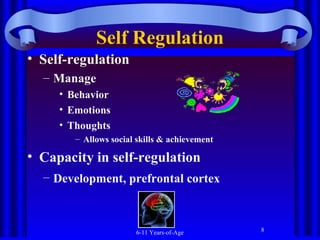
Self Regulation
• Self-regulation
– Manage
• Behavior
• Emotions
• Thoughts
– Allows social skills & achievement

• Capacity in self-regulation
– Development, prefrontal cortex

6-11 Years-of-Age

8
Developmental Changes in
Emotion
• Better understanding of emotions
• Can experience more than 1 emotion at a
time.
– Angry sister broke your toy
– Sad you don’t have toy

• Increased awareness of events leading to
emotional reactions
– “She hit me so I smashed her toy.”

6-11 Years-of-Age

9
Developmental Changes in
Emotion
• Ability to suppress or conceal
– Negative feelings

• Strategies for redirecting feelings
– Self-soothing after upset
• Play with favorite toy

• Capacity for genuine empathy

6-11 Years-of-Age

10
Kohlberg Stages
• Based on Piaget
• 6 stages of
moral
development
• Believed
universal

6-11 Years-of-Age

11
6-11 Years-of-Age

12
http://www.youtube.com/watch?v=O7pQJ0ptjk0
Kohlberg Stages

6-11 Years-of-Age

13
Kohlberg's Moral Development
Theory
• http://www.youtube.c
om/watch?
v=zY4etXWYS84

6-11 Years-of-Age

14
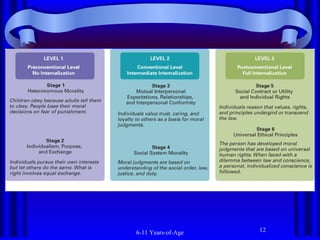
Kohlberg Stages
• 3 Levels
– Level 1: Preconventional reasoning
– Level 2: Conventional reasoning
– Level 3: Postconventional reasoning

• 6 Stages
– 2 stages in each level
– (Need to keep in mind the 3 levels only)

6-11 Years-of-Age

15
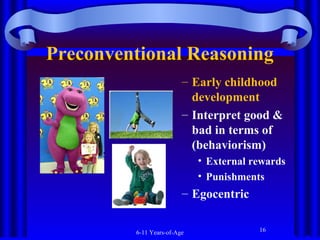
Preconventional Reasoning
– Early childhood
development
– Interpret good &
bad in terms of
(behaviorism)
• External rewards
• Punishments

– Egocentric
6-11 Years-of-Age

16
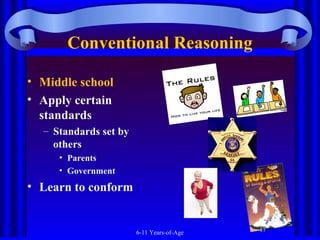
Conventional Reasoning
• Middle school
• Apply certain
standards
– Standards set by
others
• Parents
• Government

• Learn to conform

6-11 Years-of-Age

17
Postconventional Reasoning

• Usually college years
• Recognize alternative
moral courses
– Explore options
– Decide on personal
moral code

6-11 Years-of-Age

18
Kohlberg Stages Research
• Moral stages appeared later than
Kohlberg envisioned.
• Reasoning at Stage 6 rare.

6-11 Years-of-Age

19
Physical Development
• Females

• Males

– Longer life
expectancy
– Less likely to develop
• physical disorders
• mental disorders

– 10% taller
– 2X’s risk of
coronary disease
– Hormones

– More depression

– Hormones
• Stop growth of long
bones at puberty

6-11 Years-of-Age

• Promote growth of
long bones

20
Physical Development
• Females

• Males

– Brain smaller

– Larger

• More folds

– Portions of corpus
callosum larger
– Areas involved in
emotional
expression show
more activity
6-11 Years-of-Age

• Part of
hypothalamus
related to sex
• Area of parietal
lobe larger
– Visuospatial
skills
21
Cognitive Development
• Males better
– Math
– Visuospatial skills

• Females better
– Verbal abilities

• Later studies
– Verbal differences between females & males
virtually disappeared
– Math & visuospatial differences still existed
• Have cognitive differences between females & males
been exaggerated?
6-11 Years-of-Age

22
Aggresion
• Who is more aggressive M or F?

6-11 Years-of-Age

23
Socioemotional Development
• Aggression:
– Boys more physically aggressive
– Girls more verbally aggressive
• Spread malicious rumors
• Ignoring someone when angry

• Boys more likely to hide
– Negative emotions

• Girls less likely to express
– Disappointment that might hurt others’ feelings
6-11 Years-of-Age

24
Gender Differences in Prosocial Behavior
• Prosocial behavior
– Acting to help another person, particularly
when only goal is to help.
• Females
– View selves as more prosocial & empathic
– Across childhood & adolescence, engage in more
prosocial behavior

• Biggest gender difference occurs for kind &
considerate behavior
• Smaller difference in sharing
6-11 Years-of-Age

25
Developmental Changes
in Parent-Child Relationships
• Parents
– spend less time with children
– continue to be important
– support & stimulate academic achievement

• Children
– less physical discipline than they did as
preschoolers
– more self-regulation
6-11 Years-of-Age

26
Developmental Changes in Peer
Relations
• Peers
– Socializing time increases
– Group size increases
– Less supervision
– Same-sex groups preferred
• Until age 12

6-11 Years-of-Age

27
Being Popular
• Popular children
–
–
–
–
–
–
–
–

reinforce others
listen
open lines of communication with peers
happy
control negative emotions
show enthusiasm
show empathy
self-confident , not conceited
6-11 Years-of-Age

28
Other Statuses
• Neglected children
– Low rates of interaction with peers
– Described as shy by peers

• Rejected children
– Often more serious adjustment
problems than those neglected

– Some are aggressive
6-11 Years-of-Age

29
Bullying
• Bullied children
– Reported
• More loneliness
• Difficulty making friends

• Victimized
– Anxious & socially withdrawn children
• Non-threatening & unlikely to retaliate

– Aggressive children
• May be targets because their behavior is irritating
to bullies
6-11 Years-of-Age

31
Bullying Cont.
• Victims
– more headaches
– more abdominal pain
– sleeping problems
– tired
– more depression
• Bullies
– More likely to have a poor academic record
– Smoke
– Drink alcohol
6-11 Years-of-Age

32
Functions of Friendships
• Children’s friendships serve what
functions?

6-11 Years-of-Age

33
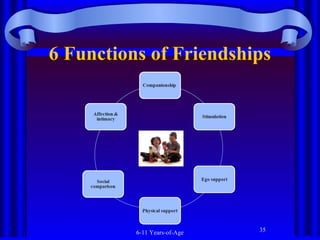
6 Functions of Friendships

6-11 Years-of-Age

35
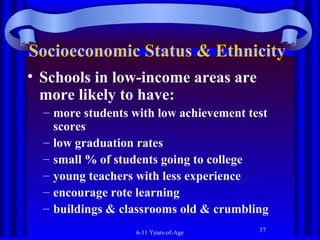
Socioeconomic Status & Ethnicity
• Schools in low-income areas are
more likely to have:
– more students with low achievement test
scores
– low graduation rates
– small % of students going to college
– young teachers with less experience
– encourage rote learning
– buildings & classrooms old & crumbling
6-11 Years-of-Age

37
Newsletter
• Newsletter 6-11 yrs.

6-11 Years-of-Age

39

Life span chapter 8

  • 1.
    Chapter 8 Socioemotional Developmentin Middle and Late Childhood 6-11 Years-of-Age PowerPoints developed by Jenni Fauchier, Butchered by Professor Carney 6-11 Years-of-Age 1
  • 2.
  • 3.
    The Development ofSelfUnderstanding   • Increasingly describe selves with psychological characteristics & traits – Ex: • Popular • Nice • Smart 6-11 Years-of-Age 3
  • 4.
    The Development ofSelfUnderstanding   • More likely: – Recognize social aspects of self • Include groups they belong to – Girl Scouts – Christian – What do I do in comparison to others? • Previous stage – What I do or don’t do 6-11 Years-of-Age 4
  • 5.
    Self-Esteem & Self-Concept  • Personal perceptions match reality? • Maybe • Self-concept – Self-evaluate in many areas • Academic • Athletic • Appearance – How might this affect a child? 6-11 Years-of-Age 5
  • 6.
    Self-Efficacy • Self-efficacy – Beliefthat one can master a situation & produce favorable outcomes • Low self-efficacy for learning – May avoid many learning tasks, especially challenging ones • Math: know it when I grow up • High-self-efficacy for learning – Eagerly work at learning tasks 6-11 Years-of-Age 6
  • 7.
    Self Regulation • Self-regulation –Manage • Behavior • Emotions • Thoughts – Allows social skills & achievement • Capacity in self-regulation – Development, prefrontal cortex 6-11 Years-of-Age 8
  • 8.
    Developmental Changes in Emotion •Better understanding of emotions • Can experience more than 1 emotion at a time. – Angry sister broke your toy – Sad you don’t have toy • Increased awareness of events leading to emotional reactions – “She hit me so I smashed her toy.” 6-11 Years-of-Age 9
  • 9.
    Developmental Changes in Emotion •Ability to suppress or conceal – Negative feelings • Strategies for redirecting feelings – Self-soothing after upset • Play with favorite toy • Capacity for genuine empathy 6-11 Years-of-Age 10
  • 10.
    Kohlberg Stages • Basedon Piaget • 6 stages of moral development • Believed universal 6-11 Years-of-Age 11
  • 11.
  • 12.
  • 13.
    Kohlberg's Moral Development Theory •http://www.youtube.c om/watch? v=zY4etXWYS84 6-11 Years-of-Age 14
  • 14.
    Kohlberg Stages • 3Levels – Level 1: Preconventional reasoning – Level 2: Conventional reasoning – Level 3: Postconventional reasoning • 6 Stages – 2 stages in each level – (Need to keep in mind the 3 levels only) 6-11 Years-of-Age 15
  • 15.
    Preconventional Reasoning – Earlychildhood development – Interpret good & bad in terms of (behaviorism) • External rewards • Punishments – Egocentric 6-11 Years-of-Age 16
  • 16.
    Conventional Reasoning • Middleschool • Apply certain standards – Standards set by others • Parents • Government • Learn to conform 6-11 Years-of-Age 17
  • 17.
    Postconventional Reasoning • Usuallycollege years • Recognize alternative moral courses – Explore options – Decide on personal moral code 6-11 Years-of-Age 18
  • 18.
    Kohlberg Stages Research •Moral stages appeared later than Kohlberg envisioned. • Reasoning at Stage 6 rare. 6-11 Years-of-Age 19
  • 19.
    Physical Development • Females •Males – Longer life expectancy – Less likely to develop • physical disorders • mental disorders – 10% taller – 2X’s risk of coronary disease – Hormones – More depression – Hormones • Stop growth of long bones at puberty 6-11 Years-of-Age • Promote growth of long bones 20
  • 20.
    Physical Development • Females •Males – Brain smaller – Larger • More folds – Portions of corpus callosum larger – Areas involved in emotional expression show more activity 6-11 Years-of-Age • Part of hypothalamus related to sex • Area of parietal lobe larger – Visuospatial skills 21
  • 21.
    Cognitive Development • Malesbetter – Math – Visuospatial skills • Females better – Verbal abilities • Later studies – Verbal differences between females & males virtually disappeared – Math & visuospatial differences still existed • Have cognitive differences between females & males been exaggerated? 6-11 Years-of-Age 22
  • 22.
    Aggresion • Who ismore aggressive M or F? 6-11 Years-of-Age 23
  • 23.
    Socioemotional Development • Aggression: –Boys more physically aggressive – Girls more verbally aggressive • Spread malicious rumors • Ignoring someone when angry • Boys more likely to hide – Negative emotions • Girls less likely to express – Disappointment that might hurt others’ feelings 6-11 Years-of-Age 24
  • 24.
    Gender Differences inProsocial Behavior • Prosocial behavior – Acting to help another person, particularly when only goal is to help. • Females – View selves as more prosocial & empathic – Across childhood & adolescence, engage in more prosocial behavior • Biggest gender difference occurs for kind & considerate behavior • Smaller difference in sharing 6-11 Years-of-Age 25
  • 25.
    Developmental Changes in Parent-ChildRelationships • Parents – spend less time with children – continue to be important – support & stimulate academic achievement • Children – less physical discipline than they did as preschoolers – more self-regulation 6-11 Years-of-Age 26
  • 26.
    Developmental Changes inPeer Relations • Peers – Socializing time increases – Group size increases – Less supervision – Same-sex groups preferred • Until age 12 6-11 Years-of-Age 27
  • 27.
    Being Popular • Popularchildren – – – – – – – – reinforce others listen open lines of communication with peers happy control negative emotions show enthusiasm show empathy self-confident , not conceited 6-11 Years-of-Age 28
  • 28.
    Other Statuses • Neglectedchildren – Low rates of interaction with peers – Described as shy by peers • Rejected children – Often more serious adjustment problems than those neglected – Some are aggressive 6-11 Years-of-Age 29
  • 29.
    Bullying • Bullied children –Reported • More loneliness • Difficulty making friends • Victimized – Anxious & socially withdrawn children • Non-threatening & unlikely to retaliate – Aggressive children • May be targets because their behavior is irritating to bullies 6-11 Years-of-Age 31
  • 30.
    Bullying Cont. • Victims –more headaches – more abdominal pain – sleeping problems – tired – more depression • Bullies – More likely to have a poor academic record – Smoke – Drink alcohol 6-11 Years-of-Age 32
  • 31.
    Functions of Friendships •Children’s friendships serve what functions? 6-11 Years-of-Age 33
  • 32.
    6 Functions ofFriendships 6-11 Years-of-Age 35
  • 33.
    Socioeconomic Status &Ethnicity • Schools in low-income areas are more likely to have: – more students with low achievement test scores – low graduation rates – small % of students going to college – young teachers with less experience – encourage rote learning – buildings & classrooms old & crumbling 6-11 Years-of-Age 37
  • 34.
    Newsletter • Newsletter 6-11yrs. 6-11 Years-of-Age 39