CHAPTER 9   Physical & Cognitive Development in Adolescence
Physical Maturational Changes   Signs of Puberty Puberty is the end of childhood & the beginning of adolescence seen in physical and sexual growth Physical Growth: Gains for both boys & girls Girls begin generally 2 years earlier than boys Growth spurt where bones become longer & denser Muscle growth in boys & girls more pronounced growth in boys body fat increase Increases more rapidly in girls heart & lung capacity increases more in boys
Sexual Maturation   Primary Sexual Characteristics Organs directly involved in sexual reproduction Secondary Sexual Characteristics Physical signs of maturity not directly linked to the reproductive organs Changes in primary & secondary sexual characteristics occur in a predictable sequence for boys & girls For girls, puberty begins w/growth of the breasts & a growth spurt, followed by pubic hair Menarch – the onset of menstruation  typically occurs about 13 For boys, puberty usually starts w/growth of the testes & scrotum followed by pubic hair, a growth spurt, & growth of the penis Spermarche – 1st spontaneous ejaculation of sperm-laden fluid  typically occurs about age 13
Mechanisms of Maturation   Hypothalamus sends hormones to the pituitary gland triggering release of growth hormones Timing of puberty’s events regulated, in part, by genetics Genetic forces greatly influenced by environmental factors Nutrition & health Puberty occurs earlier in those well-nourished & healthy Social environment also influences puberty’s onset for girls Menarche occurs in younger girls due to family conflict Psychological Impact of Puberty Body image: Adolescents more concerned about overall appearance Girls worry more about & more dissatisfied with their appearance Boys concerned about appearance in early adolescence & become more pleased as changes occur
Response to Menarche & Spermarche   Menarche is private occasion in industrialized countries Celebrated with traditions in older cultures Presentation Rites and Rites of Passage Reaction to spermarche less known because of previous knowledge of boys Rate of maturation Early & late maturation: Early maturing boys perceived as more mature & may be more willing to take adult-like responsibilities Late maturing boys often treated like little boys instead of young men Early maturing girls tend to be encouraged to engage in age-appropriate activities such as drinking, smoking, & sex
Sexual Relations Masturbation Sexual self-stimulation By age 15, 80% of boys & 20% of girls report masturbating Can still produce guilt feelings Now viewed as normal & harmless Sexual Intercourse About 50% of adolescents begin intercourse between 15 & 18 years 10% are postponing sex Double-standard Permissible for males, not for females For many girls, it is okay with affection
Pregnancy Statistics Teen pregnancies have dropped 30% in the last 10 years 43 of 1000 births is a teen Pledges in sex classes are useless Teen pregnancies in the U.S. are still 2 – 10 X higher than most other industrialized countries Caring for the child generally goes to the mother with little or no help from the father
Sexual Orientation Heterosexuality Sexual attraction & behavior with members of the opposite sex Homosexuality Sexual attraction & behavior with members of the same sex Gay: male homosexuals Lesbian: female homosexuals Bisexuality Sexual attraction & behavior with members of either sex Gender Identity The gender a person believes he or she is psychologically
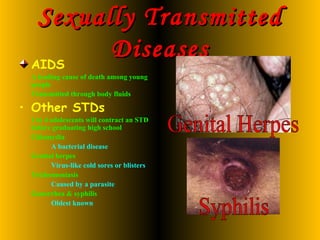
Sexually Transmitted Diseases AIDS A leading cause of death among young people Transmitted through body fluids Other STDs 1 in 4 adolescents will contract an STD before graduating high school Chlamydia A bacterial disease Genital herpes Virus-like cold sores or blisters Trichomoniasis Caused by a parasite Gonorrhea & syphilis Oldest known Genital Herpes Syphilis
Health & Nutrition Obesity Body mass index  (BMI) Adjusted ratio of weight to height Number of overweight children doubled in past 25 – 30 years Number of overweight adolescents tripled Overweight youngsters unpopular & w/low self-esteem At risk for medical problems Heredity plays a role in juvenile obesity Genes influence obesity by influencing activity level Being genetically prone to inactivity makes it more difficult to burn off calories & easier to gain weight Genes sets up the  basal metabolic rate Speed at which the body consumes calories Slower BMR burns off calories more slowly
Health   & Nutrition Environment influences weight Many external cues to eat the wrong foods, ads on the media, encouraging youth to eat tasty but fattening foods Can lose weight with a program that contains: 1. Focus on eating habits & encouragement to become more active 2. Monitoring eating, exercise, & sedentary behaviors Parents help by monitoring their own lifestyle and to set realistic goals & help children reach those goals 3. Eat very little fast food
Threats to Well-being Illegal Drugs 50% of U.S. high school seniors & 20% of 8 th  graders used marijuana in the past year Reasons for use Pleasurable experiences Everyday pressures Peer pressures Thrill of doing  something illegal Addictive Drugs Drugs producing a biological or psychological dependence leading to cravings Physiological dependence Psychological dependence
Legal Drugs Alcohol Binge drinking a “tradition” on college campuses Reasons adolescents start drinking Release inhibitions Reduce tensions & stress Family patterns & genetics play a role Tobacco Nicotine is 4 ½ X more addicting than heroin Produces psychological & physiological addiction Produces a quick dependency Produces pleasant emotional state Seeing parents & peers smoking increases chances of starting
Anorexia & Bulimia   Anorexia nervosa Disorder marked by a persistent refusal to eat & an irrational fear of being overweight Have a grossly distorted body image Bulimia nervosa Alternate between binge eating & purging via vomiting or laxatives Commonality in all bulimia is the feeling of not being able to stop eating
Piaget Formal Operations Abstract thinking using formal logic Hypotheticodeductive reasoning; Start with a general theory about  what produces a particular outcome  then deduce explanations for  specific situations in which that  particular outcome is seen Can begin with abstract possibilities & move to the concrete Propositional thought: Reasoning that uses abstract logic  in the absence of concrete examples It’s a gradual unfolding Culture influences the operations
Adolescent Egocentricism   Imaginary Audience The adolescent belief that others are as interested in them as they themselves are. The attention-getting behavior is motivated by a desire to be noticed, visible, and “on stage.” Personal Fable The part of adolescent egocentricism that involves their view of their uniqueness and invincibility. It is often seen in the belief that they’ll never suffer horrendous experiences that happen to other people .
Information Processing Information Processing Approach Seeks to identify the way that we take in, use, & store information Metacognition Knowledge that people have about their own thinking processes & their ability to monitor them Decision Making Dating, sex, work or college, friends, etc. Critical Thinking Many even into the 11 th  grade still have a self-serving bias in their reasoning
School Performance 78% of U.S. High School Students Graduate SES Scores Middle- & high-SES students score higher grades on standardized tests of achievement & complete more years of education Poverty contributes to lower scores, less years of education, etc.
Ethnic/Racial Differences in Performance African American & Hispanic Performance Asian Americans performance higher Difference in part to SES & their view of education Education is less important than getting a job Hard work in school has no  payoff Beliefs Regarding Academic Success African Americans more apt to view success as the result of external causes, luck, or social biases They have no control over their  success Adolescent beliefs about the consequences of not doing will may also contribute to the differences in school performance
Dropping Out Statistics ½ million drop out each year Earn 42% less than high school grads Unemployment rate for drop outs is 50% Males drop out more than females Hispanic & African Americans are more likely to drop out Poverty plays a major role in who completes high school

G & D Ch. 9

  • 1.
    CHAPTER 9 Physical & Cognitive Development in Adolescence
  • 2.
    Physical Maturational Changes Signs of Puberty Puberty is the end of childhood & the beginning of adolescence seen in physical and sexual growth Physical Growth: Gains for both boys & girls Girls begin generally 2 years earlier than boys Growth spurt where bones become longer & denser Muscle growth in boys & girls more pronounced growth in boys body fat increase Increases more rapidly in girls heart & lung capacity increases more in boys
  • 3.
    Sexual Maturation Primary Sexual Characteristics Organs directly involved in sexual reproduction Secondary Sexual Characteristics Physical signs of maturity not directly linked to the reproductive organs Changes in primary & secondary sexual characteristics occur in a predictable sequence for boys & girls For girls, puberty begins w/growth of the breasts & a growth spurt, followed by pubic hair Menarch – the onset of menstruation typically occurs about 13 For boys, puberty usually starts w/growth of the testes & scrotum followed by pubic hair, a growth spurt, & growth of the penis Spermarche – 1st spontaneous ejaculation of sperm-laden fluid typically occurs about age 13
  • 4.
    Mechanisms of Maturation Hypothalamus sends hormones to the pituitary gland triggering release of growth hormones Timing of puberty’s events regulated, in part, by genetics Genetic forces greatly influenced by environmental factors Nutrition & health Puberty occurs earlier in those well-nourished & healthy Social environment also influences puberty’s onset for girls Menarche occurs in younger girls due to family conflict Psychological Impact of Puberty Body image: Adolescents more concerned about overall appearance Girls worry more about & more dissatisfied with their appearance Boys concerned about appearance in early adolescence & become more pleased as changes occur
  • 5.
    Response to Menarche& Spermarche Menarche is private occasion in industrialized countries Celebrated with traditions in older cultures Presentation Rites and Rites of Passage Reaction to spermarche less known because of previous knowledge of boys Rate of maturation Early & late maturation: Early maturing boys perceived as more mature & may be more willing to take adult-like responsibilities Late maturing boys often treated like little boys instead of young men Early maturing girls tend to be encouraged to engage in age-appropriate activities such as drinking, smoking, & sex
  • 6.
    Sexual Relations MasturbationSexual self-stimulation By age 15, 80% of boys & 20% of girls report masturbating Can still produce guilt feelings Now viewed as normal & harmless Sexual Intercourse About 50% of adolescents begin intercourse between 15 & 18 years 10% are postponing sex Double-standard Permissible for males, not for females For many girls, it is okay with affection
  • 7.
    Pregnancy Statistics Teenpregnancies have dropped 30% in the last 10 years 43 of 1000 births is a teen Pledges in sex classes are useless Teen pregnancies in the U.S. are still 2 – 10 X higher than most other industrialized countries Caring for the child generally goes to the mother with little or no help from the father
  • 8.
    Sexual Orientation HeterosexualitySexual attraction & behavior with members of the opposite sex Homosexuality Sexual attraction & behavior with members of the same sex Gay: male homosexuals Lesbian: female homosexuals Bisexuality Sexual attraction & behavior with members of either sex Gender Identity The gender a person believes he or she is psychologically
  • 9.
    Sexually Transmitted DiseasesAIDS A leading cause of death among young people Transmitted through body fluids Other STDs 1 in 4 adolescents will contract an STD before graduating high school Chlamydia A bacterial disease Genital herpes Virus-like cold sores or blisters Trichomoniasis Caused by a parasite Gonorrhea & syphilis Oldest known Genital Herpes Syphilis
  • 10.
    Health & NutritionObesity Body mass index (BMI) Adjusted ratio of weight to height Number of overweight children doubled in past 25 – 30 years Number of overweight adolescents tripled Overweight youngsters unpopular & w/low self-esteem At risk for medical problems Heredity plays a role in juvenile obesity Genes influence obesity by influencing activity level Being genetically prone to inactivity makes it more difficult to burn off calories & easier to gain weight Genes sets up the basal metabolic rate Speed at which the body consumes calories Slower BMR burns off calories more slowly
  • 11.
    Health & Nutrition Environment influences weight Many external cues to eat the wrong foods, ads on the media, encouraging youth to eat tasty but fattening foods Can lose weight with a program that contains: 1. Focus on eating habits & encouragement to become more active 2. Monitoring eating, exercise, & sedentary behaviors Parents help by monitoring their own lifestyle and to set realistic goals & help children reach those goals 3. Eat very little fast food
  • 12.
    Threats to Well-beingIllegal Drugs 50% of U.S. high school seniors & 20% of 8 th graders used marijuana in the past year Reasons for use Pleasurable experiences Everyday pressures Peer pressures Thrill of doing something illegal Addictive Drugs Drugs producing a biological or psychological dependence leading to cravings Physiological dependence Psychological dependence
  • 13.
    Legal Drugs AlcoholBinge drinking a “tradition” on college campuses Reasons adolescents start drinking Release inhibitions Reduce tensions & stress Family patterns & genetics play a role Tobacco Nicotine is 4 ½ X more addicting than heroin Produces psychological & physiological addiction Produces a quick dependency Produces pleasant emotional state Seeing parents & peers smoking increases chances of starting
  • 14.
    Anorexia & Bulimia Anorexia nervosa Disorder marked by a persistent refusal to eat & an irrational fear of being overweight Have a grossly distorted body image Bulimia nervosa Alternate between binge eating & purging via vomiting or laxatives Commonality in all bulimia is the feeling of not being able to stop eating
  • 15.
    Piaget Formal OperationsAbstract thinking using formal logic Hypotheticodeductive reasoning; Start with a general theory about what produces a particular outcome then deduce explanations for specific situations in which that particular outcome is seen Can begin with abstract possibilities & move to the concrete Propositional thought: Reasoning that uses abstract logic in the absence of concrete examples It’s a gradual unfolding Culture influences the operations
  • 16.
    Adolescent Egocentricism Imaginary Audience The adolescent belief that others are as interested in them as they themselves are. The attention-getting behavior is motivated by a desire to be noticed, visible, and “on stage.” Personal Fable The part of adolescent egocentricism that involves their view of their uniqueness and invincibility. It is often seen in the belief that they’ll never suffer horrendous experiences that happen to other people .
  • 17.
    Information Processing InformationProcessing Approach Seeks to identify the way that we take in, use, & store information Metacognition Knowledge that people have about their own thinking processes & their ability to monitor them Decision Making Dating, sex, work or college, friends, etc. Critical Thinking Many even into the 11 th grade still have a self-serving bias in their reasoning
  • 18.
    School Performance 78%of U.S. High School Students Graduate SES Scores Middle- & high-SES students score higher grades on standardized tests of achievement & complete more years of education Poverty contributes to lower scores, less years of education, etc.
  • 19.
    Ethnic/Racial Differences inPerformance African American & Hispanic Performance Asian Americans performance higher Difference in part to SES & their view of education Education is less important than getting a job Hard work in school has no payoff Beliefs Regarding Academic Success African Americans more apt to view success as the result of external causes, luck, or social biases They have no control over their success Adolescent beliefs about the consequences of not doing will may also contribute to the differences in school performance
  • 20.
    Dropping Out Statistics½ million drop out each year Earn 42% less than high school grads Unemployment rate for drop outs is 50% Males drop out more than females Hispanic & African Americans are more likely to drop out Poverty plays a major role in who completes high school