Early and Middle
Adulthood
By C Settley
2016
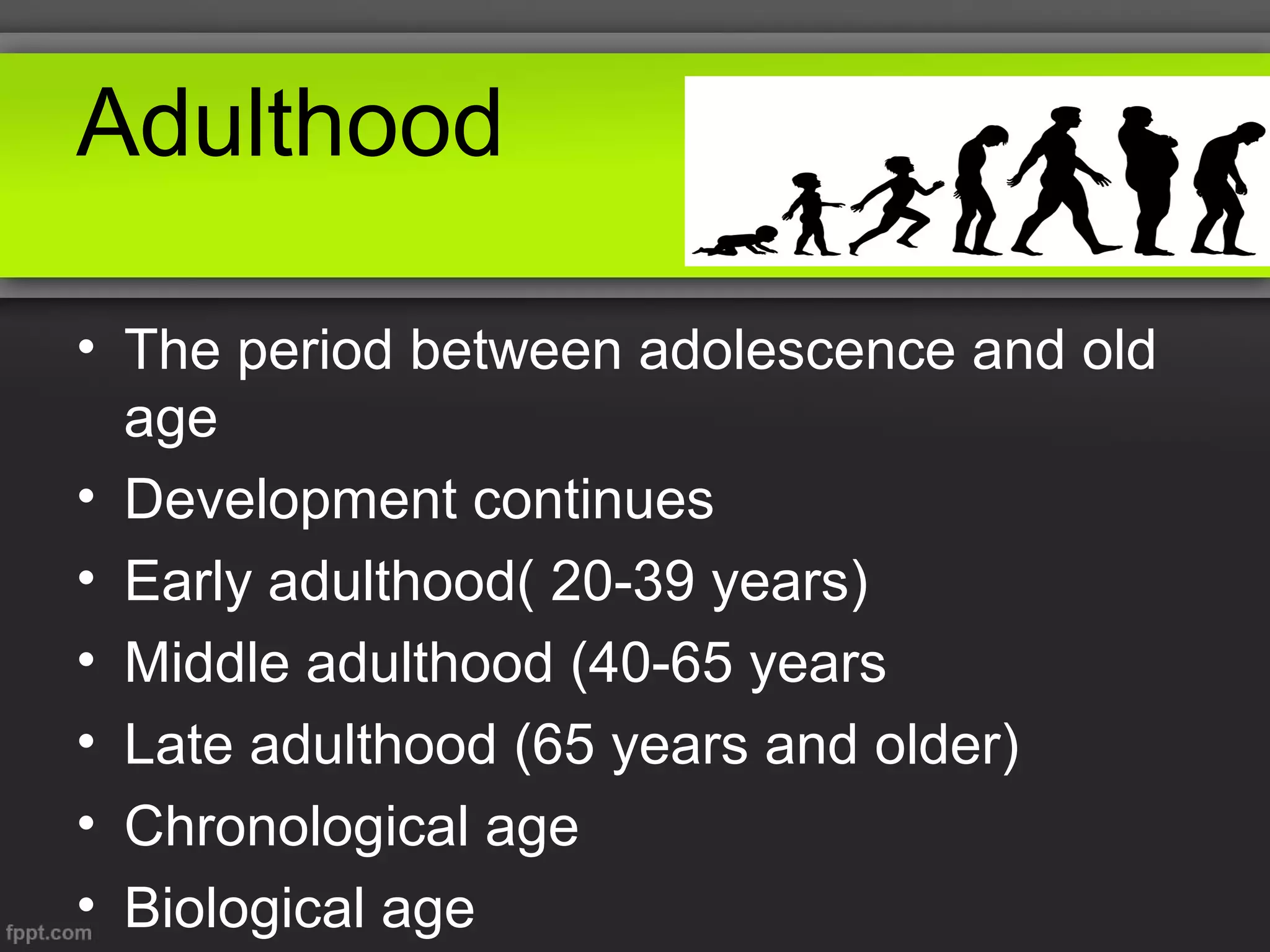
Adulthood
• The period between adolescence and old
age
• Development continues
• Early adulthood( 20-39 years)
• Middle adulthood (40-65 years
• Late adulthood (65 years and older)
• Chronological age
• Biological age
Page 472 in Human Development
Models of adulthood:
The stability model
• Based on the assumption that behaviour
remains relatively stable once the level of
optimal functioning has been reached.
• This assumption also applies to personality traits
established at an early age and which tend to
change little, for example emotional liability
(stability) or its counterpart emotional calm, and
openness or its opposite, rigidity (applying rules,
regardless).
Models of adulthood:
The irreversible decline model
• Based on the assumption that decline,
particularly after middle age, is inevitable
and irreversible.
• It is applicable particularly to the period of
late adulthood and draws attention to
those characteristics strongly affected by
the decline of sensory and motor abilities.
Models of adulthood:
The decline with compensation model
• Falls somewhere between the previously
mentioned models.
• Eg it accepts that fluid intelligence (the
ability to think abstractly) may decline, but
it is compensated for, counteracted by
experience and knowledge as reflected in
crystallised intelligence.
Models of adulthood:
The developmental model
• This model implies that adults continue to
develop their adult potential.
• Theorists emphasise that periods of crisis
and tension are part of the developmental
process, particularly if they lead to new
adaptation and insights (New
experiences).
Stages of adulthood
• Early and middle adulthood is extremely
difficult to demarcate.
• Similar characteristics.
• The development from one period to
another is called the transitional period.
Developmental tasks- page 474
Physical development
• Peak is generally reached at the age of
between 20-30 years old.
• Gradual decline afterwards.
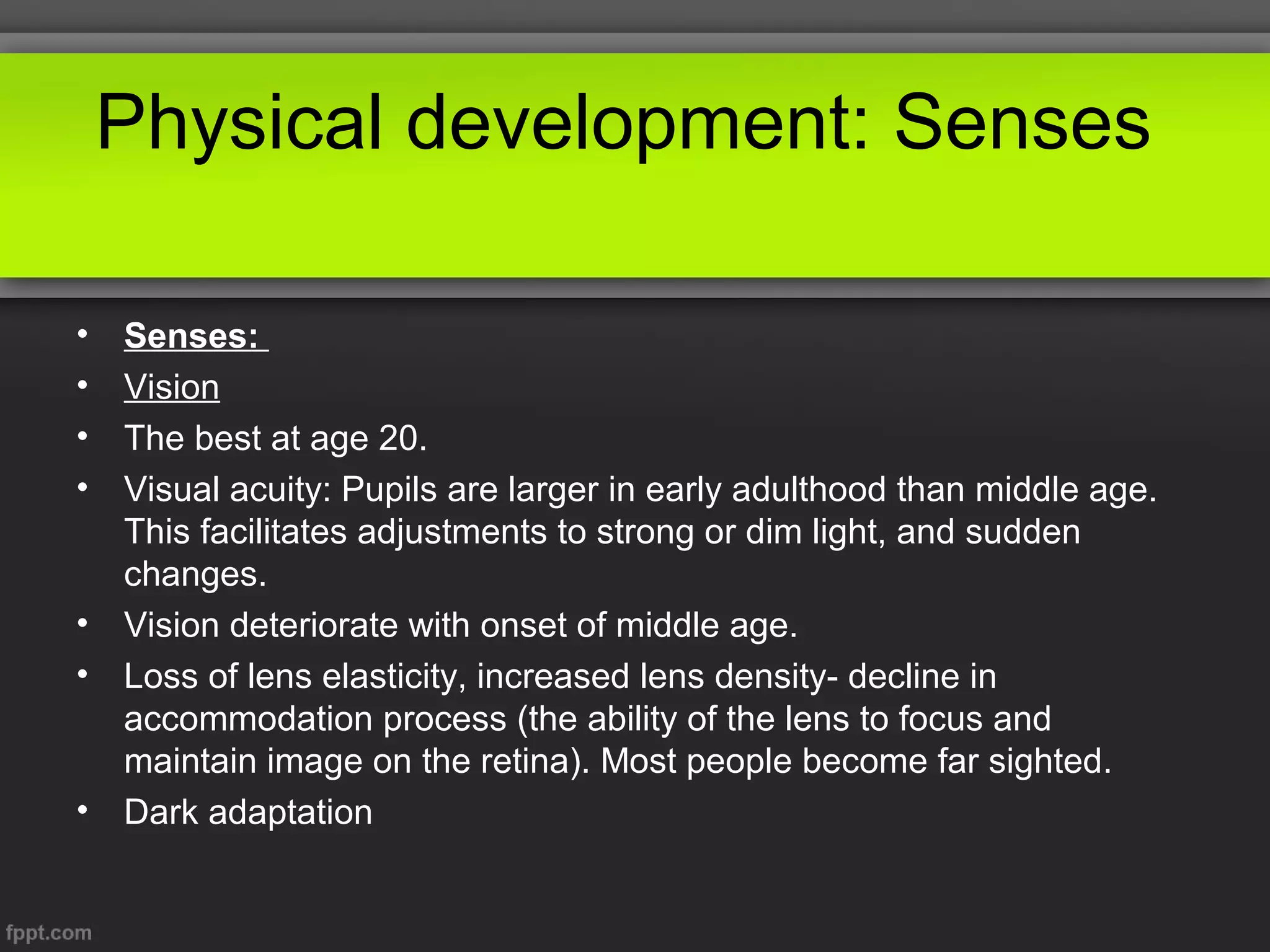
Physical development: Senses
• Senses:
• Vision
• The best at age 20.
• Visual acuity: Pupils are larger in early adulthood than middle age.
This facilitates adjustments to strong or dim light, and sudden
changes.
• Vision deteriorate with onset of middle age.
• Loss of lens elasticity, increased lens density- decline in
accommodation process (the ability of the lens to focus and
maintain image on the retina). Most people become far sighted.
• Dark adaptation
Physical development: Senses
• Glaucoma: Glaucoma is a complicated disease in which damage to the
optic nerve leads to progressive, irreversible vision loss. Glaucoma is a well
known leading cause of blindness.
• Cataract: A cataract is a clouding of the lens of your eye. As you age,
proteins in your lens begin to break down and the lens becomes cloudy. You
may not even realize you have a cataract because it usually grows very
slowly and may not impede vision early on. While cataracts are rarely
dangerous, after a number of years they will likely affect vision. By age 65,
over 90 percent of people have a cataract and half of the people between
the ages of 75 and 85 have lost some vision due to a cataract. A cataract is
not caused by overuse of your eyes and it does not travel from one eye to
the other.
Physical development: Senses
• Hearing:
• Decline in hearing acuity known as prebycusis.
• Taste, smell and touch:
• Decreases significantly.
• Implications for safety.
• Less sensitive to taste.
• Sensitivity to temperature changes
Physical development:
The brain
• The brain:
• Continues to grow and reaches max during early
adulthood.
• Weight of brain declines during middle age (after
50 years of age).
• Decrease in number of neurons.
Physical development:
Height and weight
• Nutrition & Health:
• Weight tends to increase when we reach
middle age.
• Metabolism.
Physical development:
Muscle strength
• Peak is between 25-30 years of age.
• Muscle strength and muscle endurance of
middle-aged women and men associated
to type, duration and intensity of muscular
load at work.
Physical Appearance
• Decline in physical capacities
• Lose youthful appearance
• Loss of elasticity of the skin
• Wrinkles
• Greying of hair
• Decline in visual acuity
• Menopause
• Decline in testosterone levels
Health
• Socio economic
factors
• Cultural factors
• Mortality rate for
mothers
• TB
• Ischemic heart
disease
• Strokes
• Cancer
• AIDS
• Hypertension
• Stress
Sexuality
• Sexual development continues throughout
adulthood. Adult sexuality can be affected by
several factors, including pregnancy, chronic
illness, stress, and the normal aging process.
• As humans age, adult men and women
experience a number of physical and
psychological changes that can affect sexual
relationships and sexuality.
Sexuality
• In adult men, testosterone production normally
decreases after the age of 25. Lower levels of
testosterone can result in a lack of sexual desire and
difficulty achieving erection. Other medical conditions
(e.g., benign prostatic hyperplasia [enlarged prostate],
testosterone deficiency) are more common in men who
are middle age and older and can affect sexual function.
• In adult women (usually between the ages of 45 and 60),
the ovaries stop producing the hormone estrogen and
menstrual periods cease (called menopause). In some
cases, menopause affects sexuality, causing vaginal
dryness and irritation and reducing sexual desire.
Sexuality
• Adult men and women who experience a decrease in sexual
function may benefit from a number of treatments. These treatments
include hormone replacement therapy (HRT), selective enzyme
inhibitors (e.g., Viagra, Levitra, Cialis), 5-alpha reductase inhibitors
(e.g., Proscar, Avodart), and sex therapy.
• Maintaining a healthy lifestyle (e.g., eating a proper diet, getting
regular exercise, avoiding smoking) can help many adults continue
sexual expression and sexual relationships throughout their
lifetimes. Open communication between sexual partners and proper
treatment for underlying medical conditions also can help older
adults keep intimacy an important part of life into old age.
Factors influencing
Cognitive development
• The human body reaches its functional
peak at about 30 years of age and then
starts to decline.
• Controversy on whether creativity,
memory and intelligence decreases.
• People assume that aging is associated
with intellectual deterioration.
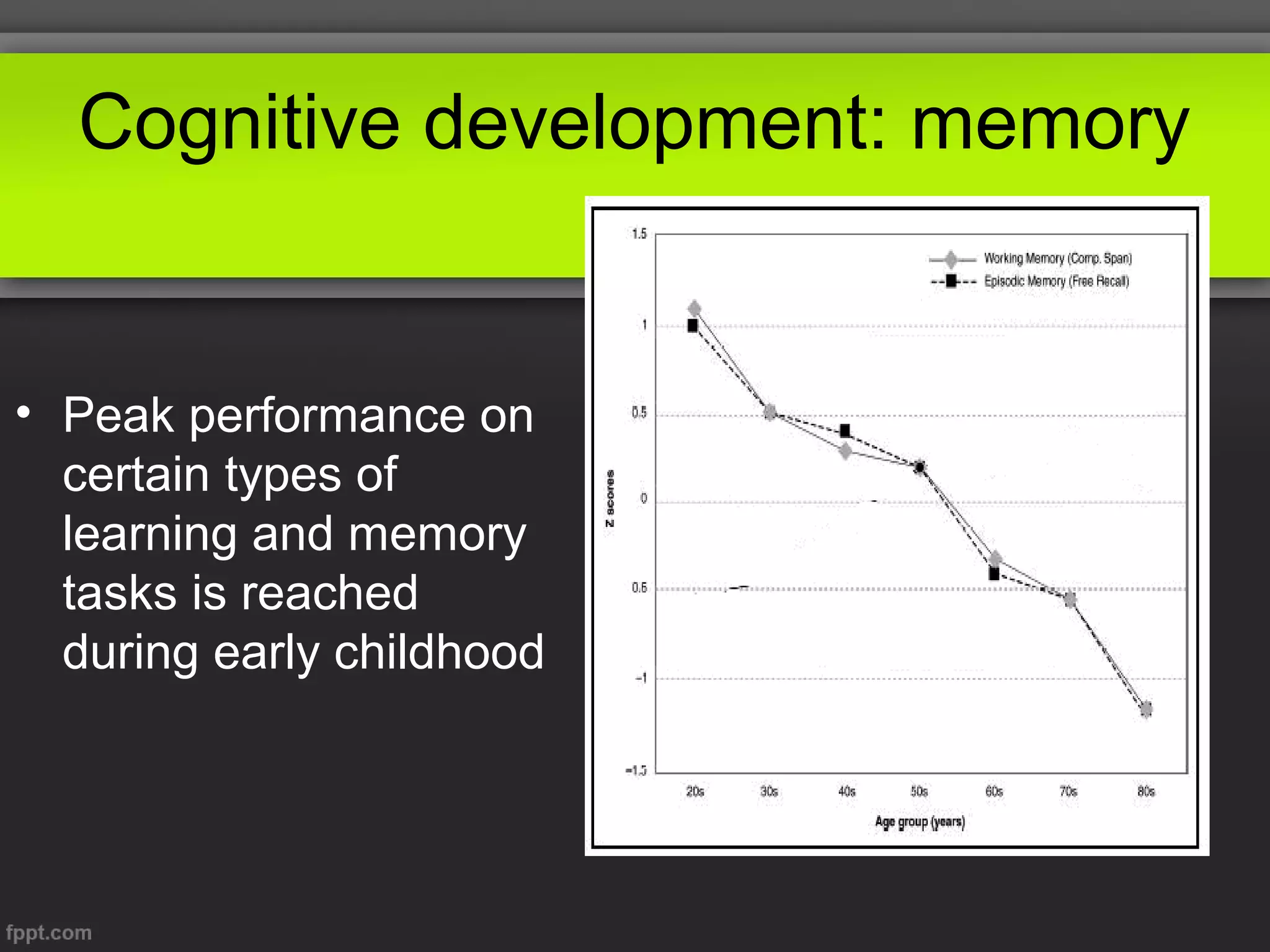
Cognitive development: memory
• Peak performance on
certain types of
learning and memory
tasks is reached
during early childhood
Cognitive development:
intelligence
• While many people claim that their
intelligence seems to decline as they age,
research suggests that while fluid
intelligence begins to decrease after
adolescence, crystallized intelligence
continues to increase throughout
adulthood.
Cognitive development:
intelligence
• Fluid intelligence involves being able to think and reason
abstractly and solve problems. This ability is considered
independent of learning, experience, and education.
• Crystallized intelligence involves knowledge that comes from prior
learning and past experiences. Situations that require crystallized
intelligence include reading comprehension and vocabulary exams.
This type of intelligence is based upon facts and rooted in
experiences. As we age and accumulate new knowledge and
understanding, crystallized intelligence becomes stronger.
Cognitive development:
intelligence
• Wisdom really does come with age,
scientists say.
• Reaction time and reasoning ability
• Alzheimer’s disease: a progressive and
irrerversible brain syndrome which affects
mainly the elderly. The brain becomes
smaller. Deterioration in memory is usually
one of the first signs.
Cognitive development: memory
Social, emotional and
personality development
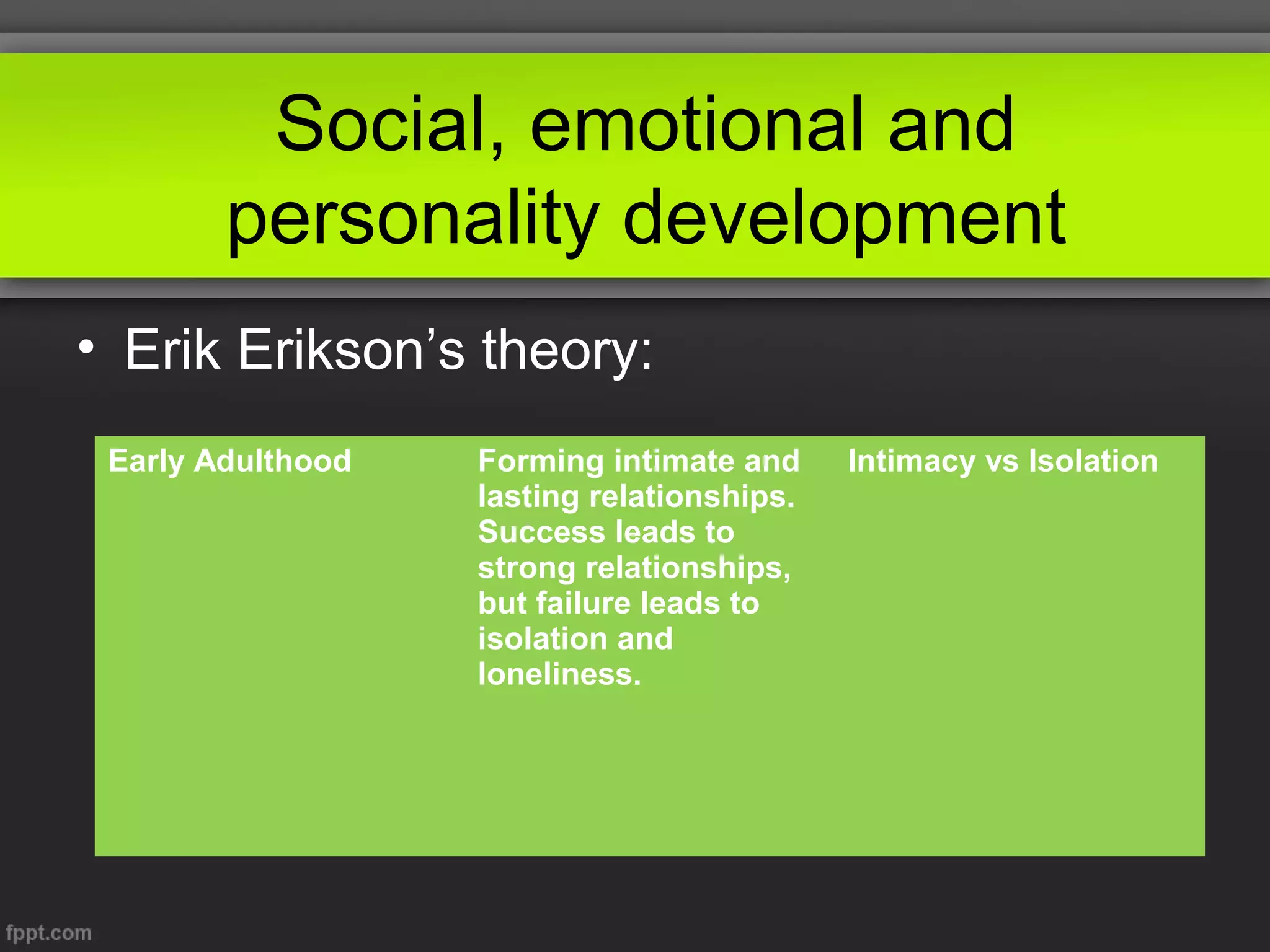
• Erik Erikson’s theory:
Early Adulthood Forming intimate and
lasting relationships.
Success leads to
strong relationships,
but failure leads to
isolation and
loneliness.
Intimacy vs Isolation
Social, emotional and
personality development
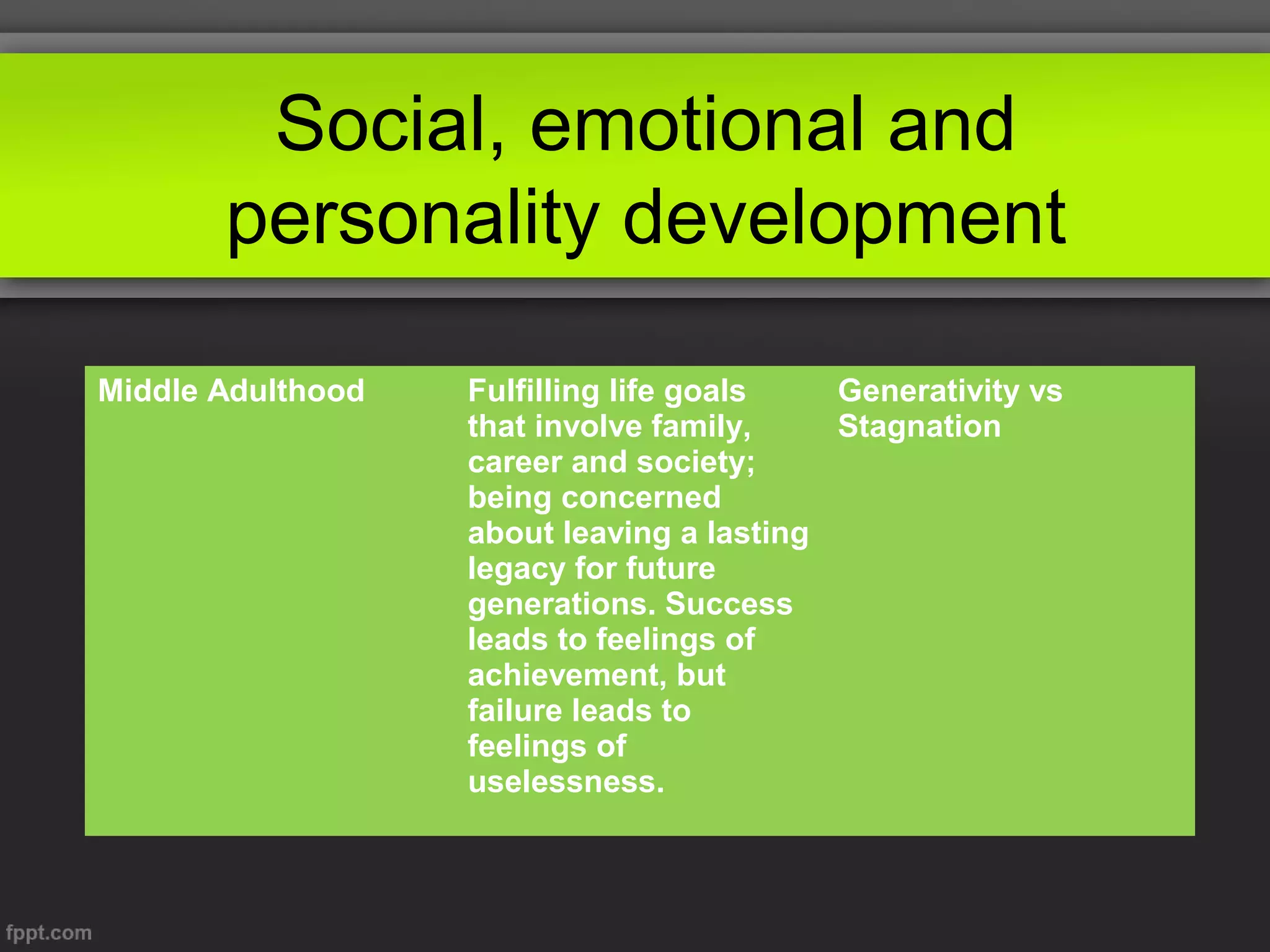
Middle Adulthood Fulfilling life goals
that involve family,
career and society;
being concerned
about leaving a lasting
legacy for future
generations. Success
leads to feelings of
achievement, but
failure leads to
feelings of
uselessness.
Generativity vs
Stagnation
Social, emotional and
personality development
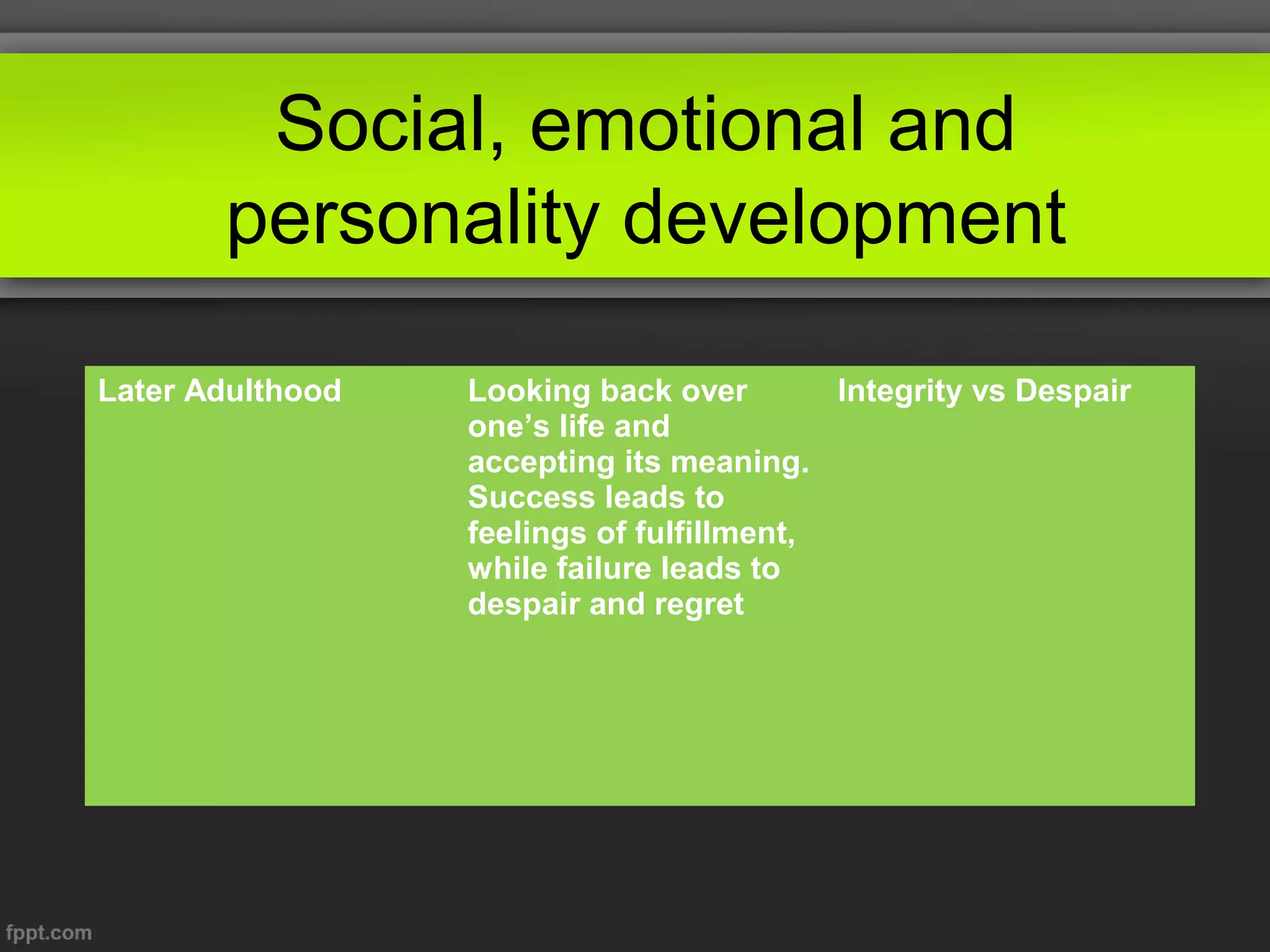
Later Adulthood Looking back over
one’s life and
accepting its meaning.
Success leads to
feelings of fulfillment,
while failure leads to
despair and regret
Integrity vs Despair
Work
• Desire to achieve or attain something.
• Achievement- motivation is expressed
differently from culture to culture and from
person to person.
• Eg success, social respect, involvement,
recognition.
• Adults’ self esteem is related to their need
to be successful in a task that gives their
lives meaning- generativity.
The importance of work
• Survival
• Opportunities to be creative, productive or artistic.
• Determines a person’s position and status in society.
• Contributes to self- esteem and self concept.
• Defines our daily schedules and outlines the days,
weeks, months and years ahead.
• Opportunity for social interaction outside the family.
• Opportunities for personal development.
• Opportunities for intellectual growth.
• WHAT ABOUT FLUID AND CRYSTALISED
INTELLIGENCE???
Social development
• Interpersonal relationships
• Intimacy
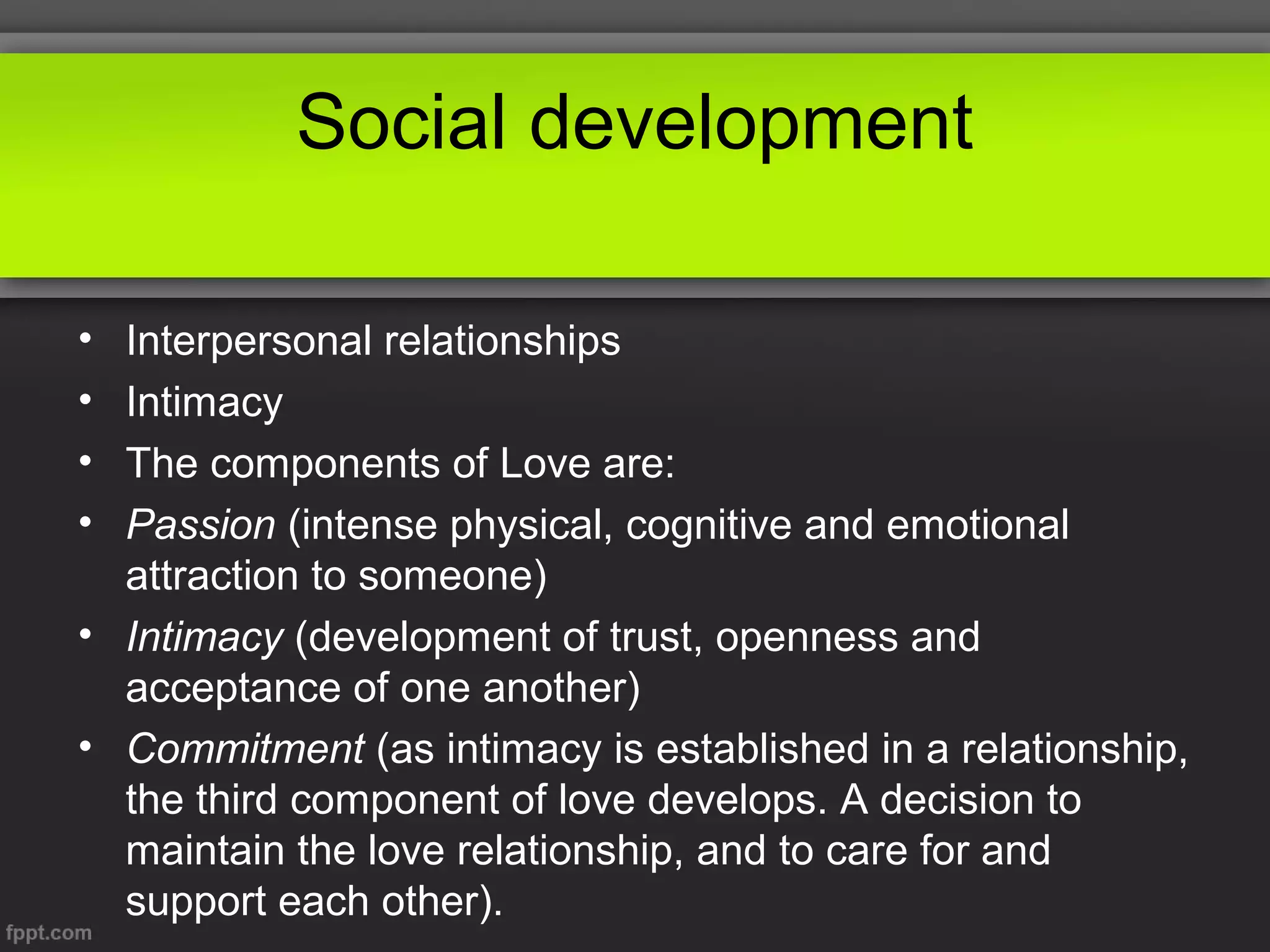
• The components of Love are:
• Passion (intense physical, cognitive and emotional
attraction to someone)
• Intimacy (development of trust, openness and
acceptance of one another)
• Commitment (as intimacy is established in a relationship,
the third component of love develops. A decision to
maintain the love relationship, and to care for and
support each other).
Moral development
• Post formal operational development
according to Kohlberg
Characteristics of maturity
• Realistic perception.
• Self acceptance.
• Competence.
• Accepting responsibility.
• The capacity for intimacy, love and concern.
• A unifying philosophy of life.
• Joy.
• Life balance.
• Commitment.
• Integration.
References
• http://www.gettyimages.com/detail/photo/xhosa-boys-undertake-
manhood-ceremony-in-high-res-stock-photography/200253333-001
• https://omgitsjez.wordpress.com/category/kohbergs-stages-of-
moral-development/
• http://psychology.about.com/od/cognitivepsychology/a/fluid-
crystal.htm
• http://www.healthcommunities.com/sexual-
development/adult.shtml#sthash.q3dakYWy.dpuf
• Marijose- PPP Template

Early and middle adulthood

  • 1.
  • 2.
    Adulthood • The periodbetween adolescence and old age • Development continues • Early adulthood( 20-39 years) • Middle adulthood (40-65 years • Late adulthood (65 years and older) • Chronological age • Biological age
  • 3.
    Page 472 inHuman Development Models of adulthood: The stability model • Based on the assumption that behaviour remains relatively stable once the level of optimal functioning has been reached. • This assumption also applies to personality traits established at an early age and which tend to change little, for example emotional liability (stability) or its counterpart emotional calm, and openness or its opposite, rigidity (applying rules, regardless).
  • 4.
    Models of adulthood: Theirreversible decline model • Based on the assumption that decline, particularly after middle age, is inevitable and irreversible. • It is applicable particularly to the period of late adulthood and draws attention to those characteristics strongly affected by the decline of sensory and motor abilities.
  • 5.
    Models of adulthood: Thedecline with compensation model • Falls somewhere between the previously mentioned models. • Eg it accepts that fluid intelligence (the ability to think abstractly) may decline, but it is compensated for, counteracted by experience and knowledge as reflected in crystallised intelligence.
  • 6.
    Models of adulthood: Thedevelopmental model • This model implies that adults continue to develop their adult potential. • Theorists emphasise that periods of crisis and tension are part of the developmental process, particularly if they lead to new adaptation and insights (New experiences).
  • 7.
    Stages of adulthood •Early and middle adulthood is extremely difficult to demarcate. • Similar characteristics. • The development from one period to another is called the transitional period.
  • 8.
  • 9.
    Physical development • Peakis generally reached at the age of between 20-30 years old. • Gradual decline afterwards.
  • 10.
    Physical development: Senses •Senses: • Vision • The best at age 20. • Visual acuity: Pupils are larger in early adulthood than middle age. This facilitates adjustments to strong or dim light, and sudden changes. • Vision deteriorate with onset of middle age. • Loss of lens elasticity, increased lens density- decline in accommodation process (the ability of the lens to focus and maintain image on the retina). Most people become far sighted. • Dark adaptation
  • 11.
    Physical development: Senses •Glaucoma: Glaucoma is a complicated disease in which damage to the optic nerve leads to progressive, irreversible vision loss. Glaucoma is a well known leading cause of blindness. • Cataract: A cataract is a clouding of the lens of your eye. As you age, proteins in your lens begin to break down and the lens becomes cloudy. You may not even realize you have a cataract because it usually grows very slowly and may not impede vision early on. While cataracts are rarely dangerous, after a number of years they will likely affect vision. By age 65, over 90 percent of people have a cataract and half of the people between the ages of 75 and 85 have lost some vision due to a cataract. A cataract is not caused by overuse of your eyes and it does not travel from one eye to the other.
  • 14.
    Physical development: Senses •Hearing: • Decline in hearing acuity known as prebycusis. • Taste, smell and touch: • Decreases significantly. • Implications for safety. • Less sensitive to taste. • Sensitivity to temperature changes
  • 15.
    Physical development: The brain •The brain: • Continues to grow and reaches max during early adulthood. • Weight of brain declines during middle age (after 50 years of age). • Decrease in number of neurons.
  • 16.
    Physical development: Height andweight • Nutrition & Health: • Weight tends to increase when we reach middle age. • Metabolism.
  • 17.
    Physical development: Muscle strength •Peak is between 25-30 years of age. • Muscle strength and muscle endurance of middle-aged women and men associated to type, duration and intensity of muscular load at work.
  • 18.
    Physical Appearance • Declinein physical capacities • Lose youthful appearance • Loss of elasticity of the skin • Wrinkles • Greying of hair • Decline in visual acuity • Menopause • Decline in testosterone levels
  • 19.
    Health • Socio economic factors •Cultural factors • Mortality rate for mothers • TB • Ischemic heart disease • Strokes • Cancer • AIDS • Hypertension • Stress
  • 20.
    Sexuality • Sexual developmentcontinues throughout adulthood. Adult sexuality can be affected by several factors, including pregnancy, chronic illness, stress, and the normal aging process. • As humans age, adult men and women experience a number of physical and psychological changes that can affect sexual relationships and sexuality.
  • 21.
    Sexuality • In adultmen, testosterone production normally decreases after the age of 25. Lower levels of testosterone can result in a lack of sexual desire and difficulty achieving erection. Other medical conditions (e.g., benign prostatic hyperplasia [enlarged prostate], testosterone deficiency) are more common in men who are middle age and older and can affect sexual function. • In adult women (usually between the ages of 45 and 60), the ovaries stop producing the hormone estrogen and menstrual periods cease (called menopause). In some cases, menopause affects sexuality, causing vaginal dryness and irritation and reducing sexual desire.
  • 22.
    Sexuality • Adult menand women who experience a decrease in sexual function may benefit from a number of treatments. These treatments include hormone replacement therapy (HRT), selective enzyme inhibitors (e.g., Viagra, Levitra, Cialis), 5-alpha reductase inhibitors (e.g., Proscar, Avodart), and sex therapy. • Maintaining a healthy lifestyle (e.g., eating a proper diet, getting regular exercise, avoiding smoking) can help many adults continue sexual expression and sexual relationships throughout their lifetimes. Open communication between sexual partners and proper treatment for underlying medical conditions also can help older adults keep intimacy an important part of life into old age.
  • 23.
    Factors influencing Cognitive development •The human body reaches its functional peak at about 30 years of age and then starts to decline. • Controversy on whether creativity, memory and intelligence decreases. • People assume that aging is associated with intellectual deterioration.
  • 24.
    Cognitive development: memory •Peak performance on certain types of learning and memory tasks is reached during early childhood
  • 25.
    Cognitive development: intelligence • Whilemany people claim that their intelligence seems to decline as they age, research suggests that while fluid intelligence begins to decrease after adolescence, crystallized intelligence continues to increase throughout adulthood.
  • 26.
    Cognitive development: intelligence • Fluidintelligence involves being able to think and reason abstractly and solve problems. This ability is considered independent of learning, experience, and education. • Crystallized intelligence involves knowledge that comes from prior learning and past experiences. Situations that require crystallized intelligence include reading comprehension and vocabulary exams. This type of intelligence is based upon facts and rooted in experiences. As we age and accumulate new knowledge and understanding, crystallized intelligence becomes stronger.
  • 27.
    Cognitive development: intelligence • Wisdomreally does come with age, scientists say. • Reaction time and reasoning ability • Alzheimer’s disease: a progressive and irrerversible brain syndrome which affects mainly the elderly. The brain becomes smaller. Deterioration in memory is usually one of the first signs.
  • 28.
  • 29.
    Social, emotional and personalitydevelopment • Erik Erikson’s theory: Early Adulthood Forming intimate and lasting relationships. Success leads to strong relationships, but failure leads to isolation and loneliness. Intimacy vs Isolation
  • 30.
    Social, emotional and personalitydevelopment Middle Adulthood Fulfilling life goals that involve family, career and society; being concerned about leaving a lasting legacy for future generations. Success leads to feelings of achievement, but failure leads to feelings of uselessness. Generativity vs Stagnation
  • 31.
    Social, emotional and personalitydevelopment Later Adulthood Looking back over one’s life and accepting its meaning. Success leads to feelings of fulfillment, while failure leads to despair and regret Integrity vs Despair
  • 32.
    Work • Desire toachieve or attain something. • Achievement- motivation is expressed differently from culture to culture and from person to person. • Eg success, social respect, involvement, recognition. • Adults’ self esteem is related to their need to be successful in a task that gives their lives meaning- generativity.
  • 33.
    The importance ofwork • Survival • Opportunities to be creative, productive or artistic. • Determines a person’s position and status in society. • Contributes to self- esteem and self concept. • Defines our daily schedules and outlines the days, weeks, months and years ahead. • Opportunity for social interaction outside the family. • Opportunities for personal development. • Opportunities for intellectual growth. • WHAT ABOUT FLUID AND CRYSTALISED INTELLIGENCE???
  • 34.
    Social development • Interpersonalrelationships • Intimacy • The components of Love are: • Passion (intense physical, cognitive and emotional attraction to someone) • Intimacy (development of trust, openness and acceptance of one another) • Commitment (as intimacy is established in a relationship, the third component of love develops. A decision to maintain the love relationship, and to care for and support each other).
  • 35.
    Moral development • Postformal operational development according to Kohlberg
  • 36.
    Characteristics of maturity •Realistic perception. • Self acceptance. • Competence. • Accepting responsibility. • The capacity for intimacy, love and concern. • A unifying philosophy of life. • Joy. • Life balance. • Commitment. • Integration.
  • 37.
    References • http://www.gettyimages.com/detail/photo/xhosa-boys-undertake- manhood-ceremony-in-high-res-stock-photography/200253333-001 • https://omgitsjez.wordpress.com/category/kohbergs-stages-of- moral-development/ •http://psychology.about.com/od/cognitivepsychology/a/fluid- crystal.htm • http://www.healthcommunities.com/sexual- development/adult.shtml#sthash.q3dakYWy.dpuf • Marijose- PPP Template