Chapter 1: Introduction Module 1.2 The Start of Life
The Beginning of Life Gametes (male and female reproductive cells) from male (sperm) and female (ovum) join, these fused gametes create a  zygote In humans, the male sex cell (sperm) and the female sex cell (the ovum) provide the developing baby with 23 chromosomes each. Each Zygote carries 46 chromosomes, all of the genetic instructions to create a human being
Period of the Zygote
Multiple Births Multiple births: Monozygotic (one zygote) Identical Twins Dizygotic (two zygotes) Fraternal Twins What causes multiple births? Fertility drugs, age of mother Racial, ethnic, and national differences
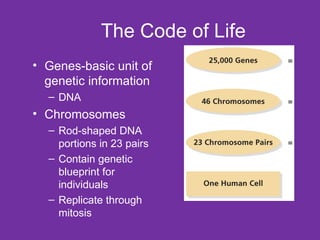
The Code of Life Genes-basic unit of genetic information DNA Chromosomes Rod-shaped DNA portions in 23 pairs Contain genetic blueprint for individuals Replicate through mitosis
Mixing and Matching of Genes Basics of genetics: DOMINANT TRAITS – expressed traits RECESSIVE TRAITS – not expressed, but still there
Genotype and Phenotype A  genotype  is the underlying combination of genetic materials present in an organism, but invisible; a  phenotype  is the visible trait, the expression of the genotype. Genotype can be: Homozygous - allele contains similar genes from each parent Heterozygous - allele contains different forms of genes from parents
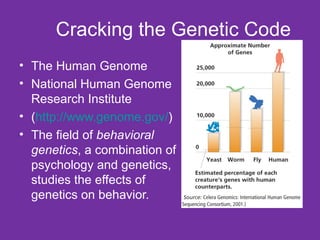
Cracking the Genetic Code The Human Genome National Human Genome Research Institute  ( http://www.genome.gov/ ) The field of  behavioral genetics , a combination of psychology and genetics, studies the effects of genetics on behavior.
When Development Deviates… Causes: Genetics Spontaneous mutation Environmental insult
When Development Deviates… Consequences: Down Syndrome - extra chromosome on 21 st  pair; 1 in 500/higher in older mothers Fragile X Syndrome -Fragile X syndrome is the most common form of inherited mental retardation in males and a significant cause in females. The inheritance is different from common dominant or recessive inheritance patterns. A fragile area on the X chromosome (called FMR1) has repeats in the genetic code. The more repeats, the more likely there is to be a problem. Boys and girls can both be affected, but because boys have only one X chromosome, a single fragile X is likely to affect them more severely. Sickle-cell Anemia -  Sickle cell anemia  is an inherited disease in which the red blood cells, normally disc-shaped, become crescent shaped. As a result, they function abnormally and cause small  blood clots . These clots give rise to recurrent painful episodes called "sickle cell pain crises." Sickle cell anemia is inherited as an autosomal recessive trait , which means it occurs in someone who has inherited hemoglobin S from both parents. Sickle cell disease is much more common in certain ethnic groups, affecting approximately one out of every 500 African Americans.
When Development Deviates… Tay-Sachs Disease -  Tay-Sachs  disease is a familial  disorder (it affects  more than 1 member of a family) that results in early death. It is found predominantly in Ashkenazi Jewish families. An enzyme deficiency that interferes with metabolism of crucial nerve tissue chemicals. Tay-Sachs disease is inherited as a recessive gene, and 1 in 25 members of the Ashkenazi Jewish population carries the gene. Klinefelter’s Syndrome - Klinefelter syndrome is a  chromosome  disorder in males. People with this condition are born with at least one extra X chromosome. Klinefelter syndrome is one of the most common  chromosomal abnormalities . About one in every 500 to 800 males is born with this disorder. Approximately 3% of the  infertile  male population have Klinefelter syndrome.
Prenatal Testing Potential tests for deviation in development: Amniocentesis CVS  Embryoscopy FBS Sonoembryology Sonogram Ultrasound sonography Important to remember : Majority of babies born healthy!!
Nature and Nurture Virtually all traits, characteristics, and behaviors are joint result of the combination and interaction of nature and nurture. Genetic and environmental factors work in tandem, affecting and being affected by the other, creating the unique individual that each of us is and will become
Nature (Genetics) Genetic influences have been identified in physical characteristics, intelligence, personality traits and behaviors, and psychological disorders. There is some speculation that entire cultures may be predisposed genetically toward certain types of philosophical viewpoints and attitudes.
Nurture (environment) includes… Social/Culture Geographical location Family Media Peers World events And everything else!
Nature and Nurture - Physical Similarities Family resemblances: More genetically similarity  more likely to share physical characteristics Monozygotic twins: best example of relationship between genetic similarity and shared physical characteristics
Nature and Nurture - Intelligence Relative contributions of nature and nurture highly researched Closer genetic link = greater correspondence of overall IQ scores Intelligence (as measured) by IQ score) is central human characteristic that differentiates humans from other species IQ scores of identical twins become increasingly similar over time This does not discount importance of environmental influence on intelligence
Nature and Nurture - Personality Research evidence indicates some of most basic personality traits have genetic roots Two of “Big Five” personality traits linked to genetic factors: Neuroticism Extroversion
Nature and Nurture - Personality Research Suggests… Examination reveals specific gene very influential in determining risk-taking (novelty-seeking gene affects production of dopamine) Twins reared apart studies: certain traits reflected contribution of genetics considerably more than others Some less basic personality trait links: political attitudes, religious interests and values, attitudes toward human sexuality
Fundamental Principle  Relative influence of nature and nurture: Role of  genetics  is often to produce tendency toward future course of development Role of  environment  affects when and whether a certain behavioral characteristic will actually be displayed
Theory about Nature/Nurture: Sandra Scarr suggests three ways child’s genetic predisposition may influence his or her environment: Active Passive Evocative
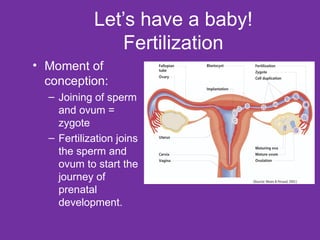
Let’s have a baby! Fertilization Moment of conception: Joining of sperm and ovum = zygote Fertilization joins the sperm and ovum to start the journey of prenatal development.
Stages of Prenatal Development The prenatal period consists of three stages: germinal, embryonic, and fetal. Germinal Embryonic Fetal
Germinal Stage Fertilization    two weeks: Shortest stage Fertilized egg now called blastocyst Travels to and implants in uterus Characterized by methodical cell division With division comes cell specialization
Embryonic Stage 2 weeks    8 weeks: Organism firmly secures to uterus and called an embryo Development of major organs and basic anatomy Three distinct layers that ultimately form different set of structures: Ectoderm - form skin, hair, teeth, sense organs, brain, spinal cord Endoderm - inner layer forms digestive system, liver, pancreas, respiratory system Mesoderm - sandwiched between other two and forms muscles, bones, blood, circulatory system
Embryonic Stage (cont.) At end of embryonic stage:  One inch long, gills and tail-like structure; rudimentary eyes, lips, teeth, stubby bulges that become arms and legs; head grows rapidly and begins to represent significant portion of body (50% of total length); rapid growth of nerve cells (100,000 neurons produced EVERY MINUTE); nervous system begins to function at 3 weeks and at 5 weeks weak brain waves detected
Fetal Stage 8 weeks    Birth: Formally starts when differentiation of major organs has occurred  Organism now called fetus Characterized by rapid development Organs become more differentiated and begin working Interconnections between body parents become more complex and integrated Brain becomes more sophisticated
Fetal Stage (cont.) Rapid development Increases in length 20 times and proportions change dramatically See Figure 2.13 At 4 months = 4 ounces; at 7 months = 3 pounds; at birth = 7 pounds Brain waves indicate several different stages of sleep and wakefulness; hear and feel vibrations Hormones released between 8 and 24 weeks that lead to gender differentiation No two fetuses are alike; broad similarities in sequence of development Differences due to genetics and the environment of womb
Pregnancy Problems Infertility - 15% of couples; inability to conceive after 12 to 18 months Maternal infertility influenced by age; hormone imbalance, damaged fallopian tubes or uterus, stress, abuse of alcohol or drugs Paternal infertility influenced by illicit drugs, tobacco, STDs Artificial insemination; IVF; GIFT; ZIFT; ethical issues Miscarriage - spontaneous abortion; 15-20% pregnancies ends in miscarriages; many times genetic abnormality Abortion - voluntary termination pregnancy; aftereffects; may contribute to increase in future pregnancies
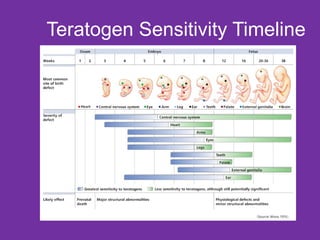
Threats to Development The prenatal environment significantly influences the development of the baby. The diet, age, prenatal support, and illnesses of mothers can affect their babies’ health and growth Prenatal environment Teratogen  - environmental agent or other factor that produces a birth defect Timing and quantity of exposure crucial; sensitivity to specific teratogen related to racial and cultural background; different organ systems vulnerable at different times during development (e.g., brain development)
Teratogen Sensitivity Timeline
Parent’s Prenatal Influence Mothers’ use of drugs, alcohol, tobacco, and caffeine can adversely affect the health and development of the unborn child. The behavior of fathers and others can also affect the child.
Mother’s Prenatal Influence  Diet - Mother’s diet supports development of fetus; global concern; postnatal enrichment of prenatal undernourishment can sometimes overcome some of effects Age - More older women giving birth due to societal transformations; mothers over 30 at greater risk for variety pregnancy and birth complications; condition of ovum; Down syndrome; adolescent mothers more likely to deliver premature babies Prenatal support - Young mothers often face adverse social and economic factors which can affect infant health; social support and poverty contribute to lack of resources for prenatal support
Mother’s Prenatal Influence (cont.)  Health - Rubella prior to 11 th  week of pregnancy; mumps increase miscarriage risk; syphilis directly transmitted to fetus; STD (gonorrhea) transmitted; AIDS (AZT during pregnancy reduces transmission to around 5%) Drug use - Poses serious risk to unborn child (legal, illegal, OTC drugs), Thalidomide, DES: diethylstilbestrol to prevent miscarriage later raised daughter risk of vaginal/cervical cancer, Birth control: fetal damage, Illicit drugs: marijuana, cocaine (crack babies) Alcohol use: even small amounts can disrupt development of fetus; FAS; FAE Tobacco use - Reduces oxygen content and increases carbon monoxide in mother’s blood   fetus respiration slows and heart beat increases and increases miscarriage risk (100,000 miscarriages caused by smoking); low birth weight; shorter; 50% more likely to have mentally retarded or disruptive child
Father’s Prenatal Influence Relatively little research Tobacco use - secondhand smoke may influence mother’s health Drug & Alcohol use - alcohol and drug use may impair sperm leading to chromosomal damage Treatment of mother - physical and emotional abuse can cause maternal stress
Becoming an Informed Consumer Optimizing the Prenatal Environment Avoid X-rays and birth control pills; get rubella vaccination Eat well and take prenatal vitamins Avoid alcohol use and other drugs Monitor caffeine intake. Avoid smoking and exposure to secondhand smoke Exercise regularly

Lifespan psychology lecture chapter 1, module 1.2

  • 1.
    Chapter 1: IntroductionModule 1.2 The Start of Life
  • 2.
    The Beginning ofLife Gametes (male and female reproductive cells) from male (sperm) and female (ovum) join, these fused gametes create a zygote In humans, the male sex cell (sperm) and the female sex cell (the ovum) provide the developing baby with 23 chromosomes each. Each Zygote carries 46 chromosomes, all of the genetic instructions to create a human being
  • 3.
  • 4.
    Multiple Births Multiplebirths: Monozygotic (one zygote) Identical Twins Dizygotic (two zygotes) Fraternal Twins What causes multiple births? Fertility drugs, age of mother Racial, ethnic, and national differences
  • 5.
    The Code ofLife Genes-basic unit of genetic information DNA Chromosomes Rod-shaped DNA portions in 23 pairs Contain genetic blueprint for individuals Replicate through mitosis
  • 6.
    Mixing and Matchingof Genes Basics of genetics: DOMINANT TRAITS – expressed traits RECESSIVE TRAITS – not expressed, but still there
  • 7.
    Genotype and PhenotypeA genotype is the underlying combination of genetic materials present in an organism, but invisible; a phenotype is the visible trait, the expression of the genotype. Genotype can be: Homozygous - allele contains similar genes from each parent Heterozygous - allele contains different forms of genes from parents
  • 8.
    Cracking the GeneticCode The Human Genome National Human Genome Research Institute ( http://www.genome.gov/ ) The field of behavioral genetics , a combination of psychology and genetics, studies the effects of genetics on behavior.
  • 9.
    When Development Deviates…Causes: Genetics Spontaneous mutation Environmental insult
  • 10.
    When Development Deviates…Consequences: Down Syndrome - extra chromosome on 21 st pair; 1 in 500/higher in older mothers Fragile X Syndrome -Fragile X syndrome is the most common form of inherited mental retardation in males and a significant cause in females. The inheritance is different from common dominant or recessive inheritance patterns. A fragile area on the X chromosome (called FMR1) has repeats in the genetic code. The more repeats, the more likely there is to be a problem. Boys and girls can both be affected, but because boys have only one X chromosome, a single fragile X is likely to affect them more severely. Sickle-cell Anemia - Sickle cell anemia is an inherited disease in which the red blood cells, normally disc-shaped, become crescent shaped. As a result, they function abnormally and cause small blood clots . These clots give rise to recurrent painful episodes called "sickle cell pain crises." Sickle cell anemia is inherited as an autosomal recessive trait , which means it occurs in someone who has inherited hemoglobin S from both parents. Sickle cell disease is much more common in certain ethnic groups, affecting approximately one out of every 500 African Americans.
  • 11.
    When Development Deviates…Tay-Sachs Disease - Tay-Sachs disease is a familial disorder (it affects more than 1 member of a family) that results in early death. It is found predominantly in Ashkenazi Jewish families. An enzyme deficiency that interferes with metabolism of crucial nerve tissue chemicals. Tay-Sachs disease is inherited as a recessive gene, and 1 in 25 members of the Ashkenazi Jewish population carries the gene. Klinefelter’s Syndrome - Klinefelter syndrome is a chromosome disorder in males. People with this condition are born with at least one extra X chromosome. Klinefelter syndrome is one of the most common chromosomal abnormalities . About one in every 500 to 800 males is born with this disorder. Approximately 3% of the infertile male population have Klinefelter syndrome.
  • 12.
    Prenatal Testing Potentialtests for deviation in development: Amniocentesis CVS Embryoscopy FBS Sonoembryology Sonogram Ultrasound sonography Important to remember : Majority of babies born healthy!!
  • 13.
    Nature and NurtureVirtually all traits, characteristics, and behaviors are joint result of the combination and interaction of nature and nurture. Genetic and environmental factors work in tandem, affecting and being affected by the other, creating the unique individual that each of us is and will become
  • 14.
    Nature (Genetics) Geneticinfluences have been identified in physical characteristics, intelligence, personality traits and behaviors, and psychological disorders. There is some speculation that entire cultures may be predisposed genetically toward certain types of philosophical viewpoints and attitudes.
  • 15.
    Nurture (environment) includes…Social/Culture Geographical location Family Media Peers World events And everything else!
  • 16.
    Nature and Nurture- Physical Similarities Family resemblances: More genetically similarity  more likely to share physical characteristics Monozygotic twins: best example of relationship between genetic similarity and shared physical characteristics
  • 17.
    Nature and Nurture- Intelligence Relative contributions of nature and nurture highly researched Closer genetic link = greater correspondence of overall IQ scores Intelligence (as measured) by IQ score) is central human characteristic that differentiates humans from other species IQ scores of identical twins become increasingly similar over time This does not discount importance of environmental influence on intelligence
  • 18.
    Nature and Nurture- Personality Research evidence indicates some of most basic personality traits have genetic roots Two of “Big Five” personality traits linked to genetic factors: Neuroticism Extroversion
  • 19.
    Nature and Nurture- Personality Research Suggests… Examination reveals specific gene very influential in determining risk-taking (novelty-seeking gene affects production of dopamine) Twins reared apart studies: certain traits reflected contribution of genetics considerably more than others Some less basic personality trait links: political attitudes, religious interests and values, attitudes toward human sexuality
  • 20.
    Fundamental Principle Relative influence of nature and nurture: Role of genetics is often to produce tendency toward future course of development Role of environment affects when and whether a certain behavioral characteristic will actually be displayed
  • 21.
    Theory about Nature/Nurture:Sandra Scarr suggests three ways child’s genetic predisposition may influence his or her environment: Active Passive Evocative
  • 22.
    Let’s have ababy! Fertilization Moment of conception: Joining of sperm and ovum = zygote Fertilization joins the sperm and ovum to start the journey of prenatal development.
  • 23.
    Stages of PrenatalDevelopment The prenatal period consists of three stages: germinal, embryonic, and fetal. Germinal Embryonic Fetal
  • 24.
    Germinal Stage Fertilization  two weeks: Shortest stage Fertilized egg now called blastocyst Travels to and implants in uterus Characterized by methodical cell division With division comes cell specialization
  • 25.
    Embryonic Stage 2weeks  8 weeks: Organism firmly secures to uterus and called an embryo Development of major organs and basic anatomy Three distinct layers that ultimately form different set of structures: Ectoderm - form skin, hair, teeth, sense organs, brain, spinal cord Endoderm - inner layer forms digestive system, liver, pancreas, respiratory system Mesoderm - sandwiched between other two and forms muscles, bones, blood, circulatory system
  • 26.
    Embryonic Stage (cont.)At end of embryonic stage: One inch long, gills and tail-like structure; rudimentary eyes, lips, teeth, stubby bulges that become arms and legs; head grows rapidly and begins to represent significant portion of body (50% of total length); rapid growth of nerve cells (100,000 neurons produced EVERY MINUTE); nervous system begins to function at 3 weeks and at 5 weeks weak brain waves detected
  • 27.
    Fetal Stage 8weeks  Birth: Formally starts when differentiation of major organs has occurred Organism now called fetus Characterized by rapid development Organs become more differentiated and begin working Interconnections between body parents become more complex and integrated Brain becomes more sophisticated
  • 28.
    Fetal Stage (cont.)Rapid development Increases in length 20 times and proportions change dramatically See Figure 2.13 At 4 months = 4 ounces; at 7 months = 3 pounds; at birth = 7 pounds Brain waves indicate several different stages of sleep and wakefulness; hear and feel vibrations Hormones released between 8 and 24 weeks that lead to gender differentiation No two fetuses are alike; broad similarities in sequence of development Differences due to genetics and the environment of womb
  • 29.
    Pregnancy Problems Infertility- 15% of couples; inability to conceive after 12 to 18 months Maternal infertility influenced by age; hormone imbalance, damaged fallopian tubes or uterus, stress, abuse of alcohol or drugs Paternal infertility influenced by illicit drugs, tobacco, STDs Artificial insemination; IVF; GIFT; ZIFT; ethical issues Miscarriage - spontaneous abortion; 15-20% pregnancies ends in miscarriages; many times genetic abnormality Abortion - voluntary termination pregnancy; aftereffects; may contribute to increase in future pregnancies
  • 30.
    Threats to DevelopmentThe prenatal environment significantly influences the development of the baby. The diet, age, prenatal support, and illnesses of mothers can affect their babies’ health and growth Prenatal environment Teratogen - environmental agent or other factor that produces a birth defect Timing and quantity of exposure crucial; sensitivity to specific teratogen related to racial and cultural background; different organ systems vulnerable at different times during development (e.g., brain development)
  • 31.
  • 32.
    Parent’s Prenatal InfluenceMothers’ use of drugs, alcohol, tobacco, and caffeine can adversely affect the health and development of the unborn child. The behavior of fathers and others can also affect the child.
  • 33.
    Mother’s Prenatal Influence Diet - Mother’s diet supports development of fetus; global concern; postnatal enrichment of prenatal undernourishment can sometimes overcome some of effects Age - More older women giving birth due to societal transformations; mothers over 30 at greater risk for variety pregnancy and birth complications; condition of ovum; Down syndrome; adolescent mothers more likely to deliver premature babies Prenatal support - Young mothers often face adverse social and economic factors which can affect infant health; social support and poverty contribute to lack of resources for prenatal support
  • 34.
    Mother’s Prenatal Influence(cont.) Health - Rubella prior to 11 th week of pregnancy; mumps increase miscarriage risk; syphilis directly transmitted to fetus; STD (gonorrhea) transmitted; AIDS (AZT during pregnancy reduces transmission to around 5%) Drug use - Poses serious risk to unborn child (legal, illegal, OTC drugs), Thalidomide, DES: diethylstilbestrol to prevent miscarriage later raised daughter risk of vaginal/cervical cancer, Birth control: fetal damage, Illicit drugs: marijuana, cocaine (crack babies) Alcohol use: even small amounts can disrupt development of fetus; FAS; FAE Tobacco use - Reduces oxygen content and increases carbon monoxide in mother’s blood  fetus respiration slows and heart beat increases and increases miscarriage risk (100,000 miscarriages caused by smoking); low birth weight; shorter; 50% more likely to have mentally retarded or disruptive child
  • 35.
    Father’s Prenatal InfluenceRelatively little research Tobacco use - secondhand smoke may influence mother’s health Drug & Alcohol use - alcohol and drug use may impair sperm leading to chromosomal damage Treatment of mother - physical and emotional abuse can cause maternal stress
  • 36.
    Becoming an InformedConsumer Optimizing the Prenatal Environment Avoid X-rays and birth control pills; get rubella vaccination Eat well and take prenatal vitamins Avoid alcohol use and other drugs Monitor caffeine intake. Avoid smoking and exposure to secondhand smoke Exercise regularly