
By : Hamad ali
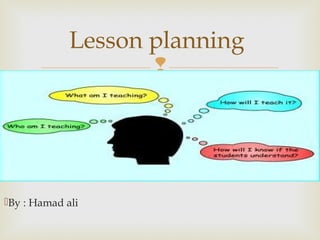
Lesson planning

Contents
 Standard stages of lesson.
 Instructional activity.
Introduction.
Statement of aim.
Development.
Recapitulation.
Consolidation.
Conclusion.
(a) what is a lesson:
Lesson is well planned and structured assignment
to be learned by pupil.
It is a well defined basic unit of instruction
completed in a time period.
Lesson is a mixture of number of ingredients,
techniques, activities and contents.
Lesson is the specific topic which the teacher has
to teach during the limited time period in front of
students of a specific class.
Introduction..
 Cognitive lesson:
The activities are related with acquisition of
knowledge. The aim of this method is to
achieve more knowledge.
Affective Lesson:
Affective activities are related with feelings
and emotions. This method affects the
feeling directly. Like a class of drawing or
music.
Different types of lesson.

Physcho Motor Lesson:
The activities are related to manipulation of
skills. It gives them a sense of satisfaction
and pleasure.
.
The organization of pupil learning activities
and resources that are needed for a specific
period of time in such a way the maximum
learning will result from the experiences
 The teacher’s social, mental and emotional
visualization of classroom experiences.
 The pool of ideas about what is to be done
and how is to be done?
What is a lesson plan?

 Lesson plan is a guide which gives security
to a teacher and direction to the students
 A lesson plan is an extremely useful tool
that serves as a combination guide,
resource, and history document reflecting
our teaching philosophy and most
importantly our goals for our students.
 Provides opportunities to a teacher to
experiment his own ideas.
Contd…..
 The teacher must have command on the subject
required to teach.
 Have knowledge about the age and mental level of
the students.
 Objectives of teaching must be very clear
 Awareness of various techniques of teaching
 Possess the organizational competence to make
the best use of available resources.
 Teacher’s knowledge and skill in evaluation and
test construction is also important.
Essentials of Lesson planning
 Well thought out scheme according to which
an activity is brought to completion.
 An organized sequential mental rehearsal of
all the phases of the activity.
 Advanced arrangement for doing something
in a proper way.
Why Lesson Plan is important?

 Inculcates self confidence in a teacher.
 Integrates different lesson so provides consistency
and continuity in teaching process.
 Provides satisfaction to students and teachers
 Provides the chance of self improvement to the
teacher
Contd…..

 Keeps the teacher and students on the
track
 Achieves the objectives
 Helps the teacher to avoid unpleasant
surprises.
 Provides the roadmaps and visuals in a
logical sequence
 Provides direction to a substitute.
Good Planning….
 Based upon the previous knowledge.
 Uses motivational techniques
 Includes necessary materials
 Is student centered, flexible, complete,
interesting and activity based.
 Has proportionate time allocation
Contd…..

 Includes evaluation process
 Provides information for the use of A.V aids.
 Provides assignment for the students.
 A lesson plane should be in written form.
Contd…..

 Frustration for the teachers and
students.
 Aimless wandering.
 Unmet objectives
 No connection to the prior learning.
 Dis organization .
Poor planning..

 Lack of needed materials.
 Poor management.
 Teacher’s instruction are inefficient .
Contd…..

 Structure the lesson
 Organize its contents.
 Determine the method of delivery.
 Assess students learning.
 Evaluate its applications
Purposes of lesson plane…

 Daily planning
 Weekly planning
 Unit planning
 Term planning
 Yearly planning
Level of lesson
planning.

 Makes the work regular and organized
 Induces confidence
 Proper utility of time
 Promotes learning
 Makes conscious for achievement of
objectives
 Improves results
Advantages of lesson planning..
 Good questions are essential for effective
communication between the teacher and
students.
 Mis use of this skill creates dis interest
and boredom in the students.
 Ask question from the entire class to
promote thinking in all students.
Questioning techniques
 ASK – PAUSE – Call technique can be
used
 Distribute the questions at random . do
not ask question from selected students.
 Ask thoughtful questions like Why , What
, When How etc.
 Acknowledge all answers to ensure
incorrect or vague answers are clarified.
Contd…..
 Direct questions are effective when you suspect
an individual’s attention is wandering.
 Do not waste time in pumping a student, if the
student does not know the answer , offer
explanation or ask question from another
student
 Do not use tricky question
 Do not compromise on the collective answer.
Contd…..

 Introduction
 Statement of aim
 Development
 Recapitulation
 Consolidation
 Conclusion
Standard stages of a lesson

 Purpose:
 Gives appropriate beginning
 To focus the attention of the students
 Creates interest
 Provides a motive to learn
 Linkage with learners background
knowledge
Introduction:

 Features:
 Short
 Relevant
 Interesting
 Innovative
 Imaginative
 Revealing the aim at the end

 Statement of aim :
 Clear
 Focused upon throughout the lesson
 Specifies the scope of lesson.
 Should not be very less/more

 Main part of the lesson
 Set up a step by step plan
 Logical order explanation :
 From known to unknown
 From easy to difficult
 From simple to complex
 Maximum use of AV Aids
Development

 Conduct planned activity
 Much class participation
 Apply maximum questioning
 Maintain writing board summary
gradually.
Contd…..
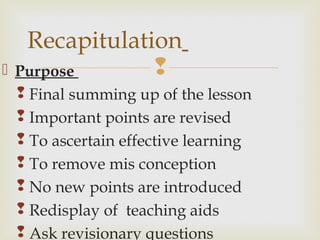
 Purpose
 Final summing up of the lesson
 Important points are revised
 To ascertain effective learning
 To remove mis conception
 No new points are introduced
 Redisplay of teaching aids
 Ask revisionary questions
Recapitulation

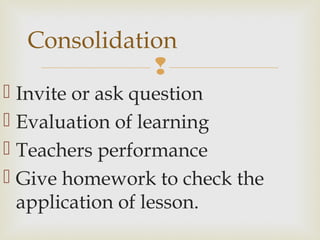
 Invite or ask question
 Evaluation of learning
 Teachers performance
 Give homework to check the
application of lesson.
Consolidation
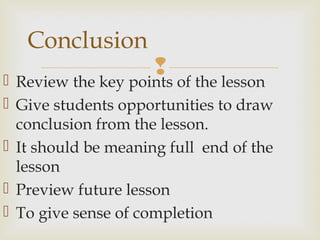
 Review the key points of the lesson
 Give students opportunities to draw
conclusion from the lesson.
 It should be meaning full end of the
lesson
 Preview future lesson
 To give sense of completion
Conclusion

He who fails to plan,
plans to fails..

Lesson planning.

Lesson planning.

  • 2.
     By : Hamadali Lesson planning
  • 3.
  • 4.
     Standard stagesof lesson.  Instructional activity. Introduction. Statement of aim. Development. Recapitulation. Consolidation. Conclusion.
  • 5.
    (a) what isa lesson: Lesson is well planned and structured assignment to be learned by pupil. It is a well defined basic unit of instruction completed in a time period. Lesson is a mixture of number of ingredients, techniques, activities and contents. Lesson is the specific topic which the teacher has to teach during the limited time period in front of students of a specific class. Introduction..
  • 6.
     Cognitive lesson: Theactivities are related with acquisition of knowledge. The aim of this method is to achieve more knowledge. Affective Lesson: Affective activities are related with feelings and emotions. This method affects the feeling directly. Like a class of drawing or music. Different types of lesson.
  • 7.
     Physcho Motor Lesson: Theactivities are related to manipulation of skills. It gives them a sense of satisfaction and pleasure. .
  • 8.
    The organization ofpupil learning activities and resources that are needed for a specific period of time in such a way the maximum learning will result from the experiences  The teacher’s social, mental and emotional visualization of classroom experiences.  The pool of ideas about what is to be done and how is to be done? What is a lesson plan?
  • 9.
      Lesson planis a guide which gives security to a teacher and direction to the students  A lesson plan is an extremely useful tool that serves as a combination guide, resource, and history document reflecting our teaching philosophy and most importantly our goals for our students.  Provides opportunities to a teacher to experiment his own ideas. Contd…..
  • 10.
     The teachermust have command on the subject required to teach.  Have knowledge about the age and mental level of the students.  Objectives of teaching must be very clear  Awareness of various techniques of teaching  Possess the organizational competence to make the best use of available resources.  Teacher’s knowledge and skill in evaluation and test construction is also important. Essentials of Lesson planning
  • 11.
     Well thoughtout scheme according to which an activity is brought to completion.  An organized sequential mental rehearsal of all the phases of the activity.  Advanced arrangement for doing something in a proper way. Why Lesson Plan is important?
  • 12.
      Inculcates selfconfidence in a teacher.  Integrates different lesson so provides consistency and continuity in teaching process.  Provides satisfaction to students and teachers  Provides the chance of self improvement to the teacher Contd…..
  • 13.
      Keeps theteacher and students on the track  Achieves the objectives  Helps the teacher to avoid unpleasant surprises.  Provides the roadmaps and visuals in a logical sequence  Provides direction to a substitute. Good Planning….
  • 14.
     Based uponthe previous knowledge.  Uses motivational techniques  Includes necessary materials  Is student centered, flexible, complete, interesting and activity based.  Has proportionate time allocation Contd…..
  • 15.
      Includes evaluationprocess  Provides information for the use of A.V aids.  Provides assignment for the students.  A lesson plane should be in written form. Contd…..
  • 16.
      Frustration forthe teachers and students.  Aimless wandering.  Unmet objectives  No connection to the prior learning.  Dis organization . Poor planning..
  • 17.
      Lack ofneeded materials.  Poor management.  Teacher’s instruction are inefficient . Contd…..
  • 18.
      Structure thelesson  Organize its contents.  Determine the method of delivery.  Assess students learning.  Evaluate its applications Purposes of lesson plane…
  • 19.
      Daily planning Weekly planning  Unit planning  Term planning  Yearly planning Level of lesson planning.
  • 20.
      Makes thework regular and organized  Induces confidence  Proper utility of time  Promotes learning  Makes conscious for achievement of objectives  Improves results Advantages of lesson planning..
  • 21.
     Good questionsare essential for effective communication between the teacher and students.  Mis use of this skill creates dis interest and boredom in the students.  Ask question from the entire class to promote thinking in all students. Questioning techniques
  • 22.
     ASK –PAUSE – Call technique can be used  Distribute the questions at random . do not ask question from selected students.  Ask thoughtful questions like Why , What , When How etc.  Acknowledge all answers to ensure incorrect or vague answers are clarified. Contd…..
  • 23.
     Direct questionsare effective when you suspect an individual’s attention is wandering.  Do not waste time in pumping a student, if the student does not know the answer , offer explanation or ask question from another student  Do not use tricky question  Do not compromise on the collective answer. Contd…..
  • 24.
      Introduction  Statementof aim  Development  Recapitulation  Consolidation  Conclusion Standard stages of a lesson
  • 25.
      Purpose:  Givesappropriate beginning  To focus the attention of the students  Creates interest  Provides a motive to learn  Linkage with learners background knowledge Introduction:
  • 26.
      Features:  Short Relevant  Interesting  Innovative  Imaginative  Revealing the aim at the end
  • 27.
      Statement ofaim :  Clear  Focused upon throughout the lesson  Specifies the scope of lesson.  Should not be very less/more
  • 28.
      Main partof the lesson  Set up a step by step plan  Logical order explanation :  From known to unknown  From easy to difficult  From simple to complex  Maximum use of AV Aids Development
  • 29.
      Conduct plannedactivity  Much class participation  Apply maximum questioning  Maintain writing board summary gradually. Contd…..
  • 30.
     Purpose  Finalsumming up of the lesson  Important points are revised  To ascertain effective learning  To remove mis conception  No new points are introduced  Redisplay of teaching aids  Ask revisionary questions Recapitulation
  • 31.
      Invite orask question  Evaluation of learning  Teachers performance  Give homework to check the application of lesson. Consolidation
  • 32.
     Review thekey points of the lesson  Give students opportunities to draw conclusion from the lesson.  It should be meaning full end of the lesson  Preview future lesson  To give sense of completion Conclusion
  • 33.
     He who failsto plan, plans to fails..
  • 34.