EFFECTIVE LESSON PLANNING
EFFECTIVE TEACHERS…
Know the content
Understand the development
of the student
Value the diversity of the
students
Use multiple assessments to
evaluate progress
Create a suitable learning
environment
Adapt and modify instruction
Use effective communication
Collaborate with all members
of the learning community
Engage in sustained
professional growth
experiences
INSTRUCTIONAL PLANNING
AND STRATEGIES
Plans are developed to provide students with meaningful learning
experiences
Plans connect to related learning opportunities
Teaching is based instructional strategies that focus on best
practice and research
Teaching is supported by strategies that foster interest and
progress
GENERAL POLICY
Plans are a legal document
Usually required weekly to the supervisor
Plan books (district, purchased, self-made notebooks)
Substitute plans
Must include
 TEKS
 Objectives
 Needed materials
 Bell Ringer
 Procedures
 Closing
GOOD PLANNING
Keeps the teacher and students on track
Achieves the objectives
Helps teachers to avoid “unpleasant” surprises
Provides the roadmap and visuals in a logical
sequence
Provides direction to a substitute
Encourages reflection, refinement, and
improvement
Enhances student achievement
POOR PLANNING
Frustration for the teacher and the student
Aimless wandering
Unmet objectives
No connections to prior learnings
Disorganization
Lack of needed materials
A waste of time
Poor management
TEKS
Objective – expected student behavior
Warm –up and introduction
Procedure
Materials – worksheets, film, text, etc.
Presentation
Practice
Application
Closure
Evaluation – test, assignment, teacher observation, etc.
•Maximize Instructional Time
•Integrate Diverse Teaching Strategies
•Have All Students On Task
A GOOD LESSON INCLUDES:
LET’S BEGIN…
The format of a lesson should..
Go one step at a time
Have a picture for every step
An effective lesson plan is a set of plans for building
something – it “constructs” the learning.
..WORKSHOP JUNE 2023Final S
electionPresentationTeachers a
re People.mp4
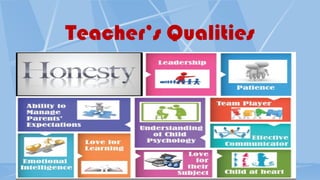
Teacher’s Qualities
HANDS-ON ACTIVITY
The greater the structure of a lesson and the
more precise the directions on what is to be
accomplished, the higher the achievement rate.
Harry Wong, The First Days of Teaching
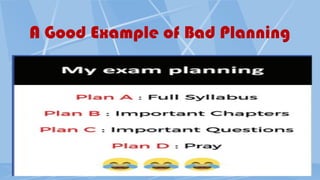
A Good Example of Bad Planning
Key Elements to be considered while
preparing a Lesson Plan
Who are the target groups?
What is the context of learning?
What should be the Learning Outcomes of the lesson?
Resources/material required
What other parts of the curriculum can it integrate?
Time required
Educational Strategies to be adopted, Learning
Activities and Tools to be used
Assessment Strategies
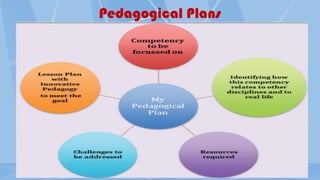
Pedagogical Plans
OBJECTIVES
A description of what the student will be able
to do at the end of the lesson
Provides alignment with Nation and state
goals.
Use behavioral verbs to describe the expected
outcomes (ACTION)
No-no’s: appreciate, enjoy, love, etc.
WARM-UP AND
INTRODUCTION
Grab the attention of the students
PROVIDES THE INTEREST/MOTIVATION factor
Set the tone for the lesson connected to the objective
 A question
 A story
 A saying
 An activity
 A discussion starter
BE CREATIVE
PRE-ASSESSMENT
What are the characteristics of the
learners in the class?
What do the students already
know and understand?
How do my students learn best?
What modifications in instruction
might I need to make?
PROCEDURES AND
PRESENTATION
Sets up a step-by-step plan
Provides a quick review of
previous learning
Provides specific activities to
assist students in developing the
new knowledge
Provides modeling of a new skill
 A picture is worth a thousand words.
 I do, We do, You do!
MATERIALS
Plan! Prepare! Have on hand!
 Murphy’s Law
Envision your needs.
List all resources.
Have enough manipulatives (when needed) for
groups or individuals.
PRACTICE
APPLYING WHAT IS LEARNED
Provide multiple learning activities
Guided practice (teacher controlled)
Use a variety of questioning strategies to determine the
level of understanding
Journaling, conferencing
Independent practice
Practice may be differentiated
BUILD ON SUCCESS
LEARNING ACTIVITIES
Graphic organizers
Creative play
Peer presenting
Performances
Role playing
Debates
Game making
Projects
Cooperative
groups
Inquiry learning
Direct instruction
Differentiation
Direct Instruction
CLOSURE
Lesson Wrap-up: Leave students with
an imprint of what the lesson covered.
Students summarize the major concepts
Displays internalized student knowledge
Teacher recaps the main points
Teacher sets the stage for the next phase
of learning
EVALUATION
Assess the learning-Rubric
 Teacher made test
 In-class or homework
assignments
 Project to apply the learning
in real-life situation
 Recitations and summaries
 Performance assessments
 Use of rubrics
 Portfolios
 Journals
 Informal assessment
REFLECTION
What went well in the lesson?
What problems did I experience?
Are there things I could have done differently?
How can I build on this lesson to make future
lessons successful?
THE SUBSTITUTE…
NOW WHAT?
The Key to substitute success – DETAILED LESSON PLANS
 Discipline routines
 Children with special needs
 Fire drill and emergency procedures
 Helpful students, helpful colleagues (phone #’s)
 Classroom schedule
 Names of administrators
 Expectations for the work
 Packet of extra activities
A teacher is one
who brings us tools
and enables us to
use them.
Jean Toomer
Lesson Plans:
Review
Reflection/Open Discussion:
Main components of a lesson plan
Critical thinking skills
Characteristics of a good lesson
Teacher responsibilities
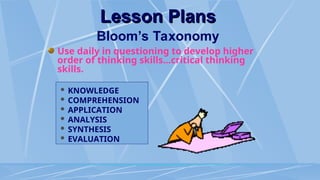
Use daily in questioning to develop higher
order of thinking skills...critical thinking
skills.
 KNOWLEDGE
 COMPREHENSION
 APPLICATION
 ANALYSIS
 SYNTHESIS
 EVALUATION
Lesson Plans
Lesson Plans
Bloom’s Taxonomy
Lesson Plans
Lesson Plans
Bloom’s Taxonomy
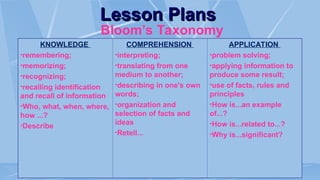
KNOWLEDGE
•remembering;
•memorizing;
•recognizing;
•recalling identification
and recall of information
•Who, what, when, where,
how ...?
•Describe
COMPREHENSION
•interpreting;
•translating from one
medium to another;
•describing in one's own
words;
•organization and
selection of facts and
ideas
•Retell...
APPLICATION
•problem solving;
•applying information to
produce some result;
•use of facts, rules and
principles
•How is...an example
of...?
•How is...related to...?
•Why is...significant?
Lesson Plans
Lesson Plans
Bloom’s Taxonomy
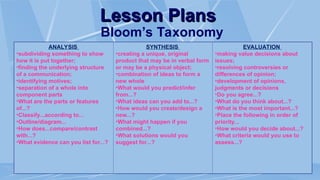
ANALYSIS
•subdividing something to show
how it is put together;
•finding the underlying structure
of a communication;
•identifying motives;
•separation of a whole into
component parts
•What are the parts or features
of...?
•Classify...according to...
•Outline/diagram...
•How does...compare/contrast
with...?
•What evidence can you list for...?
SYNTHESIS
•creating a unique, original
product that may be in verbal form
or may be a physical object;
•combination of ideas to form a
new whole
•What would you predict/infer
from...?
•What ideas can you add to...?
•How would you create/design a
new...?
•What might happen if you
combined...?
•What solutions would you
suggest for...?
EVALUATION
•making value decisions about
issues;
•resolving controversies or
differences of opinion;
•development of opinions,
judgments or decisions
•Do you agree...?
•What do you think about...?
•What is the most important...?
•Place the following in order of
priority...
•How would you decide about...?
•What criteria would you use to
assess...?
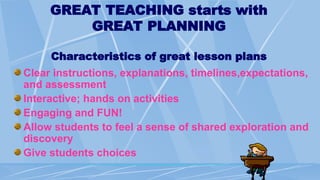
GREAT TEACHING starts with
GREAT PLANNING
Characteristics of great lesson plans
Clear instructions, explanations, timelines,expectations,
and assessment
Interactive; hands on activities
Engaging and FUN!
Allow students to feel a sense of shared exploration and
discovery
Give students choices
GREAT TEACHING starts
with GREAT PLANNING
Students engaged & motivated
Break assignments into small chunks
Hands-on manipulatives
Ask open ended questions
Make lesson relevant
Allow students to develop own questions to research
Integrate diverse teaching strategies
Talk at appropriate level
Foundational Habits
Be Explicit
Model
Reinforce
SET STUDENT GOALS
They’re all about High
Expectations
Keys to great goal setting
Regular Routine – “mini goals”- focus on small,
immediate, action-oriented
Very Specific Actions-what, when, how??
Level Appropriate
Followed by reflection- students need to evaluate- leads to
feeling of accomplishment and future goal setting
The 5 Most Important
Things You Can Do For
Your Students
CARE
SET HIGH EXPECTATIONS
CREATE ORDERLY, STRUCTURED
CLASSROOM
EARN RESPECT- stay calm, exercise
self control
TREAT EACH STUDENT WITH
COURTESY AND RESPECT
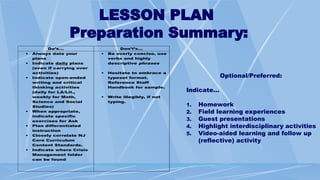
LESSON PLAN
Preparation Summary:
Do’s… Don’t’s…
 Always date your
plans
 Indicate daily plans
(even if carrying over
activities)
 Indicate open-ended
writing and critical
thinking activities
(daily for LA/Lit.,
weekly for Math,
Science and Social
Studies)
 When appropriate,
indicate specific
exercises for Ask
 Plan differentiated
instruction
 Closely correlate NJ
Core Curriculum
Content Standards.
 Indicate where Crisis
Management folder
can be found
 Be overly concise, use
verbs and highly
descriptive phrases
 Hesitate to embrace a
typeset format.
Reference Staff
Handbook for sample.
 Write illegibly, if not
typing.
Optional/Preferred:
Indicate…
1. Homework
2. Field learning experiences
3. Guest presentations
4. Highlight interdisciplinary activities
5. Video-aided learning and follow up
(reflective) activity
Effective lesson planning. Social Scienceppt

Effective lesson planning. Social Scienceppt

  • 1.
  • 2.
    EFFECTIVE TEACHERS… Know thecontent Understand the development of the student Value the diversity of the students Use multiple assessments to evaluate progress Create a suitable learning environment Adapt and modify instruction Use effective communication Collaborate with all members of the learning community Engage in sustained professional growth experiences
  • 3.
    INSTRUCTIONAL PLANNING AND STRATEGIES Plansare developed to provide students with meaningful learning experiences Plans connect to related learning opportunities Teaching is based instructional strategies that focus on best practice and research Teaching is supported by strategies that foster interest and progress
  • 4.
    GENERAL POLICY Plans area legal document Usually required weekly to the supervisor Plan books (district, purchased, self-made notebooks) Substitute plans Must include  TEKS  Objectives  Needed materials  Bell Ringer  Procedures  Closing
  • 5.
    GOOD PLANNING Keeps theteacher and students on track Achieves the objectives Helps teachers to avoid “unpleasant” surprises Provides the roadmap and visuals in a logical sequence Provides direction to a substitute Encourages reflection, refinement, and improvement Enhances student achievement
  • 6.
    POOR PLANNING Frustration forthe teacher and the student Aimless wandering Unmet objectives No connections to prior learnings Disorganization Lack of needed materials A waste of time Poor management
  • 7.
    TEKS Objective – expectedstudent behavior Warm –up and introduction Procedure Materials – worksheets, film, text, etc. Presentation Practice Application Closure Evaluation – test, assignment, teacher observation, etc. •Maximize Instructional Time •Integrate Diverse Teaching Strategies •Have All Students On Task A GOOD LESSON INCLUDES:
  • 8.
    LET’S BEGIN… The formatof a lesson should.. Go one step at a time Have a picture for every step An effective lesson plan is a set of plans for building something – it “constructs” the learning.
  • 9.
    ..WORKSHOP JUNE 2023FinalS electionPresentationTeachers a re People.mp4
  • 10.
  • 11.
  • 12.
    The greater thestructure of a lesson and the more precise the directions on what is to be accomplished, the higher the achievement rate. Harry Wong, The First Days of Teaching
  • 13.
    A Good Exampleof Bad Planning
  • 14.
    Key Elements tobe considered while preparing a Lesson Plan Who are the target groups? What is the context of learning? What should be the Learning Outcomes of the lesson? Resources/material required What other parts of the curriculum can it integrate? Time required Educational Strategies to be adopted, Learning Activities and Tools to be used Assessment Strategies
  • 15.
  • 16.
    OBJECTIVES A description ofwhat the student will be able to do at the end of the lesson Provides alignment with Nation and state goals. Use behavioral verbs to describe the expected outcomes (ACTION) No-no’s: appreciate, enjoy, love, etc.
  • 17.
    WARM-UP AND INTRODUCTION Grab theattention of the students PROVIDES THE INTEREST/MOTIVATION factor Set the tone for the lesson connected to the objective  A question  A story  A saying  An activity  A discussion starter BE CREATIVE
  • 18.
    PRE-ASSESSMENT What are thecharacteristics of the learners in the class? What do the students already know and understand? How do my students learn best? What modifications in instruction might I need to make?
  • 19.
    PROCEDURES AND PRESENTATION Sets upa step-by-step plan Provides a quick review of previous learning Provides specific activities to assist students in developing the new knowledge Provides modeling of a new skill  A picture is worth a thousand words.  I do, We do, You do!
  • 20.
    MATERIALS Plan! Prepare! Haveon hand!  Murphy’s Law Envision your needs. List all resources. Have enough manipulatives (when needed) for groups or individuals.
  • 21.
    PRACTICE APPLYING WHAT ISLEARNED Provide multiple learning activities Guided practice (teacher controlled) Use a variety of questioning strategies to determine the level of understanding Journaling, conferencing Independent practice Practice may be differentiated BUILD ON SUCCESS
  • 22.
    LEARNING ACTIVITIES Graphic organizers Creativeplay Peer presenting Performances Role playing Debates Game making Projects Cooperative groups Inquiry learning Direct instruction Differentiation Direct Instruction
  • 23.
    CLOSURE Lesson Wrap-up: Leavestudents with an imprint of what the lesson covered. Students summarize the major concepts Displays internalized student knowledge Teacher recaps the main points Teacher sets the stage for the next phase of learning
  • 24.
    EVALUATION Assess the learning-Rubric Teacher made test  In-class or homework assignments  Project to apply the learning in real-life situation  Recitations and summaries  Performance assessments  Use of rubrics  Portfolios  Journals  Informal assessment
  • 25.
    REFLECTION What went wellin the lesson? What problems did I experience? Are there things I could have done differently? How can I build on this lesson to make future lessons successful?
  • 26.
    THE SUBSTITUTE… NOW WHAT? TheKey to substitute success – DETAILED LESSON PLANS  Discipline routines  Children with special needs  Fire drill and emergency procedures  Helpful students, helpful colleagues (phone #’s)  Classroom schedule  Names of administrators  Expectations for the work  Packet of extra activities
  • 28.
    A teacher isone who brings us tools and enables us to use them. Jean Toomer
  • 29.
    Lesson Plans: Review Reflection/Open Discussion: Maincomponents of a lesson plan Critical thinking skills Characteristics of a good lesson Teacher responsibilities
  • 30.
    Use daily inquestioning to develop higher order of thinking skills...critical thinking skills.  KNOWLEDGE  COMPREHENSION  APPLICATION  ANALYSIS  SYNTHESIS  EVALUATION Lesson Plans Lesson Plans Bloom’s Taxonomy
  • 31.
    Lesson Plans Lesson Plans Bloom’sTaxonomy KNOWLEDGE •remembering; •memorizing; •recognizing; •recalling identification and recall of information •Who, what, when, where, how ...? •Describe COMPREHENSION •interpreting; •translating from one medium to another; •describing in one's own words; •organization and selection of facts and ideas •Retell... APPLICATION •problem solving; •applying information to produce some result; •use of facts, rules and principles •How is...an example of...? •How is...related to...? •Why is...significant?
  • 32.
    Lesson Plans Lesson Plans Bloom’sTaxonomy ANALYSIS •subdividing something to show how it is put together; •finding the underlying structure of a communication; •identifying motives; •separation of a whole into component parts •What are the parts or features of...? •Classify...according to... •Outline/diagram... •How does...compare/contrast with...? •What evidence can you list for...? SYNTHESIS •creating a unique, original product that may be in verbal form or may be a physical object; •combination of ideas to form a new whole •What would you predict/infer from...? •What ideas can you add to...? •How would you create/design a new...? •What might happen if you combined...? •What solutions would you suggest for...? EVALUATION •making value decisions about issues; •resolving controversies or differences of opinion; •development of opinions, judgments or decisions •Do you agree...? •What do you think about...? •What is the most important...? •Place the following in order of priority... •How would you decide about...? •What criteria would you use to assess...?
  • 33.
    GREAT TEACHING startswith GREAT PLANNING Characteristics of great lesson plans Clear instructions, explanations, timelines,expectations, and assessment Interactive; hands on activities Engaging and FUN! Allow students to feel a sense of shared exploration and discovery Give students choices
  • 34.
    GREAT TEACHING starts withGREAT PLANNING Students engaged & motivated Break assignments into small chunks Hands-on manipulatives Ask open ended questions Make lesson relevant Allow students to develop own questions to research Integrate diverse teaching strategies Talk at appropriate level
  • 35.
  • 36.
    SET STUDENT GOALS They’reall about High Expectations Keys to great goal setting Regular Routine – “mini goals”- focus on small, immediate, action-oriented Very Specific Actions-what, when, how?? Level Appropriate Followed by reflection- students need to evaluate- leads to feeling of accomplishment and future goal setting
  • 37.
    The 5 MostImportant Things You Can Do For Your Students CARE SET HIGH EXPECTATIONS CREATE ORDERLY, STRUCTURED CLASSROOM EARN RESPECT- stay calm, exercise self control TREAT EACH STUDENT WITH COURTESY AND RESPECT
  • 38.
    LESSON PLAN Preparation Summary: Do’s…Don’t’s…  Always date your plans  Indicate daily plans (even if carrying over activities)  Indicate open-ended writing and critical thinking activities (daily for LA/Lit., weekly for Math, Science and Social Studies)  When appropriate, indicate specific exercises for Ask  Plan differentiated instruction  Closely correlate NJ Core Curriculum Content Standards.  Indicate where Crisis Management folder can be found  Be overly concise, use verbs and highly descriptive phrases  Hesitate to embrace a typeset format. Reference Staff Handbook for sample.  Write illegibly, if not typing. Optional/Preferred: Indicate… 1. Homework 2. Field learning experiences 3. Guest presentations 4. Highlight interdisciplinary activities 5. Video-aided learning and follow up (reflective) activity

Editor's Notes

  • #5 ACTIVITY: Brainstorm a list of benefits of well-planned lessons and pitfalls of poorly planned lessons
  • #8 Example: division problem (visual) compare divide multiply subtract compare bring down Compare this to the directions for making a model airplane (marketers have it right)
  • #16 Let the students know your objectives, why they need to know it , and how they will use the learning. Good objective: Students will be able to illustrate clouds that signal unsettled weather. Poor objective: Students will understand that some clouds signal the approach of poor weather conditions. ACTIVITY: Have groups (2-3) write a behavioral objective for …………….
  • #18 Teachers make 1500 decisions a day… this is where it begins Previous teacher comments and test data Cum folders Classroom observation