lesson Plan
Shams ud din 21290
 A lesson plan is a framework for teaching.
 Lesson is like a journey the lesson plan is the
roadmap.
 Lesson plan are the product of teacher's thoughts
about their classes what they hope to achieve and
how they hope to achieve it.
 Teacher are the driver of a bus full students,without
your map you have no idea where you want to go or
how to get there. 1
Main Components of a Lesson Plan
 Lesson Objectives (what to achieve by the end of lesson)
 Introduction (checking previous knowledge with reference to topic in hand)
 Learning Resources Required (blackboard, charts, photographs, models, video)
 Presentation [ 1. presentation and illustration of concepts with the help of AV aids- here one
or a combination of teaching methods and/or a teaching method with one/more teaching techniques can
be used; 2. application of the concept(s); Guided & independent practice]
 Recapitulation (to assess the understanding/learning and progress of students on the lesson.
Student Learning Outcomes (SLOs) are helpful at this stage.
2
Components of a Lesson Plan
3) Teaching Method: The teaching method which would be used to teach a particular
topic must be suitable for teaching that topic. And teaching method must also be
helpful for achieving the general and specific objectives of the lesson, students’ level,
class size and available resources.
4) AV aids: AV aids to be used for teaching a topic must be in accordance with the
subject and topic of the lesson, and available resources. And it is also helpful for
achieving the general and specific objectives of the lesson.
5) Previous Knowledge Test: Previous knowledge test would involve asking questions
from children to test their previous knowledge. The purpose of previous knowledge
test is to relate the lesson of the day with previous knowledge of the students. It also
gives an idea to a teacher about where and how to start a lesson.
6) Announcement of the Topic: The teacher would announce the topic of lesson in
such a way that would arouse interest of the students. It can be a short story or some
relation with already learned concepts by students.
3
Components of a Lesson Plan
7) Presentation:
Presentation of lesson would be in two or more parts:
questions/activity would be asked from students after every part for
formative evaluation of the lesson. Steps of presentation part may
be different depending upon the topic of the lesson, teaching
method used and the level of class During presentation, easy
words should be used. The style of presentation of lesson must be
appropriate to age, background knowledge and mental level of
students. Formative evaluation will help to track progress of the
students.
4
Components of a Lesson Plan
8) Recapitulation: Recapitulation will be carried out at the end of
the lesson. It will be helpful to inform teacher about how much
he/she is successful in achieving the objectives of the lesson. It
can be some question-answers or Classroom Assessment
Techniques (CATs) {detail description is available in this
presentation in next slides}
9) Homework: The students may be assigned brief but interesting
homework for practicing the lesson of the day in more detail.
5
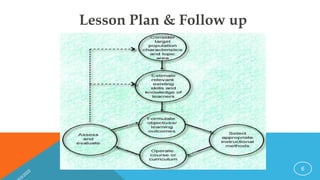
Lesson Plan & Follow up
6
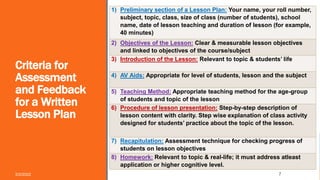
Criteria for
Assessment
and Feedback
for a Written
Lesson Plan
5/2/2022 7
1) Preliminary section of a Lesson Plan: Your name, your roll number,
subject, topic, class, size of class (number of students), school
name, date of lesson teaching and duration of lesson (for example,
40 minutes)
2) Objectives of the Lesson: Clear & measurable lesson objectives
and linked to objectives of the course/subject
3) Introduction of the Lesson: Relevant to topic & students’ life
4) AV Aids: Appropriate for level of students, lesson and the subject
5) Teaching Method: Appropriate teaching method for the age-group
of students and topic of the lesson
6) Procedure of lesson presentation: Step-by-step description of
lesson content with clarity. Step wise explanation of class activity
designed for students’ practice about the topic of the lesson.
7) Recapitulation: Assessment technique for checking progress of
students on lesson objectives
8) Homework: Relevant to topic & real-life; it must address atleast
application or higher cognitive level.
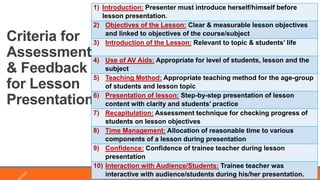
Criteria for
Assessment
& Feedback
for Lesson
Presentation
8
1) Introduction: Presenter must introduce herself/himself before
lesson presentation.
2) Objectives of the Lesson: Clear & measurable lesson objectives
and linked to objectives of the course/subject
3) Introduction of the Lesson: Relevant to topic & students’ life
4) Use of AV Aids: Appropriate for level of students, lesson and the
subject
5) Teaching Method: Appropriate teaching method for the age-group
of students and lesson topic
6) Presentation of lesson: Step-by-step presentation of lesson
content with clarity and students’ practice
7) Recapitulation: Assessment technique for checking progress of
students on lesson objectives
8) Time Management: Allocation of reasonable time to various
components of a lesson during presentation
9) Confidence: Confidence of trainee teacher during lesson
presentation
10) Interaction with Audience/Students: Trainee teacher was
interactive with audience/students during his/her presentation.
Practice, Practice & Practice
 Good lesson planning is essential to the process of
teaching and learning.
 The development of interesting lessons takes a great
deal of time and effort. As a new teacher, you must be
committed to spend necessary time on this task.
9
LESSON OBJECTIVES
10
What are Objectives?
 Objectives are stated in observable and measurable terms
(outcomes, proficiencies or competences)
 Objectives state what students should know at the end of the
lesson/segment of a course and what is expected from them.
 Objectives are behavioral in nature and more precise than
goals.
11
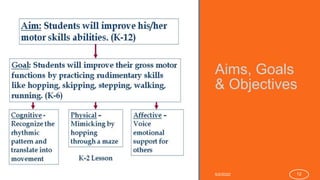
Aims, Goals
& Objectives
5/2/2022 12
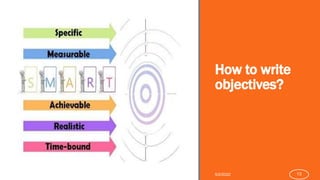
How to write
objectives?
5/2/2022 13
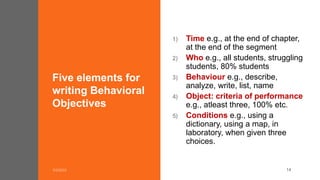
Five elements for
writing Behavioral
Objectives
1) Time e.g., at the end of chapter,
at the end of the segment
2) Who e.g., all students, struggling
students, 80% students
3) Behaviour e.g., describe,
analyze, write, list, name
4) Object: criteria of performance
e.g., atleast three, 100% etc.
5) Conditions e.g., using a
dictionary, using a map, in
laboratory, when given three
choices.
14
Examples
of
Behavioral
Objectives
1) By the end of lesson, all the students will
be able to write a short paragraph on a
topic related to their personal goals using a
paper and a pen.
2) By the end of lesson, all of the students will
be able to measure the diameter of
spherical object using Vernier caliper in
laboratory.
3) By the end of this exercise, all of the
students will be able to determine the
surface area of a solid object using the
formula of surface area in the classroom.
15
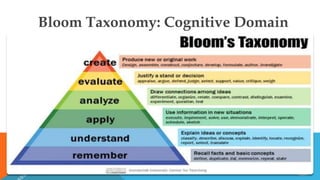
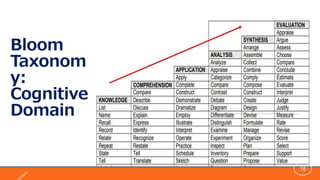
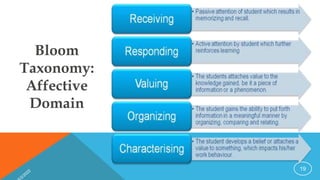
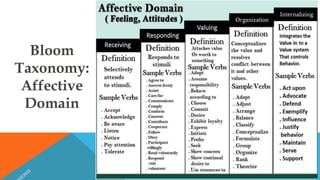
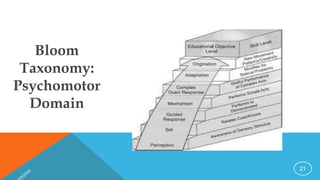
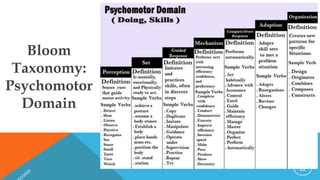
Objectives: Bloom Taxonomy
3 Domains
 Cognitive Domain
 Affective Domain
 Psychomotor Domain
16
Bloom Taxonomy: Cognitive Domain
17
Bloom
Taxonom
y:
Cognitive
Domain
18
Bloom
Taxonomy:
Affective
Domain
19
Bloom
Taxonomy:
Affective
Domain
20
Bloom
Taxonomy:
Psychomotor
Domain
21
Bloom
Taxonomy:
Psychomotor
Domain
22
23
Which teaching methods have you been exposed to?
…in high school?
…in college?
…in non-formal settings?
Teaching Method
 It refers to ways and principles used for instruction. It is
implemented by the teacher to achieve desired learning
outcomes by the students.
 It is a way of presenting the content/topic in
classroom/laboratory/playground.
 Method refers to formal structure of sequence of acts commonly
denoted by instruction.
24
Teaching Method: Analogies
 Teaching is like fishing…
 You use different lures for different fish
 You use different methods for different learners.
 Teaching is like beautiful music…
 Where, instructional methods are the instruments
 When played alone they make sound…
 When played together in tune, rhythm, and feeling, they become amazing
music!
25
Teaching Method
It is an objective-oriented activities and flow of
information in order between teachers and students.
Every teaching method has a psychological theory
in its support i.e., behaviorism (direct instruction,
mastery learning), cognitivism (discovery learning,
expository teaching) and constructivism.
26
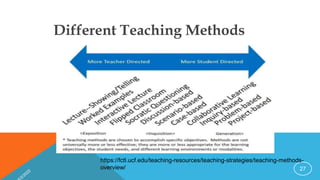
Different Teaching Methods
27
https://fctl.ucf.edu/teaching-resources/teaching-strategies/teaching-methods-
overview/
Criteria for Selecting a Teaching Method
 Nature of Topic to be Taught
 Intended Specific Purpose
 Level of class
 Size of class
 Availability of Time
 Availability of Materials and Facilities
28
Steps for Selecting a Teaching Method
 Clear Objectives
 Choose teaching method(s) [choose one method or mix of methods]
 Will the students be comfortable with this method?
 Are you (teacher) comfortable with this method?
 Will the selected teaching method be practicable?
 Will you (the teacher) be allowed to use that teaching method?
29
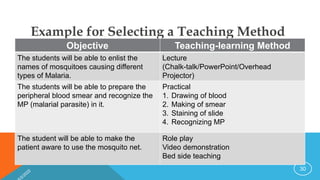
Example for Selecting a Teaching Method
30
Objective Teaching-learning Method
The students will be able to enlist the
names of mosquitoes causing different
types of Malaria.
Lecture
(Chalk-talk/PowerPoint/Overhead
Projector)
The students will be able to prepare the
peripheral blood smear and recognize the
MP (malarial parasite) in it.
Practical
1. Drawing of blood
2. Making of smear
3. Staining of slide
4. Recognizing MP
The student will be able to make the
patient aware to use the mosquito net.
Role play
Video demonstration
Bed side teaching
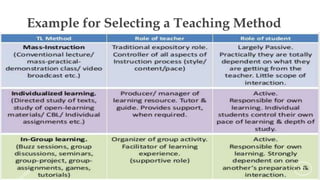
Example for Selecting a Teaching Method
31
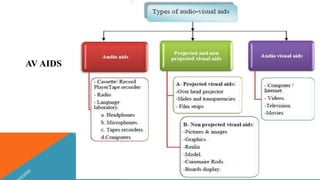
AV AIDS
32
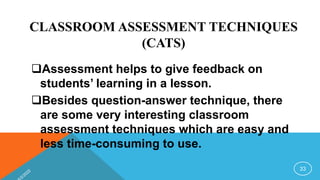
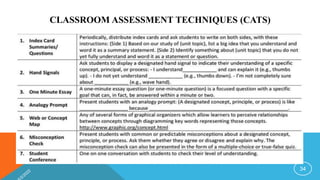
CLASSROOM ASSESSMENT TECHNIQUES
(CATS)
Assessment helps to give feedback on
students’ learning in a lesson.
Besides question-answer technique, there
are some very interesting classroom
assessment techniques which are easy and
less time-consuming to use.
33
CLASSROOM ASSESSMENT TECHNIQUES (CATS)
34
CONCLUSION
WITHOUT SOME KIND OF PLANNING ,A LESSON COULD BE JUST AS CHAOTIC AND COULD
LEAVETHE STUDENTS WITH NO CLEAR IDEA OF WHAT THEY WERE DING OR WHY.THIS KIND
OF UNCERTAINTY IS NOT GOOD FOR EFFECTIVE TEACHING LEARNING OR DISCIPLINE.ONE OF
THE MOST IMPATARNT REASON TO PLAN IS THAT THE TEACHER NEEDS TO KNOW WHAT IT IS
THEY HOPE TO ACHIEVE IN THE CLASS,WHAT IT IS THEY THE STUDENT TO BE ABLE TO DO AT
THE END OF THE LESSON THAT THEY COULD,NT DO BEFORE.
35
36
37

Lesson plan Shams.pptx

  • 1.
    lesson Plan Shams uddin 21290  A lesson plan is a framework for teaching.  Lesson is like a journey the lesson plan is the roadmap.  Lesson plan are the product of teacher's thoughts about their classes what they hope to achieve and how they hope to achieve it.  Teacher are the driver of a bus full students,without your map you have no idea where you want to go or how to get there. 1
  • 2.
    Main Components ofa Lesson Plan  Lesson Objectives (what to achieve by the end of lesson)  Introduction (checking previous knowledge with reference to topic in hand)  Learning Resources Required (blackboard, charts, photographs, models, video)  Presentation [ 1. presentation and illustration of concepts with the help of AV aids- here one or a combination of teaching methods and/or a teaching method with one/more teaching techniques can be used; 2. application of the concept(s); Guided & independent practice]  Recapitulation (to assess the understanding/learning and progress of students on the lesson. Student Learning Outcomes (SLOs) are helpful at this stage. 2
  • 3.
    Components of aLesson Plan 3) Teaching Method: The teaching method which would be used to teach a particular topic must be suitable for teaching that topic. And teaching method must also be helpful for achieving the general and specific objectives of the lesson, students’ level, class size and available resources. 4) AV aids: AV aids to be used for teaching a topic must be in accordance with the subject and topic of the lesson, and available resources. And it is also helpful for achieving the general and specific objectives of the lesson. 5) Previous Knowledge Test: Previous knowledge test would involve asking questions from children to test their previous knowledge. The purpose of previous knowledge test is to relate the lesson of the day with previous knowledge of the students. It also gives an idea to a teacher about where and how to start a lesson. 6) Announcement of the Topic: The teacher would announce the topic of lesson in such a way that would arouse interest of the students. It can be a short story or some relation with already learned concepts by students. 3
  • 4.
    Components of aLesson Plan 7) Presentation: Presentation of lesson would be in two or more parts: questions/activity would be asked from students after every part for formative evaluation of the lesson. Steps of presentation part may be different depending upon the topic of the lesson, teaching method used and the level of class During presentation, easy words should be used. The style of presentation of lesson must be appropriate to age, background knowledge and mental level of students. Formative evaluation will help to track progress of the students. 4
  • 5.
    Components of aLesson Plan 8) Recapitulation: Recapitulation will be carried out at the end of the lesson. It will be helpful to inform teacher about how much he/she is successful in achieving the objectives of the lesson. It can be some question-answers or Classroom Assessment Techniques (CATs) {detail description is available in this presentation in next slides} 9) Homework: The students may be assigned brief but interesting homework for practicing the lesson of the day in more detail. 5
  • 6.
    Lesson Plan &Follow up 6
  • 7.
    Criteria for Assessment and Feedback fora Written Lesson Plan 5/2/2022 7 1) Preliminary section of a Lesson Plan: Your name, your roll number, subject, topic, class, size of class (number of students), school name, date of lesson teaching and duration of lesson (for example, 40 minutes) 2) Objectives of the Lesson: Clear & measurable lesson objectives and linked to objectives of the course/subject 3) Introduction of the Lesson: Relevant to topic & students’ life 4) AV Aids: Appropriate for level of students, lesson and the subject 5) Teaching Method: Appropriate teaching method for the age-group of students and topic of the lesson 6) Procedure of lesson presentation: Step-by-step description of lesson content with clarity. Step wise explanation of class activity designed for students’ practice about the topic of the lesson. 7) Recapitulation: Assessment technique for checking progress of students on lesson objectives 8) Homework: Relevant to topic & real-life; it must address atleast application or higher cognitive level.
  • 8.
    Criteria for Assessment & Feedback forLesson Presentation 8 1) Introduction: Presenter must introduce herself/himself before lesson presentation. 2) Objectives of the Lesson: Clear & measurable lesson objectives and linked to objectives of the course/subject 3) Introduction of the Lesson: Relevant to topic & students’ life 4) Use of AV Aids: Appropriate for level of students, lesson and the subject 5) Teaching Method: Appropriate teaching method for the age-group of students and lesson topic 6) Presentation of lesson: Step-by-step presentation of lesson content with clarity and students’ practice 7) Recapitulation: Assessment technique for checking progress of students on lesson objectives 8) Time Management: Allocation of reasonable time to various components of a lesson during presentation 9) Confidence: Confidence of trainee teacher during lesson presentation 10) Interaction with Audience/Students: Trainee teacher was interactive with audience/students during his/her presentation.
  • 9.
    Practice, Practice &Practice  Good lesson planning is essential to the process of teaching and learning.  The development of interesting lessons takes a great deal of time and effort. As a new teacher, you must be committed to spend necessary time on this task. 9
  • 10.
  • 11.
    What are Objectives? Objectives are stated in observable and measurable terms (outcomes, proficiencies or competences)  Objectives state what students should know at the end of the lesson/segment of a course and what is expected from them.  Objectives are behavioral in nature and more precise than goals. 11
  • 12.
  • 13.
  • 14.
    Five elements for writingBehavioral Objectives 1) Time e.g., at the end of chapter, at the end of the segment 2) Who e.g., all students, struggling students, 80% students 3) Behaviour e.g., describe, analyze, write, list, name 4) Object: criteria of performance e.g., atleast three, 100% etc. 5) Conditions e.g., using a dictionary, using a map, in laboratory, when given three choices. 14
  • 15.
    Examples of Behavioral Objectives 1) By theend of lesson, all the students will be able to write a short paragraph on a topic related to their personal goals using a paper and a pen. 2) By the end of lesson, all of the students will be able to measure the diameter of spherical object using Vernier caliper in laboratory. 3) By the end of this exercise, all of the students will be able to determine the surface area of a solid object using the formula of surface area in the classroom. 15
  • 16.
    Objectives: Bloom Taxonomy 3Domains  Cognitive Domain  Affective Domain  Psychomotor Domain 16
  • 17.
  • 18.
  • 19.
  • 20.
  • 21.
  • 22.
  • 23.
    23 Which teaching methodshave you been exposed to? …in high school? …in college? …in non-formal settings?
  • 24.
    Teaching Method  Itrefers to ways and principles used for instruction. It is implemented by the teacher to achieve desired learning outcomes by the students.  It is a way of presenting the content/topic in classroom/laboratory/playground.  Method refers to formal structure of sequence of acts commonly denoted by instruction. 24
  • 25.
    Teaching Method: Analogies Teaching is like fishing…  You use different lures for different fish  You use different methods for different learners.  Teaching is like beautiful music…  Where, instructional methods are the instruments  When played alone they make sound…  When played together in tune, rhythm, and feeling, they become amazing music! 25
  • 26.
    Teaching Method It isan objective-oriented activities and flow of information in order between teachers and students. Every teaching method has a psychological theory in its support i.e., behaviorism (direct instruction, mastery learning), cognitivism (discovery learning, expository teaching) and constructivism. 26
  • 27.
  • 28.
    Criteria for Selectinga Teaching Method  Nature of Topic to be Taught  Intended Specific Purpose  Level of class  Size of class  Availability of Time  Availability of Materials and Facilities 28
  • 29.
    Steps for Selectinga Teaching Method  Clear Objectives  Choose teaching method(s) [choose one method or mix of methods]  Will the students be comfortable with this method?  Are you (teacher) comfortable with this method?  Will the selected teaching method be practicable?  Will you (the teacher) be allowed to use that teaching method? 29
  • 30.
    Example for Selectinga Teaching Method 30 Objective Teaching-learning Method The students will be able to enlist the names of mosquitoes causing different types of Malaria. Lecture (Chalk-talk/PowerPoint/Overhead Projector) The students will be able to prepare the peripheral blood smear and recognize the MP (malarial parasite) in it. Practical 1. Drawing of blood 2. Making of smear 3. Staining of slide 4. Recognizing MP The student will be able to make the patient aware to use the mosquito net. Role play Video demonstration Bed side teaching
  • 31.
    Example for Selectinga Teaching Method 31
  • 32.
  • 33.
    CLASSROOM ASSESSMENT TECHNIQUES (CATS) Assessmenthelps to give feedback on students’ learning in a lesson. Besides question-answer technique, there are some very interesting classroom assessment techniques which are easy and less time-consuming to use. 33
  • 34.
  • 35.
    CONCLUSION WITHOUT SOME KINDOF PLANNING ,A LESSON COULD BE JUST AS CHAOTIC AND COULD LEAVETHE STUDENTS WITH NO CLEAR IDEA OF WHAT THEY WERE DING OR WHY.THIS KIND OF UNCERTAINTY IS NOT GOOD FOR EFFECTIVE TEACHING LEARNING OR DISCIPLINE.ONE OF THE MOST IMPATARNT REASON TO PLAN IS THAT THE TEACHER NEEDS TO KNOW WHAT IT IS THEY HOPE TO ACHIEVE IN THE CLASS,WHAT IT IS THEY THE STUDENT TO BE ABLE TO DO AT THE END OF THE LESSON THAT THEY COULD,NT DO BEFORE. 35
  • 36.
  • 37.

Editor's Notes

  • #13 https://keydifferences.com/difference-between-aim-and-objective.html http://kdqpapertbd.web.fc2.com/work/page-1221.html
  • #19 https://www.utica.edu/academic/Assessment/new/Blooms%20Taxonomy%20-%20Best.pdf
  • #20 https://easygyan.wordpress.com/2014/04/02/blooms-taxonomy/
  • #21 https://med.neduet.edu.pk/node/119
  • #22 https://easygyan.wordpress.com/2014/04/02/blooms-taxonomy/
  • #23 https://med.neduet.edu.pk/node/119
  • #31 OHP is overhead projector.