Finite Automata:Finite Automata:
Two categories of Finite Automata:
 Deterministic Finite Automata (DFA)
The machine can exist in only one state at any
given time
 Non-deterministic Finite Automata (NFA)
The machine can exist in multiple states at the
same time
1
Deterministic FiniteDeterministic Finite
Automata (DFA):Automata (DFA):
A Deterministic Finite Automaton (DFA) is a finite
state machine that accepts/rejects finite strings
(sequence of symbols or alphabets) and perform
unique computation for each input string.
Deterministic refers to the uniqueness of the
computation.
2
Deterministic FiniteDeterministic Finite
Automata (DFA):Automata (DFA):
A DFA is defined by the 5-tuples:
{Q, ∑ , q0,F, δ }
It consists of:
Q ==> a finite set of states
∑ ==> a finite set of input symbols (alphabets)
q0 ==> a start state (q0 ∈∈ Q)
F ==> set of final states (subset of Q)
δ ==> a transition function, from Q x ∑ ==> Q
3
DFA Computation [1/3]:
 Let us consider an example, where a string is given
and have to calculate that the string is present in
the language or not ?
 Given, L is a Finite language;
∑ = { a, b }
L1 = Set of all strings starts with “a”
={ a, aa, ab, aaa,…. }
String, S = aab
The DFA for this calculation is given in next slide:
4
DFA Computation [2/3]:
5
A B
C
a
b
a,b
a,b
DFA Computation [3/3]:
 Steps:Steps:
Start from the “start state/ initial state”
For every input symbol in the string we do the
following:
Compute the next state from the current state, given the
current input symbol from the string and the transition
function
After all symbols in that strings are calculated, if the
current state is one of the final states (F) then we can say
the string will be accepted by that DFA;
 Otherwise, the string will be rejected.6
DFA Computation:
Let us consider another example, where a string is
given and have to calculate that the string is present
in the language or not ?
 Given, L is a infinite language;
∑ = { a, b }
L1 = Set of all strings starts with “a”
={ a, aa, ab, aaa,…. }
String, S = bba
Here, S = bba is not present in the language and it is invalid
operation for computation.
7
Construct a DFA:Construct a DFA:
Build a DFA for the following language:
L = {w | w is a binary string that contains 01 as a
substring}
Steps for building a DFA:
∑ = {0,1}
Decide on the states: Q
Designate start state and final state(s)
δ: Decide on the transitions
Final states == accepting states
Other states == non-accepting states
8
9
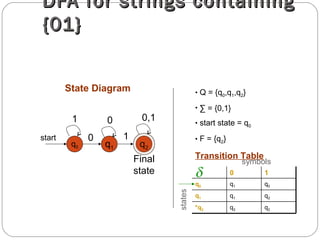
DFA for strings containingDFA for strings containing
{01}{01}
q0
start
q1
0
1 0,10
1
q2
Final
state
• Q = {q0,q1,q2}
• ∑ = {0,1}
• start state = q0
• F = {q2}
Transition Table
q2q2*q2
q2q1q1
q0q1q0
10
states
symbols
State Diagram
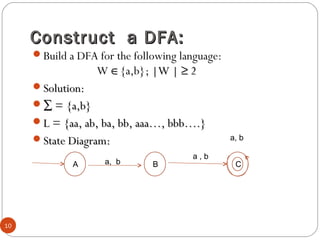
Construct a DFA:Construct a DFA:
Build a DFA for the following language:
W ∈∈{a,b}; |W | ≥ 2|W | ≥ 2
Solution:Solution:
∑∑ = {a,b}= {a,b}
L = {aa, ab, ba, bb, aaa…, bbb….}L = {aa, ab, ba, bb, aaa…, bbb….}
State Diagram:State Diagram:
10
A B Ca, b
a , b
a, b
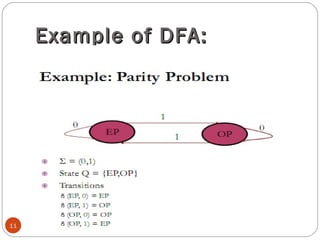
Example of DFA:Example of DFA:
11
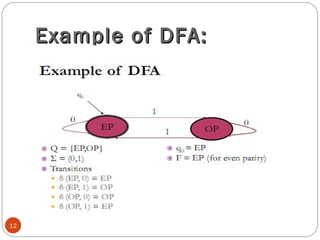
Example of DFA:Example of DFA:
12
13
End of SlidesEnd of Slides

Finite automata

  • 1.
    Finite Automata:Finite Automata: Twocategories of Finite Automata:  Deterministic Finite Automata (DFA) The machine can exist in only one state at any given time  Non-deterministic Finite Automata (NFA) The machine can exist in multiple states at the same time 1
  • 2.
    Deterministic FiniteDeterministic Finite Automata(DFA):Automata (DFA): A Deterministic Finite Automaton (DFA) is a finite state machine that accepts/rejects finite strings (sequence of symbols or alphabets) and perform unique computation for each input string. Deterministic refers to the uniqueness of the computation. 2
  • 3.
    Deterministic FiniteDeterministic Finite Automata(DFA):Automata (DFA): A DFA is defined by the 5-tuples: {Q, ∑ , q0,F, δ } It consists of: Q ==> a finite set of states ∑ ==> a finite set of input symbols (alphabets) q0 ==> a start state (q0 ∈∈ Q) F ==> set of final states (subset of Q) δ ==> a transition function, from Q x ∑ ==> Q 3
  • 4.
    DFA Computation [1/3]: Let us consider an example, where a string is given and have to calculate that the string is present in the language or not ?  Given, L is a Finite language; ∑ = { a, b } L1 = Set of all strings starts with “a” ={ a, aa, ab, aaa,…. } String, S = aab The DFA for this calculation is given in next slide: 4
  • 5.
  • 6.
    DFA Computation [3/3]: Steps:Steps: Start from the “start state/ initial state” For every input symbol in the string we do the following: Compute the next state from the current state, given the current input symbol from the string and the transition function After all symbols in that strings are calculated, if the current state is one of the final states (F) then we can say the string will be accepted by that DFA;  Otherwise, the string will be rejected.6
  • 7.
    DFA Computation: Let usconsider another example, where a string is given and have to calculate that the string is present in the language or not ?  Given, L is a infinite language; ∑ = { a, b } L1 = Set of all strings starts with “a” ={ a, aa, ab, aaa,…. } String, S = bba Here, S = bba is not present in the language and it is invalid operation for computation. 7
  • 8.
    Construct a DFA:Constructa DFA: Build a DFA for the following language: L = {w | w is a binary string that contains 01 as a substring} Steps for building a DFA: ∑ = {0,1} Decide on the states: Q Designate start state and final state(s) δ: Decide on the transitions Final states == accepting states Other states == non-accepting states 8
  • 9.
    9 DFA for stringscontainingDFA for strings containing {01}{01} q0 start q1 0 1 0,10 1 q2 Final state • Q = {q0,q1,q2} • ∑ = {0,1} • start state = q0 • F = {q2} Transition Table q2q2*q2 q2q1q1 q0q1q0 10 states symbols State Diagram
  • 10.
    Construct a DFA:Constructa DFA: Build a DFA for the following language: W ∈∈{a,b}; |W | ≥ 2|W | ≥ 2 Solution:Solution: ∑∑ = {a,b}= {a,b} L = {aa, ab, ba, bb, aaa…, bbb….}L = {aa, ab, ba, bb, aaa…, bbb….} State Diagram:State Diagram: 10 A B Ca, b a , b a, b
  • 11.
  • 12.
  • 13.