PRESENTED BY
AGLAIA
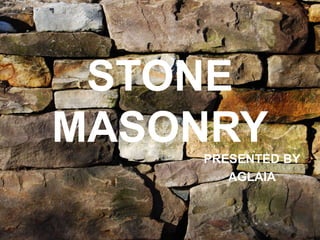
STONE
MASONRY
Introduction
• Rock, that is removed from its natural site and
generally, cut or dressed and then finished for
building purposes, is called “Stone”
• The art of building the structure with stones
as constructional units is called “Stone
Masonry”.
1. Rubble Masonry
2. Ashlar Masonry
Rubble Masonry
• The stone masonry in which either undressed or
roughly dressed stones are laid is called “Rubble
masonry”.
• In this masonry, the joints of mortar are not of uniform
thickness.
Types of Rubble Masonry
• Random Rubble masonry
• Squared Rubble
• Dry rubble masonry
Random Rubble Masonry
• The rubble masonry in which either undressed or hammer
dressed stones are used is called “Random Rubble Masonry”.
• The strength of this masonary depends upon the bond
between the stones.
• The bond should be sound both transversely and
longitudinally.
Transverse bond is obtained by the liberal use of “Bonders”
and “Throughs”
• Bonders are stones, which reach beyond the middle of the
wall from each face to overlap in the center (Dog’s Teeth
Bond).
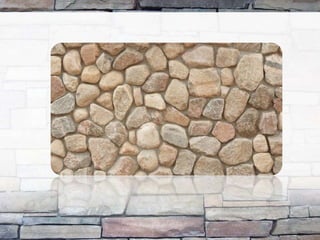
Uncoursed Random Rubble
In this ,all the stones are laid without forming
courses, is known as “Uncoursed Random Rubble
masonry”.
This masonry is the cheapest and roughest type of
masonry.
The stones to be used in this masonry are of
different sizes and shapes.
Larger stones are used at corners and at jambs to
increase their strength.
stones are laid with their longer axis roughly
horizontal and along the length of the wall.
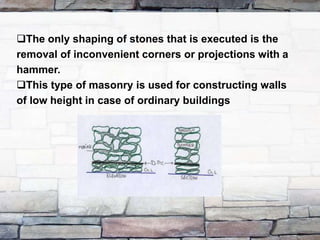
The only shaping of stones that is executed is the
removal of inconvenient corners or projections with a
hammer.
This type of masonry is used for constructing walls
of low height in case of ordinary buildings
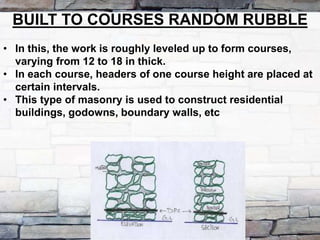
BUILT TO COURSES RANDOM RUBBLE
• In this, the work is roughly leveled up to form courses,
varying from 12 to 18 in thick.
• In each course, headers of one course height are placed at
certain intervals.
• This type of masonry is used to construct residential
buildings, godowns, boundary walls, etc
SQUARED RUBBLE MASONRY
• The Rubble masonry in which the face stones are
roughly squared by hammer dressing or chisel
dressing, before their actual laying is called
“Squared Rubble masonry”.
• There are three Types of squared rubble
masonry:
1. Uncoursed squared rubble masonry
2. Built to courses squared rubble masonry
3. Regular coursed squared rubble masonry
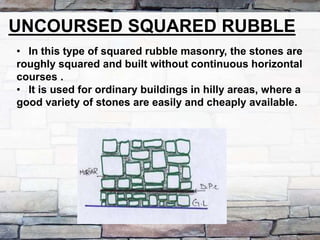
UNCOURSED SQUARED RUBBLE
• In this type of squared rubble masonry, the stones are
roughly squared and built without continuous horizontal
courses .
• It is used for ordinary buildings in hilly areas, where a
good variety of stones are easily and cheaply available.
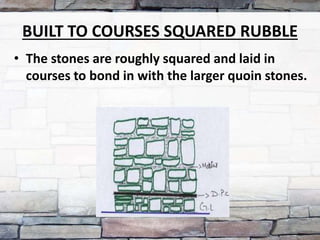
BUILT TO COURSES SQUARED RUBBLE
• The stones are roughly squared and laid in
courses to bond in with the larger quoin stones.
REGULAR COURSED SQUARED RUBBLE
• This type of masonry is built in courses of varying
height but the stones in any one course are of the
same depth.
• It is mostly used in public buildings, hospitals,
schools, markets, modern residential buildings and
in hilly areas, where a good quality of stone is
easily and cheaply available.
DRY RUBBLE MASONRY
• The rubble masonry in which stones are laid without
using any mortar is known as ” Dry Rubble Masonry”.
• It is an ordinary masonry and is recommended for
constructing walls of height not more than 18 ft.
• In case, the height is more, three adjacent courses are
laid in Squared rubble masonry, in mortar at 9 ft interval.
ASHLAR MASONRY
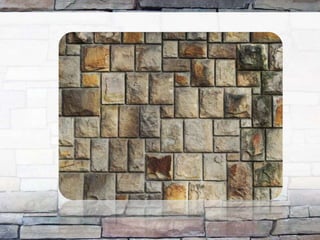
• The stone masonry in which finely dressed stones are
laid in cement or lime mortar, is known as “Ashlar
Masonry”.
• In this masonry all the joints are regular, thin, and of
uniform thickness.
• This type of masonry is costly in construction as
involves heavy cost of dressing of stones.
• This masonry is used for heavy structures, arches,
architectural buildings, high piers, abutments of bridges,
etc.
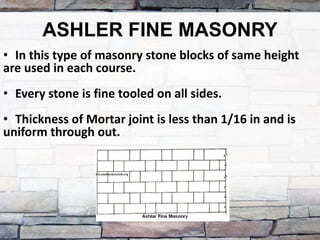
ASHLER FINE MASONRY
• In this type of masonry stone blocks of same height
are used in each course.
• Every stone is fine tooled on all sides.
• Thickness of Mortar joint is less than 1/16 in and is
uniform through out.
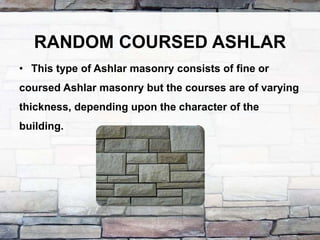
RANDOM COURSED ASHLAR
• This type of Ashlar masonry consists of fine or
coursed Ashlar masonry but the courses are of varying
thickness, depending upon the character of the
building.
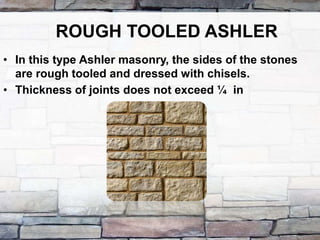
ROUGH TOOLED ASHLER
• In this type Ashler masonry, the sides of the stones
are rough tooled and dressed with chisels.
• Thickness of joints does not exceed ¼ in
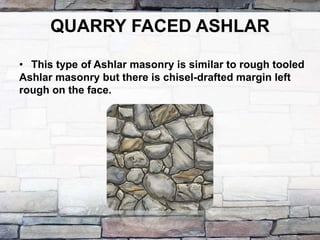
QUARRY FACED ASHLAR
• This type of Ashlar masonry is similar to rough tooled
Ashlar masonry but there is chisel-drafted margin left
rough on the face.
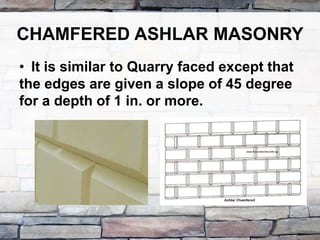
CHAMFERED ASHLAR MASONRY
• It is similar to Quarry faced except that
the edges are given a slope of 45 degree
for a depth of 1 in. or more.
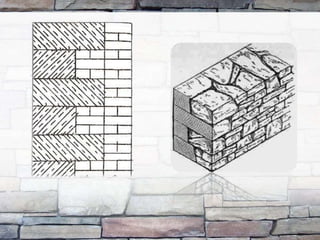
ASHLAR FACING
• They are walls with facing of Ashlar and backing of
Rubble or brick masonry for reduce cost and increase
appearance. Such walls are also called “Compound or
Composite masonry walls”.
• If the backing is of Rubble masonry, It is called “Rubble
Ashlar” and if the backing is of brick work the masonry is
termed as “Brick Ashlar”
Thank you
For more…. Mail to aglaiaconnect2018@gmail.com

Stone masonry

  • 1.
  • 2.
    Introduction • Rock, thatis removed from its natural site and generally, cut or dressed and then finished for building purposes, is called “Stone” • The art of building the structure with stones as constructional units is called “Stone Masonry”. 1. Rubble Masonry 2. Ashlar Masonry
  • 3.
    Rubble Masonry • Thestone masonry in which either undressed or roughly dressed stones are laid is called “Rubble masonry”. • In this masonry, the joints of mortar are not of uniform thickness. Types of Rubble Masonry • Random Rubble masonry • Squared Rubble • Dry rubble masonry
  • 4.
    Random Rubble Masonry •The rubble masonry in which either undressed or hammer dressed stones are used is called “Random Rubble Masonry”. • The strength of this masonary depends upon the bond between the stones. • The bond should be sound both transversely and longitudinally. Transverse bond is obtained by the liberal use of “Bonders” and “Throughs” • Bonders are stones, which reach beyond the middle of the wall from each face to overlap in the center (Dog’s Teeth Bond).
  • 6.
    Uncoursed Random Rubble Inthis ,all the stones are laid without forming courses, is known as “Uncoursed Random Rubble masonry”. This masonry is the cheapest and roughest type of masonry. The stones to be used in this masonry are of different sizes and shapes. Larger stones are used at corners and at jambs to increase their strength. stones are laid with their longer axis roughly horizontal and along the length of the wall.
  • 7.
    The only shapingof stones that is executed is the removal of inconvenient corners or projections with a hammer. This type of masonry is used for constructing walls of low height in case of ordinary buildings
  • 8.
    BUILT TO COURSESRANDOM RUBBLE • In this, the work is roughly leveled up to form courses, varying from 12 to 18 in thick. • In each course, headers of one course height are placed at certain intervals. • This type of masonry is used to construct residential buildings, godowns, boundary walls, etc
  • 9.
    SQUARED RUBBLE MASONRY •The Rubble masonry in which the face stones are roughly squared by hammer dressing or chisel dressing, before their actual laying is called “Squared Rubble masonry”. • There are three Types of squared rubble masonry: 1. Uncoursed squared rubble masonry 2. Built to courses squared rubble masonry 3. Regular coursed squared rubble masonry
  • 10.
    UNCOURSED SQUARED RUBBLE •In this type of squared rubble masonry, the stones are roughly squared and built without continuous horizontal courses . • It is used for ordinary buildings in hilly areas, where a good variety of stones are easily and cheaply available.
  • 11.
    BUILT TO COURSESSQUARED RUBBLE • The stones are roughly squared and laid in courses to bond in with the larger quoin stones.
  • 12.
    REGULAR COURSED SQUAREDRUBBLE • This type of masonry is built in courses of varying height but the stones in any one course are of the same depth. • It is mostly used in public buildings, hospitals, schools, markets, modern residential buildings and in hilly areas, where a good quality of stone is easily and cheaply available.
  • 13.
    DRY RUBBLE MASONRY •The rubble masonry in which stones are laid without using any mortar is known as ” Dry Rubble Masonry”. • It is an ordinary masonry and is recommended for constructing walls of height not more than 18 ft. • In case, the height is more, three adjacent courses are laid in Squared rubble masonry, in mortar at 9 ft interval.
  • 14.
    ASHLAR MASONRY • Thestone masonry in which finely dressed stones are laid in cement or lime mortar, is known as “Ashlar Masonry”. • In this masonry all the joints are regular, thin, and of uniform thickness. • This type of masonry is costly in construction as involves heavy cost of dressing of stones. • This masonry is used for heavy structures, arches, architectural buildings, high piers, abutments of bridges, etc.
  • 16.
    ASHLER FINE MASONRY •In this type of masonry stone blocks of same height are used in each course. • Every stone is fine tooled on all sides. • Thickness of Mortar joint is less than 1/16 in and is uniform through out.
  • 17.
    RANDOM COURSED ASHLAR •This type of Ashlar masonry consists of fine or coursed Ashlar masonry but the courses are of varying thickness, depending upon the character of the building.
  • 18.
    ROUGH TOOLED ASHLER •In this type Ashler masonry, the sides of the stones are rough tooled and dressed with chisels. • Thickness of joints does not exceed ¼ in
  • 19.
    QUARRY FACED ASHLAR •This type of Ashlar masonry is similar to rough tooled Ashlar masonry but there is chisel-drafted margin left rough on the face.
  • 20.
    CHAMFERED ASHLAR MASONRY •It is similar to Quarry faced except that the edges are given a slope of 45 degree for a depth of 1 in. or more.
  • 21.
    ASHLAR FACING • Theyare walls with facing of Ashlar and backing of Rubble or brick masonry for reduce cost and increase appearance. Such walls are also called “Compound or Composite masonry walls”. • If the backing is of Rubble masonry, It is called “Rubble Ashlar” and if the backing is of brick work the masonry is termed as “Brick Ashlar”
  • 23.
    Thank you For more….Mail to aglaiaconnect2018@gmail.com