Group 8


Department of water resource engineering Faculty of engineering Kasetsart university
What is Earthquake?
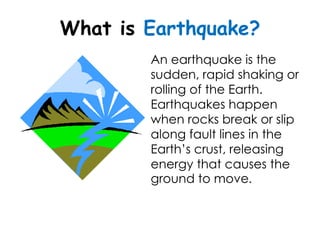
        An earthquake is the
        sudden, rapid shaking or
        rolling of the Earth.
        Earthquakes happen
        when rocks break or slip
        along fault lines in the
        Earth’s crust, releasing
        energy that causes the
        ground to move.
Earth
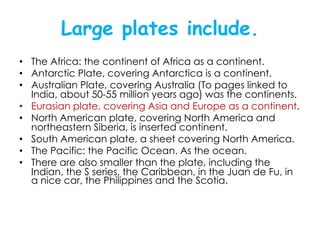
Large plates include.
â€Ē The Africa: the continent of Africa as a continent.
â€Ē Antarctic Plate, covering Antarctica is a continent.
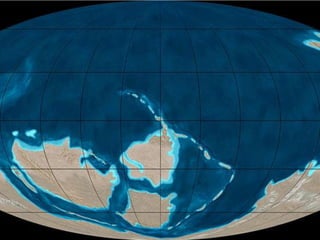
â€Ē Australian Plate, covering Australia (To pages linked to
  India, about 50-55 million years ago) was the continents.
â€Ē Eurasian plate, covering Asia and Europe as a continent.
â€Ē North American plate, covering North America and
  northeastern Siberia, is inserted continent.
â€Ē South American plate, a sheet covering North America.
â€Ē The Pacific: the Pacific Ocean. As the ocean.
â€Ē There are also smaller than the plate, including the
  Indian, the S series, the Caribbean, in the Juan de Fu, in
  a nice car, the Philippines and the Scotia.
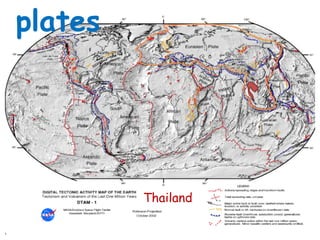
plates


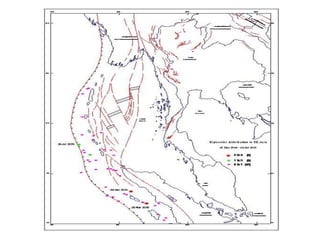
         Thailand
What Causes Earthquake


                              http://www.il.mahidol.ac.th/e-media/earth-
                              science/chapter1_3.html


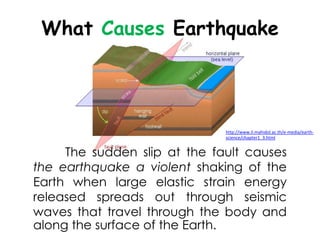
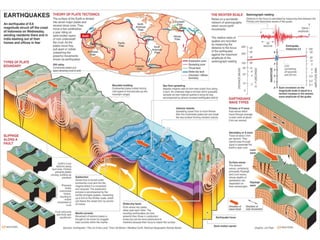
     The sudden slip at the fault causes
the earthquake a violent shaking of the
Earth when large elastic strain energy
released spreads out through seismic
waves that travel through the body and
along the surface of the Earth.
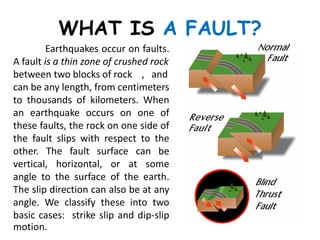
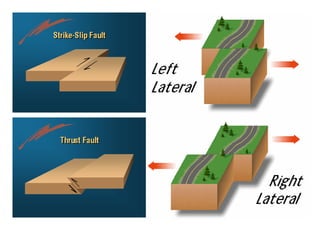
WHAT IS A FAULT?
         Earthquakes occur on faults.
A fault is a thin zone of crushed rock
between two blocks of rock , and
can be any length, from centimeters
to thousands of kilometers. When
an earthquake occurs on one of
these faults, the rock on one side of
the fault slips with respect to the
other. The fault surface can be
vertical, horizontal, or at some
angle to the surface of the earth.
The slip direction can also be at any
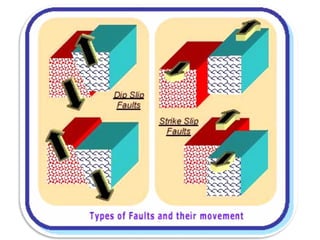
angle. We classify these into two
basic cases: strike slip and dip-slip
motion.
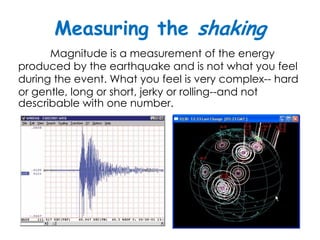
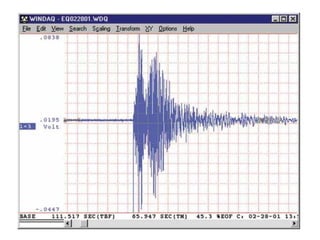
Measuring the shaking
      Magnitude is a measurement of the energy
produced by the earthquake and is not what you feel
during the event. What you feel is very complex-- hard
or gentle, long or short, jerky or rolling--and not
describable with one number.
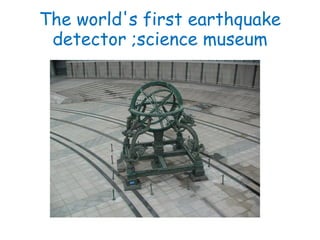
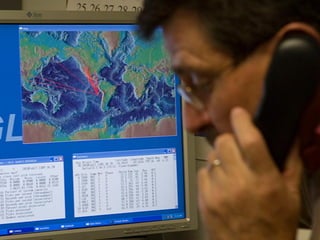
The world's first earthquake
 detector ;science museum
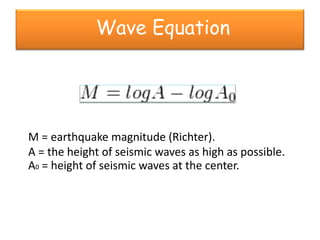
Wave Equation


M = earthquake magnitude (Richter).
A = the height of seismic waves as high as possible.
A0 = height of seismic waves at the center.
Aspects of the motion are described by the
peak velocity (how fast the ground is moving),
peak acceleration (how quickly the speed of the
ground is changing), the frequency (energy is
released in waves and these waves vibrate at
different frequencies just like sound waves), and
the duration (how long the strong shaking lasts).
Three factors primarily determine what you feel in
an earthquake. These are:

                     1) magnitude
                     2) distance from the fault
                     3) local soil conditions
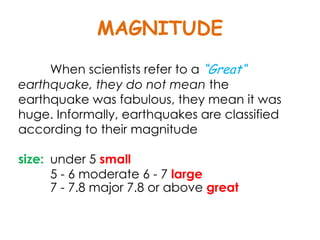
MAGNITUDE
     When scientists refer to a “Great“
earthquake, they do not mean the
earthquake was fabulous, they mean it was
huge. Informally, earthquakes are classified
according to their magnitude

size: under 5 small
      5 - 6 moderate 6 - 7 large
      7 - 7.8 major 7.8 or above great
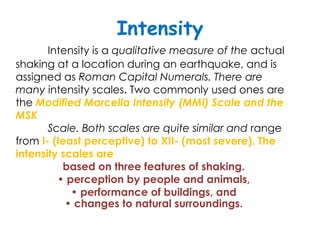
Intensity
       Intensity is a qualitative measure of the actual
shaking at a location during an earthquake, and is
assigned as Roman Capital Numerals. There are
many intensity scales. Two commonly used ones are
the Modified Marcella Intensity (MMI) Scale and the
MSK
       Scale. Both scales are quite similar and range
from I- (least perceptive) to XII- (most severe). The
intensity scales are
           based on three features of shaking.
         â€Ē perception by people and animals,
            â€Ē performance of buildings, and
           â€Ē changes to natural surroundings.
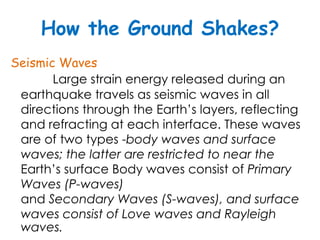
How the Ground Shakes?
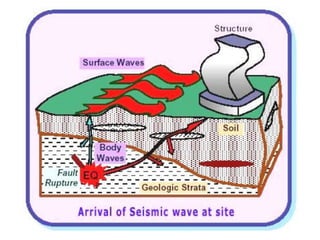
Seismic Waves
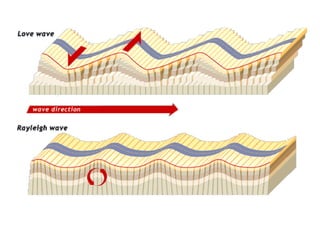
       Large strain energy released during an
 earthquake travels as seismic waves in all
 directions through the Earth’s layers, reflecting
 and refracting at each interface. These waves
 are of two types -body waves and surface
 waves; the latter are restricted to near the
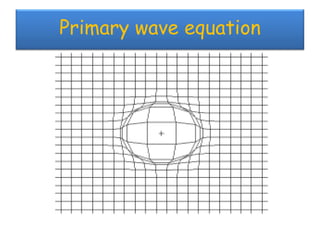
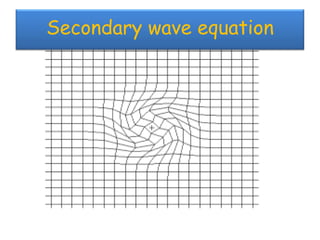
 Earth’s surface Body waves consist of Primary
 Waves (P-waves)
 and Secondary Waves (S-waves), and surface
 waves consist of Love waves and Rayleigh
 waves.
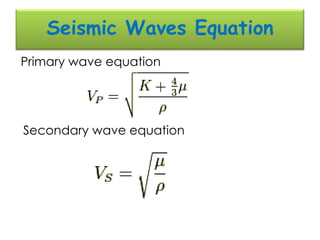
Seismic Waves Equation
Primary wave equation


Secondary wave equation
Primary wave equation
Secondary wave equation
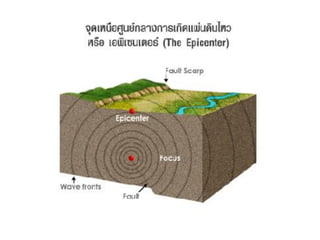
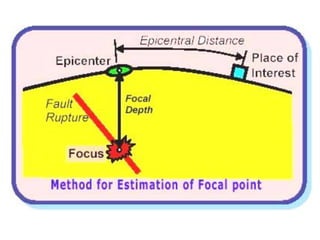
Focal Pont


      The point on the fault where slip starts is
the Focus or Hypocenter, and the point
vertically above this on the surface of the
Earth is the Epicenter. The depth of focus from
the epicenter, called as Focal Depth, is an
important parameter in determining the
damaging
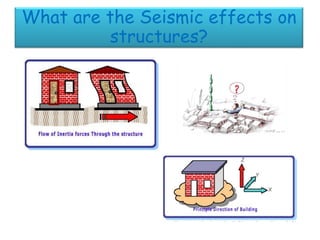
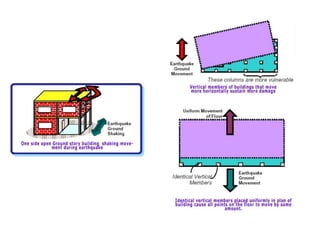
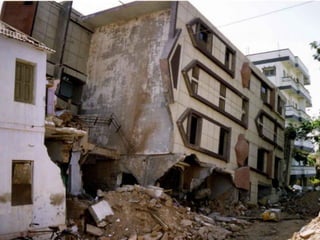
What are the Seismic effects on
         structures?
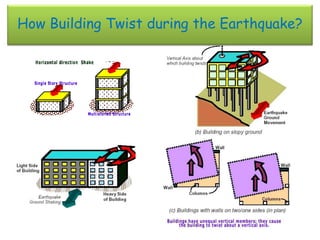
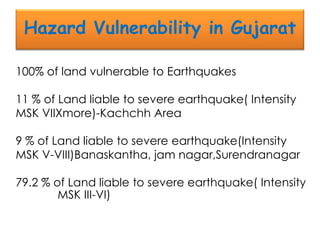
How Building Twist during the Earthquake?
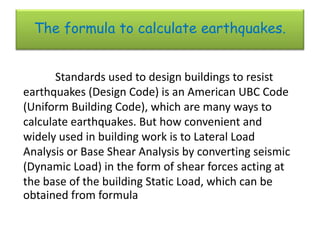
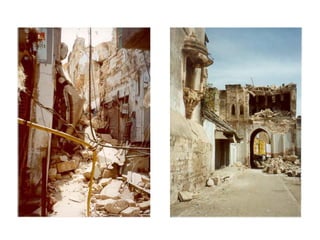
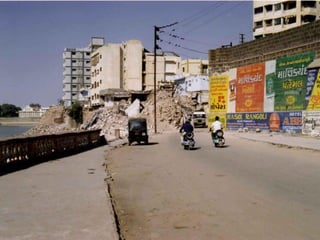
Hazard Vulnerability in Gujarat

100% of land vulnerable to Earthquakes

11 % of Land liable to severe earthquake( Intensity
MSK VIIXmore)-Kachchh Area

9 % of Land liable to severe earthquake(Intensity
MSK V-VIII)Banaskantha, jam nagar,Surendranagar

79.2 % of Land liable to severe earthquake( Intensity
        MSK III-VI)
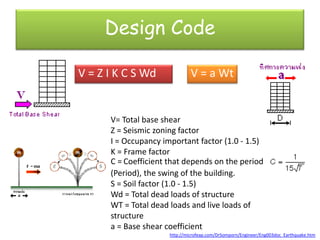
The formula to calculate earthquakes.


       Standards used to design buildings to resist
earthquakes (Design Code) is an American UBC Code
(Uniform Building Code), which are many ways to
calculate earthquakes. But how convenient and
widely used in building work is to Lateral Load
Analysis or Base Shear Analysis by converting seismic
(Dynamic Load) in the form of shear forces acting at
the base of the building Static Load, which can be
obtained from formula
Design Code

V = Z I K C S Wd               V = a Wt


      V= Total base shear
      Z = Seismic zoning factor
      I = Occupancy important factor (1.0 - 1.5)
      K = Frame factor
      C = Coefficient that depends on the period
      (Period), the swing of the building.
      S = Soil factor (1.0 - 1.5)
      Wd = Total dead loads of structure
      WT = Total dead loads and live loads of
      structure
      a = Base shear coefficient
                      http://microfeap.com/DrSomporn/Engineer/Eng003doc_Earthquake.htm
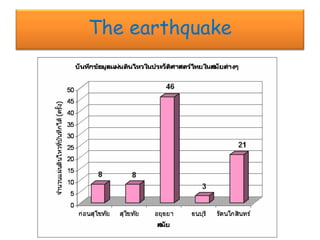
The earthquake
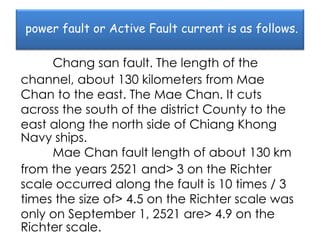
power fault or Active Fault current is as follows.

     Chang san fault. The length of the
channel, about 130 kilometers from Mae
Chan to the east. The Mae Chan. It cuts
across the south of the district County to the
east along the north side of Chiang Khong
Navy ships.
     Mae Chan fault length of about 130 km
from the years 2521 and> 3 on the Richter
scale occurred along the fault is 10 times / 3
times the size of> 4.5 on the Richter scale was
only on September 1, 2521 are> 4.9 on the
Richter scale.
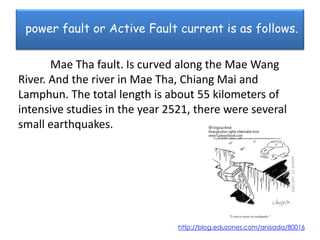
power fault or Active Fault current is as follows.

       Mae Tha fault. Is curved along the Mae Wang
River. And the river in Mae Tha, Chiang Mai and
Lamphun. The total length is about 55 kilometers of
intensive studies in the year 2521, there were several
small earthquakes.


                                http://blog.eduzones.com/anisada/80016
Statistics of earthquakes felt in the country
       since 2550 - present.( in Thailand )

       12 Sep 2550 in South Sumatra and 8.4 on the
Richter scale was felt on the high-rise building in
Bangkok.
       13 Sep 2550 the area south of the Sumatra quake
of 7.1 on the Richter scale was felt in some of the
buildings.
       12 May 2551 in Sichuan province of China, and
7.8 on the Richter scale shaking the feel of the tallest
building in Bangkok. And China has killed about 20,000
people.
       30 Sep 2552 in the middle of the island of Sumatra
was 7.9 on the Richter scale was the tallest building in
Bangkok. Indonesia has killed about 1,000 people.
Statistics of earthquakes
                  (world Record)


   9.5 Richter scale earthquake on 5 May 1960
on the southern coast of Chile. As a result,
more than 1,600 people have died and 2
million homeless.

   9.2 Richter scale earthquake on 27 Mar
1964 Alaska to the United States, the tsunami
claimed 128 lives and destroyed "in the neck,
Anchorage" (Anchorage), the largest city in
the state.
Statistics of earthquakes
                   (world Record)


   9.1 Richter scale earthquake that we all
remember well. I was born on 26 Dec 2004 at
sea in Indonesia. As a result, the tsunami is
widespread in many coastal countries in the
Indian Ocean. More than 220,000 people lost
their lives.
   9.0 Richter scale earthquake on 4 Nov 1952
at the Russian coast of the peninsula to the
Income Support values ​(Kamchatka) Russia's Far
East. As a result, a large tsunami in the Pacific
Rim. However, no reports of damage.
Statistics of earthquakes
                    (world Record)


   9.0 Richter scale earthquake on 13 Aug 1868
in North America, the port area. We are part of
Peru. But as of Chillicothe. When an earthquake
occurs. Feel the vibration as far as 1,400 miles.
   9.0 Richter scale earthquake on 26 Jan 1700
in North America. Along the west coast. Tsunami
across the Pacific. Destruction of villages along
the coast of Japan.
Statistics of earthquakes
                    (world Record)


    8.9 Richter scale earthquake that occurred
just recently on 11 Mar 2011 earthquake under
the sea to the southeast coast of Japan. Result in
a 10-meter high tsunami swept into the flood. The
damage is being reported to the periodic
    8.8 Richter scale earthquake on 27 Feb 2010
at the coast of Chile. Earthquakes along the
beach to play in the U (Maule) away from the
capital Santiago, only 500 km in the tsunami that
has killed about 500.
Statistics of earthquakes
                  (world Record)


    8.8 Richter scale earthquake on 31 Jan 1906
in Ecuador, shaking the central coast of South
America to Ecuador and Colombia. I feel
almost as far as the North American continent
at San Francisco.
    8.7 Richter scale earthquake on 4 Feb 1965
at Ballarat Island (Rat Islands) miles away from
Alaska. The tsunami wave height of 10 meters.


                  http://www.udon108.com/board/index.php?topic=79326.0
Earth quake
Earth quake
Earth quake
Earth quake
Earth quake
Earth quake
Earth quake

Earth quake

  • 1.
    Group 8 Department ofwater resource engineering Faculty of engineering Kasetsart university
  • 2.
    What is Earthquake? An earthquake is the sudden, rapid shaking or rolling of the Earth. Earthquakes happen when rocks break or slip along fault lines in the Earth’s crust, releasing energy that causes the ground to move.
  • 3.
  • 4.
    Large plates include. â€ĒThe Africa: the continent of Africa as a continent. â€Ē Antarctic Plate, covering Antarctica is a continent. â€Ē Australian Plate, covering Australia (To pages linked to India, about 50-55 million years ago) was the continents. â€Ē Eurasian plate, covering Asia and Europe as a continent. â€Ē North American plate, covering North America and northeastern Siberia, is inserted continent. â€Ē South American plate, a sheet covering North America. â€Ē The Pacific: the Pacific Ocean. As the ocean. â€Ē There are also smaller than the plate, including the Indian, the S series, the Caribbean, in the Juan de Fu, in a nice car, the Philippines and the Scotia.
  • 5.
    plates Thailand
  • 7.
    What Causes Earthquake http://www.il.mahidol.ac.th/e-media/earth- science/chapter1_3.html The sudden slip at the fault causes the earthquake a violent shaking of the Earth when large elastic strain energy released spreads out through seismic waves that travel through the body and along the surface of the Earth.
  • 8.
    WHAT IS AFAULT? Earthquakes occur on faults. A fault is a thin zone of crushed rock between two blocks of rock , and can be any length, from centimeters to thousands of kilometers. When an earthquake occurs on one of these faults, the rock on one side of the fault slips with respect to the other. The fault surface can be vertical, horizontal, or at some angle to the surface of the earth. The slip direction can also be at any angle. We classify these into two basic cases: strike slip and dip-slip motion.
  • 13.
    Measuring the shaking Magnitude is a measurement of the energy produced by the earthquake and is not what you feel during the event. What you feel is very complex-- hard or gentle, long or short, jerky or rolling--and not describable with one number.
  • 14.
    The world's firstearthquake detector ;science museum
  • 18.
    Wave Equation M =earthquake magnitude (Richter). A = the height of seismic waves as high as possible. A0 = height of seismic waves at the center.
  • 20.
    Aspects of themotion are described by the peak velocity (how fast the ground is moving), peak acceleration (how quickly the speed of the ground is changing), the frequency (energy is released in waves and these waves vibrate at different frequencies just like sound waves), and the duration (how long the strong shaking lasts). Three factors primarily determine what you feel in an earthquake. These are: 1) magnitude 2) distance from the fault 3) local soil conditions
  • 22.
    MAGNITUDE When scientists refer to a “Great“ earthquake, they do not mean the earthquake was fabulous, they mean it was huge. Informally, earthquakes are classified according to their magnitude size: under 5 small 5 - 6 moderate 6 - 7 large 7 - 7.8 major 7.8 or above great
  • 23.
    Intensity Intensity is a qualitative measure of the actual shaking at a location during an earthquake, and is assigned as Roman Capital Numerals. There are many intensity scales. Two commonly used ones are the Modified Marcella Intensity (MMI) Scale and the MSK Scale. Both scales are quite similar and range from I- (least perceptive) to XII- (most severe). The intensity scales are based on three features of shaking. â€Ē perception by people and animals, â€Ē performance of buildings, and â€Ē changes to natural surroundings.
  • 24.
    How the GroundShakes? Seismic Waves Large strain energy released during an earthquake travels as seismic waves in all directions through the Earth’s layers, reflecting and refracting at each interface. These waves are of two types -body waves and surface waves; the latter are restricted to near the Earth’s surface Body waves consist of Primary Waves (P-waves) and Secondary Waves (S-waves), and surface waves consist of Love waves and Rayleigh waves.
  • 27.
    Seismic Waves Equation Primarywave equation Secondary wave equation
  • 28.
  • 29.
  • 30.
  • 31.
  • 32.
    Focal Pont The point on the fault where slip starts is the Focus or Hypocenter, and the point vertically above this on the surface of the Earth is the Epicenter. The depth of focus from the epicenter, called as Focal Depth, is an important parameter in determining the damaging
  • 34.
    What are theSeismic effects on structures?
  • 36.
    How Building Twistduring the Earthquake?
  • 38.
    Hazard Vulnerability inGujarat 100% of land vulnerable to Earthquakes 11 % of Land liable to severe earthquake( Intensity MSK VIIXmore)-Kachchh Area 9 % of Land liable to severe earthquake(Intensity MSK V-VIII)Banaskantha, jam nagar,Surendranagar 79.2 % of Land liable to severe earthquake( Intensity MSK III-VI)
  • 39.
    The formula tocalculate earthquakes. Standards used to design buildings to resist earthquakes (Design Code) is an American UBC Code (Uniform Building Code), which are many ways to calculate earthquakes. But how convenient and widely used in building work is to Lateral Load Analysis or Base Shear Analysis by converting seismic (Dynamic Load) in the form of shear forces acting at the base of the building Static Load, which can be obtained from formula
  • 40.
    Design Code V =Z I K C S Wd V = a Wt V= Total base shear Z = Seismic zoning factor I = Occupancy important factor (1.0 - 1.5) K = Frame factor C = Coefficient that depends on the period (Period), the swing of the building. S = Soil factor (1.0 - 1.5) Wd = Total dead loads of structure WT = Total dead loads and live loads of structure a = Base shear coefficient http://microfeap.com/DrSomporn/Engineer/Eng003doc_Earthquake.htm
  • 42.
  • 43.
    power fault orActive Fault current is as follows. Chang san fault. The length of the channel, about 130 kilometers from Mae Chan to the east. The Mae Chan. It cuts across the south of the district County to the east along the north side of Chiang Khong Navy ships. Mae Chan fault length of about 130 km from the years 2521 and> 3 on the Richter scale occurred along the fault is 10 times / 3 times the size of> 4.5 on the Richter scale was only on September 1, 2521 are> 4.9 on the Richter scale.
  • 44.
    power fault orActive Fault current is as follows. Mae Tha fault. Is curved along the Mae Wang River. And the river in Mae Tha, Chiang Mai and Lamphun. The total length is about 55 kilometers of intensive studies in the year 2521, there were several small earthquakes. http://blog.eduzones.com/anisada/80016
  • 45.
    Statistics of earthquakesfelt in the country since 2550 - present.( in Thailand ) 12 Sep 2550 in South Sumatra and 8.4 on the Richter scale was felt on the high-rise building in Bangkok. 13 Sep 2550 the area south of the Sumatra quake of 7.1 on the Richter scale was felt in some of the buildings. 12 May 2551 in Sichuan province of China, and 7.8 on the Richter scale shaking the feel of the tallest building in Bangkok. And China has killed about 20,000 people. 30 Sep 2552 in the middle of the island of Sumatra was 7.9 on the Richter scale was the tallest building in Bangkok. Indonesia has killed about 1,000 people.
  • 46.
    Statistics of earthquakes (world Record) 9.5 Richter scale earthquake on 5 May 1960 on the southern coast of Chile. As a result, more than 1,600 people have died and 2 million homeless. 9.2 Richter scale earthquake on 27 Mar 1964 Alaska to the United States, the tsunami claimed 128 lives and destroyed "in the neck, Anchorage" (Anchorage), the largest city in the state.
  • 47.
    Statistics of earthquakes (world Record) 9.1 Richter scale earthquake that we all remember well. I was born on 26 Dec 2004 at sea in Indonesia. As a result, the tsunami is widespread in many coastal countries in the Indian Ocean. More than 220,000 people lost their lives. 9.0 Richter scale earthquake on 4 Nov 1952 at the Russian coast of the peninsula to the Income Support values ​(Kamchatka) Russia's Far East. As a result, a large tsunami in the Pacific Rim. However, no reports of damage.
  • 48.
    Statistics of earthquakes (world Record) 9.0 Richter scale earthquake on 13 Aug 1868 in North America, the port area. We are part of Peru. But as of Chillicothe. When an earthquake occurs. Feel the vibration as far as 1,400 miles. 9.0 Richter scale earthquake on 26 Jan 1700 in North America. Along the west coast. Tsunami across the Pacific. Destruction of villages along the coast of Japan.
  • 49.
    Statistics of earthquakes (world Record) 8.9 Richter scale earthquake that occurred just recently on 11 Mar 2011 earthquake under the sea to the southeast coast of Japan. Result in a 10-meter high tsunami swept into the flood. The damage is being reported to the periodic 8.8 Richter scale earthquake on 27 Feb 2010 at the coast of Chile. Earthquakes along the beach to play in the U (Maule) away from the capital Santiago, only 500 km in the tsunami that has killed about 500.
  • 50.
    Statistics of earthquakes (world Record) 8.8 Richter scale earthquake on 31 Jan 1906 in Ecuador, shaking the central coast of South America to Ecuador and Colombia. I feel almost as far as the North American continent at San Francisco. 8.7 Richter scale earthquake on 4 Feb 1965 at Ballarat Island (Rat Islands) miles away from Alaska. The tsunami wave height of 10 meters. http://www.udon108.com/board/index.php?topic=79326.0