Teacher
Kevin
EARTHQUAKE
Learning Objectives
1. recognize what is an earthquake;
2. investigate the causes of earthquakes;
3. describe how earthquakes can be
measured; and
4. illustrate on how can they prevent from
an earthquake.
At the end of the lesson, the student/s will be able to:
Key Terms
Earthquake – Movement of the earth’s
crust caused by tectonic plate action.
Fault - is a fracture or zone of fractures
between two blocks of rock.
Epicentre – The point on the earths crust
directly above the focus (where most
damage occurs)
Seismograph – An instrument used to
measure the strength of an earthquake
Focus – The point under the crust where
the earthquake occurred.
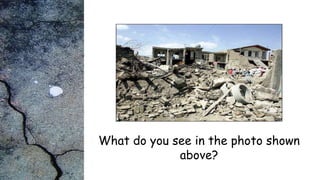
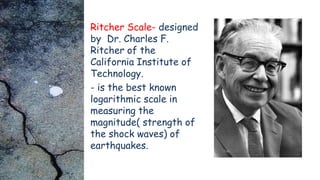
What do you see in the photo shown
above?
What are Earthquakes?
• The shaking or trembling caused by the sudden release of
energy.
• Usually associated with faulting or breaking of rocks.
• Continuing adjustment of position results in aftershocks.
Faults
■ Faults are blocks of the earth’s crust that meet together.
Scientists identify four types of faults, characterized by the position
of the fault plane, the break in the rock and the movement of the
two rock blocks.
■ Faults lines are under enormous pressure from the two pieces of
the earth’s crust pushing together.
■ The faults will eventually give way to the pressure causing
earthquakes and creating mountain ranges.
Types of Faults
Types of Faults
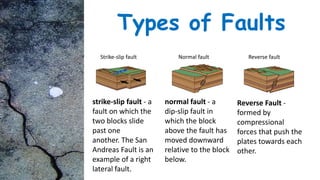
Strike-slip fault Normal fault Reverse fault
strike-slip fault - a
fault on which the
two blocks slide
past one
another. The San
Andreas Fault is an
example of a right
lateral fault.
normal fault - a
dip-slip fault in
which the block
above the fault has
moved downward
relative to the block
below.
Reverse Fault -
formed by
compressional
forces that push the
plates towards each
other.
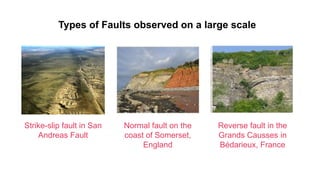
Types of Faults observed on a large scale
Strike-slip fault in San
Andreas Fault
Normal fault on the
coast of Somerset,
England
Reverse fault in the
Grands Causses in
Bédarieux, France
ACTIVE FAULT LINES
IN THE PHILIPPINES
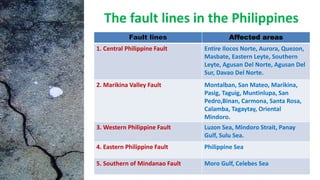
The fault lines in the Philippines
Fault lines Affected areas
1. Central Philippine Fault Entire Ilocos Norte, Aurora, Quezon,
Masbate, Eastern Leyte, Southern
Leyte, Agusan Del Norte, Agusan Del
Sur, Davao Del Norte.
2. Marikina Valley Fault Montalban, San Mateo, Marikina,
Pasig, Taguig, Muntinlupa, San
Pedro,Binan, Carmona, Santa Rosa,
Calamba, Tagaytay, Oriental
Mindoro.
3. Western Philippine Fault Luzon Sea, Mindoro Strait, Panay
Gulf, Sulu Sea.
4. Eastern Philippine Fault Philippine Sea
5. Southern of Mindanao Fault Moro Gulf, Celebes Sea
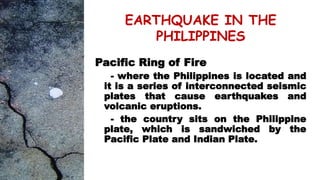
EARTHQUAKE IN THE
PHILIPPINES
Pacific Ring of Fire
- where the Philippines is located and
it is a series of interconnected seismic
plates that cause earthquakes and
volcanic eruptions.
- the country sits on the Philippine
plate, which is sandwiched by the
Pacific Plate and Indian Plate.
What Causes
an
Earthquake?
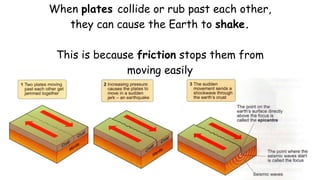
When plates collide or rub past each other,
they can cause the Earth to shake.
This is because friction stops them from
moving easily
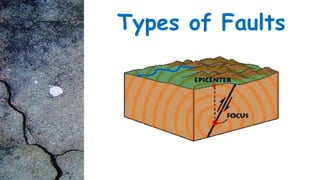
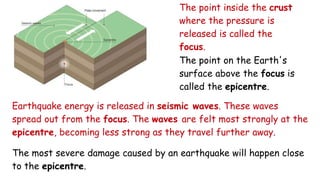
The point inside the crust
where the pressure is
released is called the
focus.
Earthquake energy is released in seismic waves. These waves
spread out from the focus. The waves are felt most strongly at the
epicentre, becoming less strong as they travel further away.
The point on the Earth's
surface above the focus is
called the epicentre.
The most severe damage caused by an earthquake will happen close
to the epicentre.
What are Seismic Waves?
• Response of material to the arrival of
energy fronts released by rupture
• Two types:
–Body waves
• P and S
–Surface waves
• R and L
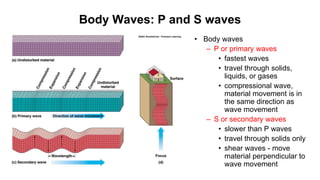
Body Waves: P and S waves
• Body waves
– P or primary waves
• fastest waves
• travel through solids,
liquids, or gases
• compressional wave,
material movement is in
the same direction as
wave movement
– S or secondary waves
• slower than P waves
• travel through solids only
• shear waves - move
material perpendicular to
wave movement
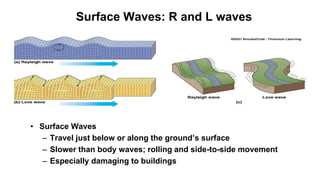
Surface Waves: R and L waves
• Surface Waves
– Travel just below or along the ground’s surface
– Slower than body waves; rolling and side-to-side movement
– Especially damaging to buildings
How are the Size and Strength
of an Earthquake Measured?
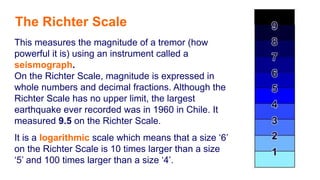
This measures the magnitude of a tremor (how
powerful it is) using an instrument called a
seismograph.
On the Richter Scale, magnitude is expressed in
whole numbers and decimal fractions. Although the
Richter Scale has no upper limit, the largest
earthquake ever recorded was in 1960 in Chile. It
measured 9.5 on the Richter Scale.
It is a logarithmic scale which means that a size ‘6’
on the Richter Scale is 10 times larger than a size
‘5’ and 100 times larger than a size ‘4’.
The Richter Scale
Ritcher Scale- designed
by Dr. Charles F.
Ritcher of the
California Institute of
Technology.
- is the best known
logarithmic scale in
measuring the
magnitude( strength of
the shock waves) of
earthquakes.
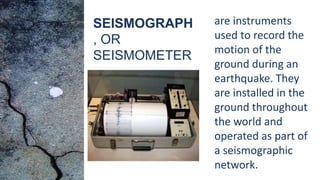
are instruments
used to record the
motion of the
ground during an
earthquake. They
are installed in the
ground throughout
the world and
operated as part of
a seismographic
network.
SEISMOGRAPH
, OR
SEISMOMETER
- is a service institute of the Department of
Science and Technology (DOST) that is
principally mandated to mitigate disasters
that may arise from volcanic eruptions,
earthquakes, tsunami and other related
geotectonic phenomena.
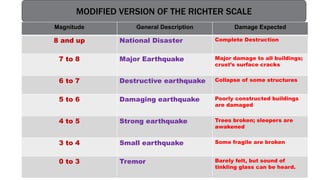
MODIFIED VERSION OF THE RICHTER SCALE
Magnitude General Description Damage Expected
8 and up National Disaster Complete Destruction
7 to 8 Major Earthquake Major damage to all buildings;
crust’s surface cracks
6 to 7 Destructive earthquake Collapse of some structures
5 to 6 Damaging earthquake Poorly constructed buildings
are damaged
4 to 5 Strong earthquake Trees broken; sleepers are
awakened
3 to 4 Small earthquake Some fragile are broken
0 to 3 Tremor Barely felt, but sound of
tinkling glass can be heard.
Analyzing a seismogram
enables seismologist to
determine the time, focus,
and epicenter, as well as
the amount of energy
released by the movement
of the rock masses.
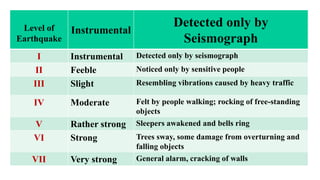
Level of
Earthquake
Instrumental
Detected only by
Seismograph
I Instrumental Detected only by seismograph
II Feeble Noticed only by sensitive people
III Slight Resembling vibrations caused by heavy traffic
IV Moderate Felt by people walking; rocking of free-standing
objects
V Rather strong Sleepers awakened and bells ring
VI Strong Trees sway, some damage from overturning and
falling objects
VII Very strong General alarm, cracking of walls
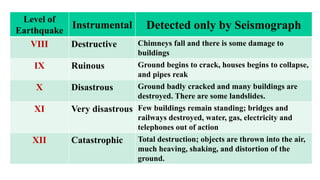
Level of
Earthquake
Instrumental Detected only by Seismograph
VIII Destructive Chimneys fall and there is some damage to
buildings
IX Ruinous Ground begins to crack, houses begins to collapse,
and pipes reak
X Disastrous Ground badly cracked and many buildings are
destroyed. There are some landslides.
XI Very disastrous Few buildings remain standing; bridges and
railways destroyed, water, gas, electricity and
telephones out of action
XII Catastrophic Total destruction; objects are thrown into the air,
much heaving, shaking, and distortion of the
ground.
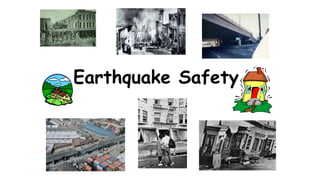
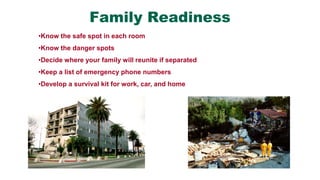
Earthquake Safety
Family Readiness
•Know the safe spot in each room
•Know the danger spots
•Decide where your family will reunite if separated
•Keep a list of emergency phone numbers
•Develop a survival kit for work, car, and home
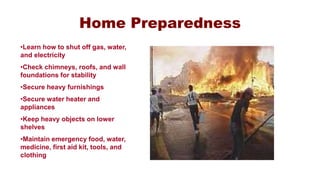
Home Preparedness
•Learn how to shut off gas, water,
and electricity
•Check chimneys, roofs, and wall
foundations for stability
•Secure heavy furnishings
•Secure water heater and
appliances
•Keep heavy objects on lower
shelves
•Maintain emergency food, water,
medicine, first aid kit, tools, and
clothing
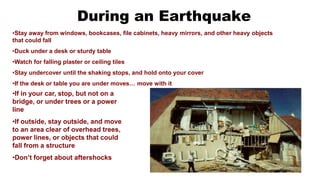
During an Earthquake
•Stay away from windows, bookcases, file cabinets, heavy mirrors, and other heavy objects
that could fall
•Duck under a desk or sturdy table
•Watch for falling plaster or ceiling tiles
•Stay undercover until the shaking stops, and hold onto your cover
•If the desk or table you are under moves… move with it
•If in your car, stop, but not on a
bridge, or under trees or a power
line
•If outside, stay outside, and move
to an area clear of overhead trees,
power lines, or objects that could
fall from a structure
•Don’t forget about aftershocks
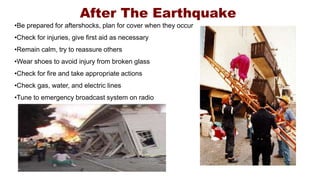
After The Earthquake
•Be prepared for aftershocks, plan for cover when they occur
•Check for injuries, give first aid as necessary
•Remain calm, try to reassure others
•Wear shoes to avoid injury from broken glass
•Check for fire and take appropriate actions
•Check gas, water, and electric lines
•Tune to emergency broadcast system on radio
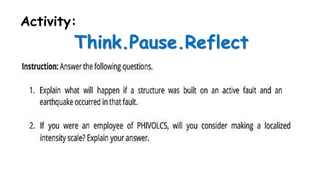
Activity:
Think.Pause.Reflect

Earthquake

  • 1.
  • 2.
  • 4.
    Learning Objectives 1. recognizewhat is an earthquake; 2. investigate the causes of earthquakes; 3. describe how earthquakes can be measured; and 4. illustrate on how can they prevent from an earthquake. At the end of the lesson, the student/s will be able to:
  • 5.
    Key Terms Earthquake –Movement of the earth’s crust caused by tectonic plate action. Fault - is a fracture or zone of fractures between two blocks of rock. Epicentre – The point on the earths crust directly above the focus (where most damage occurs) Seismograph – An instrument used to measure the strength of an earthquake Focus – The point under the crust where the earthquake occurred.
  • 6.
    What do yousee in the photo shown above?
  • 7.
    What are Earthquakes? •The shaking or trembling caused by the sudden release of energy. • Usually associated with faulting or breaking of rocks. • Continuing adjustment of position results in aftershocks.
  • 8.
    Faults ■ Faults areblocks of the earth’s crust that meet together. Scientists identify four types of faults, characterized by the position of the fault plane, the break in the rock and the movement of the two rock blocks. ■ Faults lines are under enormous pressure from the two pieces of the earth’s crust pushing together. ■ The faults will eventually give way to the pressure causing earthquakes and creating mountain ranges.
  • 9.
  • 10.
    Types of Faults Strike-slipfault Normal fault Reverse fault strike-slip fault - a fault on which the two blocks slide past one another. The San Andreas Fault is an example of a right lateral fault. normal fault - a dip-slip fault in which the block above the fault has moved downward relative to the block below. Reverse Fault - formed by compressional forces that push the plates towards each other.
  • 11.
    Types of Faultsobserved on a large scale Strike-slip fault in San Andreas Fault Normal fault on the coast of Somerset, England Reverse fault in the Grands Causses in Bédarieux, France
  • 12.
    ACTIVE FAULT LINES INTHE PHILIPPINES
  • 13.
    The fault linesin the Philippines Fault lines Affected areas 1. Central Philippine Fault Entire Ilocos Norte, Aurora, Quezon, Masbate, Eastern Leyte, Southern Leyte, Agusan Del Norte, Agusan Del Sur, Davao Del Norte. 2. Marikina Valley Fault Montalban, San Mateo, Marikina, Pasig, Taguig, Muntinlupa, San Pedro,Binan, Carmona, Santa Rosa, Calamba, Tagaytay, Oriental Mindoro. 3. Western Philippine Fault Luzon Sea, Mindoro Strait, Panay Gulf, Sulu Sea. 4. Eastern Philippine Fault Philippine Sea 5. Southern of Mindanao Fault Moro Gulf, Celebes Sea
  • 14.
    EARTHQUAKE IN THE PHILIPPINES PacificRing of Fire - where the Philippines is located and it is a series of interconnected seismic plates that cause earthquakes and volcanic eruptions. - the country sits on the Philippine plate, which is sandwiched by the Pacific Plate and Indian Plate.
  • 15.
  • 16.
    When plates collideor rub past each other, they can cause the Earth to shake. This is because friction stops them from moving easily
  • 17.
    The point insidethe crust where the pressure is released is called the focus. Earthquake energy is released in seismic waves. These waves spread out from the focus. The waves are felt most strongly at the epicentre, becoming less strong as they travel further away. The point on the Earth's surface above the focus is called the epicentre. The most severe damage caused by an earthquake will happen close to the epicentre.
  • 18.
    What are SeismicWaves? • Response of material to the arrival of energy fronts released by rupture • Two types: –Body waves • P and S –Surface waves • R and L
  • 19.
    Body Waves: Pand S waves • Body waves – P or primary waves • fastest waves • travel through solids, liquids, or gases • compressional wave, material movement is in the same direction as wave movement – S or secondary waves • slower than P waves • travel through solids only • shear waves - move material perpendicular to wave movement
  • 20.
    Surface Waves: Rand L waves • Surface Waves – Travel just below or along the ground’s surface – Slower than body waves; rolling and side-to-side movement – Especially damaging to buildings
  • 21.
    How are theSize and Strength of an Earthquake Measured?
  • 22.
    This measures themagnitude of a tremor (how powerful it is) using an instrument called a seismograph. On the Richter Scale, magnitude is expressed in whole numbers and decimal fractions. Although the Richter Scale has no upper limit, the largest earthquake ever recorded was in 1960 in Chile. It measured 9.5 on the Richter Scale. It is a logarithmic scale which means that a size ‘6’ on the Richter Scale is 10 times larger than a size ‘5’ and 100 times larger than a size ‘4’. The Richter Scale
  • 23.
    Ritcher Scale- designed byDr. Charles F. Ritcher of the California Institute of Technology. - is the best known logarithmic scale in measuring the magnitude( strength of the shock waves) of earthquakes.
  • 24.
    are instruments used torecord the motion of the ground during an earthquake. They are installed in the ground throughout the world and operated as part of a seismographic network. SEISMOGRAPH , OR SEISMOMETER
  • 25.
    - is aservice institute of the Department of Science and Technology (DOST) that is principally mandated to mitigate disasters that may arise from volcanic eruptions, earthquakes, tsunami and other related geotectonic phenomena.
  • 26.
    MODIFIED VERSION OFTHE RICHTER SCALE Magnitude General Description Damage Expected 8 and up National Disaster Complete Destruction 7 to 8 Major Earthquake Major damage to all buildings; crust’s surface cracks 6 to 7 Destructive earthquake Collapse of some structures 5 to 6 Damaging earthquake Poorly constructed buildings are damaged 4 to 5 Strong earthquake Trees broken; sleepers are awakened 3 to 4 Small earthquake Some fragile are broken 0 to 3 Tremor Barely felt, but sound of tinkling glass can be heard.
  • 27.
    Analyzing a seismogram enablesseismologist to determine the time, focus, and epicenter, as well as the amount of energy released by the movement of the rock masses.
  • 28.
    Level of Earthquake Instrumental Detected onlyby Seismograph I Instrumental Detected only by seismograph II Feeble Noticed only by sensitive people III Slight Resembling vibrations caused by heavy traffic IV Moderate Felt by people walking; rocking of free-standing objects V Rather strong Sleepers awakened and bells ring VI Strong Trees sway, some damage from overturning and falling objects VII Very strong General alarm, cracking of walls
  • 29.
    Level of Earthquake Instrumental Detectedonly by Seismograph VIII Destructive Chimneys fall and there is some damage to buildings IX Ruinous Ground begins to crack, houses begins to collapse, and pipes reak X Disastrous Ground badly cracked and many buildings are destroyed. There are some landslides. XI Very disastrous Few buildings remain standing; bridges and railways destroyed, water, gas, electricity and telephones out of action XII Catastrophic Total destruction; objects are thrown into the air, much heaving, shaking, and distortion of the ground.
  • 30.
  • 31.
    Family Readiness •Know thesafe spot in each room •Know the danger spots •Decide where your family will reunite if separated •Keep a list of emergency phone numbers •Develop a survival kit for work, car, and home
  • 32.
    Home Preparedness •Learn howto shut off gas, water, and electricity •Check chimneys, roofs, and wall foundations for stability •Secure heavy furnishings •Secure water heater and appliances •Keep heavy objects on lower shelves •Maintain emergency food, water, medicine, first aid kit, tools, and clothing
  • 33.
    During an Earthquake •Stayaway from windows, bookcases, file cabinets, heavy mirrors, and other heavy objects that could fall •Duck under a desk or sturdy table •Watch for falling plaster or ceiling tiles •Stay undercover until the shaking stops, and hold onto your cover •If the desk or table you are under moves… move with it •If in your car, stop, but not on a bridge, or under trees or a power line •If outside, stay outside, and move to an area clear of overhead trees, power lines, or objects that could fall from a structure •Don’t forget about aftershocks
  • 34.
    After The Earthquake •Beprepared for aftershocks, plan for cover when they occur •Check for injuries, give first aid as necessary •Remain calm, try to reassure others •Wear shoes to avoid injury from broken glass •Check for fire and take appropriate actions •Check gas, water, and electric lines •Tune to emergency broadcast system on radio
  • 36.