Section	3.5
     Inverse	Trigonometric
           Functions
                V63.0121.027, Calculus	I


                   October	29, 2009


Announcements


                                      .    .   .   .   .   .
What	functions	are	invertible?


   In	order	for f−1 to	be	a	function, there	must	be	only	one a in D
   corresponding	to	each b in E.
       Such	a	function	is	called one-to-one
       The	graph	of	such	a	function	passes	the horizontal	line	test:
       any	horizontal	line	intersects	the	graph	in	exactly	one	point
       if	at	all.
       If f is	continuous, then f−1 is	continuous.


                                                .    .   .   .    .    .
Outline


  Inverse	Trigonometric	Functions


  Derivatives	of	Inverse	Trigonometric	Functions
     Arcsine
     Arccosine
     Arctangent
     Arcsecant


  Applications


                                             .     .   .   .   .   .
arcsin
   Arcsin	is	the	inverse	of	the	sine	function	after	restriction	to
   [−π/2, π/2].

                                    y
                                    .


                             .       .       .                              x
                                                                            .
                             π               π                       s
                                                                     . in
                           −
                           .               −
                                           .
                             2               2


                                                  .    .    .    .    .         .
arcsin
   Arcsin	is	the	inverse	of	the	sine	function	after	restriction	to
   [−π/2, π/2].

                                    y
                                    .

                                             .
                             .       .       .                              x
                                                                            .
                             π               π                       s
                                                                     . in
                           −
                           . .             −
                                           .
                             2               2


                                                  .    .    .    .    .         .
arcsin
   Arcsin	is	the	inverse	of	the	sine	function	after	restriction	to
   [−π/2, π/2].

                                    y
                                    .
                                                 y
                                                 . =x
                                             .
                             .       .       .                              x
                                                                            .
                             π               π                       s
                                                                     . in
                           −
                           . .             −
                                           .
                             2               2


                                                  .     .   .    .    .         .
arcsin
   Arcsin	is	the	inverse	of	the	sine	function	after	restriction	to
   [−π/2, π/2].

                                     y
                                     .
                                           . . rcsin
                                             a
                                                .
                             .       .       .                                x
                                                                              .
                             π               π                         s
                                                                       . in
                           −
                           . .             −
                                           .
                             2               2
                                 .


         The	domain	of arcsin is [−1, 1]
                               [ π π]
         The	range	of arcsin is − ,
                                  2 2

                                                       .   .   .   .    .         .
arccos
   Arccos	is	the	inverse	of	the	cosine	function	after	restriction	to
   [0, π]


                                    y
                                    .


                                                                       c
                                                                       . os
                                      .                .                   x
                                                                           .
                                    0
                                    .                .
                                                     π


                                                 .         .   .   .    .      .
arccos
   Arccos	is	the	inverse	of	the	cosine	function	after	restriction	to
   [0, π]


                                    y
                                    .

                                     .
                                                                       c
                                                                       . os
                                      .                .                   x
                                                                           .
                                    0
                                    .                .
                                                     π
                                                       .


                                                 .         .   .   .    .      .
arccos
   Arccos	is	the	inverse	of	the	cosine	function	after	restriction	to
   [0, π]


                                    y
                                    .
                                               y
                                               . =x
                                     .
                                                                       c
                                                                       . os
                                      .                .                   x
                                                                           .
                                    0
                                    .                .
                                                     π
                                                       .


                                                 .         .   .   .    .      .
arccos
   Arccos	is	the	inverse	of	the	cosine	function	after	restriction	to
   [0, π]

                                . . rccos
                                  a
                                     y
                                     .

                                     .
                                                                       c
                                                                       . os
                                      .     .          .                   x
                                                                           .
                                    0
                                    .                .
                                                     π
                                                       .


         The	domain	of arccos is [−1, 1]
         The	range	of arccos is [0, π]

                                                 .         .   .   .    .      .
arctan
   Arctan	is	the	inverse	of	the	tangent	function	after	restriction	to
   [−π/2, π/2].
                                    y
                                    .


                                    .                                       x
                                                                            .
             3π              π             π              3π
           −
           .               −
                           .               .              .
              2              2             2                2


                                                                t
                                                                .an


                                                  .   .    .      .     .       .
arctan
   Arctan	is	the	inverse	of	the	tangent	function	after	restriction	to
   [−π/2, π/2].
                                    y
                                    .


                                    .                                       x
                                                                            .
             3π              π             π              3π
           −
           .               −
                           .               .              .
              2              2             2                2


                                                                t
                                                                .an


                                                  .   .    .      .     .       .
arctan
   Arctan	is	the	inverse	of	the	tangent	function	after	restriction	to
                                                         y
                                                         . =x
   [−π/2, π/2].
                                    y
                                    .


                                    .                                       x
                                                                            .
             3π              π             π              3π
           −
           .               −
                           .               .              .
              2              2             2                2


                                                                t
                                                                .an


                                                  .   .    .      .     .       .
arctan
   Arctan	is	the	inverse	of	the	tangent	function	after	restriction	to
   [−π/2, π/2].
                                    y
                                    .

                                  π
                                  .                                         a
                                                                            . rctan
                                  2

                                        .                                   x
                                                                            .

                                    π
                                −
                                .
                                    2

         The	domain	of arctan is (−∞, ∞)
                               ( π π)
         The	range	of arctan is − ,
                                  2 2
                         π                  π
          lim arctan x = , lim arctan x = −
         x→∞             2  x→−∞            2
                                                  .   .    .    .       .       .
arcsec
   Arcsecant	is	the	inverse	of	secant	after	restriction	to
   [0, π/2) ∪ (π, 3π/2].
                                   y
                                   .


                                     .                                      x
                                                                            .
             3π              π             π                  3π
           −
           .               −
                           .               .                  .
              2              2             2                    2


                                               s
                                               . ec


                                                      .   .    .    .   .       .
arcsec
   Arcsecant	is	the	inverse	of	secant	after	restriction	to
   [0, π/2) ∪ (π, 3π/2].
                                   y
                                   .


                                     .
                                     .                                          x
                                                                                .
             3π              π             π                      3π
           −
           .               −
                           .               .              .       .
              2              2             2                        2


                                               s
                                               . ec


                                                      .       .    .    .   .       .
arcsec
   Arcsecant	is	the	inverse	of	secant	after	restriction	to
                                                          y
                                                          . =x
   [0, π/2) ∪ (π, 3π/2].
                                   y
                                   .


                                    .
                                    .                                          x
                                                                               .
             3π             π             π                      3π
           −
           .              −
                          .               .              .       .
              2             2             2                        2


                                              s
                                              . ec


                                                     .       .    .    .   .       .
arcsec                           3π
                                 .
   Arcsecant	is	the	inverse	of	secant	after	restriction	to
                                   2
   [0, π/2) ∪ (π, 3π/2].
                                . .  y

                                  π
                                  .
                                  2 .

                                     .   .                                x
                                                                          .
                                                      .


         The	domain	of arcsec is (−∞, −1] ∪ [1, ∞)
                               [ π ) (π ]
         The	range	of arcsec is 0,   ∪    ,π
                                   2    2
                         π                 3π
          lim arcsec x = , lim arcsec x =
         x→∞             2 x→−∞             2
                                                  .       .   .   .   .       .
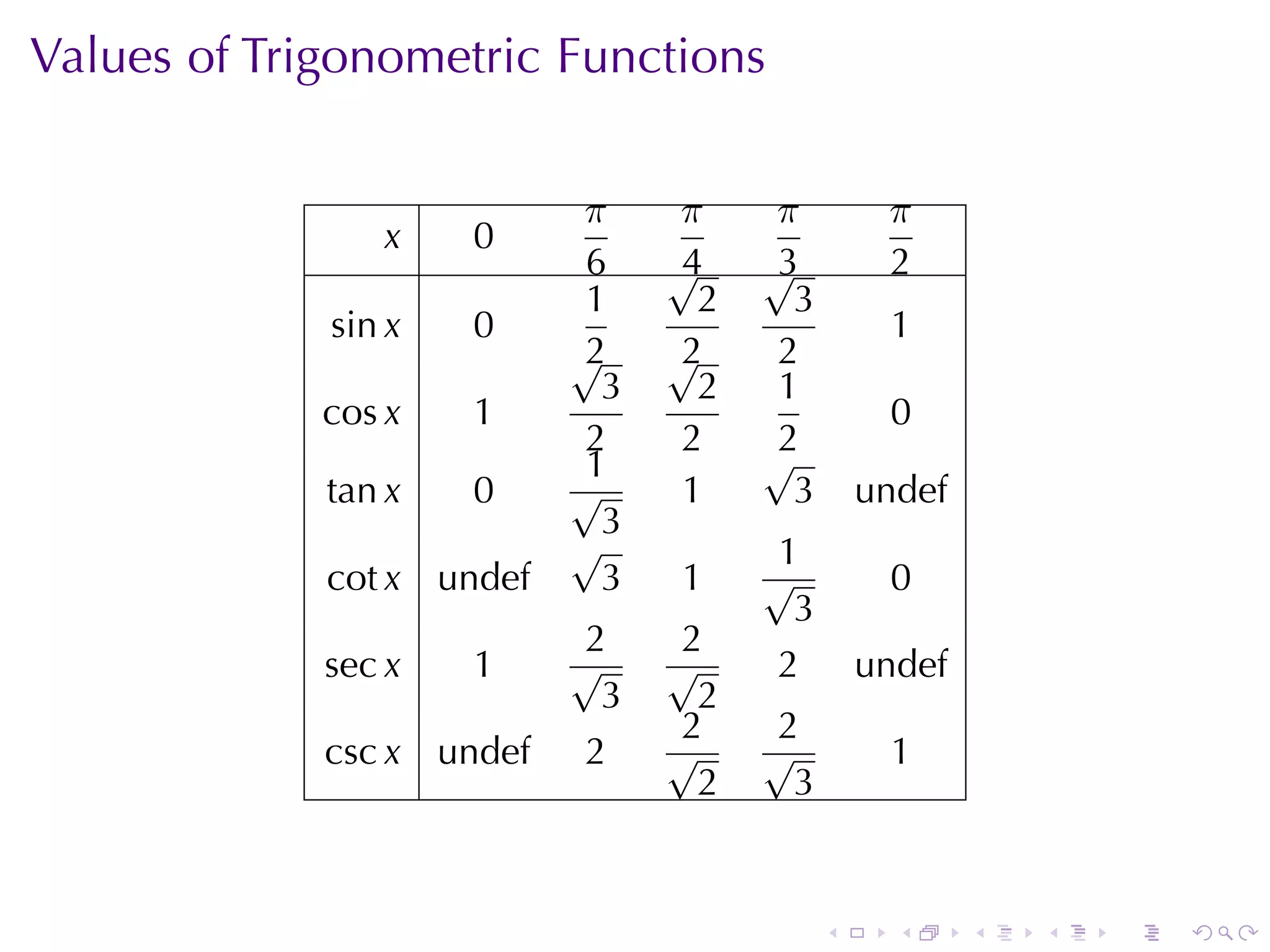
Values	of	Trigonometric	Functions

                           π     π     π          π
                x    0
                            6    √4    √3         2
                            1      2     3
             sin x   0                            1
                           √2    √2     2
                             3     2    1
             cos x   1                            0
                            2     2    √2
                            1
             tan x   0     √      1      3       undef
                             3
                           √            1
             cot x undef     3   1     √          0
                                         3
                            2     2
             sec x   1     √     √      2        undef
                             3     2
                                  2     2
             csc x undef    2    √     √          1
                                   2     3


                                             .     .     .   .   .   .
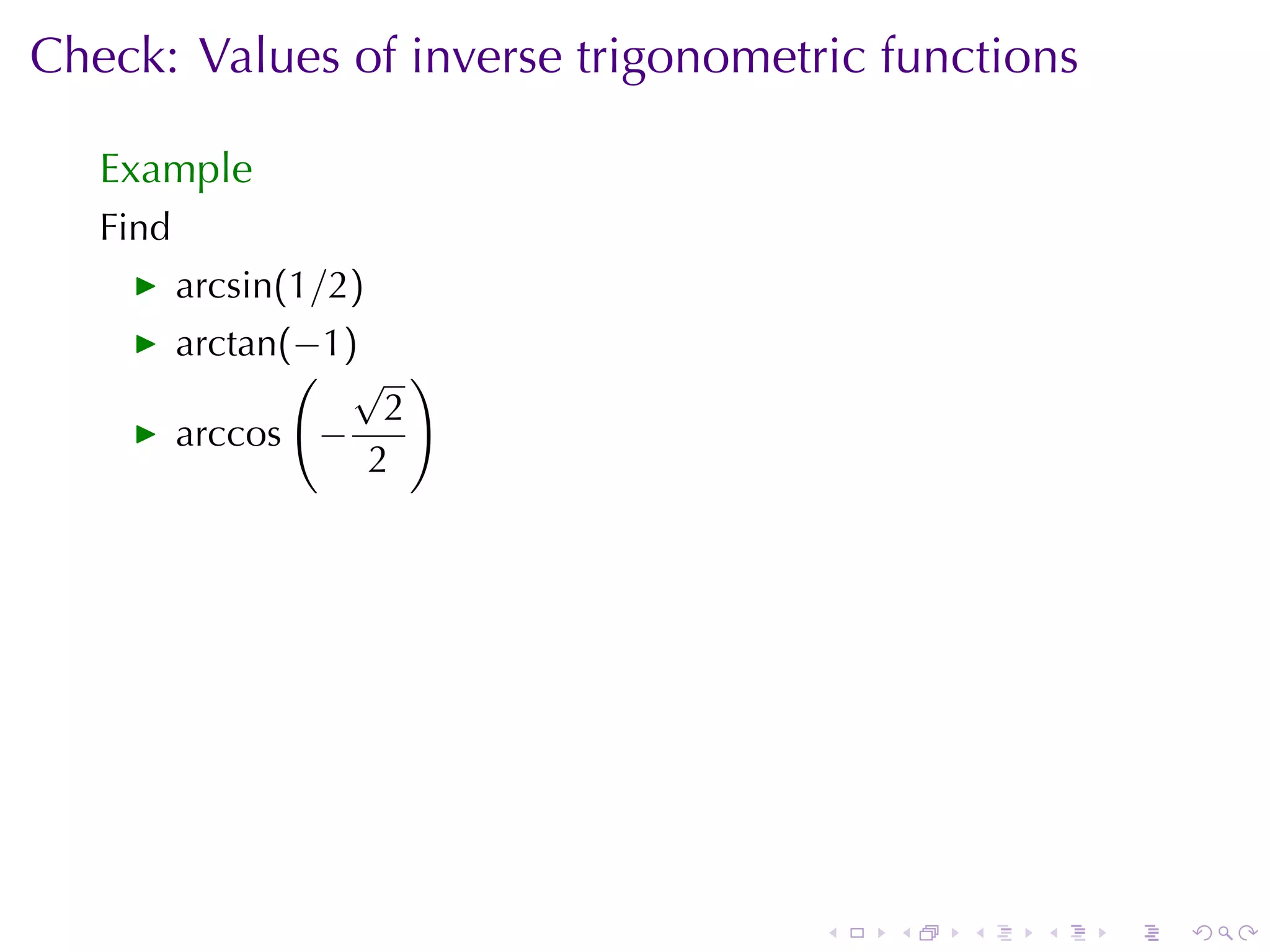
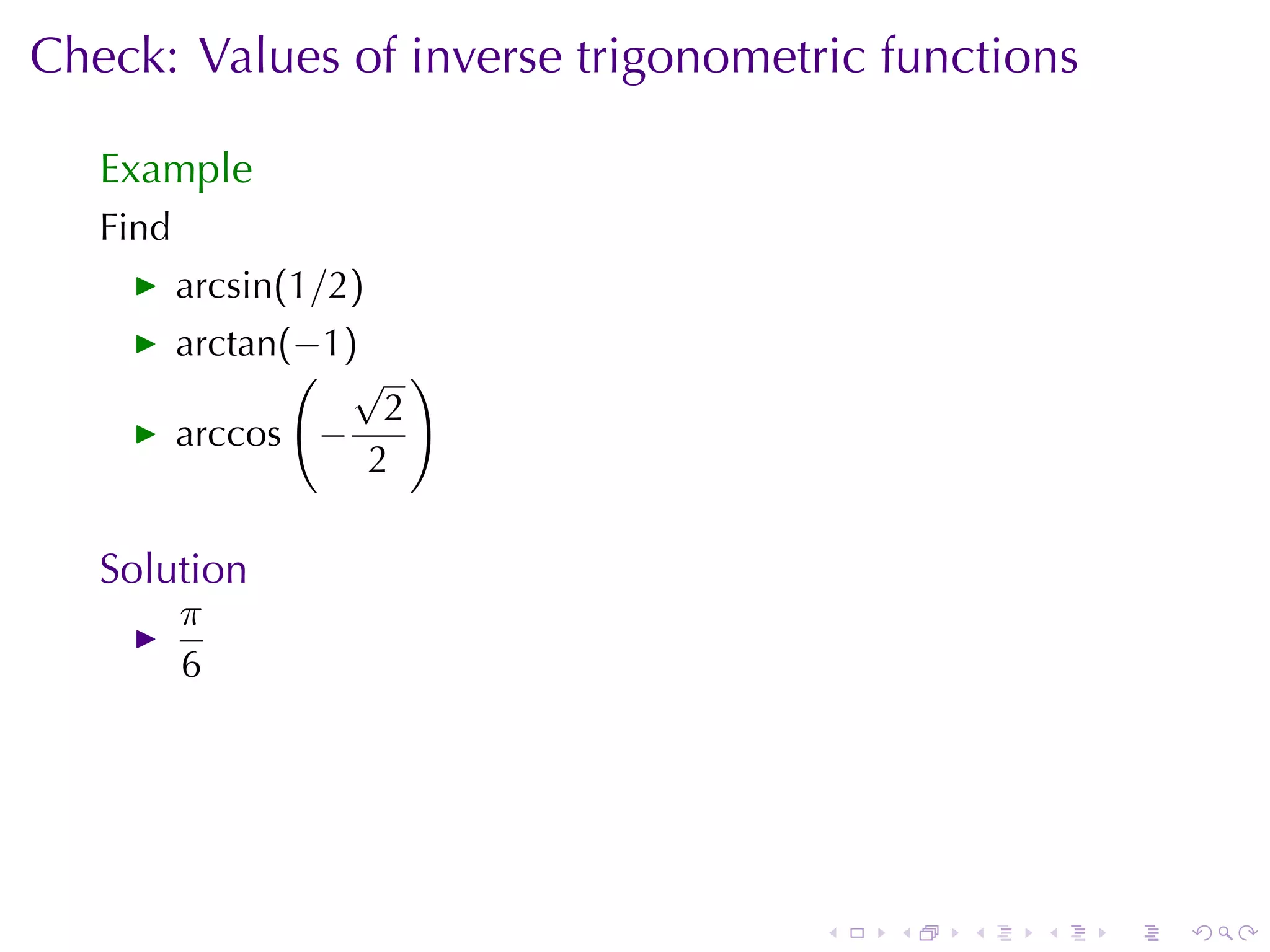
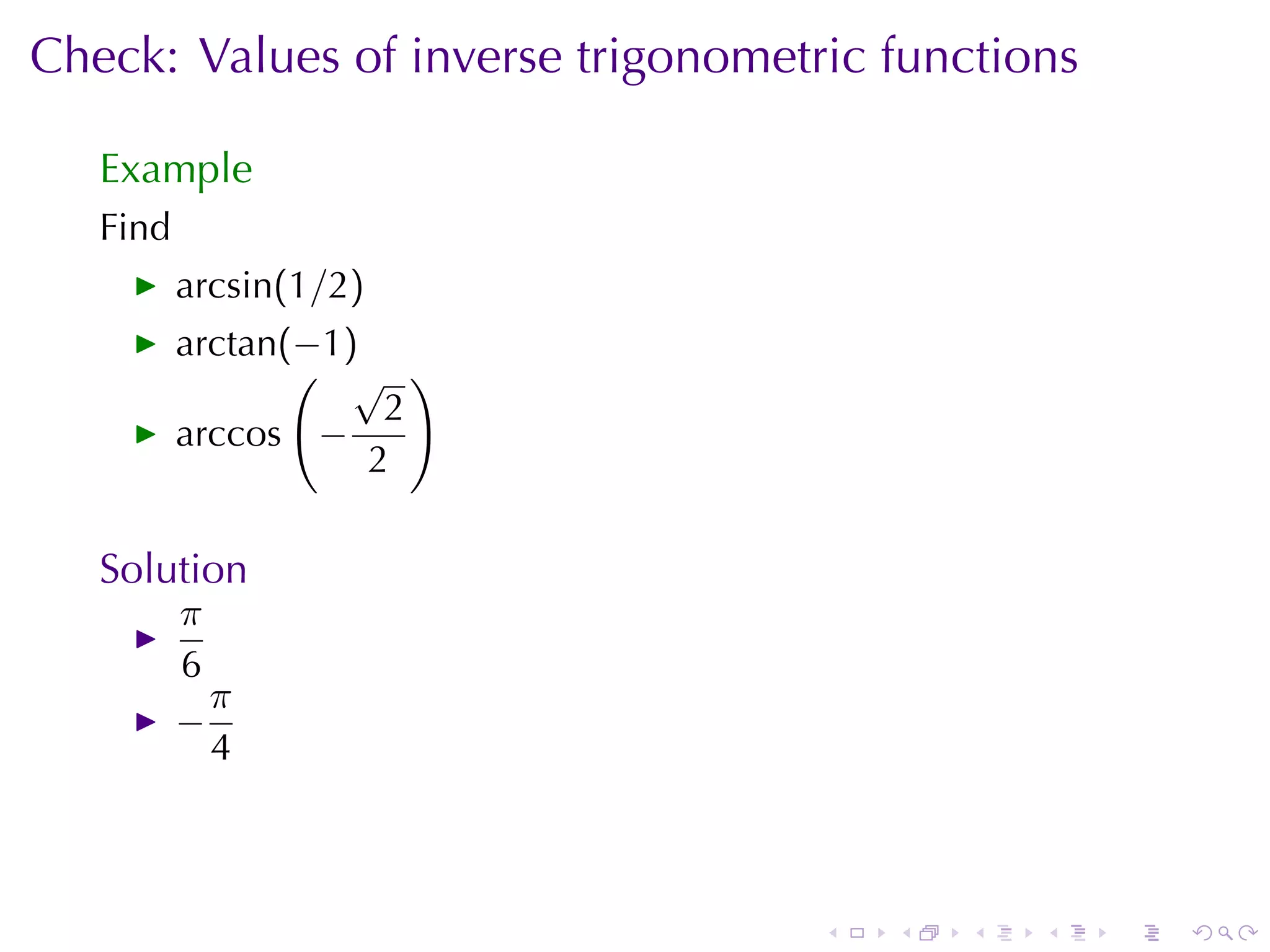
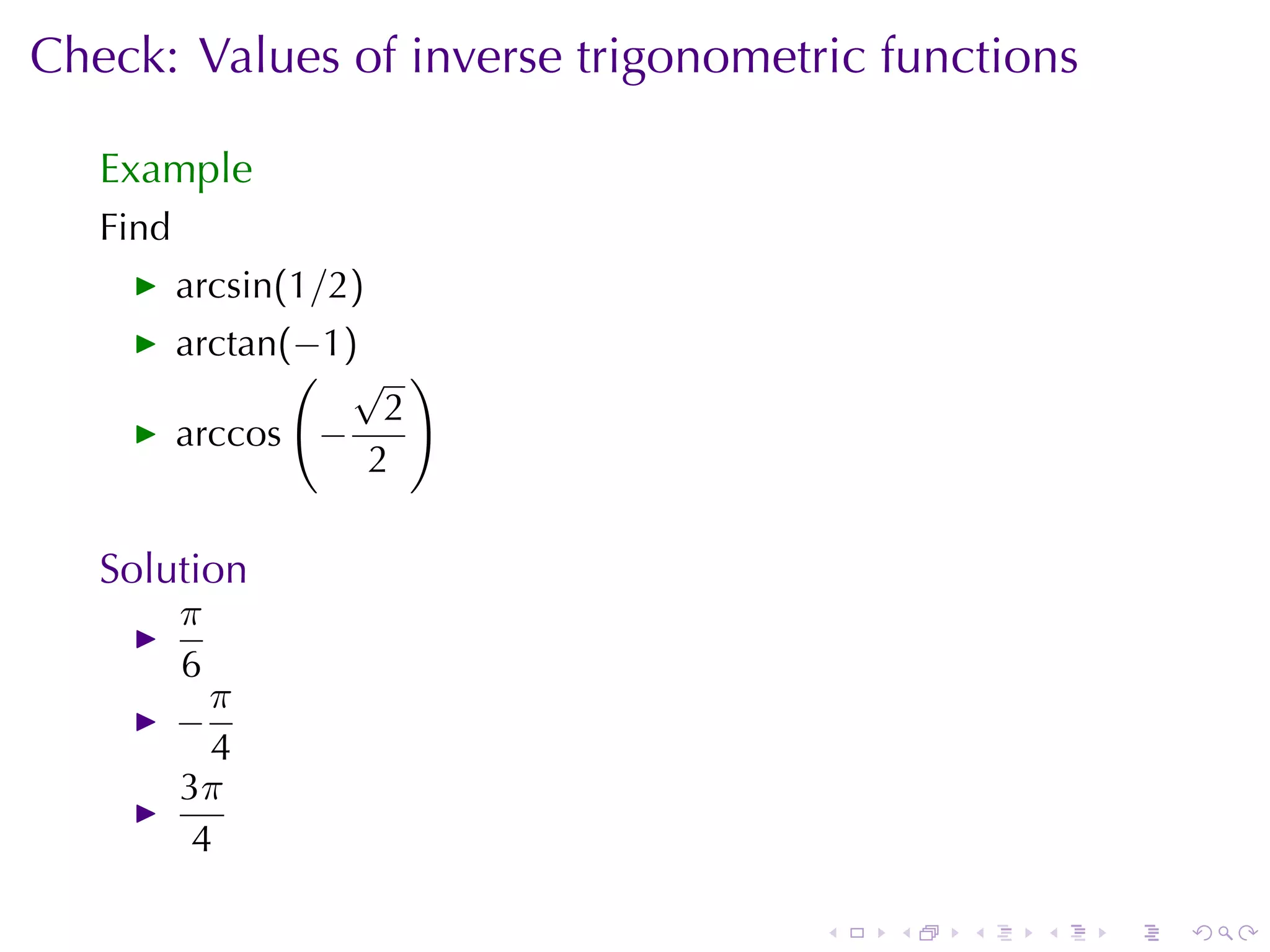
Check: Values	of	inverse	trigonometric	functions

   Example
   Find
          arcsin(1/2)
          arctan(−1)
                 ( √ )
                      2
          arccos −
                     2


                                    .   .   .   .   .   .
Check: Values	of	inverse	trigonometric	functions

   Example
   Find
          arcsin(1/2)
          arctan(−1)
                 ( √ )
                      2
          arccos −
                     2

   Solution
          π
          6


                                    .   .   .   .   .   .
Check: Values	of	inverse	trigonometric	functions

   Example
   Find
          arcsin(1/2)
          arctan(−1)
                 ( √ )
                      2
          arccos −
                     2

   Solution
          π
          6
            π
          −
            4


                                    .   .   .   .   .   .
Check: Values	of	inverse	trigonometric	functions

   Example
   Find
          arcsin(1/2)
          arctan(−1)
                 ( √ )
                      2
          arccos −
                     2

   Solution
          π
          6
            π
          −
            4
          3π
           4

                                    .   .   .   .   .   .
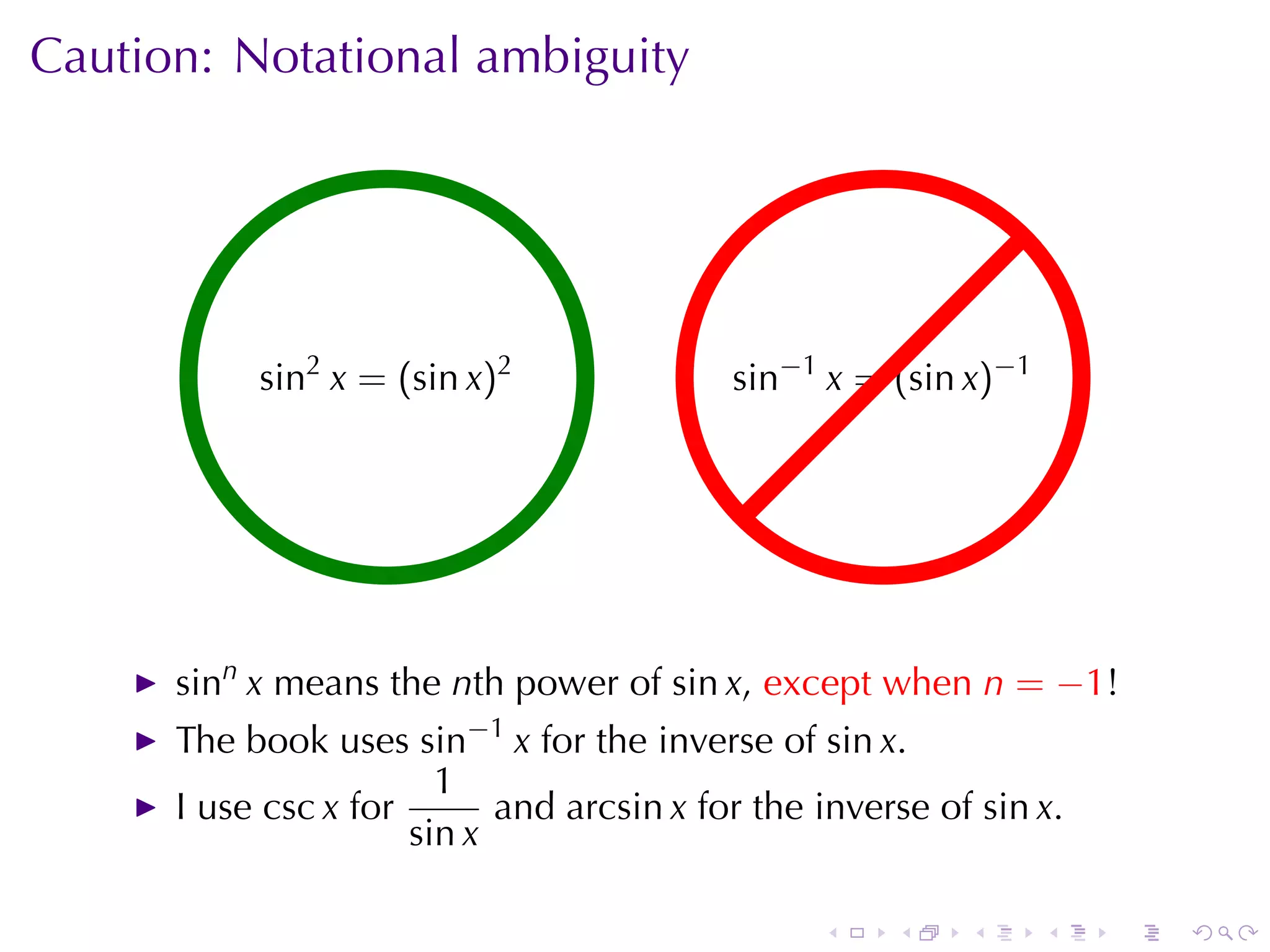
Caution: Notational	ambiguity


           . in2 x =.(sin x)2
           s                               . in−1 x = (sin x)−1
                                           s


      sinn x means	the nth	power	of sin x, except	when n = −1!
      The	book	uses sin−1 x for	the	inverse	of sin x.
                        1
      I use csc x for       and arcsin x for	the	inverse	of sin x.
                      sin x

                                                 .    .    .      .   .   .
Outline


  Inverse	Trigonometric	Functions


  Derivatives	of	Inverse	Trigonometric	Functions
     Arcsine
     Arccosine
     Arctangent
     Arcsecant


  Applications


                                             .     .   .   .   .   .
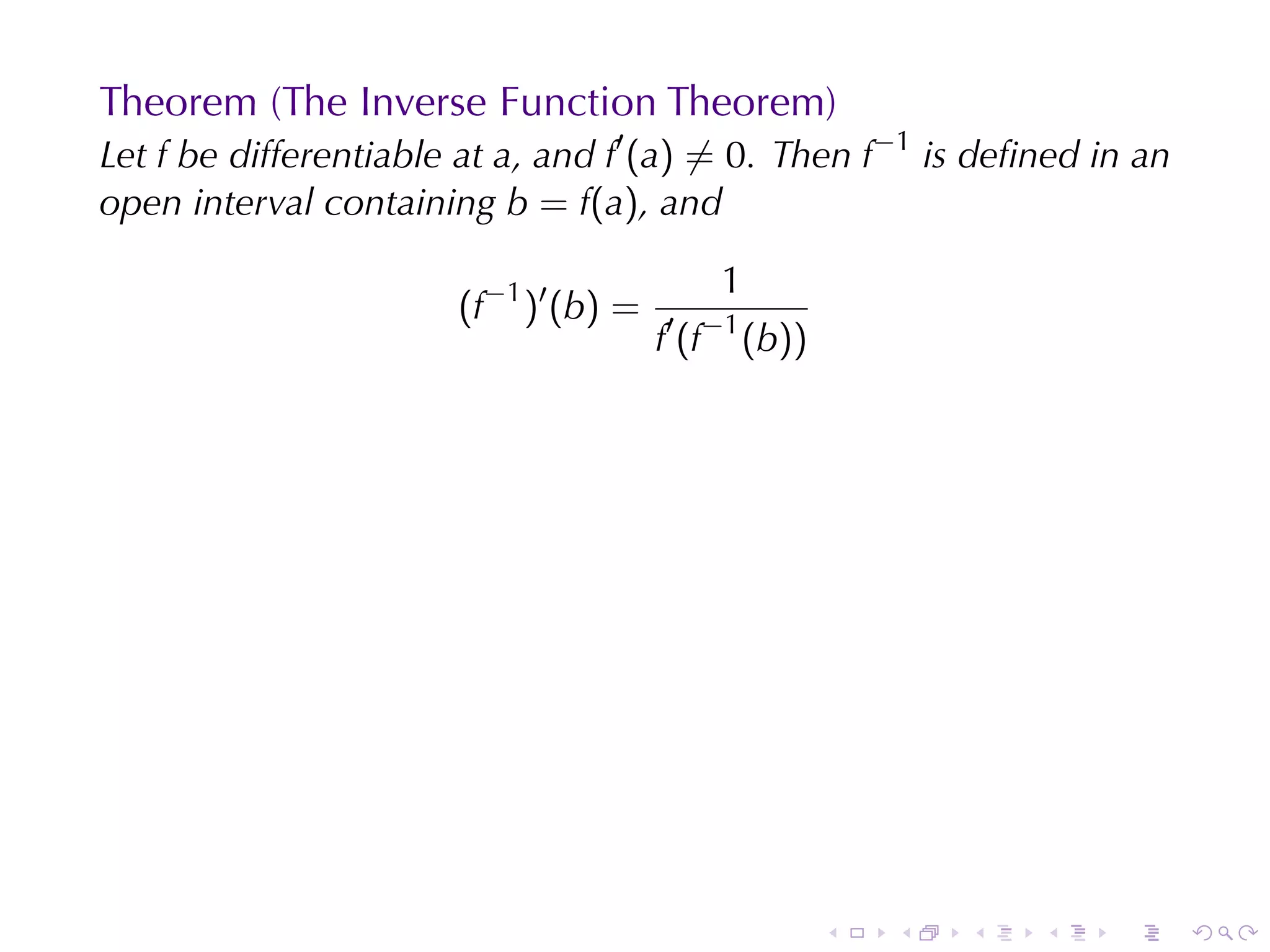
Theorem	(The	Inverse	Function	Theorem)
Let f be	differentiable	at a, and f′ (a) ̸= 0. Then f−1 is	defined	in	an
open	interval	containing b = f(a), and

                                              1
                       (f−1 )′ (b) =   ′ −1
                                       f (f   (b))


                                                     .   .   .   .   .    .
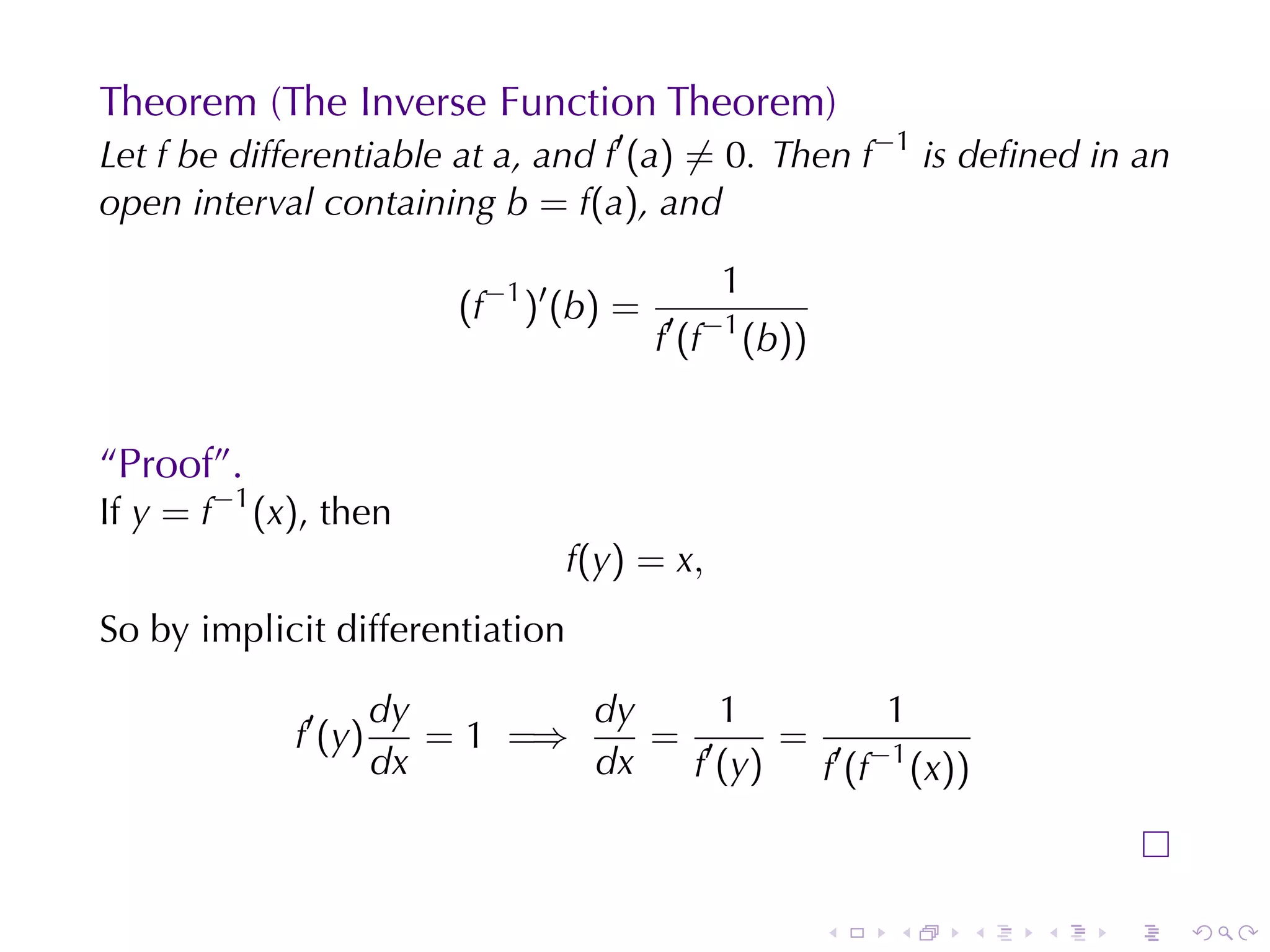
Theorem	(The	Inverse	Function	Theorem)
Let f be	differentiable	at a, and f′ (a) ̸= 0. Then f−1 is	defined	in	an
open	interval	containing b = f(a), and

                                                 1
                          (f−1 )′ (b) =   ′ −1
                                          f (f   (b))


“Proof”.
If y = f−1 (x), then
                                 f (y ) = x ,
So	by	implicit	differentiation

                      dy        dy     1         1
             f′ (y)      = 1 =⇒    = ′     = ′ −1
                      dx        dx   f (y)   f (f (x))


                                                        .   .   .   .   .   .
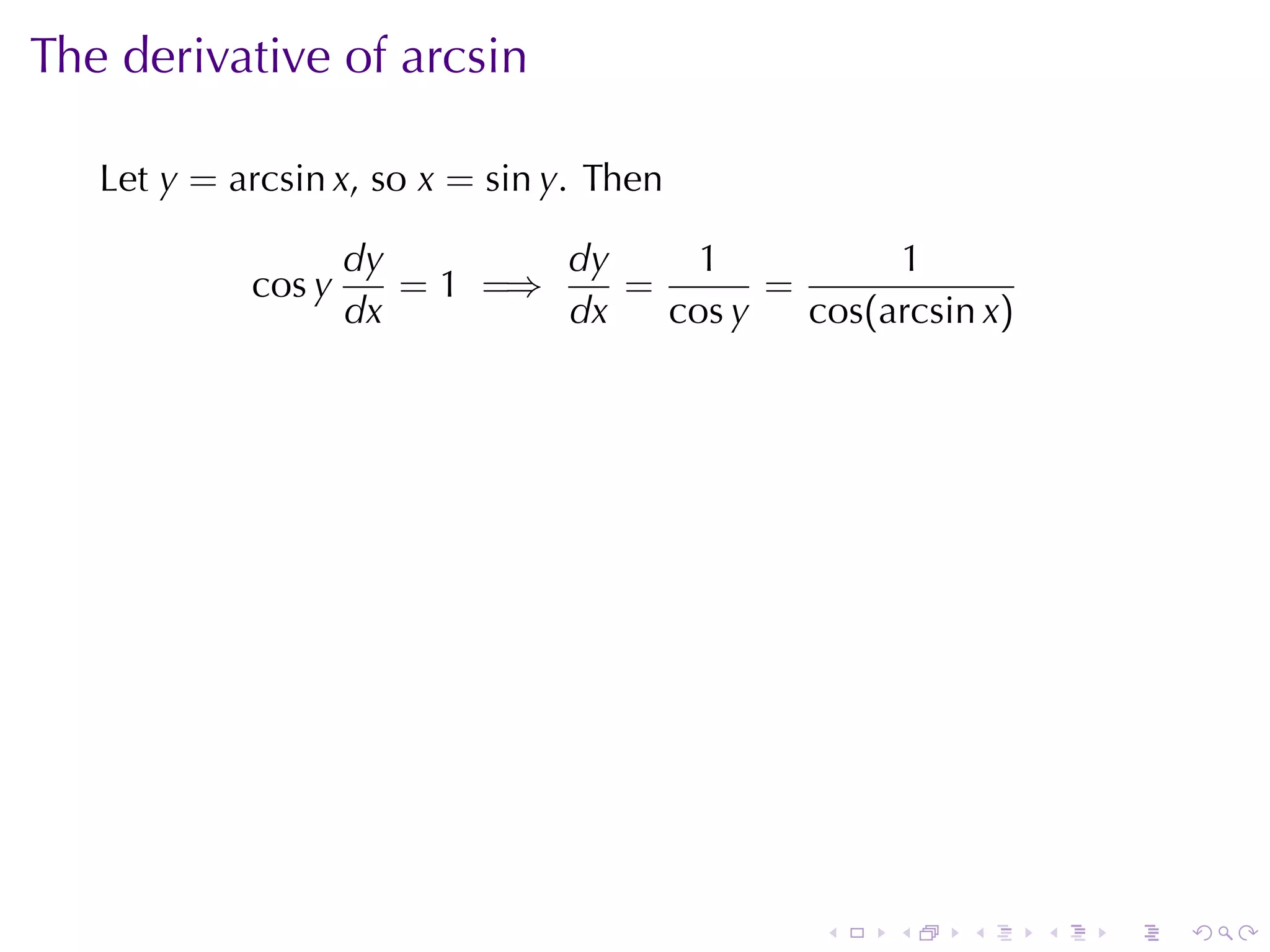
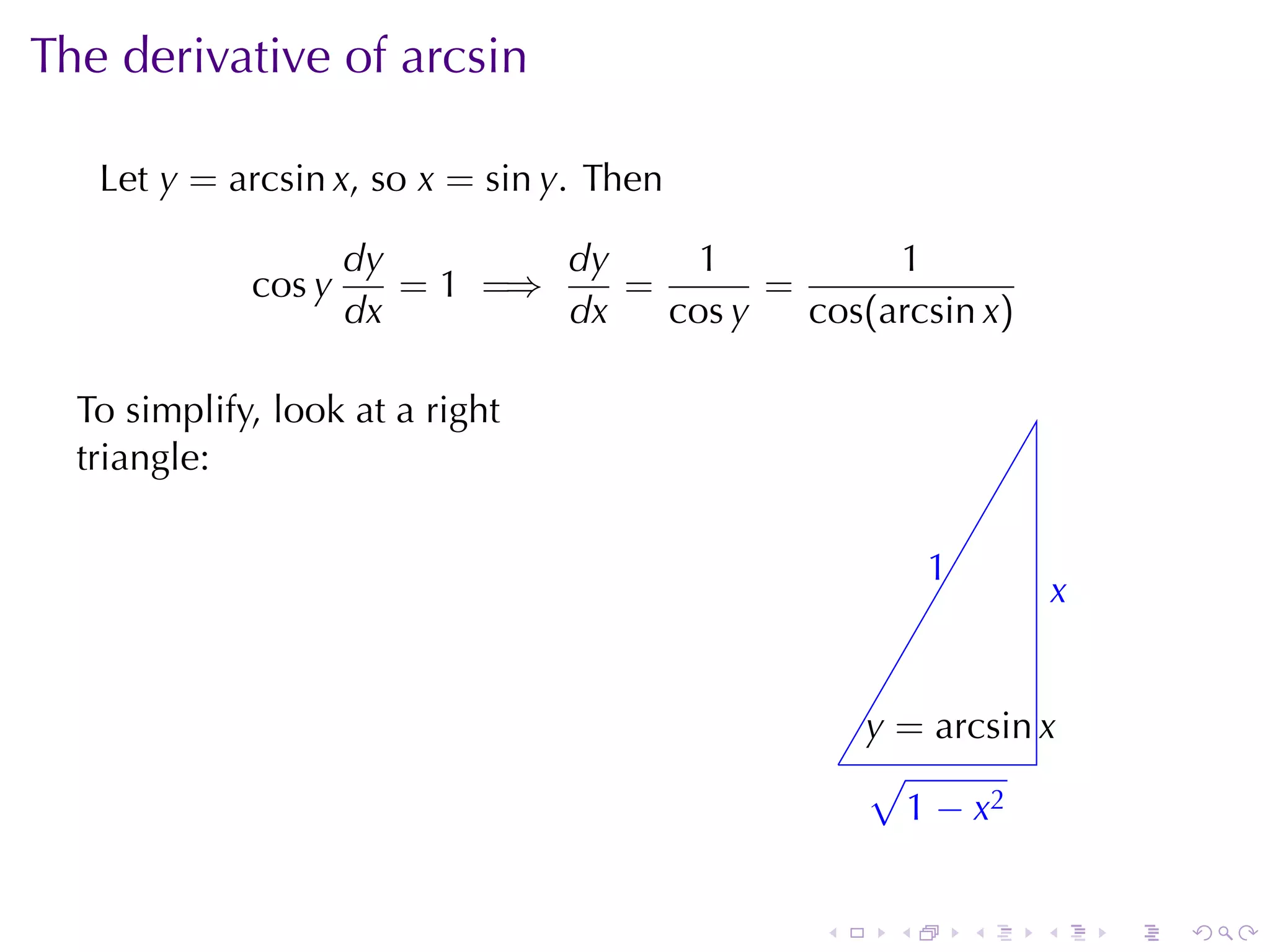
The	derivative	of	arcsin

   Let y = arcsin x, so x = sin y. Then

                    dy        dy     1          1
            cos y      = 1 =⇒    =       =
                    dx        dx   cos y   cos(arcsin x)


                                             .   .   .     .   .   .
The	derivative	of	arcsin

   Let y = arcsin x, so x = sin y. Then

                     dy        dy     1          1
             cos y      = 1 =⇒    =       =
                     dx        dx   cos y   cos(arcsin x)

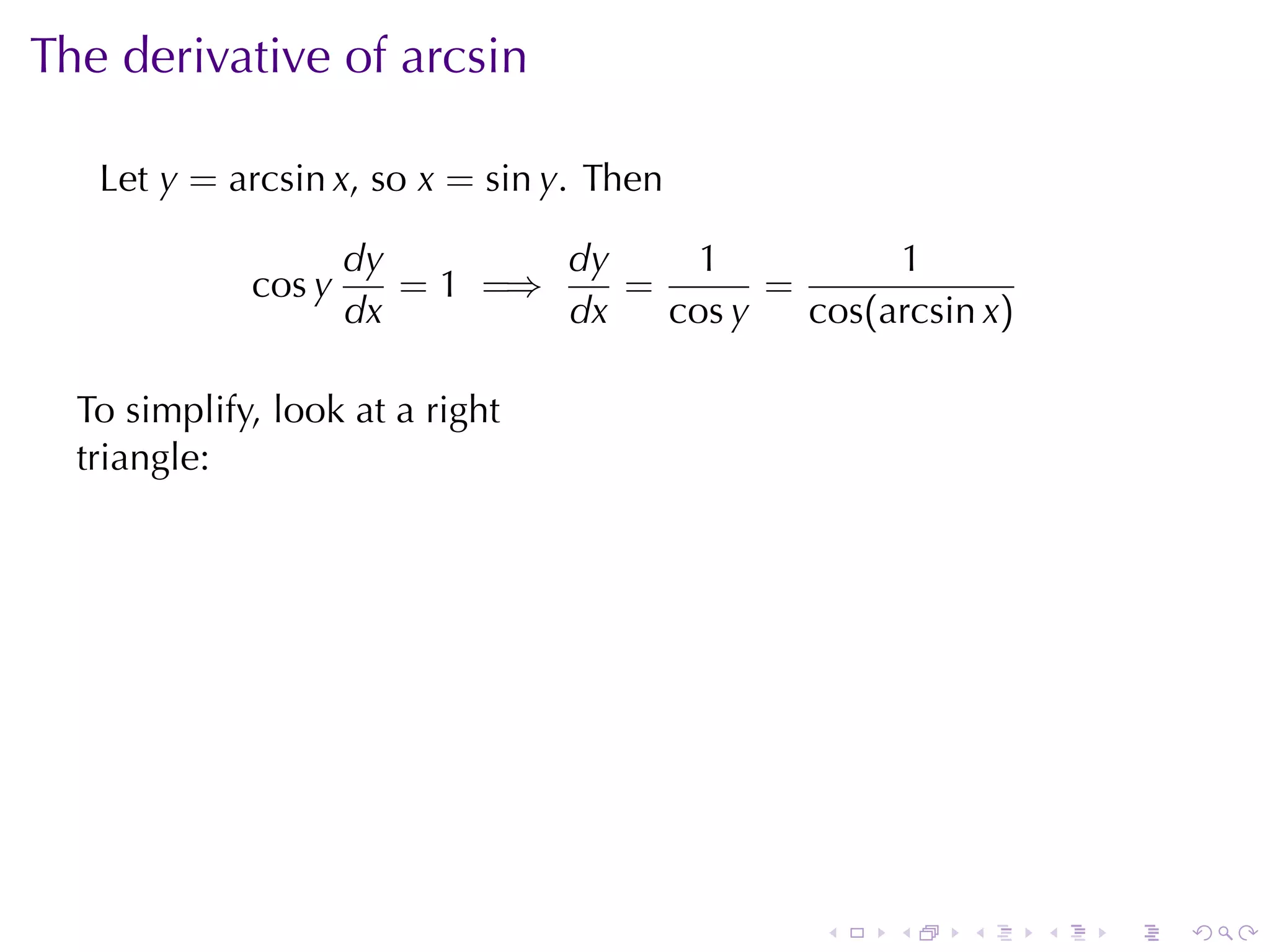
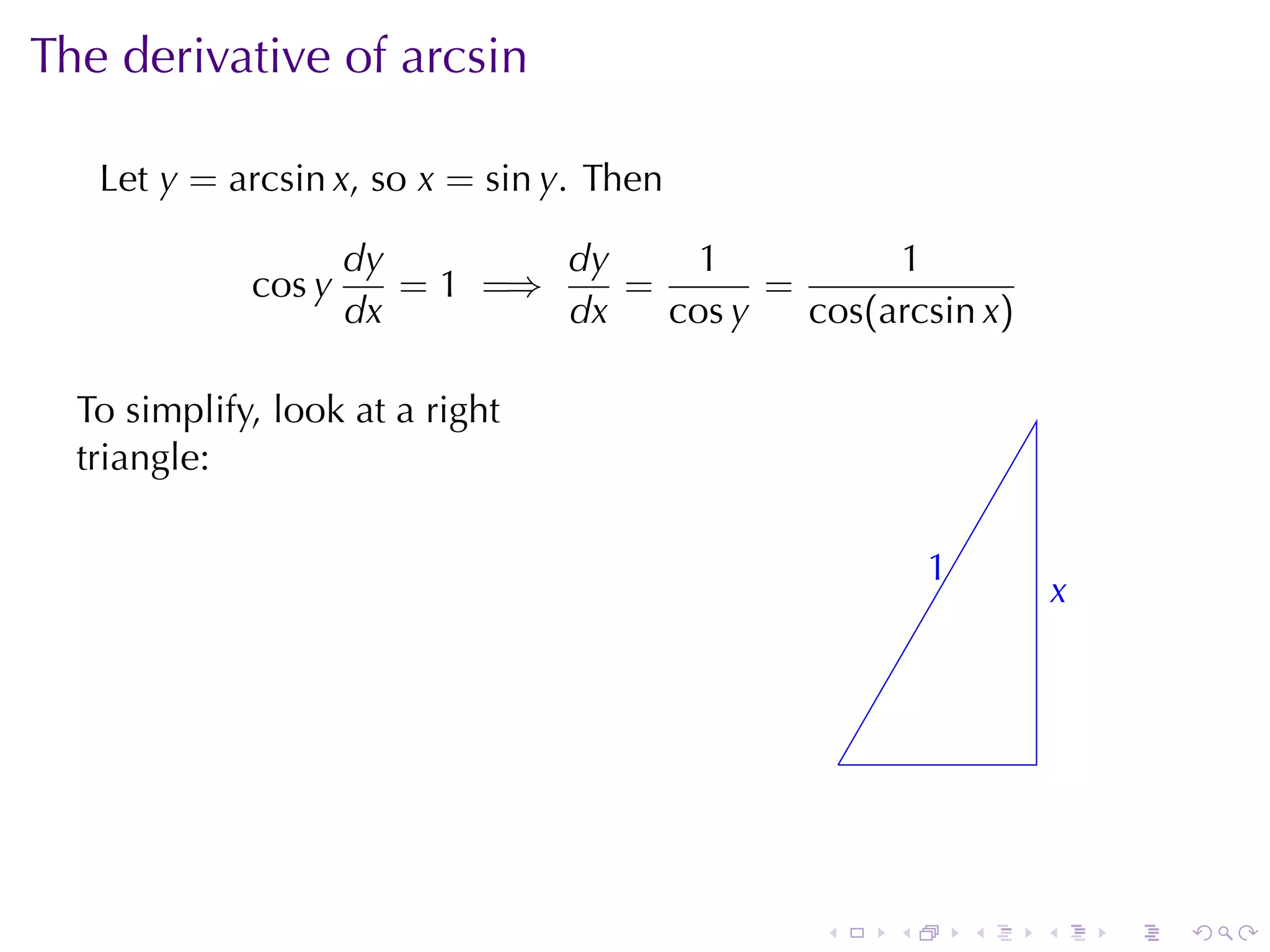
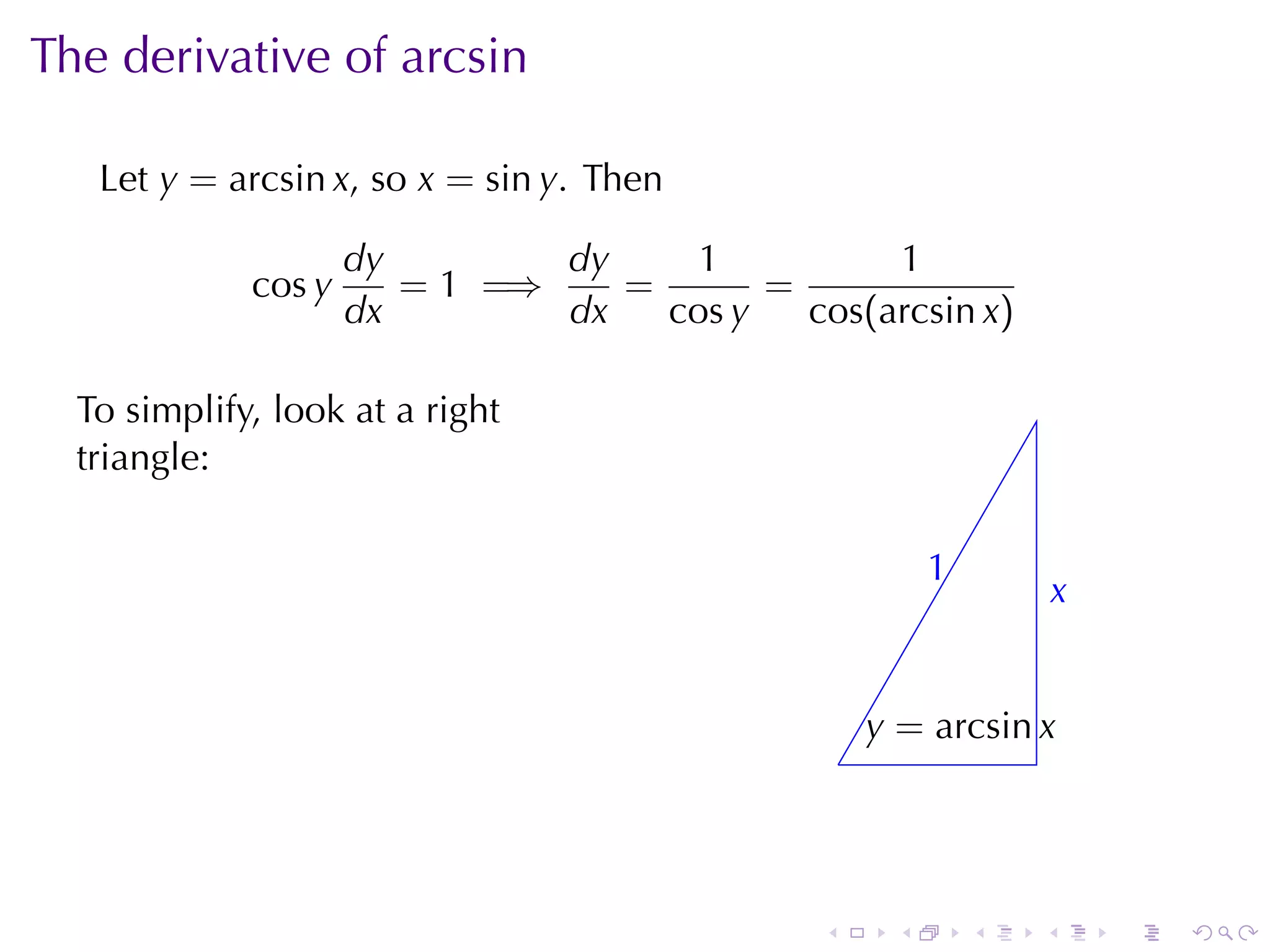
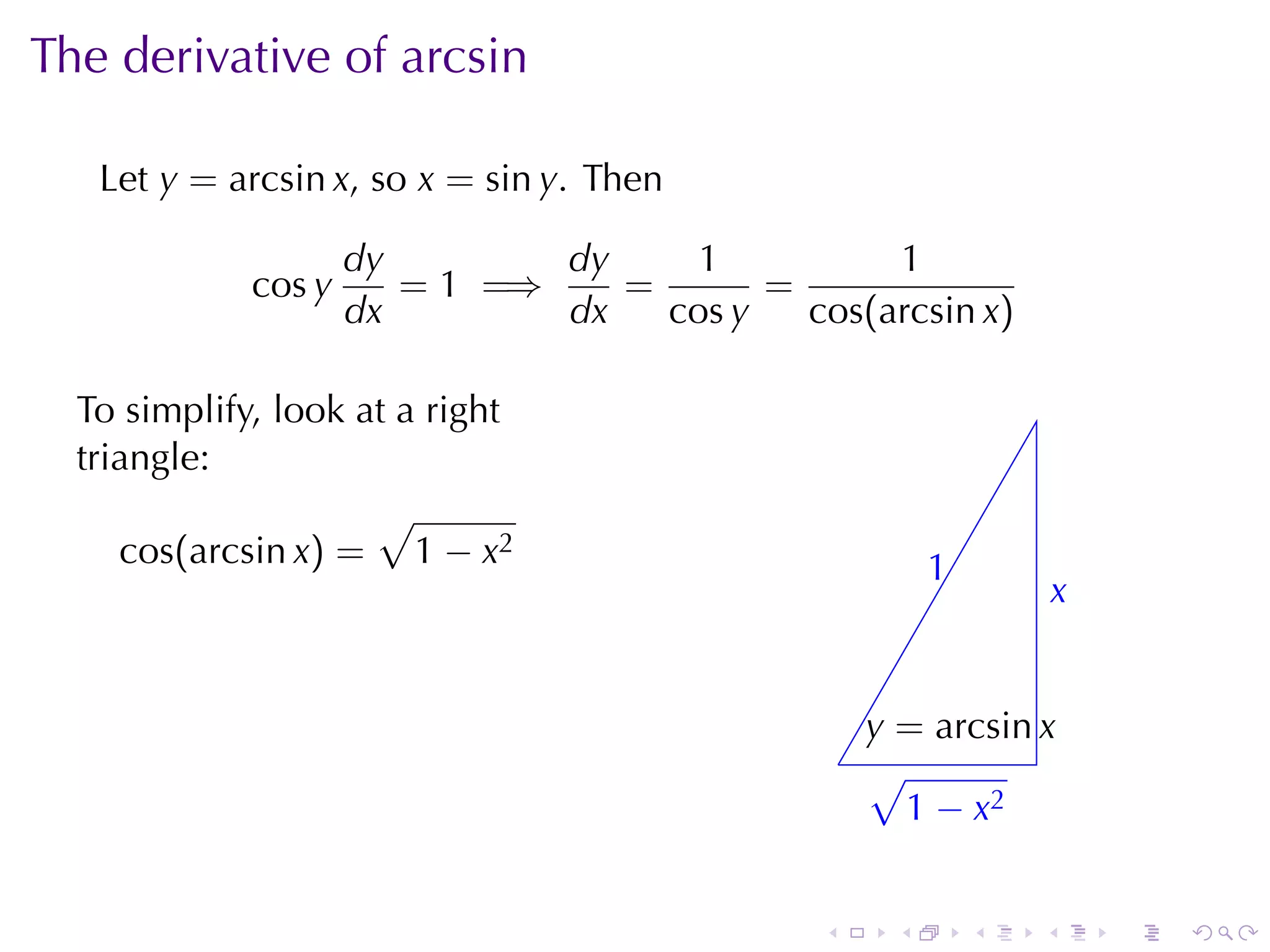
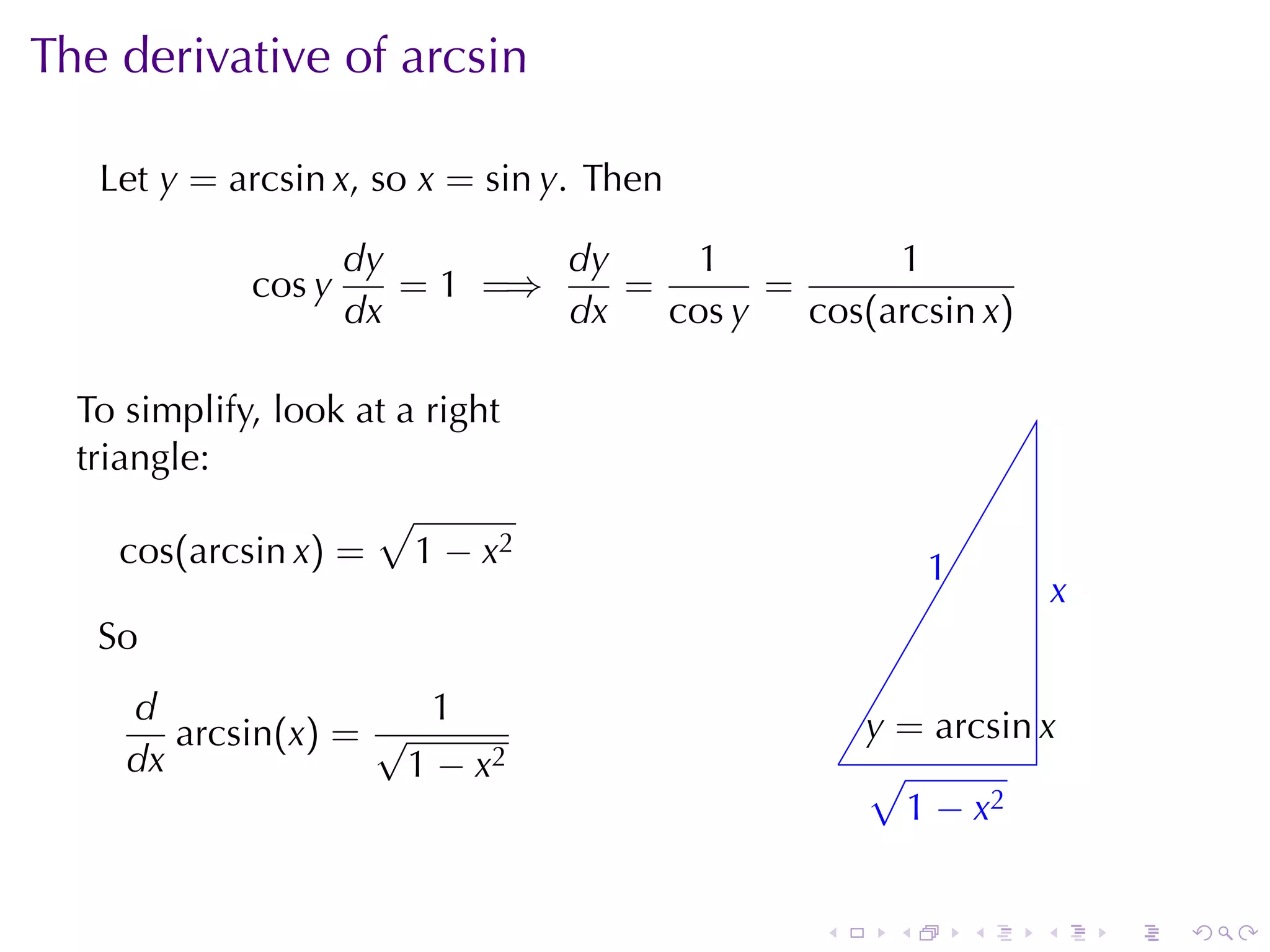
  To	simplify, look	at	a	right
  triangle:


                                                  .


                                              .       .   .   .   .   .
The	derivative	of	arcsin

   Let y = arcsin x, so x = sin y. Then

                     dy        dy     1          1
             cos y      = 1 =⇒    =       =
                     dx        dx   cos y   cos(arcsin x)

  To	simplify, look	at	a	right
  triangle:

                                                          1
                                                          .
                                                                      x
                                                                      .


                                                  .


                                              .       .       .   .       .   .
The	derivative	of	arcsin

   Let y = arcsin x, so x = sin y. Then

                     dy        dy     1          1
             cos y      = 1 =⇒    =       =
                     dx        dx   cos y   cos(arcsin x)

  To	simplify, look	at	a	right
  triangle:

                                                           1
                                                           .
                                                                       x
                                                                       .


                                                      y
                                                      . = arcsin x
                                                  .


                                              .        .       .   .       .   .
The	derivative	of	arcsin

   Let y = arcsin x, so x = sin y. Then

                     dy        dy     1          1
             cos y      = 1 =⇒    =       =
                     dx        dx   cos y   cos(arcsin x)

  To	simplify, look	at	a	right
  triangle:

                                                         1
                                                         .
                                                                     x
                                                                     .


                                                    y
                                                    . = arcsin x
                                                  . √
                                                    . 1 − x2


                                              .      .       .   .       .   .
The	derivative	of	arcsin

   Let y = arcsin x, so x = sin y. Then

                     dy        dy     1          1
             cos y      = 1 =⇒    =       =
                     dx        dx   cos y   cos(arcsin x)

  To	simplify, look	at	a	right
  triangle:
                     √
     cos(arcsin x) = 1 − x2                              1
                                                         .
                                                                     x
                                                                     .


                                                    y
                                                    . = arcsin x
                                                  . √
                                                    . 1 − x2


                                              .      .       .   .       .   .
The	derivative	of	arcsin

   Let y = arcsin x, so x = sin y. Then

                     dy        dy     1          1
             cos y      = 1 =⇒    =       =
                     dx        dx   cos y   cos(arcsin x)

  To	simplify, look	at	a	right
  triangle:
                     √
     cos(arcsin x) = 1 − x2                              1
                                                         .
                                                                     x
                                                                     .
   So
     d                 1                            y
                                                    . = arcsin x
        arcsin(x) = √
     dx               1 − x2                      . √
                                                    . 1 − x2


                                              .      .       .   .       .   .
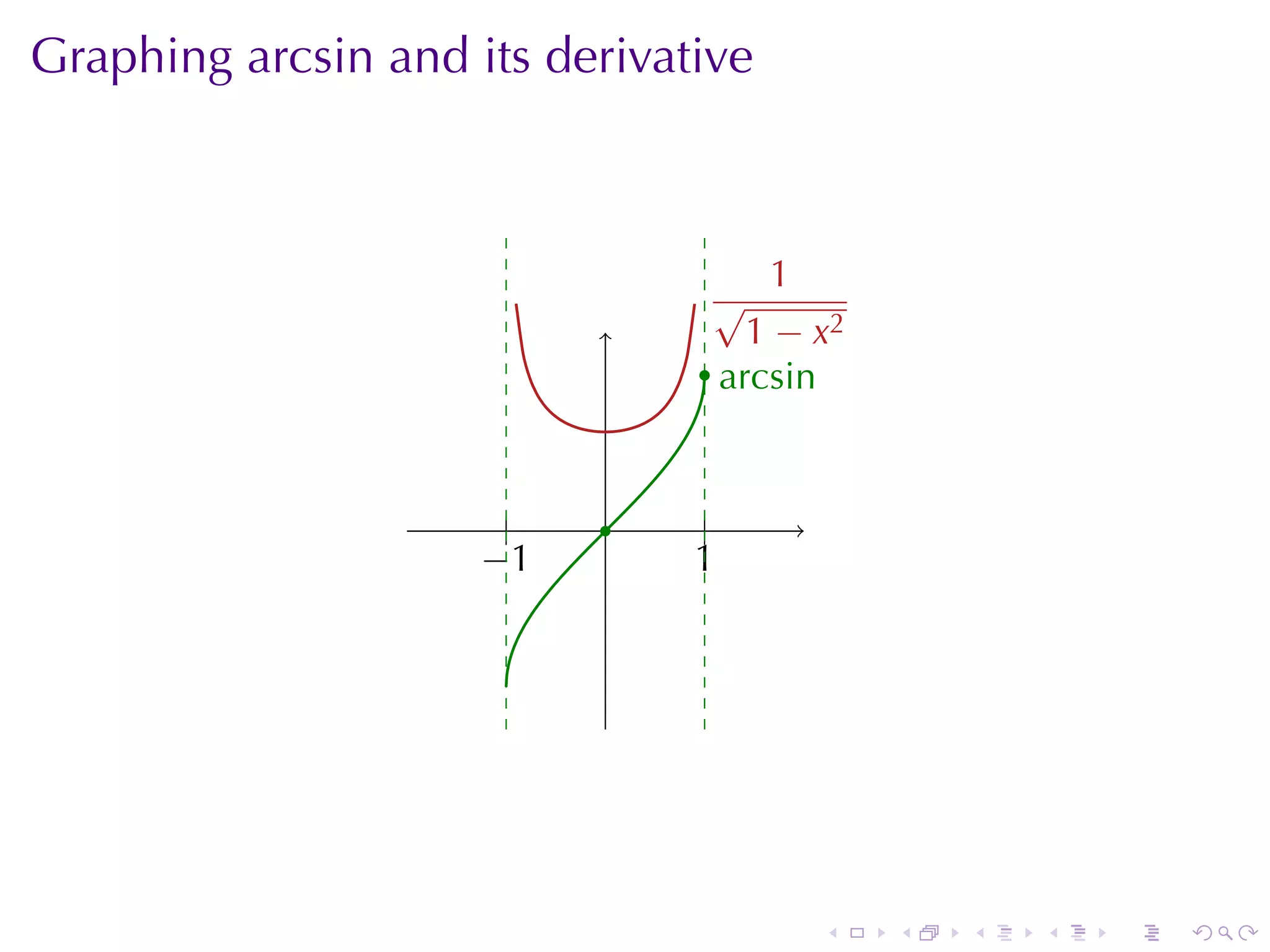
Graphing	arcsin	and	its	derivative


                                     1
                                .√
                                     1 − x2
                                . . rcsin
                                  a


                       .
                       |   .    .
                                |
                     −
                     . 1       1
                               .


                                         .    .   .   .   .   .
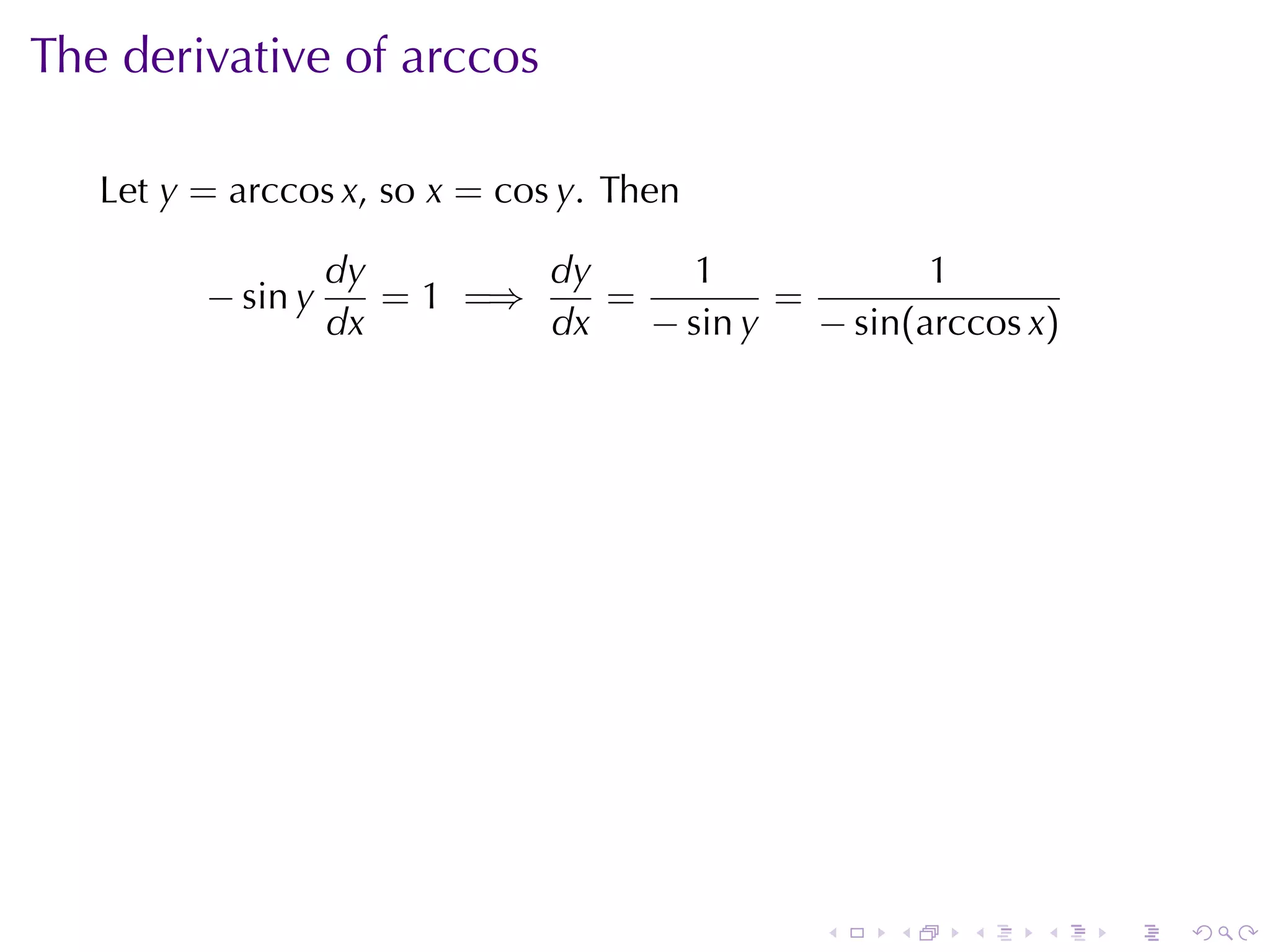
The	derivative	of	arccos

   Let y = arccos x, so x = cos y. Then

                   dy        dy      1             1
         − sin y      = 1 =⇒    =         =
                   dx        dx   − sin y   − sin(arccos x)


                                              .   .   .   .   .   .
The	derivative	of	arccos

   Let y = arccos x, so x = cos y. Then

                    dy        dy      1             1
          − sin y      = 1 =⇒    =         =
                    dx        dx   − sin y   − sin(arccos x)

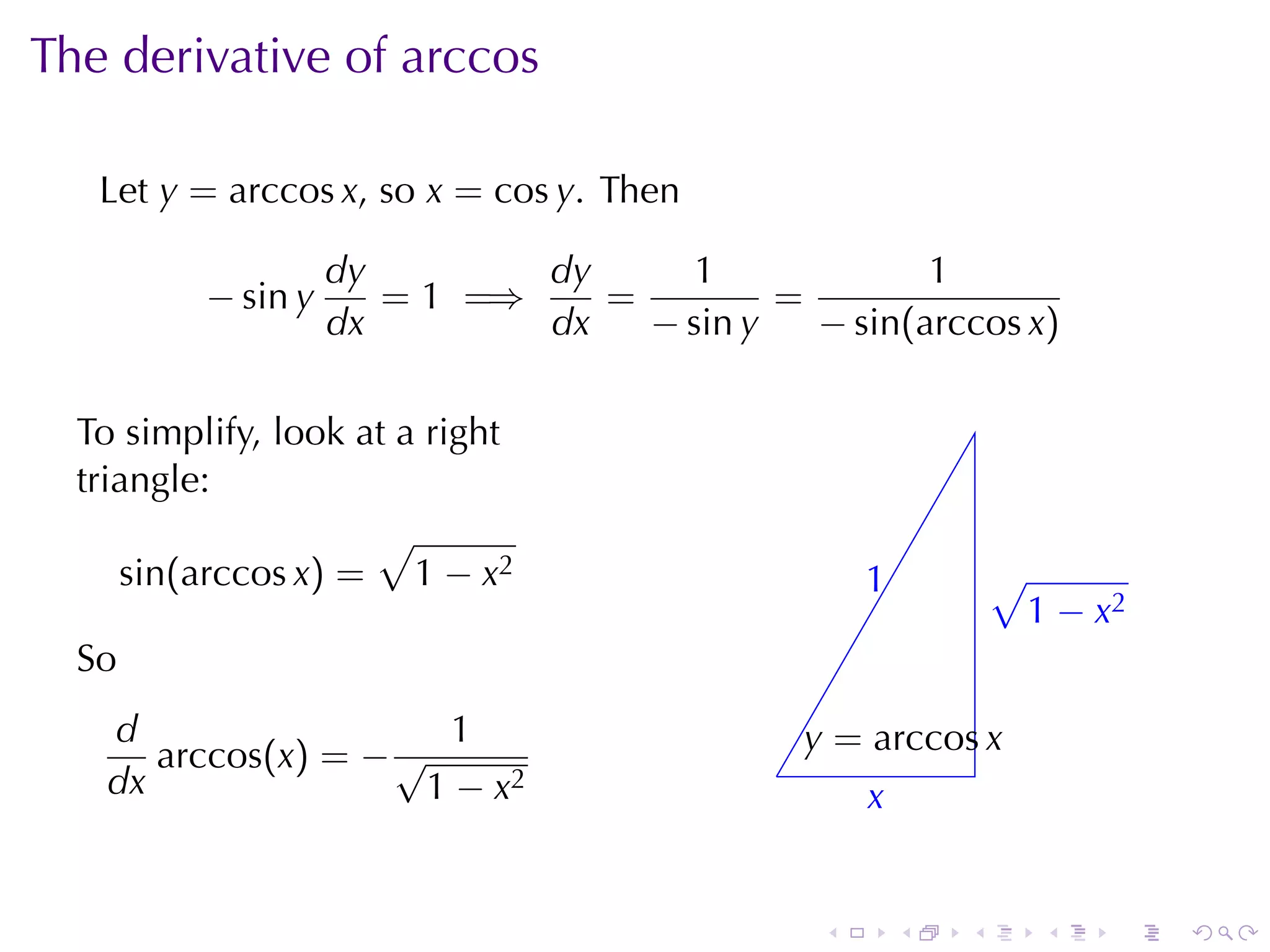
  To	simplify, look	at	a	right
  triangle:
                     √
     sin(arccos x) = 1 − x2                          1
                                                     .           √
                                                                 . 1 − x2
  So
   d                   1                        y
                                                . = arccos x
      arccos(x) = − √                       .
   dx                 1 − x2                         x
                                                     .


                                                 .       .   .      .   .   .
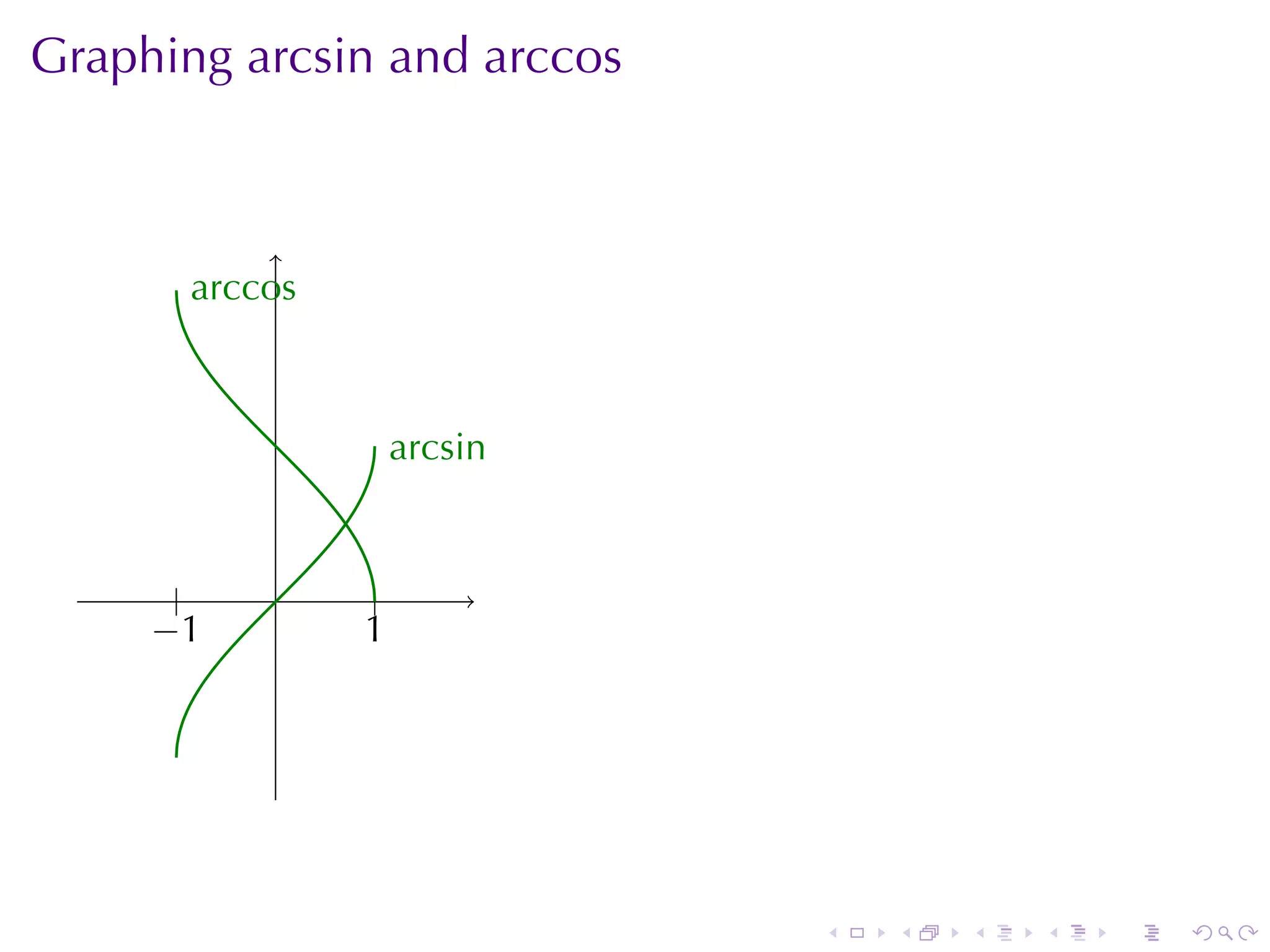
Graphing	arcsin	and	arccos


       a
       . rccos


                      a
                      . rcsin


       .
       |    .     .
                  |
     −
     . 1         1
                 .


                                .   .   .   .   .   .
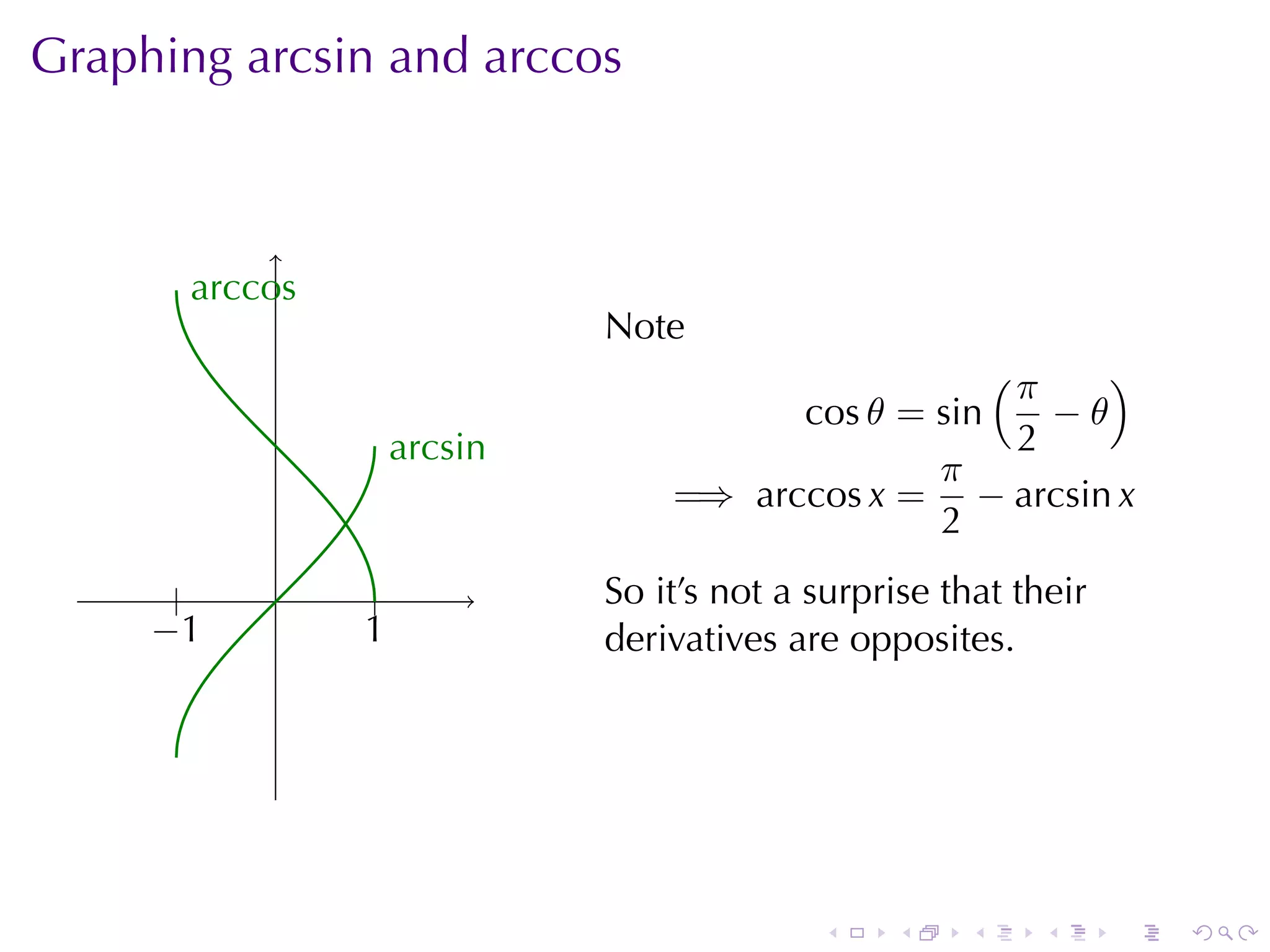
Graphing	arcsin	and	arccos


       a
       . rccos
                                Note
                                                      (π    )
                                          cos θ = sin    −θ
                      a
                      . rcsin                          2
                                                  π
                                    =⇒ arccos x = − arcsin x
                                                  2
       .
       |    .     .
                  |             So	it’s	not	a	surprise	that	their
     −
     . 1         1
                 .              derivatives	are	opposites.


                                              .    .    .     .     .   .
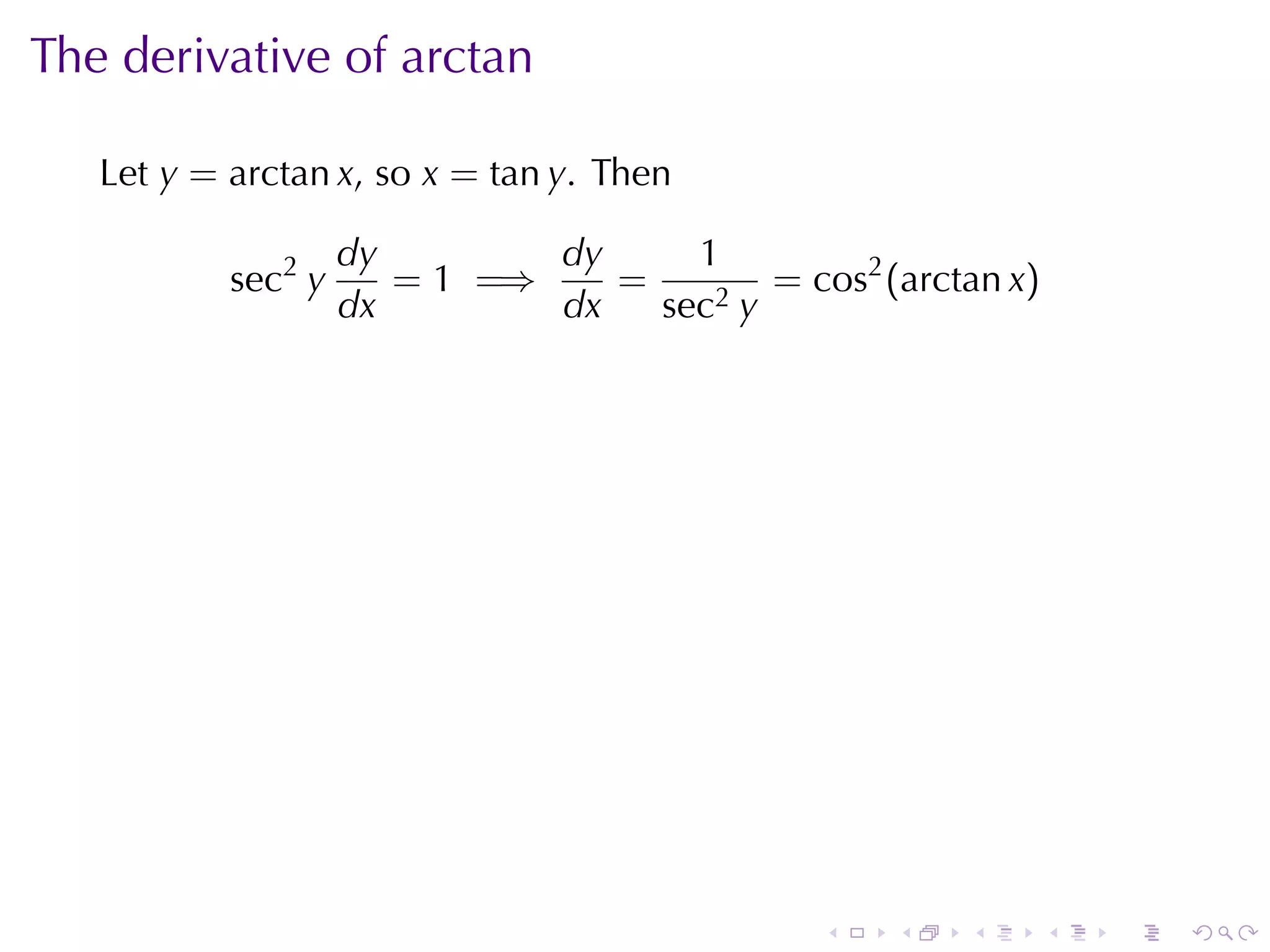
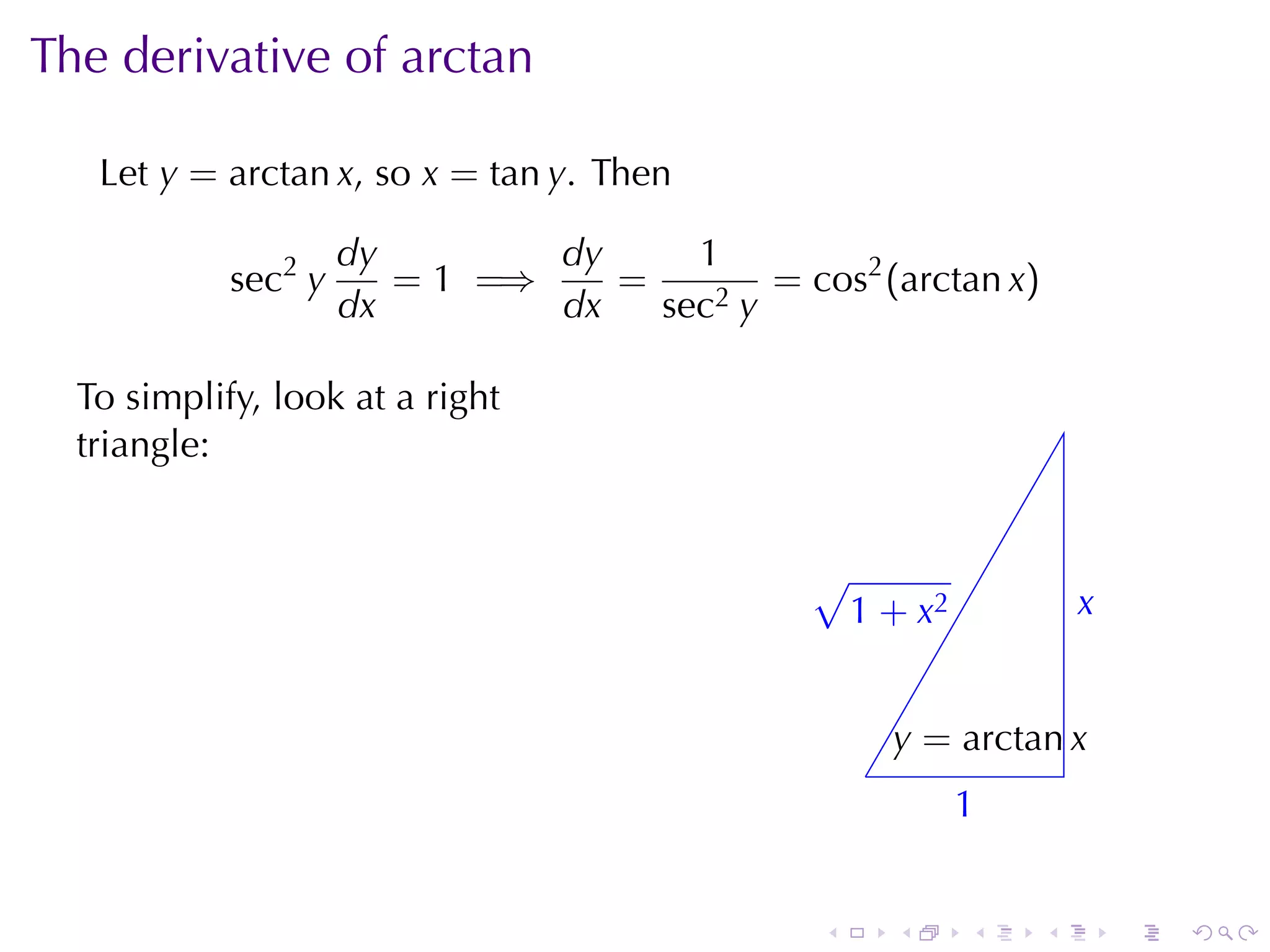
The	derivative	of	arctan

   Let y = arctan x, so x = tan y. Then

                    dy        dy     1
           sec2 y      = 1 =⇒    =        = cos2 (arctan x)
                    dx        dx   sec2 y


                                              .    .   .      .   .   .
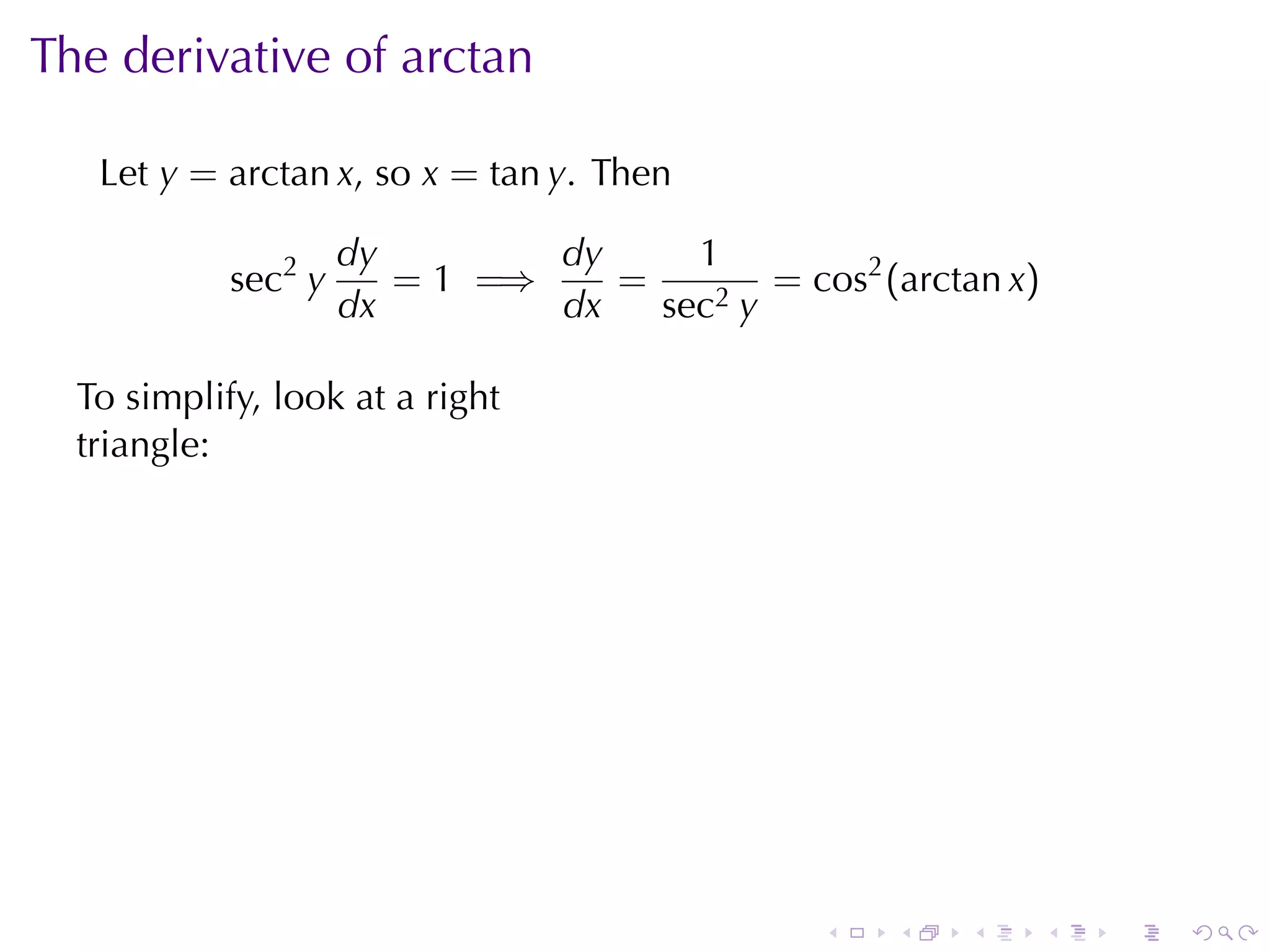
The	derivative	of	arctan

   Let y = arctan x, so x = tan y. Then

                     dy        dy     1
            sec2 y      = 1 =⇒    =        = cos2 (arctan x)
                     dx        dx   sec2 y

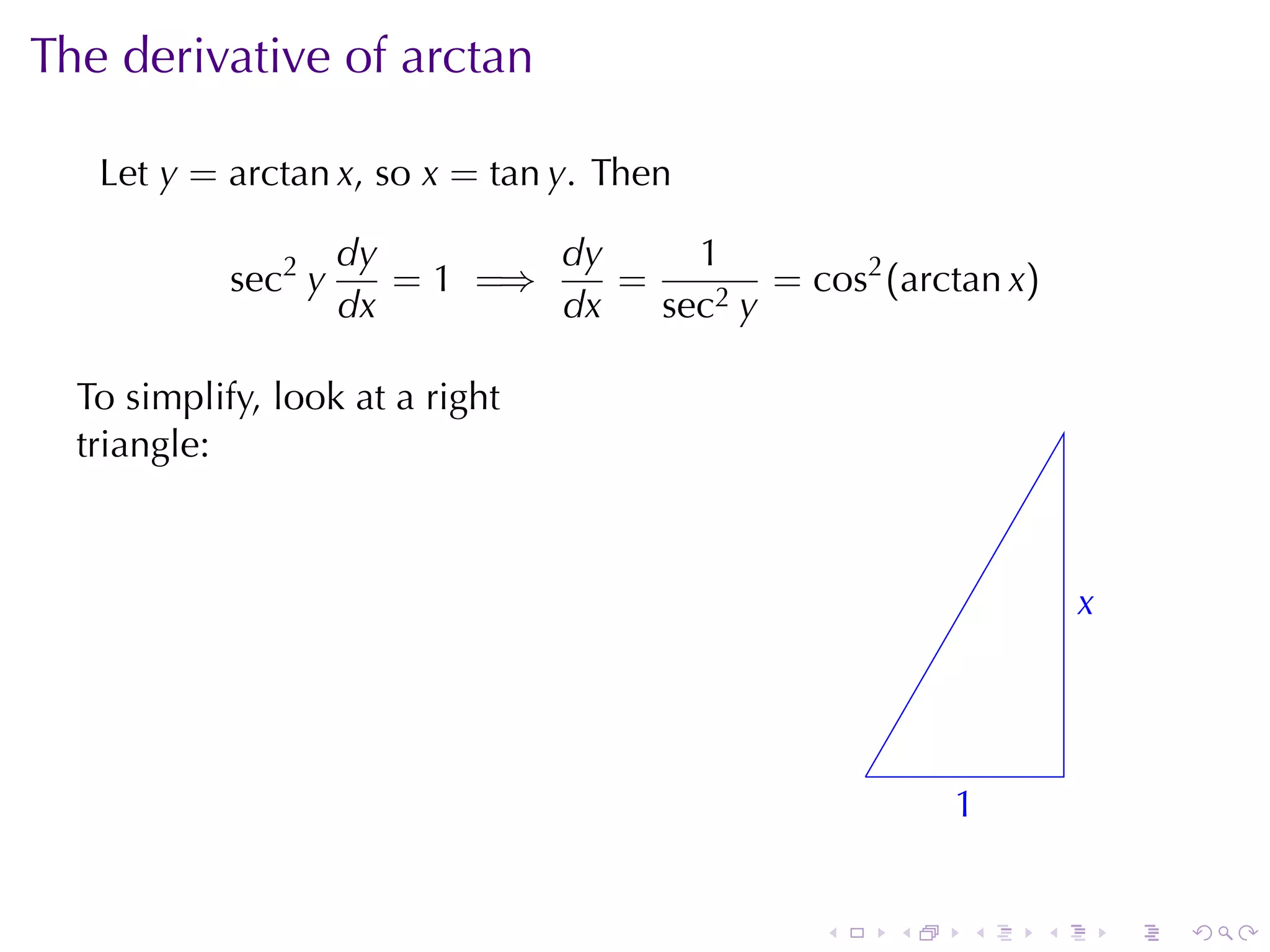
  To	simplify, look	at	a	right
  triangle:


                                                   .


                                               .       .   .   .   .   .
The	derivative	of	arctan

   Let y = arctan x, so x = tan y. Then

                     dy        dy     1
            sec2 y      = 1 =⇒    =        = cos2 (arctan x)
                     dx        dx   sec2 y

  To	simplify, look	at	a	right
  triangle:


                                                                   x
                                                                   .


                                                   .
                                                           1
                                                           .


                                               .       .   .   .       .   .
The	derivative	of	arctan

   Let y = arctan x, so x = tan y. Then

                     dy        dy     1
            sec2 y      = 1 =⇒    =        = cos2 (arctan x)
                     dx        dx   sec2 y

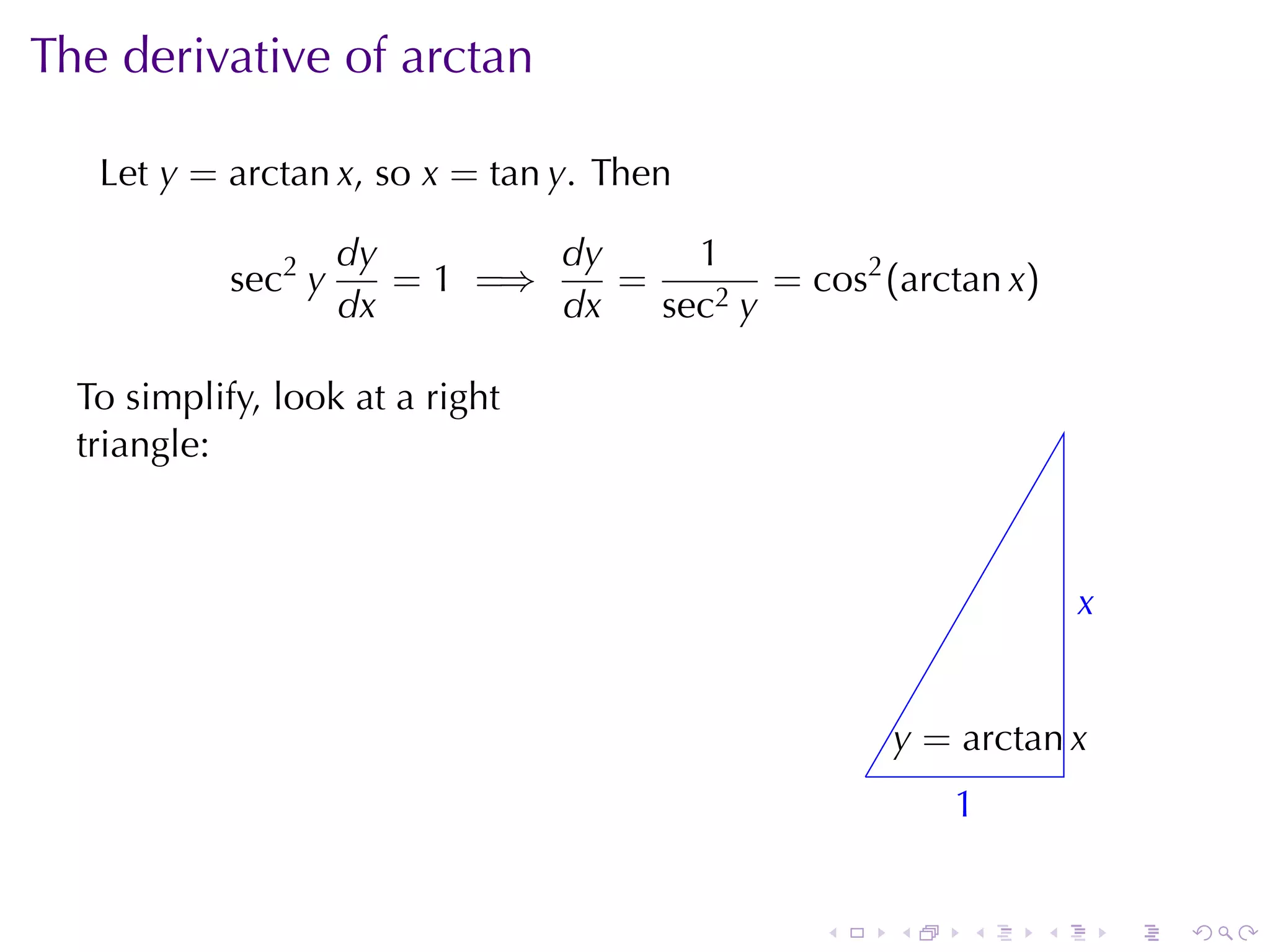
  To	simplify, look	at	a	right
  triangle:


                                                                    x
                                                                    .


                                                       y
                                                       . = arctan x
                                                   .
                                                           1
                                                           .


                                               .       .   .    .       .   .
The	derivative	of	arctan

   Let y = arctan x, so x = tan y. Then

                     dy        dy     1
            sec2 y      = 1 =⇒    =        = cos2 (arctan x)
                     dx        dx   sec2 y

  To	simplify, look	at	a	right
  triangle:


                                               √
                                               . 1 + x2             x
                                                                    .


                                                       y
                                                       . = arctan x
                                                   .
                                                           1
                                                           .


                                               .       .   .    .       .   .
The	derivative	of	arctan

   Let y = arctan x, so x = tan y. Then

                     dy        dy     1
            sec2 y      = 1 =⇒    =        = cos2 (arctan x)
                     dx        dx   sec2 y

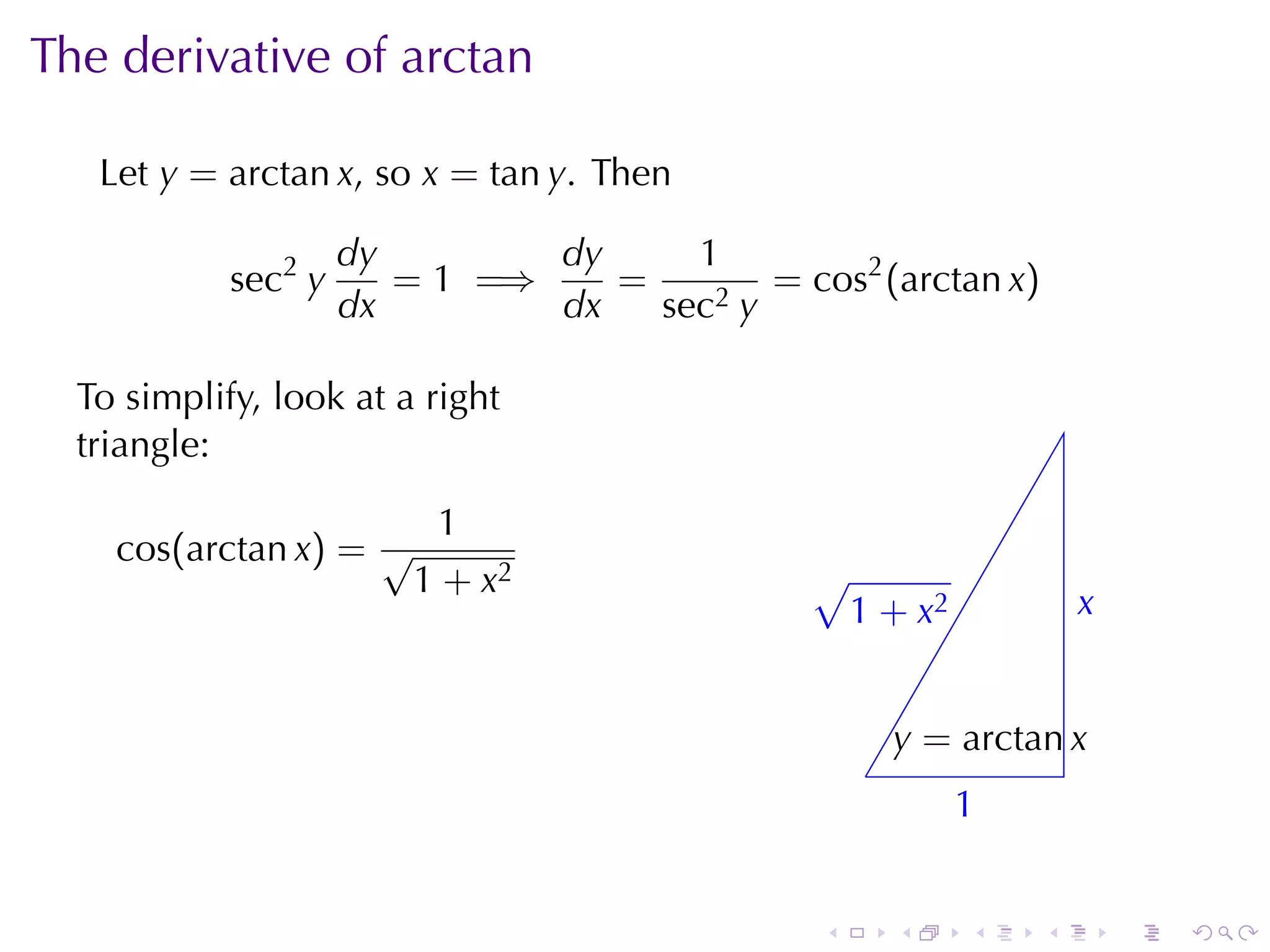
  To	simplify, look	at	a	right
  triangle:

                          1
    cos(arctan x) = √
                         1 + x2                √
                                               . 1 + x2             x
                                                                    .


                                                       y
                                                       . = arctan x
                                                   .
                                                           1
                                                           .


                                               .       .   .    .       .   .
The	derivative	of	arctan

   Let y = arctan x, so x = tan y. Then

                      dy        dy     1
             sec2 y      = 1 =⇒    =        = cos2 (arctan x)
                      dx        dx   sec2 y

  To	simplify, look	at	a	right
  triangle:

                           1
    cos(arctan x) = √
                          1 + x2                √
                                                . 1 + x2             x
                                                                     .
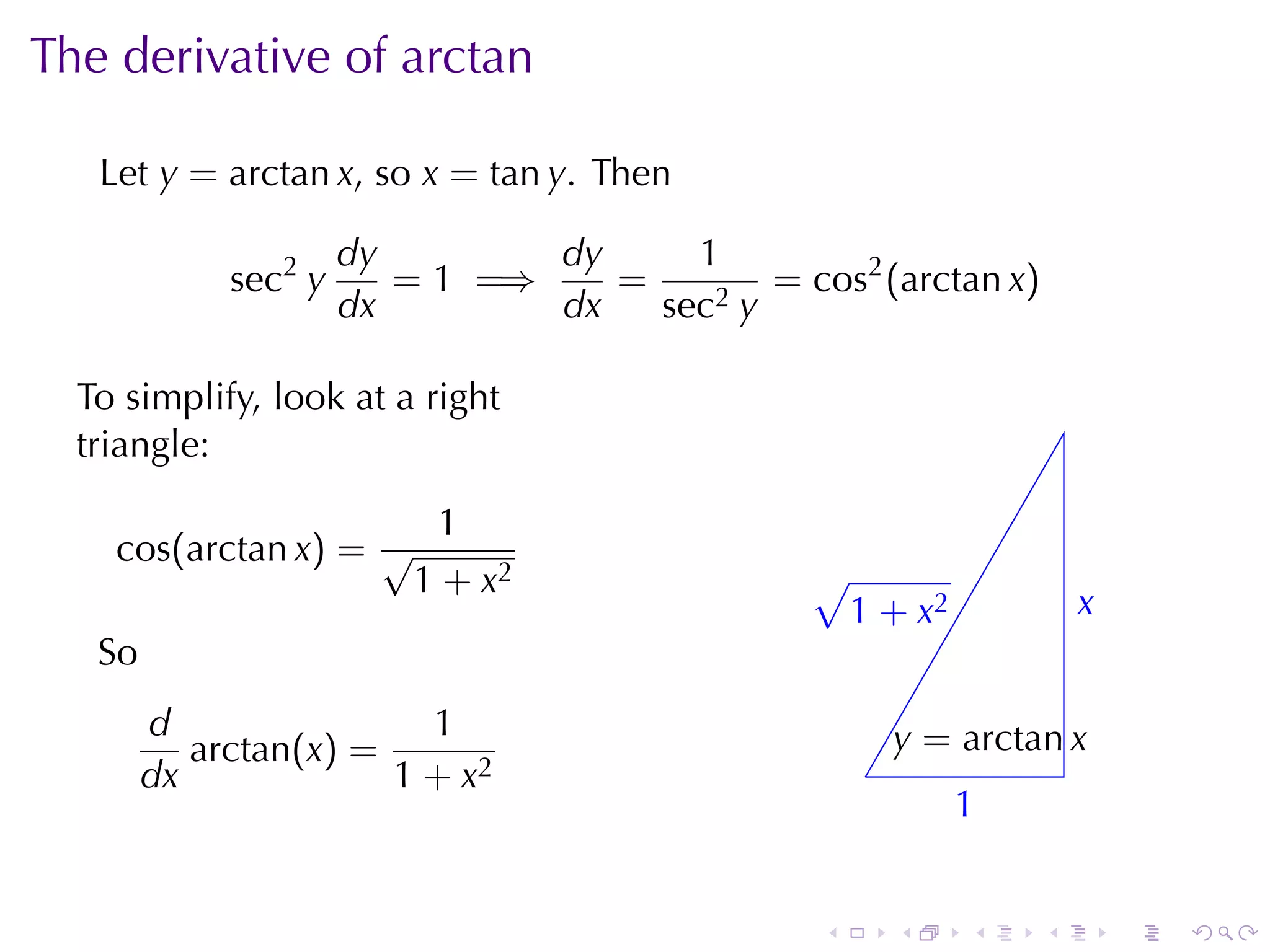
   So
        d                1                              y
                                                        . = arctan x
           arctan(x) =                              .
        dx             1 + x2
                                                            1
                                                            .


                                                .       .   .    .       .   .
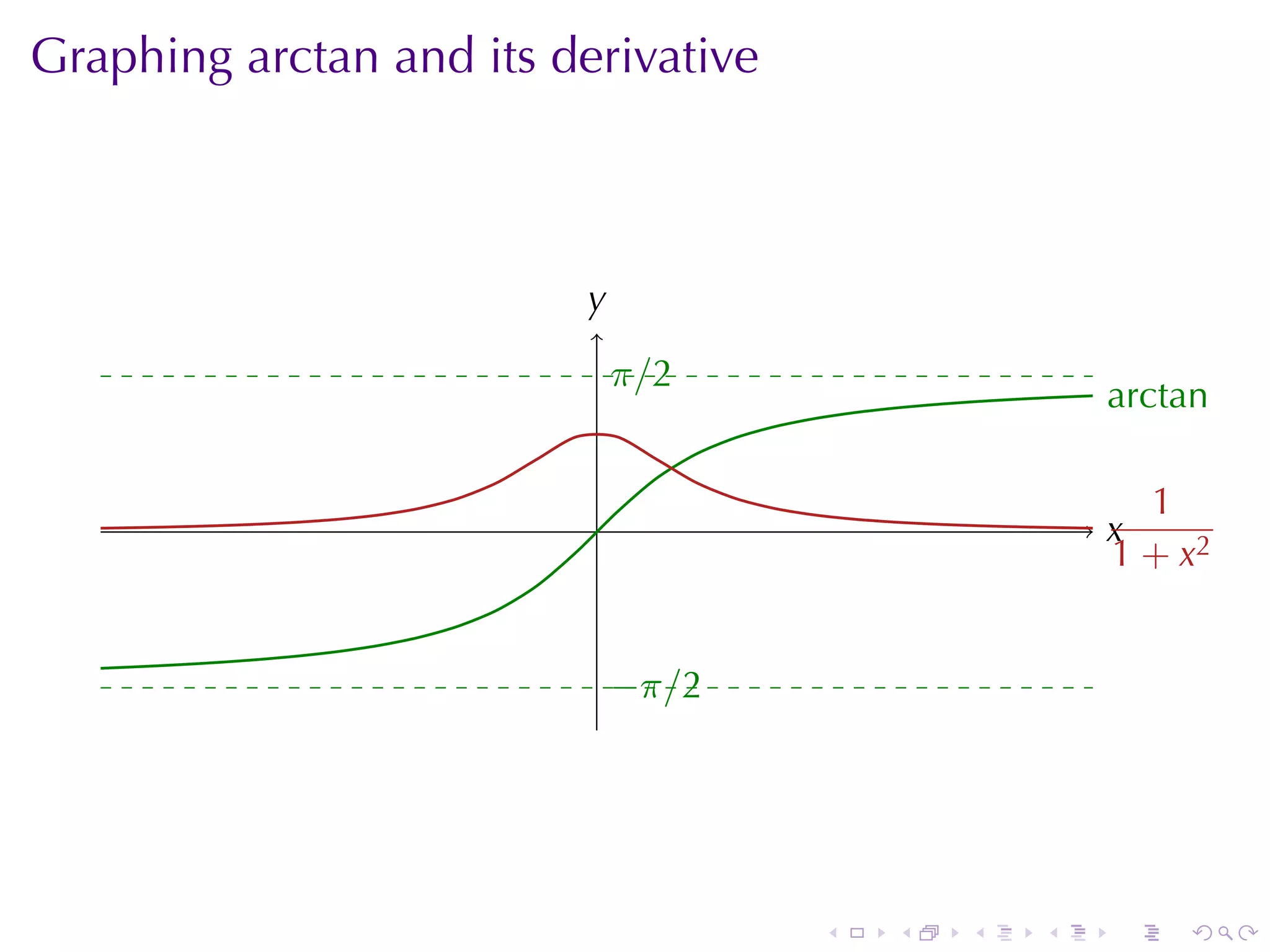
Graphing	arctan	and	its	derivative


                         y
                         .
                              . /2
                              π
                                                      a
                                                      . rctan


                          .                             1
                                                      x
                                                      .
                                                      1 + x2


                              −
                              . π/2


                                      .   .   .   .   .    .
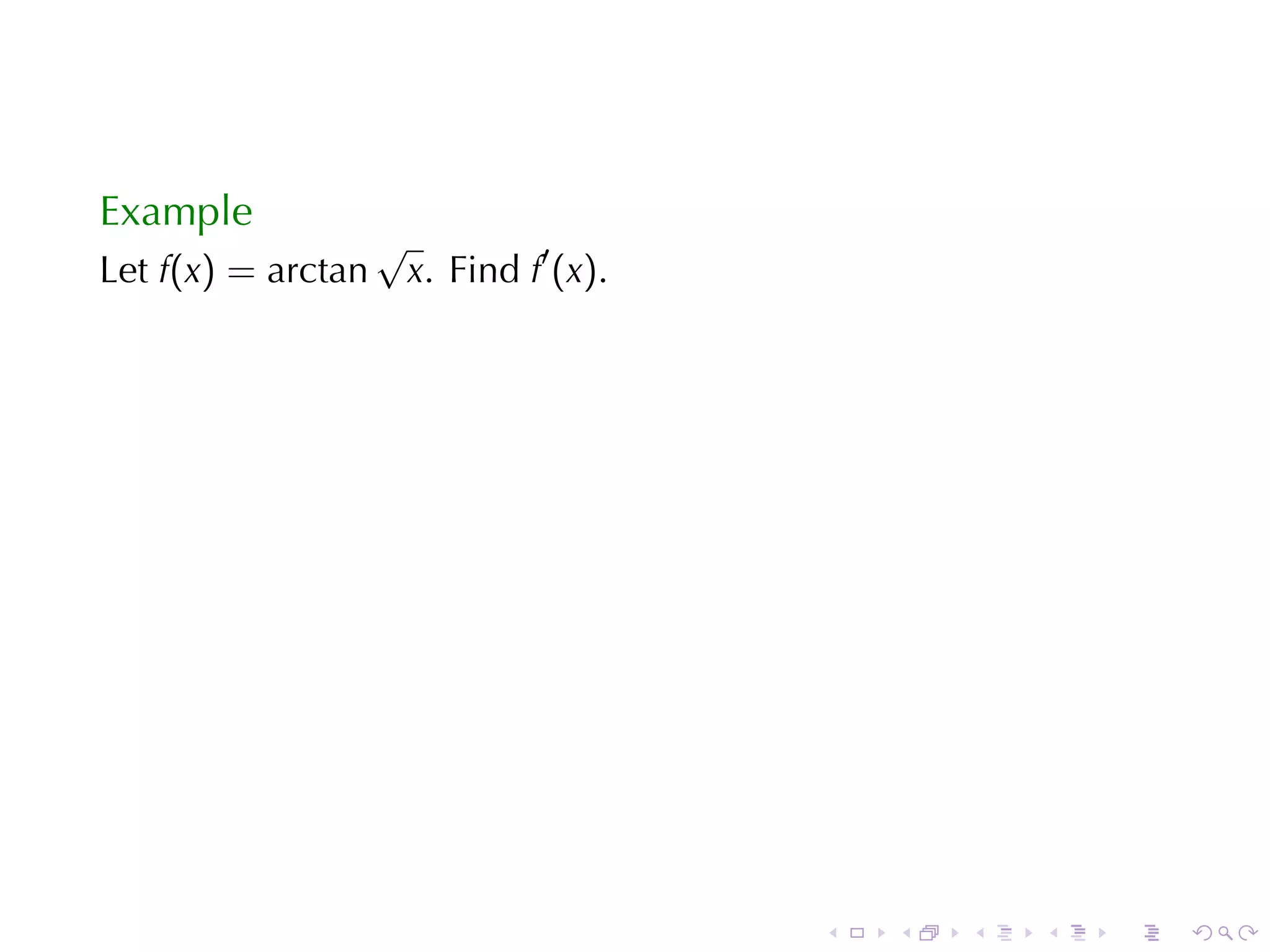
Example
                    √
Let f(x) = arctan       x. Find f′ (x).


                                          .   .   .   .   .   .
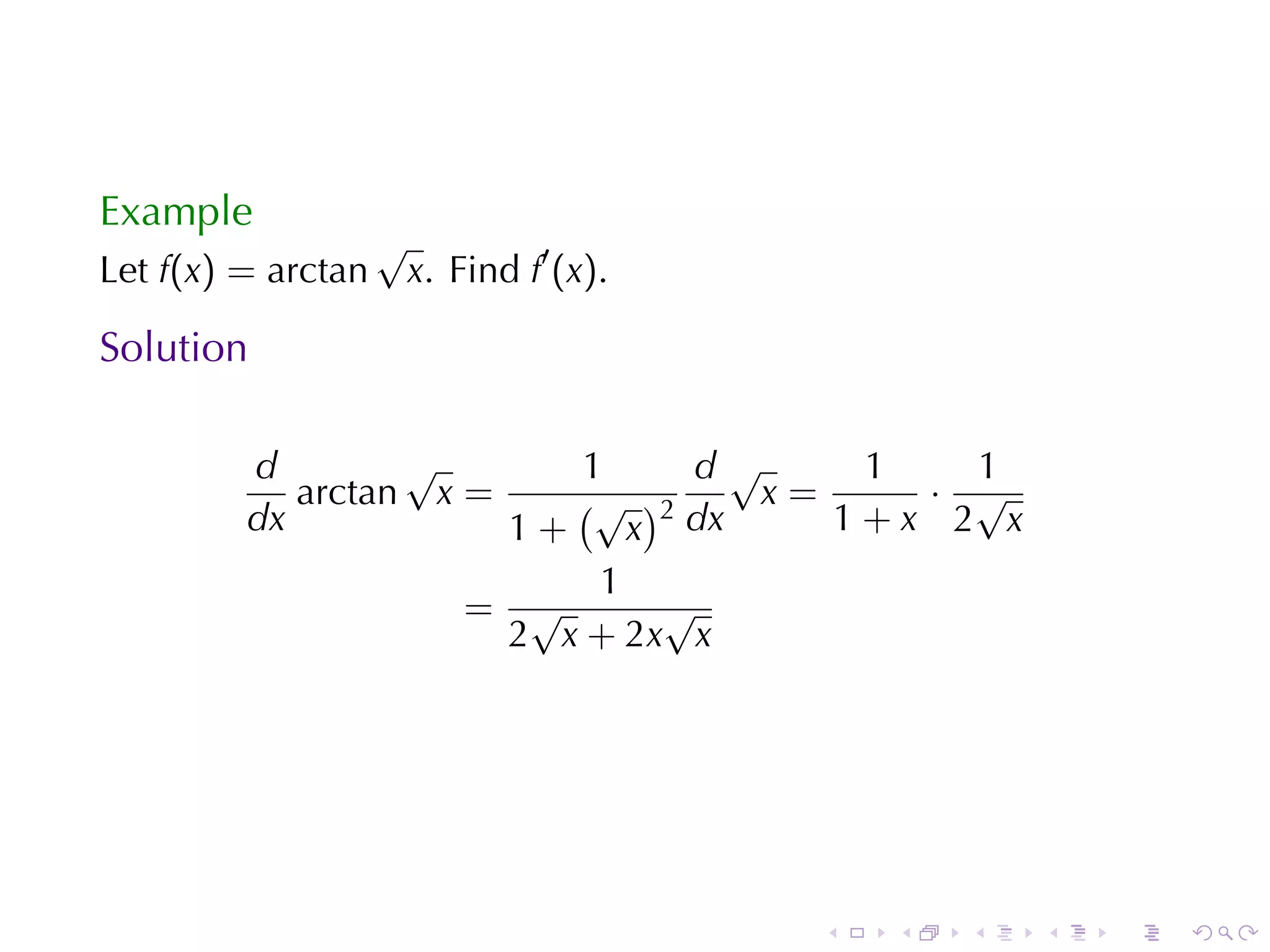
Example
                    √
Let f(x) = arctan       x. Find f′ (x).

Solution

         d        √       1     d√     1   1
            arctan x =    (√ )2    x=    · √
         dx            1+    x  dx    1+x 2 x
                           1
                     = √       √
                       2 x + 2x x


                                          .   .   .   .   .   .
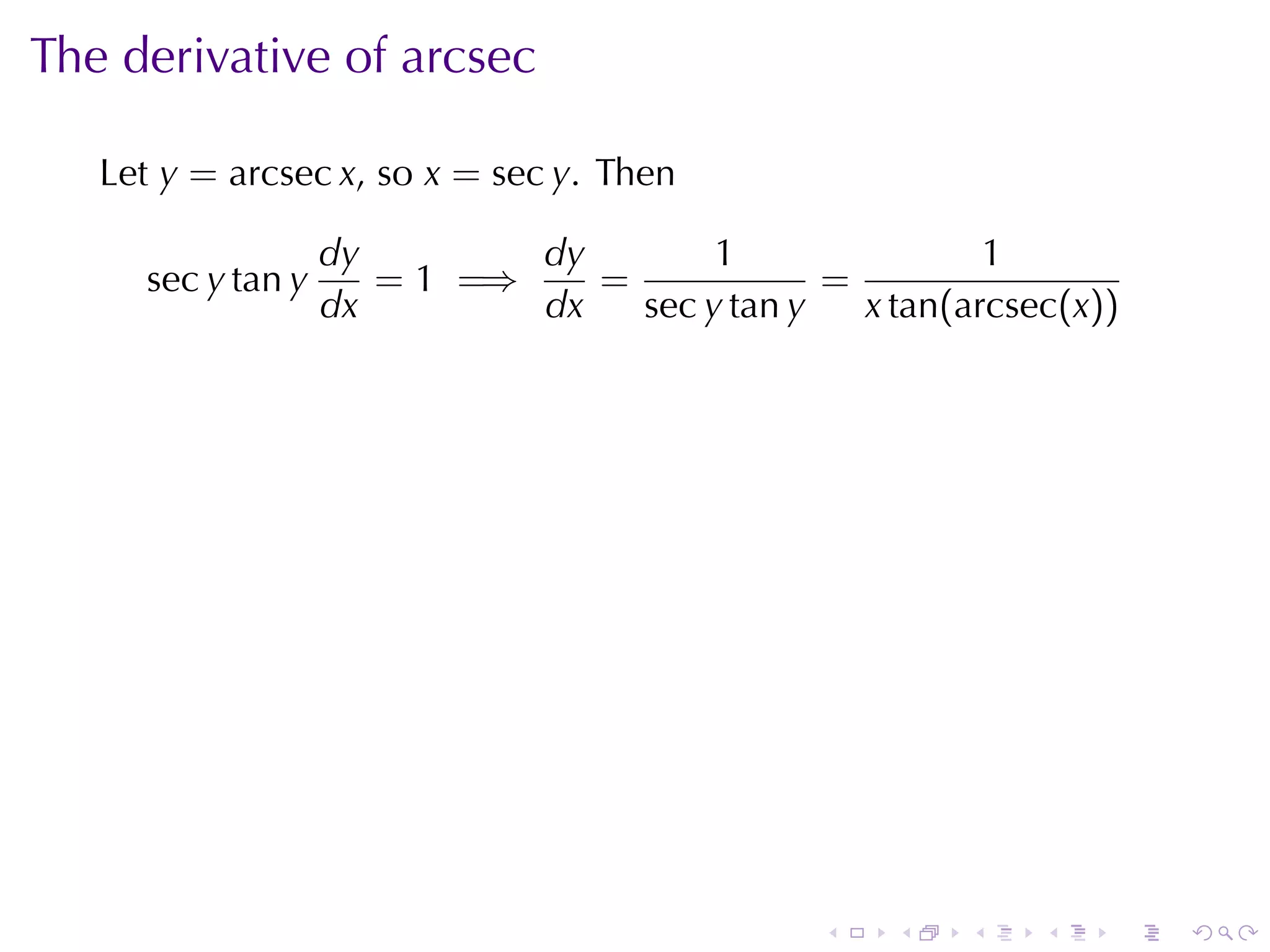
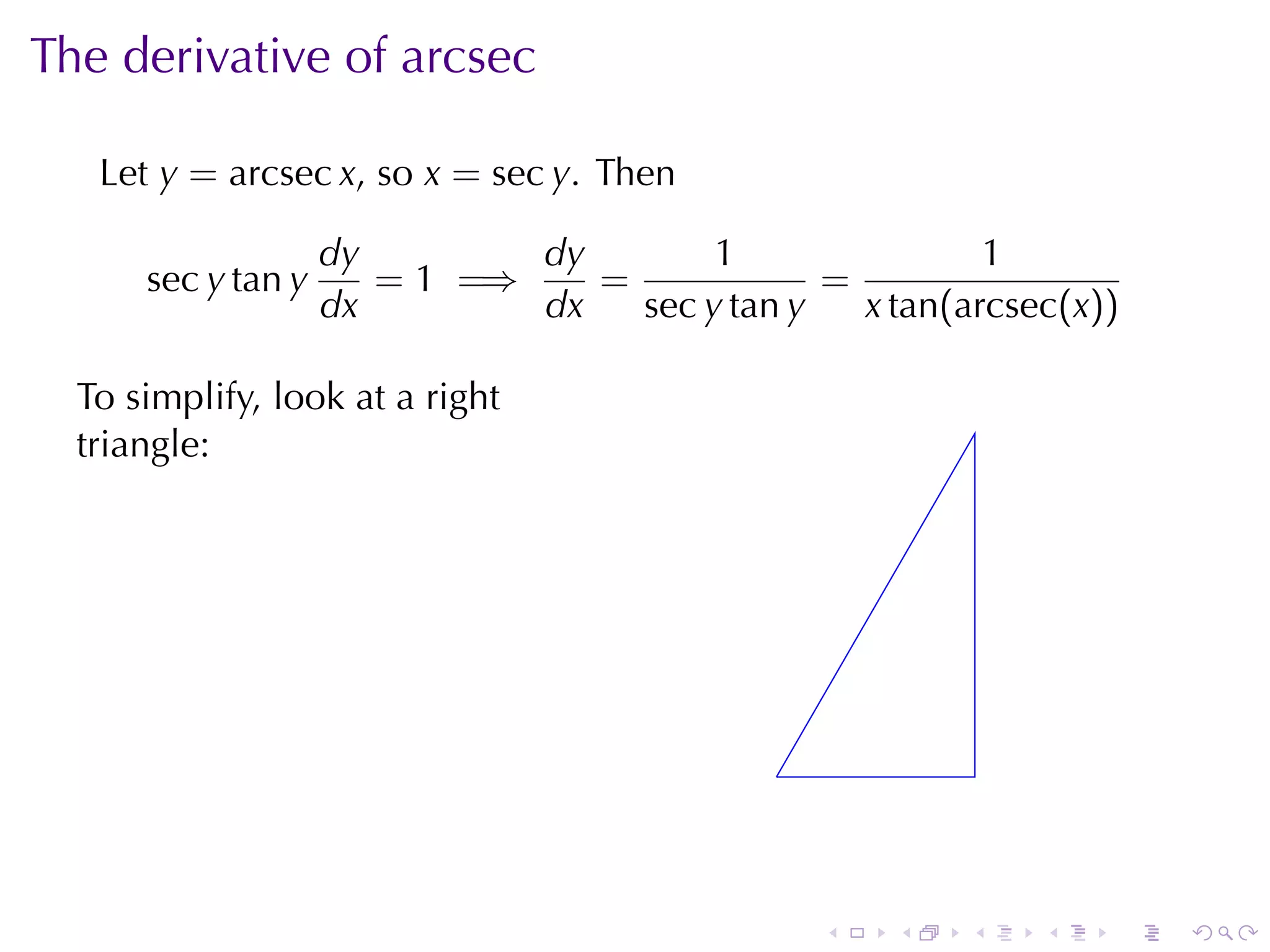
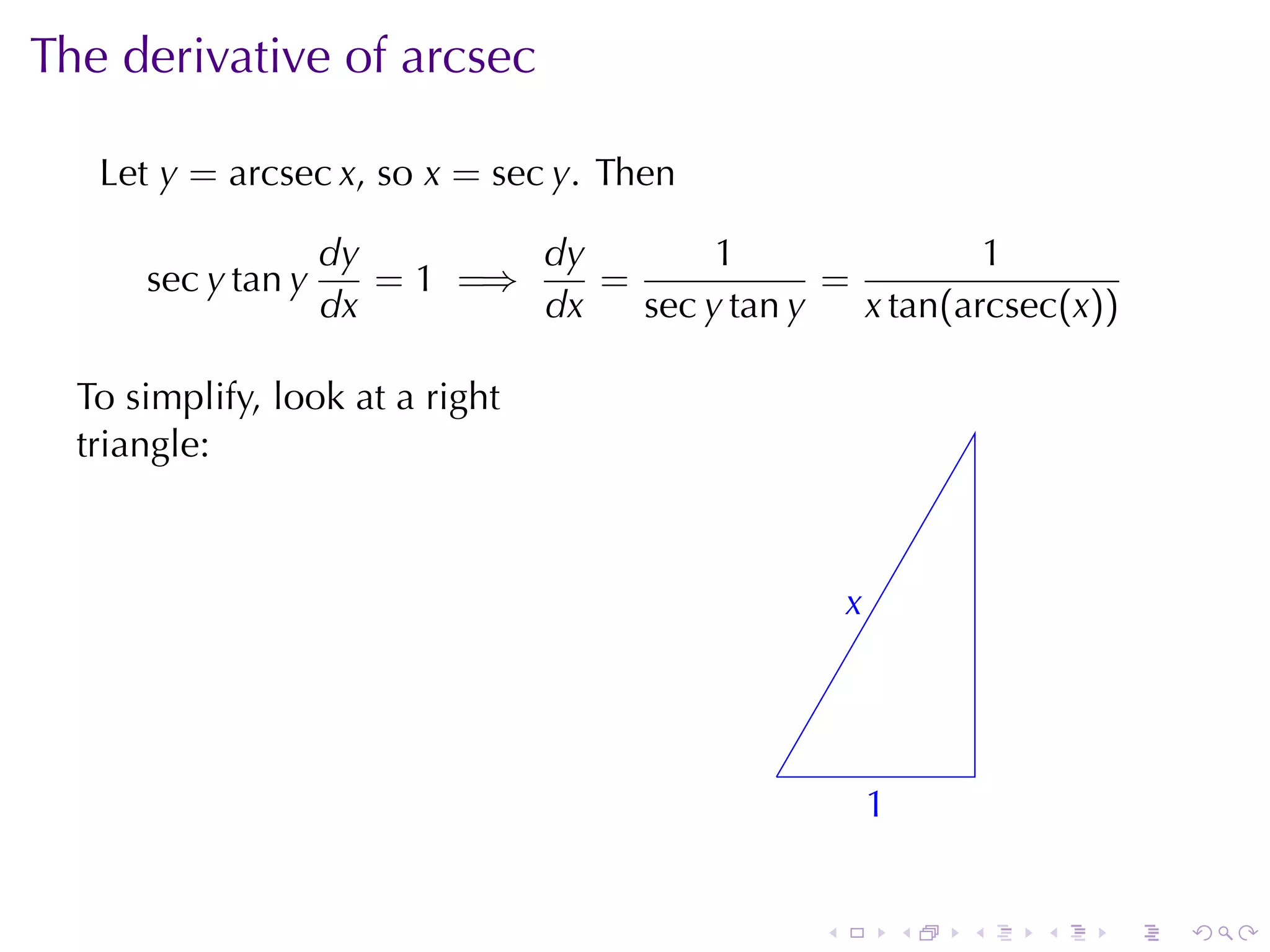
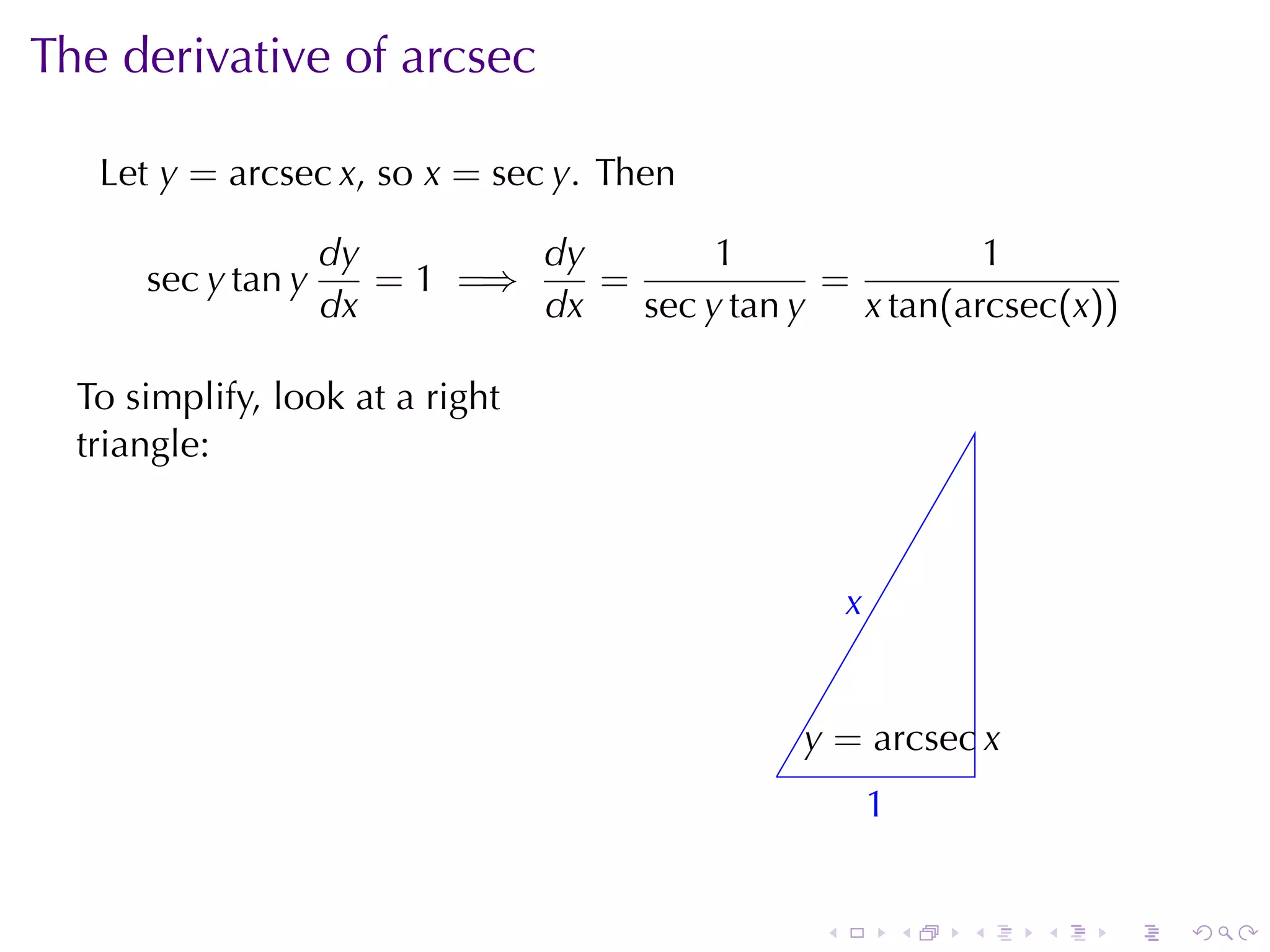
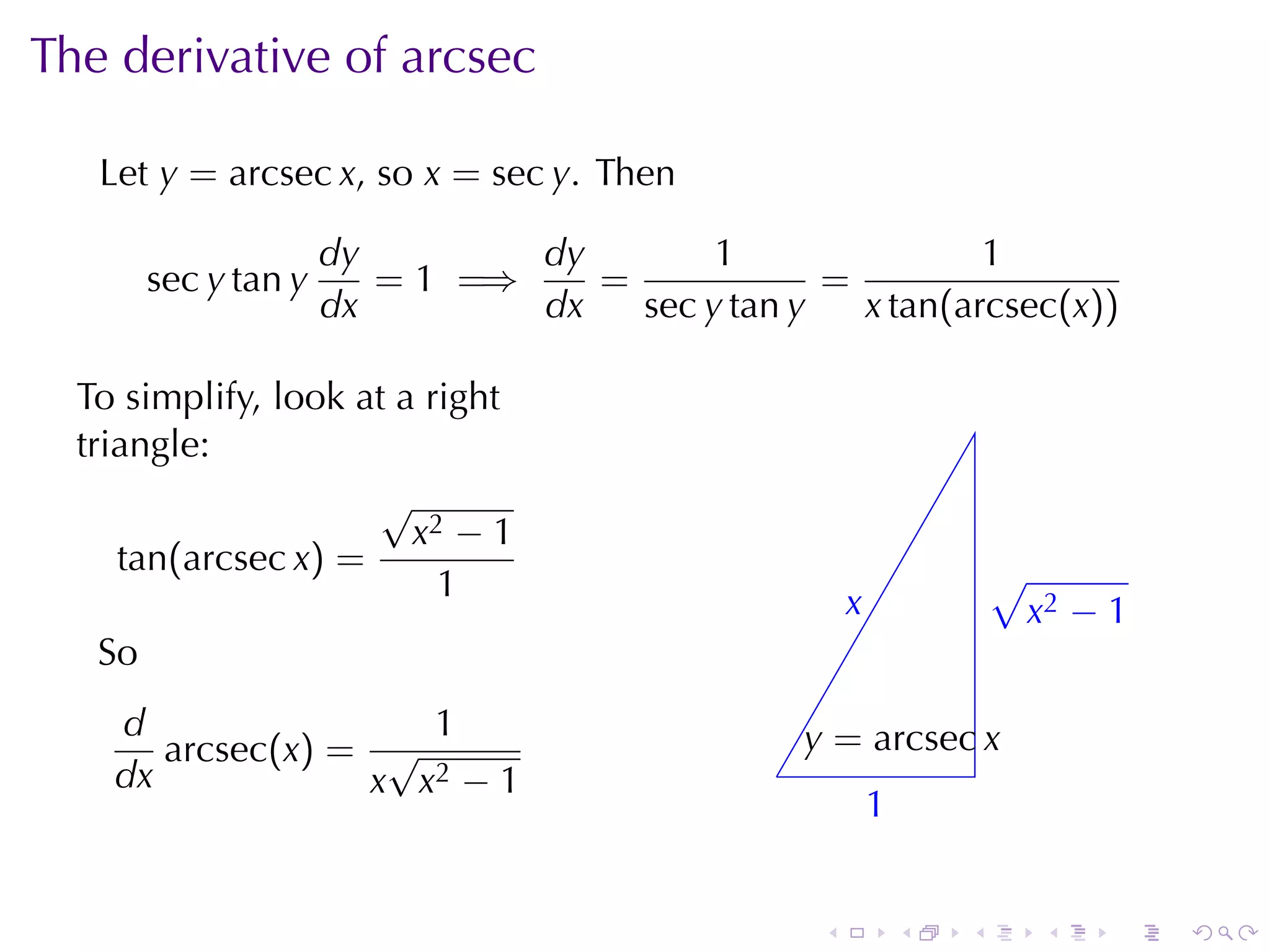
The	derivative	of	arcsec

   Let y = arcsec x, so x = sec y. Then

                   dy        dy        1                1
     sec y tan y      = 1 =⇒    =             =
                   dx        dx   sec y tan y   x tan(arcsec(x))


                                               .   .   .   .   .   .
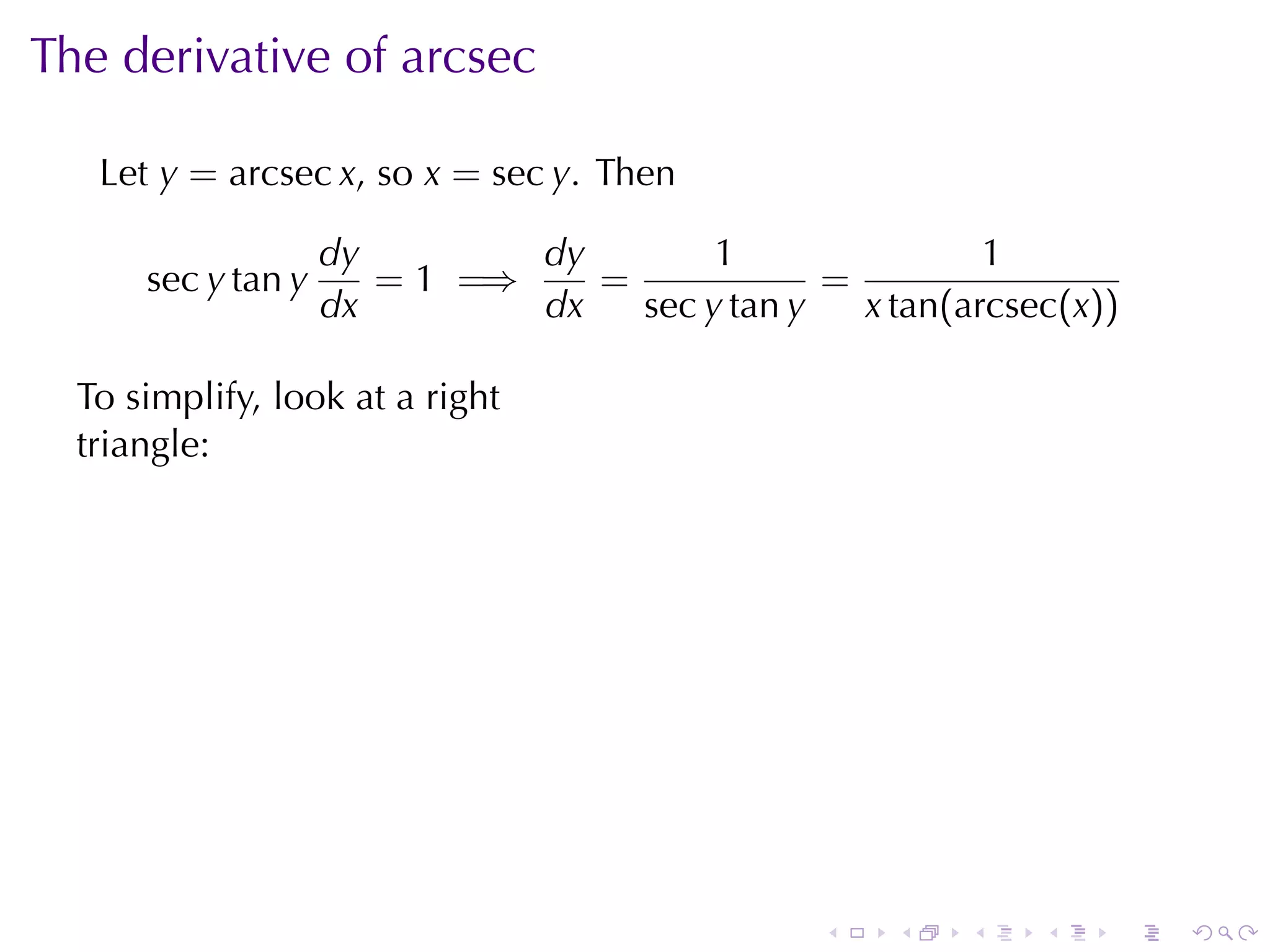
The	derivative	of	arcsec

   Let y = arcsec x, so x = sec y. Then

                    dy        dy        1                1
      sec y tan y      = 1 =⇒    =             =
                    dx        dx   sec y tan y   x tan(arcsec(x))

  To	simplify, look	at	a	right
  triangle:


                                             .


                                                 .   .   .   .   .   .
The	derivative	of	arcsec

   Let y = arcsec x, so x = sec y. Then

                    dy        dy        1                1
      sec y tan y      = 1 =⇒    =             =
                    dx        dx   sec y tan y   x tan(arcsec(x))

  To	simplify, look	at	a	right
  triangle:


                                             .


                                                 .   .   .   .   .   .
The	derivative	of	arcsec

   Let y = arcsec x, so x = sec y. Then

                    dy        dy        1                1
      sec y tan y      = 1 =⇒    =             =
                    dx        dx   sec y tan y   x tan(arcsec(x))

  To	simplify, look	at	a	right
  triangle:


                                                     x
                                                     .


                                             .
                                                         1
                                                         .


                                                 .           .   .   .   .   .
The	derivative	of	arcsec

   Let y = arcsec x, so x = sec y. Then

                    dy        dy        1                1
      sec y tan y      = 1 =⇒    =             =
                    dx        dx   sec y tan y   x tan(arcsec(x))

  To	simplify, look	at	a	right
  triangle:


                                                      x
                                                      .


                                                 y
                                                 . = arcsec x
                                             .
                                                          1
                                                          .


                                                  .           .   .   .   .   .
The	derivative	of	arcsec

   Let y = arcsec x, so x = sec y. Then

                    dy        dy        1                1
      sec y tan y      = 1 =⇒    =             =
                    dx        dx   sec y tan y   x tan(arcsec(x))

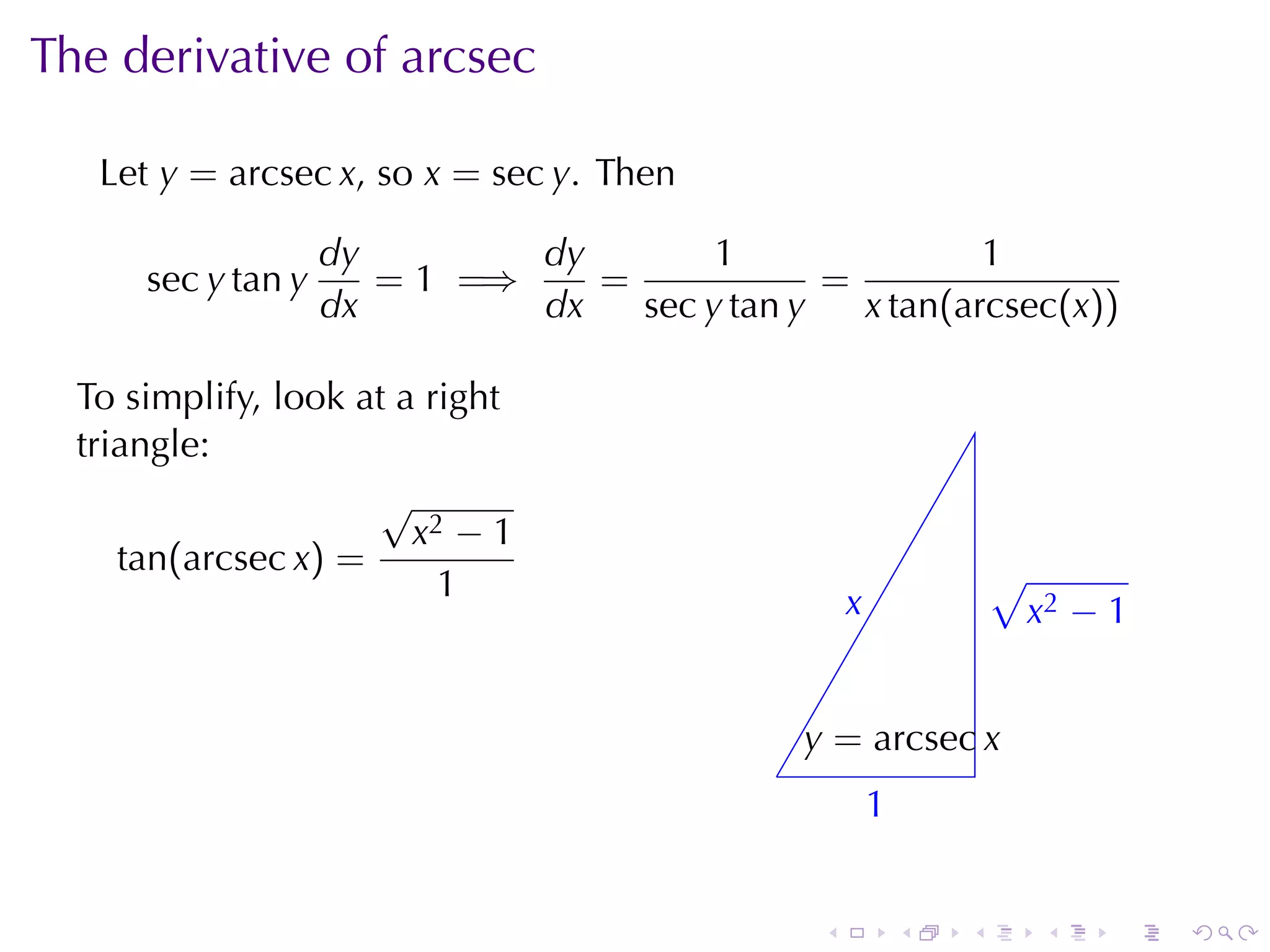
  To	simplify, look	at	a	right
  triangle:
                     √
                        x2 − 1
     tan(arcsec x) =                                                  √
                          1                           x
                                                      .               . x2 − 1


                                                 y
                                                 . = arcsec x
                                             .
                                                          1
                                                          .


                                                  .           .   .      .   .   .
The	derivative	of	arcsec

   Let y = arcsec x, so x = sec y. Then

                      dy        dy        1                1
        sec y tan y      = 1 =⇒    =             =
                      dx        dx   sec y tan y   x tan(arcsec(x))

  To	simplify, look	at	a	right
  triangle:
                     √
                        x2 − 1
     tan(arcsec x) =                                                    √
                          1                             x
                                                        .               . x2 − 1
   So
    d                1                             y
                                                   . = arcsec x
       arcsec(x) = √                           .
    dx            x x2 − 1
                                                            1
                                                            .


                                                    .           .   .      .   .   .
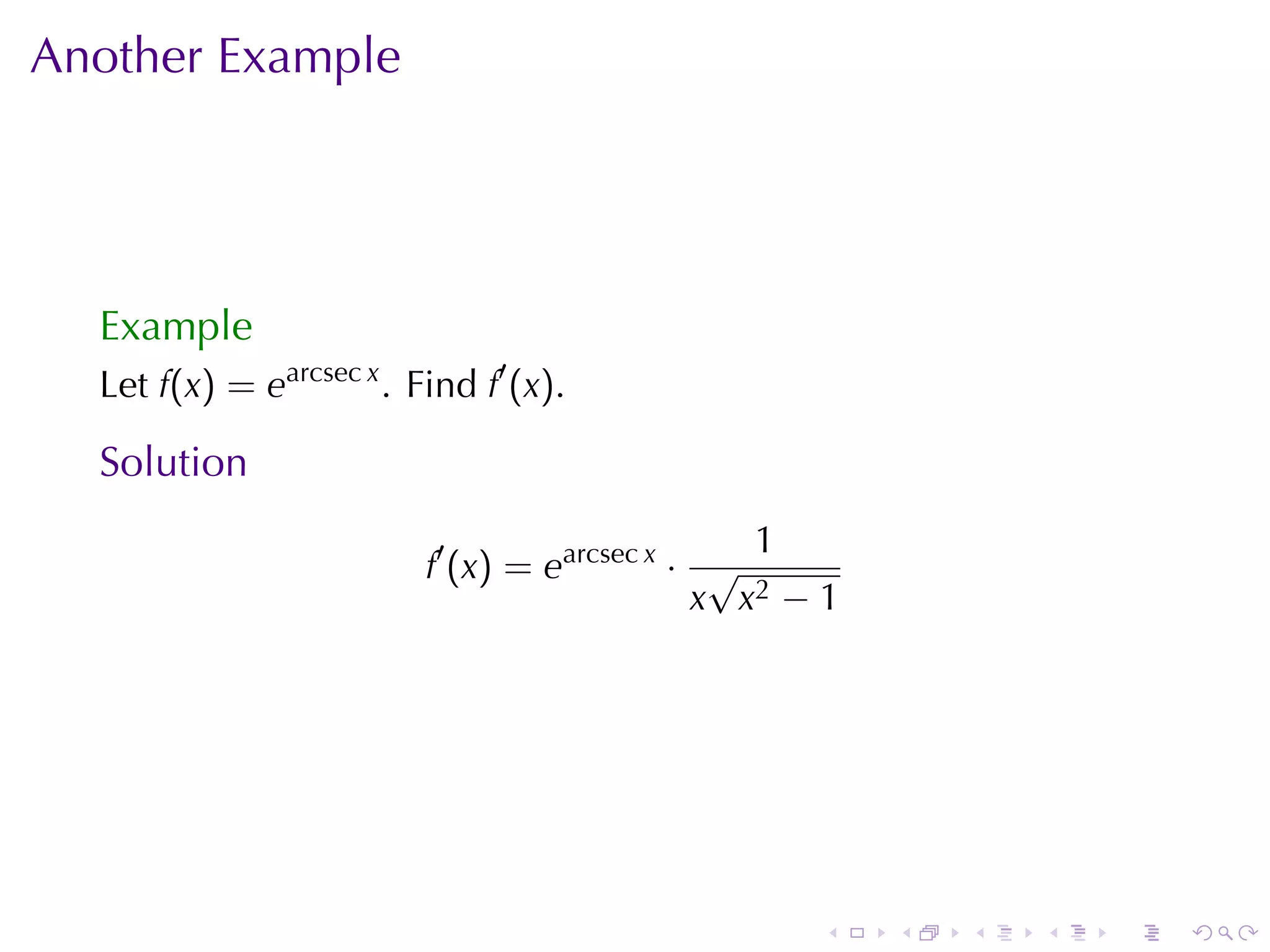
Another	Example


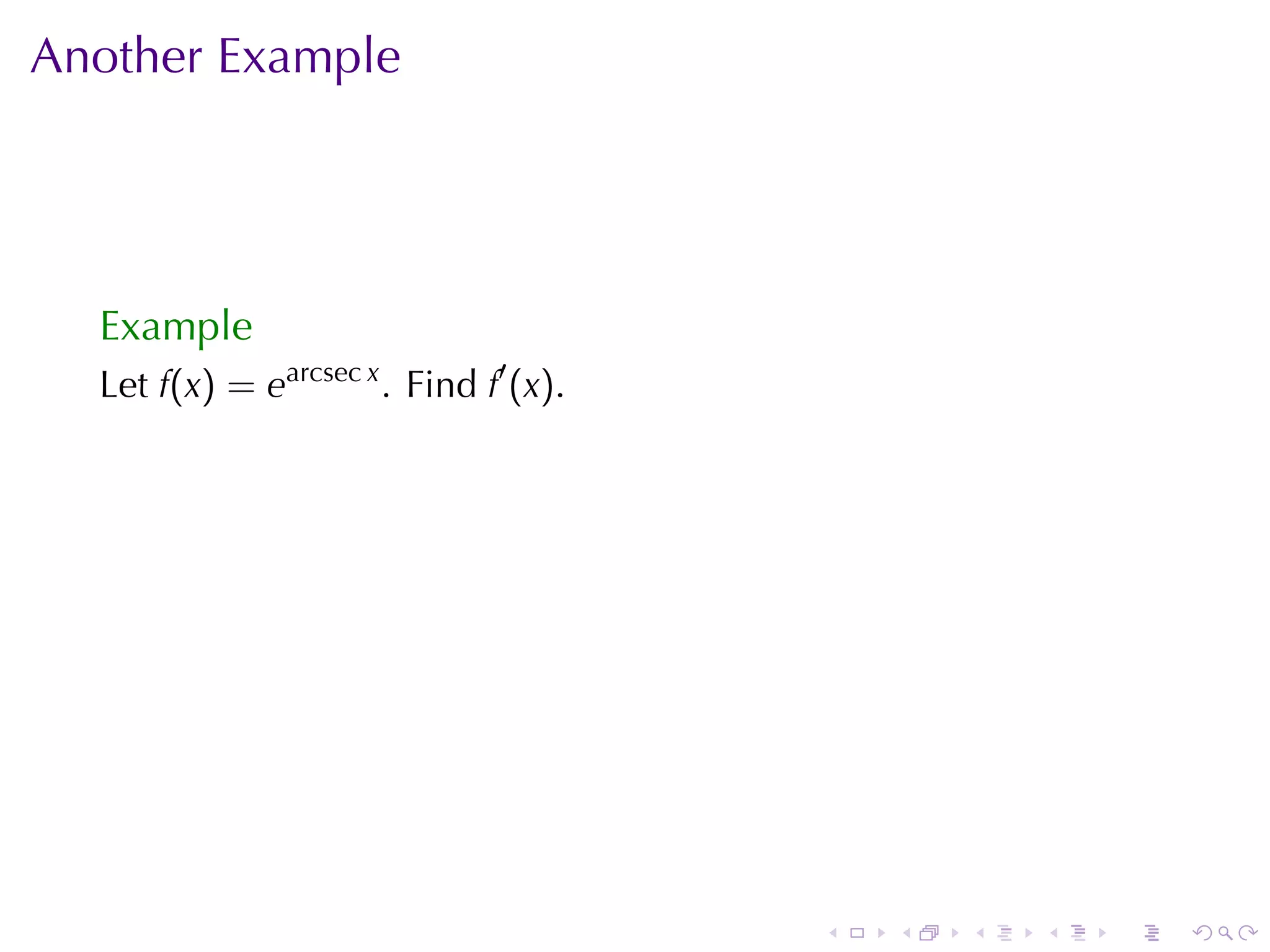
  Example
  Let f(x) = earcsec x . Find f′ (x).


                                        .   .   .   .   .   .
Another	Example


  Example
  Let f(x) = earcsec x . Find f′ (x).

  Solution
                                                 1
                          f′ (x) = earcsec x · √
                                              x x2 − 1


                                                    .    .   .   .   .   .
Outline


  Inverse	Trigonometric	Functions


  Derivatives	of	Inverse	Trigonometric	Functions
     Arcsine
     Arccosine
     Arctangent
     Arcsecant


  Applications


                                             .     .   .   .   .   .
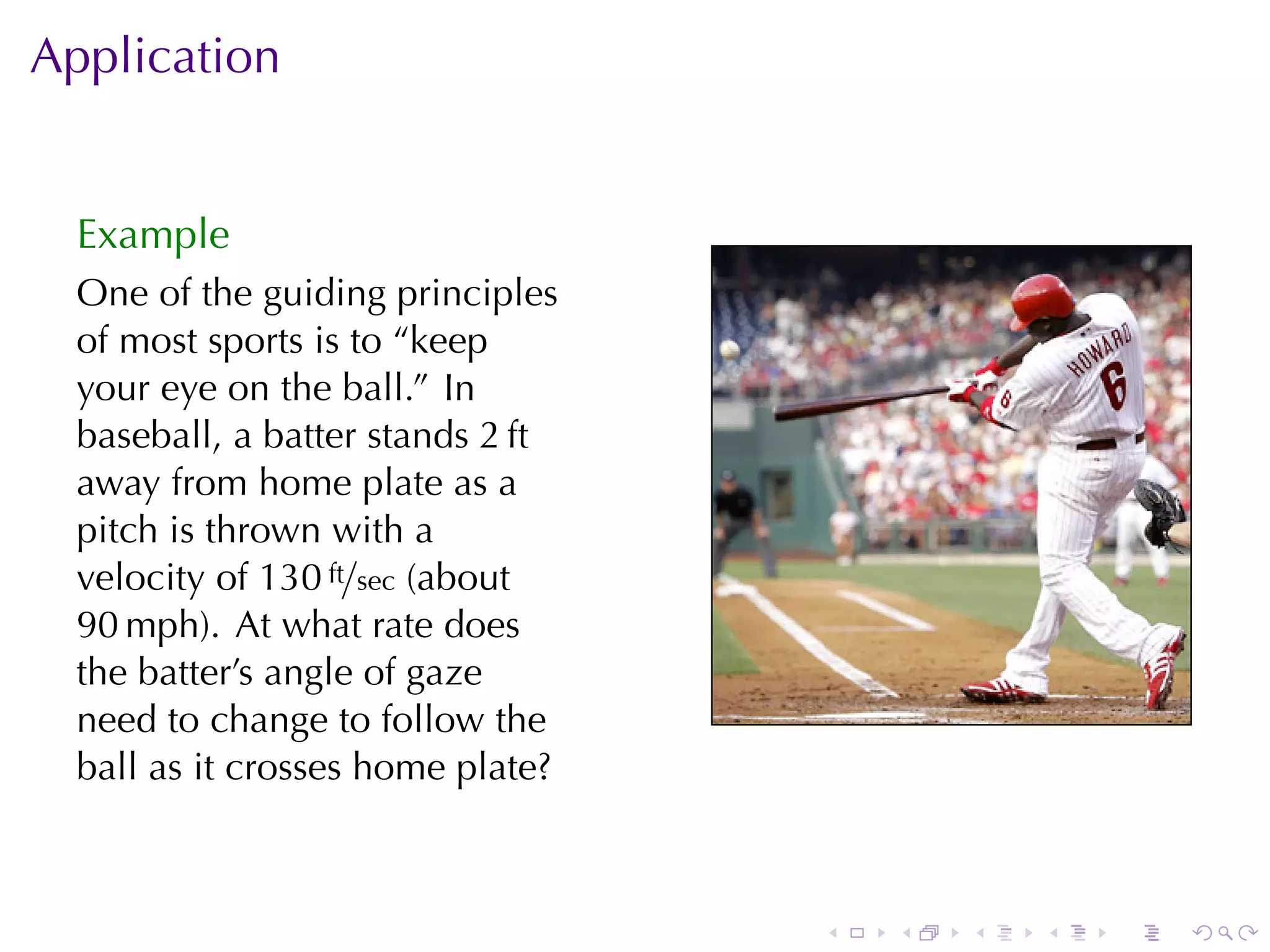
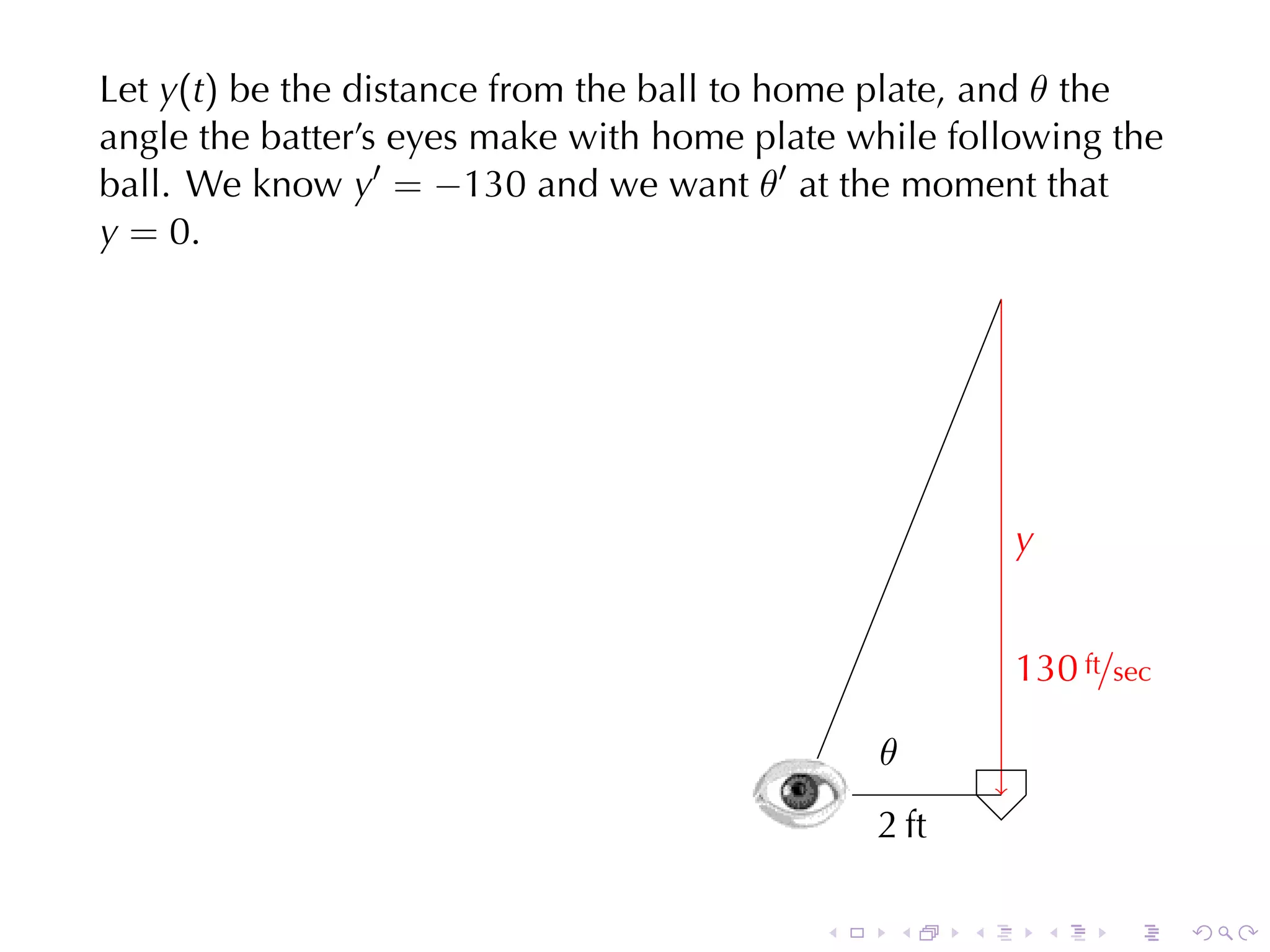
Application


  Example
  One	of	the	guiding	principles
  of	most	sports	is	to	“keep
  your	eye	on	the	ball.” In
  baseball, a	batter	stands 2 ft
  away	from	home	plate	as	a
  pitch	is	thrown	with	a
  velocity	of 130 ft/sec (about
  90 mph). At	what	rate	does
  the	batter’s	angle	of	gaze
  need	to	change	to	follow	the
  ball	as	it	crosses	home	plate?


                                   .   .   .   .   .   .
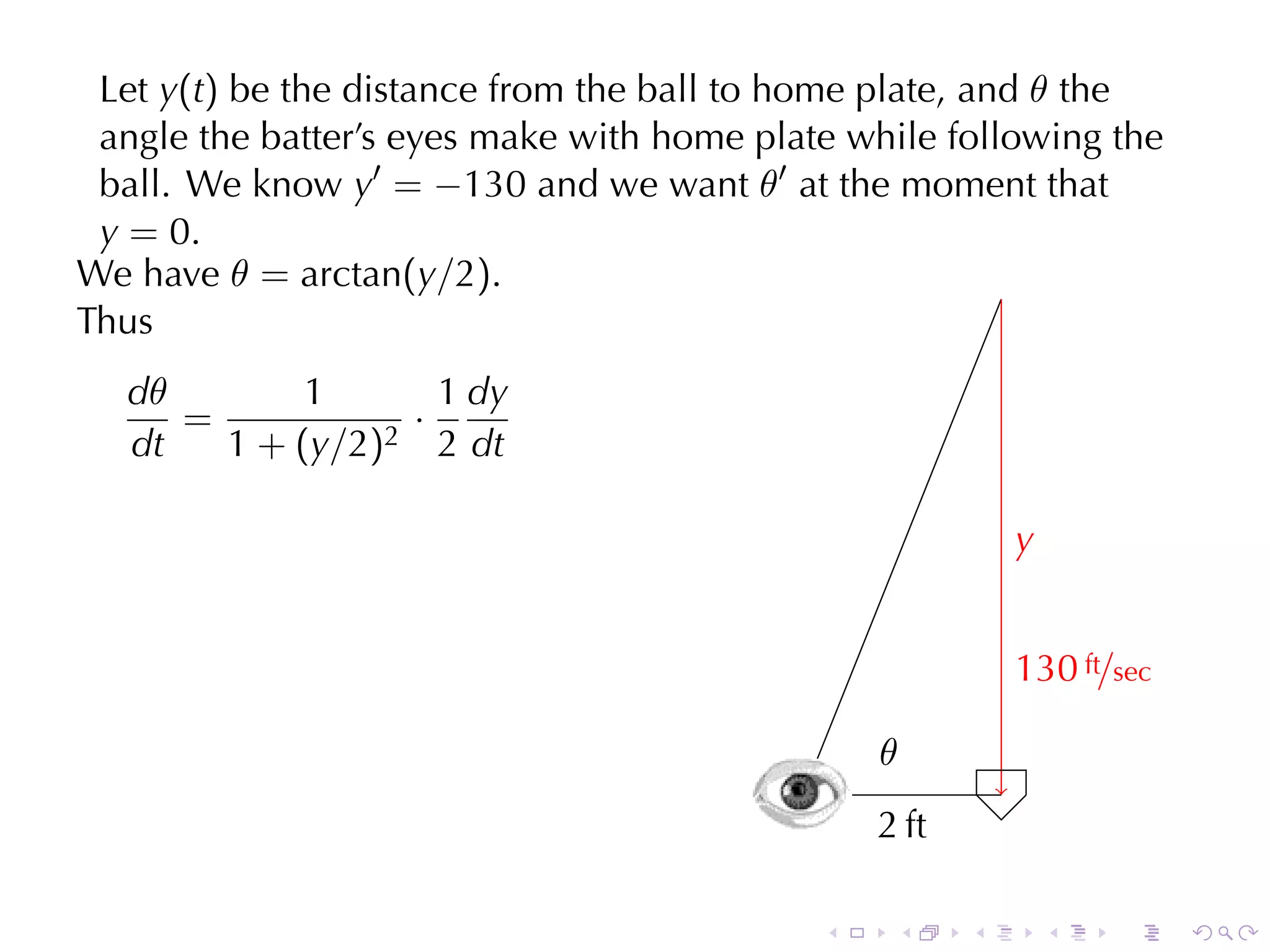
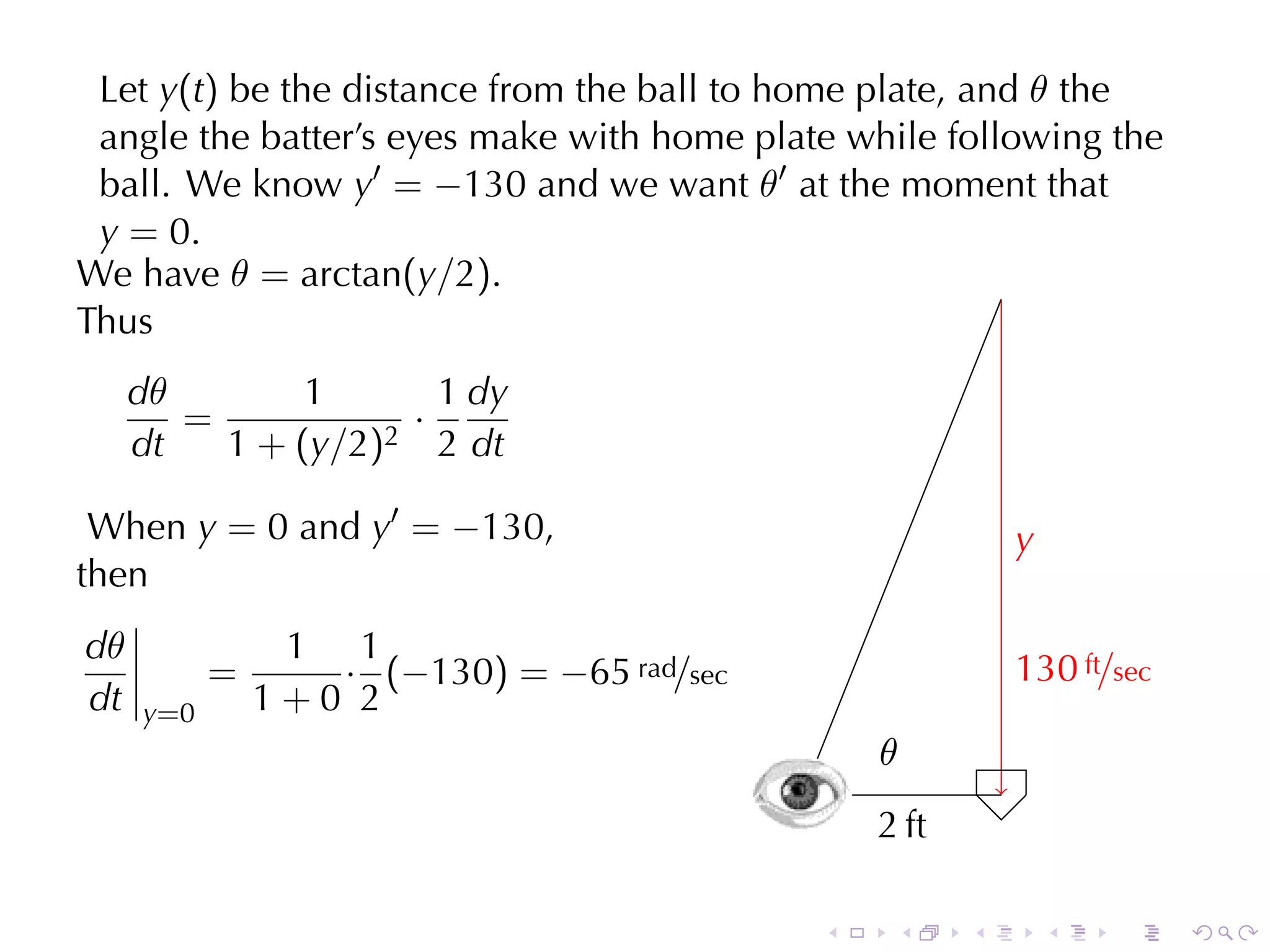
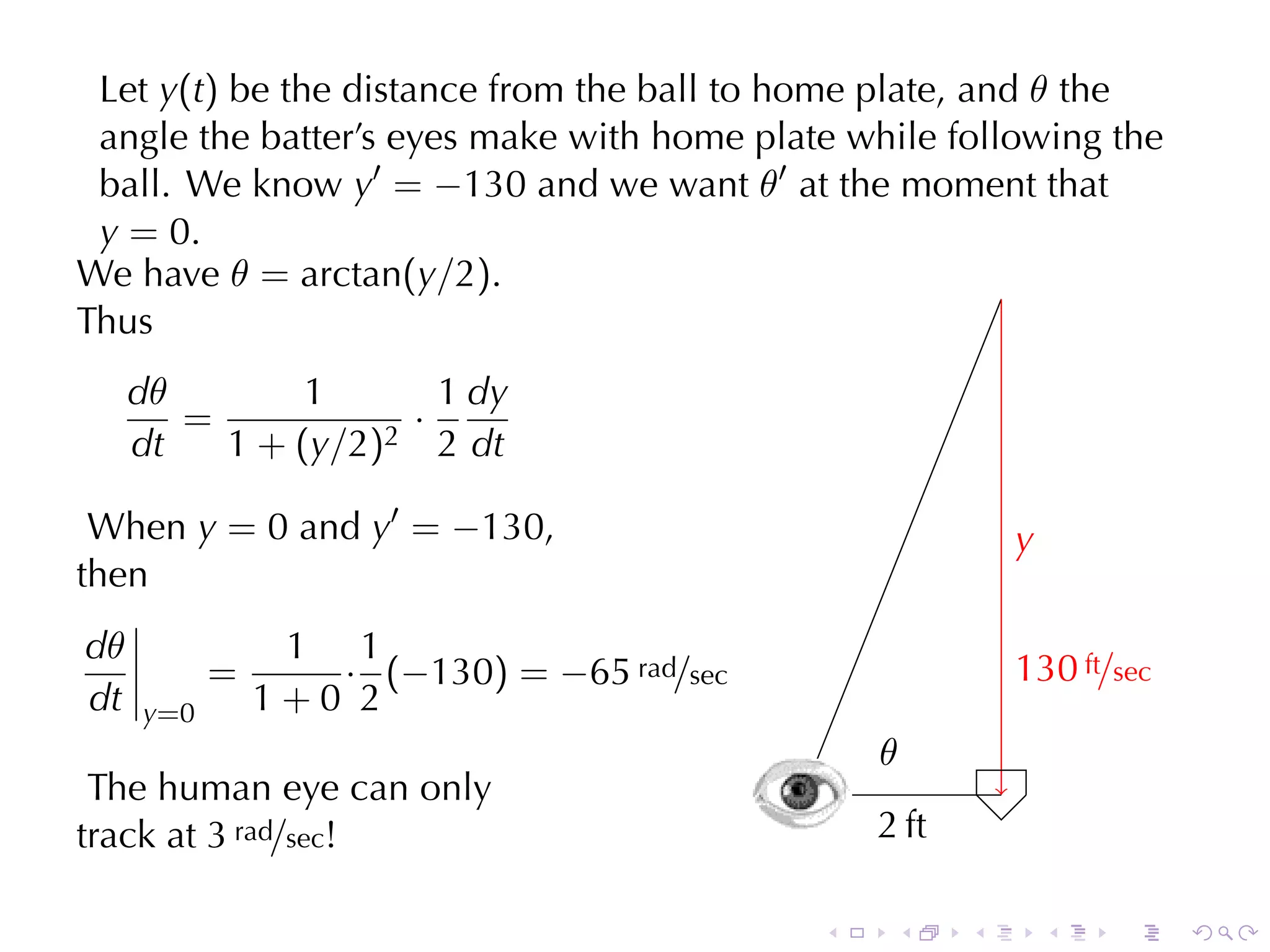
Let y(t) be	the	distance	from	the	ball	to	home	plate, and θ the
angle	the	batter’s	eyes	make	with	home	plate	while	following	the
ball. We	know y′ = −130 and	we	want θ′ at	the	moment	that
y = 0.


                                                              y
                                                              .


                                                              1
                                                              . 30 ft/sec

                                                   .
                                                   θ
                                           .
                                       .           2
                                                   . ft

                                               .    .     .       .   .     .
Let y(t) be	the	distance	from	the	ball	to	home	plate, and θ the
 angle	the	batter’s	eyes	make	with	home	plate	while	following	the
 ball. We	know y′ = −130 and	we	want θ′ at	the	moment	that
 y = 0.
We	have θ = arctan(y/2).
Thus
   dθ        1         1 dy
      =              ·
                    2 2 dt
   dt   1 + ( y /2 )

                                                               y
                                                               .


                                                               1
                                                               . 30 ft/sec

                                                    .
                                                    θ
                                            .
                                        .           2
                                                    . ft

                                                .    .     .       .   .     .
Let y(t) be	the	distance	from	the	ball	to	home	plate, and θ the
 angle	the	batter’s	eyes	make	with	home	plate	while	following	the
 ball. We	know y′ = −130 and	we	want θ′ at	the	moment	that
 y = 0.
We	have θ = arctan(y/2).
Thus
     dθ        1         1 dy
        =              ·
                      2 2 dt
     dt   1 + ( y /2 )

 When y = 0 and y′ = −130,                                         y
                                                                   .
then
dθ               1 1
            =      · (−130) = −65 rad/sec                          1
                                                                   . 30 ft/sec
dt   y =0       1+0 2
                                                        .
                                                        θ
                                                .
                                            .           2
                                                        . ft

                                                    .    .     .       .   .     .
Let y(t) be	the	distance	from	the	ball	to	home	plate, and θ the
 angle	the	batter’s	eyes	make	with	home	plate	while	following	the
 ball. We	know y′ = −130 and	we	want θ′ at	the	moment	that
 y = 0.
We	have θ = arctan(y/2).
Thus
     dθ        1         1 dy
        =              ·
                      2 2 dt
     dt   1 + ( y /2 )

 When y = 0 and y′ = −130,                                         y
                                                                   .
then
dθ               1 1
            =      · (−130) = −65 rad/sec                          1
                                                                   . 30 ft/sec
dt   y =0       1+0 2
                                                        .
                                                        θ
 The	human	eye	can	only                         .
track	at 3 rad/sec!                         .           2
                                                        . ft

                                                    .    .     .       .   .     .
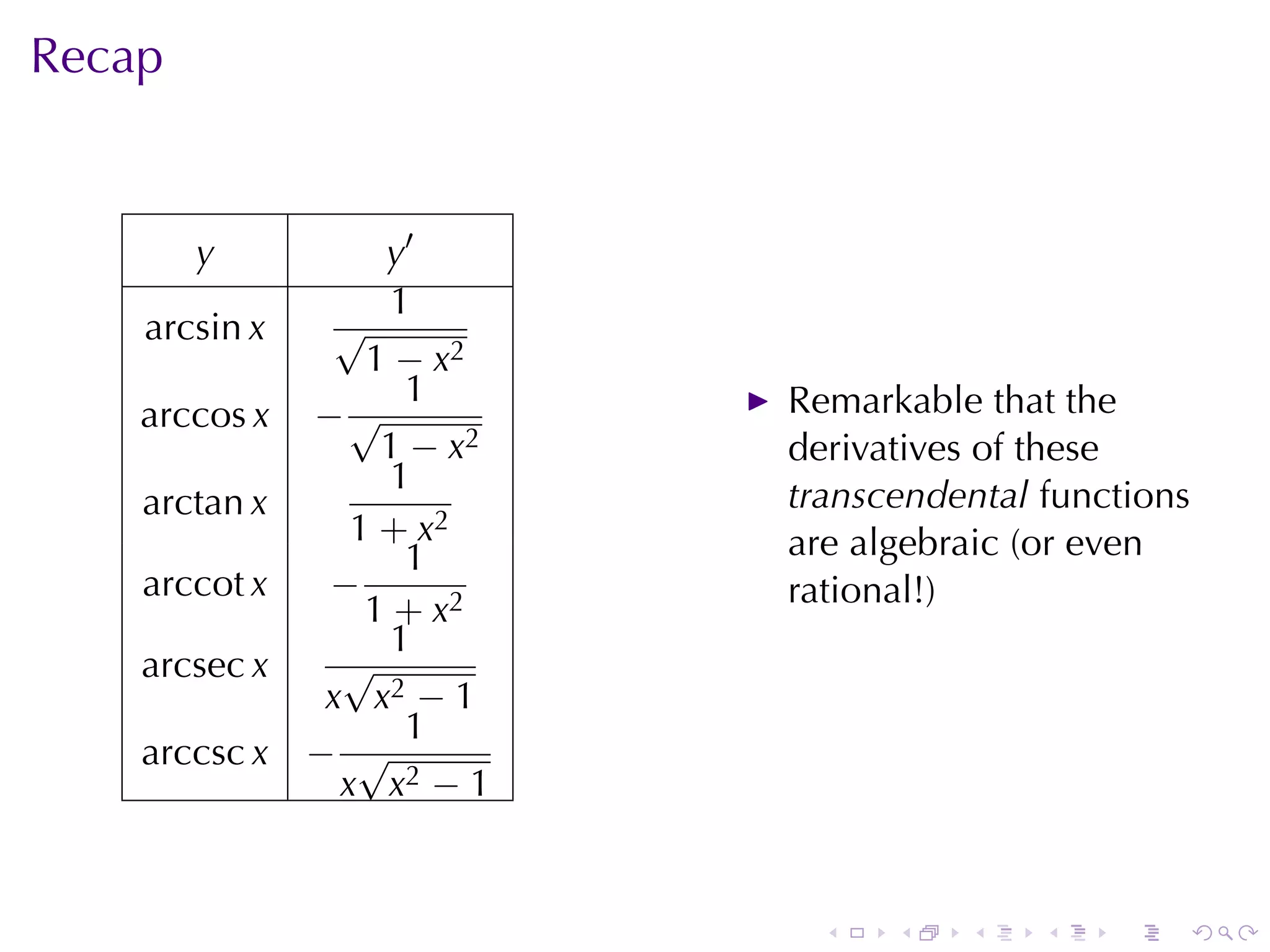
Recap


        y          y′
                   1
    arcsin x   √
                 1 − x2
                    1      Remarkable	that	the
    arccos x − √
                  1 − x2   derivatives	of	these
                   1
    arctan x               transcendental functions
                1 + x2     are	algebraic	(or	even
                    1
    arccot x  −            rational!)
                 1 + x2
                   1
    arcsec x   √
              x x2 − 1
                    1
    arccsc x − √
               x x2 − 1


                             .   .   .    .   .       .

Lesson 16: Inverse Trigonometric Functions

  • 1.
    Section 3.5 Inverse Trigonometric Functions V63.0121.027, Calculus I October 29, 2009 Announcements . . . . . .
  • 2.
    What functions are invertible? In order for f−1 to be a function, there must be only one a in D corresponding to each b in E. Such a function is called one-to-one The graph of such a function passes the horizontal line test: any horizontal line intersects the graph in exactly one point if at all. If f is continuous, then f−1 is continuous. . . . . . .
  • 3.
    Outline Inverse Trigonometric Functions Derivatives of Inverse Trigonometric Functions Arcsine Arccosine Arctangent Arcsecant Applications . . . . . .
  • 4.
    arcsin Arcsin is the inverse of the sine function after restriction to [−π/2, π/2]. y . . . . x . π π s . in − . − . 2 2 . . . . . .
  • 5.
    arcsin Arcsin is the inverse of the sine function after restriction to [−π/2, π/2]. y . . . . . x . π π s . in − . . − . 2 2 . . . . . .
  • 6.
    arcsin Arcsin is the inverse of the sine function after restriction to [−π/2, π/2]. y . y . =x . . . . x . π π s . in − . . − . 2 2 . . . . . .
  • 7.
    arcsin Arcsin is the inverse of the sine function after restriction to [−π/2, π/2]. y . . . rcsin a . . . . x . π π s . in − . . − . 2 2 . The domain of arcsin is [−1, 1] [ π π] The range of arcsin is − , 2 2 . . . . . .
  • 8.
    arccos Arccos is the inverse of the cosine function after restriction to [0, π] y . c . os . . x . 0 . . π . . . . . .
  • 9.
    arccos Arccos is the inverse of the cosine function after restriction to [0, π] y . . c . os . . x . 0 . . π . . . . . . .
  • 10.
    arccos Arccos is the inverse of the cosine function after restriction to [0, π] y . y . =x . c . os . . x . 0 . . π . . . . . . .
  • 11.
    arccos Arccos is the inverse of the cosine function after restriction to [0, π] . . rccos a y . . c . os . . . x . 0 . . π . The domain of arccos is [−1, 1] The range of arccos is [0, π] . . . . . .
  • 12.
    arctan Arctan is the inverse of the tangent function after restriction to [−π/2, π/2]. y . . x . 3π π π 3π − . − . . . 2 2 2 2 t .an . . . . . .
  • 13.
    arctan Arctan is the inverse of the tangent function after restriction to [−π/2, π/2]. y . . x . 3π π π 3π − . − . . . 2 2 2 2 t .an . . . . . .
  • 14.
    arctan Arctan is the inverse of the tangent function after restriction to y . =x [−π/2, π/2]. y . . x . 3π π π 3π − . − . . . 2 2 2 2 t .an . . . . . .
  • 15.
    arctan Arctan is the inverse of the tangent function after restriction to [−π/2, π/2]. y . π . a . rctan 2 . x . π − . 2 The domain of arctan is (−∞, ∞) ( π π) The range of arctan is − , 2 2 π π lim arctan x = , lim arctan x = − x→∞ 2 x→−∞ 2 . . . . . .
  • 16.
    arcsec Arcsecant is the inverse of secant after restriction to [0, π/2) ∪ (π, 3π/2]. y . . x . 3π π π 3π − . − . . . 2 2 2 2 s . ec . . . . . .
  • 17.
    arcsec Arcsecant is the inverse of secant after restriction to [0, π/2) ∪ (π, 3π/2]. y . . . x . 3π π π 3π − . − . . . . 2 2 2 2 s . ec . . . . . .
  • 18.
    arcsec Arcsecant is the inverse of secant after restriction to y . =x [0, π/2) ∪ (π, 3π/2]. y . . . x . 3π π π 3π − . − . . . . 2 2 2 2 s . ec . . . . . .
  • 19.
    arcsec 3π . Arcsecant is the inverse of secant after restriction to 2 [0, π/2) ∪ (π, 3π/2]. . . y π . 2 . . . x . . The domain of arcsec is (−∞, −1] ∪ [1, ∞) [ π ) (π ] The range of arcsec is 0, ∪ ,π 2 2 π 3π lim arcsec x = , lim arcsec x = x→∞ 2 x→−∞ 2 . . . . . .
  • 20.
    Values of Trigonometric Functions π π π π x 0 6 √4 √3 2 1 2 3 sin x 0 1 √2 √2 2 3 2 1 cos x 1 0 2 2 √2 1 tan x 0 √ 1 3 undef 3 √ 1 cot x undef 3 1 √ 0 3 2 2 sec x 1 √ √ 2 undef 3 2 2 2 csc x undef 2 √ √ 1 2 3 . . . . . .
  • 21.
    Check: Values of inverse trigonometric functions Example Find arcsin(1/2) arctan(−1) ( √ ) 2 arccos − 2 . . . . . .
  • 22.
    Check: Values of inverse trigonometric functions Example Find arcsin(1/2) arctan(−1) ( √ ) 2 arccos − 2 Solution π 6 . . . . . .
  • 23.
    Check: Values of inverse trigonometric functions Example Find arcsin(1/2) arctan(−1) ( √ ) 2 arccos − 2 Solution π 6 π − 4 . . . . . .
  • 24.
    Check: Values of inverse trigonometric functions Example Find arcsin(1/2) arctan(−1) ( √ ) 2 arccos − 2 Solution π 6 π − 4 3π 4 . . . . . .
  • 25.
    Caution: Notational ambiguity . in2 x =.(sin x)2 s . in−1 x = (sin x)−1 s sinn x means the nth power of sin x, except when n = −1! The book uses sin−1 x for the inverse of sin x. 1 I use csc x for and arcsin x for the inverse of sin x. sin x . . . . . .
  • 26.
    Outline Inverse Trigonometric Functions Derivatives of Inverse Trigonometric Functions Arcsine Arccosine Arctangent Arcsecant Applications . . . . . .
  • 27.
    Theorem (The Inverse Function Theorem) Let f be differentiable ata, and f′ (a) ̸= 0. Then f−1 is defined in an open interval containing b = f(a), and 1 (f−1 )′ (b) = ′ −1 f (f (b)) . . . . . .
  • 28.
    Theorem (The Inverse Function Theorem) Let f be differentiable ata, and f′ (a) ̸= 0. Then f−1 is defined in an open interval containing b = f(a), and 1 (f−1 )′ (b) = ′ −1 f (f (b)) “Proof”. If y = f−1 (x), then f (y ) = x , So by implicit differentiation dy dy 1 1 f′ (y) = 1 =⇒ = ′ = ′ −1 dx dx f (y) f (f (x)) . . . . . .
  • 29.
    The derivative of arcsin Let y = arcsin x, so x = sin y. Then dy dy 1 1 cos y = 1 =⇒ = = dx dx cos y cos(arcsin x) . . . . . .
  • 30.
    The derivative of arcsin Let y = arcsin x, so x = sin y. Then dy dy 1 1 cos y = 1 =⇒ = = dx dx cos y cos(arcsin x) To simplify, look at a right triangle: . . . . . . .
  • 31.
    The derivative of arcsin Let y = arcsin x, so x = sin y. Then dy dy 1 1 cos y = 1 =⇒ = = dx dx cos y cos(arcsin x) To simplify, look at a right triangle: 1 . x . . . . . . . .
  • 32.
    The derivative of arcsin Let y = arcsin x, so x = sin y. Then dy dy 1 1 cos y = 1 =⇒ = = dx dx cos y cos(arcsin x) To simplify, look at a right triangle: 1 . x . y . = arcsin x . . . . . . .
  • 33.
    The derivative of arcsin Let y = arcsin x, so x = sin y. Then dy dy 1 1 cos y = 1 =⇒ = = dx dx cos y cos(arcsin x) To simplify, look at a right triangle: 1 . x . y . = arcsin x . √ . 1 − x2 . . . . . .
  • 34.
    The derivative of arcsin Let y = arcsin x, so x = sin y. Then dy dy 1 1 cos y = 1 =⇒ = = dx dx cos y cos(arcsin x) To simplify, look at a right triangle: √ cos(arcsin x) = 1 − x2 1 . x . y . = arcsin x . √ . 1 − x2 . . . . . .
  • 35.
    The derivative of arcsin Let y = arcsin x, so x = sin y. Then dy dy 1 1 cos y = 1 =⇒ = = dx dx cos y cos(arcsin x) To simplify, look at a right triangle: √ cos(arcsin x) = 1 − x2 1 . x . So d 1 y . = arcsin x arcsin(x) = √ dx 1 − x2 . √ . 1 − x2 . . . . . .
  • 36.
    Graphing arcsin and its derivative 1 .√ 1 − x2 . . rcsin a . | . . | − . 1 1 . . . . . . .
  • 37.
    The derivative of arccos Let y = arccos x, so x = cos y. Then dy dy 1 1 − sin y = 1 =⇒ = = dx dx − sin y − sin(arccos x) . . . . . .
  • 38.
    The derivative of arccos Let y = arccos x, so x = cos y. Then dy dy 1 1 − sin y = 1 =⇒ = = dx dx − sin y − sin(arccos x) To simplify, look at a right triangle: √ sin(arccos x) = 1 − x2 1 . √ . 1 − x2 So d 1 y . = arccos x arccos(x) = − √ . dx 1 − x2 x . . . . . . .
  • 39.
    Graphing arcsin and arccos a . rccos a . rcsin . | . . | − . 1 1 . . . . . . .
  • 40.
    Graphing arcsin and arccos a . rccos Note (π ) cos θ = sin −θ a . rcsin 2 π =⇒ arccos x = − arcsin x 2 . | . . | So it’s not a surprise that their − . 1 1 . derivatives are opposites. . . . . . .
  • 41.
    The derivative of arctan Let y = arctan x, so x = tan y. Then dy dy 1 sec2 y = 1 =⇒ = = cos2 (arctan x) dx dx sec2 y . . . . . .
  • 42.
    The derivative of arctan Let y = arctan x, so x = tan y. Then dy dy 1 sec2 y = 1 =⇒ = = cos2 (arctan x) dx dx sec2 y To simplify, look at a right triangle: . . . . . . .
  • 43.
    The derivative of arctan Let y = arctan x, so x = tan y. Then dy dy 1 sec2 y = 1 =⇒ = = cos2 (arctan x) dx dx sec2 y To simplify, look at a right triangle: x . . 1 . . . . . . .
  • 44.
    The derivative of arctan Let y = arctan x, so x = tan y. Then dy dy 1 sec2 y = 1 =⇒ = = cos2 (arctan x) dx dx sec2 y To simplify, look at a right triangle: x . y . = arctan x . 1 . . . . . . .
  • 45.
    The derivative of arctan Let y = arctan x, so x = tan y. Then dy dy 1 sec2 y = 1 =⇒ = = cos2 (arctan x) dx dx sec2 y To simplify, look at a right triangle: √ . 1 + x2 x . y . = arctan x . 1 . . . . . . .
  • 46.
    The derivative of arctan Let y = arctan x, so x = tan y. Then dy dy 1 sec2 y = 1 =⇒ = = cos2 (arctan x) dx dx sec2 y To simplify, look at a right triangle: 1 cos(arctan x) = √ 1 + x2 √ . 1 + x2 x . y . = arctan x . 1 . . . . . . .
  • 47.
    The derivative of arctan Let y = arctan x, so x = tan y. Then dy dy 1 sec2 y = 1 =⇒ = = cos2 (arctan x) dx dx sec2 y To simplify, look at a right triangle: 1 cos(arctan x) = √ 1 + x2 √ . 1 + x2 x . So d 1 y . = arctan x arctan(x) = . dx 1 + x2 1 . . . . . . .
  • 48.
    Graphing arctan and its derivative y . . /2 π a . rctan . 1 x . 1 + x2 − . π/2 . . . . . .
  • 49.
    Example √ Let f(x) = arctan x. Find f′ (x). . . . . . .
  • 50.
    Example √ Let f(x) = arctan x. Find f′ (x). Solution d √ 1 d√ 1 1 arctan x = (√ )2 x= · √ dx 1+ x dx 1+x 2 x 1 = √ √ 2 x + 2x x . . . . . .
  • 51.
    The derivative of arcsec Let y = arcsec x, so x = sec y. Then dy dy 1 1 sec y tan y = 1 =⇒ = = dx dx sec y tan y x tan(arcsec(x)) . . . . . .
  • 52.
    The derivative of arcsec Let y = arcsec x, so x = sec y. Then dy dy 1 1 sec y tan y = 1 =⇒ = = dx dx sec y tan y x tan(arcsec(x)) To simplify, look at a right triangle: . . . . . . .
  • 53.
    The derivative of arcsec Let y = arcsec x, so x = sec y. Then dy dy 1 1 sec y tan y = 1 =⇒ = = dx dx sec y tan y x tan(arcsec(x)) To simplify, look at a right triangle: . . . . . . .
  • 54.
    The derivative of arcsec Let y = arcsec x, so x = sec y. Then dy dy 1 1 sec y tan y = 1 =⇒ = = dx dx sec y tan y x tan(arcsec(x)) To simplify, look at a right triangle: x . . 1 . . . . . . .
  • 55.
    The derivative of arcsec Let y = arcsec x, so x = sec y. Then dy dy 1 1 sec y tan y = 1 =⇒ = = dx dx sec y tan y x tan(arcsec(x)) To simplify, look at a right triangle: x . y . = arcsec x . 1 . . . . . . .
  • 56.
    The derivative of arcsec Let y = arcsec x, so x = sec y. Then dy dy 1 1 sec y tan y = 1 =⇒ = = dx dx sec y tan y x tan(arcsec(x)) To simplify, look at a right triangle: √ x2 − 1 tan(arcsec x) = √ 1 x . . x2 − 1 y . = arcsec x . 1 . . . . . . .
  • 57.
    The derivative of arcsec Let y = arcsec x, so x = sec y. Then dy dy 1 1 sec y tan y = 1 =⇒ = = dx dx sec y tan y x tan(arcsec(x)) To simplify, look at a right triangle: √ x2 − 1 tan(arcsec x) = √ 1 x . . x2 − 1 So d 1 y . = arcsec x arcsec(x) = √ . dx x x2 − 1 1 . . . . . . .
  • 58.
    Another Example Example Let f(x) = earcsec x . Find f′ (x). . . . . . .
  • 59.
    Another Example Example Let f(x) = earcsec x . Find f′ (x). Solution 1 f′ (x) = earcsec x · √ x x2 − 1 . . . . . .
  • 60.
    Outline Inverse Trigonometric Functions Derivatives of Inverse Trigonometric Functions Arcsine Arccosine Arctangent Arcsecant Applications . . . . . .
  • 61.
    Application Example One of the guiding principles of most sports is to “keep your eye on the ball.” In baseball, a batter stands 2 ft away from home plate as a pitch is thrown with a velocity of 130 ft/sec (about 90 mph). At what rate does the batter’s angle of gaze need to change to follow the ball as it crosses home plate? . . . . . .
  • 62.
    Let y(t) be the distance from the ball to home plate,and θ the angle the batter’s eyes make with home plate while following the ball. We know y′ = −130 and we want θ′ at the moment that y = 0. y . 1 . 30 ft/sec . θ . . 2 . ft . . . . . .
  • 63.
    Let y(t) be the distance from the ball to home plate,and θ the angle the batter’s eyes make with home plate while following the ball. We know y′ = −130 and we want θ′ at the moment that y = 0. We have θ = arctan(y/2). Thus dθ 1 1 dy = · 2 2 dt dt 1 + ( y /2 ) y . 1 . 30 ft/sec . θ . . 2 . ft . . . . . .
  • 64.
    Let y(t) be the distance from the ball to home plate,and θ the angle the batter’s eyes make with home plate while following the ball. We know y′ = −130 and we want θ′ at the moment that y = 0. We have θ = arctan(y/2). Thus dθ 1 1 dy = · 2 2 dt dt 1 + ( y /2 ) When y = 0 and y′ = −130, y . then dθ 1 1 = · (−130) = −65 rad/sec 1 . 30 ft/sec dt y =0 1+0 2 . θ . . 2 . ft . . . . . .
  • 65.
    Let y(t) be the distance from the ball to home plate,and θ the angle the batter’s eyes make with home plate while following the ball. We know y′ = −130 and we want θ′ at the moment that y = 0. We have θ = arctan(y/2). Thus dθ 1 1 dy = · 2 2 dt dt 1 + ( y /2 ) When y = 0 and y′ = −130, y . then dθ 1 1 = · (−130) = −65 rad/sec 1 . 30 ft/sec dt y =0 1+0 2 . θ The human eye can only . track at 3 rad/sec! . 2 . ft . . . . . .
  • 66.
    Recap y y′ 1 arcsin x √ 1 − x2 1 Remarkable that the arccos x − √ 1 − x2 derivatives of these 1 arctan x transcendental functions 1 + x2 are algebraic (or even 1 arccot x − rational!) 1 + x2 1 arcsec x √ x x2 − 1 1 arccsc x − √ x x2 − 1 . . . . . .