(Section 5.3: Solving Trig Equations) 5.22

               SECTION 5.3: SOLVING TRIG EQUATIONS

PART A: BASIC EQUATIONS IN sin, cos, csc, OR sec (LINEAR FORMS)

     Example

          Solve: 5cos x − 2 = 3cos x

          (It is assumed that you are to give all real solutions and to give them in exact form
          – no approximations – unless otherwise specified.)

          Conditional Equations

                This is an example of a conditional equation. It is true (i.e., the left side
                equals the right side) for some real values of x but not for others. In other
                words, the truth of the equation is conditional, depending on the particular
                real value that x takes on. You should be used to solving conditional
                equations in your Algebra courses.

                This is different from an identity, which holds true for all real values of x
                (for instance) for which all expressions involved are defined as real
                quantities. An identity may be thought of as an equation that has as its
                solution set the intersection (overlap) of the domains of the expressions
                involved.

          Solution

                First, solve for cos x . This process is no different from solving the linear
                equation 5u − 2 = 3u for u. In fact, you could employ the substitution
                u = cos x and do exactly that.

                                           5cos x − 2 = 3cos x
                                                2cos x = 2
                                                             2
                                                  cos x =
                                                            2
(Section 5.3: Solving Trig Equations) 5.23

                                              2
We want to find all angles whose cos value is   . We will use radian
                                             2
measure, which corresponds to “real number” solutions for x.


Second, because cos x has period 2π , we will first find solutions in the
               )
interval ⎡0, 2π . Later, we will find all of their coterminal “twin” angles.
         ⎣
If you are more comfortable with “slightly negative” Quadrant IV angles
           π                    7π
such as − than angles such as       , then you may want to look in the
            4                    4
         ⎡ π 3π ⎞
interval ⎢ − , ⎟ , instead.
         ⎣ 2 2⎠

                                                 2
Is there an “easy” angle x whose cos value is      ?
                                                2
              π                   ⎛ 2⎞
Yes, namely     , which is cos −1 ⎜   ⎟.
              4                   ⎝ 2 ⎠

                                                                    π
Look at the Unit Circle. Look at the point corresponding to the        angle.
                                                                    4
It turns out that there is another point on the Unit Circle that has the same
                                                         2
horizontal (or what we used to call “x”) coordinate,       , so we must look for
                                                        2
                                                2
another angle with that same cos value of         . We know that this point lies
                                               2
in Quadrant IV, because, aside from Quadrant I, it is the only other Quadrant
in which cos is positive in value.
(Section 5.3: Solving Trig Equations) 5.24

                                          )
If you are considering the interval ⎡0, 2π , then this other point corresponds
                                     ⎣
       7π                          ⎡ π 3π ⎞                         π
to the     angle. For the interval ⎢ − , ⎟ , it corresponds to − .
        4                          ⎣ 2 2⎠                            4

                                              π
      Note: You may have realized that −        was another solution, because
                                              4
                π
      we know     is a solution, and the cos x function is even.
                4


Third, we find all angles coterminal with the two solutions we have already
found. There may be different “good” ways of writing the solution set (the
general solution) for the equation:

                ⎧      π               7π                              ⎫
      One form: ⎨ x x = + 2π n, or x =
                ⎪      4                4
                                          + 2π n           ( n integer )⎬
                                                                        ⎪
                ⎩                                                      ⎭

                    ⎧        π                         ⎫
      Another form: ⎨ x x = ± + 2π n
                    ⎪        4
                                          ( n integer )⎬
                                                       ⎪
                    ⎩                                  ⎭

             Note: The ± symbol in this context indicates that we are
             bringing together the values from the “+” case and the values
             from the “ − ” case. We do not pick one sign over the other; the
             ± symbol does not indicate a “choice” or incomplete
             knowledge.


Fourth, we check to see if there are any nice symmetries or periodicities we
can exploit so that we may “simplify” our solution set. At this stage, people
may decide to switch from the first form of the solution set (above) to the
second.
(Section 5.3: Solving Trig Equations) 5.25

Note: Graphically, the solutions are the x-coordinates of the red points below
                                                       2
where the graph of y = cos x and the graph of y =         (the blue horizontal
                                                      2
line) intersect. Observe that the cos x function is even.


                                                                         )
Note: If you had been asked to only find solutions in the interval ⎡0, 2π ,
                                                                   ⎣
                           ⎧ π 7π ⎫
then you would have given ⎨ ,      ⎬ as your solution set.
                           ⎩ 4 4 ⎭
(Section 5.3: Solving Trig Equations) 5.26

Follow-Up Example

     Solve: sec x − 2 = 0

     Solution Sketch

           sec x − 2 = 0

                           Isolate sec x on one side.

                 sec x = 2

                           We can “take the reciprocal of both sides.” Remember that we
                           informally treat 0 and “undefined” as reciprocals in trig.

                            1    ⎛     2⎞
                 cos x =         ⎜ or   ⎟
                             2   ⎝    2 ⎠

                           We then proceed as in the previous Example….


Example

     Solve: sin x = 2

     Solution

           This equation has no solution, because 2 is outside the range of the sin x
           function, ⎡ −1, 1⎤ . There is no angle with a sin value of 2.
                     ⎣      ⎦

           The solution set is the empty set, or null set, denoted ∅ .

           Technical Note: In a Complex Variables class, you may see that sin x = 2
           actually does have solutions in C.
(Section 5.3: Solving Trig Equations) 5.27

PART B: BASIC EQUATIONS IN tan OR cot (LINEAR FORMS)

    Remember that the tan x and cot x functions differ from the other four basic trig
    functions in that they have a period of π , not 2π .

    Example

          Solve: tan x = − 3

          Solution

                First, observe that tan x has already been isolated on one side.


                Second, because tan x has period π , we will first find solutions in the
                         ⎛ π π⎞
                interval ⎜ − , ⎟ . This interval has the advantage of being the range of the
                         ⎝ 2 2⎠
                       (          )
                arctan i.e., tan −1 function, which will help us in “calculator problems.”
                However, instead of Quadrants I and IV, some people focus on Quadrants I
                and II.

                In any case, it will help to find the reference angle for our solutions.
                           π                                π
                Here, it is , because it is acute and tan = 3 . (Think: High slope.)
                           3                                3
                Reference angles are always acute, and they have only positive basic trig
                values. (Quadrantal angles are a different story.)

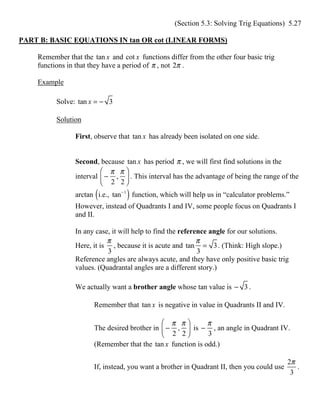
                We actually want a brother angle whose tan value is − 3 .

                       Remember that tan x is negative in value in Quadrants II and IV.

                                              ⎛ π π⎞         π
                       The desired brother in ⎜ − , ⎟ is − , an angle in Quadrant IV.
                                              ⎝ 2 2⎠         3
                       (Remember that the tan x function is odd.)

                                                                                            2π
                       If, instead, you want a brother in Quadrant II, then you could use      .
                                                                                             3
(Section 5.3: Solving Trig Equations) 5.28


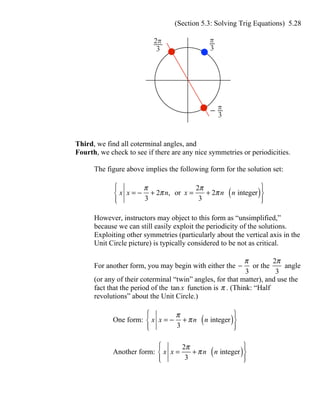
Third, we find all coterminal angles, and
Fourth, we check to see if there are any nice symmetries or periodicities.

      The figure above implies the following form for the solution set:

             ⎧        π               2π                         ⎫
             ⎨ x x = − + 2π n, or x =
             ⎪        3                3
                                         + 2π n      ( n integer )⎬
                                                                  ⎪
             ⎩                                                   ⎭

      However, instructors may object to this form as “unsimplified,”
      because we can still easily exploit the periodicity of the solutions.
      Exploiting other symmetries (particularly about the vertical axis in the
      Unit Circle picture) is typically considered to be not as critical.

                                                            π         2π
      For another form, you may begin with either the −        or the    angle
                                                             3         3
      (or any of their coterminal “twin” angles, for that matter), and use the
      fact that the period of the tan x function is π . (Think: “Half
      revolutions” about the Unit Circle.)

                      ⎧        π                       ⎫
            One form: ⎨ x x = − + π n
                      ⎪        3
                                           ( n integer )⎬
                                                        ⎪
                      ⎩                                ⎭

                          ⎧       2π                        ⎫
            Another form: ⎨ x x =
                          ⎪        3
                                     + πn     ( n integer )⎬
                                                           ⎪
                          ⎩                                 ⎭
(Section 5.3: Solving Trig Equations) 5.29

PART C: THE SQUARE ROOT METHOD (FOR QUADRATIC FORMS)

    We often grab solutions from all four Quadrants when we apply this method, whichever
    of the six basic trig functions is primarily involved.

    Follow-Up Example

          Solve: tan 2 x − 3 = 0

          Solution

                 tan 2 x − 3 = 0
                     tan 2 x = 3       ( The "square" is now isolated.)
                      tan x = ± 3      ( by the Square Root Method )
                                   π
                Here, we want        and all of its brothers.
                                   3


                Forms for the solution set:

                                  ⎧                                                             ⎫
                                  ⎪         π                 2π                                ⎪
                        One form: ⎨ x x = + π n , or x =
                                            3 
                                                                   + πn
                                                                3 
                                                                                  (           )
                                                                                      n integer ⎬
                                  ⎪    
                                                          
                                                                                               ⎪
                                  ⎪ Think: Purple points
                                  ⎩                      Think: Red points                      ⎪
                                                                                                ⎭

                                      ⎧        π                              ⎫
                        Another form: ⎨ x x = ± + π n
                                      ⎪        3
                                                                (           )
                                                                    n integer ⎬
                                                                              ⎪
                                      ⎩                                       ⎭
(Section 5.3: Solving Trig Equations) 5.30

PART D: FACTORING

    Example

         Solve: 2sin 3 x + sin x = 3sin 2 x

         Solution

                2sin 3 x + sin x = 3sin 2 x

                                 Warning: Do not divide both sides by sin x , because it is
                                 “illegal” to divide both sides of an equation by 0, and sin x
                                 could be 0 in value. (We are more careful about these kinds of
                                 issues than in the simplification and verification problems of
                                 previous Sections.) Instead, we should use Factoring. In this
                                 Example, if were to divide both sides by sin x , we would lose
                                 solutions x for which sin x = 0 . This could, however, be
                                 remedied by consideration of the sin x = 0 case as a “Special
                                 Case.” This technique is often employed in Differential
                                 Equations.

                                 The substitution u = sin x may be helpful here.

                           2u 3 + u = 3u 2

                                 Rewrite this polynomial equation in Standard Form
                                 (i.e., with descending powers on one side and 0 isolated on the
                                 other).

                     2u 3 − 3u 2 + u = 0

                                 Now, factor. Begin by factoring out the GCF on the left.

                  (               )
                u 2u 2 − 3u + 1 = 0
                 (         )(
               u 2u − 1 u − 1 = 0 )
                                 Use the Zero Factor Property (ZFP).
                                 Set each factor on the left equal to 0 and solve for u.
                                 Replace u with sin x and solve each resulting equation.
(Section 5.3: Solving Trig Equations) 5.31

First factor

           u=0
       sin x = 0
          x = πn   ( n integer )


Second factor

       2u − 1 = 0
                1
            u=
                2
                1
        sin x =
                2
                π              5π
            x = + 2π n, or x =
                6               6
                                  + 2π n    ( n integer )


                                      π π
      Note: The more efficient form    ± + 2π n
                                      2 3
                                                      ( n integer ) may be
      overkill!

Solving trignometric equations

  • 1.
    (Section 5.3: SolvingTrig Equations) 5.22 SECTION 5.3: SOLVING TRIG EQUATIONS PART A: BASIC EQUATIONS IN sin, cos, csc, OR sec (LINEAR FORMS) Example Solve: 5cos x − 2 = 3cos x (It is assumed that you are to give all real solutions and to give them in exact form – no approximations – unless otherwise specified.) Conditional Equations This is an example of a conditional equation. It is true (i.e., the left side equals the right side) for some real values of x but not for others. In other words, the truth of the equation is conditional, depending on the particular real value that x takes on. You should be used to solving conditional equations in your Algebra courses. This is different from an identity, which holds true for all real values of x (for instance) for which all expressions involved are defined as real quantities. An identity may be thought of as an equation that has as its solution set the intersection (overlap) of the domains of the expressions involved. Solution First, solve for cos x . This process is no different from solving the linear equation 5u − 2 = 3u for u. In fact, you could employ the substitution u = cos x and do exactly that. 5cos x − 2 = 3cos x 2cos x = 2 2 cos x = 2
  • 2.
    (Section 5.3: SolvingTrig Equations) 5.23 2 We want to find all angles whose cos value is . We will use radian 2 measure, which corresponds to “real number” solutions for x. Second, because cos x has period 2π , we will first find solutions in the ) interval ⎡0, 2π . Later, we will find all of their coterminal “twin” angles. ⎣ If you are more comfortable with “slightly negative” Quadrant IV angles π 7π such as − than angles such as , then you may want to look in the 4 4 ⎡ π 3π ⎞ interval ⎢ − , ⎟ , instead. ⎣ 2 2⎠ 2 Is there an “easy” angle x whose cos value is ? 2 π ⎛ 2⎞ Yes, namely , which is cos −1 ⎜ ⎟. 4 ⎝ 2 ⎠ π Look at the Unit Circle. Look at the point corresponding to the angle. 4 It turns out that there is another point on the Unit Circle that has the same 2 horizontal (or what we used to call “x”) coordinate, , so we must look for 2 2 another angle with that same cos value of . We know that this point lies 2 in Quadrant IV, because, aside from Quadrant I, it is the only other Quadrant in which cos is positive in value.
  • 3.
    (Section 5.3: SolvingTrig Equations) 5.24 ) If you are considering the interval ⎡0, 2π , then this other point corresponds ⎣ 7π ⎡ π 3π ⎞ π to the angle. For the interval ⎢ − , ⎟ , it corresponds to − . 4 ⎣ 2 2⎠ 4 π Note: You may have realized that − was another solution, because 4 π we know is a solution, and the cos x function is even. 4 Third, we find all angles coterminal with the two solutions we have already found. There may be different “good” ways of writing the solution set (the general solution) for the equation: ⎧ π 7π ⎫ One form: ⎨ x x = + 2π n, or x = ⎪ 4 4 + 2π n ( n integer )⎬ ⎪ ⎩ ⎭ ⎧ π ⎫ Another form: ⎨ x x = ± + 2π n ⎪ 4 ( n integer )⎬ ⎪ ⎩ ⎭ Note: The ± symbol in this context indicates that we are bringing together the values from the “+” case and the values from the “ − ” case. We do not pick one sign over the other; the ± symbol does not indicate a “choice” or incomplete knowledge. Fourth, we check to see if there are any nice symmetries or periodicities we can exploit so that we may “simplify” our solution set. At this stage, people may decide to switch from the first form of the solution set (above) to the second.
  • 4.
    (Section 5.3: SolvingTrig Equations) 5.25 Note: Graphically, the solutions are the x-coordinates of the red points below 2 where the graph of y = cos x and the graph of y = (the blue horizontal 2 line) intersect. Observe that the cos x function is even. ) Note: If you had been asked to only find solutions in the interval ⎡0, 2π , ⎣ ⎧ π 7π ⎫ then you would have given ⎨ , ⎬ as your solution set. ⎩ 4 4 ⎭
  • 5.
    (Section 5.3: SolvingTrig Equations) 5.26 Follow-Up Example Solve: sec x − 2 = 0 Solution Sketch sec x − 2 = 0 Isolate sec x on one side. sec x = 2 We can “take the reciprocal of both sides.” Remember that we informally treat 0 and “undefined” as reciprocals in trig. 1 ⎛ 2⎞ cos x = ⎜ or ⎟ 2 ⎝ 2 ⎠ We then proceed as in the previous Example…. Example Solve: sin x = 2 Solution This equation has no solution, because 2 is outside the range of the sin x function, ⎡ −1, 1⎤ . There is no angle with a sin value of 2. ⎣ ⎦ The solution set is the empty set, or null set, denoted ∅ . Technical Note: In a Complex Variables class, you may see that sin x = 2 actually does have solutions in C.
  • 6.
    (Section 5.3: SolvingTrig Equations) 5.27 PART B: BASIC EQUATIONS IN tan OR cot (LINEAR FORMS) Remember that the tan x and cot x functions differ from the other four basic trig functions in that they have a period of π , not 2π . Example Solve: tan x = − 3 Solution First, observe that tan x has already been isolated on one side. Second, because tan x has period π , we will first find solutions in the ⎛ π π⎞ interval ⎜ − , ⎟ . This interval has the advantage of being the range of the ⎝ 2 2⎠ ( ) arctan i.e., tan −1 function, which will help us in “calculator problems.” However, instead of Quadrants I and IV, some people focus on Quadrants I and II. In any case, it will help to find the reference angle for our solutions. π π Here, it is , because it is acute and tan = 3 . (Think: High slope.) 3 3 Reference angles are always acute, and they have only positive basic trig values. (Quadrantal angles are a different story.) We actually want a brother angle whose tan value is − 3 . Remember that tan x is negative in value in Quadrants II and IV. ⎛ π π⎞ π The desired brother in ⎜ − , ⎟ is − , an angle in Quadrant IV. ⎝ 2 2⎠ 3 (Remember that the tan x function is odd.) 2π If, instead, you want a brother in Quadrant II, then you could use . 3
  • 7.
    (Section 5.3: SolvingTrig Equations) 5.28 Third, we find all coterminal angles, and Fourth, we check to see if there are any nice symmetries or periodicities. The figure above implies the following form for the solution set: ⎧ π 2π ⎫ ⎨ x x = − + 2π n, or x = ⎪ 3 3 + 2π n ( n integer )⎬ ⎪ ⎩ ⎭ However, instructors may object to this form as “unsimplified,” because we can still easily exploit the periodicity of the solutions. Exploiting other symmetries (particularly about the vertical axis in the Unit Circle picture) is typically considered to be not as critical. π 2π For another form, you may begin with either the − or the angle 3 3 (or any of their coterminal “twin” angles, for that matter), and use the fact that the period of the tan x function is π . (Think: “Half revolutions” about the Unit Circle.) ⎧ π ⎫ One form: ⎨ x x = − + π n ⎪ 3 ( n integer )⎬ ⎪ ⎩ ⎭ ⎧ 2π ⎫ Another form: ⎨ x x = ⎪ 3 + πn ( n integer )⎬ ⎪ ⎩ ⎭
  • 8.
    (Section 5.3: SolvingTrig Equations) 5.29 PART C: THE SQUARE ROOT METHOD (FOR QUADRATIC FORMS) We often grab solutions from all four Quadrants when we apply this method, whichever of the six basic trig functions is primarily involved. Follow-Up Example Solve: tan 2 x − 3 = 0 Solution tan 2 x − 3 = 0 tan 2 x = 3 ( The "square" is now isolated.) tan x = ± 3 ( by the Square Root Method ) π Here, we want and all of its brothers. 3 Forms for the solution set: ⎧ ⎫ ⎪ π 2π ⎪ One form: ⎨ x x = + π n , or x = 3  + πn 3  ( ) n integer ⎬ ⎪        ⎪ ⎪ Think: Purple points ⎩ Think: Red points ⎪ ⎭ ⎧ π ⎫ Another form: ⎨ x x = ± + π n ⎪ 3 ( ) n integer ⎬ ⎪ ⎩ ⎭
  • 9.
    (Section 5.3: SolvingTrig Equations) 5.30 PART D: FACTORING Example Solve: 2sin 3 x + sin x = 3sin 2 x Solution 2sin 3 x + sin x = 3sin 2 x Warning: Do not divide both sides by sin x , because it is “illegal” to divide both sides of an equation by 0, and sin x could be 0 in value. (We are more careful about these kinds of issues than in the simplification and verification problems of previous Sections.) Instead, we should use Factoring. In this Example, if were to divide both sides by sin x , we would lose solutions x for which sin x = 0 . This could, however, be remedied by consideration of the sin x = 0 case as a “Special Case.” This technique is often employed in Differential Equations. The substitution u = sin x may be helpful here. 2u 3 + u = 3u 2 Rewrite this polynomial equation in Standard Form (i.e., with descending powers on one side and 0 isolated on the other). 2u 3 − 3u 2 + u = 0 Now, factor. Begin by factoring out the GCF on the left. ( ) u 2u 2 − 3u + 1 = 0 ( )( u 2u − 1 u − 1 = 0 ) Use the Zero Factor Property (ZFP). Set each factor on the left equal to 0 and solve for u. Replace u with sin x and solve each resulting equation.
  • 10.
    (Section 5.3: SolvingTrig Equations) 5.31 First factor u=0 sin x = 0 x = πn ( n integer ) Second factor 2u − 1 = 0 1 u= 2 1 sin x = 2 π 5π x = + 2π n, or x = 6 6 + 2π n ( n integer ) π π Note: The more efficient form ± + 2π n 2 3 ( n integer ) may be overkill!