7.4 Inverse Trig Functions


2 Corinthians 12:9-10
But he said to me, "My grace is sufficient for you, for
my power is made perfect in weakness." Therefore I
will boast all the more gladly about my weaknesses, so
that Christ's power may rest on me.  That is why, for
Christ's sake, I delight in weaknesses, in insults, in
hardships, in persecutions, in difficulties. For when I am
weak, then I am strong.
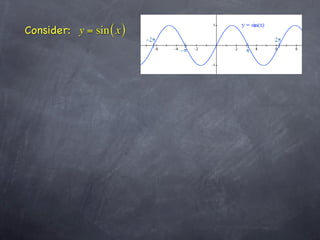
Consider: y = sin ( x )


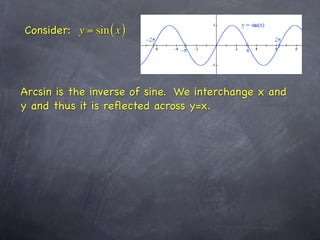
Arcsin is the inverse of sine. We interchange x and
y and thus it is reflected across y=x.
Consider: y = sin ( x )


Arcsin is the inverse of sine. We interchange x and
y and thus it is reflected across y=x.
Consider: y = sin ( x )


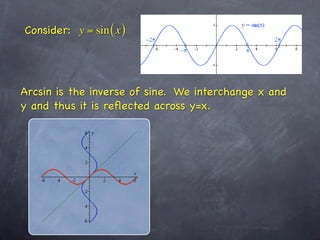
Arcsin is the inverse of sine. We interchange x and
y and thus it is reflected across y=x.


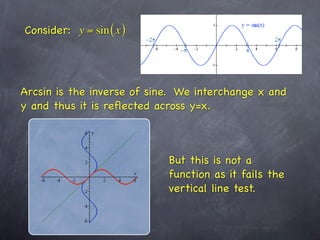
                            But this is not a
                            function as it fails the
                            vertical line test.
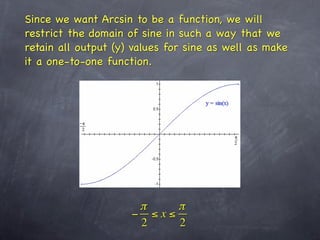
Since we want Arcsin to be a function, we will
restrict the domain of sine in such a way that we
retain all output (y) values for sine as well as make
it a one-to-one function.


                      π    π
                     − ≤x≤
                      2    2
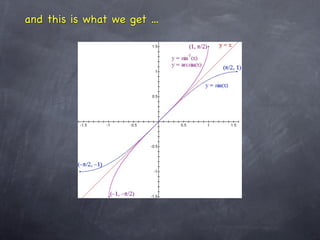
and this is what we get ...
Inverse Sine       (Arcsin)
              −1
     y = sin x

has domain:        [ −1 , 1]
                   ⎡ π π ⎤
and range:         ⎢ − 2 , 2 ⎥
                   ⎣         ⎦
Inverse Sine       (Arcsin)
              −1
     y = sin x

has domain:        [ −1 , 1]
                   ⎡ π π ⎤
and range:         ⎢ − 2 , 2 ⎥
                   ⎣         ⎦


  Same thing as viewed on
      the Unit Circle
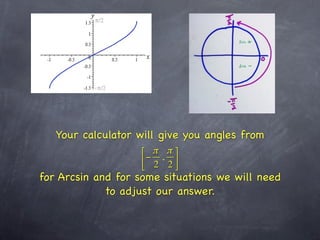
Your calculator will give you angles from
                   ⎡ π π ⎤
                      − , ⎥
                   ⎢ 2 2 ⎦
                   ⎣
for Arcsin and for some situations we will need
             to adjust our answer.
Inverse Cosine       (ArcCos)
              −1
     y = cos x

has domain:        [ −1 , 1]
and range:         [ 0, π ]


  Same thing as viewed on
      the Unit Circle
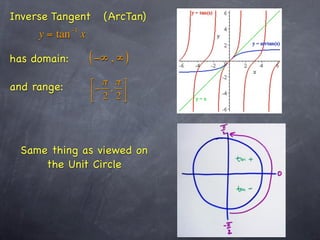
Inverse Tangent        (ArcTan)
              −1
     y = tan x

has domain:        ( −∞ , ∞ )
and range:         ⎡ π π ⎤
                   ⎢ − 2 , 2 ⎥
                   ⎣         ⎦


  Same thing as viewed on
      the Unit Circle
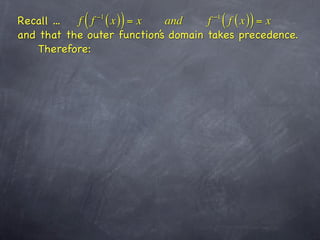
Recall ...  (        )
           f f ( x) = x
                −1
                             and     f ( f ( x )) = x
                                     −1

and that the outer function’s domain takes precedence.
    Therefore:
Recall ...  (
           f f ( x) = x
                  −1
                             )
                             and     f ( f ( x )) = x
                                                   −1

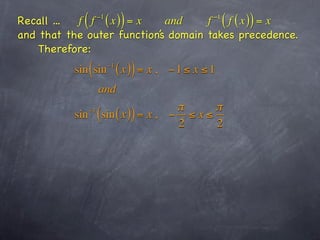
and that the outer function’s domain takes precedence.
    Therefore:
          sin ( sin    −1
                            ( x )) = x ,   −1 ≤ x ≤1
                  and
                                  π      π
          sin ( sin ( x )) = x , − ≤ x ≤
             −1

                                  2      2
Recall ...   (
           f f ( x) = x
                   −1
                              )
                             and     f ( f ( x )) = x−1

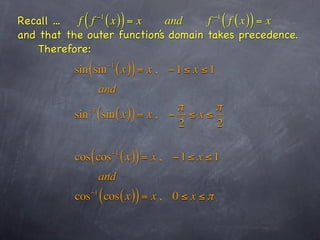
and that the outer function’s domain takes precedence.
    Therefore:
          sin ( sin     −1
                             ( x )) = x ,    −1 ≤ x ≤1
                      and
                                  π      π
          sin ( sin ( x )) = x , − ≤ x ≤
              −1

                                  2      2

           cos ( cos     −1
                              ( x )) = x ,   −1 ≤ x ≤1
                      and
           cos   −1
                      ( cos ( x )) = x ,     0≤ x ≤π
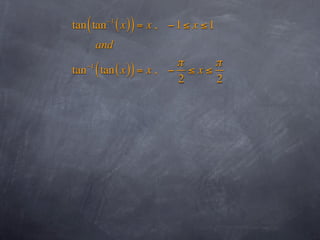
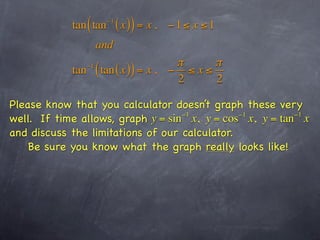
tan ( tan   −1
                 ( x )) = x ,   −1 ≤ x ≤1
        and
                        π      π
tan ( tan ( x )) = x , − ≤ x ≤
   −1

                        2      2
tan ( tan   −1
                             ( x )) = x ,   −1 ≤ x ≤1
                    and
                                    π      π
            tan ( tan ( x )) = x , − ≤ x ≤
               −1

                                    2      2

Please know that you calculator doesn’t graph these very
well. If time allows, graph y = sin x, y = cos x, y = tan x
                                   −1          −1        −1

and discuss the limitations of our calculator.
    Be sure you know what the graph really looks like!
No HW


Our most profitable lessons are learned from failure,
not success.
                      Frank Davidson

0708 ch 7 day 8

  • 1.
    7.4 Inverse TrigFunctions 2 Corinthians 12:9-10 But he said to me, "My grace is sufficient for you, for my power is made perfect in weakness." Therefore I will boast all the more gladly about my weaknesses, so that Christ's power may rest on me.  That is why, for Christ's sake, I delight in weaknesses, in insults, in hardships, in persecutions, in difficulties. For when I am weak, then I am strong.
  • 2.
    Consider: y =sin ( x )
  • 3.
    Consider: y =sin ( x ) Arcsin is the inverse of sine. We interchange x and y and thus it is reflected across y=x.
  • 4.
    Consider: y =sin ( x ) Arcsin is the inverse of sine. We interchange x and y and thus it is reflected across y=x.
  • 5.
    Consider: y =sin ( x ) Arcsin is the inverse of sine. We interchange x and y and thus it is reflected across y=x. But this is not a function as it fails the vertical line test.
  • 6.
    Since we wantArcsin to be a function, we will restrict the domain of sine in such a way that we retain all output (y) values for sine as well as make it a one-to-one function. π π − ≤x≤ 2 2
  • 7.
    and this iswhat we get ...
  • 8.
    Inverse Sine (Arcsin) −1 y = sin x has domain: [ −1 , 1] ⎡ π π ⎤ and range: ⎢ − 2 , 2 ⎥ ⎣ ⎦
  • 9.
    Inverse Sine (Arcsin) −1 y = sin x has domain: [ −1 , 1] ⎡ π π ⎤ and range: ⎢ − 2 , 2 ⎥ ⎣ ⎦ Same thing as viewed on the Unit Circle
  • 10.
    Your calculator willgive you angles from ⎡ π π ⎤ − , ⎥ ⎢ 2 2 ⎦ ⎣ for Arcsin and for some situations we will need to adjust our answer.
  • 11.
    Inverse Cosine (ArcCos) −1 y = cos x has domain: [ −1 , 1] and range: [ 0, π ] Same thing as viewed on the Unit Circle
  • 12.
    Inverse Tangent (ArcTan) −1 y = tan x has domain: ( −∞ , ∞ ) and range: ⎡ π π ⎤ ⎢ − 2 , 2 ⎥ ⎣ ⎦ Same thing as viewed on the Unit Circle
  • 13.
    Recall ... ( ) f f ( x) = x −1 and f ( f ( x )) = x −1 and that the outer function’s domain takes precedence. Therefore:
  • 14.
    Recall ... ( f f ( x) = x −1 ) and f ( f ( x )) = x −1 and that the outer function’s domain takes precedence. Therefore: sin ( sin −1 ( x )) = x , −1 ≤ x ≤1 and π π sin ( sin ( x )) = x , − ≤ x ≤ −1 2 2
  • 15.
    Recall ... ( f f ( x) = x −1 ) and f ( f ( x )) = x−1 and that the outer function’s domain takes precedence. Therefore: sin ( sin −1 ( x )) = x , −1 ≤ x ≤1 and π π sin ( sin ( x )) = x , − ≤ x ≤ −1 2 2 cos ( cos −1 ( x )) = x , −1 ≤ x ≤1 and cos −1 ( cos ( x )) = x , 0≤ x ≤π
  • 16.
    tan ( tan −1 ( x )) = x , −1 ≤ x ≤1 and π π tan ( tan ( x )) = x , − ≤ x ≤ −1 2 2
  • 17.
    tan ( tan −1 ( x )) = x , −1 ≤ x ≤1 and π π tan ( tan ( x )) = x , − ≤ x ≤ −1 2 2 Please know that you calculator doesn’t graph these very well. If time allows, graph y = sin x, y = cos x, y = tan x −1 −1 −1 and discuss the limitations of our calculator. Be sure you know what the graph really looks like!
  • 18.
    No HW Our mostprofitable lessons are learned from failure, not success. Frank Davidson

Editor's Notes

  • #2 \n
  • #3 1. Hand out Trig Identity Help Sheet for the start of this slide.\n2. Review why Even-Odd identities are true.\n3. Explain why Cofunction identities are true.\n\n
  • #4 1. Hand out Trig Identity Help Sheet for the start of this slide.\n2. Review why Even-Odd identities are true.\n3. Explain why Cofunction identities are true.\n\n
  • #5 1. Hand out Trig Identity Help Sheet for the start of this slide.\n2. Review why Even-Odd identities are true.\n3. Explain why Cofunction identities are true.\n\n
  • #6 1. Hand out Trig Identity Help Sheet for the start of this slide.\n2. Review why Even-Odd identities are true.\n3. Explain why Cofunction identities are true.\n\n
  • #7 1. Hand out Trig Identity Help Sheet for the start of this slide.\n2. Review why Even-Odd identities are true.\n3. Explain why Cofunction identities are true.\n\n
  • #8 1. Hand out Trig Identity Help Sheet for the start of this slide.\n2. Review why Even-Odd identities are true.\n3. Explain why Cofunction identities are true.\n\n
  • #9 1. Hand out Trig Identity Help Sheet for the start of this slide.\n2. Review why Even-Odd identities are true.\n3. Explain why Cofunction identities are true.\n\n
  • #10 1. Hand out Trig Identity Help Sheet for the start of this slide.\n2. Review why Even-Odd identities are true.\n3. Explain why Cofunction identities are true.\n\n
  • #11 1. Hand out Trig Identity Help Sheet for the start of this slide.\n2. Review why Even-Odd identities are true.\n3. Explain why Cofunction identities are true.\n\n
  • #12 1. Hand out Trig Identity Help Sheet for the start of this slide.\n2. Review why Even-Odd identities are true.\n3. Explain why Cofunction identities are true.\n\n
  • #13 1. Hand out Trig Identity Help Sheet for the start of this slide.\n2. Review why Even-Odd identities are true.\n3. Explain why Cofunction identities are true.\n\n
  • #14 1. Hand out Trig Identity Help Sheet for the start of this slide.\n2. Review why Even-Odd identities are true.\n3. Explain why Cofunction identities are true.\n\n
  • #15 1. Hand out Trig Identity Help Sheet for the start of this slide.\n2. Review why Even-Odd identities are true.\n3. Explain why Cofunction identities are true.\n\n