Number Theory
And Systems
Introduction to Number Theory
Number theory is about integers and their
properties.
We will start with the basic principles of
• greatest common divisors,
• least common multiples, and
• modular arithmetic
and look at some relevant algorithms.
Primes
A positive integer p greater than 1 is called prime
if the only positive factors of p are 1 and p.
A positive integer that is greater than 1 and is not
prime is called composite.
The fundamental theorem of arithmetic:
Every positive integer can be written uniquely as
the product of primes, where the prime factors
are written in order of increasing size.
Primes
Examples:
3·5
48 =
17 =
100 =
512 =
515 =
28 =
15 =
2·2·2·2·3 = 24·3
17
2·2·5·5 = 22·52
2·2·2·2·2·2·2·2·2 = 29
5·103
2·2·7
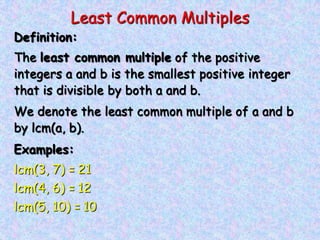
Least Common Multiples
Definition:
The least common multiple of the positive
integers a and b is the smallest positive integer
that is divisible by both a and b.
We denote the least common multiple of a and b
by lcm(a, b).
Examples:
lcm(3, 7) = 21
lcm(4, 6) = 12
lcm(5, 10) = 10
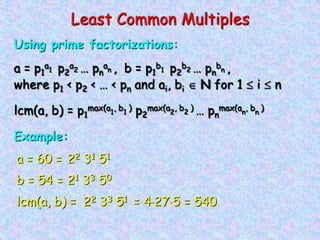
Least Common Multiples
Using prime factorizations:
a = p1
a1 p2
a2 … pn
an , b = p1
b1 p2
b2 … pn
bn ,
where p1 < p2 < … < pn and ai, bi N for 1 i n
lcm(a, b) = p1
max(a1
, b1
) p2
max(a2
, b2
) … pn
max(an
, bn
)
Example:
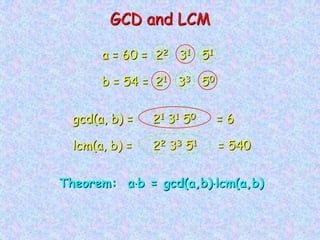
a = 60 = 22 31 51
b = 54 = 21 33 50
lcm(a, b) = 22 33 51 = 4 27 5 = 540
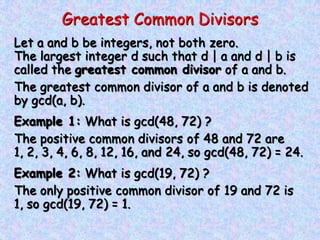
Greatest Common Divisors
Let a and b be integers, not both zero.
The largest integer d such that d | a and d | b is
called the greatest common divisor of a and b.
The greatest common divisor of a and b is denoted
by gcd(a, b).
Example 1: What is gcd(48, 72) ?
The positive common divisors of 48 and 72 are
1, 2, 3, 4, 6, 8, 12, 16, and 24, so gcd(48, 72) = 24.
Example 2: What is gcd(19, 72) ?
The only positive common divisor of 19 and 72 is
1, so gcd(19, 72) = 1.
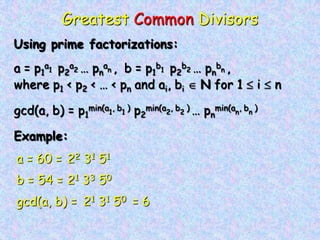
Greatest Common Divisors
Using prime factorizations:
a = p1
a1 p2
a2 … pn
an , b = p1
b1 p2
b2 … pn
bn ,
where p1 < p2 < … < pn and ai, bi N for 1 i n
gcd(a, b) = p1
min(a1
, b1
) p2
min(a2
, b2
) … pn
min(an
, bn
)
Example:
a = 60 = 22 31 51
b = 54 = 21 33 50
gcd(a, b) = 21 31 50 = 6
GCD and LCM
a = 60 = 22 31 51
b = 54 = 21 33 50
lcm(a, b) = 22 33 51 = 540
gcd(a, b) = 21 31 50 = 6
Theorem: a b = gcd(a,b) lcm(a,b)
Relatively Prime Integers
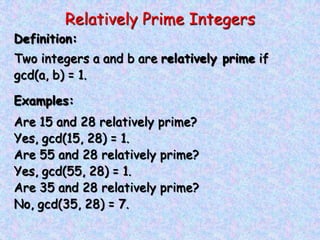
Definition:
Two integers a and b are relatively prime if
gcd(a, b) = 1.
Examples:
Are 15 and 28 relatively prime?
Yes, gcd(15, 28) = 1.
Are 55 and 28 relatively prime?
Yes, gcd(55, 28) = 1.
Are 35 and 28 relatively prime?
No, gcd(35, 28) = 7.
Modular Arithmetic
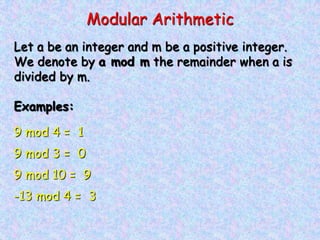
Let a be an integer and m be a positive integer.
We denote by a mod m the remainder when a is
divided by m.
Examples:
9 mod 4 = 1
9 mod 3 = 0
9 mod 10 = 9
-13 mod 4 = 3
Common Number Systems
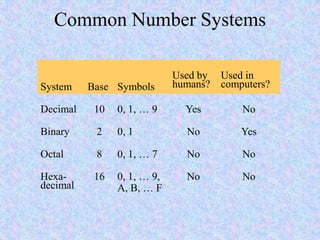
System Base Symbols
Used by
humans?
Used in
computers?
Decimal 10 0, 1, … 9 Yes No
Binary 2 0, 1 No Yes
Octal 8 0, 1, … 7 No No
Hexa-
decimal
16 0, 1, … 9,
A, B, … F
No No
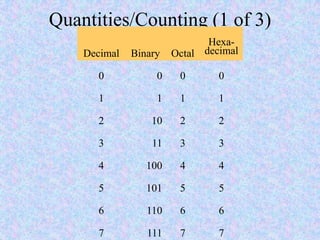
Quantities/Counting (1 of 3)
Decimal Binary Octal
Hexa-
decimal
0 0 0 0
1 1 1 1
2 10 2 2
3 11 3 3
4 100 4 4
5 101 5 5
6 110 6 6
7 111 7 7
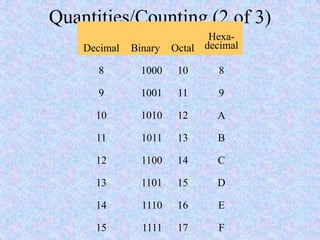
Quantities/Counting (2 of 3)
Decimal Binary Octal
Hexa-
decimal
8 1000 10 8
9 1001 11 9
10 1010 12 A
11 1011 13 B
12 1100 14 C
13 1101 15 D
14 1110 16 E
15 1111 17 F
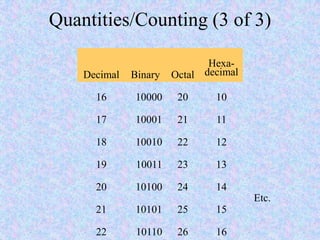
Quantities/Counting (3 of 3)
Decimal Binary Octal
Hexa-
decimal
16 10000 20 10
17 10001 21 11
18 10010 22 12
19 10011 23 13
20 10100 24 14
21 10101 25 15
22 10110 26 16
Etc.
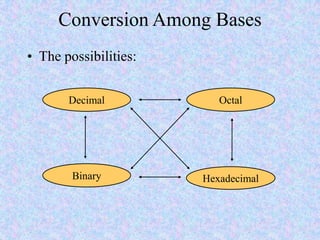
Conversion Among Bases
• The possibilities:
Hexadecimal
Decimal Octal
Binary
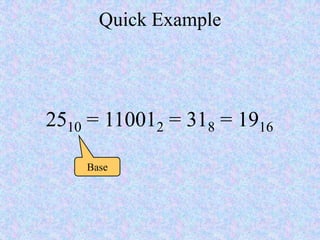
Quick Example
2510 = 110012 = 318 = 1916
Base
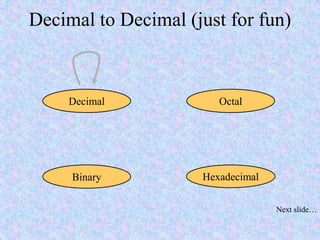
Decimal to Decimal (just for fun)
Hexadecimal
Decimal Octal
Binary
Next slide…
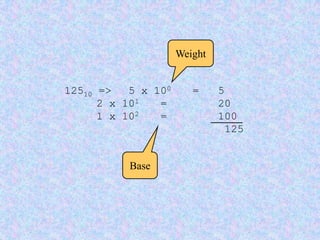
12510 => 5 x 100 = 5
2 x 101 = 20
1 x 102 = 100
125
Base
Weight
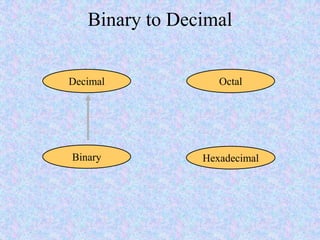
Binary to Decimal
Hexadecimal
Decimal Octal
Binary
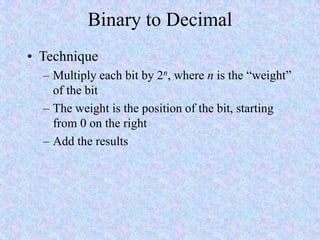
Binary to Decimal
• Technique
– Multiply each bit by 2n, where n is the “weight”
of the bit
– The weight is the position of the bit, starting
from 0 on the right
– Add the results
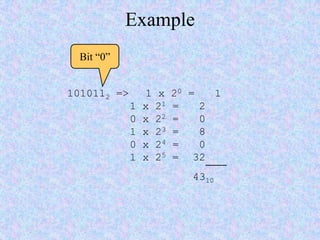
Example
1010112 => 1 x 20 = 1
1 x 21 = 2
0 x 22 = 0
1 x 23 = 8
0 x 24 = 0
1 x 25 = 32
4310
Bit “0”
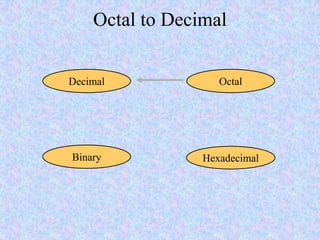
Octal to Decimal
Hexadecimal
Decimal Octal
Binary
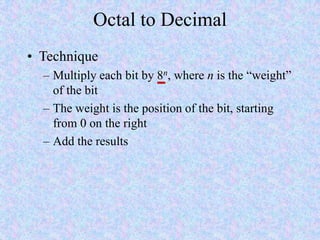
Octal to Decimal
• Technique
– Multiply each bit by 8n, where n is the “weight”
of the bit
– The weight is the position of the bit, starting
from 0 on the right
– Add the results
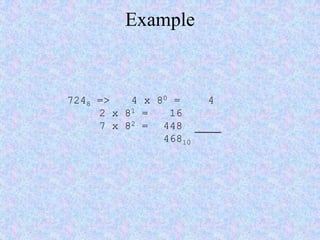
Example
7248 => 4 x 80 = 4
2 x 81 = 16
7 x 82 = 448
46810
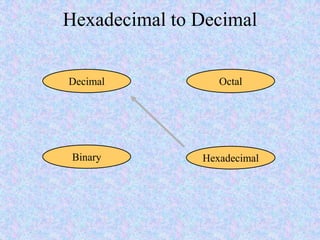
Hexadecimal to Decimal
Hexadecimal
Decimal Octal
Binary
Hexadecimal to Decimal
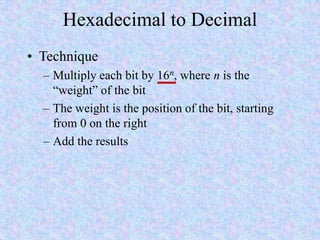
• Technique
– Multiply each bit by 16n, where n is the
“weight” of the bit
– The weight is the position of the bit, starting
from 0 on the right
– Add the results
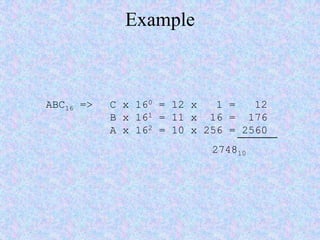
Example
ABC16 => C x 160 = 12 x 1 = 12
B x 161 = 11 x 16 = 176
A x 162 = 10 x 256 = 2560
274810
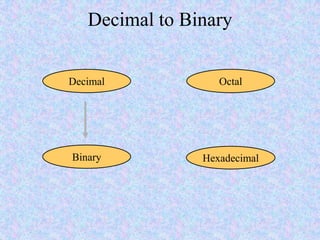
Decimal to Binary
Hexadecimal
Decimal Octal
Binary
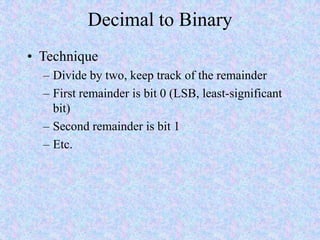
Decimal to Binary
• Technique
– Divide by two, keep track of the remainder
– First remainder is bit 0 (LSB, least-significant
bit)
– Second remainder is bit 1
– Etc.
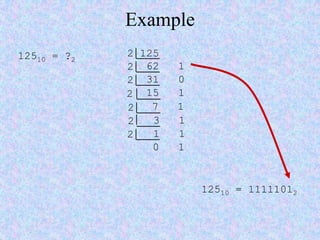
Example
12510 = ?2
2 125
62 12
31 02
15 12
7 12
3 12
1 12
0 1
12510 = 11111012
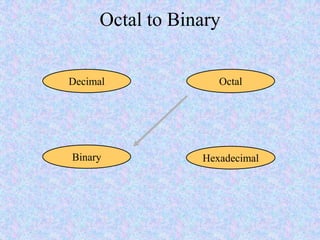
Octal to Binary
Hexadecimal
Decimal Octal
Binary
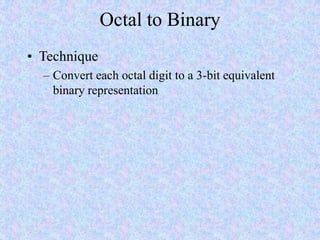
Octal to Binary
• Technique
– Convert each octal digit to a 3-bit equivalent
binary representation
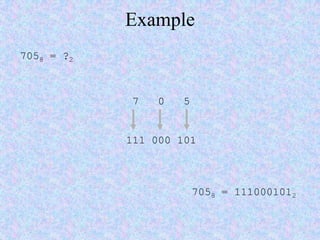
Example
7058 = ?2
7 0 5
111 000 101
7058 = 1110001012
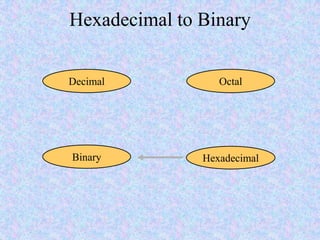
Hexadecimal to Binary
Hexadecimal
Decimal Octal
Binary
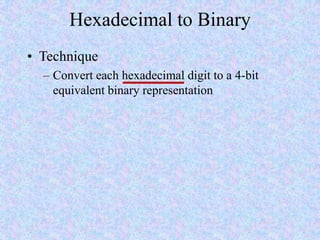
Hexadecimal to Binary
• Technique
– Convert each hexadecimal digit to a 4-bit
equivalent binary representation
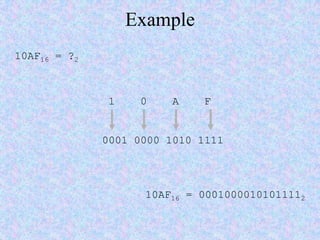
Example
10AF16 = ?2
1 0 A F
0001 0000 1010 1111
10AF16 = 00010000101011112
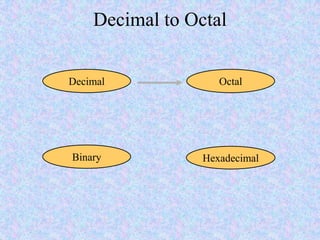
Decimal to Octal
Hexadecimal
Decimal Octal
Binary
Decimal to Octal
• Technique
– Divide by 8
– Keep track of the remainder
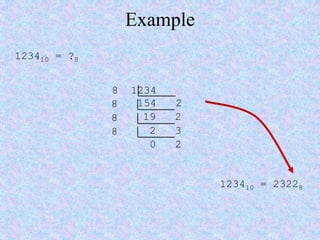
Example
123410 = ?8
8 1234
154 28
19 28
2 38
0 2
123410 = 23228
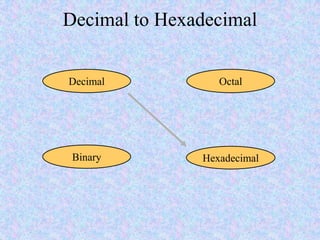
Decimal to Hexadecimal
Hexadecimal
Decimal Octal
Binary
Decimal to Hexadecimal
• Technique
– Divide by 16
– Keep track of the remainder
Example
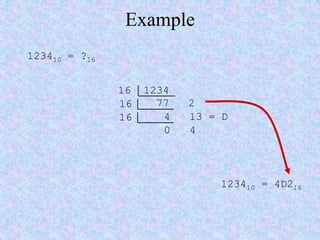
123410 = ?16
123410 = 4D216
16 1234
77 216
4 13 = D16
0 4
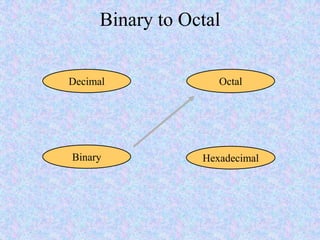
Binary to Octal
Hexadecimal
Decimal Octal
Binary
Binary to Octal
• Technique
– Group bits in threes, starting on right
– Convert to octal digits
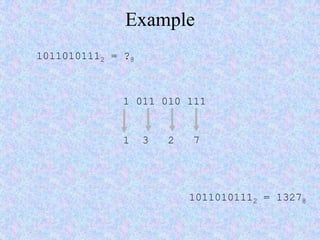
Example
10110101112 = ?8
1 011 010 111
1 3 2 7
10110101112 = 13278
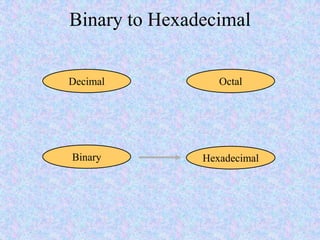
Binary to Hexadecimal
Hexadecimal
Decimal Octal
Binary
Binary to Hexadecimal
• Technique
– Group bits in fours, starting on right
– Convert to hexadecimal digits
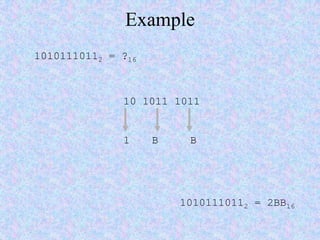
Example
10101110112 = ?16
10 1011 1011
1 B B
10101110112 = 2BB16
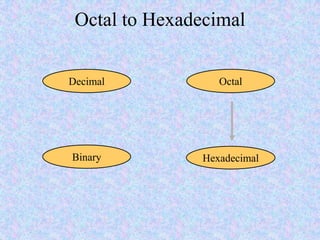
Octal to Hexadecimal
Hexadecimal
Decimal Octal
Binary
Octal to Hexadecimal
• Technique
– Use binary as an intermediary
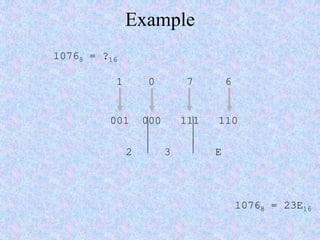
Example
10768 = ?16
1 0 7 6
001 000 111 110
2 3 E
10768 = 23E16
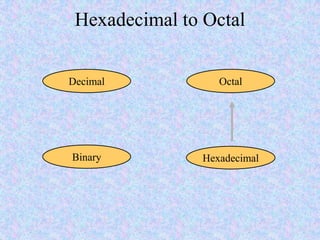
Hexadecimal to Octal
Hexadecimal
Decimal Octal
Binary
Hexadecimal to Octal
• Technique
– Use binary as an intermediary
Example
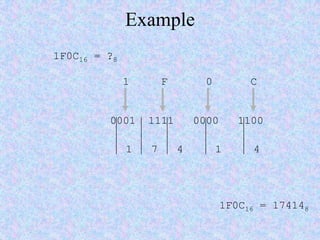
1F0C16 = ?8
1 F 0 C
0001 1111 0000 1100
1 7 4 1 4
1F0C16 = 174148
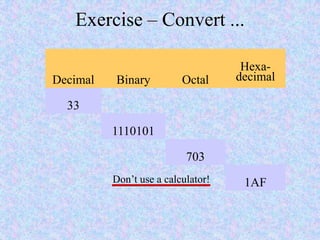
Exercise – Convert ...
Don’t use a calculator!
Decimal Binary Octal
Hexa-
decimal
33
1110101
703
1AF
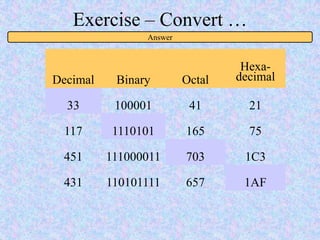
Exercise – Convert …
Decimal Binary Octal
Hexa-
decimal
33 100001 41 21
117 1110101 165 75
451 111000011 703 1C3
431 110101111 657 1AF
Answer
Thank you

Number theory