Chapter
Introduction to
Statistics
1
1 of 61
© 2012 Pearson Education, Inc.
All rights reserved.
Chapter Outline
• 1.1 An Overview of Statistics
• 1.2 Data Classification
• 1.3 Experimental Design
© 2012 Pearson Education, Inc. All rights reserved. 2 of 61
Section 1.1
An Overview of Statistics
© 2012 Pearson Education, Inc. All rights reserved. 3 of 61
Section 1.1 Objectives
• Define statistics
• Distinguish between a population and a sample
• Distinguish between a parameter and a statistic
• Distinguish between descriptive statistics and
inferential statistics
© 2012 Pearson Education, Inc. All rights reserved. 4 of 61
What is Data?
Data
Consist of information coming from observations,
counts, measurements, or responses.
• “People who eat three daily servings of whole grains
have been shown to reduce their risk of…stroke by
37%.” (Source: Whole Grains Council)
• “Seventy percent of the 1500 U.S. spinal cord
injuries to minors result from vehicle accidents, and
68 percent were not wearing a seatbelt.” (Source: UPI)
© 2012 Pearson Education, Inc. All rights reserved. 5 of 61
What is Statistics?
Statistics
The science of collecting,
organizing, analyzing, and
interpreting data in order to
make decisions.
© 2012 Pearson Education, Inc. All rights reserved. 6 of 61
Data Sets
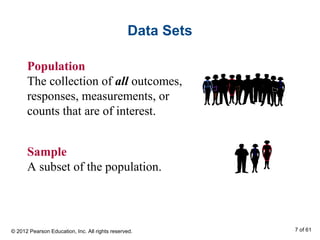
Population
The collection of all outcomes,
responses, measurements, or
counts that are of interest.
Sample
A subset of the population.
© 2012 Pearson Education, Inc. All rights reserved. 7 of 61
Example: Identifying Data Sets
In a recent survey, 1500 adults in the United States were
asked if they thought there was solid evidence for global
warming. Eight hundred fifty-five of the adults said yes.
Identify the population and the sample. Describe the
data set. (Adapted from: Pew Research Center)
© 2012 Pearson Education, Inc. All rights reserved. 8 of 61
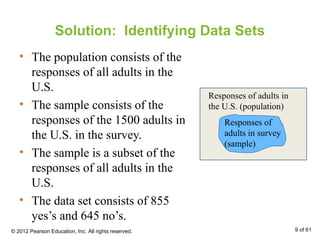
Solution: Identifying Data Sets
• The population consists of the
responses of all adults in the
U.S.
• The sample consists of the
responses of the 1500 adults in
the U.S. in the survey.
• The sample is a subset of the
responses of all adults in the
U.S.
• The data set consists of 855
yes’s and 645 no’s.
Responses of adults in
the U.S. (population)
Responses of
adults in survey
(sample)
© 2012 Pearson Education, Inc. All rights reserved. 9 of 61
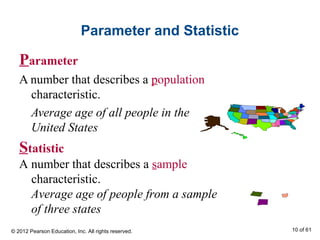
Parameter and Statistic
Parameter
A number that describes a population
characteristic.
Average age of all people in the
United States
Statistic
A number that describes a sample
characteristic.
Average age of people from a sample
of three states
© 2012 Pearson Education, Inc. All rights reserved. 10 of 61
Example: Distinguish Parameter and Statistic
Decide whether the numerical value describes a
population parameter or a sample statistic.
1. A recent survey of a sample of college
career centers reported that the average
starting salary for petroleum
engineering majors is $83,121. (Source:
National Association of Colleges and
Employers)
Solution:
Sample statistic (the average of $83,121 is based
on a subset of the population)
© 2012 Pearson Education, Inc. All rights reserved. 11 of 61
Example: Distinguish Parameter and Statistic
Decide whether the numerical value describes a
population parameter or a sample statistic.
2. The 2182 students who accepted
admission offers to Northwestern
University in 2009 have an average
SAT score of 1442. (Source: Northwestern
University)
Solution:
Population parameter (the SAT score of 1442 is
based on all the students who accepted admission
offers in 2009)
© 2012 Pearson Education, Inc. All rights reserved. 12 of 61
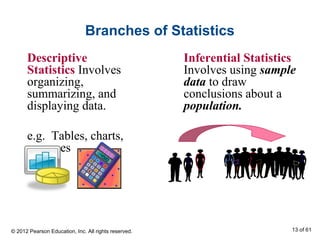
Branches of Statistics
Descriptive
Statistics Involves
organizing,
summarizing, and
displaying data.
e.g. Tables, charts,
averages
Inferential Statistics
Involves using sample
data to draw
conclusions about a
population.
© 2012 Pearson Education, Inc. All rights reserved. 13 of 61
Example: Descriptive and Inferential
Statistics
Decide which part of the study represents the
descriptive branch of statistics. What conclusions might
be drawn from the study using inferential statistics?
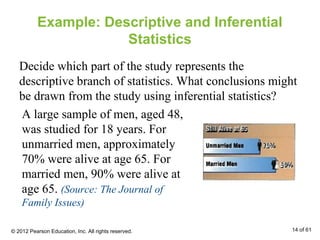
A large sample of men, aged 48,
was studied for 18 years. For
unmarried men, approximately
70% were alive at age 65. For
married men, 90% were alive at
age 65. (Source: The Journal of
Family Issues)
© 2012 Pearson Education, Inc. All rights reserved. 14 of 61
Solution: Descriptive and Inferential
Statistics
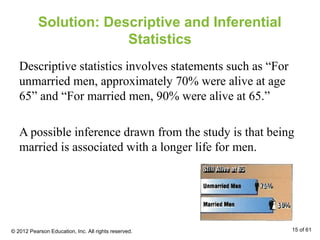
Descriptive statistics involves statements such as “For
unmarried men, approximately 70% were alive at age
65” and “For married men, 90% were alive at 65.”
A possible inference drawn from the study is that being
married is associated with a longer life for men.
© 2012 Pearson Education, Inc. All rights reserved. 15 of 61
Section 1.1 Summary
• Defined statistics
• Distinguished between a population and a sample
• Distinguished between a parameter and a statistic
• Distinguished between descriptive statistics and
inferential statistics
© 2012 Pearson Education, Inc. All rights reserved. 16 of 61
Section 1.2
Data Classification
© 2012 Pearson Education, Inc. All rights reserved. 17 of 61
Section 1.2 Objectives
• Distinguish between qualitative data and quantitative
data
• Classify data with respect to the four levels of
measurement
© 2012 Pearson Education, Inc. All rights reserved. 18 of 61
Types of Data
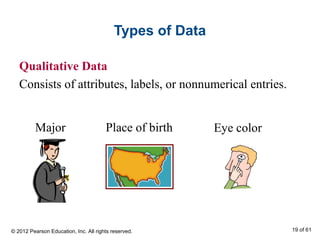
Qualitative Data
Consists of attributes, labels, or nonnumerical entries.
Major Place of birth Eye color
© 2012 Pearson Education, Inc. All rights reserved. 19 of 61
Types of Data
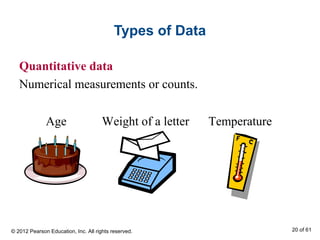
Quantitative data
Numerical measurements or counts.
Age Weight of a letter Temperature
© 2012 Pearson Education, Inc. All rights reserved. 20 of 61
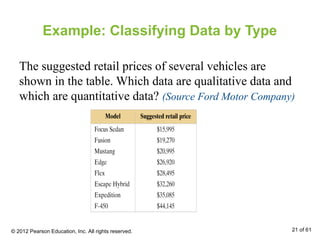
Example: Classifying Data by Type
The suggested retail prices of several vehicles are
shown in the table. Which data are qualitative data and
which are quantitative data? (Source Ford Motor Company)
© 2012 Pearson Education, Inc. All rights reserved. 21 of 61
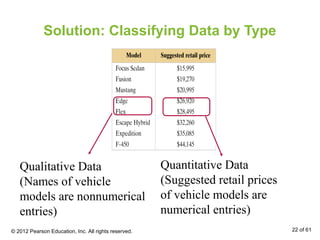
Solution: Classifying Data by Type
Quantitative Data
(Suggested retail prices
of vehicle models are
numerical entries)
© 2012 Pearson Education, Inc. All rights reserved. 22 of 61
Qualitative Data
(Names of vehicle
models are nonnumerical
entries)
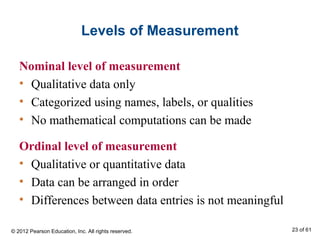
Levels of Measurement
Nominal level of measurement
• Qualitative data only
• Categorized using names, labels, or qualities
• No mathematical computations can be made
Ordinal level of measurement
• Qualitative or quantitative data
• Data can be arranged in order
• Differences between data entries is not meaningful
© 2012 Pearson Education, Inc. All rights reserved. 23 of 61
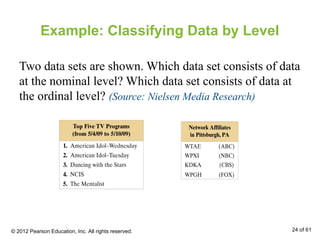
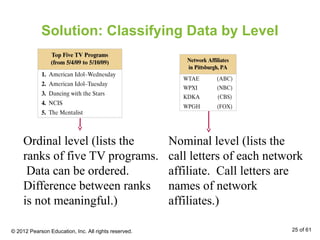
Example: Classifying Data by Level
Two data sets are shown. Which data set consists of data
at the nominal level? Which data set consists of data at
the ordinal level? (Source: Nielsen Media Research)
© 2012 Pearson Education, Inc. All rights reserved. 24 of 61
Solution: Classifying Data by Level
Ordinal level (lists the
ranks of five TV programs.
Data can be ordered.
Difference between ranks
is not meaningful.)
Nominal level (lists the
call letters of each network
affiliate. Call letters are
names of network
affiliates.)
© 2012 Pearson Education, Inc. All rights reserved. 25 of 61
Levels of Measurement
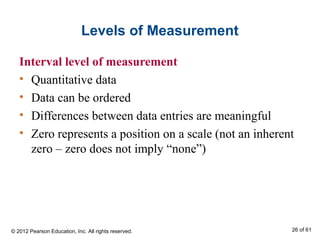
Interval level of measurement
• Quantitative data
• Data can be ordered
• Differences between data entries are meaningful
• Zero represents a position on a scale (not an inherent
zero – zero does not imply “none”)
© 2012 Pearson Education, Inc. All rights reserved. 26 of 61
Levels of Measurement
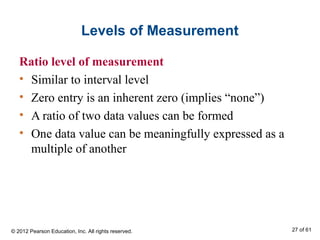
Ratio level of measurement
• Similar to interval level
• Zero entry is an inherent zero (implies “none”)
• A ratio of two data values can be formed
• One data value can be meaningfully expressed as a
multiple of another
© 2012 Pearson Education, Inc. All rights reserved. 27 of 61
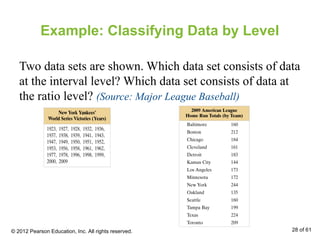
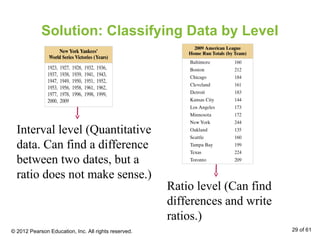
Example: Classifying Data by Level
Two data sets are shown. Which data set consists of data
at the interval level? Which data set consists of data at
the ratio level? (Source: Major League Baseball)
© 2012 Pearson Education, Inc. All rights reserved. 28 of 61
Solution: Classifying Data by Level
Interval level (Quantitative
data. Can find a difference
between two dates, but a
ratio does not make sense.)
Ratio level (Can find
differences and write
ratios.)
© 2012 Pearson Education, Inc. All rights reserved. 29 of 61
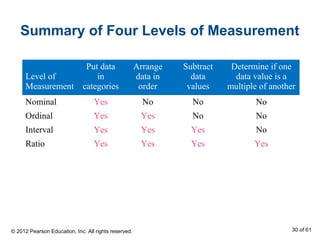
Summary of Four Levels of Measurement
Level of
Measurement
Put data
in
categories
Arrange
data in
order
Subtract
data
values
Determine if one
data value is a
multiple of another
Nominal Yes No No No
Ordinal Yes Yes No No
Interval Yes Yes Yes No
Ratio Yes Yes Yes Yes
© 2012 Pearson Education, Inc. All rights reserved. 30 of 61
Section 1.2 Summary
• Distinguished between qualitative data and
quantitative data
• Classified data with respect to the four levels of
measurement
© 2012 Pearson Education, Inc. All rights reserved. 31 of 61
Section 1.3
Experimental Design
© 2012 Pearson Education, Inc. All rights reserved. 32 of 61
Section 1.3 Objectives
• Discuss how to design a statistical study
• Discuss data collection techniques
• Discuss how to design an experiment
• Discuss sampling techniques
© 2012 Pearson Education, Inc. All rights reserved. 33 of 61
Designing a Statistical Study
3. Collect the data.
4. Describe the data using
descriptive statistics
techniques.
5. Interpret the data and
make decisions about
the population using
inferential statistics.
6. Identify any possible
errors.
1. Identify the variable(s)
of interest (the focus)
and the population of
the study.
2. Develop a detailed plan
for collecting data. If
you use a sample, make
sure the sample is
representative of the
population.
© 2012 Pearson Education, Inc. All rights reserved. 34 of 61
Data Collection
Observational study
• A researcher observes and measures characteristics of
interest of part of a population.
• Researchers observed and recorded the mouthing
behavior on nonfood objects of children up to three
years old. (Source: Pediatric Magazine)
© 2012 Pearson Education, Inc. All rights reserved. 35 of 61
Data Collection
Experiment
• A treatment is applied to part of a population and
responses are observed.
• An experiment was performed in which diabetics
took cinnamon extract daily while a control group
took none. After 40 days, the diabetics who had the
cinnamon reduced their risk of heart disease while the
control group experienced no change. (Source: Diabetes
Care)
© 2012 Pearson Education, Inc. All rights reserved. 36 of 61
Data Collection
Simulation
• Uses a mathematical or physical model to reproduce
the conditions of a situation or process.
• Often involves the use of computers.
• Automobile manufacturers use simulations with
dummies to study the effects of crashes on humans.
© 2012 Pearson Education, Inc. All rights reserved. 37 of 61
Data Collection
Survey
• An investigation of one or more characteristics of a
population.
• Commonly done by interview, mail, or telephone.
• A survey is conducted on a sample of female
physicians to determine whether the primary reason
for their career choice is financial stability.
© 2012 Pearson Education, Inc. All rights reserved. 38 of 61
Example: Methods of Data Collection
Consider the following statistical studies. Which
method of data collection would you use to collect data
for each study?
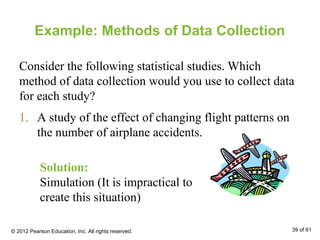
1. A study of the effect of changing flight patterns on
the number of airplane accidents.
Solution:
Simulation (It is impractical to
create this situation)
© 2012 Pearson Education, Inc. All rights reserved. 39 of 61
Example: Methods of Data Collection
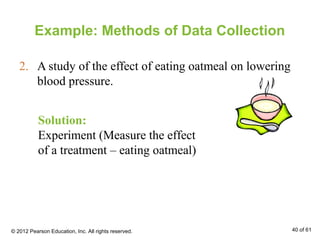
2. A study of the effect of eating oatmeal on lowering
blood pressure.
Solution:
Experiment (Measure the effect
of a treatment – eating oatmeal)
© 2012 Pearson Education, Inc. All rights reserved. 40 of 61
Example: Methods of Data Collection
Solution:
Observational study (observe
and measure certain
characteristics of part of a
population)
3. A study of how fourth grade students solve a puzzle.
© 2012 Pearson Education, Inc. All rights reserved. 41 of 61
Example: Methods of Data Collection
Solution:
Survey (Ask “Do you approve
of the way the president is
handling his job?”)
4. A study of U.S. residents’ approval rating of the U.S.
president.
© 2012 Pearson Education, Inc. All rights reserved. 42 of 61
Key Elements of Experimental Design
• Control
• Randomization
• Replication
© 2012 Pearson Education, Inc. All rights reserved. 43 of 61
Key Elements of Experimental Design:
Control
• Control for effects other than the one being measured.
• Confounding variables
 Occurs when an experimenter cannot tell the
difference between the effects of different factors on a
variable.
 A coffee shop owner remodels her shop at the same
time a nearby mall has its grand opening. If business
at the coffee shop increases, it cannot be determined
whether it is because of the remodeling or the new
mall.
© 2012 Pearson Education, Inc. All rights reserved. 44 of 61
Key Elements of Experimental Design:
Control
• Placebo effect
 A subject reacts favorably to a placebo when in
fact he or she has been given no medical treatment
at all.
 Blinding is a technique where the subject does not
know whether he or she is receiving a treatment or
a placebo.
 Double-blind experiment neither the subject nor
the experimenter knows if the subject is receiving
a treatment or a placebo.
© 2012 Pearson Education, Inc. All rights reserved. 45 of 61
Key Elements of Experimental Design:
Randomization
• Randomization is a process of randomly assigning
subjects to different treatment groups.
• Completely randomized design
 Subjects are assigned to different treatment groups
through random selection.
• Randomized block design
 Divide subjects with similar characteristics into
blocks, and then within each block, randomly
assign subjects to treatment groups.
© 2012 Pearson Education, Inc. All rights reserved. 46 of 61
Key Elements of Experimental Design:
Randomization
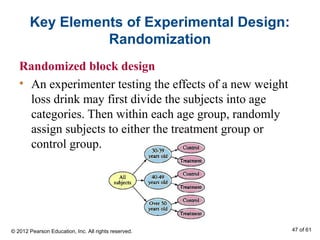
Randomized block design
• An experimenter testing the effects of a new weight
loss drink may first divide the subjects into age
categories. Then within each age group, randomly
assign subjects to either the treatment group or
control group.
© 2012 Pearson Education, Inc. All rights reserved. 47 of 61
Key Elements of Experimental Design:
Randomization
• Matched Pairs Design
 Subjects are paired up according to a similarity.
One subject in the pair is randomly selected to
receive one treatment while the other subject
receives a different treatment.
© 2012 Pearson Education, Inc. All rights reserved. 48 of 61
Key Elements of Experimental Design:
Replication
• Replication is the repetition of an experiment using a
large group of subjects.
• To test a vaccine against a strain of influenza, 10,000
people are given the vaccine and another 10,000
people are given a placebo. Because of the sample
size, the effectiveness of the vaccine would most
likely be observed.
© 2012 Pearson Education, Inc. All rights reserved. 49 of 61
Example: Experimental Design
A company wants to test the effectiveness of a new gum
developed to help people quit smoking. Identify a
potential problem with the given experimental design and
suggest a way to improve it.
The company identifies one thousand adults who are
heavy smokers. The subjects are divided into blocks
according to gender. Females are given the new gum and
males are given the placebo. After two months, the female
group has a significant number of subjects who have quit
smoking.
© 2012 Pearson Education, Inc. All rights reserved. 50 of 61
Solution: Experimental Design
Problem:
The groups are not similar. The new gum may have a
greater effect on women than men, or vice versa.
Correction:
The subjects can be divided into blocks according to
gender, but then within each block, they must be
randomly assigned to be in the treatment group or the
control group.
© 2012 Pearson Education, Inc. All rights reserved. 51 of 61
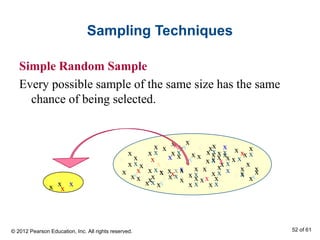
Sampling Techniques
Simple Random Sample
Every possible sample of the same size has the same
chance of being selected.
x x
x
xx
x
x
x x
x
x
x
x
x
x
x x
xx
x
x
x
x
x
x xx x
x
x
x
x
xx
x
x
x
x
x x
xx
x
x
x
x
x
x xx x
x
x
x
x
x
x
x
x
x
x
x x
xx
x
x
x
x
x
x xx x
x x
x
xx
x
x
x
x
x x
xx
x
x
x
x
x
x xx x
x x
x
x
x x
x
xx
x
x
x
x
© 2012 Pearson Education, Inc. All rights reserved. 52 of 61
Simple Random Sample
• Random numbers can be generated by a random
number table, a software program or a calculator.
• Assign a number to each member of the population.
• Members of the population that correspond to these
numbers become members of the sample.
© 2012 Pearson Education, Inc. All rights reserved. 53 of 61
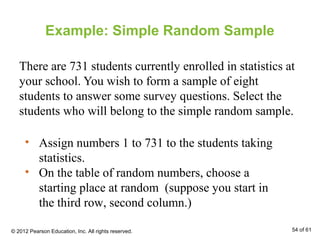
Example: Simple Random Sample
There are 731 students currently enrolled in statistics at
your school. You wish to form a sample of eight
students to answer some survey questions. Select the
students who will belong to the simple random sample.
• Assign numbers 1 to 731 to the students taking
statistics.
• On the table of random numbers, choose a
starting place at random (suppose you start in
the third row, second column.)
© 2012 Pearson Education, Inc. All rights reserved. 54 of 61
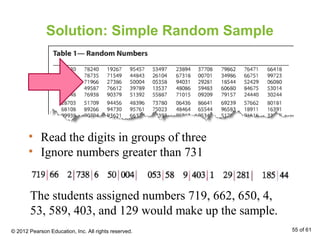
Solution: Simple Random Sample
• Read the digits in groups of three
• Ignore numbers greater than 731
The students assigned numbers 719, 662, 650, 4,
53, 589, 403, and 129 would make up the sample.
© 2012 Pearson Education, Inc. All rights reserved. 55 of 61
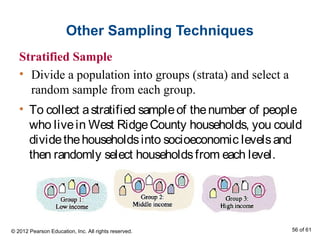
Other Sampling Techniques
Stratified Sample
• Divide a population into groups (strata) and select a
random sample from each group.
• To collect astratified sampleof thenumber of people
who livein West RidgeCounty households, you could
dividethehouseholdsinto socioeconomic levelsand
then randomly select householdsfrom each level.
© 2012 Pearson Education, Inc. All rights reserved. 56 of 61
Other Sampling Techniques
Cluster Sample
• Divide the population into groups (clusters) and
select all of the members in one or more, but not
all, of the clusters.
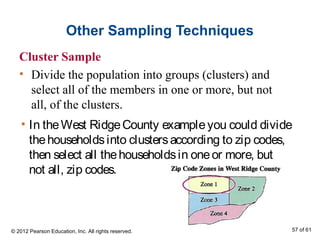
• In theWest RidgeCounty exampleyou could divide
thehouseholdsinto clustersaccording to zip codes,
then select all thehouseholdsin oneor more, but
not all, zip codes.
© 2012 Pearson Education, Inc. All rights reserved. 57 of 61
Other Sampling Techniques
Systematic Sample
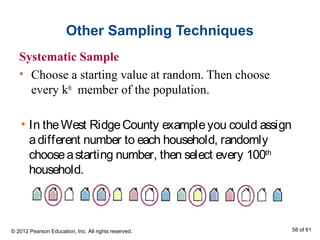
• Choose a starting value at random. Then choose
every kth
member of the population.
• In theWest RidgeCounty exampleyou could assign
adifferent number to each household, randomly
chooseastarting number, then select every 100th
household.
© 2012 Pearson Education, Inc. All rights reserved. 58 of 61
Example: Identifying Sampling Techniques
You are doing a study to determine the opinion of
students at your school regarding stem cell research.
Identify the sampling technique used.
1. You divide the student population with respect
to majors and randomly select and question
some students in each major.
Solution:
Stratified sampling (the students are divided into
strata (majors) and a sample is selected from each
major)
© 2012 Pearson Education, Inc. All rights reserved. 59 of 61
Example: Identifying Sampling Techniques
Solution:
Simple random sample (each sample of the same
size has an equal chance of being selected and
each student has an equal chance of being
selected.)
2. You assign each student a number and generate
random numbers. You then question each student
whose number is randomly selected.
© 2012 Pearson Education, Inc. All rights reserved. 60 of 61
Section 1.3 Summary
• Discussed how to design a statistical study
• Discussed data collection techniques
• Discussed how to design an experiment
• Discussed sampling techniques
© 2012 Pearson Education, Inc. All rights reserved. 61 of 61

Les5e ppt 01

  • 1.
    Chapter Introduction to Statistics 1 1 of61 © 2012 Pearson Education, Inc. All rights reserved.
  • 2.
    Chapter Outline • 1.1An Overview of Statistics • 1.2 Data Classification • 1.3 Experimental Design © 2012 Pearson Education, Inc. All rights reserved. 2 of 61
  • 3.
    Section 1.1 An Overviewof Statistics © 2012 Pearson Education, Inc. All rights reserved. 3 of 61
  • 4.
    Section 1.1 Objectives •Define statistics • Distinguish between a population and a sample • Distinguish between a parameter and a statistic • Distinguish between descriptive statistics and inferential statistics © 2012 Pearson Education, Inc. All rights reserved. 4 of 61
  • 5.
    What is Data? Data Consistof information coming from observations, counts, measurements, or responses. • “People who eat three daily servings of whole grains have been shown to reduce their risk of…stroke by 37%.” (Source: Whole Grains Council) • “Seventy percent of the 1500 U.S. spinal cord injuries to minors result from vehicle accidents, and 68 percent were not wearing a seatbelt.” (Source: UPI) © 2012 Pearson Education, Inc. All rights reserved. 5 of 61
  • 6.
    What is Statistics? Statistics Thescience of collecting, organizing, analyzing, and interpreting data in order to make decisions. © 2012 Pearson Education, Inc. All rights reserved. 6 of 61
  • 7.
    Data Sets Population The collectionof all outcomes, responses, measurements, or counts that are of interest. Sample A subset of the population. © 2012 Pearson Education, Inc. All rights reserved. 7 of 61
  • 8.
    Example: Identifying DataSets In a recent survey, 1500 adults in the United States were asked if they thought there was solid evidence for global warming. Eight hundred fifty-five of the adults said yes. Identify the population and the sample. Describe the data set. (Adapted from: Pew Research Center) © 2012 Pearson Education, Inc. All rights reserved. 8 of 61
  • 9.
    Solution: Identifying DataSets • The population consists of the responses of all adults in the U.S. • The sample consists of the responses of the 1500 adults in the U.S. in the survey. • The sample is a subset of the responses of all adults in the U.S. • The data set consists of 855 yes’s and 645 no’s. Responses of adults in the U.S. (population) Responses of adults in survey (sample) © 2012 Pearson Education, Inc. All rights reserved. 9 of 61
  • 10.
    Parameter and Statistic Parameter Anumber that describes a population characteristic. Average age of all people in the United States Statistic A number that describes a sample characteristic. Average age of people from a sample of three states © 2012 Pearson Education, Inc. All rights reserved. 10 of 61
  • 11.
    Example: Distinguish Parameterand Statistic Decide whether the numerical value describes a population parameter or a sample statistic. 1. A recent survey of a sample of college career centers reported that the average starting salary for petroleum engineering majors is $83,121. (Source: National Association of Colleges and Employers) Solution: Sample statistic (the average of $83,121 is based on a subset of the population) © 2012 Pearson Education, Inc. All rights reserved. 11 of 61
  • 12.
    Example: Distinguish Parameterand Statistic Decide whether the numerical value describes a population parameter or a sample statistic. 2. The 2182 students who accepted admission offers to Northwestern University in 2009 have an average SAT score of 1442. (Source: Northwestern University) Solution: Population parameter (the SAT score of 1442 is based on all the students who accepted admission offers in 2009) © 2012 Pearson Education, Inc. All rights reserved. 12 of 61
  • 13.
    Branches of Statistics Descriptive StatisticsInvolves organizing, summarizing, and displaying data. e.g. Tables, charts, averages Inferential Statistics Involves using sample data to draw conclusions about a population. © 2012 Pearson Education, Inc. All rights reserved. 13 of 61
  • 14.
    Example: Descriptive andInferential Statistics Decide which part of the study represents the descriptive branch of statistics. What conclusions might be drawn from the study using inferential statistics? A large sample of men, aged 48, was studied for 18 years. For unmarried men, approximately 70% were alive at age 65. For married men, 90% were alive at age 65. (Source: The Journal of Family Issues) © 2012 Pearson Education, Inc. All rights reserved. 14 of 61
  • 15.
    Solution: Descriptive andInferential Statistics Descriptive statistics involves statements such as “For unmarried men, approximately 70% were alive at age 65” and “For married men, 90% were alive at 65.” A possible inference drawn from the study is that being married is associated with a longer life for men. © 2012 Pearson Education, Inc. All rights reserved. 15 of 61
  • 16.
    Section 1.1 Summary •Defined statistics • Distinguished between a population and a sample • Distinguished between a parameter and a statistic • Distinguished between descriptive statistics and inferential statistics © 2012 Pearson Education, Inc. All rights reserved. 16 of 61
  • 17.
    Section 1.2 Data Classification ©2012 Pearson Education, Inc. All rights reserved. 17 of 61
  • 18.
    Section 1.2 Objectives •Distinguish between qualitative data and quantitative data • Classify data with respect to the four levels of measurement © 2012 Pearson Education, Inc. All rights reserved. 18 of 61
  • 19.
    Types of Data QualitativeData Consists of attributes, labels, or nonnumerical entries. Major Place of birth Eye color © 2012 Pearson Education, Inc. All rights reserved. 19 of 61
  • 20.
    Types of Data Quantitativedata Numerical measurements or counts. Age Weight of a letter Temperature © 2012 Pearson Education, Inc. All rights reserved. 20 of 61
  • 21.
    Example: Classifying Databy Type The suggested retail prices of several vehicles are shown in the table. Which data are qualitative data and which are quantitative data? (Source Ford Motor Company) © 2012 Pearson Education, Inc. All rights reserved. 21 of 61
  • 22.
    Solution: Classifying Databy Type Quantitative Data (Suggested retail prices of vehicle models are numerical entries) © 2012 Pearson Education, Inc. All rights reserved. 22 of 61 Qualitative Data (Names of vehicle models are nonnumerical entries)
  • 23.
    Levels of Measurement Nominallevel of measurement • Qualitative data only • Categorized using names, labels, or qualities • No mathematical computations can be made Ordinal level of measurement • Qualitative or quantitative data • Data can be arranged in order • Differences between data entries is not meaningful © 2012 Pearson Education, Inc. All rights reserved. 23 of 61
  • 24.
    Example: Classifying Databy Level Two data sets are shown. Which data set consists of data at the nominal level? Which data set consists of data at the ordinal level? (Source: Nielsen Media Research) © 2012 Pearson Education, Inc. All rights reserved. 24 of 61
  • 25.
    Solution: Classifying Databy Level Ordinal level (lists the ranks of five TV programs. Data can be ordered. Difference between ranks is not meaningful.) Nominal level (lists the call letters of each network affiliate. Call letters are names of network affiliates.) © 2012 Pearson Education, Inc. All rights reserved. 25 of 61
  • 26.
    Levels of Measurement Intervallevel of measurement • Quantitative data • Data can be ordered • Differences between data entries are meaningful • Zero represents a position on a scale (not an inherent zero – zero does not imply “none”) © 2012 Pearson Education, Inc. All rights reserved. 26 of 61
  • 27.
    Levels of Measurement Ratiolevel of measurement • Similar to interval level • Zero entry is an inherent zero (implies “none”) • A ratio of two data values can be formed • One data value can be meaningfully expressed as a multiple of another © 2012 Pearson Education, Inc. All rights reserved. 27 of 61
  • 28.
    Example: Classifying Databy Level Two data sets are shown. Which data set consists of data at the interval level? Which data set consists of data at the ratio level? (Source: Major League Baseball) © 2012 Pearson Education, Inc. All rights reserved. 28 of 61
  • 29.
    Solution: Classifying Databy Level Interval level (Quantitative data. Can find a difference between two dates, but a ratio does not make sense.) Ratio level (Can find differences and write ratios.) © 2012 Pearson Education, Inc. All rights reserved. 29 of 61
  • 30.
    Summary of FourLevels of Measurement Level of Measurement Put data in categories Arrange data in order Subtract data values Determine if one data value is a multiple of another Nominal Yes No No No Ordinal Yes Yes No No Interval Yes Yes Yes No Ratio Yes Yes Yes Yes © 2012 Pearson Education, Inc. All rights reserved. 30 of 61
  • 31.
    Section 1.2 Summary •Distinguished between qualitative data and quantitative data • Classified data with respect to the four levels of measurement © 2012 Pearson Education, Inc. All rights reserved. 31 of 61
  • 32.
    Section 1.3 Experimental Design ©2012 Pearson Education, Inc. All rights reserved. 32 of 61
  • 33.
    Section 1.3 Objectives •Discuss how to design a statistical study • Discuss data collection techniques • Discuss how to design an experiment • Discuss sampling techniques © 2012 Pearson Education, Inc. All rights reserved. 33 of 61
  • 34.
    Designing a StatisticalStudy 3. Collect the data. 4. Describe the data using descriptive statistics techniques. 5. Interpret the data and make decisions about the population using inferential statistics. 6. Identify any possible errors. 1. Identify the variable(s) of interest (the focus) and the population of the study. 2. Develop a detailed plan for collecting data. If you use a sample, make sure the sample is representative of the population. © 2012 Pearson Education, Inc. All rights reserved. 34 of 61
  • 35.
    Data Collection Observational study •A researcher observes and measures characteristics of interest of part of a population. • Researchers observed and recorded the mouthing behavior on nonfood objects of children up to three years old. (Source: Pediatric Magazine) © 2012 Pearson Education, Inc. All rights reserved. 35 of 61
  • 36.
    Data Collection Experiment • Atreatment is applied to part of a population and responses are observed. • An experiment was performed in which diabetics took cinnamon extract daily while a control group took none. After 40 days, the diabetics who had the cinnamon reduced their risk of heart disease while the control group experienced no change. (Source: Diabetes Care) © 2012 Pearson Education, Inc. All rights reserved. 36 of 61
  • 37.
    Data Collection Simulation • Usesa mathematical or physical model to reproduce the conditions of a situation or process. • Often involves the use of computers. • Automobile manufacturers use simulations with dummies to study the effects of crashes on humans. © 2012 Pearson Education, Inc. All rights reserved. 37 of 61
  • 38.
    Data Collection Survey • Aninvestigation of one or more characteristics of a population. • Commonly done by interview, mail, or telephone. • A survey is conducted on a sample of female physicians to determine whether the primary reason for their career choice is financial stability. © 2012 Pearson Education, Inc. All rights reserved. 38 of 61
  • 39.
    Example: Methods ofData Collection Consider the following statistical studies. Which method of data collection would you use to collect data for each study? 1. A study of the effect of changing flight patterns on the number of airplane accidents. Solution: Simulation (It is impractical to create this situation) © 2012 Pearson Education, Inc. All rights reserved. 39 of 61
  • 40.
    Example: Methods ofData Collection 2. A study of the effect of eating oatmeal on lowering blood pressure. Solution: Experiment (Measure the effect of a treatment – eating oatmeal) © 2012 Pearson Education, Inc. All rights reserved. 40 of 61
  • 41.
    Example: Methods ofData Collection Solution: Observational study (observe and measure certain characteristics of part of a population) 3. A study of how fourth grade students solve a puzzle. © 2012 Pearson Education, Inc. All rights reserved. 41 of 61
  • 42.
    Example: Methods ofData Collection Solution: Survey (Ask “Do you approve of the way the president is handling his job?”) 4. A study of U.S. residents’ approval rating of the U.S. president. © 2012 Pearson Education, Inc. All rights reserved. 42 of 61
  • 43.
    Key Elements ofExperimental Design • Control • Randomization • Replication © 2012 Pearson Education, Inc. All rights reserved. 43 of 61
  • 44.
    Key Elements ofExperimental Design: Control • Control for effects other than the one being measured. • Confounding variables  Occurs when an experimenter cannot tell the difference between the effects of different factors on a variable.  A coffee shop owner remodels her shop at the same time a nearby mall has its grand opening. If business at the coffee shop increases, it cannot be determined whether it is because of the remodeling or the new mall. © 2012 Pearson Education, Inc. All rights reserved. 44 of 61
  • 45.
    Key Elements ofExperimental Design: Control • Placebo effect  A subject reacts favorably to a placebo when in fact he or she has been given no medical treatment at all.  Blinding is a technique where the subject does not know whether he or she is receiving a treatment or a placebo.  Double-blind experiment neither the subject nor the experimenter knows if the subject is receiving a treatment or a placebo. © 2012 Pearson Education, Inc. All rights reserved. 45 of 61
  • 46.
    Key Elements ofExperimental Design: Randomization • Randomization is a process of randomly assigning subjects to different treatment groups. • Completely randomized design  Subjects are assigned to different treatment groups through random selection. • Randomized block design  Divide subjects with similar characteristics into blocks, and then within each block, randomly assign subjects to treatment groups. © 2012 Pearson Education, Inc. All rights reserved. 46 of 61
  • 47.
    Key Elements ofExperimental Design: Randomization Randomized block design • An experimenter testing the effects of a new weight loss drink may first divide the subjects into age categories. Then within each age group, randomly assign subjects to either the treatment group or control group. © 2012 Pearson Education, Inc. All rights reserved. 47 of 61
  • 48.
    Key Elements ofExperimental Design: Randomization • Matched Pairs Design  Subjects are paired up according to a similarity. One subject in the pair is randomly selected to receive one treatment while the other subject receives a different treatment. © 2012 Pearson Education, Inc. All rights reserved. 48 of 61
  • 49.
    Key Elements ofExperimental Design: Replication • Replication is the repetition of an experiment using a large group of subjects. • To test a vaccine against a strain of influenza, 10,000 people are given the vaccine and another 10,000 people are given a placebo. Because of the sample size, the effectiveness of the vaccine would most likely be observed. © 2012 Pearson Education, Inc. All rights reserved. 49 of 61
  • 50.
    Example: Experimental Design Acompany wants to test the effectiveness of a new gum developed to help people quit smoking. Identify a potential problem with the given experimental design and suggest a way to improve it. The company identifies one thousand adults who are heavy smokers. The subjects are divided into blocks according to gender. Females are given the new gum and males are given the placebo. After two months, the female group has a significant number of subjects who have quit smoking. © 2012 Pearson Education, Inc. All rights reserved. 50 of 61
  • 51.
    Solution: Experimental Design Problem: Thegroups are not similar. The new gum may have a greater effect on women than men, or vice versa. Correction: The subjects can be divided into blocks according to gender, but then within each block, they must be randomly assigned to be in the treatment group or the control group. © 2012 Pearson Education, Inc. All rights reserved. 51 of 61
  • 52.
    Sampling Techniques Simple RandomSample Every possible sample of the same size has the same chance of being selected. x x x xx x x x x x x x x x x x x xx x x x x x x xx x x x x x xx x x x x x x xx x x x x x x xx x x x x x x x x x x x x x xx x x x x x x xx x x x x xx x x x x x x xx x x x x x x xx x x x x x x x x xx x x x x © 2012 Pearson Education, Inc. All rights reserved. 52 of 61
  • 53.
    Simple Random Sample •Random numbers can be generated by a random number table, a software program or a calculator. • Assign a number to each member of the population. • Members of the population that correspond to these numbers become members of the sample. © 2012 Pearson Education, Inc. All rights reserved. 53 of 61
  • 54.
    Example: Simple RandomSample There are 731 students currently enrolled in statistics at your school. You wish to form a sample of eight students to answer some survey questions. Select the students who will belong to the simple random sample. • Assign numbers 1 to 731 to the students taking statistics. • On the table of random numbers, choose a starting place at random (suppose you start in the third row, second column.) © 2012 Pearson Education, Inc. All rights reserved. 54 of 61
  • 55.
    Solution: Simple RandomSample • Read the digits in groups of three • Ignore numbers greater than 731 The students assigned numbers 719, 662, 650, 4, 53, 589, 403, and 129 would make up the sample. © 2012 Pearson Education, Inc. All rights reserved. 55 of 61
  • 56.
    Other Sampling Techniques StratifiedSample • Divide a population into groups (strata) and select a random sample from each group. • To collect astratified sampleof thenumber of people who livein West RidgeCounty households, you could dividethehouseholdsinto socioeconomic levelsand then randomly select householdsfrom each level. © 2012 Pearson Education, Inc. All rights reserved. 56 of 61
  • 57.
    Other Sampling Techniques ClusterSample • Divide the population into groups (clusters) and select all of the members in one or more, but not all, of the clusters. • In theWest RidgeCounty exampleyou could divide thehouseholdsinto clustersaccording to zip codes, then select all thehouseholdsin oneor more, but not all, zip codes. © 2012 Pearson Education, Inc. All rights reserved. 57 of 61
  • 58.
    Other Sampling Techniques SystematicSample • Choose a starting value at random. Then choose every kth member of the population. • In theWest RidgeCounty exampleyou could assign adifferent number to each household, randomly chooseastarting number, then select every 100th household. © 2012 Pearson Education, Inc. All rights reserved. 58 of 61
  • 59.
    Example: Identifying SamplingTechniques You are doing a study to determine the opinion of students at your school regarding stem cell research. Identify the sampling technique used. 1. You divide the student population with respect to majors and randomly select and question some students in each major. Solution: Stratified sampling (the students are divided into strata (majors) and a sample is selected from each major) © 2012 Pearson Education, Inc. All rights reserved. 59 of 61
  • 60.
    Example: Identifying SamplingTechniques Solution: Simple random sample (each sample of the same size has an equal chance of being selected and each student has an equal chance of being selected.) 2. You assign each student a number and generate random numbers. You then question each student whose number is randomly selected. © 2012 Pearson Education, Inc. All rights reserved. 60 of 61
  • 61.
    Section 1.3 Summary •Discussed how to design a statistical study • Discussed data collection techniques • Discussed how to design an experiment • Discussed sampling techniques © 2012 Pearson Education, Inc. All rights reserved. 61 of 61