Chapter 1
Introduction To
Statistics
Statistics
Data and Statistics
Statistics:
Statistics is the science of collecting, organization ,
analyzing, and interpreting data in order to make decisions.
Data:
Data consist of information coming from observations,
counts, measurements, or responses.
Populations and Sample
Population:
A population is the collection of all outcomes, response ,
measurement , or counts that are of interest.
Sample:
A sample is subset of a population.
Populations and Sample
Example:
In a recent survey, 250 college students at Union College were
asked if they drinks cold drinks regularly.35 of the students said yes.
Identify the population and samples.
Response of all students at Union College(population)
Response of students in survey(sample)
Parameters and Statistics
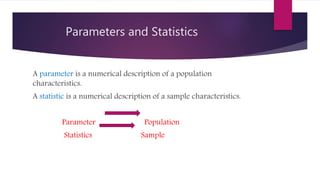
A parameter is a numerical description of a population
characteristics.
A statistic is a numerical description of a sample characteristics.
Parameter Population
Statistics Sample
Parameters and Statistics
Example:
Decide whether the numerical value describes as a population parameter or a
sample statistics.
a) A recent survey of a sample of 450 college students reported that the average
weekly income for students is $325.
Because the average of $325 is based on a sample, this is a sample statistics.
b) The average weekly income for all students is $405.
Because the average of $405 is based on a population. This is a population
parameter.
Branches of Statistics
The study of statistics has two major branches:
Descriptive statistics and inferential statistics.
Statistics
Descriptive Statistics:
Involves the organization, summarization, and display of data.
Inferential Statistics:
Involves using a sample to draw conclusions about a population.
Descriptive and Inferential Statistics
In a recent study, volunteers who had less than 6 hours of sleep were
four times more likely to answer incorrectly on a science test than
were participants who had at least 8 hours of sleep. Decide which
part is the descriptive statistics and what conclusion might be drawn
using inferential statistics.
The statement “ four times more likely to answer incorrectly” is a
descriptive statistics . An inference drawn from the sample is that all
individuals sleeping less than 6 hours are more likely to answer
science question incorrectly than individual who sleep at least 8
hours.
Data Classification
Types of Data
Data sets can consist of two types of data:
Qualitative data and quantitative data.
Qualitative Data:
Consists of attributes, labels, or non numerical entries.
Quantitative Data:
Consists of numerical measurements or counts.
Qualitative and Quantitative Data
Example:
The grade point averages of five students are listed in the table . Which data are
qualitative data and which are quantitative data?
qualitative data
quantitative data
Students GPA
Sally 3.22
Bob 3.98
Cindy 2.75
Mark 2.24
Kathy 3.84
Levels of Measurement
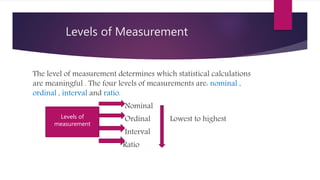
The level of measurement determines which statistical calculations
are meaningful . The four levels of measurements are: nominal ,
ordinal , interval and ratio.
Nominal
Ordinal Lowest to highest
Interval
Ratio
Levels of
measurement
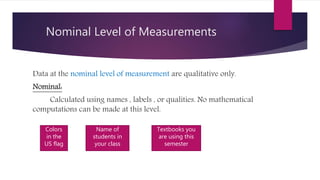
Nominal Level of Measurements
Data at the nominal level of measurement are qualitative only.
Nominal:
Calculated using names , labels , or qualities. No mathematical
computations can be made at this level.
Colors
in the
US flag
Name of
students in
your class
Textbooks you
are using this
semester
Ordinal Level of Measurements
Data at the ordinal level of measurement are qualitative and
quantitative.
Ordinal:
Arrange in order , but differences between data entries are not
meaningful.
Class standings:
freshman,
sophomore, junior
or senior
Numbers on the
back of each
player’s shirt
Top 50 songs
played on the
radio
Interval Level of Measurements
Data at the interval level of measurement are quantitative. A zero
entry simply represents a positive on a scale ; the entry is not an
inherent zero.
Interval:
Arranged in order, the differences between data entries can be
calculated.
Temperature Years on a
timeline
Atlanta Braves
World Series
victories
Ratio Level of Measurements
Data at the ratio level of measurement are similar to the interval
level, but a zero is meaningful.
Ratio:
A ratio of two data values can be formed so one data value can be
expressed as a ratio.
Ages
Grade point
Averages
Weights
Summary of Levels of Measurements
Level of
measurement
Put data in
categories
Arrange data
in order
Subtract data
values
Determine if
one data value
is a multiple
another
Nominal yes No No No
Ordinal Yes yes No No
Interval yes yes yes No
Ratio yes Yes yes yes
Experimental Design
TOPIC 3
Designing a Statistical Study
GUIDELINES:
1. Identify the variable(s) of interest (the focus) and the population of the study.
2. Developed a detailed plane for collecting data. If you use a sample ,make sure
the sample is representative of the population.
3. Collect the data.
4. Describe the data.
5. Interpret the data and make decisions about the population using inferential
statistics.
6. Identify any possible errors.
Methods of Data Collection
In an observational study, a researchers observes and measures characteristics of
interest of part of a population.
In an experiment, a treatment is applied to part of a population and responses are
observed.
A simulation is the use of a mathematical and physical model to reproduce the
conditions of a situation or process.
A survey is an investigation of one or more characteristics of a population.
A census is an measurement of entire population.
A sampling is a measurement of part of a population
Stratified Sample
A stratified sample has members from each segment of a population. This ensures
that each segment from the population is represented.

Statistics

  • 1.
  • 2.
  • 3.
    Data and Statistics Statistics: Statisticsis the science of collecting, organization , analyzing, and interpreting data in order to make decisions. Data: Data consist of information coming from observations, counts, measurements, or responses.
  • 4.
    Populations and Sample Population: Apopulation is the collection of all outcomes, response , measurement , or counts that are of interest. Sample: A sample is subset of a population.
  • 5.
    Populations and Sample Example: Ina recent survey, 250 college students at Union College were asked if they drinks cold drinks regularly.35 of the students said yes. Identify the population and samples. Response of all students at Union College(population) Response of students in survey(sample)
  • 6.
    Parameters and Statistics Aparameter is a numerical description of a population characteristics. A statistic is a numerical description of a sample characteristics. Parameter Population Statistics Sample
  • 7.
    Parameters and Statistics Example: Decidewhether the numerical value describes as a population parameter or a sample statistics. a) A recent survey of a sample of 450 college students reported that the average weekly income for students is $325. Because the average of $325 is based on a sample, this is a sample statistics. b) The average weekly income for all students is $405. Because the average of $405 is based on a population. This is a population parameter.
  • 8.
    Branches of Statistics Thestudy of statistics has two major branches: Descriptive statistics and inferential statistics. Statistics Descriptive Statistics: Involves the organization, summarization, and display of data. Inferential Statistics: Involves using a sample to draw conclusions about a population.
  • 9.
    Descriptive and InferentialStatistics In a recent study, volunteers who had less than 6 hours of sleep were four times more likely to answer incorrectly on a science test than were participants who had at least 8 hours of sleep. Decide which part is the descriptive statistics and what conclusion might be drawn using inferential statistics. The statement “ four times more likely to answer incorrectly” is a descriptive statistics . An inference drawn from the sample is that all individuals sleeping less than 6 hours are more likely to answer science question incorrectly than individual who sleep at least 8 hours.
  • 10.
  • 11.
    Types of Data Datasets can consist of two types of data: Qualitative data and quantitative data. Qualitative Data: Consists of attributes, labels, or non numerical entries. Quantitative Data: Consists of numerical measurements or counts.
  • 12.
    Qualitative and QuantitativeData Example: The grade point averages of five students are listed in the table . Which data are qualitative data and which are quantitative data? qualitative data quantitative data Students GPA Sally 3.22 Bob 3.98 Cindy 2.75 Mark 2.24 Kathy 3.84
  • 13.
    Levels of Measurement Thelevel of measurement determines which statistical calculations are meaningful . The four levels of measurements are: nominal , ordinal , interval and ratio. Nominal Ordinal Lowest to highest Interval Ratio Levels of measurement
  • 14.
    Nominal Level ofMeasurements Data at the nominal level of measurement are qualitative only. Nominal: Calculated using names , labels , or qualities. No mathematical computations can be made at this level. Colors in the US flag Name of students in your class Textbooks you are using this semester
  • 15.
    Ordinal Level ofMeasurements Data at the ordinal level of measurement are qualitative and quantitative. Ordinal: Arrange in order , but differences between data entries are not meaningful. Class standings: freshman, sophomore, junior or senior Numbers on the back of each player’s shirt Top 50 songs played on the radio
  • 16.
    Interval Level ofMeasurements Data at the interval level of measurement are quantitative. A zero entry simply represents a positive on a scale ; the entry is not an inherent zero. Interval: Arranged in order, the differences between data entries can be calculated. Temperature Years on a timeline Atlanta Braves World Series victories
  • 17.
    Ratio Level ofMeasurements Data at the ratio level of measurement are similar to the interval level, but a zero is meaningful. Ratio: A ratio of two data values can be formed so one data value can be expressed as a ratio. Ages Grade point Averages Weights
  • 18.
    Summary of Levelsof Measurements Level of measurement Put data in categories Arrange data in order Subtract data values Determine if one data value is a multiple another Nominal yes No No No Ordinal Yes yes No No Interval yes yes yes No Ratio yes Yes yes yes
  • 19.
  • 20.
    Designing a StatisticalStudy GUIDELINES: 1. Identify the variable(s) of interest (the focus) and the population of the study. 2. Developed a detailed plane for collecting data. If you use a sample ,make sure the sample is representative of the population. 3. Collect the data. 4. Describe the data. 5. Interpret the data and make decisions about the population using inferential statistics. 6. Identify any possible errors.
  • 21.
    Methods of DataCollection In an observational study, a researchers observes and measures characteristics of interest of part of a population. In an experiment, a treatment is applied to part of a population and responses are observed. A simulation is the use of a mathematical and physical model to reproduce the conditions of a situation or process. A survey is an investigation of one or more characteristics of a population. A census is an measurement of entire population. A sampling is a measurement of part of a population
  • 22.
    Stratified Sample A stratifiedsample has members from each segment of a population. This ensures that each segment from the population is represented.