Chapter
Confidence Intervals
1 of 83
6
© 2012 Pearson Education, Inc.
All rights reserved.
Chapter Outline
• 6.1 Confidence Intervals for the Mean (Large
Samples)
• 6.2 Confidence Intervals for the Mean (Small
Samples)
• 6.3 Confidence Intervals for Population Proportions
• 6.4 Confidence Intervals for Variance and Standard
Deviation
© 2012 Pearson Education, Inc. All rights reserved. 2 of 83
Section 6.1
Confidence Intervals for the Mean
(Large Samples)
© 2012 Pearson Education, Inc. All rights reserved. 3 of 83
Section 6.1 Objectives
• Find a point estimate and a margin of error
• Construct and interpret confidence intervals for the
population mean
• Determine the minimum sample size required when
estimating μ
© 2012 Pearson Education, Inc. All rights reserved. 4 of 83
Point Estimate for Population μ
Point Estimate
• A single value estimate for a population parameter
• Most unbiased point estimate of the population mean
μ is the sample mean x
Estimate Population
Parameter…
with Sample
Statistic
Mean: μ x
© 2012 Pearson Education, Inc. All rights reserved. 5 of 83
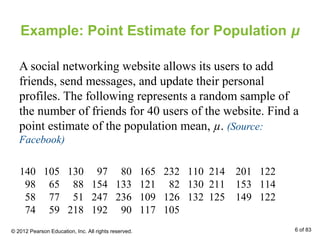
Example: Point Estimate for Population μ
A social networking website allows its users to add
friends, send messages, and update their personal
profiles. The following represents a random sample of
the number of friends for 40 users of the website. Find a
point estimate of the population mean, µ. (Source:
Facebook)
140 105 130 97 80 165 232 110 214 201 122
98 65 88 154 133 121 82 130 211 153 114
58 77 51 247 236 109 126 132 125 149 122
74 59 218 192 90 117 105
© 2012 Pearson Education, Inc. All rights reserved. 6 of 83
Solution: Point Estimate for Population μ
The sample mean of the data is
5232
130.8
40
x
x
n
Σ
= = =
Your point estimate for the mean number of friends for
all users of the website is 130.8 friends.
© 2012 Pearson Education, Inc. All rights reserved. 7 of 83
115 120 125 130 135 140 150145
Point estimate
115 120 125 130 135 140 150145
Point estimate
130.8x =
How confident do we want to be that the interval estimate
contains the population mean μ?
Interval Estimate
Interval estimate
• An interval, or range of values, used to estimate a
population parameter.
© 2012 Pearson Education, Inc. All rights reserved. 8 of 83
( )
Interval estimate
Right endpoint
146.5
Left endpoint
115.1
Level of Confidence
Level of confidence c
• The probability that the interval estimate contains the
population parameter.
z
z = 0–zc zc
Critical values
½(1 – c) ½(1 – c)
c is the area under the
standard normal curve
between the critical values.
The remaining area in the tails is 1 – c .
c
Use the Standard
Normal Table to find the
corresponding z-scores.
© 2012 Pearson Education, Inc. All rights reserved. 9 of 83
−zc
Level of Confidence
• If the level of confidence is 90%, this means that we
are 90% confident that the interval contains the
population mean μ.
z
z = 0 zc
The corresponding z-scores are ±1.645.
c = 0.90
½(1 – c) = 0.05½(1 – c) = 0.05
–zc = –1.645 zc = 1.645
© 2012 Pearson Education, Inc. All rights reserved. 10 of 83
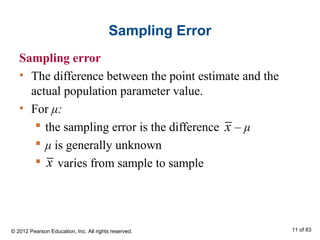
Sampling Error
Sampling error
• The difference between the point estimate and the
actual population parameter value.
• For μ:
 the sampling error is the difference – μ
 μ is generally unknown
 varies from sample to sample
x
x
© 2012 Pearson Education, Inc. All rights reserved. 11 of 83
Margin of Error
Margin of error
• The greatest possible distance between the point
estimate and the value of the parameter it is
estimating for a given level of confidence, c.
• Denoted by E.
• Sometimes called the maximum error of estimate or
error tolerance.
c x cE z z
n
= =
σσ When n ≥ 30, the sample
standard deviation, s, can
be used for σ.
© 2012 Pearson Education, Inc. All rights reserved. 12 of 83
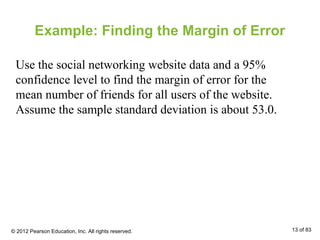
Example: Finding the Margin of Error
Use the social networking website data and a 95%
confidence level to find the margin of error for the
mean number of friends for all users of the website.
Assume the sample standard deviation is about 53.0.
© 2012 Pearson Education, Inc. All rights reserved. 13 of 83
−zc
Solution: Finding the Margin of Error
• First find the critical values
z
zcz = 0
0.95
0.0250.025
–zc = –1.96
95% of the area under the standard normal curve falls
within 1.96 standard deviations of the mean. (You
can approximate the distribution of the sample means
with a normal curve by the Central Limit Theorem,
because n = 40 ≥ 30.)
zc = 1.96
© 2012 Pearson Education, Inc. All rights reserved. 14 of 83
Solution: Finding the Margin of Error
53.0
1.96
40
16.4
c c
s
E z z
n n
σ
≈
=
×
≈
≈
You don’t know σ, but
since n ≥ 30, you can
use s in place of σ.
You are 95% confident that the margin of error for the
population mean is about 16.4 friends.
© 2012 Pearson Education, Inc. All rights reserved. 15 of 83
Confidence Intervals for the Population
Mean
A c-confidence interval for the population mean μ
•
• The probability that the confidence interval contains
μ is c.
where cx E x E E z
n
σ
µ− < < + =
© 2012 Pearson Education, Inc. All rights reserved. 16 of 83
Constructing Confidence Intervals for μ
Finding a Confidence Interval for a Population Mean
(n ≥ 30 or σ known with a normally distributed population)
In Words In Symbols
1. Find the sample statistics n and
.
2. Specify σ, if known.
Otherwise, if n ≥ 30, find the
sample standard deviation s and
use it as an estimate for σ.
x
x
n
Σ
=
2
( )
1
x x
s
n
Σ −
=
−
x
© 2012 Pearson Education, Inc. All rights reserved. 17 of 83
Constructing Confidence Intervals for μ
3. Find the critical value zc that
corresponds to the given
level of confidence.
4. Find the margin of error E.
5. Find the left and right
endpoints and form the
confidence interval.
Use the Standard
Normal Table or
technology.
Left endpoint:
Right endpoint:
Interval:
cE z
n
σ
=
x E−
x E+
x E x Eµ− < < +
In Words In Symbols
© 2012 Pearson Education, Inc. All rights reserved. 18 of 83
Example: Constructing a Confidence
Interval
Construct a 95% confidence interval for the mean
number of friends for all users of the website.
Solution: Recall and E ≈ 16.4130.8x =
130.8 16.4
114.4
x E−
≈ −
=
130.8 16.4
147.2
x E+
≈ +
=
114.4 < μ < 147.2
Left Endpoint: Right Endpoint:
© 2012 Pearson Education, Inc. All rights reserved. 19 of 83
Solution: Constructing a Confidence
Interval
114.4 < μ < 147.2
•
With 95% confidence, you can say that the
population mean number of friends is between 114.4
and 147.2.
© 2012 Pearson Education, Inc. All rights reserved. 20 of 83
Example: Constructing a Confidence
Interval σ Known
A college admissions director wishes to estimate the
mean age of all students currently enrolled. In a random
sample of 20 students, the mean age is found to be 22.9
years. From past studies, the standard deviation is
known to be 1.5 years, and the population is normally
distributed. Construct a 90% confidence interval of the
population mean age.
© 2012 Pearson Education, Inc. All rights reserved. 21 of 83
−zc
Solution: Constructing a Confidence
Interval σ Known
• First find the critical values
z
z = 0 zc
c = 0.90
½(1 – c) = 0.05½(1 – c) = 0.05
–zc = –1.645 zc = 1.645
zc = 1.645
© 2012 Pearson Education, Inc. All rights reserved. 22 of 83
• Margin of error:
• Confidence interval:
Solution: Constructing a Confidence
Interval σ Known
1.5
1.645 0.6
20
cE z
n
σ
= ≈= ×
22.9 0.6
22.3
x E−
≈ −
=
22.9 0.6
23.5
x E+
≈ +
=
Left Endpoint: Right Endpoint:
22.3 < μ < 23.5
© 2012 Pearson Education, Inc. All rights reserved. 23 of 83
Solution: Constructing a Confidence
Interval σ Known
22.3 < μ < 23.5
( )•
22.922.3 23.5
With 90% confidence, you can say that the mean age
of all the students is between 22.3 and 23.5 years.
Point estimate
xx E− x E+
© 2012 Pearson Education, Inc. All rights reserved. 24 of 83
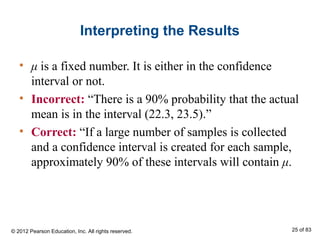
Interpreting the Results
• μ is a fixed number. It is either in the confidence
interval or not.
• Incorrect: “There is a 90% probability that the actual
mean is in the interval (22.3, 23.5).”
• Correct: “If a large number of samples is collected
and a confidence interval is created for each sample,
approximately 90% of these intervals will contain μ.
© 2012 Pearson Education, Inc. All rights reserved. 25 of 83
Interpreting the Results
The horizontal segments
represent 90% confidence
intervals for different
samples of the same size.
In the long run, 9 of every
10 such intervals will
contain μ. μ
© 2012 Pearson Education, Inc. All rights reserved. 26 of 83
Sample Size
• Given a c-confidence level and a margin of error E,
the minimum sample size n needed to estimate the
population mean µ is
• If σ is unknown, you can estimate it using s, provided
you have a preliminary sample with at least 30
members.
2
cz
n
E
σ 
=  ÷
 
© 2012 Pearson Education, Inc. All rights reserved. 27 of 83
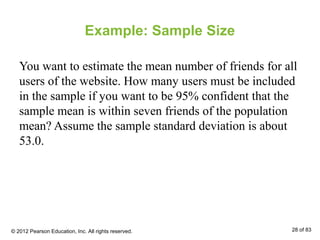
Example: Sample Size
You want to estimate the mean number of friends for all
users of the website. How many users must be included
in the sample if you want to be 95% confident that the
sample mean is within seven friends of the population
mean? Assume the sample standard deviation is about
53.0.
© 2012 Pearson Education, Inc. All rights reserved. 28 of 83
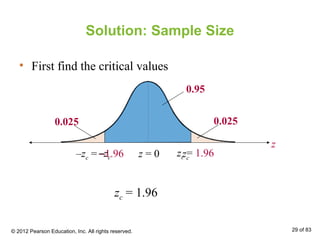
−zc
Solution: Sample Size
• First find the critical values
zc = 1.96
z
z = 0 zc
0.95
0.0250.025
–zc = –1.96 zc = 1.96
© 2012 Pearson Education, Inc. All rights reserved. 29 of 83
Solution: Sample Size
zc = 1.96 σ ≈ s ≈ 53.0 E = 7
2 2
1.96 53.0
220.23
7
cz
n
E
σ × 
≈ ≈
 
=  ÷



÷
 
When necessary, round up to obtain a whole number.
You should include at least 221 users in your sample.
© 2012 Pearson Education, Inc. All rights reserved. 30 of 83
Section 6.1 Summary
• Found a point estimate and a margin of error
• Constructed and interpreted confidence intervals for
the population mean
• Determined the minimum sample size required when
estimating μ
© 2012 Pearson Education, Inc. All rights reserved. 31 of 83
Section 6.2
Confidence Intervals for the Mean
(Small Samples)
© 2012 Pearson Education, Inc. All rights reserved. 32 of 83
Section 6.2 Objectives
• Interpret the t-distribution and use a t-distribution
table
• Construct confidence intervals when n < 30, the
population is normally distributed, and σ is unknown
© 2012 Pearson Education, Inc. All rights reserved. 33 of 83
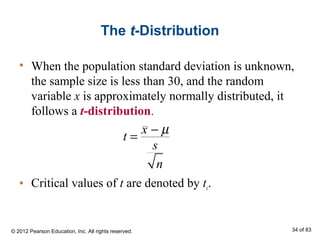
The t-Distribution
• When the population standard deviation is unknown,
the sample size is less than 30, and the random
variable x is approximately normally distributed, it
follows a t-distribution.
• Critical values of t are denoted by tc.
t =
x − µ
s
n
© 2012 Pearson Education, Inc. All rights reserved. 34 of 83
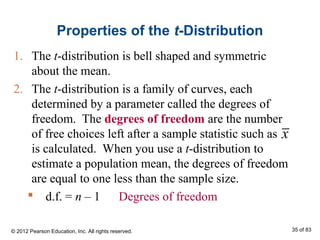
Properties of the t-Distribution
1. The t-distribution is bell shaped and symmetric
about the mean.
2. The t-distribution is a family of curves, each
determined by a parameter called the degrees of
freedom. The degrees of freedom are the number
of free choices left after a sample statistic such as
is calculated. When you use a t-distribution to
estimate a population mean, the degrees of freedom
are equal to one less than the sample size.
 d.f. = n – 1 Degrees of freedom
x
© 2012 Pearson Education, Inc. All rights reserved. 35 of 83
Properties of the t-Distribution
3. The total area under a t-curve is 1 or 100%.
4. The mean, median, and mode of the t-distribution are
equal to zero.
5. As the degrees of freedom increase, the t-distribution
approaches the normal distribution. After 30 d.f., the t-
distribution is very close to the standard normal z-
distribution.
t
0
Standard normal curve
The tails in the t-
distribution are “thicker”
than those in the standard
normal distribution.d.f. = 5
d.f. = 2
© 2012 Pearson Education, Inc. All rights reserved. 36 of 83
Example: Critical Values of t
Find the critical value tc for a 95% confidence level
when the sample size is 15.
Table 5: t-Distribution
tc = 2.145
Solution: d.f. = n – 1 = 15 – 1 = 14
© 2012 Pearson Education, Inc. All rights reserved. 37 of 83
Solution: Critical Values of t
95% of the area under the t-distribution curve with 14
degrees of freedom lies between t = ±2.145.
t
–tc = –2.145 tc = 2.145
c = 0.95
© 2012 Pearson Education, Inc. All rights reserved. 38 of 83
Confidence Intervals for the Population
Mean
A c-confidence interval for the population mean μ
•
• The probability that the confidence interval contains
μ is c.
where c
s
x E x E E t
n
µ− < < + =
© 2012 Pearson Education, Inc. All rights reserved. 39 of 83
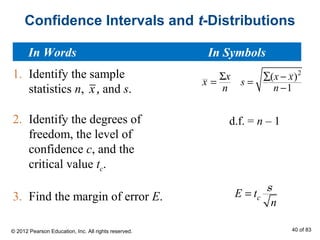
Confidence Intervals and t-Distributions
1. Identify the sample
statistics n, , and s.
2. Identify the degrees of
freedom, the level of
confidence c, and the
critical value tc.
3. Find the margin of error E.
x
x
n
Σ
=
2
( )
1
x x
s
n
∑ −
=
−
cE t
n
=
s
d.f. = n – 1
x
In Words In Symbols
© 2012 Pearson Education, Inc. All rights reserved. 40 of 83
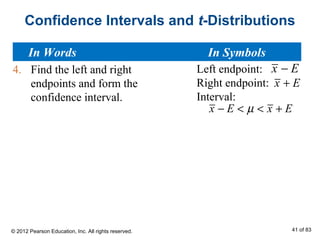
Confidence Intervals and t-Distributions
4. Find the left and right
endpoints and form the
confidence interval.
Left endpoint:
Right endpoint:
Interval:
x E−
x E+
x E x Eµ− < < +
In Words In Symbols
© 2012 Pearson Education, Inc. All rights reserved. 41 of 83
Example: Constructing a Confidence
Interval
You randomly select 16 coffee shops and measure the
temperature of the coffee sold at each. The sample mean
temperature is 162.0ºF with a sample standard deviation
of 10.0ºF. Find the 95% confidence interval for the
population mean temperature. Assume the temperatures
are approximately normally distributed.
Solution:
Use the t-distribution (n < 30, σ is unknown,
temperatures are approximately normally distributed).
© 2012 Pearson Education, Inc. All rights reserved. 42 of 83
Solution: Constructing a Confidence
Interval
• n =16, x = 162.0 s = 10.0 c = 0.95
• df = n – 1 = 16 – 1 = 15
• Critical Value Table 5: t-Distribution
tc = 2.131
© 2012 Pearson Education, Inc. All rights reserved. 43 of 83
Solution: Constructing a Confidence
Interval
• Margin of error:
• Confidence interval:
10
2.131 5.3
16
cE t
n
= = × ≈
s
162 5.3
156.7
x E−
≈ −
=
162 5.3
167.3
x E+
≈ +
=
Left Endpoint: Right Endpoint:
156.7 < μ < 167.3
© 2012 Pearson Education, Inc. All rights reserved. 44 of 83
Solution: Constructing a Confidence
Interval
• 156.7 < μ < 167.3
( )•
162.0156.7 167.3
With 95% confidence, you can say that the
population mean temperature of coffee sold is
between 156.7ºF and 167.3ºF.
Point estimate
xx E− x E+
© 2012 Pearson Education, Inc. All rights reserved. 45 of 83
No
Normal or t-Distribution?
Is n ≥ 30?
Is the population normally,
or approximately
normally, distributed? Cannot use the normal
distribution or the t-distribution.
Yes
Is σ known?
No
Use the normal distribution with
If σ is unknown, use s instead.
cE z
n
=
σ
Yes
No
Use the normal distribution with
.cE z
n
=
σ
Yes
Use the t-distribution with
and n – 1 degrees of freedom.
cE t
n
=
s
© 2012 Pearson Education, Inc. All rights reserved. 46 of 83
Example: Normal or t-Distribution?
You randomly select 25 newly constructed houses. The
sample mean construction cost is $181,000 and the
population standard deviation is $28,000. Assuming
construction costs are normally distributed, should you
use the normal distribution, the t-distribution, or neither
to construct a 95% confidence interval for the
population mean construction cost?
Solution:
Use the normal distribution (the population is
normally distributed and the population standard
deviation is known)
© 2012 Pearson Education, Inc. All rights reserved. 47 of 83
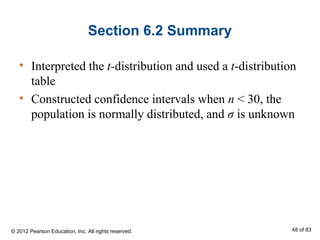
Section 6.2 Summary
• Interpreted the t-distribution and used a t-distribution
table
• Constructed confidence intervals when n < 30, the
population is normally distributed, and σ is unknown
© 2012 Pearson Education, Inc. All rights reserved. 48 of 83
Section 6.3
Confidence Intervals for Population
Proportions
© 2012 Pearson Education, Inc. All rights reserved. 49 of 83
Section 6.3 Objectives
• Find a point estimate for the population proportion
• Construct a confidence interval for a population
proportion
• Determine the minimum sample size required when
estimating a population proportion
© 2012 Pearson Education, Inc. All rights reserved. 50 of 83
Point Estimate for Population p
Population Proportion
• The probability of success in a single trial of a
binomial experiment.
• Denoted by p
Point Estimate for p
• The proportion of successes in a sample.
• Denoted by

 read as “p hat”
number of successes in sample
ˆ
sample size
x
p
n
= =
© 2012 Pearson Education, Inc. All rights reserved. 51 of 83
Point Estimate for Population p
Point Estimate for q, the population proportion of
failures
• Denoted by
• Read as “q hat”
= −1ˆ ˆq p
Estimate Population
Parameter…
with Sample
Statistic
Proportion: p ˆp
© 2012 Pearson Education, Inc. All rights reserved. 52 of 83
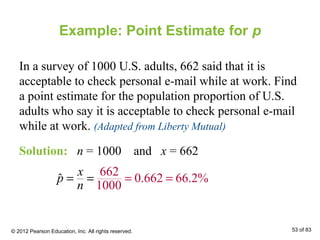
Example: Point Estimate for p
In a survey of 1000 U.S. adults, 662 said that it is
acceptable to check personal e-mail while at work. Find
a point estimate for the population proportion of U.S.
adults who say it is acceptable to check personal e-mail
while at work. (Adapted from Liberty Mutual)
Solution: n = 1000 and x = 662
662
0.662 66.2%
1000
ˆ
x
p
n
= == =
© 2012 Pearson Education, Inc. All rights reserved. 53 of 83
Confidence Intervals for p
A c-confidence interval for a population proportion p
•
•The probability that the confidence interval contains p is c.
ˆ ˆwhereˆ ˆ c
pq
p E p p E E z
n
− < < + =
© 2012 Pearson Education, Inc. All rights reserved. 54 of 83
Constructing Confidence Intervals for p
1. Identify the sample statistics n
and x.
2. Find the point estimate
3. Verify that the sampling
distribution of can be
approximated by a normal
distribution.
4. Find the critical value zc that
corresponds to the given level of
confidence c.
ˆ
x
p
n
=
Use the
Standard
Normal Table or
technology.
.ˆp
5, 5ˆ ˆnp nq≥ ≥pˆ
In Words In Symbols
© 2012 Pearson Education, Inc. All rights reserved. 55 of 83
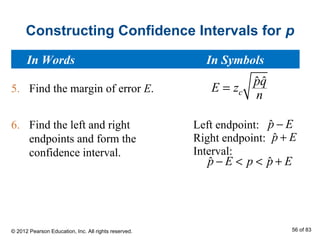
Constructing Confidence Intervals for p
5. Find the margin of error E.
6. Find the left and right
endpoints and form the
confidence interval.
ˆ ˆ
c
pq
E z
n
=
Left endpoint:
Right endpoint:
Interval:
ˆp E−
ˆp E+
ˆ ˆp E p p E− < < +
In Words In Symbols
© 2012 Pearson Education, Inc. All rights reserved. 56 of 83
Example: Confidence Interval for p
In a survey of 1000 U.S. adults, 662 said that it is
acceptable to check personal e-mail while at work.
Construct a 95% confidence interval for the population
proportion of U.S. adults who say that it is acceptable to
check personal e-mail while at work.
Solution: Recall ˆ 0.662p =
1 0.6ˆ ˆ1 62 0.338q p − == − =
© 2012 Pearson Education, Inc. All rights reserved. 57 of 83
Solution: Confidence Interval for p
• Verify the sampling distribution of can be
approximated by the normal distribution
ˆp
1000 0.662 2ˆ 66 5np × = >=
1000 0.338 8ˆ 33 5nq × = >=
• Margin of error:
(0.662) (0.ˆ ˆ 338)
1.96 0.029
1000c
pq
E z
n
= =
×
≈
© 2012 Pearson Education, Inc. All rights reserved. 58 of 83
Solution: Confidence Interval for p
• Confidence interval:
ˆ
0.662 0.029
0.633
p E−
≈ −
=
Left Endpoint: Right Endpoint:
0.633 < p < 0.691
ˆ
0.662 0.029
0.691
p E+
≈ +
=
© 2012 Pearson Education, Inc. All rights reserved. 59 of 83
Solution: Confidence Interval for p
• 0.633 < p < 0.691
With 95% confidence, you can say that the
population proportion of U.S. adults who say that it is
acceptable to check personal e-mail while at work is
between 63.3% and 69.1%.
Point estimate
ˆpˆp E− ˆp E+
© 2012 Pearson Education, Inc. All rights reserved. 60 of 83
Sample Size
• Given a c-confidence level and a margin of error E,
the minimum sample size n needed to estimate p is
• This formula assumes you have an estimate for
and .
• If not, use and
2
ˆ ˆ cz
n pq
E
 
=  ÷
 
ˆ 0.5.=qˆ 0.5=p
ˆp
ˆq
© 2012 Pearson Education, Inc. All rights reserved. 61 of 83
Example: Sample Size
You are running a political campaign and wish to
estimate, with 95% confidence, the population
proportion of registered voters who will vote for your
candidate. Your estimate must be accurate within 3% of
the true population proportion. Find the minimum
sample size needed if
1. no preliminary estimate is available.
Solution:
Because you do not have a preliminary estimate
for use and ˆ 5.0.q =ˆ 0.5p =p,ˆ
© 2012 Pearson Education, Inc. All rights reserved. 62 of 83
Solution: Sample Size
• c = 0.95 zc = 1.96 E = 0.03
2 2
1.96
(0.5)(0.5) 1067.11
0.
ˆ
03
ˆ cz
n pq
E
 
≈
 
= = ÷

÷
 
Round up to the nearest whole number.
With no preliminary estimate, the minimum sample
size should be at least 1068 voters.
© 2012 Pearson Education, Inc. All rights reserved. 63 of 83
Example: Sample Size
You are running a political campaign and wish to
estimate, with 95% confidence, the population
proportion of registered voters who will vote for your
candidate. Your estimate must be accurate within 3% of
the true population proportion. Find the minimum
sample size needed if
2. a preliminary estimate gives .ˆ 0.31p =
Solution:
Use the preliminary estimate
1 0.31 0. 9ˆ ˆ 61q p − == − =
ˆ 0.31p =
© 2012 Pearson Education, Inc. All rights reserved. 64 of 83
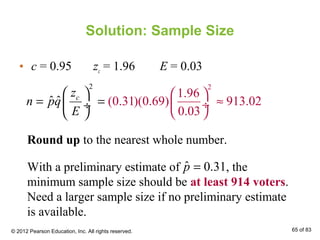
Solution: Sample Size
• c = 0.95 zc = 1.96 E = 0.03
2 2
1.96
(0.31)(0.69) 913.02
0.
ˆ ˆ
03
cz
n pq
E
 
≈ ÷

 
= = ÷
  
Round up to the nearest whole number.
With a preliminary estimate of , the
minimum sample size should be at least 914 voters.
Need a larger sample size if no preliminary estimate
is available.
ˆ 0.31p =
© 2012 Pearson Education, Inc. All rights reserved. 65 of 83
Section 6.3 Summary
• Found a point estimate for the population proportion
• Constructed a confidence interval for a population
proportion
• Determined the minimum sample size required when
estimating a population proportion
© 2012 Pearson Education, Inc. All rights reserved. 66 of 83
Section 6.4
Confidence Intervals for Variance
and Standard Deviation
© 2012 Pearson Education, Inc. All rights reserved. 67 of 83
Section 6.4 Objectives
• Interpret the chi-square distribution and use a
chi-square distribution table
• Use the chi-square distribution to construct a
confidence interval for the variance and standard
deviation
© 2012 Pearson Education, Inc. All rights reserved. 68 of 83
The Chi-Square Distribution
• The point estimate for σ2
is s2
• The point estimate for σ is s
• s2
is the most unbiased estimate for σ2
Estimate Population
Parameter…
with Sample
Statistic
Variance: σ2
s2
Standard deviation: σ s
© 2012 Pearson Education, Inc. All rights reserved. 69 of 83
The Chi-Square Distribution
• You can use the chi-square distribution to construct a
confidence interval for the variance and standard
deviation.
• If the random variable x has a normal distribution,
then the distribution of
forms a chi-square distribution for samples of any
size n > 1.
2
2
2
( 1)n s
χ
−
=
σ
© 2012 Pearson Education, Inc. All rights reserved. 70 of 83
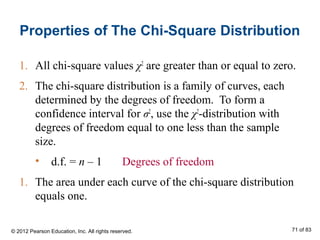
Properties of The Chi-Square Distribution
1. All chi-square values χ2
are greater than or equal to zero.
2. The chi-square distribution is a family of curves, each
determined by the degrees of freedom. To form a
confidence interval for σ2
, use the χ2
-distribution with
degrees of freedom equal to one less than the sample
size.
• d.f. = n – 1 Degrees of freedom
1. The area under each curve of the chi-square distribution
equals one.
© 2012 Pearson Education, Inc. All rights reserved. 71 of 83
Properties of The Chi-Square Distribution
4. Chi-square distributions are positively skewed.
Chi-square Distributions
© 2012 Pearson Education, Inc. All rights reserved. 72 of 83
• There are two critical values for each level of
confidence.
• The value χ2
R represents the right-tail critical value
• The value χ2
Lrepresents the left-tail critical value.
Critical Values for χ2
The area between
the left and right
critical values is c.
χ2
c
1
2
c−
1
2
c−
2
Lχ 2
Rχ
© 2012 Pearson Education, Inc. All rights reserved. 73 of 83
Example: Finding Critical Values for χ2
Find the critical values and for a 95% confidence
interval when the sample size is 18.
Solution:
• d.f. = n – 1 = 18 – 1 = 17 d.f.
• Area to the right of χ2
R =
1 0.95
0.025
2
1
2
c
= =
− −
• Area to the right of χ2
L =
1 0.95
0.975
2
1
2
c
= =
+ +
2
Lχ2
Rχ
• Each area in the table represents the region under the
chi-square curve to the right of the critical value.
© 2012 Pearson Education, Inc. All rights reserved. 74 of 83
Solution: Finding Critical Values for χ2
Table 6: χ2
-Distribution
2
Rχ =2
Lχ =
95% of the area under the curve lies between 7.564 and
30.191.
30.1917.564
© 2012 Pearson Education, Inc. All rights reserved. 75 of 83
Confidence Interval for σ:
•
Confidence Intervals for σ2
and σ
2 2
2 2
( 1) ( 1)
R L
n s n s
χ χ
− −
< <2
σ
• The probability that the confidence intervals contain
σ2
or σ is c.
Confidence Interval for σ2
:
•
2 2
2 2
( 1) ( 1)
R L
n s n s
χ χ
− −
< <σ
© 2012 Pearson Education, Inc. All rights reserved. 76 of 83
Confidence Intervals for σ2
and σ
1. Verify that the population has a
normal distribution.
2. Identify the sample statistic n and
the degrees of freedom.
3. Find the point estimate s2
.
4. Find the critical values χ2
R and χ2
L
that correspond to the given level
of confidence c.
Use Table 6 in
Appendix B.
2
2 )
1
x x
s
n
∑ −
=
−
(
d.f. = n – 1
In Words In Symbols
© 2012 Pearson Education, Inc. All rights reserved. 77 of 83
Confidence Intervals for σ2
and σ
5. Find the left and right
endpoints and form the
confidence interval for the
population variance.
6. Find the confidence
interval for the population
standard deviation by
taking the square root of
each endpoint.
2 2
2 2
( 1) ( 1)
R L
n s n s
χ χ
− −
< <2
σ
2 2
2 2
( 1) ( 1)
R L
n s n s
χ χ
− −
< <σ
In Words In Symbols
© 2012 Pearson Education, Inc. All rights reserved. 78 of 83
Example: Constructing a Confidence
Interval
You randomly select and weigh 30 samples of an allergy
medicine. The sample standard deviation is 1.20
milligrams. Assuming the weights are normally
distributed, construct 99% confidence intervals for the
population variance and standard deviation.
Solution:
• d.f. = n – 1 = 30 – 1 = 29 d.f.
© 2012 Pearson Education, Inc. All rights reserved. 79 of 83
Solution: Constructing a Confidence
Interval
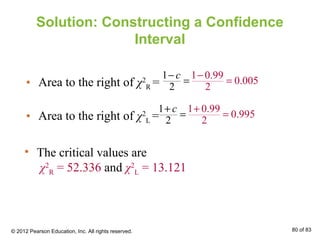
• The critical values are
χ2
R = 52.336 and χ2
L = 13.121
• Area to the right of χ2
R =
1 0.99
0.005
2
1
2
c
= =
− −
• Area to the right of χ2
L =
1 0.99
0.995
2
1
2
c
= =
+ +
© 2012 Pearson Education, Inc. All rights reserved. 80 of 83
Solution: Constructing a Confidence
Interval
2
22
(30 1)(1.20)
0.80
52.336
( 1)
R
n s
χ
−
≈
−
=
Confidence Interval for σ2
:
2
22
(30 1)(1.20)
3.18
13.121
( 1)
L
n s
χ
−
≈
−
=
Left endpoint:
Right endpoint:
0.80 < σ2
< 3.18
With 99% confidence, you can say that the population
variance is between 0.80 and 3.18.
© 2012 Pearson Education, Inc. All rights reserved. 81 of 83
Solution: Constructing a Confidence
Interval
2 2
(30 1)(1.20) (30 1)(1.20)
52.336 13.121
σ
− −
< <
Confidence Interval for σ :
0.89 < σ < 1.78
With 99% confidence, you can say that the population
standard deviation is between 0.89 and 1.78 milligrams.
2 2
2 2
( 1) ( 1)
R L
n s n s
χ χ
− −
< <σ
© 2012 Pearson Education, Inc. All rights reserved. 82 of 83
Section 6.4 Summary
• Interpreted the chi-square distribution and used a
chi-square distribution table
• Used the chi-square distribution to construct a
confidence interval for the variance and standard
deviation
© 2012 Pearson Education, Inc. All rights reserved. 83 of 83

Les5e ppt 06

  • 1.
    Chapter Confidence Intervals 1 of83 6 © 2012 Pearson Education, Inc. All rights reserved.
  • 2.
    Chapter Outline • 6.1Confidence Intervals for the Mean (Large Samples) • 6.2 Confidence Intervals for the Mean (Small Samples) • 6.3 Confidence Intervals for Population Proportions • 6.4 Confidence Intervals for Variance and Standard Deviation © 2012 Pearson Education, Inc. All rights reserved. 2 of 83
  • 3.
    Section 6.1 Confidence Intervalsfor the Mean (Large Samples) © 2012 Pearson Education, Inc. All rights reserved. 3 of 83
  • 4.
    Section 6.1 Objectives •Find a point estimate and a margin of error • Construct and interpret confidence intervals for the population mean • Determine the minimum sample size required when estimating μ © 2012 Pearson Education, Inc. All rights reserved. 4 of 83
  • 5.
    Point Estimate forPopulation μ Point Estimate • A single value estimate for a population parameter • Most unbiased point estimate of the population mean μ is the sample mean x Estimate Population Parameter… with Sample Statistic Mean: μ x © 2012 Pearson Education, Inc. All rights reserved. 5 of 83
  • 6.
    Example: Point Estimatefor Population μ A social networking website allows its users to add friends, send messages, and update their personal profiles. The following represents a random sample of the number of friends for 40 users of the website. Find a point estimate of the population mean, µ. (Source: Facebook) 140 105 130 97 80 165 232 110 214 201 122 98 65 88 154 133 121 82 130 211 153 114 58 77 51 247 236 109 126 132 125 149 122 74 59 218 192 90 117 105 © 2012 Pearson Education, Inc. All rights reserved. 6 of 83
  • 7.
    Solution: Point Estimatefor Population μ The sample mean of the data is 5232 130.8 40 x x n Σ = = = Your point estimate for the mean number of friends for all users of the website is 130.8 friends. © 2012 Pearson Education, Inc. All rights reserved. 7 of 83
  • 8.
    115 120 125130 135 140 150145 Point estimate 115 120 125 130 135 140 150145 Point estimate 130.8x = How confident do we want to be that the interval estimate contains the population mean μ? Interval Estimate Interval estimate • An interval, or range of values, used to estimate a population parameter. © 2012 Pearson Education, Inc. All rights reserved. 8 of 83 ( ) Interval estimate Right endpoint 146.5 Left endpoint 115.1
  • 9.
    Level of Confidence Levelof confidence c • The probability that the interval estimate contains the population parameter. z z = 0–zc zc Critical values ½(1 – c) ½(1 – c) c is the area under the standard normal curve between the critical values. The remaining area in the tails is 1 – c . c Use the Standard Normal Table to find the corresponding z-scores. © 2012 Pearson Education, Inc. All rights reserved. 9 of 83
  • 10.
    −zc Level of Confidence •If the level of confidence is 90%, this means that we are 90% confident that the interval contains the population mean μ. z z = 0 zc The corresponding z-scores are ±1.645. c = 0.90 ½(1 – c) = 0.05½(1 – c) = 0.05 –zc = –1.645 zc = 1.645 © 2012 Pearson Education, Inc. All rights reserved. 10 of 83
  • 11.
    Sampling Error Sampling error •The difference between the point estimate and the actual population parameter value. • For μ:  the sampling error is the difference – μ  μ is generally unknown  varies from sample to sample x x © 2012 Pearson Education, Inc. All rights reserved. 11 of 83
  • 12.
    Margin of Error Marginof error • The greatest possible distance between the point estimate and the value of the parameter it is estimating for a given level of confidence, c. • Denoted by E. • Sometimes called the maximum error of estimate or error tolerance. c x cE z z n = = σσ When n ≥ 30, the sample standard deviation, s, can be used for σ. © 2012 Pearson Education, Inc. All rights reserved. 12 of 83
  • 13.
    Example: Finding theMargin of Error Use the social networking website data and a 95% confidence level to find the margin of error for the mean number of friends for all users of the website. Assume the sample standard deviation is about 53.0. © 2012 Pearson Education, Inc. All rights reserved. 13 of 83
  • 14.
    −zc Solution: Finding theMargin of Error • First find the critical values z zcz = 0 0.95 0.0250.025 –zc = –1.96 95% of the area under the standard normal curve falls within 1.96 standard deviations of the mean. (You can approximate the distribution of the sample means with a normal curve by the Central Limit Theorem, because n = 40 ≥ 30.) zc = 1.96 © 2012 Pearson Education, Inc. All rights reserved. 14 of 83
  • 15.
    Solution: Finding theMargin of Error 53.0 1.96 40 16.4 c c s E z z n n σ ≈ = × ≈ ≈ You don’t know σ, but since n ≥ 30, you can use s in place of σ. You are 95% confident that the margin of error for the population mean is about 16.4 friends. © 2012 Pearson Education, Inc. All rights reserved. 15 of 83
  • 16.
    Confidence Intervals forthe Population Mean A c-confidence interval for the population mean μ • • The probability that the confidence interval contains μ is c. where cx E x E E z n σ µ− < < + = © 2012 Pearson Education, Inc. All rights reserved. 16 of 83
  • 17.
    Constructing Confidence Intervalsfor μ Finding a Confidence Interval for a Population Mean (n ≥ 30 or σ known with a normally distributed population) In Words In Symbols 1. Find the sample statistics n and . 2. Specify σ, if known. Otherwise, if n ≥ 30, find the sample standard deviation s and use it as an estimate for σ. x x n Σ = 2 ( ) 1 x x s n Σ − = − x © 2012 Pearson Education, Inc. All rights reserved. 17 of 83
  • 18.
    Constructing Confidence Intervalsfor μ 3. Find the critical value zc that corresponds to the given level of confidence. 4. Find the margin of error E. 5. Find the left and right endpoints and form the confidence interval. Use the Standard Normal Table or technology. Left endpoint: Right endpoint: Interval: cE z n σ = x E− x E+ x E x Eµ− < < + In Words In Symbols © 2012 Pearson Education, Inc. All rights reserved. 18 of 83
  • 19.
    Example: Constructing aConfidence Interval Construct a 95% confidence interval for the mean number of friends for all users of the website. Solution: Recall and E ≈ 16.4130.8x = 130.8 16.4 114.4 x E− ≈ − = 130.8 16.4 147.2 x E+ ≈ + = 114.4 < μ < 147.2 Left Endpoint: Right Endpoint: © 2012 Pearson Education, Inc. All rights reserved. 19 of 83
  • 20.
    Solution: Constructing aConfidence Interval 114.4 < μ < 147.2 • With 95% confidence, you can say that the population mean number of friends is between 114.4 and 147.2. © 2012 Pearson Education, Inc. All rights reserved. 20 of 83
  • 21.
    Example: Constructing aConfidence Interval σ Known A college admissions director wishes to estimate the mean age of all students currently enrolled. In a random sample of 20 students, the mean age is found to be 22.9 years. From past studies, the standard deviation is known to be 1.5 years, and the population is normally distributed. Construct a 90% confidence interval of the population mean age. © 2012 Pearson Education, Inc. All rights reserved. 21 of 83
  • 22.
    −zc Solution: Constructing aConfidence Interval σ Known • First find the critical values z z = 0 zc c = 0.90 ½(1 – c) = 0.05½(1 – c) = 0.05 –zc = –1.645 zc = 1.645 zc = 1.645 © 2012 Pearson Education, Inc. All rights reserved. 22 of 83
  • 23.
    • Margin oferror: • Confidence interval: Solution: Constructing a Confidence Interval σ Known 1.5 1.645 0.6 20 cE z n σ = ≈= × 22.9 0.6 22.3 x E− ≈ − = 22.9 0.6 23.5 x E+ ≈ + = Left Endpoint: Right Endpoint: 22.3 < μ < 23.5 © 2012 Pearson Education, Inc. All rights reserved. 23 of 83
  • 24.
    Solution: Constructing aConfidence Interval σ Known 22.3 < μ < 23.5 ( )• 22.922.3 23.5 With 90% confidence, you can say that the mean age of all the students is between 22.3 and 23.5 years. Point estimate xx E− x E+ © 2012 Pearson Education, Inc. All rights reserved. 24 of 83
  • 25.
    Interpreting the Results •μ is a fixed number. It is either in the confidence interval or not. • Incorrect: “There is a 90% probability that the actual mean is in the interval (22.3, 23.5).” • Correct: “If a large number of samples is collected and a confidence interval is created for each sample, approximately 90% of these intervals will contain μ. © 2012 Pearson Education, Inc. All rights reserved. 25 of 83
  • 26.
    Interpreting the Results Thehorizontal segments represent 90% confidence intervals for different samples of the same size. In the long run, 9 of every 10 such intervals will contain μ. μ © 2012 Pearson Education, Inc. All rights reserved. 26 of 83
  • 27.
    Sample Size • Givena c-confidence level and a margin of error E, the minimum sample size n needed to estimate the population mean µ is • If σ is unknown, you can estimate it using s, provided you have a preliminary sample with at least 30 members. 2 cz n E σ  =  ÷   © 2012 Pearson Education, Inc. All rights reserved. 27 of 83
  • 28.
    Example: Sample Size Youwant to estimate the mean number of friends for all users of the website. How many users must be included in the sample if you want to be 95% confident that the sample mean is within seven friends of the population mean? Assume the sample standard deviation is about 53.0. © 2012 Pearson Education, Inc. All rights reserved. 28 of 83
  • 29.
    −zc Solution: Sample Size •First find the critical values zc = 1.96 z z = 0 zc 0.95 0.0250.025 –zc = –1.96 zc = 1.96 © 2012 Pearson Education, Inc. All rights reserved. 29 of 83
  • 30.
    Solution: Sample Size zc= 1.96 σ ≈ s ≈ 53.0 E = 7 2 2 1.96 53.0 220.23 7 cz n E σ ×  ≈ ≈   =  ÷    ÷   When necessary, round up to obtain a whole number. You should include at least 221 users in your sample. © 2012 Pearson Education, Inc. All rights reserved. 30 of 83
  • 31.
    Section 6.1 Summary •Found a point estimate and a margin of error • Constructed and interpreted confidence intervals for the population mean • Determined the minimum sample size required when estimating μ © 2012 Pearson Education, Inc. All rights reserved. 31 of 83
  • 32.
    Section 6.2 Confidence Intervalsfor the Mean (Small Samples) © 2012 Pearson Education, Inc. All rights reserved. 32 of 83
  • 33.
    Section 6.2 Objectives •Interpret the t-distribution and use a t-distribution table • Construct confidence intervals when n < 30, the population is normally distributed, and σ is unknown © 2012 Pearson Education, Inc. All rights reserved. 33 of 83
  • 34.
    The t-Distribution • Whenthe population standard deviation is unknown, the sample size is less than 30, and the random variable x is approximately normally distributed, it follows a t-distribution. • Critical values of t are denoted by tc. t = x − µ s n © 2012 Pearson Education, Inc. All rights reserved. 34 of 83
  • 35.
    Properties of thet-Distribution 1. The t-distribution is bell shaped and symmetric about the mean. 2. The t-distribution is a family of curves, each determined by a parameter called the degrees of freedom. The degrees of freedom are the number of free choices left after a sample statistic such as is calculated. When you use a t-distribution to estimate a population mean, the degrees of freedom are equal to one less than the sample size.  d.f. = n – 1 Degrees of freedom x © 2012 Pearson Education, Inc. All rights reserved. 35 of 83
  • 36.
    Properties of thet-Distribution 3. The total area under a t-curve is 1 or 100%. 4. The mean, median, and mode of the t-distribution are equal to zero. 5. As the degrees of freedom increase, the t-distribution approaches the normal distribution. After 30 d.f., the t- distribution is very close to the standard normal z- distribution. t 0 Standard normal curve The tails in the t- distribution are “thicker” than those in the standard normal distribution.d.f. = 5 d.f. = 2 © 2012 Pearson Education, Inc. All rights reserved. 36 of 83
  • 37.
    Example: Critical Valuesof t Find the critical value tc for a 95% confidence level when the sample size is 15. Table 5: t-Distribution tc = 2.145 Solution: d.f. = n – 1 = 15 – 1 = 14 © 2012 Pearson Education, Inc. All rights reserved. 37 of 83
  • 38.
    Solution: Critical Valuesof t 95% of the area under the t-distribution curve with 14 degrees of freedom lies between t = ±2.145. t –tc = –2.145 tc = 2.145 c = 0.95 © 2012 Pearson Education, Inc. All rights reserved. 38 of 83
  • 39.
    Confidence Intervals forthe Population Mean A c-confidence interval for the population mean μ • • The probability that the confidence interval contains μ is c. where c s x E x E E t n µ− < < + = © 2012 Pearson Education, Inc. All rights reserved. 39 of 83
  • 40.
    Confidence Intervals andt-Distributions 1. Identify the sample statistics n, , and s. 2. Identify the degrees of freedom, the level of confidence c, and the critical value tc. 3. Find the margin of error E. x x n Σ = 2 ( ) 1 x x s n ∑ − = − cE t n = s d.f. = n – 1 x In Words In Symbols © 2012 Pearson Education, Inc. All rights reserved. 40 of 83
  • 41.
    Confidence Intervals andt-Distributions 4. Find the left and right endpoints and form the confidence interval. Left endpoint: Right endpoint: Interval: x E− x E+ x E x Eµ− < < + In Words In Symbols © 2012 Pearson Education, Inc. All rights reserved. 41 of 83
  • 42.
    Example: Constructing aConfidence Interval You randomly select 16 coffee shops and measure the temperature of the coffee sold at each. The sample mean temperature is 162.0ºF with a sample standard deviation of 10.0ºF. Find the 95% confidence interval for the population mean temperature. Assume the temperatures are approximately normally distributed. Solution: Use the t-distribution (n < 30, σ is unknown, temperatures are approximately normally distributed). © 2012 Pearson Education, Inc. All rights reserved. 42 of 83
  • 43.
    Solution: Constructing aConfidence Interval • n =16, x = 162.0 s = 10.0 c = 0.95 • df = n – 1 = 16 – 1 = 15 • Critical Value Table 5: t-Distribution tc = 2.131 © 2012 Pearson Education, Inc. All rights reserved. 43 of 83
  • 44.
    Solution: Constructing aConfidence Interval • Margin of error: • Confidence interval: 10 2.131 5.3 16 cE t n = = × ≈ s 162 5.3 156.7 x E− ≈ − = 162 5.3 167.3 x E+ ≈ + = Left Endpoint: Right Endpoint: 156.7 < μ < 167.3 © 2012 Pearson Education, Inc. All rights reserved. 44 of 83
  • 45.
    Solution: Constructing aConfidence Interval • 156.7 < μ < 167.3 ( )• 162.0156.7 167.3 With 95% confidence, you can say that the population mean temperature of coffee sold is between 156.7ºF and 167.3ºF. Point estimate xx E− x E+ © 2012 Pearson Education, Inc. All rights reserved. 45 of 83
  • 46.
    No Normal or t-Distribution? Isn ≥ 30? Is the population normally, or approximately normally, distributed? Cannot use the normal distribution or the t-distribution. Yes Is σ known? No Use the normal distribution with If σ is unknown, use s instead. cE z n = σ Yes No Use the normal distribution with .cE z n = σ Yes Use the t-distribution with and n – 1 degrees of freedom. cE t n = s © 2012 Pearson Education, Inc. All rights reserved. 46 of 83
  • 47.
    Example: Normal ort-Distribution? You randomly select 25 newly constructed houses. The sample mean construction cost is $181,000 and the population standard deviation is $28,000. Assuming construction costs are normally distributed, should you use the normal distribution, the t-distribution, or neither to construct a 95% confidence interval for the population mean construction cost? Solution: Use the normal distribution (the population is normally distributed and the population standard deviation is known) © 2012 Pearson Education, Inc. All rights reserved. 47 of 83
  • 48.
    Section 6.2 Summary •Interpreted the t-distribution and used a t-distribution table • Constructed confidence intervals when n < 30, the population is normally distributed, and σ is unknown © 2012 Pearson Education, Inc. All rights reserved. 48 of 83
  • 49.
    Section 6.3 Confidence Intervalsfor Population Proportions © 2012 Pearson Education, Inc. All rights reserved. 49 of 83
  • 50.
    Section 6.3 Objectives •Find a point estimate for the population proportion • Construct a confidence interval for a population proportion • Determine the minimum sample size required when estimating a population proportion © 2012 Pearson Education, Inc. All rights reserved. 50 of 83
  • 51.
    Point Estimate forPopulation p Population Proportion • The probability of success in a single trial of a binomial experiment. • Denoted by p Point Estimate for p • The proportion of successes in a sample. • Denoted by   read as “p hat” number of successes in sample ˆ sample size x p n = = © 2012 Pearson Education, Inc. All rights reserved. 51 of 83
  • 52.
    Point Estimate forPopulation p Point Estimate for q, the population proportion of failures • Denoted by • Read as “q hat” = −1ˆ ˆq p Estimate Population Parameter… with Sample Statistic Proportion: p ˆp © 2012 Pearson Education, Inc. All rights reserved. 52 of 83
  • 53.
    Example: Point Estimatefor p In a survey of 1000 U.S. adults, 662 said that it is acceptable to check personal e-mail while at work. Find a point estimate for the population proportion of U.S. adults who say it is acceptable to check personal e-mail while at work. (Adapted from Liberty Mutual) Solution: n = 1000 and x = 662 662 0.662 66.2% 1000 ˆ x p n = == = © 2012 Pearson Education, Inc. All rights reserved. 53 of 83
  • 54.
    Confidence Intervals forp A c-confidence interval for a population proportion p • •The probability that the confidence interval contains p is c. ˆ ˆwhereˆ ˆ c pq p E p p E E z n − < < + = © 2012 Pearson Education, Inc. All rights reserved. 54 of 83
  • 55.
    Constructing Confidence Intervalsfor p 1. Identify the sample statistics n and x. 2. Find the point estimate 3. Verify that the sampling distribution of can be approximated by a normal distribution. 4. Find the critical value zc that corresponds to the given level of confidence c. ˆ x p n = Use the Standard Normal Table or technology. .ˆp 5, 5ˆ ˆnp nq≥ ≥pˆ In Words In Symbols © 2012 Pearson Education, Inc. All rights reserved. 55 of 83
  • 56.
    Constructing Confidence Intervalsfor p 5. Find the margin of error E. 6. Find the left and right endpoints and form the confidence interval. ˆ ˆ c pq E z n = Left endpoint: Right endpoint: Interval: ˆp E− ˆp E+ ˆ ˆp E p p E− < < + In Words In Symbols © 2012 Pearson Education, Inc. All rights reserved. 56 of 83
  • 57.
    Example: Confidence Intervalfor p In a survey of 1000 U.S. adults, 662 said that it is acceptable to check personal e-mail while at work. Construct a 95% confidence interval for the population proportion of U.S. adults who say that it is acceptable to check personal e-mail while at work. Solution: Recall ˆ 0.662p = 1 0.6ˆ ˆ1 62 0.338q p − == − = © 2012 Pearson Education, Inc. All rights reserved. 57 of 83
  • 58.
    Solution: Confidence Intervalfor p • Verify the sampling distribution of can be approximated by the normal distribution ˆp 1000 0.662 2ˆ 66 5np × = >= 1000 0.338 8ˆ 33 5nq × = >= • Margin of error: (0.662) (0.ˆ ˆ 338) 1.96 0.029 1000c pq E z n = = × ≈ © 2012 Pearson Education, Inc. All rights reserved. 58 of 83
  • 59.
    Solution: Confidence Intervalfor p • Confidence interval: ˆ 0.662 0.029 0.633 p E− ≈ − = Left Endpoint: Right Endpoint: 0.633 < p < 0.691 ˆ 0.662 0.029 0.691 p E+ ≈ + = © 2012 Pearson Education, Inc. All rights reserved. 59 of 83
  • 60.
    Solution: Confidence Intervalfor p • 0.633 < p < 0.691 With 95% confidence, you can say that the population proportion of U.S. adults who say that it is acceptable to check personal e-mail while at work is between 63.3% and 69.1%. Point estimate ˆpˆp E− ˆp E+ © 2012 Pearson Education, Inc. All rights reserved. 60 of 83
  • 61.
    Sample Size • Givena c-confidence level and a margin of error E, the minimum sample size n needed to estimate p is • This formula assumes you have an estimate for and . • If not, use and 2 ˆ ˆ cz n pq E   =  ÷   ˆ 0.5.=qˆ 0.5=p ˆp ˆq © 2012 Pearson Education, Inc. All rights reserved. 61 of 83
  • 62.
    Example: Sample Size Youare running a political campaign and wish to estimate, with 95% confidence, the population proportion of registered voters who will vote for your candidate. Your estimate must be accurate within 3% of the true population proportion. Find the minimum sample size needed if 1. no preliminary estimate is available. Solution: Because you do not have a preliminary estimate for use and ˆ 5.0.q =ˆ 0.5p =p,ˆ © 2012 Pearson Education, Inc. All rights reserved. 62 of 83
  • 63.
    Solution: Sample Size •c = 0.95 zc = 1.96 E = 0.03 2 2 1.96 (0.5)(0.5) 1067.11 0. ˆ 03 ˆ cz n pq E   ≈   = = ÷  ÷   Round up to the nearest whole number. With no preliminary estimate, the minimum sample size should be at least 1068 voters. © 2012 Pearson Education, Inc. All rights reserved. 63 of 83
  • 64.
    Example: Sample Size Youare running a political campaign and wish to estimate, with 95% confidence, the population proportion of registered voters who will vote for your candidate. Your estimate must be accurate within 3% of the true population proportion. Find the minimum sample size needed if 2. a preliminary estimate gives .ˆ 0.31p = Solution: Use the preliminary estimate 1 0.31 0. 9ˆ ˆ 61q p − == − = ˆ 0.31p = © 2012 Pearson Education, Inc. All rights reserved. 64 of 83
  • 65.
    Solution: Sample Size •c = 0.95 zc = 1.96 E = 0.03 2 2 1.96 (0.31)(0.69) 913.02 0. ˆ ˆ 03 cz n pq E   ≈ ÷    = = ÷    Round up to the nearest whole number. With a preliminary estimate of , the minimum sample size should be at least 914 voters. Need a larger sample size if no preliminary estimate is available. ˆ 0.31p = © 2012 Pearson Education, Inc. All rights reserved. 65 of 83
  • 66.
    Section 6.3 Summary •Found a point estimate for the population proportion • Constructed a confidence interval for a population proportion • Determined the minimum sample size required when estimating a population proportion © 2012 Pearson Education, Inc. All rights reserved. 66 of 83
  • 67.
    Section 6.4 Confidence Intervalsfor Variance and Standard Deviation © 2012 Pearson Education, Inc. All rights reserved. 67 of 83
  • 68.
    Section 6.4 Objectives •Interpret the chi-square distribution and use a chi-square distribution table • Use the chi-square distribution to construct a confidence interval for the variance and standard deviation © 2012 Pearson Education, Inc. All rights reserved. 68 of 83
  • 69.
    The Chi-Square Distribution •The point estimate for σ2 is s2 • The point estimate for σ is s • s2 is the most unbiased estimate for σ2 Estimate Population Parameter… with Sample Statistic Variance: σ2 s2 Standard deviation: σ s © 2012 Pearson Education, Inc. All rights reserved. 69 of 83
  • 70.
    The Chi-Square Distribution •You can use the chi-square distribution to construct a confidence interval for the variance and standard deviation. • If the random variable x has a normal distribution, then the distribution of forms a chi-square distribution for samples of any size n > 1. 2 2 2 ( 1)n s χ − = σ © 2012 Pearson Education, Inc. All rights reserved. 70 of 83
  • 71.
    Properties of TheChi-Square Distribution 1. All chi-square values χ2 are greater than or equal to zero. 2. The chi-square distribution is a family of curves, each determined by the degrees of freedom. To form a confidence interval for σ2 , use the χ2 -distribution with degrees of freedom equal to one less than the sample size. • d.f. = n – 1 Degrees of freedom 1. The area under each curve of the chi-square distribution equals one. © 2012 Pearson Education, Inc. All rights reserved. 71 of 83
  • 72.
    Properties of TheChi-Square Distribution 4. Chi-square distributions are positively skewed. Chi-square Distributions © 2012 Pearson Education, Inc. All rights reserved. 72 of 83
  • 73.
    • There aretwo critical values for each level of confidence. • The value χ2 R represents the right-tail critical value • The value χ2 Lrepresents the left-tail critical value. Critical Values for χ2 The area between the left and right critical values is c. χ2 c 1 2 c− 1 2 c− 2 Lχ 2 Rχ © 2012 Pearson Education, Inc. All rights reserved. 73 of 83
  • 74.
    Example: Finding CriticalValues for χ2 Find the critical values and for a 95% confidence interval when the sample size is 18. Solution: • d.f. = n – 1 = 18 – 1 = 17 d.f. • Area to the right of χ2 R = 1 0.95 0.025 2 1 2 c = = − − • Area to the right of χ2 L = 1 0.95 0.975 2 1 2 c = = + + 2 Lχ2 Rχ • Each area in the table represents the region under the chi-square curve to the right of the critical value. © 2012 Pearson Education, Inc. All rights reserved. 74 of 83
  • 75.
    Solution: Finding CriticalValues for χ2 Table 6: χ2 -Distribution 2 Rχ =2 Lχ = 95% of the area under the curve lies between 7.564 and 30.191. 30.1917.564 © 2012 Pearson Education, Inc. All rights reserved. 75 of 83
  • 76.
    Confidence Interval forσ: • Confidence Intervals for σ2 and σ 2 2 2 2 ( 1) ( 1) R L n s n s χ χ − − < <2 σ • The probability that the confidence intervals contain σ2 or σ is c. Confidence Interval for σ2 : • 2 2 2 2 ( 1) ( 1) R L n s n s χ χ − − < <σ © 2012 Pearson Education, Inc. All rights reserved. 76 of 83
  • 77.
    Confidence Intervals forσ2 and σ 1. Verify that the population has a normal distribution. 2. Identify the sample statistic n and the degrees of freedom. 3. Find the point estimate s2 . 4. Find the critical values χ2 R and χ2 L that correspond to the given level of confidence c. Use Table 6 in Appendix B. 2 2 ) 1 x x s n ∑ − = − ( d.f. = n – 1 In Words In Symbols © 2012 Pearson Education, Inc. All rights reserved. 77 of 83
  • 78.
    Confidence Intervals forσ2 and σ 5. Find the left and right endpoints and form the confidence interval for the population variance. 6. Find the confidence interval for the population standard deviation by taking the square root of each endpoint. 2 2 2 2 ( 1) ( 1) R L n s n s χ χ − − < <2 σ 2 2 2 2 ( 1) ( 1) R L n s n s χ χ − − < <σ In Words In Symbols © 2012 Pearson Education, Inc. All rights reserved. 78 of 83
  • 79.
    Example: Constructing aConfidence Interval You randomly select and weigh 30 samples of an allergy medicine. The sample standard deviation is 1.20 milligrams. Assuming the weights are normally distributed, construct 99% confidence intervals for the population variance and standard deviation. Solution: • d.f. = n – 1 = 30 – 1 = 29 d.f. © 2012 Pearson Education, Inc. All rights reserved. 79 of 83
  • 80.
    Solution: Constructing aConfidence Interval • The critical values are χ2 R = 52.336 and χ2 L = 13.121 • Area to the right of χ2 R = 1 0.99 0.005 2 1 2 c = = − − • Area to the right of χ2 L = 1 0.99 0.995 2 1 2 c = = + + © 2012 Pearson Education, Inc. All rights reserved. 80 of 83
  • 81.
    Solution: Constructing aConfidence Interval 2 22 (30 1)(1.20) 0.80 52.336 ( 1) R n s χ − ≈ − = Confidence Interval for σ2 : 2 22 (30 1)(1.20) 3.18 13.121 ( 1) L n s χ − ≈ − = Left endpoint: Right endpoint: 0.80 < σ2 < 3.18 With 99% confidence, you can say that the population variance is between 0.80 and 3.18. © 2012 Pearson Education, Inc. All rights reserved. 81 of 83
  • 82.
    Solution: Constructing aConfidence Interval 2 2 (30 1)(1.20) (30 1)(1.20) 52.336 13.121 σ − − < < Confidence Interval for σ : 0.89 < σ < 1.78 With 99% confidence, you can say that the population standard deviation is between 0.89 and 1.78 milligrams. 2 2 2 2 ( 1) ( 1) R L n s n s χ χ − − < <σ © 2012 Pearson Education, Inc. All rights reserved. 82 of 83
  • 83.
    Section 6.4 Summary •Interpreted the chi-square distribution and used a chi-square distribution table • Used the chi-square distribution to construct a confidence interval for the variance and standard deviation © 2012 Pearson Education, Inc. All rights reserved. 83 of 83