Vir Regulon
Mital Chandegara
Biotechnology (ll)
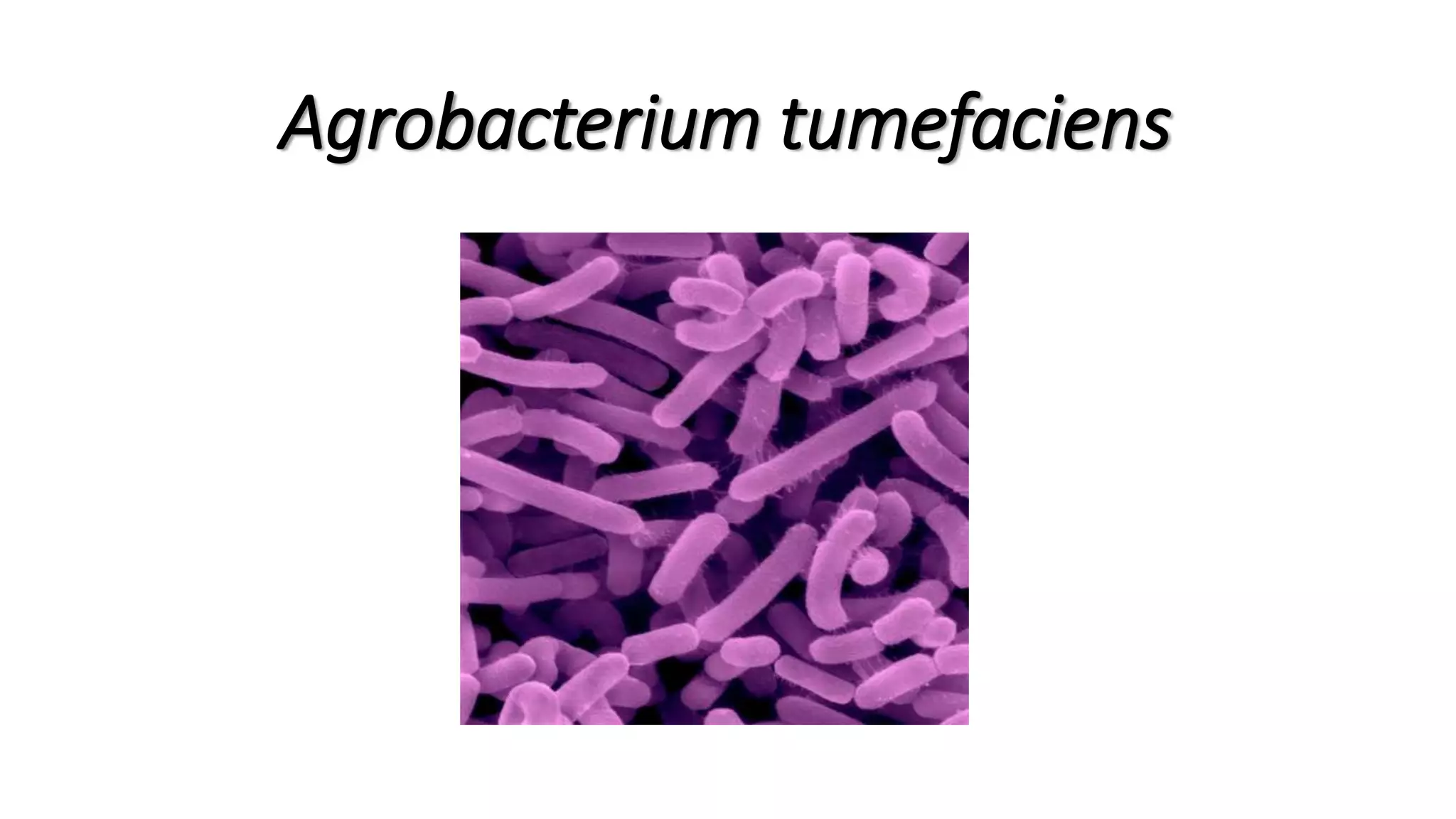
Agrobacterium tumefaciens
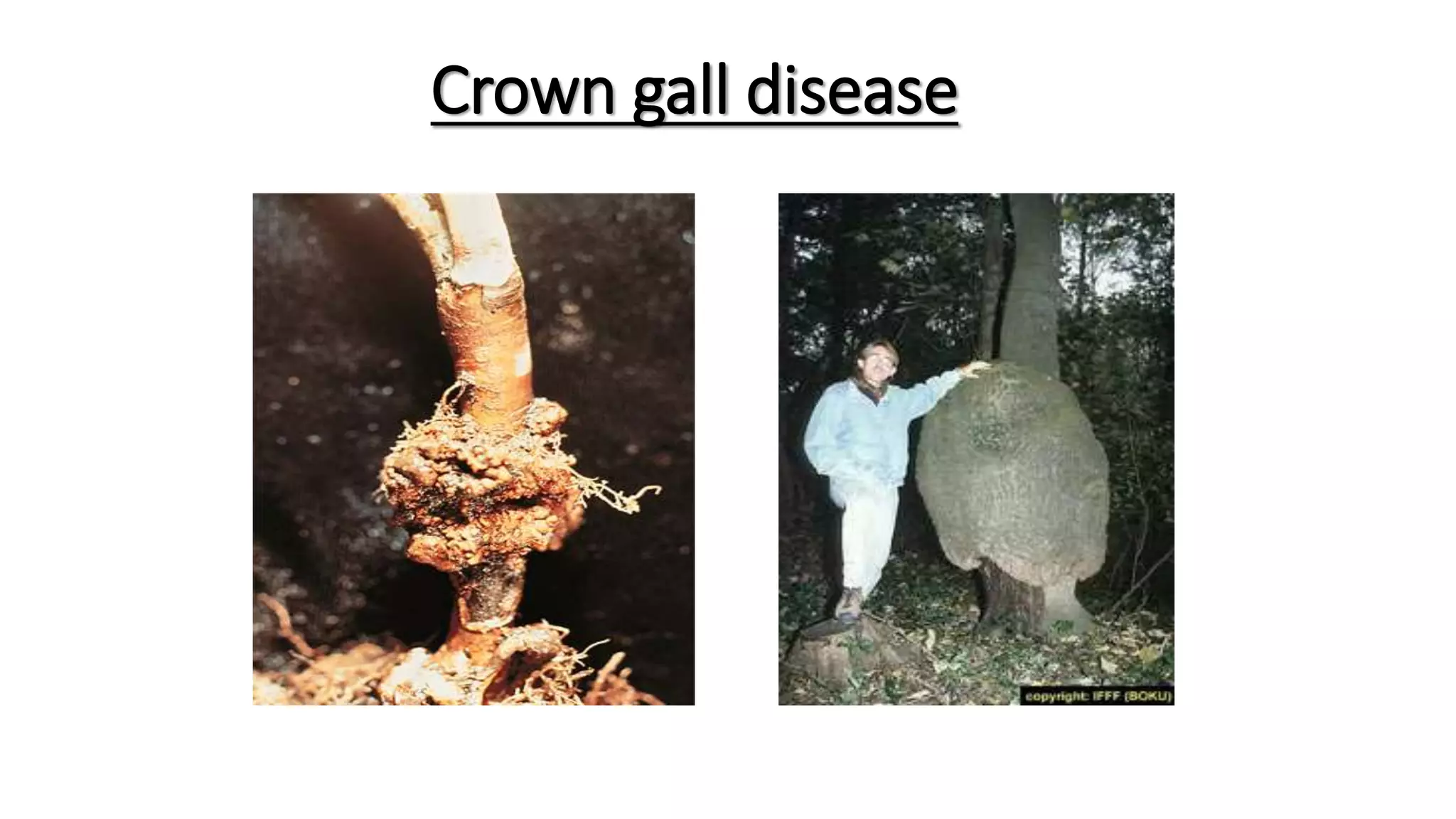
Crown gall disease
Ti plasmid
Vir regulon
• Vir region consist 8 operon (~40kb in size)
• Product of it’s genes are responsible for T- DNA transfer from bacteria to
plant host.
 T-DNA transfer is 6 step process:
1) Signal recognition by Agrobacterium
2) Attachment to plant cell
3) Vir gene induction
4) T DNA strand production
5) T-DNA transfer out of bacterial cell
6) Transfer of T-complex & Vir protein into plant cell & nuclear localization
1) Signal recognition by Agrobacterium
• Wounded plant secrete wide range of
chemical compound that can function as
“chemotactic agents” to attract bacteria at
wounded site.
• Secreted sap have characteristic pH (5 - 5.8)
and high content of phenolics compound
,lignin etc
• These condition stimulate vir gene expression
2) Attachment to plant cells
• Several chromosomal virulence genes chv A, chvB & pscA are required for
attachment
• involve in synthesis , processing & export of cyclic β -1,2- glucan & other
sugars.
• A. tumefaciens cells synthesis cellulose fibrils that entrap large no. of bacteria
at wounded site
• It also produce additional exopolysaccharide – unipolar polysaccharide which
helps the bacterial cells to attach plant cells in polar fashion
• UPP consist 2 types of sugars: N-acetylglucosamine & N-acetylgalactosamine
• UPP mutant defective in attachment
3) Vir gene induction
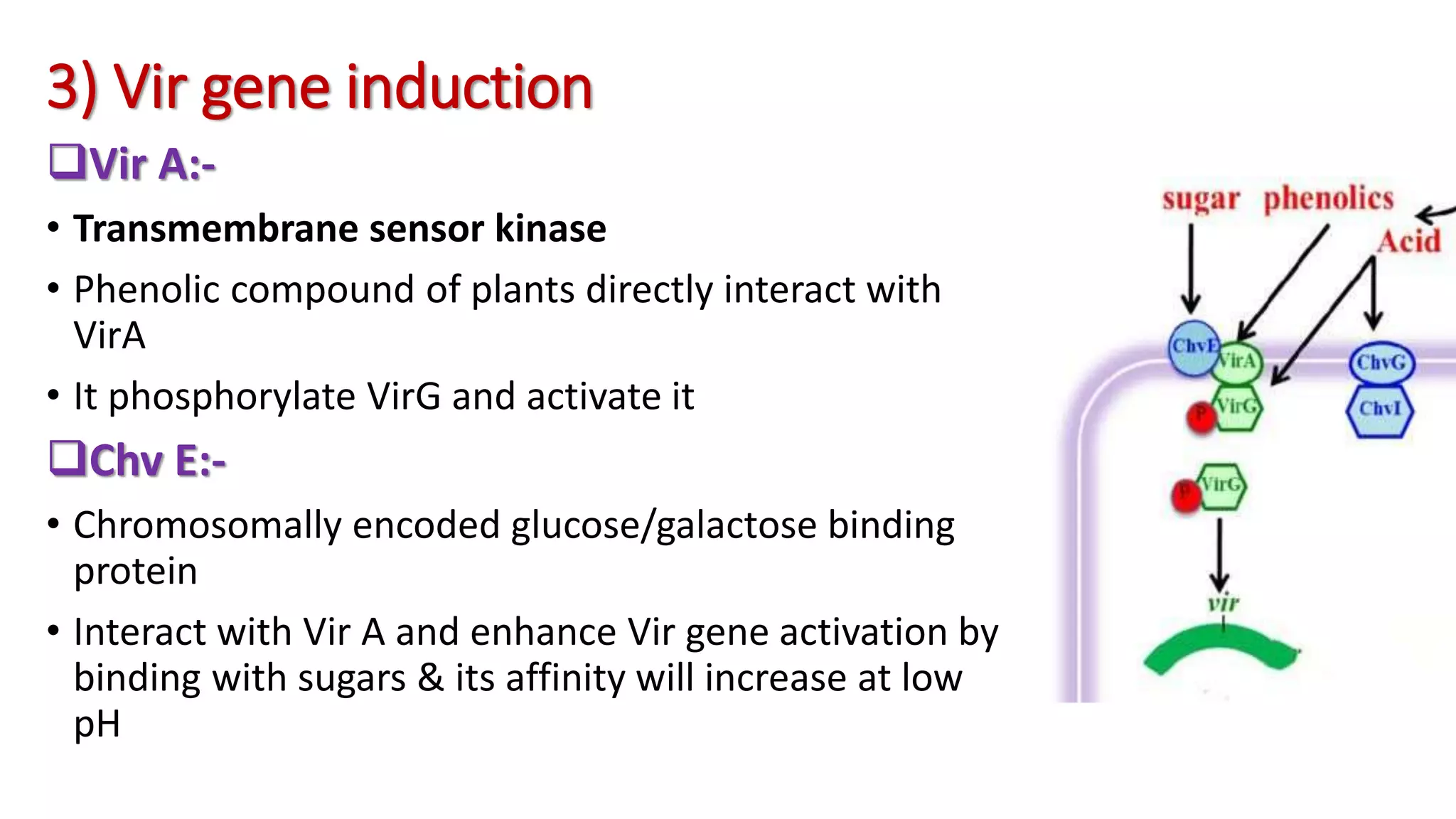
Vir A:-
• Transmembrane sensor kinase
• Phenolic compound of plants directly interact with
VirA
• It phosphorylate VirG and activate it
Chv E:-
• Chromosomally encoded glucose/galactose binding
protein
• Interact with Vir A and enhance Vir gene activation by
binding with sugars & its affinity will increase at low
pH
Chv G/Chv I:-
• Its 2 component system which activate transcription of Vir G
Vir H2:-
• At high concentration, phenolics compound are bacteriostatic so Vir H2
involve in detoxification of harmful phenolic compound
Vir G:-
• It is transcription factor
• It induce expression of all vir gene
4) T-DNA strand production
VirD1- VirD2 complex:-
• It recognized RB & LB
• virD1 &virD2 gene encode site specific
nicking enzyme that nicks bottom T DNA
strand between 3rd & 4th bases of the
T-DNA borders.
VirD1 function:-
• Required for T-DNA processing
• Modulate virD2 activity
VirD2 function:-
• Covalently attached to 5’ end of ss TDNA via phosphodiester bond with
specific Tyr residue & protect 5’ end
 VirC1:-
• It assist repair machinery to replace displaced strand
• it recruit T DNA complex at pole to interact with
VirD4
5)Transfer of T-DNA out of bacterial cell
• For delivery of T-DNA across the bacterial
envelope to plant plasma membrane it require
Type IV secretion system
• T4SS contain 12 proteins (Vir B1- VirB11
&VirD4).
• These proteins form 2 functional components
1. Ti pilus
2. Membrane
associated
transporter complex
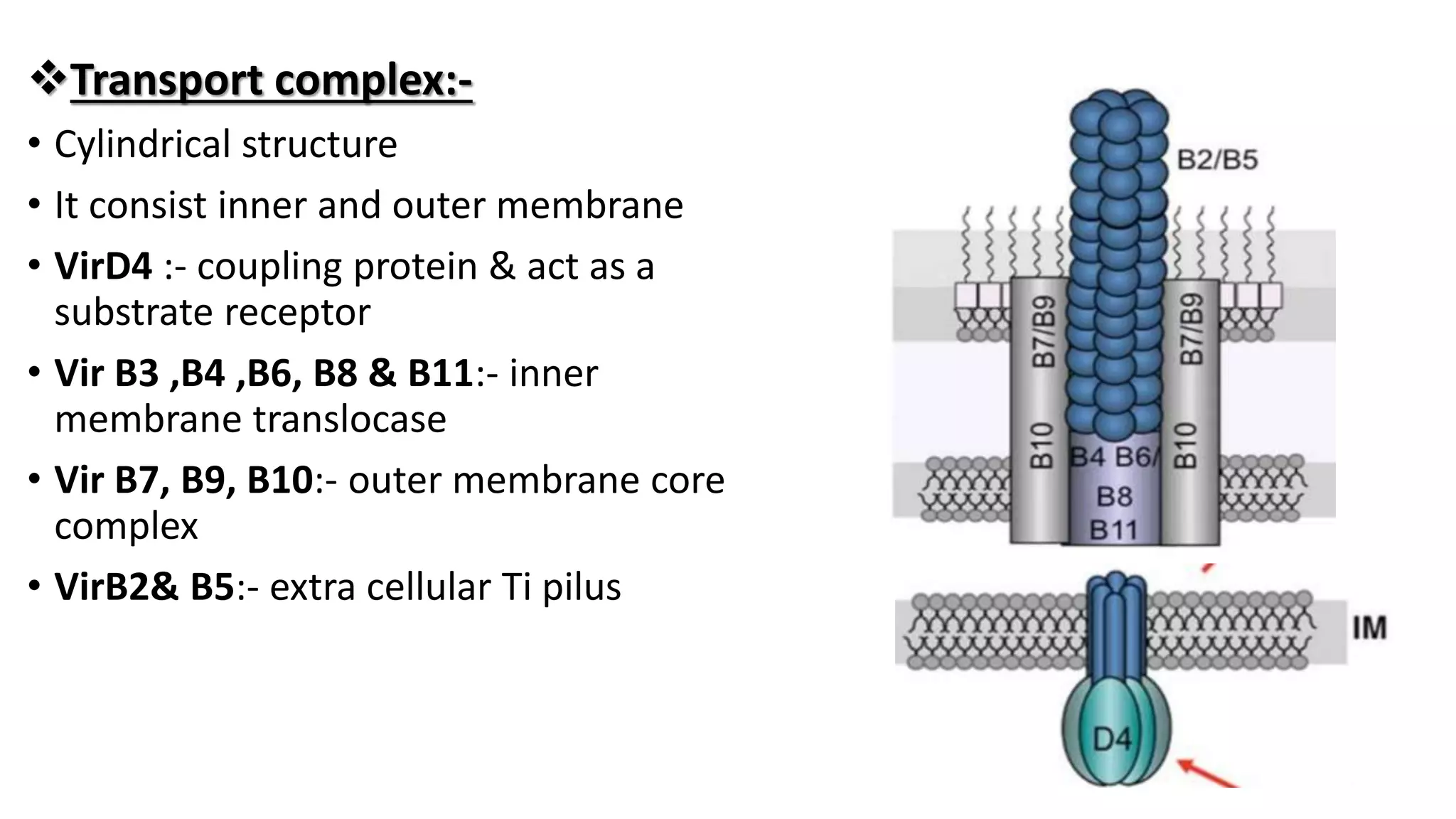
Transport complex:-
• Cylindrical structure
• It consist inner and outer membrane
• VirD4 :- coupling protein & act as a
substrate receptor
• Vir B3 ,B4 ,B6, B8 & B11:- inner
membrane translocase
• Vir B7, B9, B10:- outer membrane core
complex
• VirB2& B5:- extra cellular Ti pilus
VirD4 & VirB11:-
• T DNA 1st bind with Vir D4( substrate receptor) and it will delivered to B11, as it
bind it activate the ATP hydrolysis activities of these proteins.
• These signal may cause conformational change of VirB10.
VirB10:-
• Play important role in T4SS opening and assembly.
VirB1:-
• It prepare sites in bacterial envelope for transporter assembly by localized lysis of
peptidoglycan layer.
• VirD5&Vir F also exported from cell
6)Transfer of T-complex &vir protein into plant cell &
nuclear localisation
T- complex:-
• It contain T-DNA ,VirD2& VirE2
 Vir D2:-
• Protect the 5’ end of T-DNA and consist nuclear localisation signal which
facilitate its interaction with plant protein (importin)
• It bind with cyclophilins (pp) which also aid integration
VirE2:-
• It coats the T strand & protect from degradation
• It interact with VIP2 (nuclear factors) that mediate interaction with chromatin &
facilitate integration
VIP1:-
• VIP 1 interact with VirE2- ssDNA complex and then it bind with α importin &
form ternary complex.
• VIP1 function as a adaptor.
• VIP1 also interact with plant histone(H2A-1).
• Mitogen activated protein kinase3(MPK3) phosphorylate the VIP1 on serine
79 and VIP 1 function as a transcription factor that induce expression of several
stress responsive genes
VirF:-
• For efficient T DNA integration , host and bacterial virulence protein may need
to be removed
• It is mediated by VirF & plant ubiquitin proteasome complex
• Vir F degrade the VIP1 protein and repress the VIP 1 mediated host
defense response.
• Premature or excessive degradation of VirE2- VIP 1 complex by Vir F
might hinder the T- DNA nuclear import & integration.
VirD5:-
• Interact with Vir F and protect rapid degradation by defensive action
of host UPS.
• It may also interact with VIP1 – Vir E2 and form stable ternary
complex ( Vir D5-VIP 1- Vir E2) & prevent its degradation
REGULATION BY PLANT HORMONS
Auxin:-
• At higher concentration: It affect the bacterial growth & inhibit vir gene
induction by competing with phenolics inducers for interaction with Vir A
protein & prevent further transformation.
• At lower concentration: It promote transformation
Cytokinin:-
• It affects bacterial virulence by regulating vir promoter activity and bacterial
growth .
Salicylic acid :-
• Plant defense molecule
• It influence the A. tumefaciens infection by inhibiting the expression of vir
gene , bacterial growth & bacterial attachment to plant.
Ethylene:-
• It repress the vir gene expression but shows no significant inhibitory effects
on bacterial growth & population size
Agrobacterium :-
Natural genetic engineer
 Plant biotechnology : Adrian Slater, Nigel Scott
and Mark Fowler
 Agrobacterium mediated plant transformation :
biology and applications DOI:10.1199/tab.0186
 The Agrobacterium Ti plasmid
DOI:10.1128/microbiolspec.PLAS-0010-2013
 Transfer of T- DNA from Agrobacterium to pant
cell (Review article)
Thank you

Vir regulon

  • 1.
  • 2.
  • 3.
  • 4.
  • 5.
    Vir regulon • Virregion consist 8 operon (~40kb in size) • Product of it’s genes are responsible for T- DNA transfer from bacteria to plant host.  T-DNA transfer is 6 step process: 1) Signal recognition by Agrobacterium 2) Attachment to plant cell 3) Vir gene induction 4) T DNA strand production 5) T-DNA transfer out of bacterial cell 6) Transfer of T-complex & Vir protein into plant cell & nuclear localization
  • 6.
    1) Signal recognitionby Agrobacterium • Wounded plant secrete wide range of chemical compound that can function as “chemotactic agents” to attract bacteria at wounded site. • Secreted sap have characteristic pH (5 - 5.8) and high content of phenolics compound ,lignin etc • These condition stimulate vir gene expression
  • 7.
    2) Attachment toplant cells • Several chromosomal virulence genes chv A, chvB & pscA are required for attachment • involve in synthesis , processing & export of cyclic β -1,2- glucan & other sugars. • A. tumefaciens cells synthesis cellulose fibrils that entrap large no. of bacteria at wounded site • It also produce additional exopolysaccharide – unipolar polysaccharide which helps the bacterial cells to attach plant cells in polar fashion • UPP consist 2 types of sugars: N-acetylglucosamine & N-acetylgalactosamine • UPP mutant defective in attachment
  • 10.
    3) Vir geneinduction Vir A:- • Transmembrane sensor kinase • Phenolic compound of plants directly interact with VirA • It phosphorylate VirG and activate it Chv E:- • Chromosomally encoded glucose/galactose binding protein • Interact with Vir A and enhance Vir gene activation by binding with sugars & its affinity will increase at low pH
  • 11.
    Chv G/Chv I:- •Its 2 component system which activate transcription of Vir G Vir H2:- • At high concentration, phenolics compound are bacteriostatic so Vir H2 involve in detoxification of harmful phenolic compound Vir G:- • It is transcription factor • It induce expression of all vir gene
  • 12.
    4) T-DNA strandproduction VirD1- VirD2 complex:- • It recognized RB & LB • virD1 &virD2 gene encode site specific nicking enzyme that nicks bottom T DNA strand between 3rd & 4th bases of the T-DNA borders.
  • 13.
    VirD1 function:- • Requiredfor T-DNA processing • Modulate virD2 activity VirD2 function:- • Covalently attached to 5’ end of ss TDNA via phosphodiester bond with specific Tyr residue & protect 5’ end  VirC1:- • It assist repair machinery to replace displaced strand • it recruit T DNA complex at pole to interact with VirD4
  • 14.
    5)Transfer of T-DNAout of bacterial cell • For delivery of T-DNA across the bacterial envelope to plant plasma membrane it require Type IV secretion system • T4SS contain 12 proteins (Vir B1- VirB11 &VirD4). • These proteins form 2 functional components 1. Ti pilus 2. Membrane associated transporter complex
  • 15.
    Transport complex:- • Cylindricalstructure • It consist inner and outer membrane • VirD4 :- coupling protein & act as a substrate receptor • Vir B3 ,B4 ,B6, B8 & B11:- inner membrane translocase • Vir B7, B9, B10:- outer membrane core complex • VirB2& B5:- extra cellular Ti pilus
  • 16.
    VirD4 & VirB11:- •T DNA 1st bind with Vir D4( substrate receptor) and it will delivered to B11, as it bind it activate the ATP hydrolysis activities of these proteins. • These signal may cause conformational change of VirB10. VirB10:- • Play important role in T4SS opening and assembly. VirB1:- • It prepare sites in bacterial envelope for transporter assembly by localized lysis of peptidoglycan layer. • VirD5&Vir F also exported from cell
  • 17.
    6)Transfer of T-complex&vir protein into plant cell & nuclear localisation T- complex:- • It contain T-DNA ,VirD2& VirE2  Vir D2:- • Protect the 5’ end of T-DNA and consist nuclear localisation signal which facilitate its interaction with plant protein (importin) • It bind with cyclophilins (pp) which also aid integration VirE2:- • It coats the T strand & protect from degradation • It interact with VIP2 (nuclear factors) that mediate interaction with chromatin & facilitate integration
  • 18.
    VIP1:- • VIP 1interact with VirE2- ssDNA complex and then it bind with α importin & form ternary complex. • VIP1 function as a adaptor. • VIP1 also interact with plant histone(H2A-1). • Mitogen activated protein kinase3(MPK3) phosphorylate the VIP1 on serine 79 and VIP 1 function as a transcription factor that induce expression of several stress responsive genes VirF:- • For efficient T DNA integration , host and bacterial virulence protein may need to be removed • It is mediated by VirF & plant ubiquitin proteasome complex
  • 19.
    • Vir Fdegrade the VIP1 protein and repress the VIP 1 mediated host defense response. • Premature or excessive degradation of VirE2- VIP 1 complex by Vir F might hinder the T- DNA nuclear import & integration. VirD5:- • Interact with Vir F and protect rapid degradation by defensive action of host UPS. • It may also interact with VIP1 – Vir E2 and form stable ternary complex ( Vir D5-VIP 1- Vir E2) & prevent its degradation
  • 22.
    REGULATION BY PLANTHORMONS Auxin:- • At higher concentration: It affect the bacterial growth & inhibit vir gene induction by competing with phenolics inducers for interaction with Vir A protein & prevent further transformation. • At lower concentration: It promote transformation Cytokinin:- • It affects bacterial virulence by regulating vir promoter activity and bacterial growth .
  • 23.
    Salicylic acid :- •Plant defense molecule • It influence the A. tumefaciens infection by inhibiting the expression of vir gene , bacterial growth & bacterial attachment to plant. Ethylene:- • It repress the vir gene expression but shows no significant inhibitory effects on bacterial growth & population size
  • 24.
  • 25.
     Plant biotechnology: Adrian Slater, Nigel Scott and Mark Fowler  Agrobacterium mediated plant transformation : biology and applications DOI:10.1199/tab.0186  The Agrobacterium Ti plasmid DOI:10.1128/microbiolspec.PLAS-0010-2013  Transfer of T- DNA from Agrobacterium to pant cell (Review article)
  • 26.