Application of Transgenic Crops and its
limitation in insect pest management
MOHAMMAD IRSHAD
ENTOMOLOGY
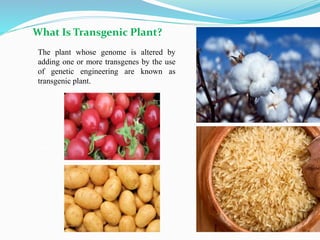
What Is Transgenic Plant?
The plant whose genome is altered by
adding one or more transgenes by the use
of genetic engineering are known as
transgenic plant.
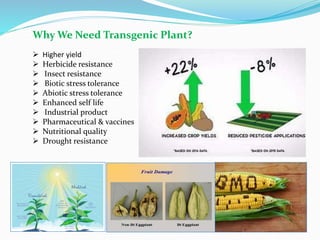
Why We Need Transgenic Plant?
 Higher yield
 Herbicide resistance
 Insect resistance
 Biotic stress tolerance
 Abiotic stress tolerance
 Enhanced self life
 Industrial product
 Pharmaceutical & vaccines
 Nutritional quality
 Drought resistance
History of transgenic crops
(1)In 1982 1st transgenic crop produced which is an abiotic resistance
tobacco crop.
(2) In 1984 1st successful plant genetic engineering experiments using
caulimovirus vector.
(3) In 1993 Bt cotton was first approved for field trail in the united
states and first approved commercial use in the united states in 1995
Bt cotton was approved.
(5) In 1994 1st genetically modified crops approved for sale in us was
flavr savr tomato.
(6)1995 1st pesticide producing crop Bt potato was approved U.S
environment protection agency.
(4) In 2002 a joint venture between monsanto and mahyco introduced
Bt cotton in India.
(7) In 2000 Golden rice with beata carotene developed with
increased nutritional value.
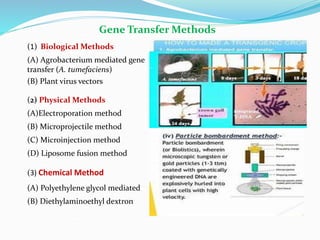
Gene Transfer Methods
Biological Methods
(1)
(A) Agrobacterium mediated gene
transfer (A. tumefaciens)
(B) Plant virus vectors
(2) Physical Methods
(A)Electroporation method
(B) Microprojectile method
(C) Microinjection method
(D) Liposome fusion method
(3) Chemical Method
(A) Polyethylene glycol mediated
(B) Diethylaminoethyl dextron
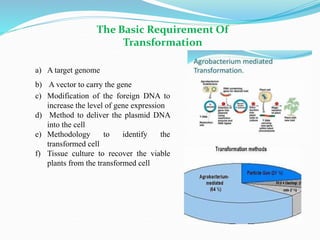
The Basic Requirement Of
Transformation
a) A target genome
b) A vector to carry the gene
c) Modification of the foreign DNA to
increase the level of gene expression
d) Method to deliver the plasmid DNA
into the cell
e) Methodology to identify the
transformed cell
f) Tissue culture to recover the viable
plants from the transformed cell
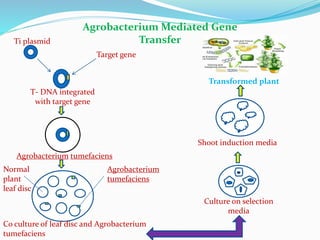
Agrobacterium Mediated Gene
Transfer
Target gene
Ti plasmid
T- DNA integrated
with target gene
Agrobacterium tumefaciens
Agrobacterium
tumefaciens
Normal
plant
leaf disc
Co culture of leaf disc and Agrobacterium
tumefaciens
Culture on selection
media
Shoot induction media
Transformed plant
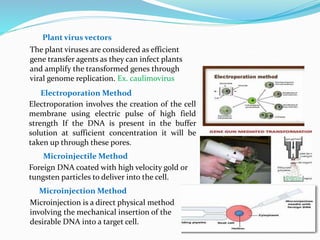
Plant virus vectors
The plant viruses are considered as efficient
gene transfer agents as they can infect plants
and amplify the transformed genes through
viral genome replication. Ex. caulimovirus
Electroporation Method
Electroporation involves the creation of the cell
membrane using electric pulse of high field
strength If the DNA is present in the buffer
solution at sufficient concentration it will be
taken up through these pores.
Microinjectile Method
Foreign DNA coated with high velocity gold or
tungsten particles to deliver into the cell.
Microinjection Method
Microinjection is a direct physical method
involving the mechanical insertion of the
desirable DNA into a target cell.
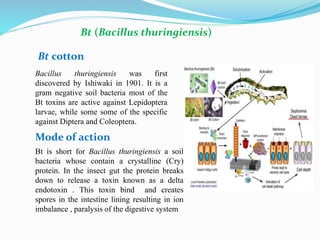
Bt cotton
Bacillus thuringiensis was first
discovered by Ishiwaki in 1901. It is a
gram negative soil bacteria most of the
Bt toxins are active against Lepidoptera
larvae, while some some of the specific
against Diptera and Coleoptera.
Mode of action
Bt is short for Bacillus thuringiensis a soil
bacteria whose contain a crystalline (Cry)
protein. In the insect gut the protein breaks
down to release a toxin known as a delta
endotoxin . This toxin bind and creates
spores in the intestine lining resulting in ion
imbalance , paralysis of the digestive system
Bt (Bacillus thuringiensis)
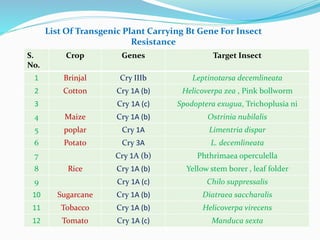
List Of Transgenic Plant Carrying Bt Gene For Insect
Resistance
S.
No.
Crop Genes Target Insect
1 Brinjal Cry IIIb Leptinotarsa decemlineata
2 Cotton Cry 1A (b) Helicoverpa zea , Pink bollworm
3 Cry 1A (c) Spodoptera exugua, Trichoplusia ni
4 Maize Cry 1A (b) Ostrinia nubilalis
5 poplar Cry 1A Limentria dispar
6 Potato Cry 3A L. decemlineata
7 Cry 1A (b) Phthrimaea operculella
8 Rice Cry 1A (b) Yellow stem borer , leaf folder
9 Cry 1A (c) Chilo suppressalis
10 Sugarcane Cry 1A (b) Diatraea saccharalis
11 Tobacco Cry 1A (b) Helicoverpa virecens
12 Tomato Cry 1A (c) Manduca sexta
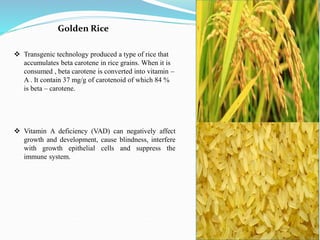
Golden Rice
 Transgenic technology produced a type of rice that
accumulates beta carotene in rice grains. When it is
consumed , beta carotene is converted into vitamin –
A . It contain 37 mg/g of carotenoid of which 84 %
is beta – carotene.
 Vitamin A deficiency (VAD) can negatively affect
growth and development, cause blindness, interfere
with growth epithelial cells and suppress the
immune system.
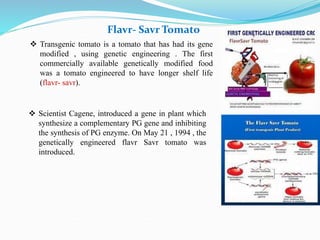
Flavr- Savr Tomato
 Transgenic tomato is a tomato that has had its gene
modified , using genetic engineering . The first
commercially available genetically modified food
was a tomato engineered to have longer shelf life
(flavr- savr).
 Scientist Cagene, introduced a gene in plant which
synthesize a complementary PG gene and inhibiting
the synthesis of PG enzyme. On May 21 , 1994 , the
genetically engineered flavr Savr tomato was
introduced.
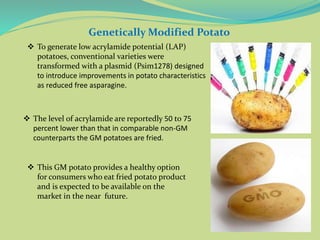
Genetically Modified Potato
 To generate low acrylamide potential (LAP)
potatoes, conventional varieties were
transformed with a plasmid (Psim1278) designed
to introduce improvements in potato characteristics
as reduced free asparagine.
 The level of acrylamide are reportedly 50 to 75
percent lower than that in comparable non-GM
counterparts the GM potatoes are fried.
 This GM potato provides a healthy option
for consumers who eat fried potato product
and is expected to be available on the
market in the near future.
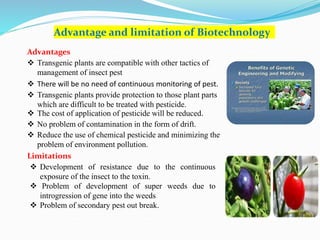
Advantage and limitation of Biotechnology
Advantages
 Transgenic plants are compatible with other tactics of
management of insect pest
 There will be no need of continuous monitoring of pest.
 Transgenic plants provide protection to those plant parts
which are difficult to be treated with pesticide.
 The cost of application of pesticide will be reduced.
 No problem of contamination in the form of drift.
 Reduce the use of chemical pesticide and minimizing the
problem of environment pollution.
Limitations
 Development of resistance due to the continuous
exposure of the insect to the toxin.
 Problem of development of super weeds due to
introgression of gene into the weeds
 Problem of secondary pest out break.
Challenges of Transgenic Crops
 Environment effects
Biosafety require maintaining an equilibrium among assuring a high level of human
health and environment , while at the same time providing a table regulatory means
in the food chain in addition more general concern include environment pollution
unintentional gene transfer to wild plants possible creation of invasive weeds , risk
to crop genetic diversity religious culture and ethical concerns and fright of
unknown effects
 Effect On Non Target Organisms
Genetically modified plants can be hazardous to the health of animals. The
transgene which has been inserted in to a target organism to modify its original
characteristics for the benefit of human being may also have a negative effect on
other non target organisms.
 Socio Economic Concerns
Peoples attitude are considered vital factors influencing both the use of
biotechnology and its expansion .
CONCLUSION
 GM crops have been proven to be solution for the increasing food
consumption and industrial demand.
 To protect and preserve the environment by increasing yield and reducing
reliance upon chemical pesticides and herbicides.
 Plant genome sequencing programmes will accelerate the development of
GM crops.
 The identification of a wide range of genes in model species will allow the
rapid identification of genes of economic importance in crop species.
 The need for concerted action to assist in the safe application of plant genetic
modification by industry in partnership with governments, charitable
foundations and international research organizations to food staples of the
developing world is greatly required.
Genetic Engineering in Insect Pest management

Genetic Engineering in Insect Pest management

  • 1.
    Application of TransgenicCrops and its limitation in insect pest management MOHAMMAD IRSHAD ENTOMOLOGY
  • 2.
    What Is TransgenicPlant? The plant whose genome is altered by adding one or more transgenes by the use of genetic engineering are known as transgenic plant.
  • 3.
    Why We NeedTransgenic Plant?  Higher yield  Herbicide resistance  Insect resistance  Biotic stress tolerance  Abiotic stress tolerance  Enhanced self life  Industrial product  Pharmaceutical & vaccines  Nutritional quality  Drought resistance
  • 4.
    History of transgeniccrops (1)In 1982 1st transgenic crop produced which is an abiotic resistance tobacco crop. (2) In 1984 1st successful plant genetic engineering experiments using caulimovirus vector. (3) In 1993 Bt cotton was first approved for field trail in the united states and first approved commercial use in the united states in 1995 Bt cotton was approved. (5) In 1994 1st genetically modified crops approved for sale in us was flavr savr tomato. (6)1995 1st pesticide producing crop Bt potato was approved U.S environment protection agency. (4) In 2002 a joint venture between monsanto and mahyco introduced Bt cotton in India. (7) In 2000 Golden rice with beata carotene developed with increased nutritional value.
  • 5.
    Gene Transfer Methods BiologicalMethods (1) (A) Agrobacterium mediated gene transfer (A. tumefaciens) (B) Plant virus vectors (2) Physical Methods (A)Electroporation method (B) Microprojectile method (C) Microinjection method (D) Liposome fusion method (3) Chemical Method (A) Polyethylene glycol mediated (B) Diethylaminoethyl dextron
  • 6.
    The Basic RequirementOf Transformation a) A target genome b) A vector to carry the gene c) Modification of the foreign DNA to increase the level of gene expression d) Method to deliver the plasmid DNA into the cell e) Methodology to identify the transformed cell f) Tissue culture to recover the viable plants from the transformed cell
  • 7.
    Agrobacterium Mediated Gene Transfer Targetgene Ti plasmid T- DNA integrated with target gene Agrobacterium tumefaciens Agrobacterium tumefaciens Normal plant leaf disc Co culture of leaf disc and Agrobacterium tumefaciens Culture on selection media Shoot induction media Transformed plant
  • 8.
    Plant virus vectors Theplant viruses are considered as efficient gene transfer agents as they can infect plants and amplify the transformed genes through viral genome replication. Ex. caulimovirus Electroporation Method Electroporation involves the creation of the cell membrane using electric pulse of high field strength If the DNA is present in the buffer solution at sufficient concentration it will be taken up through these pores. Microinjectile Method Foreign DNA coated with high velocity gold or tungsten particles to deliver into the cell. Microinjection Method Microinjection is a direct physical method involving the mechanical insertion of the desirable DNA into a target cell.
  • 9.
    Bt cotton Bacillus thuringiensiswas first discovered by Ishiwaki in 1901. It is a gram negative soil bacteria most of the Bt toxins are active against Lepidoptera larvae, while some some of the specific against Diptera and Coleoptera. Mode of action Bt is short for Bacillus thuringiensis a soil bacteria whose contain a crystalline (Cry) protein. In the insect gut the protein breaks down to release a toxin known as a delta endotoxin . This toxin bind and creates spores in the intestine lining resulting in ion imbalance , paralysis of the digestive system Bt (Bacillus thuringiensis)
  • 10.
    List Of TransgenicPlant Carrying Bt Gene For Insect Resistance S. No. Crop Genes Target Insect 1 Brinjal Cry IIIb Leptinotarsa decemlineata 2 Cotton Cry 1A (b) Helicoverpa zea , Pink bollworm 3 Cry 1A (c) Spodoptera exugua, Trichoplusia ni 4 Maize Cry 1A (b) Ostrinia nubilalis 5 poplar Cry 1A Limentria dispar 6 Potato Cry 3A L. decemlineata 7 Cry 1A (b) Phthrimaea operculella 8 Rice Cry 1A (b) Yellow stem borer , leaf folder 9 Cry 1A (c) Chilo suppressalis 10 Sugarcane Cry 1A (b) Diatraea saccharalis 11 Tobacco Cry 1A (b) Helicoverpa virecens 12 Tomato Cry 1A (c) Manduca sexta
  • 11.
    Golden Rice  Transgenictechnology produced a type of rice that accumulates beta carotene in rice grains. When it is consumed , beta carotene is converted into vitamin – A . It contain 37 mg/g of carotenoid of which 84 % is beta – carotene.  Vitamin A deficiency (VAD) can negatively affect growth and development, cause blindness, interfere with growth epithelial cells and suppress the immune system.
  • 12.
    Flavr- Savr Tomato Transgenic tomato is a tomato that has had its gene modified , using genetic engineering . The first commercially available genetically modified food was a tomato engineered to have longer shelf life (flavr- savr).  Scientist Cagene, introduced a gene in plant which synthesize a complementary PG gene and inhibiting the synthesis of PG enzyme. On May 21 , 1994 , the genetically engineered flavr Savr tomato was introduced.
  • 13.
    Genetically Modified Potato To generate low acrylamide potential (LAP) potatoes, conventional varieties were transformed with a plasmid (Psim1278) designed to introduce improvements in potato characteristics as reduced free asparagine.  The level of acrylamide are reportedly 50 to 75 percent lower than that in comparable non-GM counterparts the GM potatoes are fried.  This GM potato provides a healthy option for consumers who eat fried potato product and is expected to be available on the market in the near future.
  • 14.
    Advantage and limitationof Biotechnology Advantages  Transgenic plants are compatible with other tactics of management of insect pest  There will be no need of continuous monitoring of pest.  Transgenic plants provide protection to those plant parts which are difficult to be treated with pesticide.  The cost of application of pesticide will be reduced.  No problem of contamination in the form of drift.  Reduce the use of chemical pesticide and minimizing the problem of environment pollution. Limitations  Development of resistance due to the continuous exposure of the insect to the toxin.  Problem of development of super weeds due to introgression of gene into the weeds  Problem of secondary pest out break.
  • 15.
    Challenges of TransgenicCrops  Environment effects Biosafety require maintaining an equilibrium among assuring a high level of human health and environment , while at the same time providing a table regulatory means in the food chain in addition more general concern include environment pollution unintentional gene transfer to wild plants possible creation of invasive weeds , risk to crop genetic diversity religious culture and ethical concerns and fright of unknown effects  Effect On Non Target Organisms Genetically modified plants can be hazardous to the health of animals. The transgene which has been inserted in to a target organism to modify its original characteristics for the benefit of human being may also have a negative effect on other non target organisms.  Socio Economic Concerns Peoples attitude are considered vital factors influencing both the use of biotechnology and its expansion .
  • 16.
    CONCLUSION  GM cropshave been proven to be solution for the increasing food consumption and industrial demand.  To protect and preserve the environment by increasing yield and reducing reliance upon chemical pesticides and herbicides.  Plant genome sequencing programmes will accelerate the development of GM crops.  The identification of a wide range of genes in model species will allow the rapid identification of genes of economic importance in crop species.  The need for concerted action to assist in the safe application of plant genetic modification by industry in partnership with governments, charitable foundations and international research organizations to food staples of the developing world is greatly required.