Plant Tissue Culture
“Somatic Embryogenesis”
By
KAUSHAL KUMAR SAHU
Assistant Professor (Ad Hoc)
Department of Biotechnology
Govt. Digvijay Autonomous P. G. College
Raj-Nandgaon ( C. G. )
CONTENTS
 INTRODUCTION
 HISTORY
 SOMATIC EMBRYOGENESIS DEVELOPMENT
- INDUCTION
- DEVELOPMENT
- MATURATION
 SYNTHETIC SEED
 FACTORS AFFECTING SOMATIC
EMBRYOGENESIS
 APPLICATIONS
 REFERENCE
INTRODUCTION
The act of fertilization trigger the egg cell (called
zygote after fertilization) to divide and develop into
an embryo.
and the process of embryo development is
known as embryogenesis.
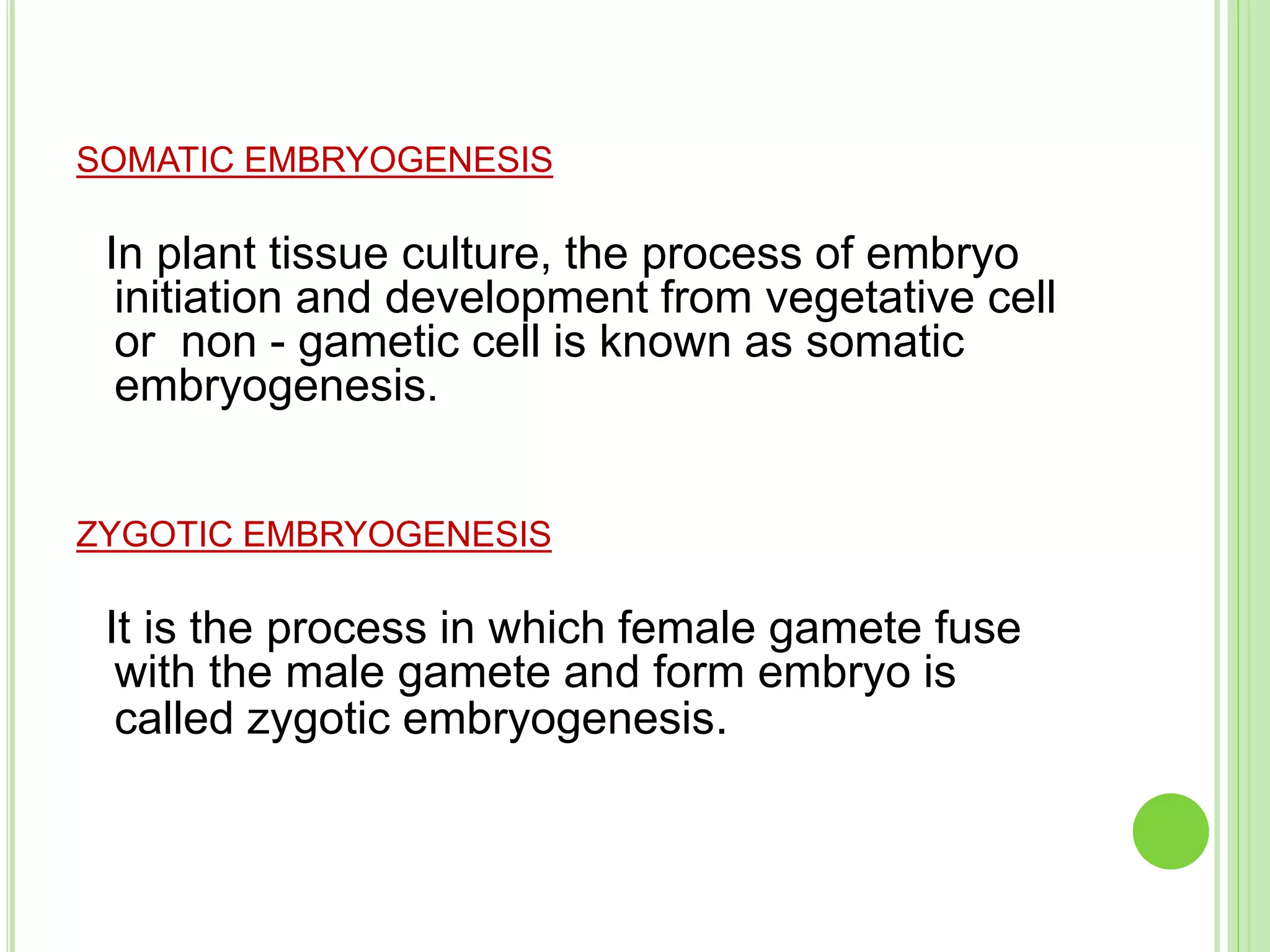
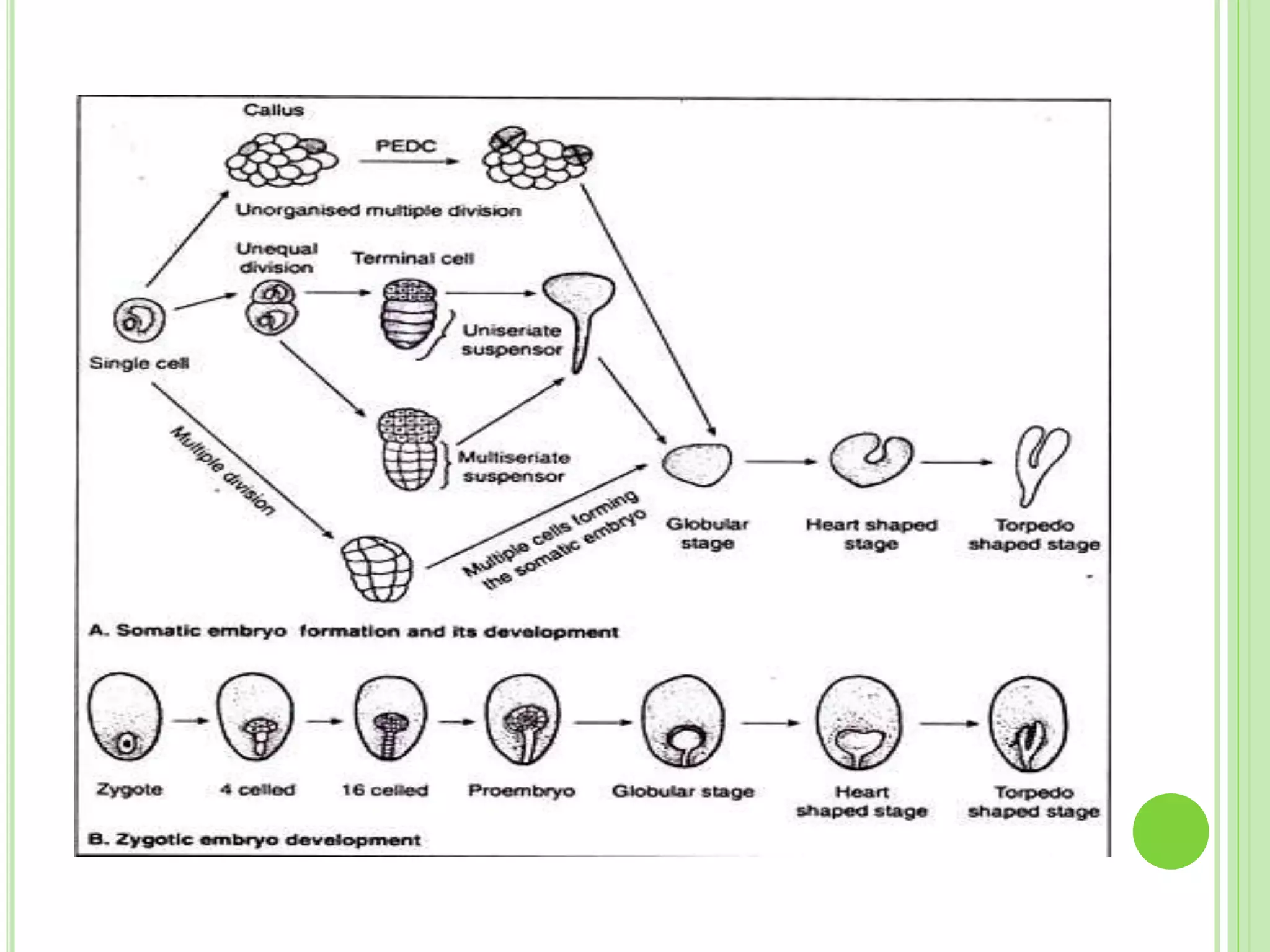
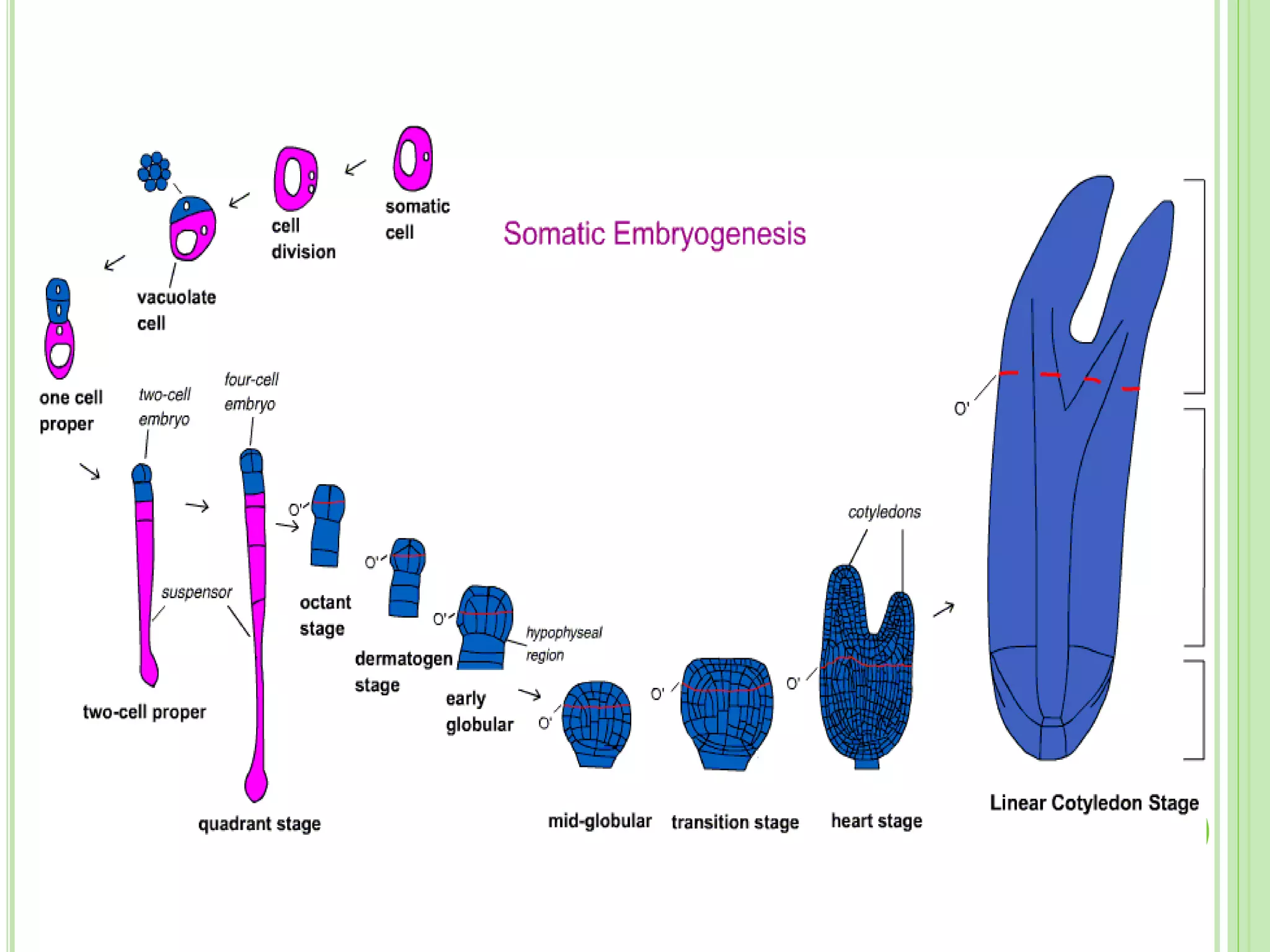
SOMATIC EMBRYOGENESIS
In plant tissue culture, the process of embryo
initiation and development from vegetative cell
or non - gametic cell is known as somatic
embryogenesis.
ZYGOTIC EMBRYOGENESIS
It is the process in which female gamete fuse
with the male gamete and form embryo is
called zygotic embryogenesis.
HISTORY
 The first observation of somatic embryogenesis
were made in Daucus Carota (carrot) by Steward
et al. 1958.
 Ever since, this species have been widely used to
investigate various aspects of in vitro somatic
embryogenesis.
 Other plants in which this phenomenon has been
studied in some detail are Citrus sp. by
Rangaswamy, 1961 and in Coffea sp. Monaco et al.
1977.
SOMATIC EMBRYOGENESIS DEVELOPMENT
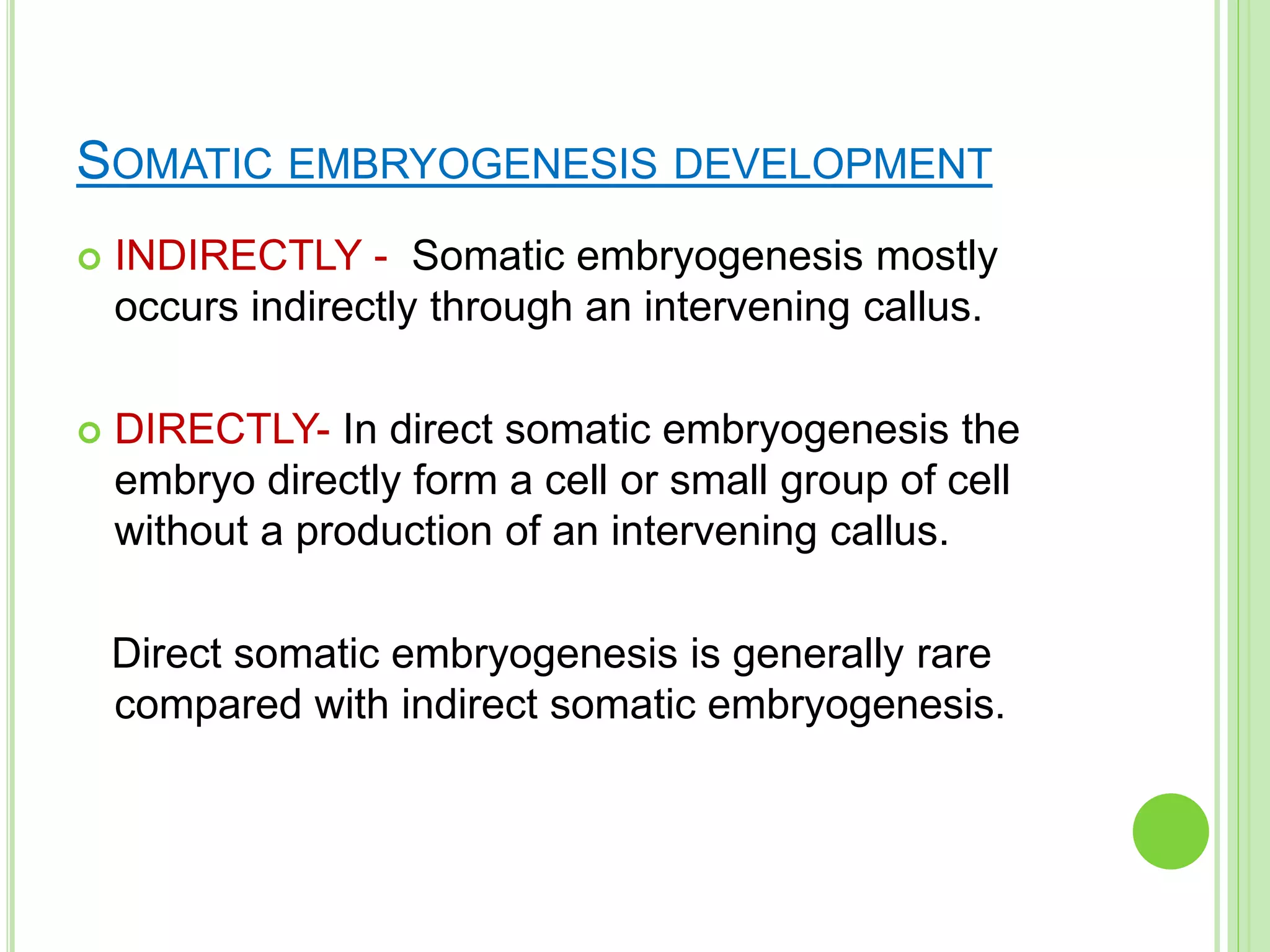
 INDIRECTLY - Somatic embryogenesis mostly
occurs indirectly through an intervening callus.
 DIRECTLY- In direct somatic embryogenesis the
embryo directly form a cell or small group of cell
without a production of an intervening callus.
Direct somatic embryogenesis is generally rare
compared with indirect somatic embryogenesis.
INDUCTION
 An auxin 2,4-D is generally necessary to induce
embryogenesis in plant such as carrot.
However the requirement of
exogenous auxin for the induction of somatic
embryogenesis depends on the nature of the
explant used.
 Initially exposure of 2,4-D for 2-7 days is necessary
to acquire competence to form embryo.
 An important phenomenon associated with the
induction of somatic embryogenesis is change of
cellular polarity.
 PGR employed for the induction of embryogenesis
by altering the cell polarity and promotion of
asymmetric cell division.
 Due to asymmetric division only small daughter cell
develop into embryo.
 Since the root pole of the somatic embryogenesis is
always oriented toward the large cell.
DEVELOPMENT
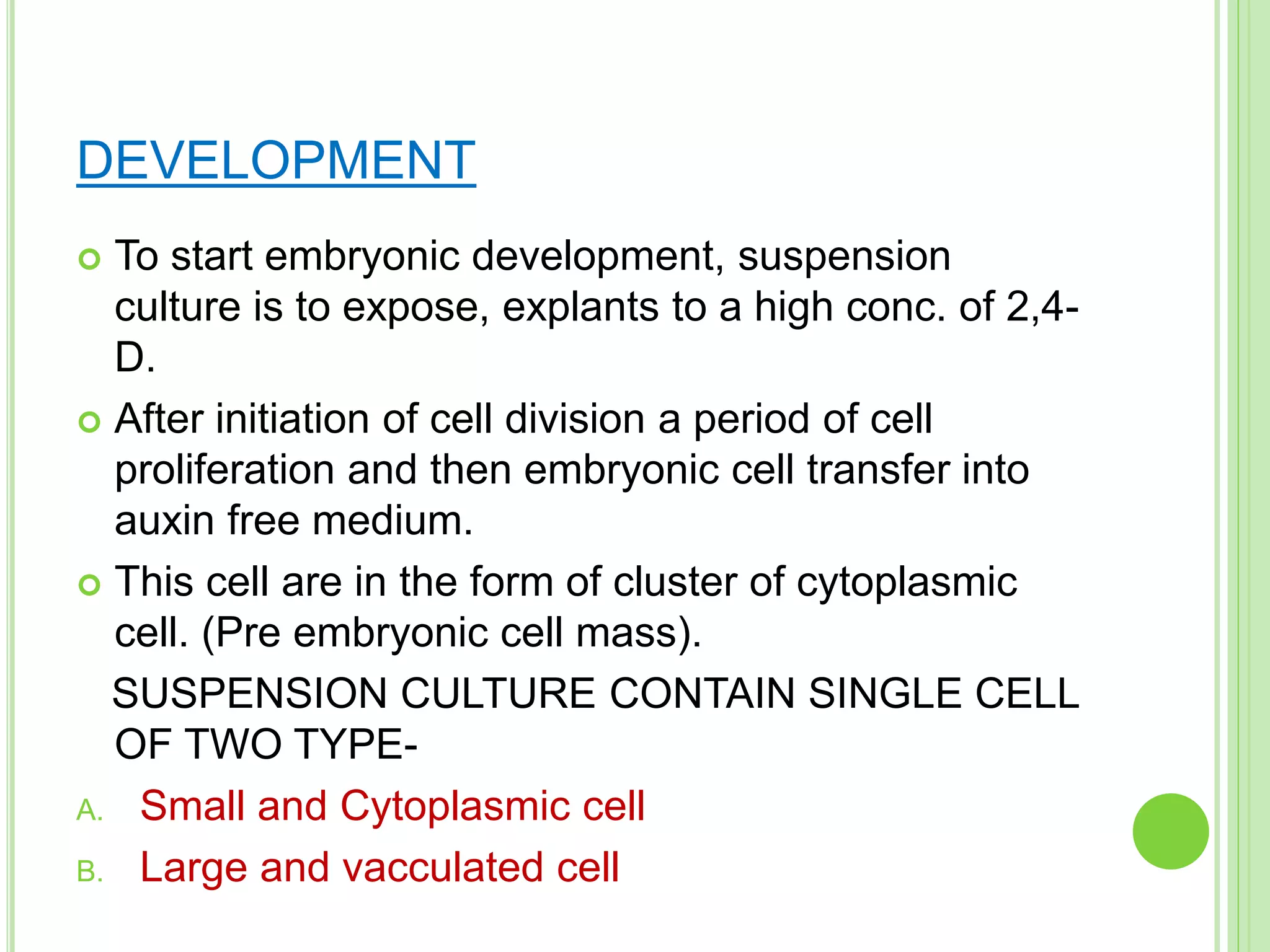
 To start embryonic development, suspension
culture is to expose, explants to a high conc. of 2,4-
D.
 After initiation of cell division a period of cell
proliferation and then embryonic cell transfer into
auxin free medium.
 This cell are in the form of cluster of cytoplasmic
cell. (Pre embryonic cell mass).
SUSPENSION CULTURE CONTAIN SINGLE CELL
OF TWO TYPE-
A. Small and Cytoplasmic cell
B. Large and vacculated cell
A. Small and cytoplasmic cell
- small PEM cell (400-800)μm3 .
- connected with the plasmodesmata, many starch
grains (5-25) per cell and small vacuoles.
- high density of ribosome, many endoplasmic
reticulum and high hydrogenase activity
B. Large and vacculated cell
- large size (1000-3000) μm3.
- few plasmodesmata, few starch (1-2)per cell.
- bigger vaccule, less ribosome density, few
endoplasmic reticulum and low hydrogenase activity.
 Auxin cause cell elongation and then it is removed
from the medium.
 Embryonic culture transfer to auxin free medium
and disruption stop.
 And globules developed into globular embryo.
 Globular embryo then continues further
development and form embryo.
 Because after embryogenic induction, embryo start
synthesis their own auxin.
MATURATION OF SOMATIC EMBRYO
 The quality of somatic embryogenesis with regards
to their conversion into plants, has been very poor
3-5%.
 This is because the apparently normal looking
somatic embryo are actually incomplete in their
development.
 Somatic embryo normally do not go through the
final phase of embryogenesis called ‘embryo
maturation’.
 Which is characterised by the accumulation of
embryo specific reserve food material and protein
which impart desiccation tolerance to the embryo
size of the embryo do not increase during this
phase.
 ABA is known to trigger the expression of genes
which normally express during the drying-down
phase of seed .
 ABA promote maturation of somatic embryo is also
known as stress hormone.
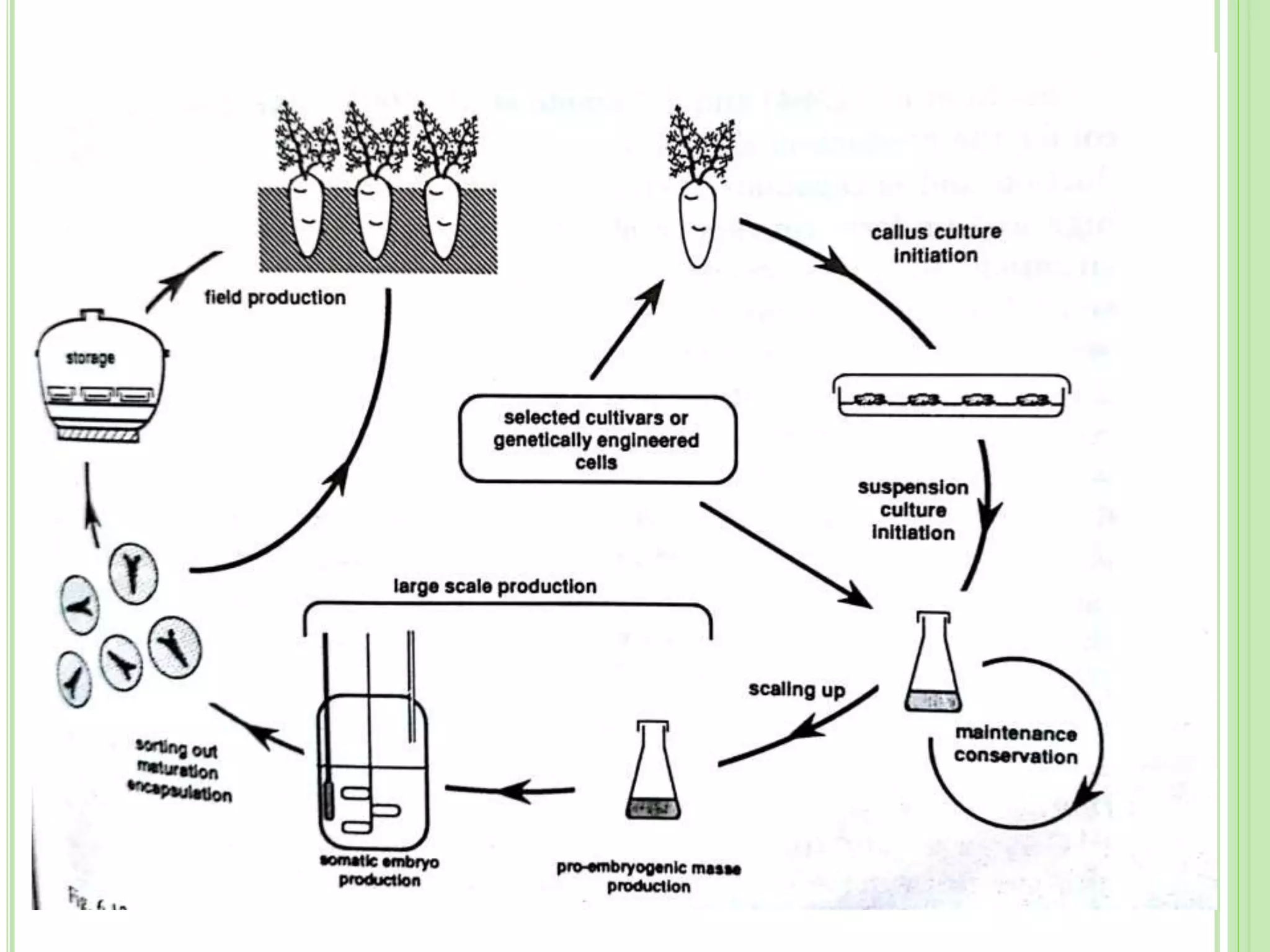
SYNTHETIC SEED
 Naked embryos are converted into synthetic seed
by encapsulating in a protective covering.
CURRENTLY TWO TYPE OF SYNTHETIC SEEDS
ARE BEING DEVELOPED
A. Desiccated synthetic seed-
 First synthetic seed produce by Kitto and Janick
1982 . Involve encapsulation of multiple somatic
embryos.
 They have selected polyoxyethylene which is
readily soluble in water and dries to form a thin
film.
 It does not support growth of microorganism and it
is non toxic to the embryo.
B. Hydrated synthetic seed
 In 1984 Redenbaugh et al. developed a technique
for encapsulation of single hydrated somatic
embryo of alfalfa.
 Ca-alginate encapsulation widely used for
production hydrated synthetic seed.
 SE are mixed with 2% w/v solution of Na-alginate
into a 100 mM solution of Ca(NO3)2.
 Ion exchange reaction occur and sodium ion
replaced by calcium ion forming Ca-alginate.
Gelling complete within 30 min.
FACTOR AFFECTING SOMATIC
EMBRYOGENESIS
 EXPLANTS – Immature embryo have proved to be
the best explant to raise embryonic culture.
 GENOTYPE – 500 varieties of rice can be studied
by Kamiya et al. 1988, 19 showed 65-100%
embryogenesis, 41 showed 35-64%embryogenesis
and remaining 440 were less efficient.
- Genotype variation are due to endogenous level of
hormones.
 GROWTH REGULATORS – (AUXIN) a synthetic
auxin for induction of somatic embryogenesis.
- 2,4-D most commonly used auxin.
(CYTOKININ)
- it inhibit the embryonic potential.
 NITROGEN SOURCE – addition of small amount
of nitrogen in the form of NH4Cl in the presence of
KNO3 allow embryo development.
 POLYAMINE – increase in the level of endogenous
polyamine will induce the induction of somatic
embryogenesis.
APPLICATION
 Synthetic seed production.
 Genetic engineering.
 Quarantine and international exchange.
 Germplasm conservation.
REFERENCE
 PLANT TISSUE CULTURE
theory and practice, a revised Edition
by- S.S.Bhojwani
M.K. Razdan

Somatic embryogenesis, in plant tissue culture

  • 1.
    Plant Tissue Culture “SomaticEmbryogenesis” By KAUSHAL KUMAR SAHU Assistant Professor (Ad Hoc) Department of Biotechnology Govt. Digvijay Autonomous P. G. College Raj-Nandgaon ( C. G. )
  • 2.
    CONTENTS  INTRODUCTION  HISTORY SOMATIC EMBRYOGENESIS DEVELOPMENT - INDUCTION - DEVELOPMENT - MATURATION  SYNTHETIC SEED  FACTORS AFFECTING SOMATIC EMBRYOGENESIS  APPLICATIONS  REFERENCE
  • 3.
    INTRODUCTION The act offertilization trigger the egg cell (called zygote after fertilization) to divide and develop into an embryo. and the process of embryo development is known as embryogenesis.
  • 4.
    SOMATIC EMBRYOGENESIS In planttissue culture, the process of embryo initiation and development from vegetative cell or non - gametic cell is known as somatic embryogenesis. ZYGOTIC EMBRYOGENESIS It is the process in which female gamete fuse with the male gamete and form embryo is called zygotic embryogenesis.
  • 5.
    HISTORY  The firstobservation of somatic embryogenesis were made in Daucus Carota (carrot) by Steward et al. 1958.  Ever since, this species have been widely used to investigate various aspects of in vitro somatic embryogenesis.  Other plants in which this phenomenon has been studied in some detail are Citrus sp. by Rangaswamy, 1961 and in Coffea sp. Monaco et al. 1977.
  • 7.
    SOMATIC EMBRYOGENESIS DEVELOPMENT INDIRECTLY - Somatic embryogenesis mostly occurs indirectly through an intervening callus.  DIRECTLY- In direct somatic embryogenesis the embryo directly form a cell or small group of cell without a production of an intervening callus. Direct somatic embryogenesis is generally rare compared with indirect somatic embryogenesis.
  • 9.
    INDUCTION  An auxin2,4-D is generally necessary to induce embryogenesis in plant such as carrot. However the requirement of exogenous auxin for the induction of somatic embryogenesis depends on the nature of the explant used.  Initially exposure of 2,4-D for 2-7 days is necessary to acquire competence to form embryo.  An important phenomenon associated with the induction of somatic embryogenesis is change of cellular polarity.
  • 10.
     PGR employedfor the induction of embryogenesis by altering the cell polarity and promotion of asymmetric cell division.  Due to asymmetric division only small daughter cell develop into embryo.  Since the root pole of the somatic embryogenesis is always oriented toward the large cell.
  • 12.
    DEVELOPMENT  To startembryonic development, suspension culture is to expose, explants to a high conc. of 2,4- D.  After initiation of cell division a period of cell proliferation and then embryonic cell transfer into auxin free medium.  This cell are in the form of cluster of cytoplasmic cell. (Pre embryonic cell mass). SUSPENSION CULTURE CONTAIN SINGLE CELL OF TWO TYPE- A. Small and Cytoplasmic cell B. Large and vacculated cell
  • 13.
    A. Small andcytoplasmic cell - small PEM cell (400-800)μm3 . - connected with the plasmodesmata, many starch grains (5-25) per cell and small vacuoles. - high density of ribosome, many endoplasmic reticulum and high hydrogenase activity B. Large and vacculated cell - large size (1000-3000) μm3. - few plasmodesmata, few starch (1-2)per cell. - bigger vaccule, less ribosome density, few endoplasmic reticulum and low hydrogenase activity.
  • 14.
     Auxin causecell elongation and then it is removed from the medium.  Embryonic culture transfer to auxin free medium and disruption stop.  And globules developed into globular embryo.  Globular embryo then continues further development and form embryo.  Because after embryogenic induction, embryo start synthesis their own auxin.
  • 15.
    MATURATION OF SOMATICEMBRYO  The quality of somatic embryogenesis with regards to their conversion into plants, has been very poor 3-5%.  This is because the apparently normal looking somatic embryo are actually incomplete in their development.  Somatic embryo normally do not go through the final phase of embryogenesis called ‘embryo maturation’.  Which is characterised by the accumulation of embryo specific reserve food material and protein which impart desiccation tolerance to the embryo size of the embryo do not increase during this phase.
  • 16.
     ABA isknown to trigger the expression of genes which normally express during the drying-down phase of seed .  ABA promote maturation of somatic embryo is also known as stress hormone.
  • 17.
    SYNTHETIC SEED  Nakedembryos are converted into synthetic seed by encapsulating in a protective covering. CURRENTLY TWO TYPE OF SYNTHETIC SEEDS ARE BEING DEVELOPED A. Desiccated synthetic seed-  First synthetic seed produce by Kitto and Janick 1982 . Involve encapsulation of multiple somatic embryos.  They have selected polyoxyethylene which is readily soluble in water and dries to form a thin film.
  • 18.
     It doesnot support growth of microorganism and it is non toxic to the embryo. B. Hydrated synthetic seed  In 1984 Redenbaugh et al. developed a technique for encapsulation of single hydrated somatic embryo of alfalfa.  Ca-alginate encapsulation widely used for production hydrated synthetic seed.  SE are mixed with 2% w/v solution of Na-alginate into a 100 mM solution of Ca(NO3)2.  Ion exchange reaction occur and sodium ion replaced by calcium ion forming Ca-alginate. Gelling complete within 30 min.
  • 21.
    FACTOR AFFECTING SOMATIC EMBRYOGENESIS EXPLANTS – Immature embryo have proved to be the best explant to raise embryonic culture.  GENOTYPE – 500 varieties of rice can be studied by Kamiya et al. 1988, 19 showed 65-100% embryogenesis, 41 showed 35-64%embryogenesis and remaining 440 were less efficient. - Genotype variation are due to endogenous level of hormones.
  • 22.
     GROWTH REGULATORS– (AUXIN) a synthetic auxin for induction of somatic embryogenesis. - 2,4-D most commonly used auxin. (CYTOKININ) - it inhibit the embryonic potential.  NITROGEN SOURCE – addition of small amount of nitrogen in the form of NH4Cl in the presence of KNO3 allow embryo development.  POLYAMINE – increase in the level of endogenous polyamine will induce the induction of somatic embryogenesis.
  • 23.
    APPLICATION  Synthetic seedproduction.  Genetic engineering.  Quarantine and international exchange.  Germplasm conservation.
  • 24.
    REFERENCE  PLANT TISSUECULTURE theory and practice, a revised Edition by- S.S.Bhojwani M.K. Razdan